
Key Christian Terms · In Plain Words
Righteousness: Being Right with God
Righteousness means being right with God: living in line with who he is and what he asks.
It is one of the Bible’s biggest words, and it is good news. Nobody earns it by being perfect. God gives it as a gift through Jesus, and then it slowly grows into the way we live.
“Blessed are they which do hunger and thirst after righteousness: for they shall be filled.”
Matthew 5:6 (KJV)
In Plain Words
What Does Righteousness Mean?
In one sentence
Righteousness means being right with God: living in line with who he is and what he asks.
Think of righteousness as “rightness.” A righteous judge rules fairly. A righteous person does what is right. And a righteous God is always good, fair and true to his word.
The problem is that none of us measures up. The Bible says, “all have sinned, and come short of the glory of God” (Romans 3:23). The good news is that God does not leave us there. He offers his own righteousness as a gift to everyone who trusts in Jesus.
The word itself: The Old Testament word is the Hebrew tsedeq; the New Testament word is the Greek dikaiosunē. Both carry the idea of something straight, fair and right: something that measures up to the standard.
Three Ways the Bible Uses the Word
God is righteous
God’s own character is the standard of what is right. He is good, fair, faithful and true to every promise he makes.
God gives righteousness to us
Jesus lived the perfect life we cannot live and took the penalty for our wrongdoing on the cross. When you trust him, God counts you as righteous because of what Christ did.
It shows up in how we live
Honesty, fairness, kindness, forgiveness, doing good when no one is watching. These grow as a response to God’s love, not as a way to earn it.
An Everyday Picture
A Debt Paid in Full
Imagine you owe a debt so large you could never repay it. A friend walks into the bank and pays every cent. Then he does something more: he has his own spotless account history put in your name. You walk out not just free of debt, but with a perfect record.
That is close to what the Bible means by receiving righteousness. Jesus paid what we owed, and his perfect record is credited to us. Like every picture it has limits, because God’s gift is a relationship and not only a bank transfer. But it shows the heart of it: the record that counts is his, not ours.
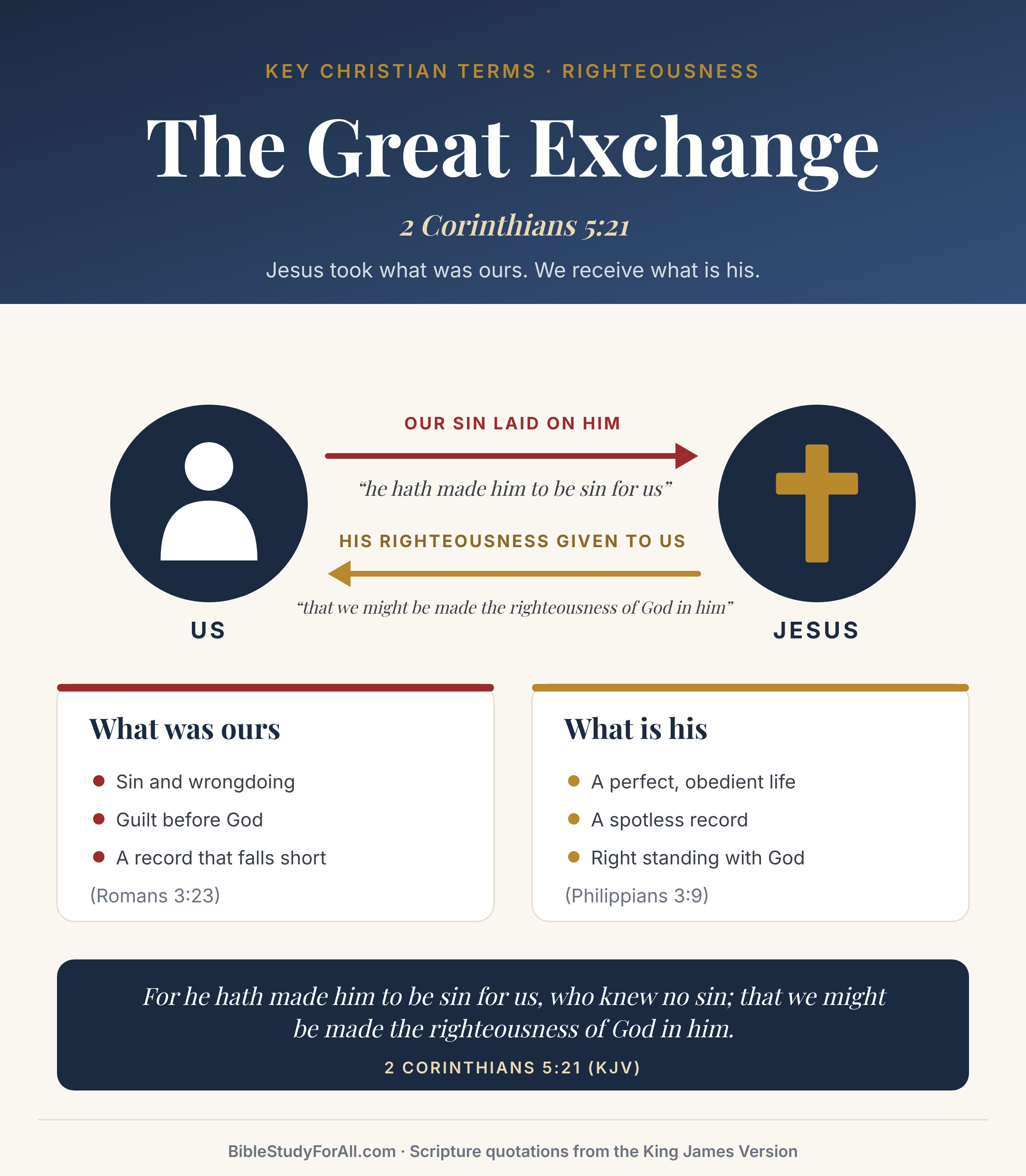
2 Corinthians 5:21
The Great Exchange
Paul sums it up in one verse. On the cross Jesus took what was ours, and everyone who trusts him receives what is his.
What the Bible Says
Three Key Verses
Romans 3:22
“Even the righteousness of God which is by faith of Jesus Christ unto all and upon all them that believe: for there is no difference.”
In plain words: God’s own righteousness is offered to everyone who believes, with no one left out.
2 Corinthians 5:21
“For he hath made him to be sin for us, who knew no sin; that we might be made the righteousness of God in him.”
In plain words: Jesus took our sin; we receive his righteousness. That is the great exchange.
Philippians 3:9
“And be found in him, not having mine own righteousness, which is of the law, but that which is through the faith of Christ, the righteousness which is of God by faith.”
In plain words: Paul stopped relying on his own good record and rested on the righteousness that comes from God.
Clearing It Up
What It Is and What It Isn’t
A common mix-up
“Righteous means perfect.”
Your standing with God rests on Jesus’ perfection, not your own. Christians still stumble, and God still forgives: “If we confess our sins, he is faithful and just to forgive us our sins” (1 John 1:9).
A common mix-up
“Righteous means self-righteous.”
Knowing it is a gift makes people humble, not proud. Jesus told a parable to those “which trusted in themselves that they were righteous, and despised others” (Luke 18:9).
A common mix-up
“I have to be good enough first.”
God makes you right first; changed living follows. “Not by works of righteousness which we have done, but according to his mercy he saved us” (Titus 3:5).
How It Connects
Righteousness and the Other Big Words
The Bible’s big words are not separate ideas. They are different angles on one story: what God has done for us in Jesus.
The moment God declares you righteous in his sight.
The whole rescue that righteousness is part of.
Why the gift is free: God’s undeserved kindness.
How the gift is received: by trusting Jesus.
How righteousness grows in daily life over time.
How Jesus’ death deals with sin so we can be made right.
Living It Out
Putting It into Practice
1
Rest in the gift when you fail
When you mess up, do not try to win back God’s approval. Confess it, thank him that Jesus’ record still stands for you, and get up again.
2
Keep growing
Read the Bible, pray, and spend time with other believers. Right living grows the way a plant does: slowly, steadily, with the right food.
3
Respond with gratitude
Do good because you are loved, not to be loved. Thankfulness, not fear or guilt, is the fuel of a righteous life.
Questions
Quick Questions
Is righteousness the same as being a good person?
Not quite. Being good is part of it, but the Bible’s standard is God himself, and by that standard “all our righteousnesses are as filthy rags” (Isaiah 64:6). Biblical righteousness starts with being made right with God through Jesus, and then shows itself in good living.
What does “the righteousness of God” mean?
Paul uses the phrase in two connected ways. It describes God’s own character: he is always right and fair. And it describes the gift God gives: right standing with him “by faith of Jesus Christ unto all and upon all them that believe” (Romans 3:22). Christians often see both meanings at work in passages like Romans 1:17.
Were people in the Old Testament made righteous the same way?
Yes. Abraham lived long before Jesus, yet “he believed in the LORD; and he counted it to him for righteousness” (Genesis 15:6). Paul uses Abraham as his main example of being made right by faith (Romans 4:3). Old Testament believers trusted God’s promise; we trust the promise kept in Jesus.
Why did Jesus say our righteousness must exceed the Pharisees’?
In Matthew 5:20 Jesus said, “except your righteousness shall exceed the righteousness of the scribes and Pharisees, ye shall in no case enter into the kingdom of heaven.” The Pharisees were careful on the outside, but Jesus looks at the heart. No one can reach that standard alone, which is exactly why we need the righteousness God gives.
Keep Reading
Continue Your Study
Read the key passages for yourself, then explore the Bible books and topics where righteousness comes up most.
Scripture quotations are from the King James Version (KJV), which is in the public domain. Verse links open at BibleGateway.