
Key Christian Terms · In Plain Words
Faith: Trusting God at His Word
Faith means trusting God: believing what he says is true and relying on him, especially on Jesus, to keep his promises.
Faith is not a leap in the dark or a feeling we work up. It is trust placed in Someone who has proved himself trustworthy. Everyone trusts something; faith is trusting God.
“Now faith is the substance of things hoped for, the evidence of things not seen.”
Hebrews 11:1 (KJV)
In Plain Words
What Does Faith Mean?
In one sentence
Faith means trusting God: believing what he says is true and relying on him, especially on Jesus, to keep his promises.
You use faith every day. You sit on a chair without checking its legs; you take medicine a doctor prescribes. Faith in God is like that, but placed in the most trustworthy Person there is. The Bible says, “without faith it is impossible to please him: for he that cometh to God must believe that he is, and that he is a rewarder of them that diligently seek him” (Hebrews 11:6).
Faith is only as strong as what it rests on. A little faith in a strong bridge gets you across; great faith in a rotten one does not. That is why Christian faith looks to Jesus, “the author and finisher of our faith” (Hebrews 12:2). It is not faith in faith; it is faith in him.
The word itself: The Greek word pistis means faith, trust or faithfulness, and the verb pisteuō means to believe or trust. In the Old Testament the Hebrew ’emunah carries the idea of firmness and reliability; the word “amen” comes from the same root.
Three Parts of Faith
Knowing
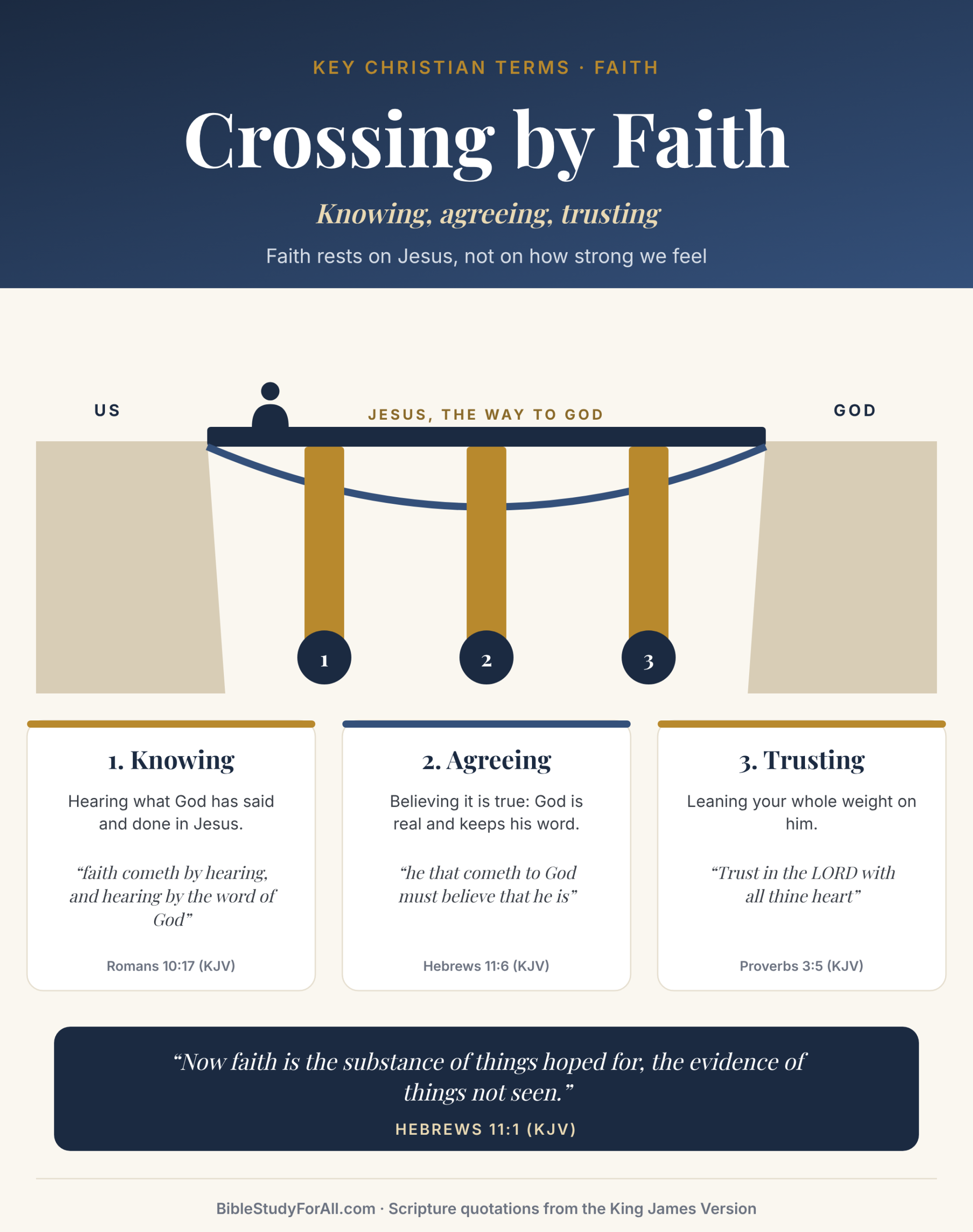
Faith begins with hearing what God has said and done. You cannot trust someone you know nothing about.
Agreeing
Believing that it is true: that God is real, that Jesus died and rose again, and that his promises can be counted on.
Trusting
Leaning your whole weight on God, not just agreeing in your head. This is the heart of saving faith.
An Everyday Picture
Stepping onto the Bridge
Imagine standing at the edge of a deep canyon with a strong bridge across it. You can study the bridge, read about the engineers, and agree that it would hold you. But you only cross when you step onto it and trust it with your weight.
That is faith. Knowing about God and agreeing that he is real matter, but faith is when we rest our lives on him. And notice: it is the bridge, not the strength of your step, that carries you across. Even shaky faith in Jesus is enough, because he is strong.
Romans 10:17 · Hebrews 11:6 · Proverbs 3:5
Crossing by Faith
Faith has three parts. Like the piers of a bridge, together they carry a person across to God.
What the Bible Says
Three Key Verses
Hebrews 11:1
“Now faith is the substance of things hoped for, the evidence of things not seen.”
In plain words: Faith is being sure of what God has promised, even before we see it.
Romans 10:17
“So then faith cometh by hearing, and hearing by the word of God.”
In plain words: Faith grows as we hear and read what God has said.
Galatians 2:20
“I am crucified with Christ: nevertheless I live; yet not I, but Christ liveth in me: and the life which I now live in the flesh I live by the faith of the Son of God, who loved me, and gave himself for me.”
In plain words: Faith means living every day trusting Jesus, who loved us and gave himself for us.
Clearing It Up
What It Is and What It Isn’t
A common mix-up
“Faith is believing without any reason.”
Biblical faith rests on what God has said and done in history. John wrote his Gospel “that ye might believe that Jesus is the Christ, the Son of God” (John 20:31). Faith goes beyond what we can see, but not against the evidence.
A common mix-up
“I need great faith for God to help me.”
Jesus said faith “as a grain of mustard seed” is enough (Matthew 17:20). Even a struggling father’s prayer, “Lord, I believe; help thou mine unbelief” (Mark 9:24), was answered.
A common mix-up
“Faith is just a private feeling.”
Real faith shows itself in how we live. “For as the body without the spirit is dead, so faith without works is dead also” (James 2:26).
How It Connects
Faith and the Other Big Words
The Bible’s big words are not separate ideas. They are different angles on one story: what God has done for us in Jesus.
Grace is God’s gift; faith is the open hand that receives it.
“Being justified by faith, we have peace with God.”
“By grace are ye saved through faith.”
Turning from sin and turning to Jesus go together.
Abraham believed God, and it was counted for righteousness.
Faith trusts the promises God has bound himself to keep.
Living It Out
Putting It into Practice
1
Feed your faith
Faith grows by hearing God’s word (Romans 10:17). Read a Gospel slowly, and notice what Jesus says and does.
2
Pray honestly
Bring your doubts to God. The apostles prayed, “Increase our faith” (Luke 17:5). God is not offended by honest questions.
3
Take one step of trust
Trust God with one specific worry or decision this week, and obey what you know he asks. Faith grows as it is used.
Questions
Quick Questions
What is the difference between faith and belief?
In the New Testament they are the same word family (pistis, pisteuō). “Belief” can sound like agreeing with an idea, but biblical belief includes trust. James notes that even “the devils also believe, and tremble” (James 2:19); saving faith goes further and rests on Christ.
Is it wrong to have doubts?
Doubt is not the opposite of faith; unbelief that turns away from God is. Many in the Bible wrestled with doubt: Thomas (John 20:24–29), John the Baptist (Matthew 11:2–6), and the psalmists. Bring doubts to God and to other believers, and look again at Jesus.
Where does faith come from?
The Bible says faith comes by hearing the word of God (Romans 10:17), and also calls it a gift: “by grace are ye saved through faith; and that not of yourselves: it is the gift of God” (Ephesians 2:8). Christians explain how God’s gift and our response fit together in different ways, but all agree no one can boast.
What does Hebrews 11 teach about faith?
Hebrews 11 is often called the “hall of faith.” It lists people like Abel, Noah, Abraham, Moses and Rahab, who trusted God’s promises before they saw them fulfilled. “By faith Abraham, when he was called to go out into a place which he should after receive for an inheritance, obeyed” (Hebrews 11:8). Faith trusts and obeys.
Keep Reading
Continue Your Study
Read the key passages for yourself, then explore the Bible books and topics where faith comes up most.
Scripture quotations are from the King James Version (KJV), which is in the public domain. Verse links open at BibleGateway.