
Resources · Church History
Protestant Denominations
The major Protestant traditions, from the Lutherans and the Reformed to the Baptists, Methodists and Pentecostals: who founded each one, when and where it began, how it came about, what it believes and how its churches worship. Each section ends with the American church bodies that belong to that family.
One Lord, one faith, one baptism.
The Traditions
Going Deeper
Note: Scripture quotations and verse links on this site use the King James Version (KJV) because it is in the public domain, while most modern translations limit how much can be quoted online. Feel free to read along in the translation of your choice.
13 Traditions
From the Reformation of 1517 to today
Summary Table
Founders, dates, baptism, Communion, government
Family Tree and Map
How the traditions grew from one another
Printable Copy
Save, share or print the comparison
Quick Reference
Summary Table
Thirteen Protestant traditions side by side, in the order they began: who founded each one, when and where, how it baptizes, what it teaches about the Lord’s Supper, how its churches are governed and what it stresses most.
| Tradition | Founded By | When | Where | Baptism | Lord’s Supper | Church Government | Main Emphasis |
|---|---|---|---|---|---|---|---|
| 1Lutheran About 75 million worldwide | Martin Luther (1483–1546), a German monk and Bible professor. | 1517: the Ninety-five Theses (October 31). Augsburg Confession, 1530. | Wittenberg, Saxony (Germany). Spread to Scandinavia and the Baltic lands. | Infants and adults, by pouring or immersion. Baptism is a means of God’s grace. | Christ’s true body and blood are present “in, with and under” the bread and wine. | Synods and councils; bishops in many countries. | Justification by faith alone; the difference between Law and Gospel. |
| 2Reformed About 75 million worldwide | Ulrich Zwingli in Zurich, John Calvin (1509–1564) in Geneva, and John Knox in Scotland. | Zwingli began preaching in Zurich in 1519; Calvin’s Institutes, 1536; Scotland, 1560. | Zurich and Geneva, Switzerland; then France, the Netherlands, Hungary, Scotland and America. | Infants of believers and adult converts, as the sign of God’s covenant; usually by sprinkling or pouring. | Christ is spiritually present and received by faith. | Presbyterian: elders in a session, presbytery and general assembly. | The sovereignty of God, His covenant, and salvation by His grace from first to last. |
| 3Anabaptist About 2.5 million worldwide | Conrad Grebel, Felix Manz and George Blaurock; later Menno Simons, Jakob Hutter and Jakob Ammann. | January 21, 1525 (first believer’s baptisms). Amish split, 1693. | Zurich, Switzerland; then the Netherlands, Moravia and, from 1683, Pennsylvania. | Believers only, on confession of faith; usually by pouring. | A memorial of Christ’s death; many also practice foot washing. | Congregational, with bishops, ministers and deacons. | Following Jesus in daily life, nonviolence, and a church separate from the state. |
| 4Anglican About 85 million worldwide | King Henry VIII and Archbishop Thomas Cranmer (1489–1556); settled under Queen Elizabeth I. | 1534: Act of Supremacy. Book of Common Prayer, 1549; Thirty-nine Articles, 1563. | England (Canterbury and London); spread through the British Empire. | Infants and adults, by pouring or immersion. | Christ is truly present, received spiritually by faith (“Holy Communion”). | Episcopal: bishops, priests and deacons. The Archbishop of Canterbury is the honored leader. | Reformed doctrine in a historic, liturgical form of worship. |
| 5Congregational A few million worldwide | English Puritans and Separatists: Robert Browne, the Pilgrims (William Bradford) and the Puritans (John Winthrop). | Browne’s church, 1581; Pilgrims at Plymouth, 1620; Massachusetts Bay, 1630. | Norwich, England; then Plymouth and Boston, New England. | Infants of believers and adult converts. | Christ spiritually present, received by faith. | Congregational: each local church governs itself under Christ. | Each church a covenanted body of believers, free to govern itself by Scripture. |
| 6Baptist About 50 million members in Baptist World Alliance churches; many more Baptists worldwide | John Smyth and Thomas Helwys, English Separatists; in America, Roger Williams. | 1609 (Amsterdam); first Baptist church in England, 1612; in America, 1638. | Amsterdam; London; Providence, Rhode Island. | Believers only, by immersion, as a public testimony of faith. | An ordinance in memory of Christ’s death. | Congregational: each church is self-governing; pastors and deacons. | A converted church membership, soul liberty and the authority of the Bible. |
| 7Quaker About 400,000 worldwide, the largest number in Kenya | George Fox (1624–1691), an English preacher; later William Penn and Robert Barclay. | 1652, when Fox preached to large crowds in the north of England. | Pendle Hill and Firbank Fell, northwest England; then Pennsylvania (1682). | No outward baptism; Friends seek the inward baptism of the Spirit. | No outward Communion; Friends seek inward communion with Christ. | Monthly and yearly meetings; decisions by seeking unity, with no vote. | The inward light of Christ, silent waiting on God, peace and simplicity. |
| 8Methodist About 80 million worldwide (World Methodist Council) | John Wesley (1703–1791) and his brother Charles, Anglican priests; in America, Francis Asbury. | Holy Club at Oxford, 1729; Wesley’s conversion, May 24, 1738; American church organized 1784. | Oxford and London, England; Baltimore, Maryland. | Infants and adults, by sprinkling, pouring or immersion. | Christ is spiritually present; the table is open to all who love Him. | Connectional: bishops and conferences; pastors are appointed. | God’s grace for all, assurance of salvation, and holy living. |
| 9Restoration About 5 million worldwide | Barton W. Stone and Thomas and Alexander Campbell, former Presbyterians. | Cane Ridge revival, 1801; Declaration and Address, 1809; the two movements united January 1, 1832. | Cane Ridge and Lexington, Kentucky; Washington, Pennsylvania; Bethany, (West) Virginia. | Believers, by immersion, for the forgiveness of sins. | Every Lord’s Day, as a memorial. | Congregational: elders and deacons in each church. | Christian unity by returning to the faith and practice of the New Testament church. |
| 10Adventist About 22 million Seventh-day Adventists worldwide | William Miller, a Baptist preacher; then Joseph Bates, James White and Ellen G. White (1827–1915). | Millerite movement, 1831–1844; Seventh-day Adventist Church organized May 1863. | Upstate New York and New England; Battle Creek, Michigan. | Believers, by immersion. | Communion, usually each quarter, with foot washing. | Representative: local conferences, unions and a General Conference. | The soon return of Christ, the seventh-day Sabbath and healthful living. |
| 11Holiness Millions worldwide; the Church of the Nazarene alone about 2.6 million | Methodist leaders such as Phoebe Palmer; later Phineas Bresee (Nazarene), William and Catherine Booth (Salvation Army). | National Camp Meeting, 1867; Salvation Army, 1865; Church of the Nazarene united 1908. | Vineland, New Jersey; London; Los Angeles; Pilot Point, Texas. | Believers and, in some churches, infants. The Salvation Army keeps no outward sacraments. | A memorial and means of grace (most churches). | Mostly connectional, with superintendents; the Salvation Army has a military-style order. | Entire sanctification: a heart cleansed and filled with God’s love. |
| 12Pentecostal Pentecostals and charismatics: several hundred million, about a quarter of all Christians | Charles F. Parham (Topeka) and William J. Seymour (1870–1922), who led the Azusa Street Revival. | January 1, 1901 (Topeka); Azusa Street Revival, 1906–1909. Charismatic renewal from 1960. | Topeka, Kansas; Los Angeles, California. | Believers, by immersion. | A memorial of Christ’s death. | Varies: congregational with district councils (Assemblies of God); bishops in some churches. | The baptism in the Holy Spirit, speaking in tongues and the gifts of the Spirit today. |
| 13Nondenominational Tens of millions; the fastest-growing group of American Protestants | No single founder. Grew from the revivals of Whitefield, Finney, Moody and Billy Graham; Calvary Chapel (Chuck Smith) and others. | Independent churches from the 1800s; rapid growth since the 1960s and 1970s. | Across the United States, then worldwide. | Usually believers, by immersion. | Usually a memorial, monthly or weekly. | Independent: led by a pastor and elders or a board. | The Bible, personal conversion, the cross and sharing the gospel. |
The First Reformation Church · About 75 million worldwide
Founded ByMartin Luther (1483–1546), a German monk and Bible professor.
When1517: the Ninety-five Theses (October 31). Augsburg Confession, 1530.
WhereWittenberg, Saxony (Germany). Spread to Scandinavia and the Baltic lands.
BaptismInfants and adults, by pouring or immersion. Baptism is a means of God’s grace.
Lord’s SupperChrist’s true body and blood are present “in, with and under” the bread and wine.
Church GovernmentSynods and councils; bishops in many countries.
Main EmphasisJustification by faith alone; the difference between Law and Gospel.
The Swiss and Scottish Reformation · About 75 million worldwide
Founded ByUlrich Zwingli in Zurich, John Calvin (1509–1564) in Geneva, and John Knox in Scotland.
WhenZwingli began preaching in Zurich in 1519; Calvin’s Institutes, 1536; Scotland, 1560.
WhereZurich and Geneva, Switzerland; then France, the Netherlands, Hungary, Scotland and America.
BaptismInfants of believers and adult converts, as the sign of God’s covenant; usually by sprinkling or pouring.
Lord’s SupperChrist is spiritually present and received by faith.
Church GovernmentPresbyterian: elders in a session, presbytery and general assembly.
Main EmphasisThe sovereignty of God, His covenant, and salvation by His grace from first to last.
The Radical Reformation · About 2.5 million worldwide
Founded ByConrad Grebel, Felix Manz and George Blaurock; later Menno Simons, Jakob Hutter and Jakob Ammann.
WhenJanuary 21, 1525 (first believer’s baptisms). Amish split, 1693.
WhereZurich, Switzerland; then the Netherlands, Moravia and, from 1683, Pennsylvania.
BaptismBelievers only, on confession of faith; usually by pouring.
Lord’s SupperA memorial of Christ’s death; many also practice foot washing.
Church GovernmentCongregational, with bishops, ministers and deacons.
Main EmphasisFollowing Jesus in daily life, nonviolence, and a church separate from the state.
The English Reformation · About 85 million worldwide
Founded ByKing Henry VIII and Archbishop Thomas Cranmer (1489–1556); settled under Queen Elizabeth I.
When1534: Act of Supremacy. Book of Common Prayer, 1549; Thirty-nine Articles, 1563.
WhereEngland (Canterbury and London); spread through the British Empire.
BaptismInfants and adults, by pouring or immersion.
Lord’s SupperChrist is truly present, received spiritually by faith (“Holy Communion”).
Church GovernmentEpiscopal: bishops, priests and deacons. The Archbishop of Canterbury is the honored leader.
Main EmphasisReformed doctrine in a historic, liturgical form of worship.
The Puritans and Pilgrims · A few million worldwide
Founded ByEnglish Puritans and Separatists: Robert Browne, the Pilgrims (William Bradford) and the Puritans (John Winthrop).
WhenBrowne’s church, 1581; Pilgrims at Plymouth, 1620; Massachusetts Bay, 1630.
WhereNorwich, England; then Plymouth and Boston, New England.
BaptismInfants of believers and adult converts.
Lord’s SupperChrist spiritually present, received by faith.
Church GovernmentCongregational: each local church governs itself under Christ.
Main EmphasisEach church a covenanted body of believers, free to govern itself by Scripture.
Believers’ Churches · About 50 million members in Baptist World Alliance churches; many more Baptists worldwide
Founded ByJohn Smyth and Thomas Helwys, English Separatists; in America, Roger Williams.
When1609 (Amsterdam); first Baptist church in England, 1612; in America, 1638.
WhereAmsterdam; London; Providence, Rhode Island.
BaptismBelievers only, by immersion, as a public testimony of faith.
Lord’s SupperAn ordinance in memory of Christ’s death.
Church GovernmentCongregational: each church is self-governing; pastors and deacons.
Main EmphasisA converted church membership, soul liberty and the authority of the Bible.
The Society of Friends · About 400,000 worldwide, the largest number in Kenya
Founded ByGeorge Fox (1624–1691), an English preacher; later William Penn and Robert Barclay.
When1652, when Fox preached to large crowds in the north of England.
WherePendle Hill and Firbank Fell, northwest England; then Pennsylvania (1682).
BaptismNo outward baptism; Friends seek the inward baptism of the Spirit.
Lord’s SupperNo outward Communion; Friends seek inward communion with Christ.
Church GovernmentMonthly and yearly meetings; decisions by seeking unity, with no vote.
Main EmphasisThe inward light of Christ, silent waiting on God, peace and simplicity.
The Evangelical Revival · About 80 million worldwide (World Methodist Council)
Founded ByJohn Wesley (1703–1791) and his brother Charles, Anglican priests; in America, Francis Asbury.
WhenHoly Club at Oxford, 1729; Wesley’s conversion, May 24, 1738; American church organized 1784.
WhereOxford and London, England; Baltimore, Maryland.
BaptismInfants and adults, by sprinkling, pouring or immersion.
Lord’s SupperChrist is spiritually present; the table is open to all who love Him.
Church GovernmentConnectional: bishops and conferences; pastors are appointed.
Main EmphasisGod’s grace for all, assurance of salvation, and holy living.
Restoring the New Testament Church · About 5 million worldwide
Founded ByBarton W. Stone and Thomas and Alexander Campbell, former Presbyterians.
WhenCane Ridge revival, 1801; Declaration and Address, 1809; the two movements united January 1, 1832.
WhereCane Ridge and Lexington, Kentucky; Washington, Pennsylvania; Bethany, (West) Virginia.
BaptismBelievers, by immersion, for the forgiveness of sins.
Lord’s SupperEvery Lord’s Day, as a memorial.
Church GovernmentCongregational: elders and deacons in each church.
Main EmphasisChristian unity by returning to the faith and practice of the New Testament church.
Awaiting the Second Advent · About 22 million Seventh-day Adventists worldwide
Founded ByWilliam Miller, a Baptist preacher; then Joseph Bates, James White and Ellen G. White (1827–1915).
WhenMillerite movement, 1831–1844; Seventh-day Adventist Church organized May 1863.
WhereUpstate New York and New England; Battle Creek, Michigan.
BaptismBelievers, by immersion.
Lord’s SupperCommunion, usually each quarter, with foot washing.
Church GovernmentRepresentative: local conferences, unions and a General Conference.
Main EmphasisThe soon return of Christ, the seventh-day Sabbath and healthful living.
The Holiness Movement · Millions worldwide; the Church of the Nazarene alone about 2.6 million
Founded ByMethodist leaders such as Phoebe Palmer; later Phineas Bresee (Nazarene), William and Catherine Booth (Salvation Army).
WhenNational Camp Meeting, 1867; Salvation Army, 1865; Church of the Nazarene united 1908.
WhereVineland, New Jersey; London; Los Angeles; Pilot Point, Texas.
BaptismBelievers and, in some churches, infants. The Salvation Army keeps no outward sacraments.
Lord’s SupperA memorial and means of grace (most churches).
Church GovernmentMostly connectional, with superintendents; the Salvation Army has a military-style order.
Main EmphasisEntire sanctification: a heart cleansed and filled with God’s love.
The Twentieth-Century Revival · Pentecostals and charismatics: several hundred million, about a quarter of all Christians
Founded ByCharles F. Parham (Topeka) and William J. Seymour (1870–1922), who led the Azusa Street Revival.
WhenJanuary 1, 1901 (Topeka); Azusa Street Revival, 1906–1909. Charismatic renewal from 1960.
WhereTopeka, Kansas; Los Angeles, California.
BaptismBelievers, by immersion.
Lord’s SupperA memorial of Christ’s death.
Church GovernmentVaries: congregational with district councils (Assemblies of God); bishops in some churches.
Main EmphasisThe baptism in the Holy Spirit, speaking in tongues and the gifts of the Spirit today.
Evangelical Churches Without a Denomination · Tens of millions; the fastest-growing group of American Protestants
Founded ByNo single founder. Grew from the revivals of Whitefield, Finney, Moody and Billy Graham; Calvary Chapel (Chuck Smith) and others.
WhenIndependent churches from the 1800s; rapid growth since the 1960s and 1970s.
WhereAcross the United States, then worldwide.
BaptismUsually believers, by immersion.
Lord’s SupperUsually a memorial, monthly or weekly.
Church GovernmentIndependent: led by a pastor and elders or a board.
Main EmphasisThe Bible, personal conversion, the cross and sharing the gospel.
Scroll sideways to see every column. Each tradition is described in the words its own churches use. Numbers match the family tree and the map. Membership figures are rounded estimates.
Printable Copy
Printable Protestant Denominations (PDF)
The summary table on two landscape pages, plus the family tree and the map. It opens in a new tab, where you can save it to your phone or computer, share it, or print it for a class or small group.
About This Page
Understanding the Protestant Churches
The Name
What Is a Protestant?
Protestants are Christians whose churches come from the Reformation of the 1500s, when Martin Luther and others called the church back to the Bible and to salvation by grace through faith in Christ.
The word comes from the “Protestation” that Lutheran princes read at the Diet of Speyer in 1529, when they protested against an order to stop the Reformation in their lands. In time it came to mean all the churches of the Western world that separated from Rome in the 1500s, and the many churches that later grew out of them.
The Reformers did not set out to start a new religion. They believed they were restoring the faith of the apostles, which they found in Scripture, and they kept the historic creeds: the Apostles’ Creed, the Nicene Creed and the teaching that God is one God in three Persons. Today Protestants, counting the independent churches that share their beliefs, make up nearly two in five of the world’s Christians.
Common Ground
What All Protestants Share
Different as their worship may look, the historic Protestant churches agree on the heart of the gospel, often summed up in five Latin phrases called the five “solas.”
Scripture alone is the final authority for faith and life (2 Timothy 3:16). We are saved by grace alone, through faith alone, in Christ alone, and all to the glory of God alone (Ephesians 2:8–9; 1 Timothy 2:5).
Protestants also share the belief that every believer may come to God directly through Christ, the “priesthood of all believers” (1 Peter 2:9), and that the Bible should be in the language of the people. Out of that conviction came Luther’s German Bible, Tyndale’s English New Testament and, in 1611, the King James Version.
Differences
Why Are There So Many?
Protestant churches agree on the gospel but differ on secondary questions: how to baptize, what happens at the Lord’s Supper, how a church is governed, and how the Holy Spirit works today.
Because Protestants hold that Scripture alone is the final authority, sincere believers who read the same Bible have sometimes reached different conclusions on these questions, and have formed separate churches so they could follow their consciences. Other divisions came from geography and language: German Lutherans, Scottish Presbyterians and English Anglicans each built churches in their own lands.
This page sets out each tradition fairly, in its own words. The differences are real, but most Bible-believing Protestants gladly recognize one another as brothers and sisters in Christ (John 17:21).
What Unites Protestants
The Five Solas of the Reformation
Five short Latin phrases sum up what the Reformers recovered from Scripture. Every historic Protestant tradition on this page holds them.
Sola Scriptura
Scripture Alone
The Bible is the only infallible rule for faith and life.
“All scripture is given by inspiration of God, and is profitable for doctrine, for reproof, for correction, for instruction in righteousness:”
2 Timothy 3:16 (KJV)
Sola Gratia
Grace Alone
Salvation is God’s free gift, not something we earn.
“For by grace are ye saved through faith; and that not of yourselves: it is the gift of God:”
Ephesians 2:8 (KJV)
Sola Fide
Faith Alone
We are declared righteous by trusting Christ, not by our works.
“Therefore being justified by faith, we have peace with God through our Lord Jesus Christ:”
Romans 5:1 (KJV)
Solus Christus
Christ Alone
Jesus is the only Mediator between God and man.
“For there is one God, and one mediator between God and men, the man Christ Jesus;”
1 Timothy 2:5 (KJV)
Soli Deo Gloria
To God’s Glory Alone
All of life is lived for the glory of God.
“Whether therefore ye eat, or drink, or whatsoever ye do, do all to the glory of God.”
1 Corinthians 10:31 (KJV)
Key Verse
One Lord, One Faith
“There is one body, and one Spirit, even as ye are called in one hope of your calling; One Lord, one faith, one baptism, One God and Father of all, who is above all, and through all, and in you all.”
Ephesians 4:4-6 (KJV)
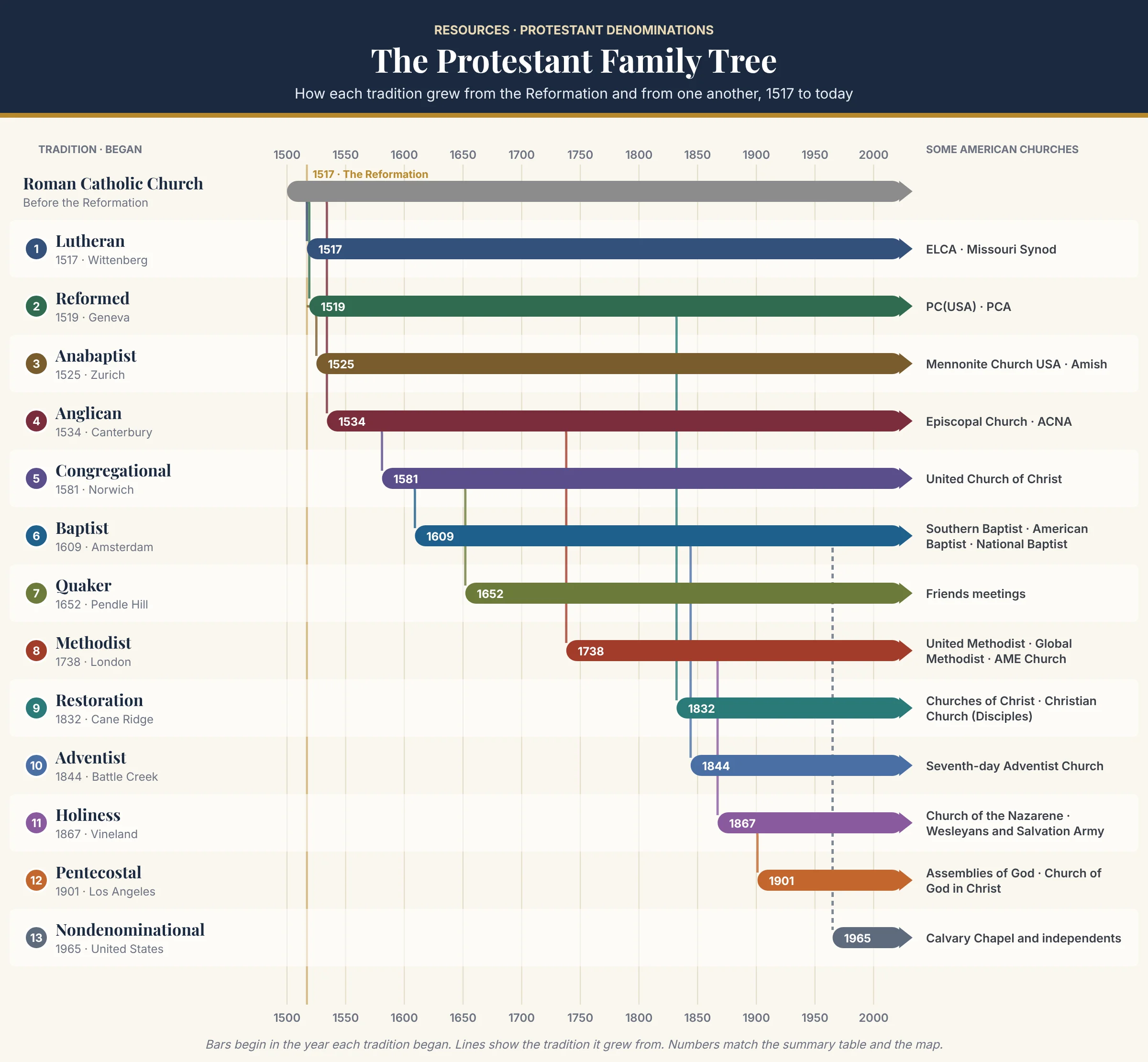
Graphic 1 of 2
The Protestant Family Tree
How each tradition grew out of the Reformation and out of one another, from 1517 to today. Each bar begins in the year the tradition began; the names on the right are some of its churches in America.
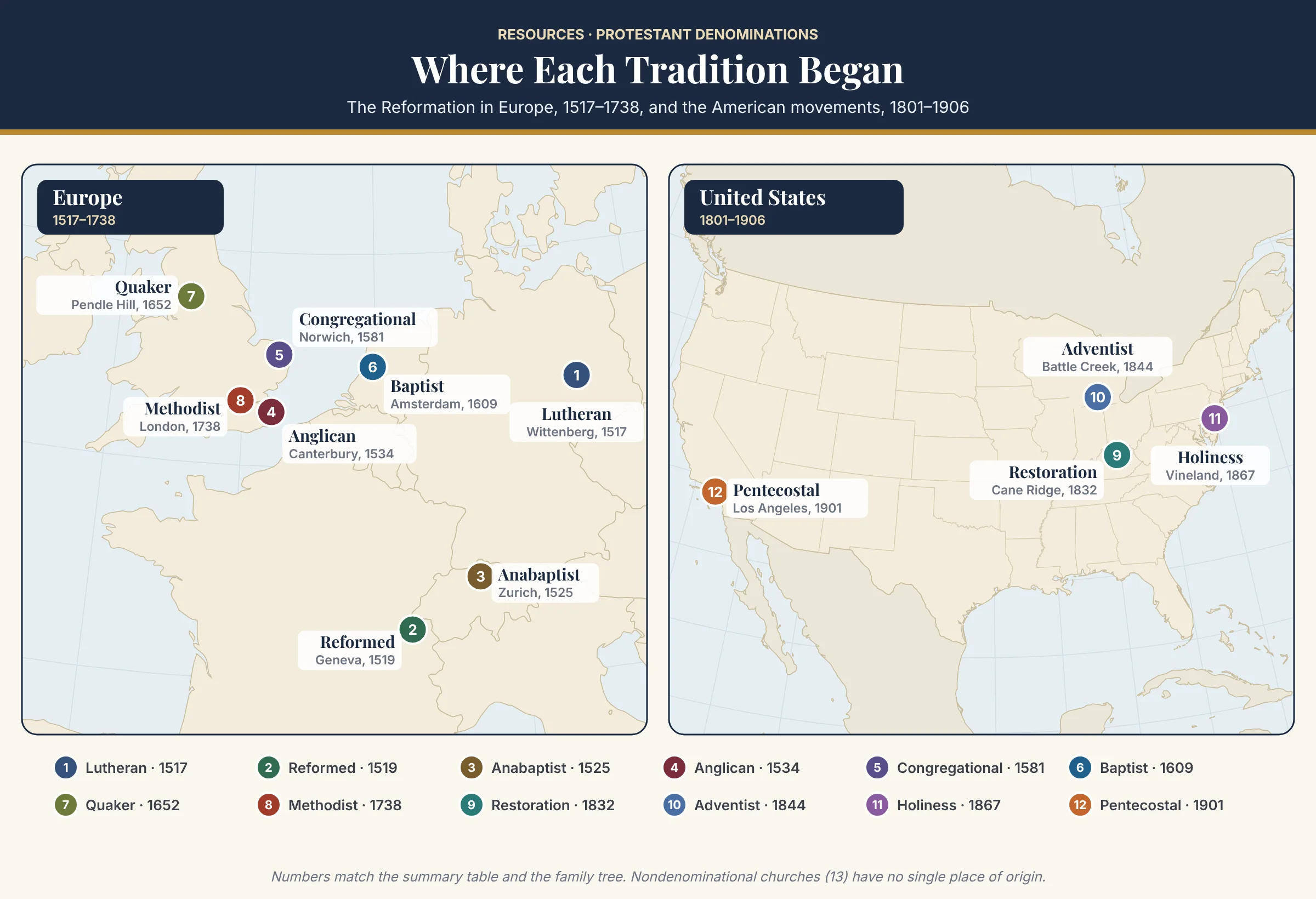
Graphic 2 of 2
Where Each Tradition Began
The first traditions began in Germany, Switzerland and England in the 1500s and 1600s; the later ones began in America. The numbers match the summary table.
1 of 13 · The First Reformation Church
Lutheran Churches
The first church of the Reformation, named (against his wishes) after Martin Luther. Lutherans hold that a sinner is made right with God only by faith in Christ, and they keep a reverent, liturgical worship centered on Word and Sacrament.
Lutheran at a Glance
Founded byMartin Luther (1483–1546), a German monk and Bible professor.
When1517: the Ninety-five Theses (October 31). Augsburg Confession, 1530.
WhereWittenberg, Saxony (Germany). Spread to Scandinavia and the Baltic lands.
Key documentsThe Book of Concord (1580), including the Augsburg Confession and Luther’s Small and Large Catechisms.
BaptismInfants and adults, by pouring or immersion. Baptism is a means of God’s grace.
Lord’s SupperChrist’s true body and blood are present “in, with and under” the bread and wine.
Church governmentSynods and councils; bishops in many countries.
Followers todayAbout 75 million worldwide
How It Began
Martin Luther was an Augustinian monk who taught the Bible at the University of Wittenberg. Troubled by his own sin, he found peace in Romans: “The just shall live by faith” (Romans 1:17). When the friar Johann Tetzel sold indulgences, Luther posted his Ninety-five Theses on October 31, 1517, calling for a debate. He was excommunicated in 1521, and at the Diet of Worms he refused to take back his writings unless he was shown wrong “by Scripture and plain reason.”
Hidden at the Wartburg castle, Luther translated the New Testament into German (1522). His friend Philip Melanchthon wrote the Augsburg Confession (1530), still the chief Lutheran statement of faith. Lutheranism became the church of much of Germany and of Denmark, Norway, Sweden, Finland and the Baltic lands, and German and Scandinavian immigrants brought it to America.
What Lutherans Believe
Lutherans teach that God declares sinners righteous for Christ’s sake, through faith alone, apart from works. God’s Law shows us our sin; the Gospel gives us Christ. Grace comes to us through the “means of grace”: the preached Word, Baptism and the Lord’s Supper. Lutherans baptize infants, believing God works faith through Baptism, and confess that Christ’s body and blood are truly present in the Supper.
Worship and Church Life
Lutheran worship follows the historic liturgy, with the church year, readings, a sermon and Holy Communion. Luther loved music and wrote hymns such as “A Mighty Fortress Is Our God.” Children learn the faith through Luther’s Small Catechism. J. S. Bach was a Lutheran church musician.
Distinctives
What Sets It Apart
- Justification by grace through faith alone
- Law and Gospel rightly distinguished
- The real presence of Christ in the Lord’s Supper
- Keeps historic worship unless Scripture forbids it
Practices
- Liturgical worship following the church year
- Infant baptism and confirmation in the early teens
- Holy Communion, often weekly
- Teaching from Luther’s Small Catechism
In America
American Church Bodies
Some of the churches in this family in the United States, each described on our American Church Bodies page:
“For therein is the righteousness of God revealed from faith to faith: as it is written, The just shall live by faith.”Romans 1:17 (KJV)
2 of 13 · The Swiss and Scottish Reformation
Reformed and Presbyterian Churches
The “Reformed” churches took their name from the conviction that the church should be reformed according to the Word of God in worship and government as well as doctrine. Where they are governed by elders, they are called Presbyterian.
Reformed at a Glance
Founded byUlrich Zwingli in Zurich, John Calvin (1509–1564) in Geneva, and John Knox in Scotland.
WhenZwingli began preaching in Zurich in 1519; Calvin’s Institutes, 1536; Scotland, 1560.
WhereZurich and Geneva, Switzerland; then France, the Netherlands, Hungary, Scotland and America.
Key documentsHeidelberg Catechism (1563), Belgic Confession, Canons of Dort (1619), Westminster Confession (1646).
BaptismInfants of believers and adult converts, as the sign of God’s covenant; usually by sprinkling or pouring.
Lord’s SupperChrist is spiritually present and received by faith.
Church governmentPresbyterian: elders in a session, presbytery and general assembly.
Followers todayAbout 75 million worldwide
How It Began
In 1519 Ulrich Zwingli began preaching straight through the book of Matthew in Zurich, and the city turned to the Reformation. In Geneva the French scholar John Calvin taught from 1536, and his Institutes of the Christian Religion became the most influential Protestant theology. Refugees trained in Geneva carried Reformed teaching to France (the Huguenots), the Netherlands and Hungary.
John Knox, who had studied under Calvin, led the Scottish Reformation in 1560 and gave the Church of Scotland its Presbyterian form. In England the Westminster Assembly (1643–1649) wrote the Westminster Confession and Catechisms, still the standards of most Presbyterian churches. Scots-Irish settlers brought Presbyterianism to America, where the first presbytery met in Philadelphia in 1706.
What the Reformed Believe
Reformed theology begins with the glory and sovereignty of God. Because all people are dead in sin, salvation is God’s work: He chose His people in Christ before the foundation of the world, Christ died for them, and the Holy Spirit draws them to faith and keeps them to the end (Ephesians 1:4; John 6:44). This teaching is often summed up in the five points of the Synod of Dort (1619). God deals with His people by covenant, so the children of believers are baptized as members of the covenant community.
Worship and Church Life
Reformed worship is simple and centered on the preaching of Scripture, following what the Bible commands. Many churches sing the Psalms. Each congregation is led by elders chosen by the members; elders from many churches meet as a presbytery, and presbyteries meet as a general assembly.
Distinctives
What Sets It Apart
- The sovereignty of God in salvation
- Covenant theology and infant baptism
- Rule by elders at every level
- Worship regulated by Scripture
Practices
- Expository preaching through books of the Bible
- Psalms and hymns; simple, Word-centered worship
- Government by elders (presbyters)
- Catechism teaching for children and new members
“For of Him, and through Him, and to Him, are all things: to whom be glory for ever. Amen.”Romans 11:36 (KJV)
3 of 13 · The Radical Reformation
Anabaptists: Mennonites, Amish and Hutterites
“Anabaptist” means “rebaptizer,” a name their enemies gave them because they baptized adults who had been baptized as infants. They called themselves simply Brethren, and taught that the church is a fellowship of committed disciples.
Anabaptist at a Glance
Founded byConrad Grebel, Felix Manz and George Blaurock; later Menno Simons, Jakob Hutter and Jakob Ammann.
WhenJanuary 21, 1525 (first believer’s baptisms). Amish split, 1693.
WhereZurich, Switzerland; then the Netherlands, Moravia and, from 1683, Pennsylvania.
Key documentsSchleitheim Confession (1527); Dordrecht Confession (1632).
BaptismBelievers only, on confession of faith; usually by pouring.
Lord’s SupperA memorial of Christ’s death; many also practice foot washing.
Church governmentCongregational, with bishops, ministers and deacons.
Followers todayAbout 2.5 million worldwide
How It Began
Some of Zwingli’s young followers in Zurich believed he was moving too slowly and that infant baptism had no warrant in Scripture. On January 21, 1525, Conrad Grebel baptized George Blaurock in a home in Zurich, and Blaurock then baptized the others. Both Catholic and Protestant authorities persecuted them severely; Felix Manz was drowned in the Limmat River in 1527, the first of thousands of Anabaptist martyrs remembered in the Martyrs Mirror (1660).
Menno Simons, a Dutch priest, joined the movement in 1536 and gathered the scattered believers, who became known as Mennonites. Jakob Hutter led communities in Moravia that shared all their goods (Hutterites). In 1693 Jakob Ammann led a stricter group, the Amish. Invited by William Penn, Mennonites settled in Germantown, Pennsylvania, in 1683, and the Amish followed in the 1730s.
What Anabaptists Believe
Anabaptists teach that faith must come before baptism, so only those who confess Christ should be baptized. They stress obedience to Jesus’ teaching, especially the Sermon on the Mount: love of enemies, refusal to take up the sword, telling the truth without oaths, and simple living (Matthew 5:44). The church is a separate, disciplined fellowship, and the state should not govern it.
Worship and Church Life
Worship is simple. The Old Order Amish meet in homes, sing slow hymns from the Ausbund (a hymnal from the 1500s), avoid many modern technologies and dress plainly. Most Mennonites live and worship much like other evangelicals but keep a strong witness for peace and service. Hutterites live on shared farms called colonies.
Distinctives
What Sets It Apart
- The church as a community of committed disciples
- Nonresistance and peacemaking
- Separation of church and state
- Mutual aid and service to neighbors
Practices
- Believer’s baptism, often in the teen years or later
- Foot washing with the Lord’s Supper (many groups)
- Refusal of military service (conscientious objection)
- Plain dress and simple living (Amish and Old Order groups)
In America
American Church Bodies
Some of the churches in this family in the United States, each described on our American Church Bodies page:
“Then Peter and the other apostles answered and said, We ought to obey God rather than men.”Acts 5:29 (KJV)
4 of 13 · The English Reformation
Anglican and Episcopal Churches
The Church of England and the family of churches around the world that grew from it, called the Anglican Communion. In the United States and Scotland it is called Episcopal, from the Greek word for bishop.
Anglican at a Glance
Founded byKing Henry VIII and Archbishop Thomas Cranmer (1489–1556); settled under Queen Elizabeth I.
When1534: Act of Supremacy. Book of Common Prayer, 1549; Thirty-nine Articles, 1563.
WhereEngland (Canterbury and London); spread through the British Empire.
Key documentsThe Book of Common Prayer, the Thirty-nine Articles and the Ordinal.
BaptismInfants and adults, by pouring or immersion.
Lord’s SupperChrist is truly present, received spiritually by faith (“Holy Communion”).
Church governmentEpiscopal: bishops, priests and deacons. The Archbishop of Canterbury is the honored leader.
Followers todayAbout 85 million worldwide
How It Began
In 1534 Parliament’s Act of Supremacy made King Henry VIII the head of the Church of England, after the pope refused to annul his marriage. Henry changed little doctrine, but under his son Edward VI, Archbishop Thomas Cranmer led a true Reformation: English Bibles in every church, and the Book of Common Prayer (1549, 1552). Cranmer was burned at the stake under Queen Mary in 1556.
Queen Elizabeth I restored the Protestant church in 1559, and the Thirty-nine Articles (1563) set out its doctrine. The King James Version of 1611 was made for the Church of England. After the American Revolution, American Anglicans organized the Protestant Episcopal Church in 1789. Today the largest Anglican churches are in Africa, especially Nigeria and Uganda.
What Anglicans Believe
The Thirty-nine Articles teach that Holy Scripture contains all things necessary to salvation, that we are justified by faith only, and that the church may keep traditions that do not contradict Scripture. Anglicans hold to the Apostles’ and Nicene Creeds and to the historic order of bishops, priests and deacons. Within the family there are evangelical (“low church”) and Anglo-Catholic (“high church”) wings.
Worship and Church Life
Worship follows the Prayer Book: Morning and Evening Prayer, set readings from the Old Testament, Psalms, Epistles and Gospels, confession of sin, the creeds and Holy Communion. Its beautiful language has shaped English speech for nearly five hundred years. Bishops confirm those who have been baptized.
Distinctives
What Sets It Apart
- Bishops in historic succession
- The Book of Common Prayer
- A “middle way” between Rome and the continental Reformers
- A worldwide Anglican Communion
Practices
- Prayer Book worship and the church year
- Infant baptism and confirmation by a bishop
- Holy Communion (the Eucharist), usually weekly
- Daily Morning and Evening Prayer
In America
American Church Bodies
Some of the churches in this family in the United States, each described on our American Church Bodies page:
“O worship the LORD in the beauty of holiness: fear before Him, all the earth.”Psalms 96:9 (KJV)
5 of 13 · The Puritans and Pilgrims
Congregational Churches
The Puritans wanted to “purify” the Church of England of practices they believed were not found in the Bible. Those who left it, the Separatists, formed churches governed by their own members, and they founded New England.
Congregational at a Glance
Founded byEnglish Puritans and Separatists: Robert Browne, the Pilgrims (William Bradford) and the Puritans (John Winthrop).
WhenBrowne’s church, 1581; Pilgrims at Plymouth, 1620; Massachusetts Bay, 1630.
WhereNorwich, England; then Plymouth and Boston, New England.
Key documentsCambridge Platform (1648) and Savoy Declaration (1658), based on the Westminster Confession.
BaptismInfants of believers and adult converts.
Lord’s SupperChrist spiritually present, received by faith.
Church governmentCongregational: each local church governs itself under Christ.
Followers todayA few million worldwide
How It Began
Robert Browne gathered an independent church in Norwich in 1581, teaching that each congregation should be a covenanted company of believers. Separatists from Scrooby fled to Holland and, in 1620, sailed on the Mayflower to Plymouth. From 1630 thousands of Puritans led by John Winthrop founded the Massachusetts Bay Colony, hoping to build “a city upon a hill.”
Congregationalists founded Harvard (1636) and Yale (1701) to train ministers. Jonathan Edwards, a Congregational pastor, was a leader of the Great Awakening in the 1730s and 1740s. In the early 1800s many Boston churches turned Unitarian and left the faith of their founders; most of the remaining Congregational churches joined the United Church of Christ in 1957.
What Congregationalists Believe
The early Congregationalists held Reformed doctrine, much like the Presbyterians, but taught that Christ rules each local church directly through His Word, with no bishop or presbytery over it. Members join by covenant with God and one another and choose their own pastors and deacons (Matthew 18:20).
Worship and Church Life
Worship in the old New England meetinghouses was plain, centered on long sermons, prayer and Psalm singing. Town meetings in New England grew from the same habit of self-government. Today Congregational churches range from conservative to very liberal.
Distinctives
What Sets It Apart
- Self-governing local congregations
- Puritan roots in Reformed doctrine
- Founders of New England’s churches and colleges
- Leaders of the Great Awakening
Practices
- Church covenant signed by members
- Members call their own pastor
- Plain meetinghouse worship centered on preaching
- Independent local churches joined in voluntary fellowship
In America
American Church Bodies
Some of the churches in this family in the United States, each described on our American Church Bodies page:
“For where two or three are gathered together in My name, there am I in the midst of them.”Matthew 18:20 (KJV)
6 of 13 · Believers’ Churches
Baptist Churches
Baptists hold that the church is made up of believers who have been born again and baptized by immersion on their own profession of faith. They are the largest Protestant family in the United States.
Baptist at a Glance
Founded byJohn Smyth and Thomas Helwys, English Separatists; in America, Roger Williams.
When1609 (Amsterdam); first Baptist church in England, 1612; in America, 1638.
WhereAmsterdam; London; Providence, Rhode Island.
Key documentsNo binding creed; confessions such as the London Baptist Confession (1689) and the Baptist Faith and Message (1925, 2000).
BaptismBelievers only, by immersion, as a public testimony of faith.
Lord’s SupperAn ordinance in memory of Christ’s death.
Church governmentCongregational: each church is self-governing; pastors and deacons.
Followers todayAbout 50 million members in Baptist World Alliance churches; many more Baptists worldwide
How It Began
John Smyth, an English Separatist pastor, fled to Amsterdam with his congregation. Studying the New Testament, he became convinced that baptism belongs only to believers, and in 1609 he baptized himself and his flock. Thomas Helwys led part of the group home to Spitalfields, London, in 1612, the first Baptist church on English soil. He wrote a bold plea for religious liberty for all and died in prison.
Calvinistic (“Particular”) Baptists arose in London in the 1630s and adopted immersion; their 1689 Confession is still widely used. In America, Roger Williams founded the First Baptist Church in Providence, Rhode Island, in 1638, and Rhode Island became a haven of religious freedom. Baptists grew rapidly in the Great Awakenings and on the frontier. Famous Baptists include William Carey, father of modern missions, Charles Spurgeon and Billy Graham.
What Baptists Believe
Baptists stress the authority of the Bible, salvation by grace through personal faith in Christ, and baptism by immersion as a picture of dying and rising with Him (Romans 6:4). Each local church is self-governing, and every believer is a priest before God. Baptists have long championed the separation of church and state, so that faith is never forced. Some Baptists are Calvinist; others hold that Christ died for all and any may freely respond.
Worship and Church Life
Baptist worship is usually simple and centered on preaching, with hymns or contemporary songs and an invitation to respond to the gospel. The Lord’s Supper is often observed monthly or quarterly. Churches cooperate in associations and conventions to send missionaries.
Distinctives
What Sets It Apart
- Only believers are baptized, by immersion
- Autonomy of the local church
- Soul liberty and the priesthood of every believer
- Separation of church and state
Practices
- Believer’s baptism by immersion
- The Lord’s Supper as a memorial
- Invitation to receive Christ at the end of the service
- Cooperative missions through conventions
In America
American Church Bodies
Some of the churches in this family in the United States, each described on our American Church Bodies page:
“Therefore we are buried with Him by baptism into death: that like as Christ was raised up from the dead by the glory of the Father, even so we also should walk in newness of life.”Romans 6:4 (KJV)
7 of 13 · The Society of Friends
Quakers (Religious Society of Friends)
George Fox taught that Christ Himself is present to teach His people, so worship needs no clergy or set forms. Opponents mocked Friends for trembling before God, calling them “Quakers,” and the name stuck.
Quaker at a Glance
Founded byGeorge Fox (1624–1691), an English preacher; later William Penn and Robert Barclay.
When1652, when Fox preached to large crowds in the north of England.
WherePendle Hill and Firbank Fell, northwest England; then Pennsylvania (1682).
Key documentsNo creed. Robert Barclay’s Apology (1676); local books of “Faith and Practice.”
BaptismNo outward baptism; Friends seek the inward baptism of the Spirit.
Lord’s SupperNo outward Communion; Friends seek inward communion with Christ.
Church governmentMonthly and yearly meetings; decisions by seeking unity, with no vote.
Followers todayAbout 400,000 worldwide, the largest number in Kenya
How It Began
George Fox searched for years among ministers who could not answer his questions. In 1647 he wrote that he heard a voice say, “There is one, even Christ Jesus, that can speak to thy condition.” In 1652, after a vision on Pendle Hill, he preached to about a thousand people at Firbank Fell, and the Friends movement spread quickly. Thousands of Friends were jailed for refusing to swear oaths or pay tithes to the state church.
William Penn, a wealthy Quaker, founded Pennsylvania in 1682 as a “holy experiment” in religious freedom. Quakers were among the first to oppose slavery (the Germantown protest of 1688) and later helped run the Underground Railroad.
What Quakers Believe
Friends teach that the light of Christ shines in every person (John 1:9) and that God still guides His people directly by His Spirit. They see all of life as sacred, so they keep no outward sacraments. Their “testimonies” of simplicity, peace, integrity and equality shape daily life. Early Friends held the Bible in high regard but placed the Spirit’s inward guidance first; historic Christian teaching holds that the Spirit always speaks in agreement with Scripture, the final authority (2 Timothy 3:16).
Worship and Church Life
In traditional “unprogrammed” meetings Friends sit in silence until someone feels led to speak. Many Friends churches, especially in Kenya and the American Midwest, are “programmed,” with pastors, hymns and sermons, and are evangelical in belief.
Distinctives
What Sets It Apart
- The inward light of Christ
- No clergy in traditional meetings
- Decisions by seeking unity in the Spirit
- Early opponents of slavery
Practices
- Silent, unprogrammed worship (or pastoral worship in evangelical Friends churches)
- No outward sacraments
- Plain speech and simple living
- Peace witness and conscientious objection
In America
American Church Bodies
Some of the churches in this family in the United States, each described on our American Church Bodies page:
“That was the true Light, which lighteth every man that cometh into the world.”John 1:9 (KJV)
8 of 13 · The Evangelical Revival
Methodist and Wesleyan Churches
A revival movement within the Church of England that became a worldwide family of churches. Its members were nicknamed “Methodists” for their methodical habits of prayer, Bible study and service.
Methodist at a Glance
Founded byJohn Wesley (1703–1791) and his brother Charles, Anglican priests; in America, Francis Asbury.
WhenHoly Club at Oxford, 1729; Wesley’s conversion, May 24, 1738; American church organized 1784.
WhereOxford and London, England; Baltimore, Maryland.
Key documentsArticles of Religion (Wesley’s 25), Wesley’s Standard Sermons and Notes on the New Testament, the General Rules.
BaptismInfants and adults, by sprinkling, pouring or immersion.
Lord’s SupperChrist is spiritually present; the table is open to all who love Him.
Church governmentConnectional: bishops and conferences; pastors are appointed.
Followers todayAbout 80 million worldwide (World Methodist Council)
How It Began
At Oxford in 1729 Charles Wesley, John Wesley and their friends formed a “Holy Club” for prayer, study and visiting prisoners. Yet John lacked peace with God. On May 24, 1738, at a meeting on Aldersgate Street in London, as Luther’s preface to Romans was read, he wrote, “I felt my heart strangely warmed… I did trust in Christ, Christ alone, for salvation.” With George Whitefield he began preaching in the open fields to miners and workers, and organized converts into societies and small “classes.”
Wesley remained an Anglican all his life. After the American Revolution he sent Thomas Coke to America, and at the Christmas Conference in Baltimore in 1784 the Methodist Episcopal Church was formed with Francis Asbury as bishop. Circuit-riding preachers carried Methodism across the frontier, and by 1850 it was the largest church in America. Charles Wesley wrote about 6,000 hymns, including “And Can It Be.”
What Methodists Believe
Methodists teach that Christ died for all and that God’s grace goes before every person, enabling anyone to respond in faith. Believers can know they are saved, for “the Spirit itself beareth witness” (Romans 8:16). Wesley also taught that God can so fill a believer with love that sin no longer rules the heart, which he called Christian perfection or entire sanctification.
Worship and Church Life
Methodist worship is warm and hymn-filled, often following a simple liturgy, with an open Communion table. Pastors are appointed by bishops and move among churches. Methodists have always stressed service to the poor, founding schools, hospitals and missions.
Distinctives
What Sets It Apart
- Grace offered to all (Arminian theology)
- Assurance of salvation
- Holiness of heart and life
- A connected system of churches
Practices
- Hymn singing (Charles Wesley’s hymns)
- Small groups for accountability (class meetings)
- Open Communion
- Pastors appointed by a bishop
In America
American Church Bodies
Some of the churches in this family in the United States, each described on our American Church Bodies page:
“The Spirit itself beareth witness with our spirit, that we are the children of God:”Romans 8:16 (KJV)
9 of 13 · Restoring the New Testament Church
Restoration Movement (Stone-Campbell)
An American movement that sought to end denominational divisions by laying aside man-made creeds and restoring the church as it was in the New Testament. Its members called themselves simply “Christians” or “Disciples of Christ.”
Restoration at a Glance
Founded byBarton W. Stone and Thomas and Alexander Campbell, former Presbyterians.
WhenCane Ridge revival, 1801; Declaration and Address, 1809; the two movements united January 1, 1832.
WhereCane Ridge and Lexington, Kentucky; Washington, Pennsylvania; Bethany, (West) Virginia.
Key documentsNo creed but Christ and the Bible; Thomas Campbell’s Declaration and Address (1809).
BaptismBelievers, by immersion, for the forgiveness of sins.
Lord’s SupperEvery Lord’s Day, as a memorial.
Church governmentCongregational: elders and deacons in each church.
Followers todayAbout 5 million worldwide
How It Began
In August 1801 a great revival at Cane Ridge, Kentucky, drew perhaps 20,000 people. Barton W. Stone, the Presbyterian pastor there, soon left his presbytery to be “Christians only.” In Pennsylvania, Thomas Campbell, an immigrant Presbyterian minister, wrote the Declaration and Address (1809), pleading for the unity of all Christians on the Bible alone. His son Alexander Campbell became the movement’s leading voice.
On January 1, 1832, in Lexington, Kentucky, followers of Stone and Campbell joined hands as one movement. Later it divided: the Churches of Christ, who use no instruments in worship, were counted separately in 1906, and the Christian Church (Disciples of Christ) and the independent Christian Churches parted in the 1960s.
What They Believe
The movement’s motto was, “Where the Scriptures speak, we speak; where the Scriptures are silent, we are silent” (1 Peter 4:11). Its churches practice believer’s baptism by immersion, which they connect closely with forgiveness of sins (Acts 2:38), and the Lord’s Supper every Sunday. They avoid creeds and denominational names, wishing to be Christians only.
Worship and Church Life
Worship centers on the Lord’s Supper each Lord’s Day, Bible teaching and singing; Churches of Christ sing without instruments. Each church is led by its own elders. Members are known for strong Bible knowledge.
Distinctives
What Sets It Apart
- No creed but the Bible
- Unity by restoring the New Testament church
- Weekly Communion
- Bible names for Bible things
Practices
- The Lord’s Supper every Sunday
- Baptism of believers by immersion
- A cappella singing (Churches of Christ)
- Local elders lead each congregation
In America
American Church Bodies
Some of the churches in this family in the United States, each described on our American Church Bodies page:
“If any man speak, let him speak as the oracles of God; if any man minister, let him do it as of the ability which God giveth: that God in all things may be glorified through Jesus Christ, to whom be praise and dominion for ever and ever. Amen.”1 Peter 4:11 (KJV)
10 of 13 · Awaiting the Second Advent
Adventist Churches
Adventists take their name from their hope in the Second Advent, the return of Jesus Christ. The largest group, the Seventh-day Adventist Church, also worships on Saturday, the seventh day.
Adventist at a Glance
Founded byWilliam Miller, a Baptist preacher; then Joseph Bates, James White and Ellen G. White (1827–1915).
WhenMillerite movement, 1831–1844; Seventh-day Adventist Church organized May 1863.
WhereUpstate New York and New England; Battle Creek, Michigan.
Key documentsThe 28 Fundamental Beliefs of the Seventh-day Adventist Church.
BaptismBelievers, by immersion.
Lord’s SupperCommunion, usually each quarter, with foot washing.
Church governmentRepresentative: local conferences, unions and a General Conference.
Followers todayAbout 22 million Seventh-day Adventists worldwide
How It Began
William Miller, a Baptist farmer-preacher in New York, concluded from Daniel 8:14 that Christ would return about 1843–1844. Tens of thousands joined the movement, and when October 22, 1844, passed, it became known as the “Great Disappointment.” A small group led by Joseph Bates, James White and Ellen G. White concluded that Christ had begun a new work in the heavenly sanctuary that day, and adopted the seventh-day Sabbath.
The Seventh-day Adventist Church was organized at Battle Creek, Michigan, in May 1863. It grew into a worldwide church known for its schools, hospitals and health message. Other Adventist bodies include the Advent Christian Church (1860), which keeps Sunday.
What Adventists Believe
Seventh-day Adventists hold to the Trinity, the authority of Scripture, salvation by grace through faith, and the literal, soon return of Christ (Titus 2:13). They keep the Sabbath from Friday sunset to Saturday sunset, teach that the dead sleep until the resurrection, and regard Ellen White as having the gift of prophecy, though Scripture remains their standard. Many evangelicals regard Adventists as fellow believers while holding that some of these teachings go beyond Scripture; see our World Religions page.
Worship and Church Life
Saturday worship begins with Sabbath School (Bible study classes) followed by a sermon service. Adventists avoid alcohol and tobacco, follow the Old Testament food laws, and many are vegetarian. They run one of the largest Protestant school and hospital systems in the world.
Distinctives
What Sets It Apart
- Expectation of Christ’s soon return
- The seventh-day Sabbath
- Ellen G. White’s writings honored
- Worldwide schools and hospitals
Practices
- Saturday (seventh-day) Sabbath worship
- Sabbath School Bible classes
- Health message: no alcohol, tobacco or pork
- Foot washing with Communion
In America
American Church Bodies
Some of the churches in this family in the United States, each described on our American Church Bodies page:
“Looking for that blessed hope, and the glorious appearing of the great God and our Saviour Jesus Christ;”Titus 2:13 (KJV)
11 of 13 · The Holiness Movement
Holiness Churches
A revival of John Wesley’s teaching on holiness that swept America after the Civil War and gave birth to new churches devoted to holy living, evangelism and care for the poor.
Holiness at a Glance
Founded byMethodist leaders such as Phoebe Palmer; later Phineas Bresee (Nazarene), William and Catherine Booth (Salvation Army).
WhenNational Camp Meeting, 1867; Salvation Army, 1865; Church of the Nazarene united 1908.
WhereVineland, New Jersey; London; Los Angeles; Pilot Point, Texas.
Key documentsEach church’s Manual or Discipline (e.g. the Nazarene Manual).
BaptismBelievers and, in some churches, infants. The Salvation Army keeps no outward sacraments.
Lord’s SupperA memorial and means of grace (most churches).
Church governmentMostly connectional, with superintendents; the Salvation Army has a military-style order.
Followers todayMillions worldwide; the Church of the Nazarene alone about 2.6 million
How It Began
In New York City in the 1830s Phoebe Palmer led the “Tuesday Meeting for the Promotion of Holiness,” urging believers to give themselves wholly to God. After the Civil War, Methodist ministers held the first National Camp Meeting for the Promotion of Holiness at Vineland, New Jersey, in 1867, and holiness camp meetings spread across the country.
When many Methodists cooled toward the message, new churches formed: the Wesleyan Methodists (1843) and Free Methodists (1860), the Church of God (Anderson, Indiana, 1881), and the Church of the Nazarene, begun by Phineas Bresee in Los Angeles in 1895 and united at Pilot Point, Texas, in 1908. In London in 1865 William and Catherine Booth began the mission that became the Salvation Army.
What Holiness Churches Believe
Holiness churches teach that after conversion God can, in a second work of grace, cleanse the believer’s heart from inward sin and fill it with perfect love (1 Thessalonians 5:23). They call believers to holy living in every area of life (1 Peter 1:16). They are evangelical and Wesleyan, holding that Christ died for all.
Worship and Church Life
Worship is warm and evangelistic, with testimony, altar calls and revival meetings. Holiness churches were among the first to welcome women preachers, and they are known for rescue missions, disaster relief and care for the poor.
Distinctives
What Sets It Apart
- Entire sanctification as a second work of grace
- Strict standards of holy living
- Wesleyan theology
- Parent of the Pentecostal movement
Practices
- Revival and camp meetings
- Altar calls for salvation and sanctification
- Women ordained as ministers
- Missions to the poor (Salvation Army)
In America
American Church Bodies
Some of the churches in this family in the United States, each described on our American Church Bodies page:
“Because it is written, Be ye holy; for I am holy.”1 Peter 1:16 (KJV)
12 of 13 · The Twentieth-Century Revival
Pentecostal and Charismatic Churches
Pentecostals take their name from the Day of Pentecost, when the Holy Spirit came upon the disciples and they spoke in other tongues (Acts 2). In little more than a century they have become one of the largest Christian movements in the world.
Pentecostal at a Glance
Founded byCharles F. Parham (Topeka) and William J. Seymour (1870–1922), who led the Azusa Street Revival.
WhenJanuary 1, 1901 (Topeka); Azusa Street Revival, 1906–1909. Charismatic renewal from 1960.
WhereTopeka, Kansas; Los Angeles, California.
Key documentsEach body’s statement, such as the Assemblies of God “16 Fundamental Truths.”
BaptismBelievers, by immersion.
Lord’s SupperA memorial of Christ’s death.
Church governmentVaries: congregational with district councils (Assemblies of God); bishops in some churches.
Followers todayPentecostals and charismatics: several hundred million, about a quarter of all Christians
How It Began
At Charles Parham’s Bethel Bible School in Topeka, Kansas, on January 1, 1901, student Agnes Ozman spoke in tongues after prayer. In 1906 William J. Seymour, a Black holiness preacher who had studied under Parham, began meetings in an old building at 312 Azusa Street in Los Angeles. For three years people of every race came from around the world, and returned home to spread the revival.
New churches formed: the Church of God in Christ (1907), the Church of God (Cleveland, Tennessee), and the Assemblies of God (1914). Aimee Semple McPherson founded the Foursquare Church in the 1920s. From 1960 the “charismatic renewal” brought the same experience into Episcopal, Lutheran, Catholic and other churches. Today the movement is growing fastest in Africa, Latin America and Asia.
What Pentecostals Believe
Pentecostals hold evangelical beliefs about the Bible, Christ and salvation. They also teach that believers should seek the baptism in the Holy Spirit, a gift of power for witness, often after conversion, and many teach that speaking in tongues is its first sign (Acts 2:4). They believe all the gifts of the Spirit, including prophecy and healing, continue today. (A smaller “Oneness” branch denies the Trinity and stands outside historic Christian teaching.)
Worship and Church Life
Pentecostal worship is joyful and expressive, with lively music, raised hands, prayer for the sick, and time to respond at the altar. Pentecostals are known for zeal in evangelism and missions.
Distinctives
What Sets It Apart
- Baptism in the Holy Spirit
- Speaking in tongues
- All spiritual gifts active today
- Rapid worldwide growth
Practices
- Expressive praise and worship
- Prayer for healing and anointing with oil
- Seeking the baptism in the Holy Spirit
- Strong emphasis on missions
In America
American Church Bodies
Some of the churches in this family in the United States, each described on our American Church Bodies page:
“And they were all filled with the Holy Ghost, and began to speak with other tongues, as the Spirit gave them utterance.”Acts 2:4 (KJV)
13 of 13 · Evangelical Churches Without a Denomination
Nondenominational and Independent Evangelical Churches
Many evangelical churches today belong to no denomination at all. Most share the beliefs of Baptists or Pentecostals, but each congregation stands on its own.
Nondenominational at a Glance
Founded byNo single founder. Grew from the revivals of Whitefield, Finney, Moody and Billy Graham; Calvary Chapel (Chuck Smith) and others.
WhenIndependent churches from the 1800s; rapid growth since the 1960s and 1970s.
WhereAcross the United States, then worldwide.
Key documentsEach church’s own statement of faith, usually evangelical.
BaptismUsually believers, by immersion.
Lord’s SupperUsually a memorial, monthly or weekly.
Church governmentIndependent: led by a pastor and elders or a board.
Followers todayTens of millions; the fastest-growing group of American Protestants
How It Began
The roots go back to the Great Awakenings of the 1700s and the revivals of Charles Finney and D. L. Moody, whose church in Chicago was independent. In the 1920s many conservatives left churches that had turned liberal and founded independent Bible churches. After World War II, Billy Graham’s crusades and new ministries drew evangelicals together across denominational lines.
In 1965 Chuck Smith became pastor of Calvary Chapel in Costa Mesa, California, which welcomed young people of the “Jesus Movement” and grew into a fellowship of independent churches. Other networks and many large community churches followed. Today nondenominational churches are the fastest-growing group of Protestants in America.
What They Believe
Most nondenominational churches are evangelical: they hold that the Bible is God’s inspired Word, that every person must be born again by faith in Christ, that His death on the cross is the only ground of salvation, and that believers should share the gospel (John 3:3). Beliefs vary from church to church, so it is wise to read a church’s statement of faith.
Worship and Church Life
Worship is usually informal and contemporary, with a band, verse-by-verse or topical preaching, and small groups meeting in homes during the week, following the pattern of the early church (Acts 2:42).
Distinctives
What Sets It Apart
- No denominational ties
- Evangelical statement of faith
- Pastor- and elder-led
- Fastest-growing Protestant group in America
Practices
- Contemporary worship music
- Small groups in homes
- Believer’s baptism by immersion
- Verse-by-verse or topical Bible preaching
In America
American Church Bodies
Some of the churches in this family in the United States, each described on our American Church Bodies page:
“And they continued stedfastly in the apostles’ doctrine and fellowship, and in breaking of bread, and in prayers.”Acts 2:42 (KJV)
Secondary Questions
How the Traditions Differ
Protestants agree on the gospel. These are the main questions on which their churches differ.
Baptism
Infant baptism as a sign of God’s covenant (Lutheran, Reformed, Anglican, Methodist), or baptism of believers only, usually by immersion (Baptist, Anabaptist, Restoration, Pentecostal).
The Lord’s Supper
Christ’s real presence in the bread and wine (Lutheran); His spiritual presence received by faith (Reformed, Anglican, Methodist); or a memorial (Baptist and many others).
Church Government
Rule by bishops (Anglican, Methodist), by elders and presbyteries (Presbyterian), or by each congregation (Baptist, Congregational, Restoration, nondenominational).
God’s Choice and Ours
Reformed churches stress God’s sovereign choice in salvation; Methodists, Holiness churches and Pentecostals stress grace offered to all and freely received.
Gifts of the Spirit
Pentecostals and charismatics teach that tongues, prophecy and healing continue today; many other churches believe those sign gifts were mainly for the apostolic age.
Worship
Liturgical and Prayer Book worship (Lutheran, Anglican), simple Word-centered worship (Reformed, Baptist), silent waiting (Quaker), or expressive praise (Pentecostal).
“One man esteemeth one day above another: another esteemeth every day alike . Let every man be fully persuaded in his own mind.”Romans 14:5 (KJV)
More Churches
Other Protestant Groups
Forerunners of the Reformation and smaller Protestant families, with a note on groups that are not Protestant.
Waldensians
c. 1170s · Lyon and the Alps
Followers of Peter Waldo who preached from the Bible in the common language. They survived centuries of persecution and joined the Reformed churches in 1532.
Hussites and Moravians
1415 · 1457 · 1727
Jan Hus of Bohemia was burned in 1415 for teaching from Scripture. His heirs, the Unity of the Brethren, were renewed at Herrnhut, Germany, in 1727 and began the first great Protestant missions.
Church of the Brethren
1708 · Schwarzenau, Germany
Alexander Mack led German Pietists who baptized adults by triple immersion. Known in America as “Dunkers,” they share Anabaptist peace convictions.
Plymouth Brethren
1820s · Dublin and Plymouth
John Nelson Darby and others met simply to break bread each Sunday, with no clergy. Darby’s teaching on the rapture spread widely through the Scofield Reference Bible.
Evangelical Free and Covenant Churches
1870s–1880s · Sweden and Norway
Scandinavian Pietist free churches that immigrants brought to America: the Evangelical Free Church of America and the Evangelical Covenant Church.
Christian and Missionary Alliance
1887 · New York
Founded by A. B. Simpson to send missionaries to unreached peoples, preaching Christ as Saviour, Sanctifier, Healer and Coming King.
Salvation Army
1865 · London
William and Catherine Booth’s holiness mission to the poor, organized as an “army” with officers and soldiers. It observes no outward sacraments.
Messianic Congregations
1960s–1970s · United States
Jewish believers in Jesus as the Messiah who worship with Jewish customs and feasts while holding evangelical beliefs.
Groups Outside Protestantism
Not Protestant
Latter-day Saints, Jehovah’s Witnesses, Christian Science, Unitarian Universalists and Oneness groups reject the Trinity or add new scriptures, so they are not counted as Protestant. See our World Religions page.
Over 800 Years
Protestant History Timeline
From the forerunners of the Reformation to the independent churches of today.
c. 1170s
Peter Waldo
The Waldensians preach from the Bible in the common tongue.
1382
Wycliffe Bible
John Wycliffe’s followers complete the first whole Bible in English.
1415
Jan Hus
The Bohemian reformer is burned at the Council of Constance.
1517
Ninety-five Theses
Martin Luther calls for reform in Wittenberg.
1519
Zwingli in Zurich
The Swiss Reformation begins.
1525
First Anabaptists
Believer’s baptisms in Zurich.
1529
“Protestants”
The name comes from the Protestation at Speyer.
1534
Church of England
The Act of Supremacy breaks with Rome.
1536
Calvin’s Institutes
Reformed teaching centers on Geneva.
1560
Scotland
John Knox leads the Scottish Reformation.
1609
First Baptists
John Smyth’s church in Amsterdam.
1611
King James Bible
The Authorized Version is published.
1620
Pilgrims
The Mayflower lands at Plymouth.
1646
Westminster
The Westminster Confession of Faith.
1652
Quakers
George Fox preaches at Firbank Fell.
1738
Wesley
John Wesley’s heart is “strangely warmed.”
1784
American Methodists
The Christmas Conference in Baltimore.
1801
Cane Ridge
The great Kentucky revival.
1863
Seventh-day Adventists
The church is organized in Battle Creek.
1906
Azusa Street
The Pentecostal revival in Los Angeles.
1960
Charismatic Renewal
Pentecostal experience spreads into older churches.
1965
Calvary Chapel
The Jesus Movement and independent churches grow.
Questions
Questions About Protestant Denominations
What does “Protestant” mean?
It comes from the “Protestation” read by Lutheran princes at the Diet of Speyer in 1529. The word now describes the churches that came from the Reformation and the many churches that grew out of them. Protestants are not mainly “against” something; the Latin protestari also means to declare or bear witness, and the Reformers bore witness to the gospel.
Are Protestant churches part of the one true church?
The Bible teaches that the true church is the whole company of people who belong to Christ by faith, in every place and time (Ephesians 4:4–6; 1 Corinthians 12:13). Denominations are families of local churches. A denomination’s name does not save anyone; faith in Christ does (Acts 4:12).
What is the difference between “evangelical” and “mainline”?
In America, “mainline” describes the older, historic denominations such as the United Methodist Church, the ELCA, the Episcopal Church and the PC(USA). “Evangelical” describes churches that stress the authority of the Bible, the need to be born again, the cross and evangelism, such as the Southern Baptists, the Missouri Synod Lutherans, the PCA and the Assemblies of God. See our American Church Bodies page.
Are Catholics and Orthodox Christians Protestant?
No. The Roman Catholic and Eastern Orthodox churches are older than the Reformation and are not Protestant. They share the ancient creeds with Protestants but differ on the authority of tradition and on how a person is justified before God. See our World Religions page.
Are Mormons and Jehovah’s Witnesses Protestant?
No. Although they began in Protestant America, they reject the Trinity and the full deity of Christ, and add new scriptures or a new translation, so they stand outside historic Christianity. Unitarian Universalists and Oneness groups also deny the Trinity.
How should I choose a church?
Look for a church that teaches the Bible faithfully as God’s Word, preaches salvation by grace through faith in Christ, worships God reverently, observes baptism and the Lord’s Supper, and cares for its members, as the first church did (Acts 2:42). Read its statement of faith and ask the pastor questions.
Is “nondenominational” a denomination?
Not formally. Nondenominational churches have no denominational headquarters, but most hold evangelical beliefs and many belong to informal networks such as Calvary Chapel.
Which is the largest Protestant tradition?
Worldwide, Pentecostals and charismatics are the largest and fastest-growing group, followed by Anglicans, Baptists, Lutherans, Methodists and Reformed churches. In the United States, Baptists are the largest family, and the Southern Baptist Convention is the largest single Protestant body.
Keep Studying
Related Studies
The major U.S. church bodies, from the United Methodists to the Southern Baptists.
How Christianity compares with the other religions of the world.
From Tyndale and the King James Version to today’s translations.
Continue Your Study
Scripture quotations and verse links are from the King James Version (KJV).