
Acts 1–11 · Pentecost · Bible Study
The Church Is Created
At Pentecost the Holy Spirit came upon Jesus’ followers, and the church was born. The book of Acts tells how the message spread from Jerusalem to the wider world. Walk through the first years of the church scene by scene, from the ascension to the first Gentile believers, and follow the gospel all the way to Rome.
“And the Lord added to the church daily such as should be saved.”
Acts 2:47
120 Believers
Praying in the upper room
Day 50
Pentecost, fifty days after Passover
3,000 Baptized
On the first day
About 30 Years
From Jerusalem to Rome
Why the Church Matters
God’s New Family Is Born
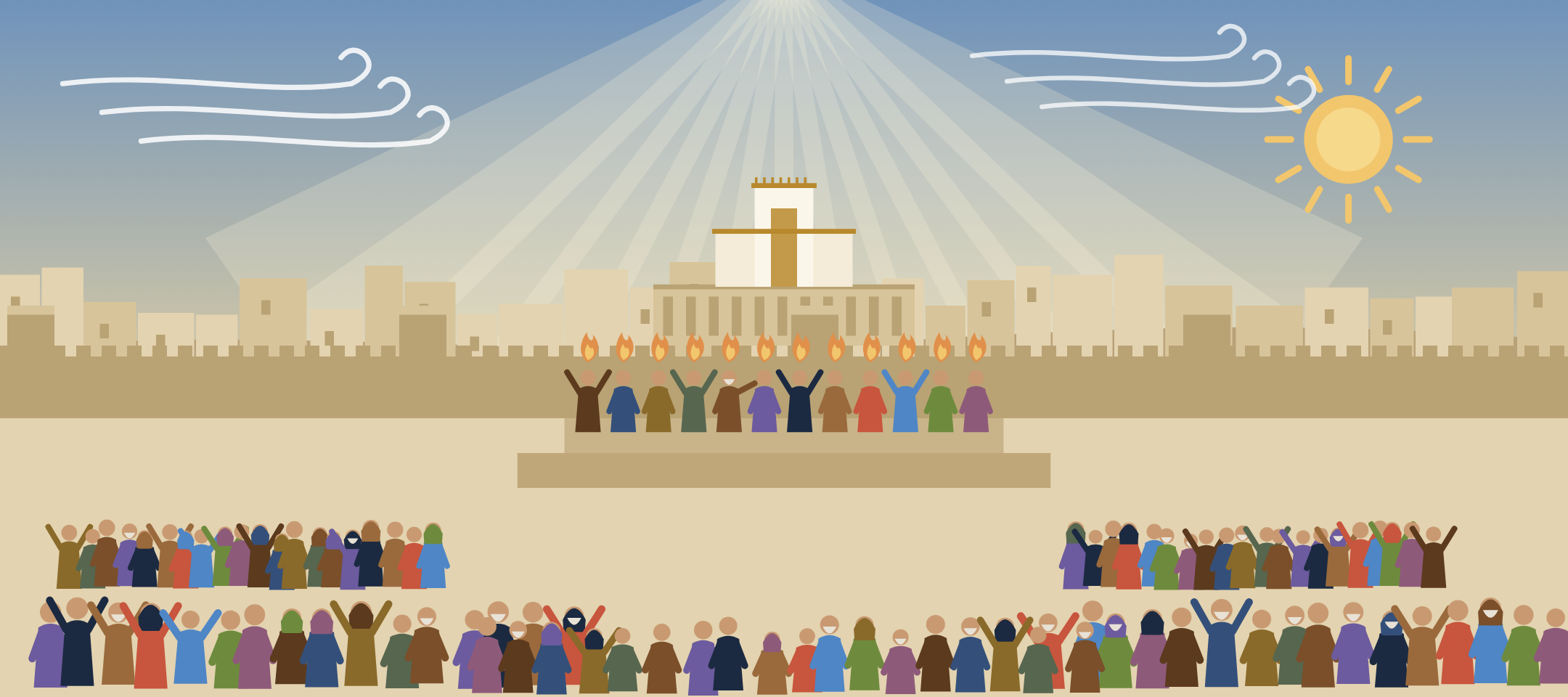
The four Gospels end with Jesus risen and about to return to the Father. Acts begins there and tells what happened next. Jesus did not leave his followers alone. He sent the Holy Spirit, and a frightened group of about 120 people became a church that, within one generation, had spread across the Roman world.
The story shows three things. The church is God’s work: it began when the Spirit came, and “the Lord added to the church daily” (Acts 2:47). The church is a family: Jews and Gentiles, rich and poor, men and women, made one in Christ (Galatians 3:28). And the church is sent: every believer is a witness to Jesus “unto the uttermost part of the earth” (Acts 1:8). If you are a Christian today, this is your family story.
At a Glance
The Birth of the Church in Nine Scenes
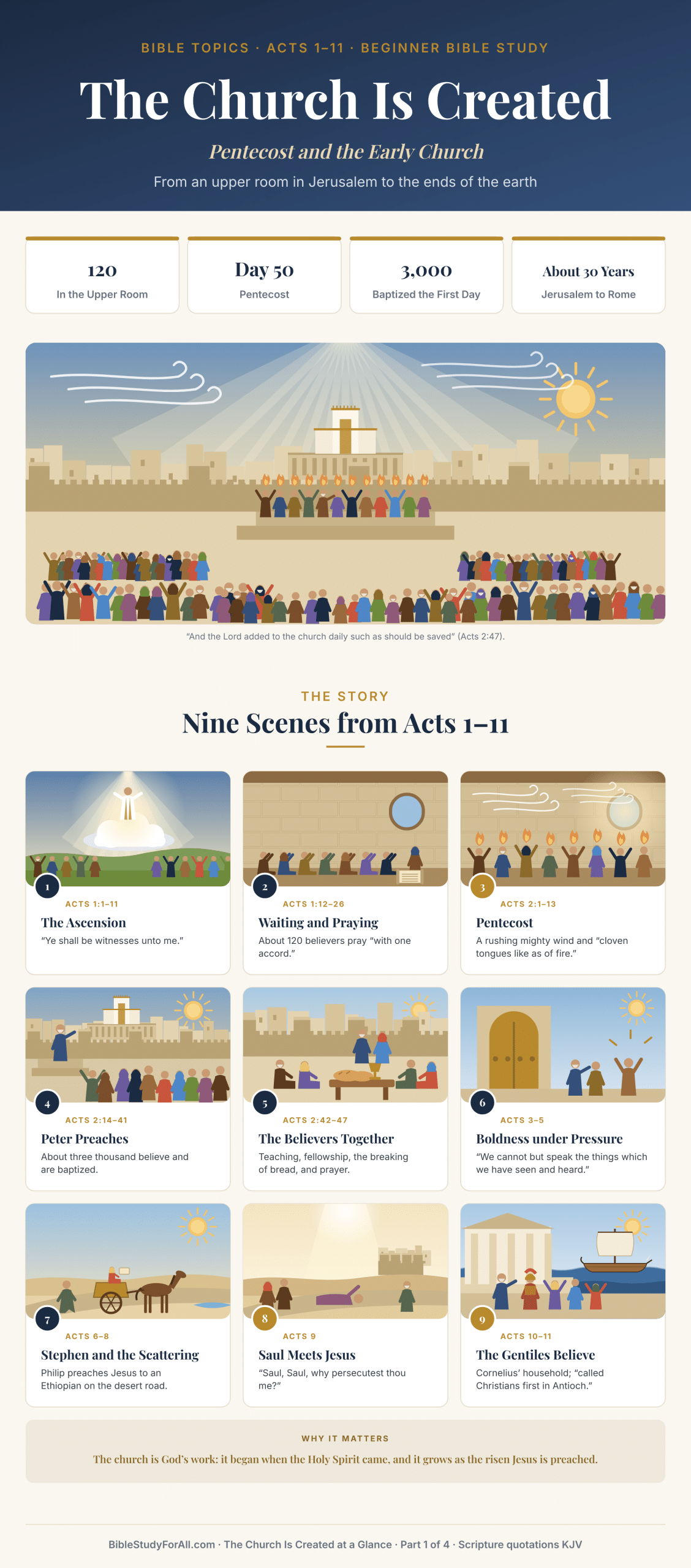
The first eleven chapters of Acts move in nine scenes: the ascension, the waiting, Pentecost, Peter’s sermon, the believers together, boldness under pressure, Stephen and the scattering, Saul’s conversion, and the door opened to the Gentiles. Select a scene to jump straight to it.
Scene 1 · Acts 1:1–11
Jesus gives his followers their mission and is taken up into heaven.
Scene 2 · Acts 1:12–26
About 120 believers pray together, and Matthias takes Judas’ place.
Scene 3 · Acts 2:1–13
The Holy Spirit comes, and the crowd hears God praised in their own languages.
Scene 4 · Acts 2:14–41
The man who denied Jesus now boldly preaches the risen Christ.
Scene 5 · Acts 2:42–47; 4:32–37
Teaching, fellowship, meals, and prayer, and the Lord adds to their number daily.
Scene 6 · Acts 3–5
A lame man walks, the apostles are arrested, and the church prays for courage.
Scene 7 · Acts 6–8
Seven servants chosen, Stephen martyred, and the gospel reaches Samaria and Africa.
Scene 9 · Acts 10–11
Peter preaches to a Roman officer’s household, and believers are first called Christians.
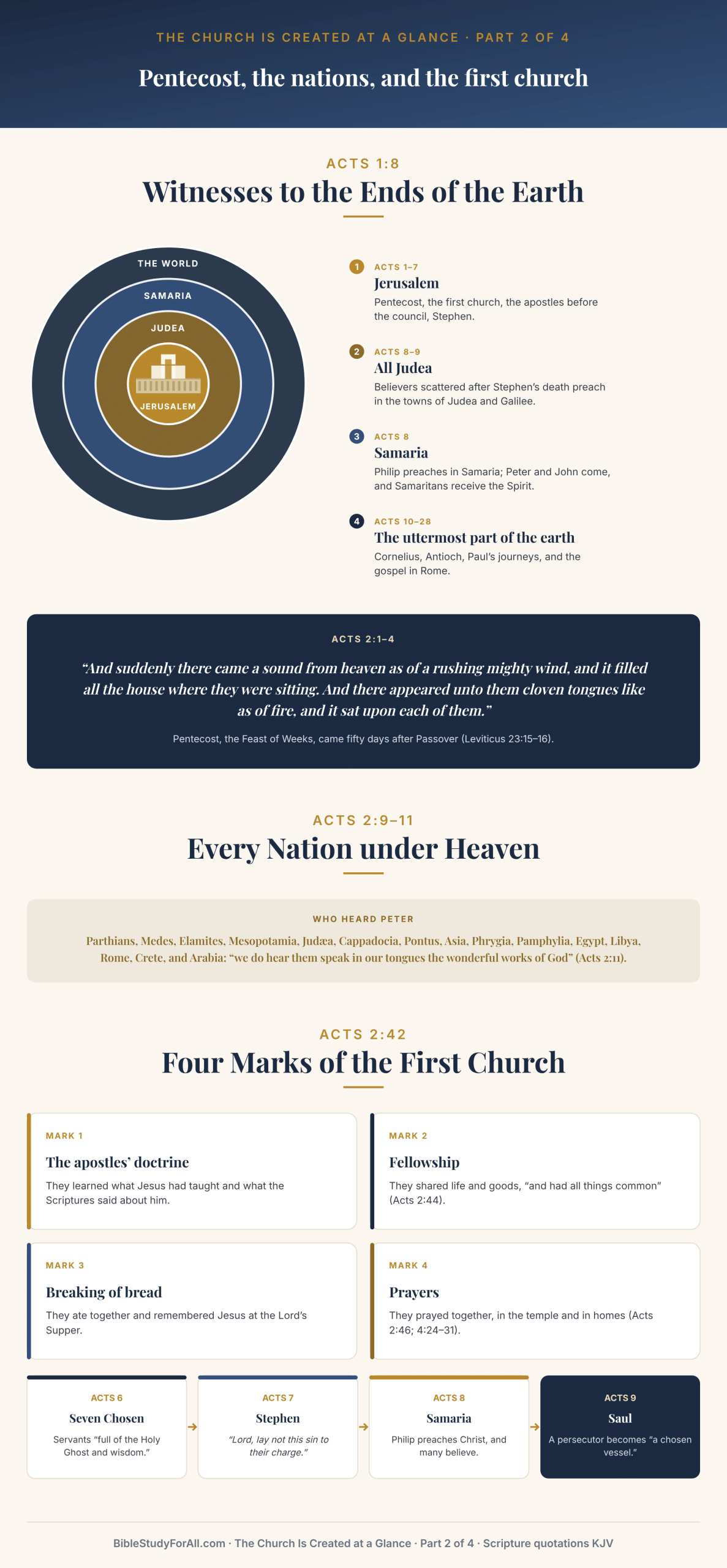
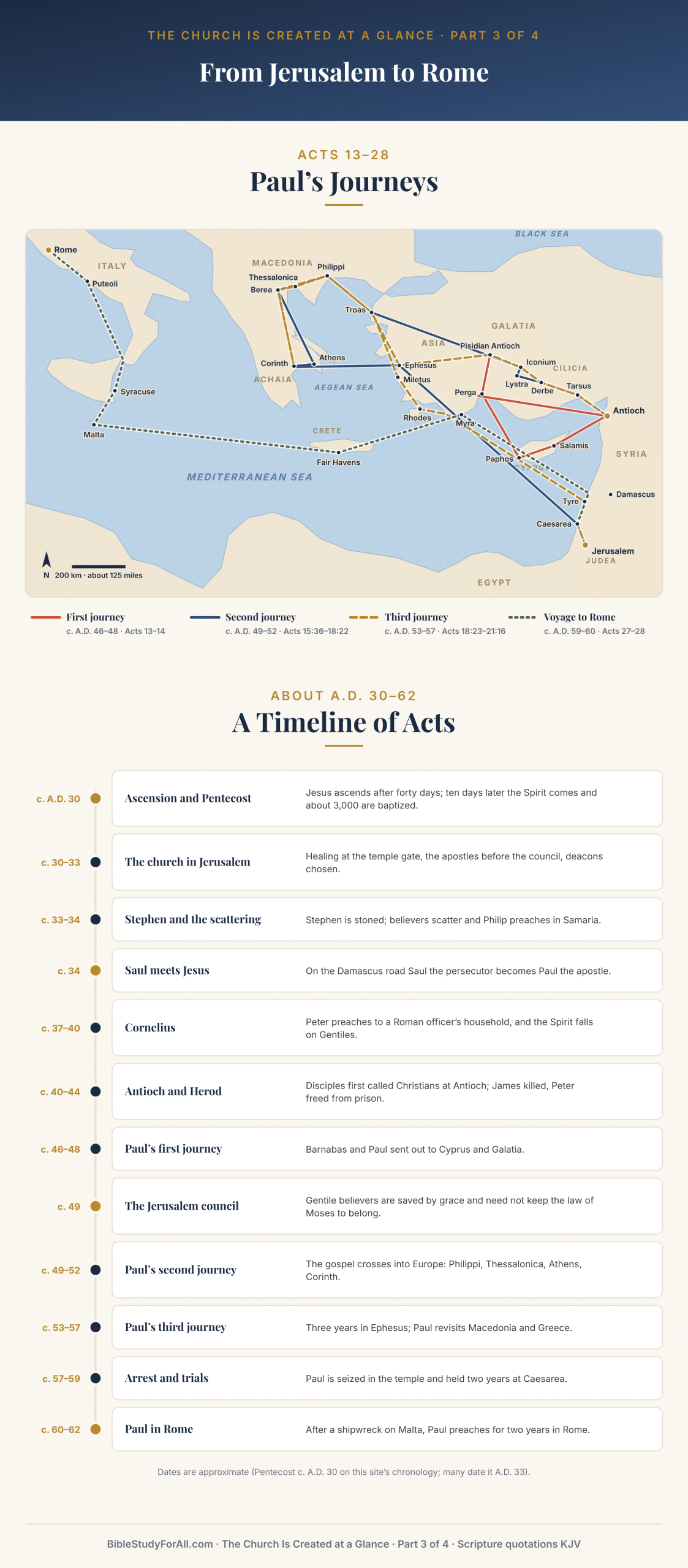
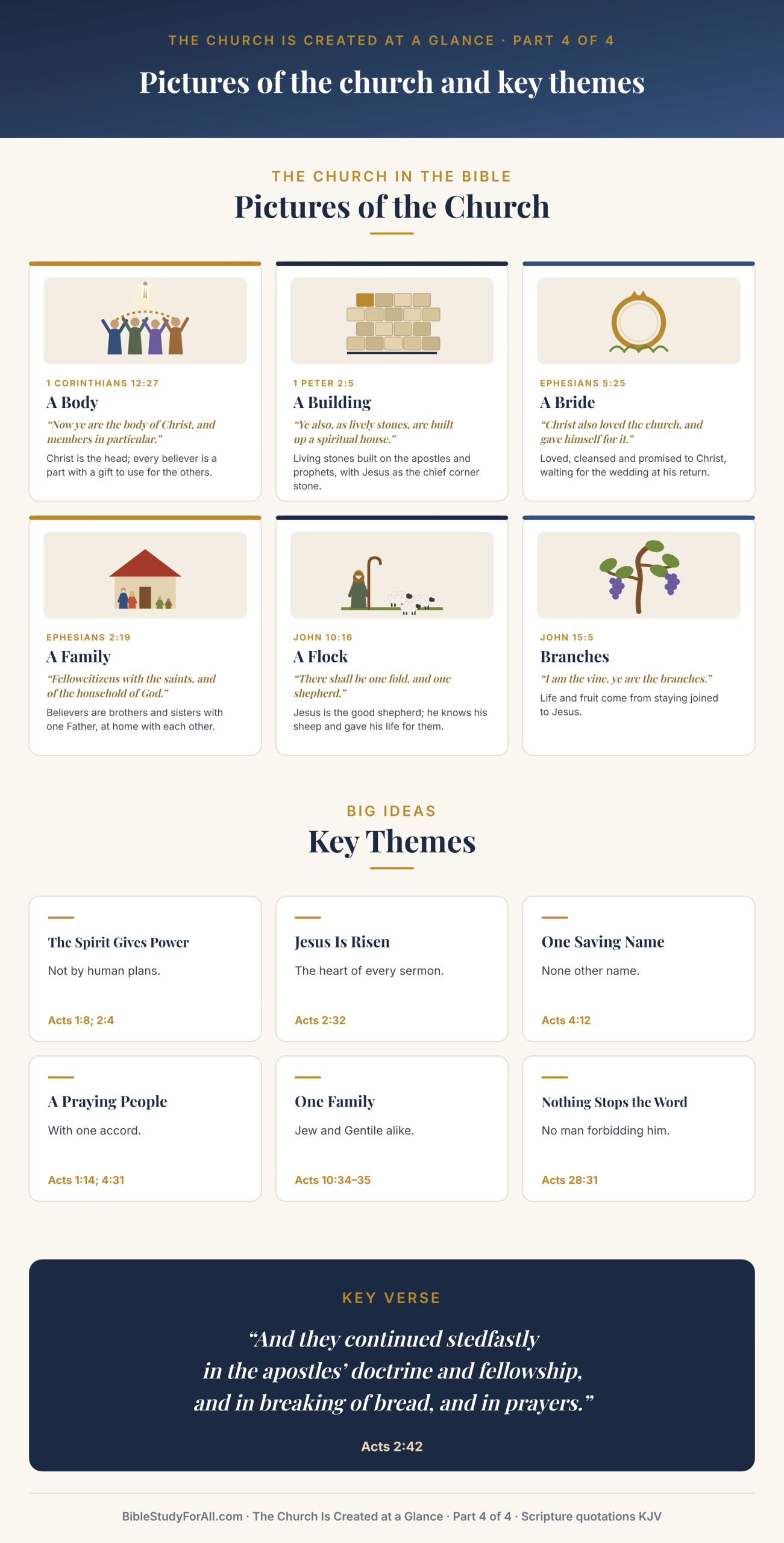
The whole story in four illustrated parts. Save or print them to keep beside your Bible.
Before You Begin
Three Habits for This Study
You don’t need any background to follow along. These habits will help you get the most from each scene.
Read Acts as part two
Luke wrote two books for Theophilus. Acts picks up where Luke’s Gospel ends. Read Luke 24:44–53 and then Acts 1–2 (KJV) together.
Follow the map
Acts 1:8 is the book’s outline: Jerusalem, Judea and Samaria, then the ends of the earth. Watch the circle widen in each scene.
Watch the Holy Spirit
Acts could be called “the Acts of the Holy Spirit.” Notice each time the Spirit fills, sends, guides, or gives courage.
Scene 1 of 9 · Acts 1:1–11
The Promise and the Ascension
When: Forty days after the resurrection, c. A.D. 30
“But ye shall receive power, after that the Holy Ghost is come upon you: and ye shall be witnesses unto me both in Jerusalem, and in all Judæa, and in Samaria, and unto the uttermost part of the earth.”Acts 1:8 (KJV) · Read Acts 1:1–11
What happens
Luke opens Acts by reminding his friend Theophilus of “all that Jesus began both to do and teach” (Acts 1:1). For forty days after his resurrection, Jesus showed himself alive “by many infallible proofs” and spoke about the kingdom of God (Acts 1:3). He told the apostles not to leave Jerusalem, but to “wait for the promise of the Father”: “ye shall be baptized with the Holy Ghost not many days hence” (Acts 1:4–5).
On the Mount of Olives he gave them their mission. They would receive power when the Spirit came, and they would be his witnesses from Jerusalem to the ends of the earth. Then “while they beheld, he was taken up; and a cloud received him out of their sight” (Acts 1:9). Two men in white stood by them and said, “this same Jesus, which is taken up from you into heaven, shall so come in like manner as ye have seen him go into heaven” (Acts 1:11).
Look closer
Acts 1:8 is the outline of the whole book. Chapters 1–7 take place in Jerusalem, chapters 8–9 in Judea and Samaria, and chapters 10–28 carry the gospel out to the nations until Paul preaches in Rome. See To the Ends of the Earth below.
The disciples asked, “Lord, wilt thou at this time restore again the kingdom to Israel?” Jesus did not give them a date. He gave them a job (Acts 1:6–8). The church lives between his going and his coming again; see our Jesus Returning study.
Think about it
Jesus gave his followers a mission before he left. Where is your “Jerusalem,” the place where you can be his witness this week?
Scene 2 of 9 · Acts 1:12–26
Waiting and Praying
When: The ten days before Pentecost
“These all continued with one accord in prayer and supplication, with the women, and Mary the mother of Jesus, and with his brethren.”Acts 1:14 (KJV) · Read Acts 1:12–26
What happens
The apostles walk back from the Mount of Olives, “a sabbath day’s journey,” and go up into an upper room in Jerusalem (Acts 1:12–13). Luke lists the eleven by name. With them are the women who had followed Jesus, Mary his mother, and his brothers, who had not believed in him before the resurrection (John 7:5). The whole company numbers “about an hundred and twenty” (Acts 1:15).
Peter stands up and explains from the Psalms that someone must take the place of Judas. It must be a man who had been with them from John’s baptism to the ascension, “a witness with us of his resurrection” (Acts 1:22). Two are put forward, Joseph called Barsabas and Matthias. They pray, cast lots, “and the lot fell upon Matthias; and he was numbered with the eleven apostles” (Acts 1:26).
Look closer
The church was born in a prayer meeting. Before the Spirit came there was no preaching, no plan, and no crowd, only a small group waiting on God “with one accord,” a phrase Luke uses again and again in these chapters (Acts 2:1, 46; 4:24; 5:12).
Casting lots was an Old Testament way of seeking God’s choice (Proverbs 16:33). It is never mentioned again in the New Testament after Pentecost. From then on, the church seeks God’s guidance through the Spirit, prayer, and the Scriptures (Acts 13:2; 15:28).
Think about it
The first believers waited and prayed before they did anything else. What are you trying to do for God without first asking him?
Scene 3 of 9 · Acts 2:1–13
Pentecost: Wind and Fire
When: The day of Pentecost, fifty days after Passover
“And they were all filled with the Holy Ghost, and began to speak with other tongues, as the Spirit gave them utterance.”Acts 2:4 (KJV) · Read Acts 2:1–13
What happens
“And when the day of Pentecost was fully come, they were all with one accord in one place. And suddenly there came a sound from heaven as of a rushing mighty wind, and it filled all the house where they were sitting. And there appeared unto them cloven tongues like as of fire, and it sat upon each of them” (Acts 2:1–3).
Jerusalem is crowded with Jews and converts “out of every nation under heaven” who have come for the feast (Acts 2:5). Hearing the sound, a crowd gathers, and they are amazed, “because that every man heard them speak in his own language.” Luke lists fifteen lands and peoples, from Parthia and Mesopotamia to Egypt, Rome, Crete, and Arabia: “we do hear them speak in our tongues the wonderful works of God” (Acts 2:6–11). Some ask, “What meaneth this?” Others mock: “These men are full of new wine.”
Look closer
Pentecost (Greek for “fiftieth”) was the Feast of Weeks, when Israel brought the firstfruits of the wheat harvest to God (Leviticus 23:15–17). On that day God gathered the firstfruits of a new harvest of people.
Wind and fire are signs of God’s presence: the Spirit is like the wind (John 3:8), and God came down on Sinai in fire (Exodus 19:18). At Babel, God confused one language and scattered the nations (Genesis 11:7–9). At Pentecost, people of many languages hear one message about Jesus. John the Baptist had promised that Jesus would “baptize you with the Holy Ghost, and with fire” (Matthew 3:11).
Think about it
The Spirit came on each of them, not only on the apostles. How does it change your view of yourself to know that the Spirit lives in every believer?
Scene 4 of 9 · Acts 2:14–41
Peter Preaches, and Three Thousand Believe
When: The same day
“Then Peter said unto them, Repent, and be baptized every one of you in the name of Jesus Christ for the remission of sins, and ye shall receive the gift of the Holy Ghost.”Acts 2:38 (KJV) · Read Acts 2:14–41
What happens
Peter stands up with the eleven and answers the crowd. These men are not drunk, “seeing it is but the third hour of the day” (nine in the morning). This is what the prophet Joel foretold: “I will pour out of my Spirit upon all flesh” (Acts 2:15–17). Then he preaches Jesus: a man approved of God by miracles, delivered up by God’s plan, crucified by wicked hands, and raised from the dead, “whereof we all are witnesses” (Acts 2:22–24, 32). Jesus is now exalted at God’s right hand and has poured out the Spirit. “Therefore let all the house of Israel know assuredly, that God hath made that same Jesus, whom ye have crucified, both Lord and Christ” (Acts 2:36).
The crowd is “pricked in their heart” and asks, “Men and brethren, what shall we do?” Peter calls them to repent and be baptized, and promises the Spirit “unto you, and to your children, and to all that are afar off” (Acts 2:39). “Then they that gladly received his word were baptized: and the same day there were added unto them about three thousand souls” (Acts 2:41).
Look closer
Fifty days earlier, Peter had denied Jesus three times to a servant girl by a fire (Luke 22:55–62). Now he stands before thousands in the same city and names Jesus as Lord. The difference is the risen Christ and the Holy Spirit.
Peter’s sermon is mostly Scripture: Joel 2, Psalm 16, and Psalm 110. Its center is the resurrection. The apostles preached that God had raised Jesus, and that this proves who he is.
Think about it
Peter went from denying Jesus to preaching him. What fear keeps you quiet about Jesus, and what would help you speak?
Scene 5 of 9 · Acts 2:42–47; 4:32–37
The Believers Together
When: The first months in Jerusalem
“And they continued stedfastly in the apostles’ doctrine and fellowship, and in breaking of bread, and in prayers.”Acts 2:42 (KJV) · Read Acts 2:42–47; 4:32–37
What happens
Luke gives a picture of the new church. The believers devote themselves to four things: the apostles’ teaching, fellowship, the breaking of bread, and prayer. “Fear came upon every soul: and many wonders and signs were done by the apostles” (Acts 2:43). They share what they have, selling property and goods to give “as every man had need” (Acts 2:45).
They meet daily in the temple courts and eat together in their homes “with gladness and singleness of heart, praising God, and having favour with all the people. And the Lord added to the church daily such as should be saved” (Acts 2:46–47). Later Luke adds, “the multitude of them that believed were of one heart and of one soul” (Acts 4:32). A man from Cyprus named Joses sells a field and lays the money at the apostles’ feet; the apostles call him Barnabas, “the son of consolation” (Acts 4:36–37).
Look closer
This is the first time Luke uses the word “church” in Acts (Acts 2:47 in the King James Version). The Greek word ekklesia means an assembly, people called together. The church is not a building; it is a people.
Their sharing was free, not forced. When Ananias and Sapphira lied about their gift, Peter told them, “Whiles it remained, was it not thine own?” (Acts 5:4). Their sin was not keeping some of the money but pretending to give it all.
Think about it
The first church grew in teaching, fellowship, the Lord’s Supper, and prayer. Which of these four is weakest in your life right now?
Scene 6 of 9 · Acts 3–5
Boldness under Pressure
When: c. A.D. 30–33
“For we cannot but speak the things which we have seen and heard.”Acts 4:20 (KJV) · Read Acts 3–5
What happens
Peter and John go up to the temple at the hour of prayer. At the gate called Beautiful sits a man lame from birth, begging. Peter says, “Silver and gold have I none; but such as I have give I thee: In the name of Jesus Christ of Nazareth rise up and walk” (Acts 3:6). The man leaps up, “walking, and leaping, and praising God” (Acts 3:8), and Peter preaches to the crowd that gathers.
The temple leaders arrest Peter and John, but “many of them which heard the word believed; and the number of the men was about five thousand” (Acts 4:4). Before the council Peter declares, “Neither is there salvation in any other: for there is none other name under heaven given among men, whereby we must be saved” (Acts 4:12). Ordered to stop, they refuse. The church prays, “grant unto thy servants, that with all boldness they may speak thy word” (Acts 4:29), and the place is shaken. When the apostles are arrested again and beaten, they answer, “We ought to obey God rather than men” (Acts 5:29), and go away “rejoicing that they were counted worthy to suffer shame for his name” (Acts 5:41).
Look closer
The council noticed that Peter and John were “unlearned and ignorant men,” and “they took knowledge of them, that they had been with Jesus” (Acts 4:13). Their courage came from time with Jesus, not from training.
Notice what the church prayed for when threatened. They did not ask God to remove the danger. They asked for boldness to keep speaking, and for God to keep working (Acts 4:29–30).
Think about it
When the believers were threatened, they prayed for boldness, not safety. What would it look like to pray that way about a hard situation you face?
Scene 7 of 9 · Acts 6–8
Stephen and the Scattering
When: c. A.D. 33–34
“Therefore they that were scattered abroad went every where preaching the word.”Acts 8:4 (KJV) · Read Acts 6–8
What happens
As the church grows, Greek-speaking widows are overlooked in the daily food. The apostles ask the church to choose seven men “full of the Holy Ghost and wisdom” to serve, so that the apostles can give themselves “to prayer, and to the ministry of the word” (Acts 6:3–4). One of the seven, Stephen, does great wonders and speaks with such wisdom that his opponents cannot answer him. Brought before the council, he traces Israel’s history from Abraham to Solomon and accuses the leaders of resisting the Holy Spirit as their fathers did (Acts 7:51).
Stephen sees “the Son of man standing on the right hand of God,” and they drag him out of the city and stone him. He dies praying, “Lord Jesus, receive my spirit … Lord, lay not this sin to their charge” (Acts 7:56–60). A young man named Saul watches over their coats. A great persecution follows, and the believers are scattered through Judea and Samaria. But the scattering spreads the message. Philip preaches Christ in Samaria, and many believe (Acts 8:5–12). Then an angel sends him to a desert road, where an Ethiopian official is reading Isaiah 53 in his chariot. “Then Philip opened his mouth, and began at the same scripture, and preached unto him Jesus” (Acts 8:35), and the man is baptized and goes on his way rejoicing.
Look closer
Stephen is the first Christian martyr. His last words echo Jesus on the cross: “Father, into thy hands I commend my spirit” and “Father, forgive them” (Luke 23:34, 46). The Greek word for “witness” is martys, the word that came to mean martyr.
Jews and Samaritans had been enemies for centuries (John 4:9). Now Samaritans receive the Spirit when Peter and John lay hands on them (Acts 8:14–17), and an African court official carries the gospel home. The circle of Acts 1:8 is widening.
Think about it
Persecution scattered the believers, and they preached wherever they went. Where has God placed you, perhaps unexpectedly, to speak about him?
Scene 8 of 9 · Acts 9:1–31
Saul Meets Jesus
When: c. A.D. 34
“And he fell to the earth, and heard a voice saying unto him, Saul, Saul, why persecutest thou me?”Acts 9:4 (KJV) · Read Acts 9:1–31
What happens
Saul, “yet breathing out threatenings and slaughter against the disciples of the Lord,” gets letters from the high priest to arrest believers in Damascus (Acts 9:1–2). Near the city, a light from heaven flashes around him. He falls to the ground and hears a voice: “Saul, Saul, why persecutest thou me?” “Who art thou, Lord?” “I am Jesus whom thou persecutest” (Acts 9:4–5).
Blind, Saul is led into Damascus, where he fasts and prays for three days. The Lord sends a disciple named Ananias, who is afraid: he has heard “how much evil he hath done to thy saints.” The Lord answers, “he is a chosen vessel unto me, to bear my name before the Gentiles, and kings, and the children of Israel” (Acts 9:13–15). Ananias lays his hands on him and calls him “Brother Saul.” Something like scales falls from his eyes, and he is baptized. “And straightway he preached Christ in the synagogues, that he is the Son of God” (Acts 9:20). Then, Luke says, “had the churches rest throughout all Judæa and Galilee and Samaria” (Acts 9:31).
Look closer
Jesus did not ask, “Why do you persecute my followers?” He asked, “Why persecutest thou me?” Jesus so closely identifies with his church that to hurt the church is to hurt him. Paul would later teach that the church is the body of Christ (1 Corinthians 12:27).
Saul is his Hebrew name and Paul his Roman one; Luke begins calling him Paul in Acts 13:9, when his mission to the Gentiles begins. Paul tells his own story twice more in Acts (22:6–16; 26:12–18).
Think about it
Ananias was afraid to visit Saul, but he went and called him “Brother.” Is there someone God may be asking you to welcome whom you find hard to trust?
Scene 9 of 9 · Acts 10–11
The Door Opens to the Gentiles
When: c. A.D. 37–44
“Of a truth I perceive that God is no respecter of persons: But in every nation he that feareth him, and worketh righteousness, is accepted with him.”Acts 10:34–35 (KJV) · Read Acts 10–11
What happens
Cornelius, a Roman centurion in Caesarea, is “a devout man, and one that feared God with all his house” (Acts 10:2). An angel tells him to send for Peter in Joppa. At the same time, Peter sees a vision on a rooftop: a great sheet let down from heaven, full of animals that were unclean under the law of Moses, and a voice saying, “What God hath cleansed, that call not thou common” (Acts 10:15). As Peter wonders what it means, Cornelius’ men arrive at the gate.
Peter goes with them, enters a Gentile’s house, and preaches Jesus to the household and friends gathered there. “While Peter yet spake these words, the Holy Ghost fell on all them which heard the word” (Acts 10:44), and they are baptized. Back in Jerusalem, the church hears the story and glorifies God: “Then hath God also to the Gentiles granted repentance unto life” (Acts 11:18). Soon believers in Antioch of Syria are preaching to Greeks, and many turn to the Lord. Barnabas brings Saul to teach there for a whole year, “and the disciples were called Christians first in Antioch” (Acts 11:26).
Look closer
From Abraham on, God had promised that all nations would be blessed (Genesis 12:3), and Jesus had sent his disciples to “all nations” (Matthew 28:19). Still, the first believers were Jews, and many found it hard to imagine Gentiles in the church without first keeping the law of Moses. Peter’s vision and the Spirit’s coming on Cornelius settled it. In Acts 15 the church council in Jerusalem agreed: “we believe that through the grace of the Lord Jesus Christ we shall be saved, even as they” (Acts 15:11).
The church in Antioch became the base for the mission to the world. From there the Holy Spirit said, “Separate me Barnabas and Saul for the work whereunto I have called them” (Acts 13:2).
Think about it
God had to show Peter that no one was outside the reach of the gospel. Is there a kind of person you have quietly decided God does not want?
Acts 2:42
Four Marks of the First Church
Luke sums up the life of the new church in one verse. These four habits are still the heartbeat of a healthy church today.
1
The apostles’ doctrine
They learned what Jesus had taught and what the Scriptures said about him.
2
Fellowship
They shared life and goods, “and had all things common” (Acts 2:44).
3
Breaking of bread
They ate together and remembered Jesus at the Lord’s Supper.
4
Prayers
They prayed together, in the temple and in homes (Acts 2:46; 4:24–31).
Who heard Peter at Pentecost
Luke names the lands the crowd came from (Acts 2:9–11): Parthians, Medes, Elamites, Mesopotamia, Judaea, Cappadocia, Pontus, Asia, Phrygia, Pamphylia, Egypt, Libya about Cyrene, Strangers of Rome, Jews and proselytes, Cretes, and Arabians. From the first day, the church was international. Many of these visitors carried the news home with them.
The Church in the Bible
What Is the Church?
The church is not a building or an organization first of all. It is the people Jesus has called to himself, gathered by the Holy Spirit. The New Testament uses several pictures to describe it.
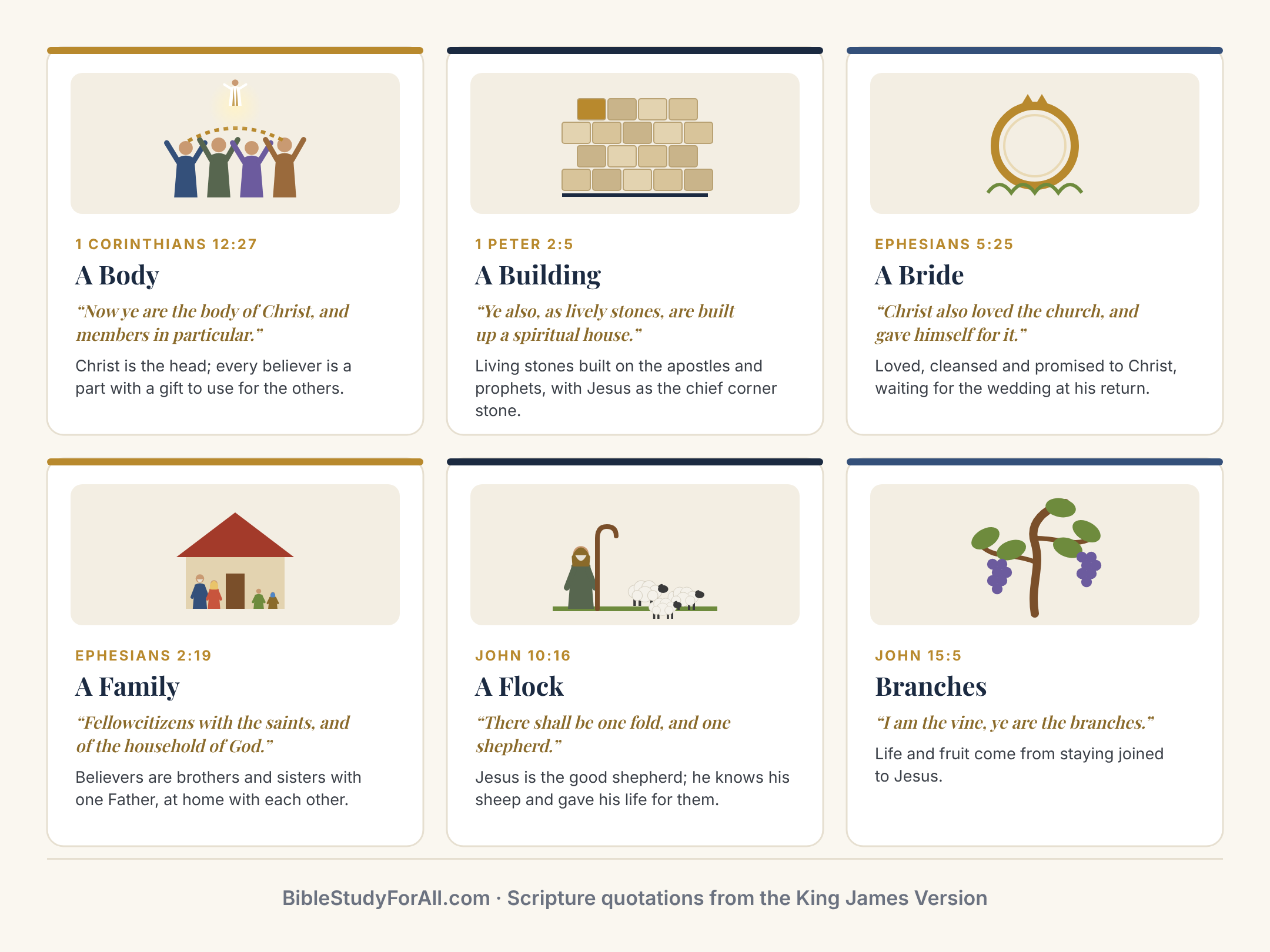
1 Corinthians 12:27
A Body
“Now ye are the body of Christ, and members in particular.”
Christ is the head; every believer is a part with a gift to use for the others.
1 Peter 2:5
A Building
“Ye also, as lively stones, are built up a spiritual house.”
Living stones built on the apostles and prophets, with Jesus as the chief corner stone.
Ephesians 5:25
A Bride
“Christ also loved the church, and gave himself for it.”
Loved, cleansed and promised to Christ, waiting for the wedding at his return.
Ephesians 2:19
A Family
“Fellowcitizens with the saints, and of the household of God.”
Believers are brothers and sisters with one Father, at home with each other.
John 10:16
A Flock
“There shall be one fold, and one shepherd.”
Jesus is the good shepherd; he knows his sheep and gave his life for them.
John 15:5
Branches
“I am the vine, ye are the branches.”
Life and fruit come from staying joined to Jesus.
Jesus builds it
Jesus first spoke of the church when Peter confessed that he was the Christ: “upon this rock I will build my church; and the gates of hell shall not prevail against it” (Matthew 16:18). Notice whose church it is (my church), who builds it (Jesus), and how secure it is. Paul says that God gave Christ “to be the head over all things to the church, which is his body” (Ephesians 1:22–23).
Acts 12–28
To the Ends of the Earth
After Acts 12 the story follows Paul. From the church in Antioch he sets out with Barnabas, then with Silas, Timothy, and Luke, planting churches in the great cities of the Roman world. Acts ends with Paul in Rome, the capital of the empire, “preaching the kingdom of God … with all confidence, no man forbidding him” (Acts 28:31).
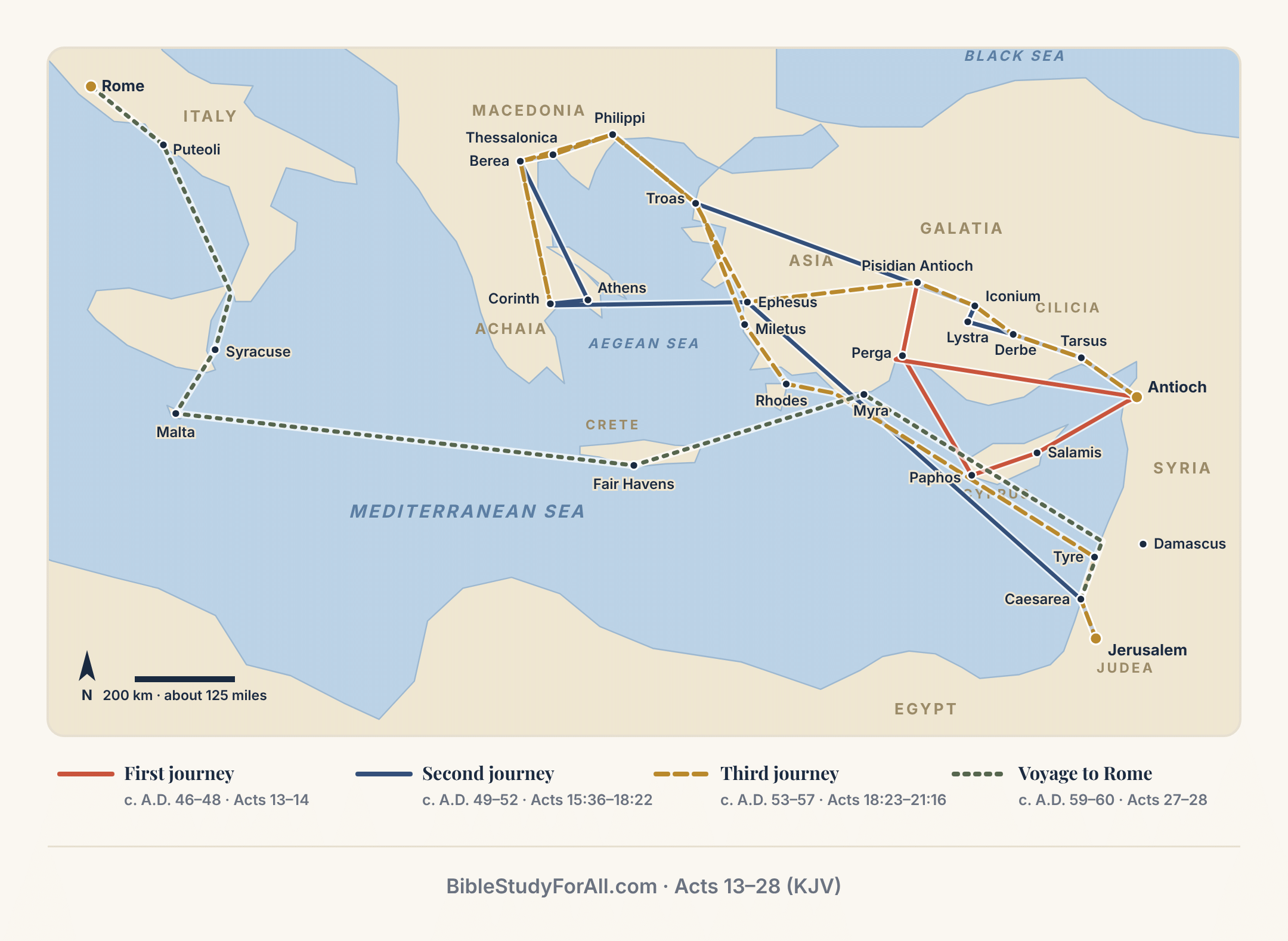
| Journey | When | Read | Places |
|---|---|---|---|
| First journey | c. A.D. 46–48 | Acts 13–14 | Antioch, Seleucia, Salamis, Paphos, Perga, Pisidian Antioch, Iconium, Lystra, Derbe, Attalia |
| Second journey | c. A.D. 49–52 | Acts 15:36–18:22 | Antioch, Tarsus, Derbe, Lystra, Iconium, Troas, Neapolis, Philippi, Thessalonica, Berea, Athens, Corinth, Cenchrea, Ephesus, Caesarea, Jerusalem |
| Third journey | c. A.D. 53–57 | Acts 18:23–21:16 | Antioch, Tarsus, Derbe, Iconium, Pisidian Antioch, Ephesus, Troas, Philippi, Thessalonica, Berea, Corinth, Assos, Miletus, Rhodes, Patara, Tyre, Caesarea, Jerusalem |
| Voyage to Rome | c. A.D. 59–60 | Acts 27–28 | Caesarea, Sidon, Myra, Fair Havens, Malta, Syracuse, Rhegium, Puteoli, Rome |
Acts 15:1–35
One Church, Jew and Gentile
Must Gentile believers be circumcised and keep the law of Moses? The apostles and elders meet in Jerusalem and agree that God “put no difference between us and them, purifying their hearts by faith” (Acts 15:9).
Acts 16:9–15
Into Europe
In a vision a man of Macedonia pleads, “Come over into Macedonia, and help us.” In Philippi a businesswoman named Lydia believes, the first convert in Europe.
Acts 17:6
The World Turned Upside Down
In Thessalonica a mob complains, “These that have turned the world upside down are come hither also.” The gospel was changing whole cities.
About A.D. 30–62
A Timeline of Acts
Acts covers about thirty years. Luke does not give dates, but events such as the death of Herod Agrippa (A.D. 44) and Gallio’s term in Corinth (about A.D. 51–52) let us place the story in history.
| When | What happens | Read |
|---|---|---|
| c. A.D. 30 | Ascension and Pentecost. Jesus ascends after forty days; ten days later the Spirit comes and about 3,000 are baptized. | Acts 1–2 |
| c. 30–33 | The church in Jerusalem. Healing at the temple gate, the apostles before the council, deacons chosen. | Acts 3–6 |
| c. 33–34 | Stephen and the scattering. Stephen is stoned; believers scatter and Philip preaches in Samaria. | Acts 7–8 |
| c. 34 | Saul meets Jesus. On the Damascus road Saul the persecutor becomes Paul the apostle. | Acts 9 |
| c. 37–40 | Cornelius. Peter preaches to a Roman officer’s household, and the Spirit falls on Gentiles. | Acts 10–11 |
| c. 40–44 | Antioch and Herod. Disciples first called Christians at Antioch; James killed, Peter freed from prison. | Acts 11–12 |
| c. 46–48 | Paul’s first journey. Barnabas and Paul sent out to Cyprus and Galatia. | Acts 13–14 |
| c. 49 | The Jerusalem council. Gentile believers are saved by grace and need not keep the law of Moses to belong. | Acts 15 |
| c. 49–52 | Paul’s second journey. The gospel crosses into Europe: Philippi, Thessalonica, Athens, Corinth. | Acts 15:36–18:22 |
| c. 53–57 | Paul’s third journey. Three years in Ephesus; Paul revisits Macedonia and Greece. | Acts 18:23–21:16 |
| c. 57–59 | Arrest and trials. Paul is seized in the temple and held two years at Caesarea. | Acts 21–26 |
| c. 60–62 | Paul in Rome. After a shipwreck on Malta, Paul preaches for two years in Rome. | Acts 27–28 |
Dates are approximate. This site dates Jesus’ ministry about A.D. 27–30, which places Pentecost in A.D. 30; many place the crucifixion and Pentecost in A.D. 33, which moves the earliest dates a few years later.
| Place | Read | What happened there |
|---|---|---|
| Jerusalem | Acts 2; 15 | Pentecost; the first church; the council |
| Samaria | Acts 8:5–25 | Philip preaches; Samaritans believe |
| Damascus | Acts 9:1–25 | Saul meets Jesus and is baptized |
| Caesarea | Acts 10 | Cornelius, the first Gentile household |
| Antioch | Acts 11:19–26; 13:1–3 | Disciples first called Christians; Paul sent out |
| Philippi | Acts 16 | First church in Europe; Lydia and the jailer |
| Athens | Acts 17:16–34 | Paul on Mars’ hill: “the unknown god” |
| Corinth | Acts 18 | Paul stays eighteen months |
| Ephesus | Acts 19 | Three years of teaching; the riot |
| Rome | Acts 28 | Paul preaches “no man forbidding him” |
Reading Acts
When Did the Church Begin?
Christians agree that Pentecost was a decisive new beginning. They describe the church’s relationship to what came before in different ways. Here are the main views, in brief.
A new body at Pentecost
The Church Began at Pentecost
Many Christians hold that the church was born when the Spirit came. Jesus spoke of it as future, “I will build my church” (Matthew 16:18), and Paul says believers are baptized by one Spirit into one body (1 Corinthians 12:13). Dispensational teachers in particular see the church as distinct from Israel, a new work of God in this age.
One people of God
The Church Renewed at Pentecost
Others, including many in the covenant (Reformed) tradition, see one people of God from Abraham onward. Israel was called “the church in the wilderness” (Acts 7:38), and Gentiles are grafted into the same olive tree (Romans 11:17). On this view Pentecost did not start a new people but renewed and opened God’s people to all nations.
Founded by Jesus
The Church Began with Jesus
Still others point to Jesus calling and training the Twelve as the founding of the church, with Pentecost as its public birth or empowering. Jesus already gave instructions to “tell it unto the church” (Matthew 18:17), and the apostles are its foundation (Ephesians 2:20).
Common ground
Whichever view you hold, the main points are shared. The church belongs to Jesus, who died for it (Acts 20:28). It lives by the Holy Spirit, who came at Pentecost. And it is made of all who trust in Christ, “for ye are all one in Christ Jesus” (Galatians 3:28).
Big Ideas
Six Themes of the Early Church
The Spirit gives power
The church began when the Holy Ghost came, not by human plans (Acts 1:8; 2:4).
Jesus is risen
The resurrection was the center of every sermon in Acts (Acts 2:32; 4:33).
Salvation in one name
There is none other name under heaven whereby we must be saved (Acts 4:12).
A praying people
They continued with one accord in prayer before and after Pentecost (Acts 1:14; 4:31).
One family
Jews, Samaritans and Gentiles are made one in Christ (Acts 10:34–35; 15:9).
Nothing stops the word
Prison, persecution and shipwreck only spread the gospel further (Acts 8:4; 28:31).
The Center of It All
The Church and Jesus
The church exists because of Jesus and for Jesus. He promised it, bought it, sends his Spirit to it, rules it as its head, and is coming back for it.
Matthew 16:18
Jesus builds it
“Upon this rock I will build my church; and the gates of hell shall not prevail against it.”
John 14:16
The promised Comforter
“And I will pray the Father, and he shall give you another Comforter, that he may abide with you for ever.”
Acts 20:28
Bought with his blood
“To feed the church of God, which he hath purchased with his own blood.”
Ephesians 5:25
Loved by Christ
“Christ also loved the church, and gave himself for it.”
Colossians 1:18
Christ the head
“And he is the head of the body, the church.”
Ephesians 2:20
The chief corner stone
“Jesus Christ himself being the chief corner stone.”
Revelation 19:7
The wedding to come
“For the marriage of the Lamb is come, and his wife hath made herself ready.”
Verses to Remember
Key Verses about the Church
Along with the verses in each scene above, these are worth reading slowly, and memorizing.
Acts 1:8
“But ye shall receive power, after that the Holy Ghost is come upon you: and ye shall be witnesses unto me both in Jerusalem, and in all Judæa, and in Samaria, and unto the uttermost part of the earth.”
Acts 2:38
“Repent, and be baptized every one of you in the name of Jesus Christ for the remission of sins, and ye shall receive the gift of the Holy Ghost.”
Acts 2:42
“And they continued stedfastly in the apostles’ doctrine and fellowship, and in breaking of bread, and in prayers.”
Acts 4:12
“Neither is there salvation in any other: for there is none other name under heaven given among men, whereby we must be saved.”
Acts 4:20
“For we cannot but speak the things which we have seen and heard.”
Acts 5:29
“We ought to obey God rather than men.”
Acts 16:31
“Believe on the Lord Jesus Christ, and thou shalt be saved, and thy house.”
Hebrews 10:24–25
“And let us consider one another to provoke unto love and to good works: Not forsaking the assembling of ourselves together, as the manner of some is; but exhorting one another.”
Summary
Five Things to Remember
1
The Spirit came
At Pentecost the Holy Spirit filled the believers and the church was born (Acts 2:1–4).
2
Jesus is Lord
The apostles preached the crucified and risen Jesus as Lord and Christ (Acts 2:36).
3
Repent and believe
Forgiveness and the Spirit are offered to all who turn to Christ (Acts 2:38–39).
4
Devoted together
Teaching, fellowship, the Lord’s Supper and prayer marked the church (Acts 2:42).
5
Sent to the world
From Jerusalem to Rome, the gospel is for every nation (Acts 1:8; 28:31).
For Reflection
Questions to Think About
- Why do you think Jesus told the disciples to wait for the Spirit before they began their mission (Acts 1:4–8)?
- What changed Peter from a man who denied Jesus into a bold preacher (Luke 22:54–62; Acts 2:14–36)?
- Which of the four marks in Acts 2:42 does your church do well, and which could grow?
- How did God use persecution to spread the gospel (Acts 8:1–4)? Have you seen God bring good out of hardship?
- Peter learned that God is no respecter of persons (Acts 10:34). How should that shape the way your church welcomes people?
Questions
Common Questions about the Early Church
What does the word “church” mean?
The New Testament word is ekklesia, an assembly or gathering of people called together. It is used for a local congregation (“the church that is in their house,” Romans 16:5), for the believers in a city or region, and for all of God’s people everywhere (Ephesians 5:25). The English word “church” comes from a Greek word meaning “belonging to the Lord.” In the Bible the church is always people, never a building.
What is Pentecost?
Pentecost was the Feast of Weeks, one of Israel’s three great pilgrim feasts. It came seven weeks after Passover, on the fiftieth day (Leviticus 23:15–21), and celebrated the wheat harvest. Jewish tradition also linked it with the giving of the law at Sinai. Because Jesus died at Passover, Pentecost fell about seven weeks after his resurrection and ten days after his ascension. Many churches still celebrate Pentecost as the birthday of the church.
What were the “other tongues” at Pentecost?
In Acts 2 they were real languages that visitors recognized: “every man heard them speak in his own language” (Acts 2:6). Speaking in tongues happens again in Acts 10:46 and 19:6, and Paul discusses the gift in 1 Corinthians 12–14. Christians differ on whether such gifts continue today. Many Pentecostal and charismatic Christians believe they do; many others hold that some gifts were given mainly for the apostolic age. Both sides agree that the greatest gift is love (1 Corinthians 13:13).
Does every Christian receive the Holy Spirit?
Peter promised the gift of the Holy Ghost to all who repent and are baptized, “unto you, and to your children, and to all that are afar off” (Acts 2:38–39). Paul writes, “if any man have not the Spirit of Christ, he is none of his” (Romans 8:9). Christians agree that the Spirit lives in every believer. Some traditions also teach a later experience, often called the baptism or filling of the Spirit, while others see later fillings as renewed strength for service, as in Acts 4:31.
Why was baptism so important in Acts?
Baptism was how new believers publicly identified with Jesus and joined his church, as Jesus had commanded (Matthew 28:19). In Acts it follows faith quickly, often the same day (Acts 2:41; 8:36–38; 16:33). Christians practice baptism in different ways. Many baptize believers who profess faith, usually by immersion. Others also baptize the children of believers, pointing to the household baptisms in Acts (16:15, 33) and the promise “to your children” (Acts 2:39).
Did the first Christians give up all their property?
Many sold land or goods to meet needs, “and had all things common” (Acts 2:44–45; 4:32–35). But it was voluntary, not required. Peter told Ananias that his land and its price had remained his own (Acts 5:4), and believers like Mary the mother of John Mark still had their own homes (Acts 12:12). The point is generous love for one another, not a fixed economic system.
Who led the early church?
At first the apostles led the church. Seven men were chosen to serve the needy (Acts 6:1–6), often seen as the first deacons. Paul and Barnabas appointed elders in every church they planted (Acts 14:23), and in Jerusalem “the apostles and elders” met together (Acts 15:6), with James, the brother of Jesus, taking a leading role (Acts 15:13–21). Today churches are governed in different ways, for example by bishops, by elders, or by the congregation, each drawing on these passages.
Who wrote Acts, and when?
Acts is the second volume of a work written for Theophilus; the first is Luke’s Gospel (Luke 1:1–4; Acts 1:1). From early times the author has been identified as Luke, “the beloved physician” (Colossians 4:14) and Paul’s travel companion. In some passages he writes “we” (Acts 16:10–17; 20:5–28:16), showing he was there. Acts ends with Paul under house arrest in Rome about A.D. 62, so many date it then; others date it in the 70s or 80s.
Why were believers called “Christians”?
Believers first called themselves disciples, brethren, saints, or followers of “the way” (Acts 9:2). The name “Christians,” meaning people who belong to Christ, was first used in Antioch (Acts 11:26), probably by outsiders. It appears only two other times in the Bible (Acts 26:28; 1 Peter 4:16), where Peter says, “if any man suffer as a Christian, let him not be ashamed.”
What happened to Paul after Acts?
Acts ends with Paul waiting two years in Rome for his trial (Acts 28:30–31). Luke does not say what happened next. Early Christian writers record that Paul was released, traveled again, and was later arrested and put to death in Rome under the emperor Nero, about A.D. 64–67. His last letter, 2 Timothy, was written from prison: “I have fought a good fight, I have finished my course, I have kept the faith” (2 Timothy 4:7).
Do I need to belong to a church?
The New Testament knows nothing of Christians who live apart from other believers. The first converts “continued stedfastly” in fellowship (Acts 2:42), and Hebrews urges, “Not forsaking the assembling of ourselves together” (Hebrews 10:25). God gives each believer gifts “to profit withal,” for the good of the others (1 Corinthians 12:7). Belonging to a local church is how we learn, serve, are cared for, and grow.
Keep Reading
Continue Your Journey
Read the story for yourself in Acts, then look ahead to the hope the church waits for: Jesus’ promised return.
Scripture quotations are from the King James Version (KJV), which is in the public domain. Verse links open at BibleGateway. Dates are approximate, following this site’s dating of Jesus’ ministry (about A.D. 27–30).