
Matthew 26–28 · Mark 14–16 · Luke 22–24 · John 18–20 · Bible Study
The Crucifixion
Jesus was arrested, tried, and crucified under Pontius Pilate. Christians believe He died to pay for the sin of the world and rose again on the third day, defeating death. Walk through the last night and day of His life, scene by scene, from the upper room to the empty tomb, and see why the cross stands at the centre of the Christian faith.
“Behold the Lamb of God, which taketh away the sin of the world.”
John 1:29
Passover
Jerusalem, c. A.D. 30
Six Hours
On the cross
Seven Sayings
Words from the cross
The Third Day
He is risen
Why the Cross Matters
The Center of the Gospel
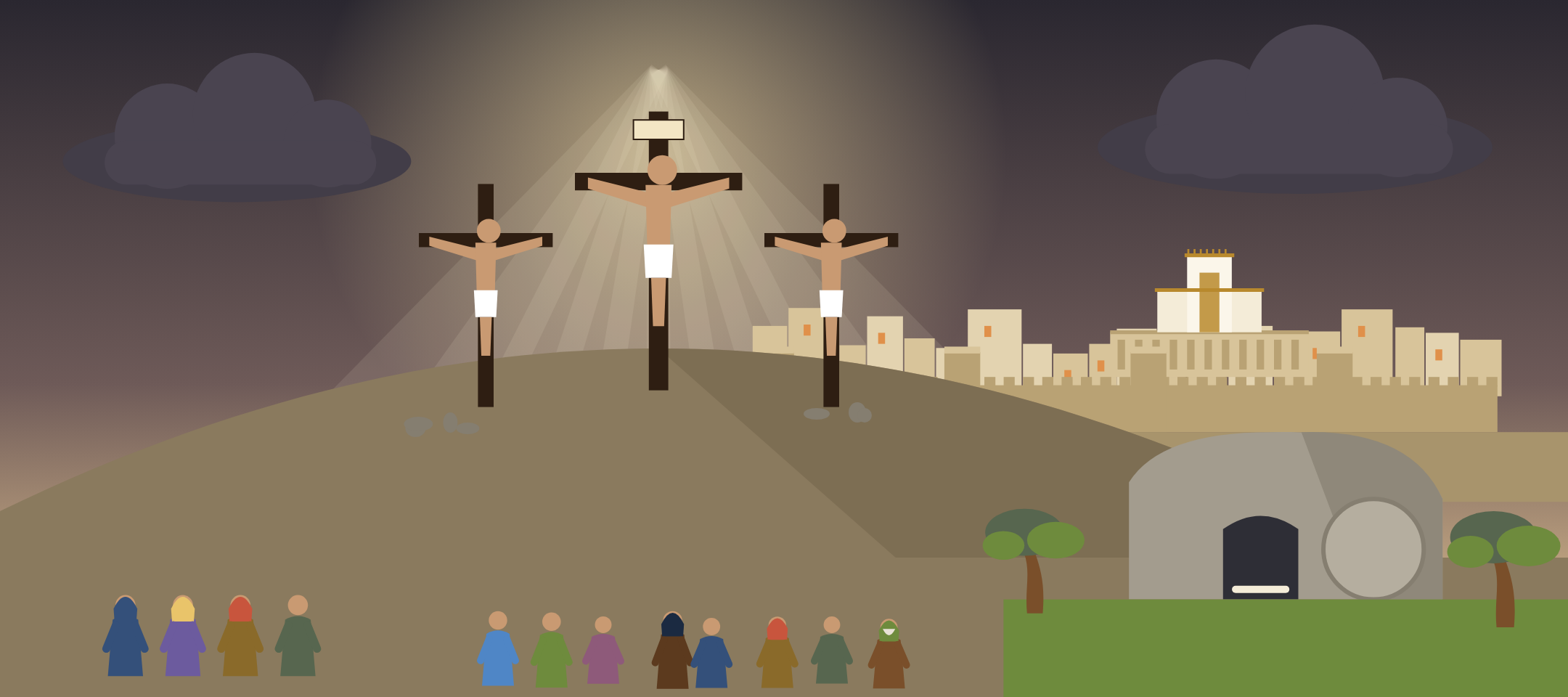
The four Gospels give about a third of their pages to the last week of Jesus’ life. When Paul summed up the gospel, he put it first: “Christ died for our sins according to the scriptures; And that He was buried, and that He rose again the third day according to the scriptures” (1 Corinthians 15:3–4). The creeds Christians have confessed for centuries say the same: He “suffered under Pontius Pilate, was crucified, dead, and buried … the third day He rose again from the dead.”
The cross shows us three things at once. It shows the seriousness of sin, which cost the life of God’s Son. It shows the love of God: “God commendeth His love toward us, in that, while we were yet sinners, Christ died for us” (Romans 5:8). And with the empty tomb it shows the victory of God over death itself. The Roman cross was a symbol of shame; Christians have made it the sign of their hope.
At a Glance
The Cross in Nine Scenes
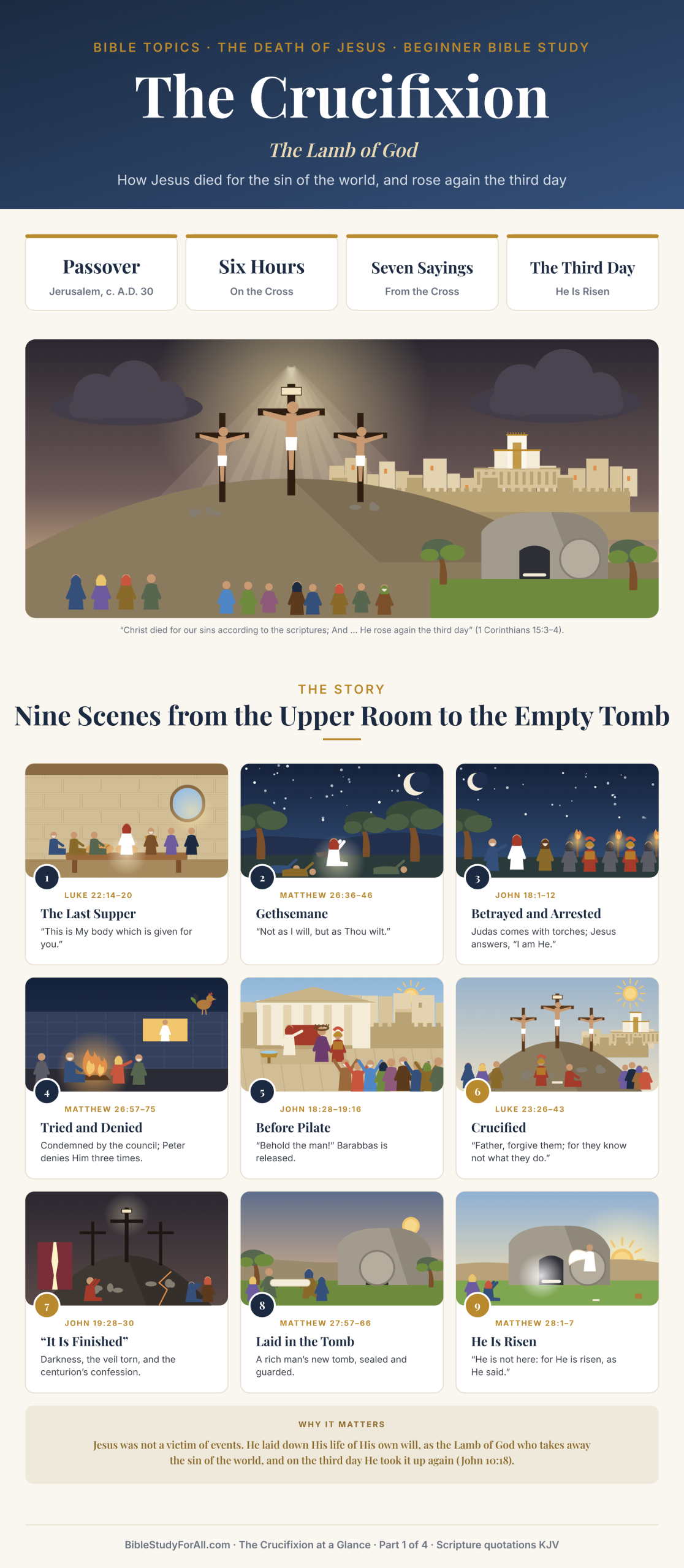
The Gospels tell the story of Jesus’ death in nine scenes: the Last Supper, Gethsemane, the arrest, the trial and Peter’s denial, Pilate, the crucifixion, His death, the burial, and the empty tomb. Select a scene to jump straight to it.
Scene 1 · Luke 22:7–23
At the Passover meal Jesus gives the bread and the cup, and speaks of His death.
Scene 2 · Matthew 26:36–46
Jesus prays in agony among the olive trees while His disciples sleep.
Scene 3 · John 18:1–12
Judas comes with soldiers and torches; Jesus steps forward and is taken.
Scene 4 · Matthew 26:57–75
The council condemns Jesus while Peter, by the fire, denies Him three times.
Scene 5 · John 18:28–19:16
Pilate finds no fault in Him, yet releases Barabbas and hands Jesus over.
Scene 6 · Luke 23:26–43
Nailed to the cross between two thieves, Jesus prays for those who crucify Him.
Scene 7 · Matthew 27:45–56
Darkness falls, Jesus gives up His spirit, the veil is torn, and the centurion believes.
Scene 8 · Matthew 27:57–66
Joseph of Arimathæa buries Jesus in a new tomb; the stone is sealed and guarded.
Scene 9 · Matthew 28:1–10
At dawn the stone is rolled away, the tomb is empty, and the women meet the risen Lord.
The nine scenes in one illustrated graphic. Save or print it to keep beside your Bible.
Before You Begin
Three Habits for This Study
You don’t need any background to follow along. These habits will help you take in the most important events in the Bible.
Read it slowly
Choose one Gospel and read its account in one sitting, such as Mark 14–16. It takes about twenty minutes.
Compare the four
Each Gospel adds details the others leave out. Together they give the seven sayings from the cross and the full picture.
Make it personal
Paul wrote of “the Son of God, who loved me, and gave Himself for me” (Galatians 2:20). Read the story as one that includes you.
Scene 1 of 9 · Luke 22:7–23; Matthew 26:17–30
The Last Supper
When: Thursday evening, Passover, c. A.D. 30
“This is My body which is given for you: this do in remembrance of Me.”Luke 22:19 (KJV) · Read Luke 22:7–23
What happens
On the night of the Passover, Jesus gathered the twelve in an upper room in Jerusalem. “With desire I have desired to eat this passover with you before I suffer,” He told them (Luke 22:15). The meal remembered how God had rescued Israel from Egypt, when the blood of a lamb on each door made judgment pass over.
During the meal Jesus did something new. “And He took bread, and gave thanks, and brake it, and gave unto them, saying, This is My body which is given for you: this do in remembrance of Me. Likewise also the cup after supper, saying, This cup is the new testament in My blood, which is shed for you” (Luke 22:19–20). He told them plainly that one of them would betray Him, and that Peter would deny Him three times before the cock crowed (Luke 22:21, 34).
Look closer
John tells us what was in Jesus’ heart that night: “having loved His own which were in the world, He loved them unto the end” (John 13:1). He washed their feet, and gave them “a new commandment … That ye love one another; as I have loved you” (John 13:34).
Christians have kept this meal ever since, as the Lord’s Supper, Communion or the Eucharist. Traditions explain how Christ is present in it differently, but all receive it as Jesus commanded, and “as often as ye eat this bread, and drink this cup, ye do shew the Lord’s death till He come” (1 Corinthians 11:26). For the days before this night, see our Jesus’ Ministry study.
Think about it
Jesus gave His disciples a meal to remember Him by. Why do you think He chose bread and a cup, things used every day?
Scene 2 of 9 · Matthew 26:36–46; Luke 22:39–46
The Garden of Gethsemane
When: Late Thursday night
“O My Father, if it be possible, let this cup pass from Me: nevertheless not as I will, but as Thou wilt.”Matthew 26:39 (KJV) · Read Matthew 26:36–46
What happens
After the meal they sang a hymn and walked out across the Kidron Valley to a garden of olive trees on the Mount of Olives called Gethsemane. Jesus took Peter, James and John further in and said, “My soul is exceeding sorrowful, even unto death: tarry ye here, and watch with Me” (Matthew 26:38).
He went a little further, fell on His face and prayed. Three times He asked the Father to take the cup of suffering away, and three times He yielded to the Father’s will. “And being in an agony He prayed more earnestly: and His sweat was as it were great drops of blood falling down to the ground” (Luke 22:44). An angel came to strengthen Him (Luke 22:43). Each time He returned, He found the disciples asleep. “What, could ye not watch with Me one hour?” He asked Peter. “Watch and pray, that ye enter not into temptation: the spirit indeed is willing, but the flesh is weak” (Matthew 26:40–41).
Look closer
The “cup” is an Old Testament picture of God’s judgment against sin (Isaiah 51:17; Jeremiah 25:15). Jesus was not afraid only of pain; He was about to bear the judgment that sin deserves. His prayer shows that He was truly human, and that He chose the cross freely.
“Gethsemane” means “oil press.” Olives were crushed there to make oil. On this night the Son of God was pressed under the weight of what lay ahead, and He still said, “Thy will be done” (Matthew 26:42).
Think about it
Jesus brought His honest feelings to the Father and still chose His will. What would it look like for you to pray “not as I will, but as Thou wilt” about something you face?
Scene 3 of 9 · John 18:1–12; Matthew 26:47–56
Betrayed and Arrested
When: Around midnight
“As soon then as He had said unto them, I am He, they went backward, and fell to the ground.”John 18:6 (KJV) · Read John 18:1–12
What happens
While Jesus was still speaking, Judas arrived with a band of soldiers and officers from the chief priests, “with lanterns and torches and weapons” (John 18:3). He had agreed to a signal: “Whomsoever I shall kiss, that same is He: hold Him fast” (Matthew 26:48). He came to Jesus, said, “Hail, master,” and kissed Him. “Judas, betrayest thou the Son of man with a kiss?” Jesus asked (Luke 22:48).
Jesus did not hide. He stepped forward and asked, “Whom seek ye?” They said, “Jesus of Nazareth.” When He answered, “I am He,” they drew back and fell to the ground (John 18:4–6). Peter drew a sword and cut off the right ear of Malchus, the high priest’s servant. Jesus told him to put it away, touched the ear and healed it (John 18:10–11; Luke 22:51). “Thinkest thou that I cannot now pray to My Father, and He shall presently give Me more than twelve legions of angels?” (Matthew 26:53). Then “all the disciples forsook Him, and fled” (Matthew 26:56).
Look closer
Judas had been paid thirty pieces of silver (Matthew 26:15), the price of a slave (Exodus 21:32). Later, full of remorse, he threw the money down in the temple and took his own life (Matthew 27:3–5).
The arrest shows who was in control. Armed men fell back at His word, and Jesus could have called on angels. He went with them because He had chosen to: “No man taketh it from Me, but I lay it down of Myself” (John 10:18). Even in that moment He healed an enemy and protected His friends: “let these go their way” (John 18:8).
Think about it
Jesus healed the ear of a man who came to arrest Him. Is there someone who has opposed you whom you could treat with that kind of mercy?
Scene 4 of 9 · Matthew 26:57–75; Luke 22:54–71
Before the Council; Peter’s Denial
When: Through the night to daybreak
“And the Lord turned, and looked upon Peter. And Peter remembered the word of the Lord.”Luke 22:61 (KJV) · Read Matthew 26:57–75
What happens
Jesus was taken first to Annas, then to the high priest Caiaphas, where the council had gathered. Many false witnesses spoke, but their stories did not agree. Jesus said nothing. Then the high priest demanded, “I adjure Thee by the living God, that Thou tell us whether Thou be the Christ, the Son of God.” Jesus answered, “Thou hast said: nevertheless I say unto you, Hereafter shall ye see the Son of man sitting on the right hand of power, and coming in the clouds of heaven” (Matthew 26:63–64). The high priest tore his clothes and cried blasphemy, and they answered, “He is guilty of death” (Matthew 26:66). They spat on Him and struck Him.
Outside in the courtyard, Peter warmed himself by a fire. A servant girl said, “Thou also wast with Jesus of Galilee.” Three times Peter denied it, the last time with curses: “I know not the man. And immediately the cock crew” (Matthew 26:69–74). At that moment, Luke says, the Lord turned and looked at Peter, and Peter “went out, and wept bitterly” (Luke 22:61–62).
Look closer
Jesus’ answer joined two great Old Testament pictures: the King at God’s right hand (Psalm 110:1) and the Son of man coming with the clouds (Daniel 7:13). The council understood exactly what He claimed. He was condemned not for anything He had done, but for who He said He was.
Peter’s story does not end in the courtyard. After the resurrection the angel said, “tell His disciples and Peter” (Mark 16:7), and Jesus restored him by another fire, asking three times, “lovest thou Me?” (John 21:15–17). Failure is not the end for those who return to Jesus.
Think about it
Peter failed badly, and Jesus restored him. Where do you need to hear that your failures do not have the last word?
Scene 5 of 9 · John 18:28–19:16; Luke 23:1–25
Before Pilate
When: Friday morning
“Then came Jesus forth, wearing the crown of thorns, and the purple robe. And Pilate saith unto them, Behold the man!”John 19:5 (KJV) · Read John 18:28–19:16
What happens
At daybreak the council led Jesus to Pontius Pilate, the Roman governor, because only Rome could carry out an execution. Pilate asked, “Art Thou the King of the Jews?” Jesus answered, “My kingdom is not of this world” (John 18:33, 36). Pilate went out and said, “I find in Him no fault at all” (John 18:38). He sent Jesus to Herod, who mocked Him and sent Him back (Luke 23:7–11).
It was the custom to release one prisoner at the feast. Pilate offered Jesus, but the crowd, stirred up by the chief priests, demanded Barabbas, a man jailed for rebellion and murder. “What shall I do then with Jesus which is called Christ? They all say unto him, Let Him be crucified” (Matthew 27:22). Pilate had Him scourged, and the soldiers put a crown of thorns on His head and a purple robe on Him, mocking, “Hail, King of the Jews!” (John 19:1–3). Pilate brought Him out: “Behold the man!” (John 19:5). Then he washed his hands before the crowd, released Barabbas, and delivered Jesus to be crucified (Matthew 27:24–26).
Look closer
Barabbas, guilty, went free; Jesus, innocent, took His place. It is a living picture of what the cross means: “the just for the unjust, that He might bring us to God” (1 Peter 3:18).
Pilate, his wife (Matthew 27:19), Herod, and later the centurion and one of the thieves all say the same thing: this man has done nothing wrong. The Gospels make sure we know Jesus died innocent. Pilate thought he held the power, but Jesus told him, “Thou couldest have no power at all against Me, except it were given thee from above” (John 19:11).
Think about it
Pilate tried to wash his hands of Jesus. Why is it impossible to stay neutral about who Jesus is?
Scene 6 of 9 · Luke 23:26–43; John 19:17–27
Crucified at Calvary
When: The third hour (about 9 a.m.)
“Then said Jesus, Father, forgive them; for they know not what they do.”Luke 23:34 (KJV) · Read Luke 23:26–43
What happens
Jesus went out carrying His cross, and the soldiers made Simon of Cyrene, who was coming in from the country, carry it behind Him (Luke 23:26). Women followed, weeping. “And when they were come to the place, which is called Calvary, there they crucified Him, and the malefactors, one on the right hand, and the other on the left. Then said Jesus, Father, forgive them; for they know not what they do. And they parted His raiment, and cast lots” (Luke 23:33–34).
Pilate fixed a sign above Him in Hebrew, Greek and Latin: “JESUS OF NAZARETH THE KING OF THE JEWS” (John 19:19–20). The rulers mocked, “He saved others; Himself He cannot save” (Matthew 27:42). One of the thieves joined in, but the other rebuked him and said, “Lord, remember me when Thou comest into Thy kingdom.” Jesus answered, “Verily I say unto thee, To day shalt thou be with Me in paradise” (Luke 23:42–43). Seeing His mother standing near with John, He gave them to each other: “Woman, behold thy son! … Behold thy mother!” (John 19:26–27).
Look closer
Crucifixion was Rome’s cruellest and most shameful death, kept for slaves and rebels. The Gospel writers describe it in few words; they do not dwell on the pain but on what Jesus said and did. Hebrews says He “endured the cross, despising the shame” (Hebrews 12:2).
The mockers were right without knowing it: He could not save Himself and save us. He stayed on the cross so that others could be saved. The thief had no time to earn anything, yet he was promised paradise that day, a picture of salvation as a gift received by faith.
Think about it
The thief asked only, “Lord, remember me.” What does his story tell you about how God welcomes people?
Scene 7 of 9 · Matthew 27:45–56; John 19:28–37
“It Is Finished”
When: The sixth to the ninth hour (noon to 3 p.m.)
“When Jesus therefore had received the vinegar, He said, It is finished: and He bowed His head, and gave up the ghost.”John 19:30 (KJV) · Read Matthew 27:45–56
What happens
“Now from the sixth hour there was darkness over all the land unto the ninth hour. And about the ninth hour Jesus cried with a loud voice, saying, Eli, Eli, lama sabachthani? that is to say, My God, My God, why hast Thou forsaken Me?” (Matthew 27:45–46). Knowing that all was now accomplished, He said, “I thirst,” and was given vinegar on a sponge (John 19:28–29). Then He said, “It is finished,” and with a loud voice, “Father, into Thy hands I commend My spirit” (John 19:30; Luke 23:46).
At that moment “the veil of the temple was rent in twain from the top to the bottom; and the earth did quake, and the rocks rent” (Matthew 27:51). The Roman centurion who had watched it all said, “Truly this was the Son of God” (Matthew 27:54). To be sure He was dead, a soldier pierced His side with a spear, “and forthwith came there out blood and water” (John 19:34). They did not break His legs, so that the scripture was fulfilled: “A bone of Him shall not be broken” (John 19:36).
Look closer
“My God, My God, why hast Thou forsaken Me?” are the opening words of Psalm 22, which goes on to describe pierced hands and feet and garments divided by lot, and ends in triumph. On the cross Jesus bore the sin of the world, and with it the separation from God that sin brings (2 Corinthians 5:21).
“It is finished” is one word in Greek, tetelestai. It was the cry of someone who had completed a task: the debt paid, the work done. The torn veil, which had closed off the Most Holy Place, now showed that the way to God was open to all “by the blood of Jesus” (Hebrews 10:19–20).
Think about it
Jesus said, “It is finished.” Is there anything you are still trying to add to what He has done to make yourself right with God?
Scene 8 of 9 · Matthew 27:57–66; John 19:38–42
Laid in the Tomb
When: Friday before sunset, and the sabbath
“And laid it in his own new tomb, which he had hewn out in the rock: and he rolled a great stone to the door of the sepulchre, and departed.”Matthew 27:60 (KJV) · Read Matthew 27:57–66
What happens
The sabbath began at sunset, so there was little time. Joseph of Arimathæa, a rich man and a secret disciple who sat on the council, went boldly to Pilate and asked for the body of Jesus (Matthew 27:57–58; Mark 15:43). Nicodemus, who had first come to Jesus by night, brought about a hundred pounds of myrrh and aloes. Together they wrapped the body in linen with the spices and laid it in Joseph’s new tomb, cut in the rock in a garden near the place of crucifixion (John 19:38–42).
The women from Galilee watched where He was laid, then went home to prepare spices, and “rested the sabbath day according to the commandment” (Luke 23:55–56). The next day the chief priests remembered that Jesus had said, “After three days I will rise again,” and asked Pilate to make the tomb secure. So they went “and made the sepulchre sure, sealing the stone, and setting a watch” (Matthew 27:63–66).
Look closer
Isaiah had written that the Servant would make “His grave with the wicked, and with the rich in His death” (Isaiah 53:9). He died between criminals and was buried by a rich man.
The burial matters. It shows Jesus truly died; Paul puts it in the heart of the gospel: “Christ died for our sins … And that He was buried, and that He rose again the third day” (1 Corinthians 15:3–4). And the seal and the guard, set up to stop a resurrection, became witnesses that the tomb was empty by no human hand.
Think about it
Joseph and Nicodemus, once secret followers, stepped out publicly at the darkest moment. What would it take for you to be open about following Jesus?
Scene 9 of 9 · Matthew 28:1–10; Luke 24:1–12
He Is Risen
When: Sunday at dawn, the first day of the week
“He is not here: for He is risen, as He said. Come, see the place where the Lord lay.”Matthew 28:6 (KJV) · Read Matthew 28:1–10
What happens
“In the end of the sabbath, as it began to dawn toward the first day of the week, came Mary Magdalene and the other Mary to see the sepulchre” (Matthew 28:1). There was a great earthquake; an angel of the Lord rolled back the stone and sat on it, and the guards shook with fear. The angel said to the women, “Fear not ye: for I know that ye seek Jesus, which was crucified. He is not here: for He is risen, as He said” (Matthew 28:5–6).
They ran “with fear and great joy” to tell the disciples, and on the way Jesus Himself met them: “All hail.” They took hold of His feet and worshipped Him (Matthew 28:8–9). Over the next forty days He appeared to Peter, to the twelve, to two disciples on the road to Emmaus, and to more than five hundred at once (1 Corinthians 15:5–6). He showed them His hands and His side: “Behold My hands and My feet, that it is I Myself” (Luke 24:39).
Look closer
The cross and the empty tomb belong together. Jesus had foretold both, again and again: He “must go unto Jerusalem, and suffer many things … and be killed, and be raised again the third day” (Matthew 16:21). The resurrection is God’s verdict on the cross: Jesus “was delivered for our offences, and was raised again for our justification” (Romans 4:25).
Paul says everything rests on it: “if Christ be not raised, your faith is vain; ye are yet in your sins … But now is Christ risen from the dead” (1 Corinthians 15:17, 20). For what happened next, the ascension and Pentecost, see The Church Is Created.
Think about it
The first witnesses of the resurrection ran “with fear and great joy.” What does the empty tomb mean for the things you fear most?
Thursday Evening to Sunday Dawn
The Final Hours
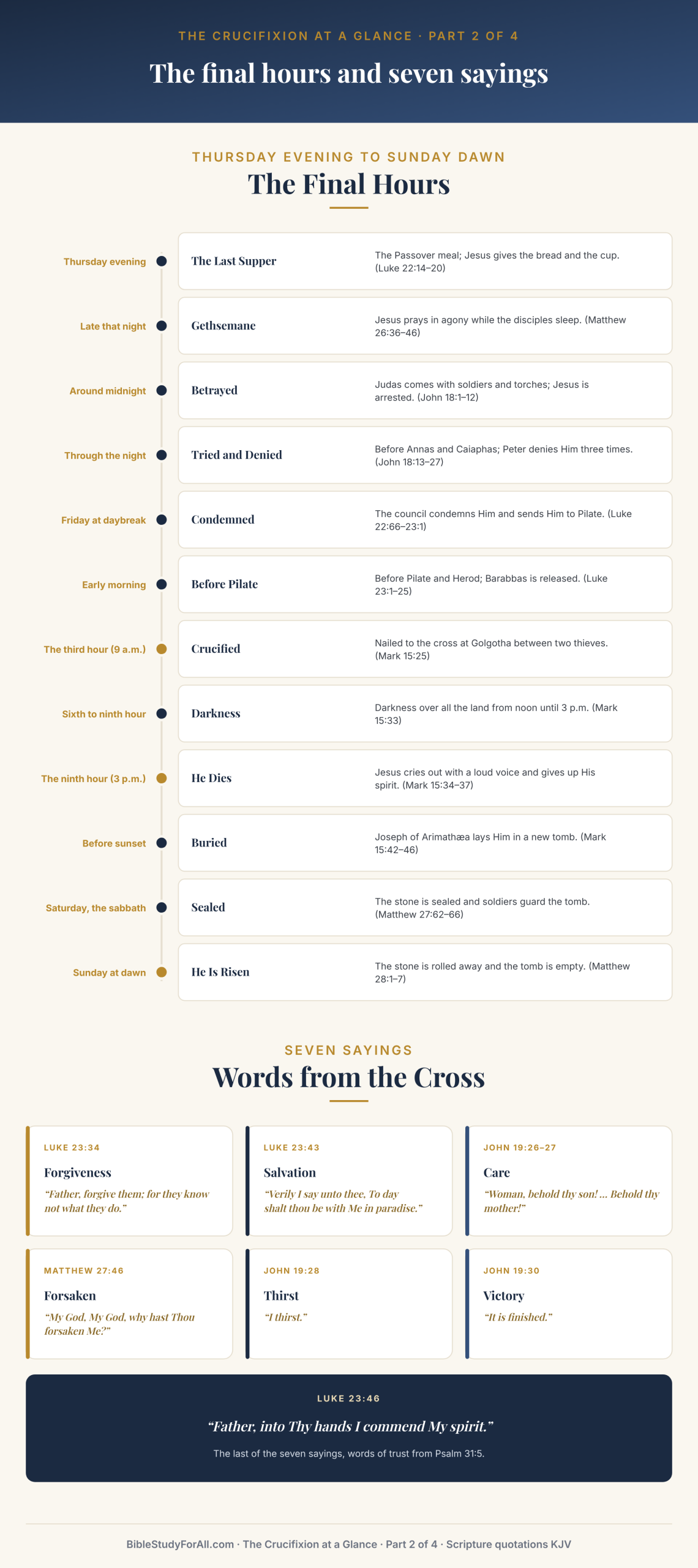
Putting the four Gospels together, the events unfold like this. Times follow the traditional reckoning (for other views of the day, see Questions Christians Discuss). Mark counts hours from sunrise, so “the third hour” is about 9 a.m.
| When | What happened | Read |
|---|---|---|
| Thursday evening | The Last Supper. The Passover meal; Jesus gives the bread and the cup. | Luke 22:14–20 |
| Late that night | Gethsemane. Jesus prays in agony while the disciples sleep. | Matthew 26:36–46 |
| Around midnight | Betrayed. Judas comes with soldiers and torches; Jesus is arrested. | John 18:1–12 |
| Through the night | Tried and Denied. Before Annas and Caiaphas; Peter denies Him three times. | John 18:13–27 |
| Friday at daybreak | Condemned. The council condemns Him and sends Him to Pilate. | Luke 22:66–23:1 |
| Early morning | Before Pilate. Before Pilate and Herod; Barabbas is released. | Luke 23:1–25 |
| The third hour (9 a.m.) | Crucified. Nailed to the cross at Golgotha between two thieves. | Mark 15:25 |
| Sixth to ninth hour | Darkness. Darkness over all the land from noon until 3 p.m. | Mark 15:33 |
| The ninth hour (3 p.m.) | He Dies. Jesus cries out with a loud voice and gives up His spirit. | Mark 15:34–37 |
| Before sunset | Buried. Joseph of Arimathæa lays Him in a new tomb. | Mark 15:42–46 |
| Saturday, the sabbath | Sealed. The stone is sealed and soldiers guard the tomb. | Matthew 27:62–66 |
| Sunday at dawn | He Is Risen. The stone is rolled away and the tomb is empty. | Matthew 28:1–7 |
Seven Sayings
Words from the Cross
The four Gospels record seven things Jesus said from the cross. Read in the traditional order, they move from forgiveness for others to trust in the Father.
2 · Luke 23:43
Salvation
“Verily I say unto thee, To day shalt thou be with Me in paradise.”
Psalm 22 · Psalm 31
Two of the sayings quote the Psalms: “My God, My God, why hast Thou forsaken Me?” (Psalm 22:1) and “Into Thine hand I commit My spirit” (Psalm 31:5). Even in death, Jesus prayed the Scriptures.
The final hours and the seven sayings in one illustrated graphic.
Foretold Long Before
Prophecies Fulfilled at the Cross
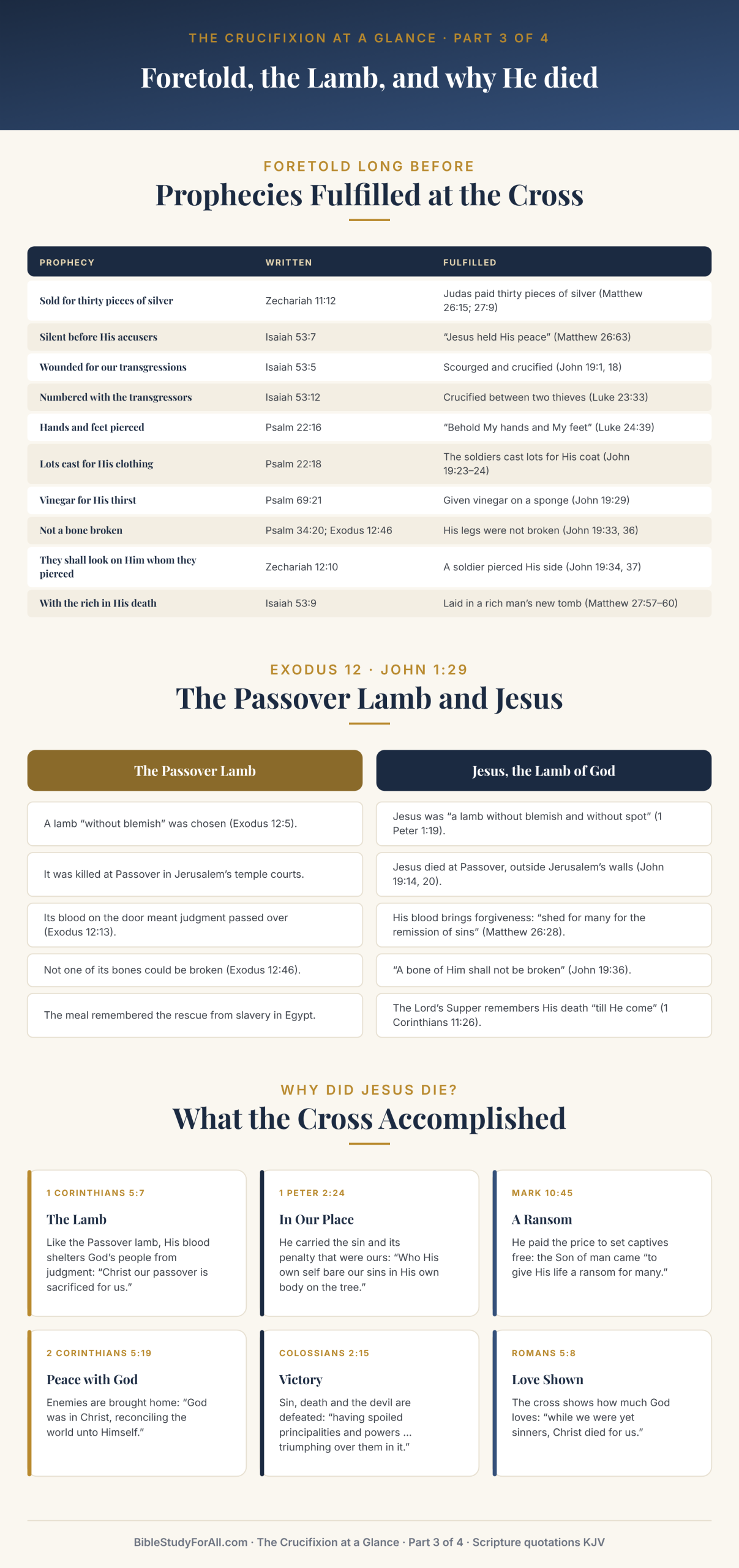
After His resurrection Jesus showed His disciples that the Scriptures had spoken of His suffering all along: “Ought not Christ to have suffered these things, and to enter into His glory?” (Luke 24:26). Here are ten of the prophecies the Gospel writers saw fulfilled.
| Prophecy | Written | Fulfilled |
|---|---|---|
| Sold for thirty pieces of silver | Zechariah 11:12 | Judas paid thirty pieces of silver (Matthew 26:15) |
| Silent before His accusers | Isaiah 53:7 | “Jesus held His peace” (Matthew 26:63) |
| Wounded for our transgressions | Isaiah 53:5 | Scourged and crucified (John 19:1, 18) |
| Numbered with the transgressors | Isaiah 53:12 | Crucified between two thieves (Luke 23:33) |
| Hands and feet pierced | Psalm 22:16 | “Behold My hands and My feet” (Luke 24:39) |
| Lots cast for His clothing | Psalm 22:18 | The soldiers cast lots for His coat (John 19:23–24) |
| Vinegar for His thirst | Psalm 69:21 | Given vinegar on a sponge (John 19:29) |
| Not a bone broken | Psalm 34:20; Exodus 12:46 | His legs were not broken (John 19:33, 36) |
| They shall look on Him whom they pierced | Zechariah 12:10 | A soldier pierced His side (John 19:34, 37) |
| With the rich in His death | Isaiah 53:9 | Laid in a rich man’s new tomb (Matthew 27:57–60) |
Isaiah 53
About seven hundred years before the cross, Isaiah described a Servant of the LORD who would suffer for others: “Surely He hath borne our griefs, and carried our sorrows … He was wounded for our transgressions, He was bruised for our iniquities … and the LORD hath laid on Him the iniquity of us all” (Isaiah 53:4–6). When an Ethiopian official asked Philip who the prophet was speaking of, Philip “began at the same scripture, and preached unto him Jesus” (Acts 8:35).
Exodus 12 · John 1:29
The Passover Lamb and Jesus
Jesus died at Passover, the feast that remembered Israel’s rescue from Egypt (see our Exodus study). John the Baptist had called Him “the Lamb of God,” and Paul wrote, “Christ our passover is sacrificed for us” (1 Corinthians 5:7).
| The Passover lamb | Jesus, the Lamb of God |
|---|---|
| A lamb “without blemish” was chosen (Exodus 12:5). | Jesus was “a lamb without blemish and without spot” (1 Peter 1:19). |
| It was killed at Passover in Jerusalem’s temple courts. | Jesus died at Passover, outside Jerusalem’s walls (John 19:14, 20). |
| Its blood on the door meant judgment passed over (Exodus 12:13). | His blood brings forgiveness: “shed for many for the remission of sins” (Matthew 26:28). |
| Not one of its bones could be broken (Exodus 12:46). | “A bone of Him shall not be broken” (John 19:36). |
| The meal remembered the rescue from slavery in Egypt. | The Lord’s Supper remembers His death “till He come” (1 Corinthians 11:26). |
Why Did Jesus Die?
What the Cross Accomplished
The New Testament uses many pictures to explain the cross. Each one shows a different side of the same great work.
1 Corinthians 5:7; John 1:29
The Lamb
Like the Passover lamb, His blood shelters God’s people from judgment: “Christ our passover is sacrificed for us.”
1 Peter 2:24; Isaiah 53:5–6
In Our Place
He carried the sin and its penalty that were ours: “Who His own self bare our sins in His own body on the tree.”
Mark 10:45
A Ransom
He paid the price to set captives free: the Son of man came “to give His life a ransom for many.”
2 Corinthians 5:19; Romans 5:10
Peace with God
Enemies are brought home: “God was in Christ, reconciling the world unto Himself.”
Colossians 2:15; Hebrews 2:14
Victory
Sin, death and the devil are defeated: “having spoiled principalities and powers … triumphing over them in it.”
Romans 5:8; John 15:13
Love Shown
The cross shows how much God loves: “while we were yet sinners, Christ died for us.”
How Christians explain it
Christian traditions put the weight on different pictures. Many Protestants emphasize substitution: Christ bore the penalty of sin in our place (Isaiah 53:5–6). Others, including many Orthodox Christians, emphasize victory: Christ defeated sin, death and the devil (Hebrews 2:14). Others stress the cross as the supreme example of love that draws us to God (1 John 4:10). Most teachers hold these together, as the Bible does. All agree that Jesus died “for our sins” (1 Corinthians 15:3) and that salvation comes by grace through faith in Him (Ephesians 2:8).
The prophecies, the Passover lamb and what the cross accomplished in one illustrated graphic.
Matthew 12:40 · Mark 15:42 · John 19:31
Questions Christians Discuss
The Gospels agree on what happened. On a few details of when and where, Bible-believing Christians come to different conclusions. This page does not take sides; here is what each view says.
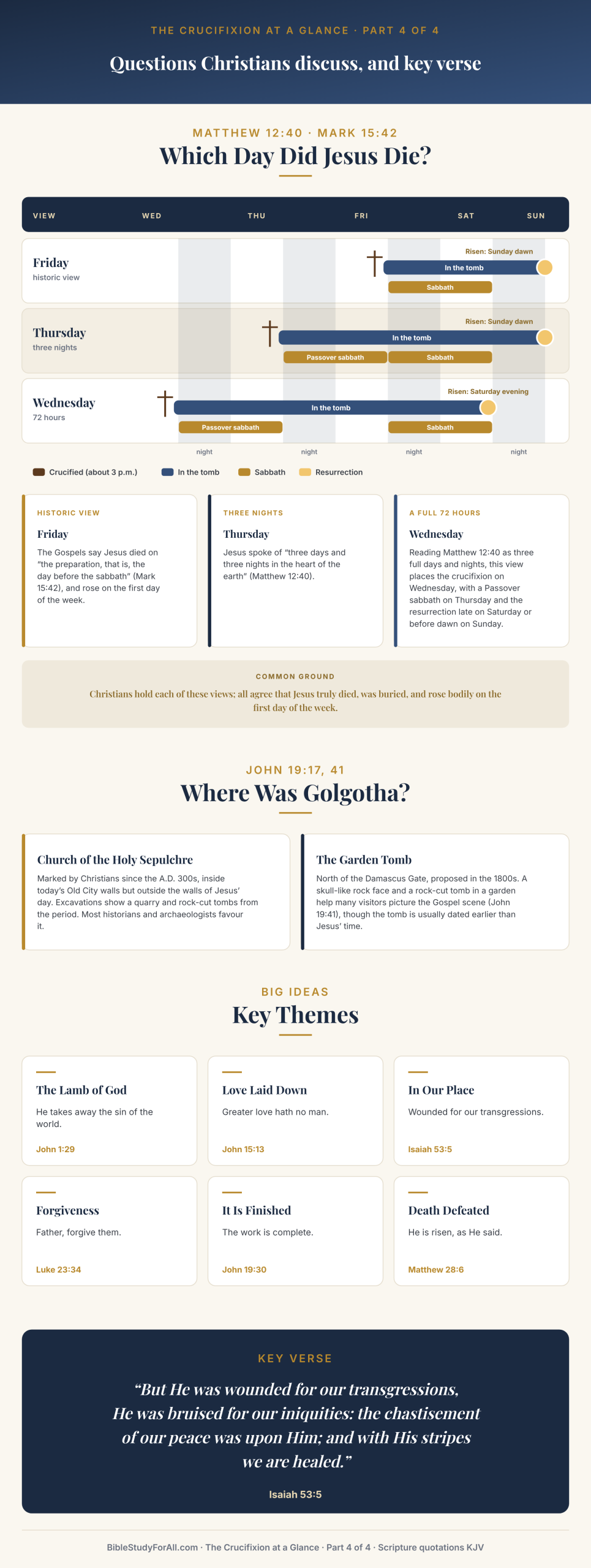
Which Day Did Jesus Die?
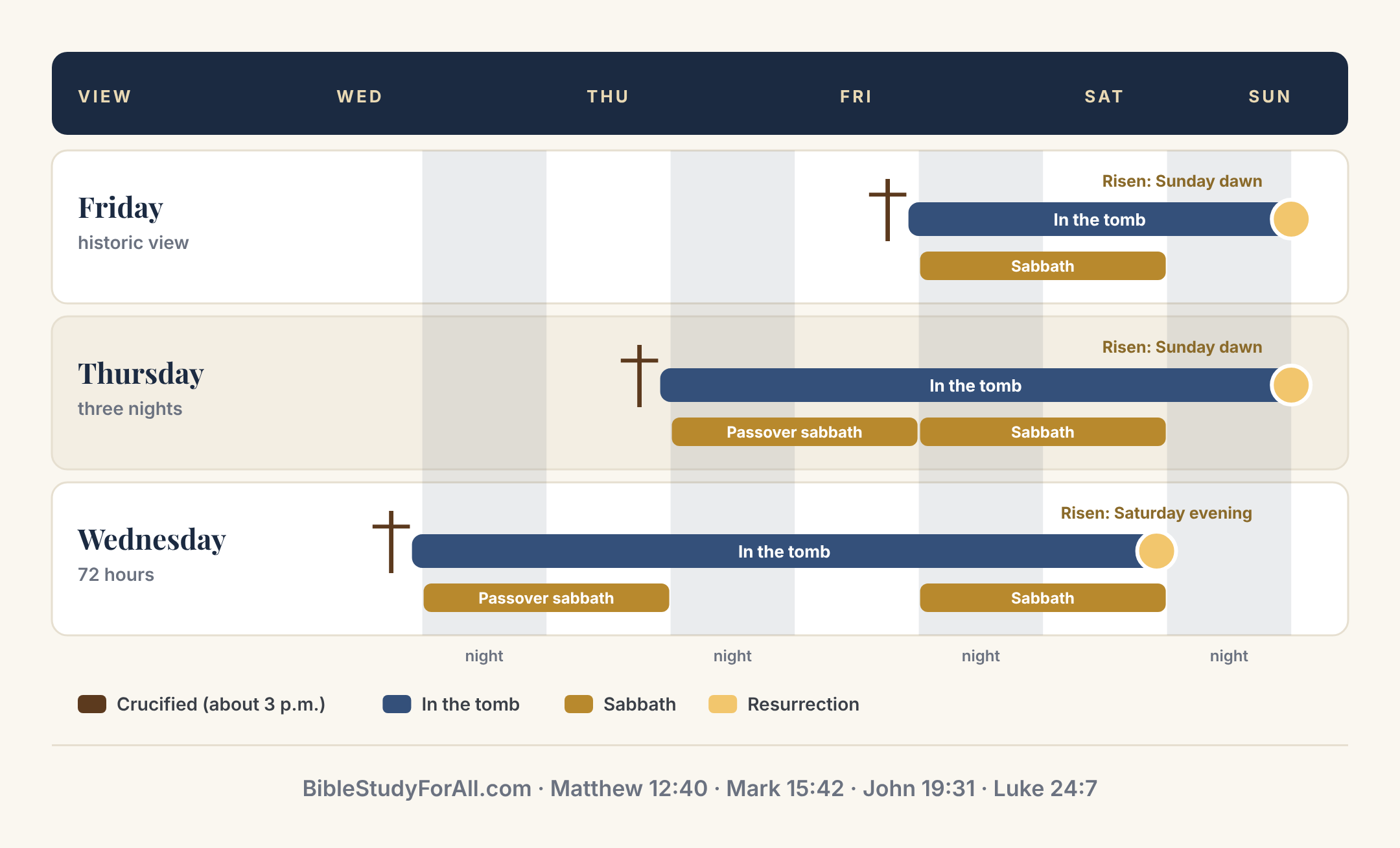
| View | What it teaches |
|---|---|
| Friday | The historic and most widely held view. The Gospels say Jesus died on “the preparation, that is, the day before the sabbath” (Mark 15:42), and rose on the first day of the week. Counting parts of days as days, as Jews commonly did, Friday, Saturday and Sunday make “the third day” (Luke 24:7). |
| Thursday | Held by some to fit “three nights”. Jesus spoke of “three days and three nights in the heart of the earth” (Matthew 12:40). A Thursday crucifixion gives three nights (Thursday, Friday, Saturday) and can allow a special Passover sabbath before the weekly sabbath (John 19:31 calls it “an high day”). |
| Wednesday | Held by some to give a full 72 hours. Reading Matthew 12:40 as three full days and nights, this view places the crucifixion on Wednesday, with a Passover sabbath on Thursday and the resurrection late on Saturday or before dawn on Sunday. |
Which Year?
Jesus died while Pontius Pilate governed Judæa (A.D. 26–36) and Caiaphas was high priest. Most scholars date the crucifixion to A.D. 30 or A.D. 33, the years in that span when Passover fits the Gospel accounts. The choice depends partly on when Jesus’ ministry began (Luke 3:1). This site uses c. A.D. 30, the date also used in our Jesus’ Ministry study; A.D. 33 is held by many as well.
Where Was Golgotha?
Church of the Holy Sepulchre
Marked by Christians since the A.D. 300s, inside today’s Old City walls but outside the walls of Jesus’ day. Excavations show a quarry and rock-cut tombs from the period. Most historians and archaeologists favour it.
The Garden Tomb
North of the Damascus Gate, proposed in the 1800s. A skull-like rock face and a rock-cut tomb in a garden help many visitors picture the Gospel scene (John 19:41), though the tomb is usually dated earlier than Jesus’ time.
Common ground
These questions are worth studying, and they do not change the heart of the story. Every one of these views confesses that Jesus truly died outside Jerusalem at Passover, was buried in a rock tomb in a garden, and rose bodily on the first day of the week. John wrote so “that ye might believe” (John 19:35).
Living by the Cross
How Should We Respond?
The cross is not only something to understand. Jesus and the apostles call everyone who hears it to respond.
John 3:16
Come to the cross
Turn from sin and trust Christ, who died for you. “Whosoever believeth in Him should not perish” (John 3:16).
Luke 22:19; 1 Corinthians 11:26
Remember His death
Jesus gave the bread and the cup “in remembrance of Me.” Every Lord’s Supper proclaims His death.
Luke 9:23
Take up your cross
Following Jesus means daily saying no to self and yes to Him (Luke 9:23).
Luke 23:34; Ephesians 4:32
Forgive as He forgave
Jesus prayed for those who crucified Him. We forgive because we have been forgiven (Ephesians 4:32).
Galatians 6:14
Glory in the cross
Paul boasted in nothing “save in the cross of our Lord Jesus Christ” (Galatians 6:14).
Galatians 2:20
Live in His love
“I am crucified with Christ: nevertheless I live; yet not I, but Christ liveth in me” (Galatians 2:20).
Big Ideas
Six Themes of the Cross
The Lamb of God
He takes away the sin of the world (John 1:29).
Love laid down
Greater love has no one than this (John 15:13).
In our place
He was wounded for our transgressions (Isaiah 53:5).
Forgiveness
“Father, forgive them” (Luke 23:34).
It is finished
His work of salvation is complete (John 19:30).
Death defeated
“He is risen, as He said” (Matthew 28:6).
Questions Christians discuss, the themes and the key verse in one illustrated graphic.
Verses to Remember
Key Verses about the Cross
Along with the verses in each scene above, these are worth reading slowly, and memorizing.
Isaiah 53:5
“But He was wounded for our transgressions, He was bruised for our iniquities: the chastisement of our peace was upon Him; and with His stripes we are healed.”
John 3:16
“For God so loved the world, that He gave His only begotten Son, that whosoever believeth in Him should not perish, but have everlasting life.”
Mark 10:45
“For even the Son of man came not to be ministered unto, but to minister, and to give His life a ransom for many.”
Romans 5:8
“But God commendeth His love toward us, in that, while we were yet sinners, Christ died for us.”
2 Corinthians 5:21
“For He hath made Him to be sin for us, who knew no sin; that we might be made the righteousness of God in Him.”
1 Peter 2:24
“Who His own self bare our sins in His own body on the tree, that we, being dead to sins, should live unto righteousness: by whose stripes ye were healed.”
Galatians 2:20
“I am crucified with Christ: nevertheless I live; yet not I, but Christ liveth in me.”
1 Corinthians 15:3–4
“Christ died for our sins according to the scriptures; And that He was buried, and that He rose again the third day according to the scriptures.”
Summary
Five Things to Remember
1
He chose the cross
Jesus laid down His life of His own will (John 10:18).
2
He died innocent
Pilate found no fault in Him; He died for others (Luke 23:4).
3
He died for sin
The Lamb of God bore our sins in His body (1 Peter 2:24).
4
It is finished
Nothing can be added to what He has done (John 19:30).
5
He rose again
On the third day the tomb was empty (Matthew 28:6).
For Reflection
Questions to Think About
- In Gethsemane Jesus prayed, “not as I will, but as Thou wilt” (Matthew 26:39). What makes that prayer hard to pray?
- Barabbas went free while Jesus died. In what way is Barabbas’ story your story too?
- Of the seven sayings from the cross, which speaks to you most right now, and why?
- Why do you think God tore the temple veil “from the top to the bottom” (Matthew 27:51)?
- Paul said, “God forbid that I should glory, save in the cross” (Galatians 6:14). What would it look like to boast in the cross this week?
Questions
Common Questions about the Crucifixion
Why did Jesus have to die?
The Bible teaches that “the wages of sin is death; but the gift of God is eternal life through Jesus Christ our Lord” (Romans 6:23), and that “without shedding of blood is no remission” (Hebrews 9:22). Jesus, who had no sin, died in the place of sinners so that God could forgive them and remain just (Romans 3:25–26). He said Himself that He came “to give His life a ransom for many” (Mark 10:45).
Who killed Jesus?
Several share the responsibility in the Gospels: Judas betrayed Him, the council condemned Him, the crowd called for His death, and Pilate and the Roman soldiers carried it out (Acts 4:27). The New Testament never blames the Jewish people as a whole; Jesus and all His first followers were Jewish. Christians also confess that Jesus died for their own sins, and that in the end He gave His life freely: “No man taketh it from Me, but I lay it down of Myself” (John 10:18).
Did Jesus really die?
Yes. Roman soldiers were experts in execution and confirmed His death; a spear brought out blood and water (John 19:33–34). The centurion reported to Pilate that He was dead (Mark 15:44–45), and His body was wrapped in about a hundred pounds of spices and sealed in a tomb. The Roman historian Tacitus also records that Christ “suffered the extreme penalty” under Pontius Pilate.
What does “My God, My God, why hast Thou forsaken Me?” mean?
These words begin Psalm 22. On the cross Jesus bore the sin of the world, and with it the separation from God that sin deserves (2 Corinthians 5:21; Isaiah 53:6). By quoting the psalm, He also pointed to the whole of it, which describes the scene at the cross (Psalm 22:16–18) and ends in praise and victory (Psalm 22:27–31).
Where did Jesus go between His death and resurrection?
His body lay in the tomb. Jesus told the thief, “To day shalt Thou be with Me in paradise” (Luke 23:43), and He committed His spirit into the Father’s hands (Luke 23:46). Christians read 1 Peter 3:18–20 and the creed’s phrase “He descended into hell” (or “to the dead”) in different ways: as Jesus truly sharing death, as announcing His victory, or as going to the place of the righteous dead.
Was it three days and three nights?
Jesus said He would be “three days and three nights in the heart of the earth” (Matthew 12:40) and also that He would rise “the third day” (Matthew 16:21). Many understand the first as a Jewish way of counting any part of a day as a day, which fits a Friday crucifixion. Others hold a Thursday or Wednesday crucifixion to fit three full nights. See Questions Christians Discuss.
Why is the day called Good Friday?
Most Christians remember the crucifixion on the Friday before Easter. It is called “good” because of what Jesus’ death accomplished. The darkest day in history became the day salvation was won.
What was the veil of the temple?
A thick curtain separated the Most Holy Place, where God’s presence dwelt, from the rest of the temple. Only the high priest could pass through it, once a year, with blood (Hebrews 9:7). When Jesus died, God tore it “from the top to the bottom” (Mark 15:38). Through Christ, the way into God’s presence is open to everyone who trusts Him (Hebrews 10:19–22).
How do we know the resurrection happened?
The tomb was empty, and even Jesus’ enemies did not deny it; they claimed the body had been stolen (Matthew 28:11–15). Jesus appeared alive to many people over forty days, including more than five hundred at once (1 Corinthians 15:5–8). His frightened disciples became bold witnesses who were willing to die for what they had seen, and the church began in the same city, weeks later (Acts 2).
What does the cross mean for me today?
Jesus’ death opens the way to forgiveness and new life for anyone who turns to Him: “the blood of Jesus Christ His Son cleanseth us from all sin” (1 John 1:7). It also shapes how Christians live: forgiving others, serving, and taking up their cross daily (Luke 9:23). See How Should We Respond? and our Righteousness study.
Keep Reading
Continue Your Journey
Read the account for yourself in one of the Gospels, then follow the story on to the birth of the church.
Scripture quotations are from the King James Version (KJV), which is in the public domain. Verse links open at BibleGateway. Views on the day, year and place of the crucifixion are described as their own teachers describe them; this page does not take a side.