
Key Christian Terms · In Plain Words
Atonement: Made One with God
Atonement means God dealing with our sin through Jesus’ death, so that people separated from him can be made one with him again.
Sin breaks our relationship with God. Atonement is how God mends it. The whole Bible points to the cross as the place where that happens.
“And not only so, but we also joy in God through our Lord Jesus Christ, by whom we have now received the atonement.”
Romans 5:11 (KJV)
In Plain Words
What Does Atonement Mean?
In one sentence
Atonement means God dealing with our sin through Jesus’ death, so that people separated from him can be made one with him again.
The English word is easy to remember: at-one-ment. It means bringing two parties who are apart back together, at one. Sin separates us from a holy God. Atonement is God’s way of removing what stands between us, so we can be reconciled.
In the Old Testament, atonement was made through sacrifices, pointing to something greater. In the New Testament, Jesus is that greater sacrifice: “For Christ also hath once suffered for sins, the just for the unjust, that he might bring us to God” (1 Peter 3:18).
The word itself: The Hebrew kippur, as in Yom Kippur, the Day of Atonement, means to cover or wipe clean. The KJV uses “atonement” once in the New Testament, for the Greek katallagē, reconciliation: “by whom we have now received the atonement” (Romans 5:11).
What the Cross Accomplished
He took our place
Jesus bore the punishment our sins deserved, the righteous for the unrighteous.
He made peace
The broken relationship is mended. God reconciles us to himself through the blood of the cross.
He won the victory
At the cross Jesus defeated sin, death and the powers of evil that held us captive.
An Everyday Picture
Mending What Was Broken
Imagine two close friends whose friendship is broken by a serious wrong. One was hurt, the other is to blame. For the friendship to be mended, the wrong cannot just be ignored. Someone has to pay what it cost, and the guilty one has to come back.
In the gospel, the one who was wronged pays the cost himself. God, in Jesus, takes the hurt and the penalty on himself and then invites us home. “God was in Christ, reconciling the world unto himself, not imputing their trespasses unto them” (2 Corinthians 5:19).
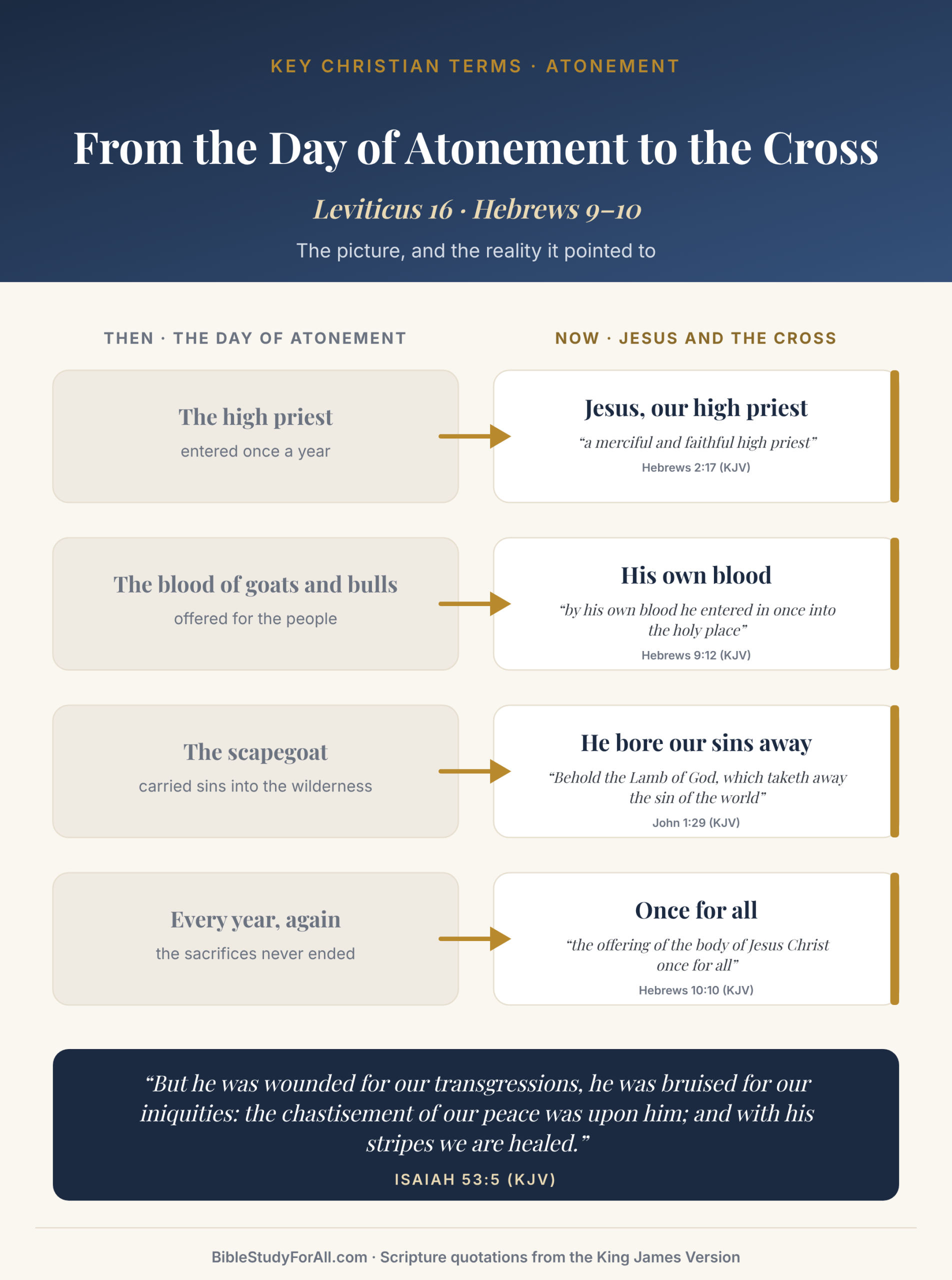
Leviticus 16 · Hebrews 9–10
From the Day of Atonement to the Cross
Once a year, Israel’s high priest made atonement for the people. The book of Hebrews shows how Jesus fulfilled every part of that day.
What the Bible Says
Three Key Verses
Isaiah 53:5
“But he was wounded for our transgressions, he was bruised for our iniquities: the chastisement of our peace was upon him; and with his stripes we are healed.”
In plain words: Centuries before the cross, Isaiah saw that the Messiah would be wounded for our sins.
1 John 2:2
“And he is the propitiation for our sins: and not for ours only, but also for the sins of the whole world.”
In plain words: Jesus’ death fully deals with sin, and it is offered to the whole world.
Hebrews 10:12
“But this man, after he had offered one sacrifice for sins for ever, sat down on the right hand of God.”
In plain words: Jesus’ one sacrifice is enough forever. Nothing more needs to be added.
Clearing It Up
What It Is and What It Isn’t
A common mix-up
“Atonement means God was angry and Jesus calmed him down.”
The Father and the Son act together in love. “God so loved the world, that he gave his only begotten Son” (John 3:16). The cross is God himself paying the price of our sin.
A common mix-up
“We still need to pay for our own sins.”
Jesus “offered one sacrifice for sins for ever” (Hebrews 10:12). We respond with faith, repentance and thankful lives, but we add nothing to the payment.
A common mix-up
“The Old Testament sacrifices took sins away.”
They pointed forward. “It is not possible that the blood of bulls and of goats should take away sins” (Hebrews 10:4). They were pictures of the one true sacrifice to come.
How It Connects
Atonement and the Other Big Words
The Bible’s big words are not separate ideas. They are different angles on one story: what God has done for us in Jesus.
Atonement is the price; redemption is the freedom it buys.
The cross is why God can declare sinners “not guilty.”
God provides the sacrifice himself, out of undeserved love.
Our sin went to Jesus; his righteousness comes to us.
Atonement is the heart of how God saves.
Jesus called it “my blood of the new testament,” the new covenant.
Living It Out
Putting It into Practice
1
Look at the cross often
When guilt weighs on you, read Isaiah 53 or the Gospel accounts of the crucifixion. Remember that the debt is paid.
2
Come close to God
Atonement opens the way. Hebrews says we can draw near “with a true heart in full assurance of faith” (Hebrews 10:22). Pray boldly.
3
Be a peacemaker
God has given us “the ministry of reconciliation” (2 Corinthians 5:18). Seek to mend a broken relationship, and tell others how they can be reconciled to God.
Questions
Quick Questions
What was the Day of Atonement?
Once a year the high priest entered the Most Holy Place with sacrificial blood to make atonement for Israel’s sins. A second goat, the scapegoat, was sent into the wilderness, picturing sins carried away: “the goat shall bear upon him all their iniquities unto a land not inhabited” (Leviticus 16:22). Jewish people still observe the day as Yom Kippur.
Why did there have to be blood?
God taught that “the life of the flesh is in the blood” (Leviticus 17:11), and that sin brings death. Blood showed that a life was given in place of the sinner. Hebrews says, “without shedding of blood is no remission” (Hebrews 9:22). Jesus gave his own life so that we could live.
How do Christians explain the atonement?
The Bible uses several pictures, and Christians have emphasized them differently over the centuries. Many stress substitution: Jesus bore the penalty in our place (Isaiah 53:5). Others stress victory: Jesus defeated sin, death and the devil (Colossians 2:15). Others stress the cross as the supreme example of God’s love that wins our hearts (1 John 4:10). Most Christians see truth in all of these together.
Did Jesus die for everyone?
John writes that Jesus is “the propitiation for our sins: and not for ours only, but also for the sins of the whole world” (1 John 2:2). Christians differ on how to understand the scope and purpose of the atonement, but all agree that the gospel is to be offered freely to everyone and that all who come to Christ are welcomed.
Keep Reading
Continue Your Study
Read the key passages for yourself, then explore the Bible books and topics where atonement comes up most.
Scripture quotations are from the King James Version (KJV), which is in the public domain. Verse links open at BibleGateway.