
Key Christian Terms · In Plain Words
Covenant: God’s Binding Promises
A covenant is a binding agreement. In the Bible, it is God committing himself to his people with solemn promises he will never break.
The Bible’s story is held together by covenants. They show a God who does not just make promises but binds himself to keep them, and they lead step by step to Jesus.
“Know therefore that the LORD thy God, he is God, the faithful God, which keepeth covenant and mercy with them that love him and keep his commandments to a thousand generations.”
Deuteronomy 7:9 (KJV)
In Plain Words
What Does Covenant Mean?
In one sentence
A covenant is a binding agreement. In the Bible, it is God committing himself to his people with solemn promises he will never break.
A covenant is more than a contract. A contract is about goods or services; a covenant is about a relationship. Marriage is the closest picture most of us know: two people bind themselves to each other with solemn promises.
In the Bible, God makes covenants with people, choosing to bind himself to them. Again and again the heart of it is the same promise: “I will be their God, and they shall be my people” (Jeremiah 31:33). And God keeps his word: “My covenant will I not break, nor alter the thing that is gone out of my lips” (Psalm 89:34).
The word itself: The Hebrew word is berith; the Greek is diathēkē. The KJV often translates diathēkē as “testament,” which is why the two parts of the Bible are called the Old and New Testaments: the old and new covenants.
What a Bible Covenant Includes
Promises
God binds himself with solemn promises: land, descendants, blessing, a king, forgiveness.
A relationship and response
God’s people are called to trust him and walk in his ways. The covenant is a relationship, not just a deal.
A sign
Each covenant had a visible sign: the rainbow, circumcision, the Sabbath, and in the new covenant, the cup of the Lord’s Supper.
An Everyday Picture
Like a Wedding Vow
At a wedding, a couple stand before witnesses and make vows: “for better, for worse, for richer, for poorer.” Rings are exchanged as a sign. From that moment they belong to each other, not because of a deal but because of a promise.
God’s covenants are like that. He makes solemn promises, gives a sign to remember them by, and binds himself to his people. The difference is that God never breaks his vows, even when we break ours. In Jesus he made a new covenant sealed with his own blood (Luke 22:20).
Genesis to the Gospels
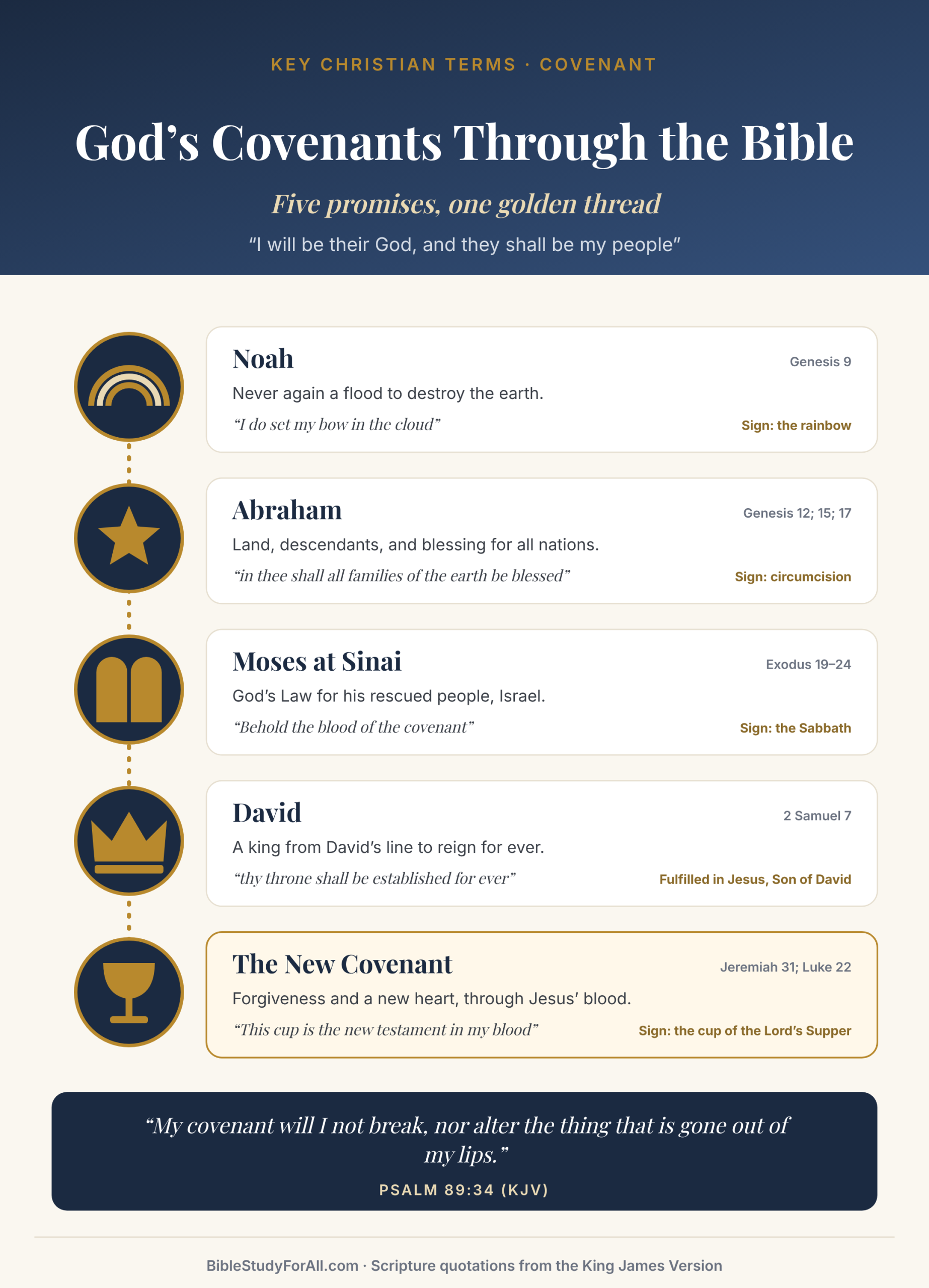
God’s Covenants Through the Bible
Five great covenants run through Scripture like a golden thread, each building on the last and pointing to Jesus.
What the Bible Says
Three Key Verses
Deuteronomy 7:9
“Know therefore that the LORD thy God, he is God, the faithful God, which keepeth covenant and mercy with them that love him and keep his commandments to a thousand generations.”
In plain words: God is faithful. He keeps his covenant promises for a thousand generations.
Jeremiah 31:33
“But this shall be the covenant that I will make with the house of Israel; After those days, saith the LORD, I will put my law in their inward parts, and write it in their hearts; and will be their God, and they shall be my people.”
In plain words: In the new covenant God writes his ways on our hearts and becomes our God.
Luke 22:20
“Likewise also the cup after supper, saying, This cup is the new testament in my blood, which is shed for you.”
In plain words: Jesus sealed the new covenant with his own blood, remembered at the Lord’s Supper.
Clearing It Up
What It Is and What It Isn’t
A common mix-up
“A covenant is just a contract.”
A contract ends when someone fails to deliver. God’s covenants rest on his faithfulness: “For the mountains shall depart, and the hills be removed; but my kindness shall not depart from thee, neither shall the covenant of my peace be removed” (Isaiah 54:10).
A common mix-up
“The Old Testament covenants don’t matter anymore.”
They are the story Jesus fulfills. Through Christ, believers share in the promise to Abraham: “if ye be Christ’s, then are ye Abraham’s seed, and heirs according to the promise” (Galatians 3:29).
A common mix-up
“The new covenant is a brand-new idea.”
God promised it centuries earlier through Jeremiah: “Behold, the days come, saith the LORD, that I will make a new covenant with the house of Israel, and with the house of Judah” (Jeremiah 31:31).
How It Connects
Covenant and the Other Big Words
The Bible’s big words are not separate ideas. They are different angles on one story: what God has done for us in Jesus.
The new covenant was sealed by Jesus’ sacrifice.
Abraham trusted God’s covenant promise and was counted righteous.
God starts every covenant out of undeserved love.
God redeemed Israel from Egypt to bring them into covenant.
The new covenant brings forgiveness and a new heart.
In the new covenant God writes his law on our hearts.
Living It Out
Putting It into Practice
1
Trust God’s promises
When life is uncertain, remember that God binds himself to his word. Find one promise in Scripture and hold onto it this week.
2
Remember at the Lord’s Table
Each time you take Communion, remember the new covenant Jesus sealed with his blood (1 Corinthians 11:25).
3
Keep your own word
People who belong to a promise-keeping God learn to keep their promises: in marriage, friendship, work and church.
Questions
Quick Questions
What are the main covenants in the Bible?
Five stand out: with Noah, never again to destroy the earth by flood (Genesis 9); with Abraham, land, descendants and blessing for all nations (Genesis 12, 15, 17); with Israel at Sinai through Moses, the Law (Exodus 19–24); with David, a forever king from his line (2 Samuel 7); and the new covenant, forgiveness and a new heart, fulfilled in Jesus (Jeremiah 31; Luke 22:20). See The Abrahamic Covenant.
Why is it called the “New Testament”?
“Testament” is the older English word for covenant. Jesus said at the Last Supper, “This cup is the new testament in my blood, which is shed for you” (Luke 22:20). The books that tell of Jesus and the new covenant came to be called the New Testament.
How do the covenants fit together?
Christians describe this in different ways. Covenant theology sees one overarching covenant of grace running through all of Scripture, with the new covenant as its fullest form. Dispensationalism sees distinct stages in God’s dealings and expects specific promises to Israel, such as the land, to be fulfilled in the future. Others hold views in between. All agree the covenants find their center in Jesus (2 Corinthians 1:20).
Can a covenant be broken?
People broke the covenant at Sinai again and again (Jeremiah 31:32), and faced the consequences the Law described. But God never breaks his side. The new covenant promises a heart that wants to obey and complete forgiveness: “I will forgive their iniquity, and I will remember their sin no more” (Jeremiah 31:34).
Keep Reading
Continue Your Study
Read the key passages for yourself, then explore the Bible books and topics where covenant comes up most.
Scripture quotations are from the King James Version (KJV), which is in the public domain. Verse links open at BibleGateway.