
Key Christian Terms · In Plain Words
Grace: God’s Kindness We Don’t Deserve
Grace is God’s free, undeserved kindness: giving us his love, forgiveness and help when we have earned none of it.
Grace is the heartbeat of the Christian faith. It means God treats us far better than we deserve, not because of who we are, but because of who he is.
“For by grace are ye saved through faith; and that not of yourselves: it is the gift of God.”
Ephesians 2:8 (KJV)
In Plain Words
What Does Grace Mean?
In one sentence
Grace is God’s free, undeserved kindness: giving us his love, forgiveness and help when we have earned none of it.
Grace is a gift you could never earn and never repay. If you work for something, you are paid wages. If someone hands it to you freely, out of love, that is grace. Paul puts it simply: “if by grace, then is it no more of works: otherwise grace is no more grace” (Romans 11:6).
The Bible’s greatest picture of grace is Jesus. “For ye know the grace of our Lord Jesus Christ, that, though he was rich, yet for your sakes he became poor, that ye through his poverty might be rich” (2 Corinthians 8:9). Grace is not just a nice idea. It is God giving himself for us.
The word itself: The New Testament word is the Greek charis, meaning favour, kindness or a gift freely given. The Old Testament often uses the Hebrew chen, favour, as when “Noah found grace in the eyes of the LORD” (Genesis 6:8).
Three Ways Grace Works
Grace that saves
God forgives and accepts us as a free gift through Jesus, not as a reward for being good.
Grace that strengthens
God gives daily help in weakness, hard times and temptation. His grace is enough for whatever we face.
Grace that changes
Grace does not leave us as we were. It teaches us to say no to wrong and yes to a godly life.
An Everyday Picture
A Gift You Can’t Pay For
Imagine a child who saves up for weeks to buy her father a birthday present, but she is still a long way short. Her father quietly gives her the money, then opens the gift with joy and hangs it on the wall for everyone to see. Everything she gave him, he first gave her.
That is grace. We bring nothing to God that he did not first give us. He supplies the gift, and then delights in us anyway. Grace turns our relationship with God from a contract into a family.
Three Words Side by Side
Grace, Mercy and Justice
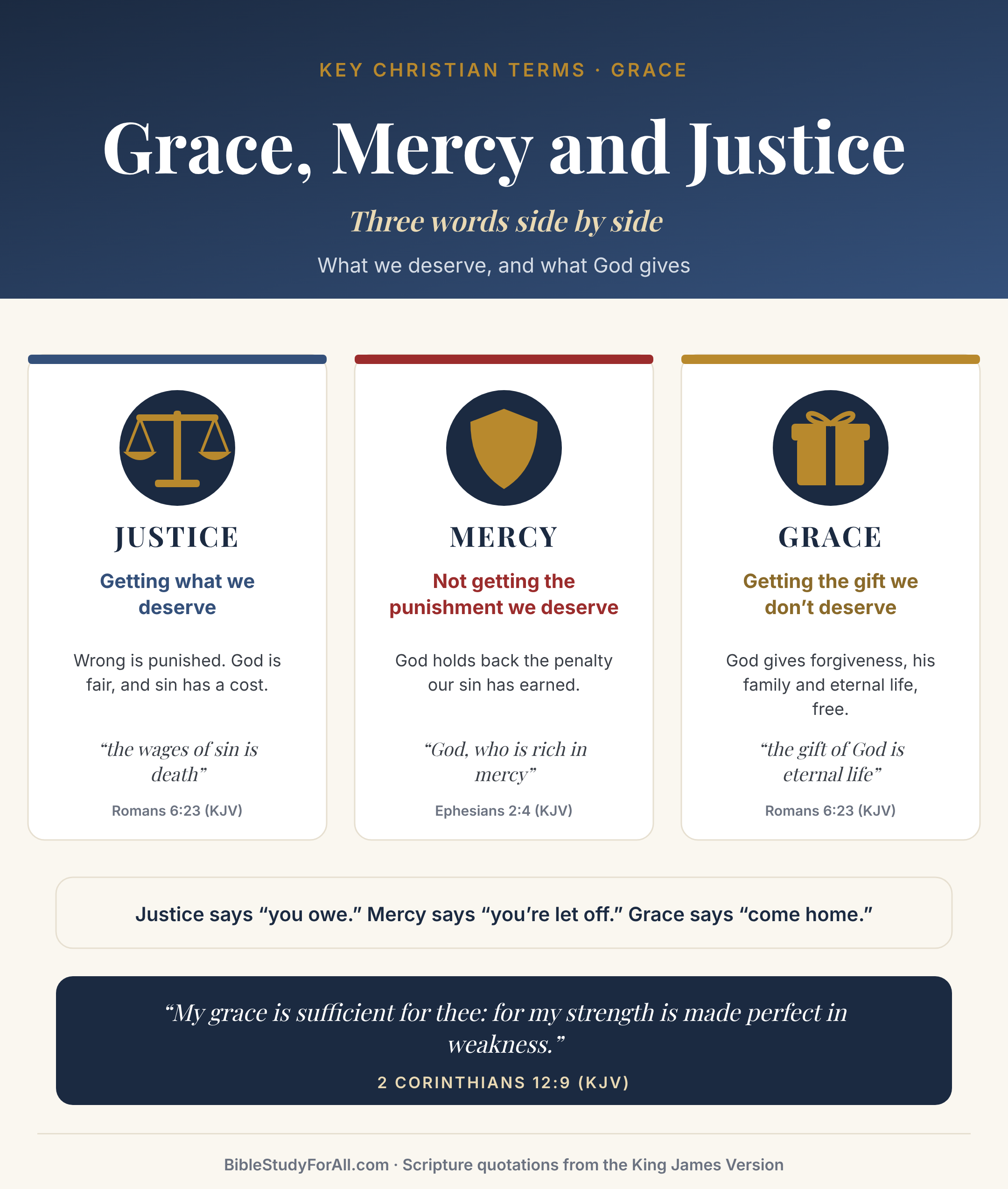
A simple way to see grace is to set it beside two other words people often mix it up with.
What the Bible Says
Three Key Verses
Ephesians 2:8–9
“For by grace are ye saved through faith; and that not of yourselves: it is the gift of God: Not of works, lest any man should boast.”
In plain words: You cannot earn being saved. It is a gift, received by trusting God.
2 Corinthians 12:9
“And he said unto me, My grace is sufficient for thee: for my strength is made perfect in weakness. Most gladly therefore will I rather glory in my infirmities, that the power of Christ may rest upon me.”
In plain words: God’s grace is enough to carry you, even when you feel weakest.
Hebrews 4:16
“Let us therefore come boldly unto the throne of grace, that we may obtain mercy, and find grace to help in time of need.”
In plain words: Because of grace, you can come to God boldly, any time, for help.
Clearing It Up
What It Is and What It Isn’t
A common mix-up
“Grace means sin doesn’t matter.”
Paul answered this directly: “Shall we continue in sin, that grace may abound? God forbid” (Romans 6:1–2). Grace forgives sin, and it also frees us from it.
A common mix-up
“Grace is for the really bad people.”
Everyone needs grace. “For all have sinned, and come short of the glory of God” (Romans 3:23). The most respectable person is saved the same way as the worst: freely.
A common mix-up
“I got in by grace; now I stay in by effort.”
Grace is not just the starting line. We “stand” in grace (Romans 5:2) and “grow in grace” (2 Peter 3:18). Effort matters, but it is powered by grace, not a replacement for it.
How It Connects
Grace and the Other Big Words
The Bible’s big words are not separate ideas. They are different angles on one story: what God has done for us in Jesus.
Grace is the reason salvation is free.
God declares us “not guilty” freely, by his grace.
Faith
Grace is the gift; faith is the hand that receives it.
Page coming soon
God’s righteousness is given to us as a gift of grace.
God’s kindness draws us to turn back to him.
We are bought back “according to the riches of his grace.”
Living It Out
Putting It into Practice
1
Stop trying to earn it
Notice when you are trying to make God love you more. He already does. Thank him for grace instead of bargaining with him.
2
Ask for grace every day
Bring your weak spots to God and ask for help. “Come boldly unto the throne of grace” (Hebrews 4:16).
3
Pass it on
Treat others better than they deserve: be patient, forgive, give without keeping score. Grace received becomes grace given.
Questions
Quick Questions
What is the difference between grace and mercy?
They are close friends. Mercy is God holding back the punishment we deserve. Grace is God giving us the good we do not deserve: forgiveness, adoption into his family, eternal life. Paul uses both together: “But God, who is rich in mercy, for his great love wherewith he loved us … (by grace ye are saved;)” (Ephesians 2:4–5).
Was there grace in the Old Testament?
Yes, all through it. God showed grace to Noah (Genesis 6:8), chose Israel out of love rather than merit (Deuteronomy 7:7–8), and describes himself as “gracious and merciful, slow to anger, and of great kindness” (Joel 2:13). John says that in Jesus grace came in its fullest form: “grace and truth came by Jesus Christ” (John 1:17).
Can I resist or waste God’s grace?
Paul urges believers to “receive not the grace of God in vain” (2 Corinthians 6:1). Christians explain how grace and human choice fit together in different ways, but all agree that grace is a gift to be received with gratitude and lived out, not taken for granted.
What does “saying grace” at meals mean?
It comes from the old use of the word for thanks. Giving thanks before a meal is a small daily reminder that everything we have, even our food, is a gift from God (1 Timothy 4:4–5).
Keep Reading
Continue Your Study
Read the key passages for yourself, then explore the Bible books and topics where grace comes up most.
Scripture quotations are from the King James Version (KJV), which is in the public domain. Verse links open at BibleGateway.