
Key Christian Terms · In Plain Words
Justification: Declared “Not Guilty”
Justification is God declaring a guilty person “not guilty” and fully accepted, because of what Jesus has done.
It is a courtroom word. It is not about how we feel or how good we have become. It is God’s verdict, given freely to everyone who trusts in Jesus.
“Therefore being justified by faith, we have peace with God through our Lord Jesus Christ.”
Romans 5:1 (KJV)
In Plain Words
What Does Justification Mean?
In one sentence
Justification is God declaring a guilty person “not guilty” and fully accepted, because of what Jesus has done.
Picture yourself in a courtroom before God, the perfect Judge. The charges are real, and you know you are guilty. Justification is the moment the Judge announces: not guilty, case closed, welcome into the family.
How can a fair judge do that? Because the penalty has been paid. Jesus took the punishment for sin on the cross, and his righteousness is counted to those who believe. So God is both fair and forgiving at once: he is “just, and the justifier of him which believeth in Jesus” (Romans 3:26).
The word itself: The Greek word dikaioō means “to declare righteous” or “to count as right.” It comes from the same family as the word for righteousness. A judge does not make a person good; he announces where that person stands before the law.
Three Things to Know
It is a verdict
Justification is God’s declaration about where you stand with him. Growing in holiness follows, but the verdict itself is God’s to give.
It is a gift, not a wage
It comes freely, by God’s grace. Faith does not earn it; faith simply receives it, like an open hand.
Real faith shows itself
Paul and James agree: we are made right with God through faith in Jesus, and that faith is the kind that changes how we live.
An Everyday Picture
The Fine Was Paid
Imagine standing before a judge for something you really did. The fine is far more than you could ever pay. Then the judge steps down from the bench, takes off his robe, and pays the fine himself. The law is satisfied, the record is cleared, and you walk out free.
That is the heart of justification. The judge did not pretend the crime never happened, and he did not lower the standard. Justice was fully done, but the Judge himself, in Jesus, paid what justice required.
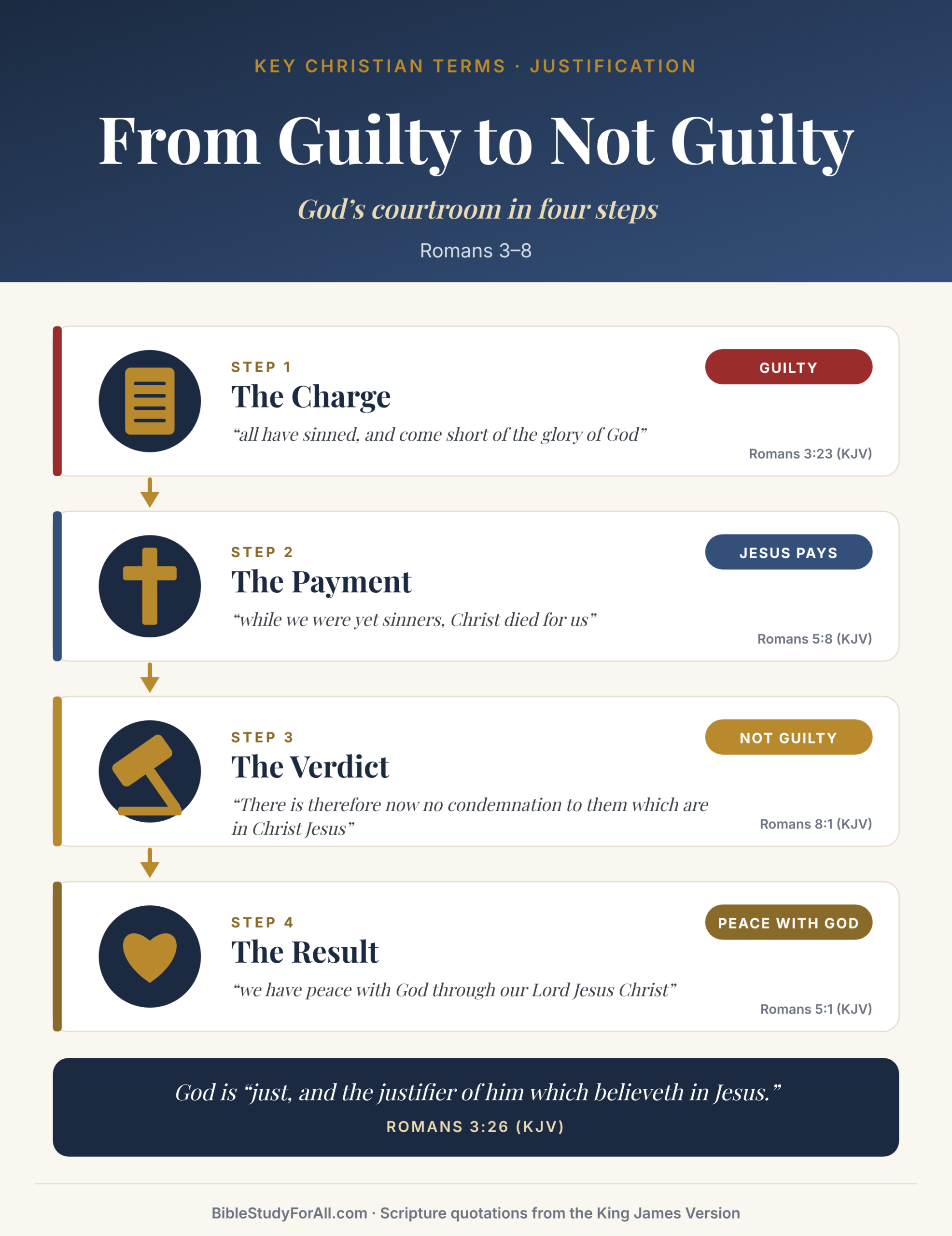
Romans 3–8
From Guilty to Not Guilty
Paul’s letter to the Romans walks through God’s courtroom in four steps.
What the Bible Says
Three Key Verses
Romans 3:24
“Being justified freely by his grace through the redemption that is in Christ Jesus.”
In plain words: Being made right with God is free to us. It cost Jesus everything.
Romans 4:5
“But to him that worketh not, but believeth on him that justifieth the ungodly, his faith is counted for righteousness.”
In plain words: God declares right not those who earn it, but those who trust him, even the ungodly.
Romans 8:1
“There is therefore now no condemnation to them which are in Christ Jesus, who walk not after the flesh, but after the Spirit.”
In plain words: For those who belong to Jesus, the case is closed. No condemnation, ever.
Clearing It Up
What It Is and What It Isn’t
A common mix-up
“Justified just means forgiven.”
It means even more. Forgiveness wipes the record clean; justification also counts you righteous, with Christ’s own record. God “hath made him to be sin for us, who knew no sin; that we might be made the righteousness of God in him” (2 Corinthians 5:21).
A common mix-up
“I have to keep earning God’s acceptance.”
God’s verdict does not rise and fall with your good and bad days. “Who shall lay any thing to the charge of God’s elect? It is God that justifieth” (Romans 8:33).
A common mix-up
“If it is by faith, how I live doesn’t matter.”
Good works do not earn justification, but they follow it. We are “created in Christ Jesus unto good works” (Ephesians 2:10).
How It Connects
Justification and the Other Big Words
The Bible’s big words are not separate ideas. They are different angles on one story: what God has done for us in Jesus.
What God counts to you when he justifies you.
Justification is one part of God’s whole rescue.
Faith
The open hand that receives God’s verdict.
Page coming soon
Grace
Why the verdict is free: it is God’s kindness, not our merit.
Page coming soon
Atonement
The payment on the cross that makes the verdict fair.
Page coming soon
Sanctification
What follows: being made more like Jesus day by day.
Page coming soon
Living It Out
Putting It into Practice
1
Stop putting yourself on trial
When guilt comes back about sins you have confessed, remember the verdict. If God has declared you not guilty, you do not need to keep re-opening the case.
2
Live from peace, not for it
“We have peace with God” (Romans 5:1). Pray, serve and obey as someone already accepted, not as someone trying to get in.
3
Treat others the same way
People who have been freely pardoned learn to forgive freely. Let God’s mercy to you shape the way you deal with people who wrong you.
Questions
Quick Questions
Do Paul and James disagree?
Paul says “a man is justified by faith without the deeds of the law” (Romans 3:28). James says “by works a man is justified, and not by faith only” (James 2:24). Most Christians see no contradiction: Paul is explaining how a person is made right with God, and James is showing that real faith always proves itself in action. Both use Abraham as their example.
When does justification happen?
The New Testament ties it to faith in Christ: “Therefore being justified by faith, we have peace with God” (Romans 5:1). Many Christians also connect it closely with baptism (Titus 3:5–7). And the final day of judgment will openly confirm God’s verdict (Romans 2:13–16).
Was Abraham justified the same way?
Yes. Paul’s key example is Abraham: “Abraham believed God, and it was counted unto him for righteousness” (Romans 4:3, quoting Genesis 15:6). Abraham was declared right with God by trusting his promise, years before he was circumcised and centuries before the Law was given.
Keep Reading
Continue Your Study
Read the key passages for yourself, then explore the Bible books and topics where justification comes up most.
Scripture quotations are from the King James Version (KJV), which is in the public domain. Verse links open at BibleGateway.