
Resources · Comparing Beliefs
World Religions Compared
A side-by-side look at the major religions of the world and the best-known groups that grew out of Christianity: who they worship, what they say about Jesus Christ, which books they follow, who founded them and when, where they began, and what they teach about heaven and hell. Each faith is compared with traditional Bible-believing Christianity.
Many paths are offered. One Way is given.
The Faiths
Going Deeper
Note: Scripture quotations and verse links on this site use the King James Version (KJV) because it is in the public domain, while most modern translations limit how much can be quoted online. Feel free to read along in the translation of your choice.
12 Faiths Compared
Christianity and eleven other religions and groups
Summary Table
God, Jesus, scriptures, founders, heaven and hell
2 World Maps
Where each began and where it is followed today
Printable Copy
Save, share or print the comparison
Quick Reference
Summary Table
Twelve faiths side by side, beginning with traditional Christianity, the base for every comparison on this page.
| Faith | God | Jesus Christ | Sacred Texts | Founder and Date | Where It Began and Is Followed | Heaven and Hell | How a Person Gets There |
|---|---|---|---|---|---|---|---|
| Our Starting Point | |||||||
| 1Christianity About 2.3 billion Christians of all traditions | One God eternally in three Persons: the Father, the Son and the Holy Spirit. | The eternal Son of God, fully God and fully man; born of a virgin, died for our sins, rose bodily, and will return. | The Bible: 66 books, inspired by God and without error. | Jesus Christ. The church began at Pentecost, c. A.D. 30. | Began in Jerusalem. Followed worldwide, most in the Americas, Europe and Africa. | Yes. Heaven is eternal life with God; hell is everlasting punishment apart from Him. | By God’s grace, through faith in Jesus Christ alone, not by our own works. |
| World Religions | |||||||
| 2Judaism About 15 million Jews | One God, the God of Abraham, Isaac and Jacob (not a Trinity). | A Jewish teacher, but not the Messiah and not the Son of God. | The Hebrew Bible (Tanakh: the same books as our Old Testament) and the Talmud. | God’s covenant with Abraham (c. 2000 B.C.) and the Law given through Moses at Sinai (c. 1446 B.C.). | Began in the land of Israel. Today most Jews live in Israel and the United States. | The focus is on this life. Traditional teaching: resurrection and the World to Come. | Faithfulness to God’s covenant: keeping His commandments, repentance, prayer and good deeds, trusting His mercy. |
| 3Islam About 2 billion Muslims | Allah, the one God, who is absolutely one (no Trinity, no Son). | Isa, a great prophet and the Messiah, born of a virgin; not the Son of God and not crucified. | The Qur’an, with the Hadith (sayings of Muhammad). | Muhammad (c. A.D. 570–632); first revelation reported in A.D. 610. | Began in Mecca, Arabia. Followed in the Middle East, North Africa and South and Southeast Asia. | Yes: Paradise and Hell, after the Day of Judgment. | Faith in Allah and His prophets, the Five Pillars and good deeds, hoping in Allah’s mercy on Judgment Day. |
| 4Hinduism About 1.2 billion Hindus | Brahman, the ultimate reality, worshiped through many gods such as Vishnu, Shiva and Devi. | Many Hindus honor Jesus as a holy teacher or a god among many, not as the only Savior. | The Vedas and Upanishads, the Bhagavad Gita, the Ramayana and the Mahabharata. | No single founder; developed over centuries from c. 1500 B.C. | Began in northern India. About 94% of Hindus live in India; also Nepal. | Rebirth (reincarnation); heavens and hells are temporary stops between lives. | Release from rebirth (moksha) through knowledge, devotion, or good works, over many lifetimes. |
| 5Buddhism About 320 million Buddhists | No creator God. Gods may exist, but they are not the focus and cannot save. | Respected by some as a wise and compassionate teacher; not the Savior. | The Tripitaka (Pali Canon) and, in East Asia, the Mahayana sutras. | Siddhartha Gautama, “the Buddha” (traditionally c. 563–483 B.C.). | Began in northeast India. Followed in China, Thailand, Japan, Myanmar, Sri Lanka and much of East Asia. | Rebirth; heavens and hells are temporary realms. The goal is nirvana, the end of suffering. | Following the Buddha’s teaching (the Eightfold Path) to end craving and reach nirvana. |
| 6Sikhism About 25–30 million Sikhs | One God (Waheguru), the formless Creator, who is beyond birth and death. | Not part of Sikh teaching; respected by some as a holy man. | The Guru Granth Sahib, the Sikh scripture, honored as the living Guru. | Guru Nanak (1469–1539), beginning c. A.D. 1499, followed by nine more Gurus. | Began in the Punjab (northwest India). Most Sikhs live in Punjab; also the UK, Canada and the U.S. | Rebirth by karma; the goal is release and union with God. | By God’s grace, remembering God’s name, living honestly and serving others. |
| Other Christian Traditions | |||||||
| 7Roman Catholic About 1.4 billion Catholics | One God in three Persons: Father, Son and Holy Spirit. | The eternal Son of God, fully God and fully man, who died for sin and rose bodily. | The Bible with 73 books (including the Apocrypha), plus Sacred Tradition as taught by the Church. | Catholics trace their church to Jesus and the apostle Peter. Rome and the East separated in A.D. 1054. | Centered in Rome (Vatican City). Followed in Latin America, Europe, Africa, the Philippines and the U.S. | Yes: heaven and hell, with purgatory as a cleansing before heaven. | By God’s grace, received through faith, baptism and the sacraments, and dying in a state of grace. |
| 8Eastern Orthodox About 220 million Orthodox Christians | One God in three Persons: Father, Son and Holy Spirit. | The eternal Son of God, fully God and fully man, who died for sin and rose bodily. | The Bible (Old Testament from the Greek Septuagint, with added books), read within Holy Tradition. | Traces itself to the apostles. Separated from Rome in A.D. 1054. | Centered in Constantinople (Istanbul). Followed in Russia, Ukraine, Greece, Romania, Serbia and Eastern Europe. | Yes: heaven and hell (no formal purgatory). | By grace, through faith, baptism, the sacraments and a lifelong walk toward union with God (theosis). |
| Movements From 1800s America | |||||||
| 9Seventh-day Adventist About 22 million baptized members | One God in three Persons: Father, Son and Holy Spirit. | The eternal Son of God, fully God and fully man; since 1844 ministering in the heavenly sanctuary. | The Bible, with the writings of Ellen G. White as “a continuing and authoritative source of truth.” | Ellen G. White, James White and Joseph Bates; organized 1863 (roots in 1844). | Began in New England and Michigan. Today most members live in Africa, Latin America and Asia. | Heaven, then the new earth. No everlasting hell: the dead sleep until the resurrection, and the lost are destroyed. | By grace through faith in Christ, shown by obedience to God’s law, including the seventh-day Sabbath. |
| 10Latter-day Saints (Mormons) About 17.5 million members (church figure) | Heavenly Father, an exalted being with a glorified body; the Father, Son and Holy Ghost are three separate beings. | The firstborn spirit Son of Heavenly Father, the Savior; separate from the Father; He visited the Americas. | The Bible (KJV), the Book of Mormon, Doctrine and Covenants, and the Pearl of Great Price. | Joseph Smith (1805–1844); church organized April 6, 1830. | Began in Fayette, New York; headquarters Salt Lake City, Utah. Most members now live outside the U.S. | Nearly all reach one of three kingdoms of glory; the highest is the celestial kingdom. Outer darkness for very few. | Faith in Christ, repentance, baptism by Latter-day Saint authority, temple ordinances and enduring to the end. |
| 11Jehovah’s Witnesses Nearly 9 million active members | Jehovah alone is Almighty God (no Trinity). The holy spirit is God’s active force, not a person. | God’s first creation, the archangel Michael before His birth; Savior and King, but not Almighty God. | The Bible in their own New World Translation, explained by Watch Tower publications. | Charles Taze Russell (1852–1916), from the 1870s; named Jehovah’s Witnesses in 1931. | Began near Pittsburgh, Pennsylvania; headquarters Warwick, New York. Active in over 200 lands. | 144,000 go to heaven; a “great crowd” will live forever on a paradise earth. No hellfire: the wicked cease to exist. | Faith in Jesus’ ransom, baptism as a Witness, obeying Jehovah, and loyalty to His organization. |
| 12Christian Science A small membership; the church does not publish figures | God is divine Mind, Spirit, Life, Truth and Love; the only reality. Matter, sin, sickness and death are not real. | The human man who showed “the Christ,” the divine idea; the Son of God but not God, and His death did not pay for sin. | The Bible and Mary Baker Eddy’s “Science and Health with Key to the Scriptures” (1875). | Mary Baker Eddy (1821–1910); church founded in 1879. | Began in Boston, Massachusetts. Mostly in the U.S., with branch churches elsewhere. | Heaven and hell are states of thought, not places. | By understanding that God is All and that sin, sickness and death are unreal. |
Our Starting Point · About 2.3 billion Christians of all traditions
GodOne God eternally in three Persons: the Father, the Son and the Holy Spirit.
Jesus ChristThe eternal Son of God, fully God and fully man; born of a virgin, died for our sins, rose bodily, and will return.
Sacred TextsThe Bible: 66 books, inspired by God and without error.
Founder and DateJesus Christ. The church began at Pentecost, c. A.D. 30.
Where It Began and Is FollowedBegan in Jerusalem. Followed worldwide, most in the Americas, Europe and Africa.
Heaven and HellYes. Heaven is eternal life with God; hell is everlasting punishment apart from Him.
How a Person Gets ThereBy God’s grace, through faith in Jesus Christ alone, not by our own works.
World Religions · About 15 million Jews
GodOne God, the God of Abraham, Isaac and Jacob (not a Trinity).
Jesus ChristA Jewish teacher, but not the Messiah and not the Son of God.
Sacred TextsThe Hebrew Bible (Tanakh: the same books as our Old Testament) and the Talmud.
Founder and DateGod’s covenant with Abraham (c. 2000 B.C.) and the Law given through Moses at Sinai (c. 1446 B.C.).
Where It Began and Is FollowedBegan in the land of Israel. Today most Jews live in Israel and the United States.
Heaven and HellThe focus is on this life. Traditional teaching: resurrection and the World to Come.
How a Person Gets ThereFaithfulness to God’s covenant: keeping His commandments, repentance, prayer and good deeds, trusting His mercy.
World Religions · About 2 billion Muslims
GodAllah, the one God, who is absolutely one (no Trinity, no Son).
Jesus ChristIsa, a great prophet and the Messiah, born of a virgin; not the Son of God and not crucified.
Sacred TextsThe Qur’an, with the Hadith (sayings of Muhammad).
Founder and DateMuhammad (c. A.D. 570–632); first revelation reported in A.D. 610.
Where It Began and Is FollowedBegan in Mecca, Arabia. Followed in the Middle East, North Africa and South and Southeast Asia.
Heaven and HellYes: Paradise and Hell, after the Day of Judgment.
How a Person Gets ThereFaith in Allah and His prophets, the Five Pillars and good deeds, hoping in Allah’s mercy on Judgment Day.
World Religions · About 1.2 billion Hindus
GodBrahman, the ultimate reality, worshiped through many gods such as Vishnu, Shiva and Devi.
Jesus ChristMany Hindus honor Jesus as a holy teacher or a god among many, not as the only Savior.
Sacred TextsThe Vedas and Upanishads, the Bhagavad Gita, the Ramayana and the Mahabharata.
Founder and DateNo single founder; developed over centuries from c. 1500 B.C.
Where It Began and Is FollowedBegan in northern India. About 94% of Hindus live in India; also Nepal.
Heaven and HellRebirth (reincarnation); heavens and hells are temporary stops between lives.
How a Person Gets ThereRelease from rebirth (moksha) through knowledge, devotion, or good works, over many lifetimes.
World Religions · About 320 million Buddhists
GodNo creator God. Gods may exist, but they are not the focus and cannot save.
Jesus ChristRespected by some as a wise and compassionate teacher; not the Savior.
Sacred TextsThe Tripitaka (Pali Canon) and, in East Asia, the Mahayana sutras.
Founder and DateSiddhartha Gautama, “the Buddha” (traditionally c. 563–483 B.C.).
Where It Began and Is FollowedBegan in northeast India. Followed in China, Thailand, Japan, Myanmar, Sri Lanka and much of East Asia.
Heaven and HellRebirth; heavens and hells are temporary realms. The goal is nirvana, the end of suffering.
How a Person Gets ThereFollowing the Buddha’s teaching (the Eightfold Path) to end craving and reach nirvana.
World Religions · About 25–30 million Sikhs
GodOne God (Waheguru), the formless Creator, who is beyond birth and death.
Jesus ChristNot part of Sikh teaching; respected by some as a holy man.
Sacred TextsThe Guru Granth Sahib, the Sikh scripture, honored as the living Guru.
Founder and DateGuru Nanak (1469–1539), beginning c. A.D. 1499, followed by nine more Gurus.
Where It Began and Is FollowedBegan in the Punjab (northwest India). Most Sikhs live in Punjab; also the UK, Canada and the U.S.
Heaven and HellRebirth by karma; the goal is release and union with God.
How a Person Gets ThereBy God’s grace, remembering God’s name, living honestly and serving others.
Other Christian Traditions · About 1.4 billion Catholics
GodOne God in three Persons: Father, Son and Holy Spirit.
Jesus ChristThe eternal Son of God, fully God and fully man, who died for sin and rose bodily.
Sacred TextsThe Bible with 73 books (including the Apocrypha), plus Sacred Tradition as taught by the Church.
Founder and DateCatholics trace their church to Jesus and the apostle Peter. Rome and the East separated in A.D. 1054.
Where It Began and Is FollowedCentered in Rome (Vatican City). Followed in Latin America, Europe, Africa, the Philippines and the U.S.
Heaven and HellYes: heaven and hell, with purgatory as a cleansing before heaven.
How a Person Gets ThereBy God’s grace, received through faith, baptism and the sacraments, and dying in a state of grace.
Other Christian Traditions · About 220 million Orthodox Christians
GodOne God in three Persons: Father, Son and Holy Spirit.
Jesus ChristThe eternal Son of God, fully God and fully man, who died for sin and rose bodily.
Sacred TextsThe Bible (Old Testament from the Greek Septuagint, with added books), read within Holy Tradition.
Founder and DateTraces itself to the apostles. Separated from Rome in A.D. 1054.
Where It Began and Is FollowedCentered in Constantinople (Istanbul). Followed in Russia, Ukraine, Greece, Romania, Serbia and Eastern Europe.
Heaven and HellYes: heaven and hell (no formal purgatory).
How a Person Gets ThereBy grace, through faith, baptism, the sacraments and a lifelong walk toward union with God (theosis).
Movements From 1800s America · About 22 million baptized members
GodOne God in three Persons: Father, Son and Holy Spirit.
Jesus ChristThe eternal Son of God, fully God and fully man; since 1844 ministering in the heavenly sanctuary.
Sacred TextsThe Bible, with the writings of Ellen G. White as “a continuing and authoritative source of truth.”
Founder and DateEllen G. White, James White and Joseph Bates; organized 1863 (roots in 1844).
Where It Began and Is FollowedBegan in New England and Michigan. Today most members live in Africa, Latin America and Asia.
Heaven and HellHeaven, then the new earth. No everlasting hell: the dead sleep until the resurrection, and the lost are destroyed.
How a Person Gets ThereBy grace through faith in Christ, shown by obedience to God’s law, including the seventh-day Sabbath.
Movements From 1800s America · About 17.5 million members (church figure)
GodHeavenly Father, an exalted being with a glorified body; the Father, Son and Holy Ghost are three separate beings.
Jesus ChristThe firstborn spirit Son of Heavenly Father, the Savior; separate from the Father; He visited the Americas.
Sacred TextsThe Bible (KJV), the Book of Mormon, Doctrine and Covenants, and the Pearl of Great Price.
Founder and DateJoseph Smith (1805–1844); church organized April 6, 1830.
Where It Began and Is FollowedBegan in Fayette, New York; headquarters Salt Lake City, Utah. Most members now live outside the U.S.
Heaven and HellNearly all reach one of three kingdoms of glory; the highest is the celestial kingdom. Outer darkness for very few.
How a Person Gets ThereFaith in Christ, repentance, baptism by Latter-day Saint authority, temple ordinances and enduring to the end.
Movements From 1800s America · Nearly 9 million active members
GodJehovah alone is Almighty God (no Trinity). The holy spirit is God’s active force, not a person.
Jesus ChristGod’s first creation, the archangel Michael before His birth; Savior and King, but not Almighty God.
Sacred TextsThe Bible in their own New World Translation, explained by Watch Tower publications.
Founder and DateCharles Taze Russell (1852–1916), from the 1870s; named Jehovah’s Witnesses in 1931.
Where It Began and Is FollowedBegan near Pittsburgh, Pennsylvania; headquarters Warwick, New York. Active in over 200 lands.
Heaven and Hell144,000 go to heaven; a “great crowd” will live forever on a paradise earth. No hellfire: the wicked cease to exist.
How a Person Gets ThereFaith in Jesus’ ransom, baptism as a Witness, obeying Jehovah, and loyalty to His organization.
Movements From 1800s America · A small membership; the church does not publish figures
GodGod is divine Mind, Spirit, Life, Truth and Love; the only reality. Matter, sin, sickness and death are not real.
Jesus ChristThe human man who showed “the Christ,” the divine idea; the Son of God but not God, and His death did not pay for sin.
Sacred TextsThe Bible and Mary Baker Eddy’s “Science and Health with Key to the Scriptures” (1875).
Founder and DateMary Baker Eddy (1821–1910); church founded in 1879.
Where It Began and Is FollowedBegan in Boston, Massachusetts. Mostly in the U.S., with branch churches elsewhere.
Heaven and HellHeaven and hell are states of thought, not places.
How a Person Gets ThereBy understanding that God is All and that sin, sickness and death are unreal.
Scroll sideways to see every column. Each faith is summed up in the words its own followers use; the detail sections below compare each one with the Bible. Numbers match the maps. Membership figures are rounded estimates.
Printable Copy
Printable Comparison (PDF)
The summary table on two landscape pages, plus both maps and the timeline. It opens in a new tab, where you can save it to your phone or computer, share it, or print it for a class or small group.
About This Page
Why Compare the World’s Religions?
Why Compare?
Knowing What Others Believe
Your neighbors, coworkers and classmates may follow many different faiths. Knowing what they believe, and how it compares with the Bible, helps you understand them and share your own faith clearly.
A few generations ago most people in America met only a few kinds of belief. Today a single street may have Muslim, Hindu, Buddhist, Jewish, Latter-day Saint and Jehovah’s Witness neighbors. Many of them hold their faith sincerely and live it with great devotion.
Understanding what someone actually believes, in the words their own faith uses, is the first step to a real conversation. It also keeps us from repeating rumors or caricatures. This page sets out the main teachings of each faith as fairly and accurately as we can, and then shows how each one compares with the teaching of Scripture.
Our Measure
The Bible as the Standard
This page compares every faith with the Bible, which we believe is God’s inspired and inerrant Word, and with traditional Christianity as it has been taught since the apostles.
Every comparison needs a fixed point. Ours is the Bible, the sixty-six books of the Old and New Testaments, which we believe God inspired, men wrote, and which is without error (2 Timothy 3:16; John 17:17).
The “base” column of this comparison is traditional Bible-believing Christianity as summed up in the historic creeds and the Protestant Reformation: one God in three Persons; Jesus Christ fully God and fully man, who died for our sins and rose bodily; and salvation by grace alone, through faith alone, in Christ alone. Like the Bereans, we test every teaching by the Scriptures (Acts 17:11).
With Respect
Speaking the Truth in Love
Each faith is described as its own followers describe it. Where it differs from the Bible we say so plainly, but always with respect for the people who hold it.
The Bible calls us to be ready to give an answer for the hope that is in us “with meekness and fear” (1 Peter 3:15), and to speak “the truth in love” (Ephesians 4:15). This page tries to do both.
The descriptions of each religion use its own terms and its own sources. The “How It Compares With the Bible” notes then show, with Scripture, where it agrees with and where it differs from the Christian faith. Membership figures are rounded estimates and change from year to year.
Key Verse
The Way, the Truth, and the Life
“Jesus saith unto him, I am the way, the truth, and the life: no man cometh unto the Father, but by Me.”
John 14:6 (KJV)
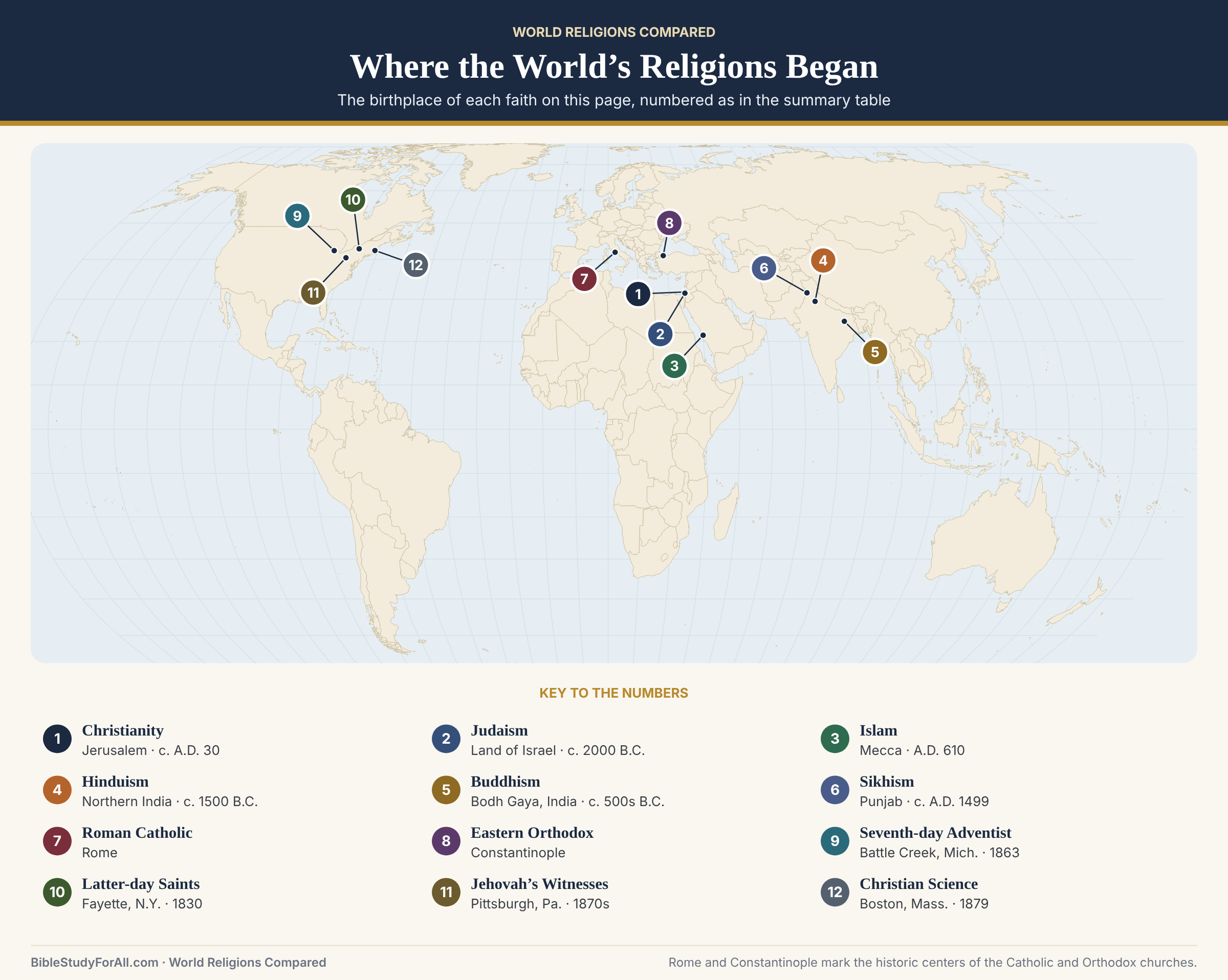
Map 1 of 2
Where the World’s Religions Began
Each faith on this page began in one of three regions: the Middle East, India, or the northeastern United States. The numbers match the summary table.
Map 2 of 2
Where Each Religion Is Followed Today
The largest religious group in each country. Christianity is the largest faith in most of the Americas, Europe, southern Africa and Oceania; Islam across North Africa, the Middle East and parts of Asia; Hinduism in India and Nepal.
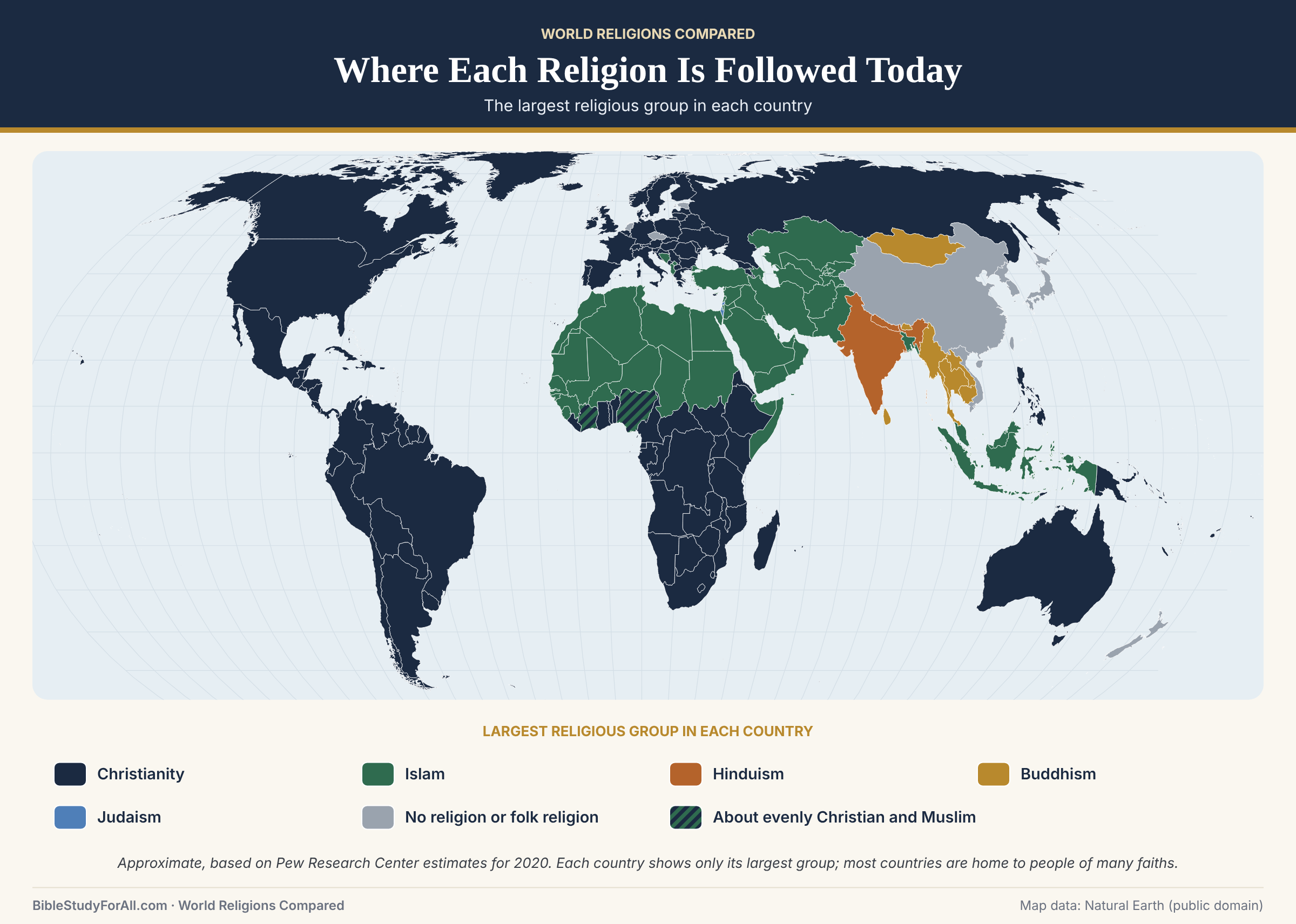
Approximate, based on Pew Research Center estimates for 2020. Nigeria and Côte d’Ivoire are about evenly Christian and Muslim.
1 of 12 · Our Starting Point
Traditional Christianity
The faith of the Bible, taught by Jesus and His apostles and handed down in the historic creeds. This is the base used for every comparison on this page.
Christianity at a Glance
Followers are calledChristians
Followers todayAbout 2.3 billion Christians of all traditions
GodOne God eternally in three Persons: the Father, the Son and the Holy Spirit.
Jesus ChristThe eternal Son of God, fully God and fully man; born of a virgin, died for our sins, rose bodily, and will return.
Sacred textsThe Bible: 66 books, inspired by God and without error.
Founder and dateJesus Christ. The church began at Pentecost, c. A.D. 30.
WhereBegan in Jerusalem. Followed worldwide, most in the Americas, Europe and Africa.
Heaven and hellYes. Heaven is eternal life with God; hell is everlasting punishment apart from Him.
How a person gets thereBy God’s grace, through faith in Jesus Christ alone, not by our own works.
Who God Is
There is one true and living God, the Creator of all things (Deuteronomy 6:4; Genesis 1:1). He exists eternally as three Persons, the Father, the Son and the Holy Spirit, equal in power and glory (Matthew 28:19). He is holy, just, loving and unchanging.
Who Jesus Is
Jesus Christ is the eternal Word who “was God” and “was made flesh” (John 1:1, John 1:14). Born of the virgin Mary, He lived a sinless life, died on the cross as the sacrifice for our sins, rose bodily on the third day, ascended to heaven, and will come again (1 Corinthians 15:3–4; Acts 1:11).
The Problem and the Answer
All people have sinned and fall short of the glory of God (Romans 3:23). We cannot save ourselves. God offers eternal life as a free gift to everyone who repents and trusts in Christ (Romans 6:23; Ephesians 2:8–9). The Reformation summed this up as Scripture alone, grace alone, faith alone, Christ alone, to the glory of God alone.
Heaven and Hell
At death believers go to be with the Lord (2 Corinthians 5:8). At the end of the age all the dead will be raised and judged. The righteous enter eternal life, and those who rejected God go into everlasting punishment (Matthew 25:46). Jesus has gone to prepare a place for His people (John 14:2–3).
Practices
- Baptism and the Lord’s Supper, the two ordinances Jesus gave
- Worship on the Lord’s Day (Sunday), the day of the resurrection
- Prayer, Bible reading and fellowship in a local church
- Sharing the gospel with all nations
“For by grace are ye saved through faith; and that not of yourselves: it is the gift of God: Not of works, lest any man should boast.”Ephesians 2:8–9 (KJV)
2 of 12 · World Religion
Judaism
The faith of the Old Testament people of Israel, as it continued after the destruction of the Temple in A.D. 70. Christianity grew from its roots: Jesus and the apostles were Jews.
Judaism at a Glance
Followers are calledJews
Followers todayAbout 15 million Jews
GodOne God, the God of Abraham, Isaac and Jacob (not a Trinity).
Jesus ChristA Jewish teacher, but not the Messiah and not the Son of God.
Sacred textsThe Hebrew Bible (Tanakh: the same books as our Old Testament) and the Talmud.
Founder and dateGod’s covenant with Abraham (c. 2000 B.C.) and the Law given through Moses at Sinai (c. 1446 B.C.).
WhereBegan in the land of Israel. Today most Jews live in Israel and the United States.
Heaven and hellThe focus is on this life. Traditional teaching: resurrection and the World to Come.
How a person gets thereFaithfulness to God’s covenant: keeping His commandments, repentance, prayer and good deeds, trusting His mercy.
What Jews Believe
Judaism confesses one God, the Creator, who chose Israel and made a covenant with Abraham and his descendants. Its central confession is the Shema: “Hear, O Israel: The LORD our God is one LORD” (Deuteronomy 6:4). God gave the Law (Torah) to Moses at Mount Sinai, and Jews show their love for God by keeping its commandments (mitzvot).
After the Romans destroyed the Temple in A.D. 70, sacrifices ended and rabbis led the people in prayer and study. Their teaching was written down in the Mishnah and the Talmud. Today the main branches are Orthodox, Conservative and Reform Judaism.
The Messiah and the Afterlife
Traditional Judaism looks for a Messiah, a descendant of David who will restore Israel and bring peace, but does not believe Jesus was that Messiah. It teaches the resurrection of the dead and the World to Come (Olam Ha-Ba). Gehinnom is usually described as a place of cleansing that lasts no more than a year for most. The righteous of all nations are said to have a share in the World to Come.
Practices
- The Sabbath, from Friday sunset to Saturday sunset
- Synagogue prayer and study of the Torah
- Passover, Yom Kippur (Day of Atonement), Rosh Hashanah and other feasts
- Food laws (kosher) and circumcision of boys
Common Ground
Where We Agree
- One God, the Creator of all things
- The books of the Old Testament as God’s Word
- Abraham, Moses, David and the prophets
- The hope of a promised Messiah
How It Compares With the Bible
What the Bible Teaches
- Jesus is the promised Messiah, foretold by Moses and the prophets (Isaiah 53:5–6; Micah 5:2; Luke 24:27).
- No one is made right with God by keeping the Law; righteousness comes by faith (Romans 3:20–22; Galatians 2:16).
- The Temple sacrifices pointed to Christ, who offered Himself once for all (Hebrews 10:10–12).
- Paul, himself a Jew, prayed that Israel would be saved through Christ (Romans 10:1; Romans 10:9).
“But He was wounded for our transgressions, He was bruised for our iniquities: the chastisement of our peace was upon Him; and with His stripes we are healed.”Isaiah 53:5 (KJV)
3 of 12 · World Religion
Islam
“Islam” means submission to God, and a Muslim is “one who submits.” Muslims believe God sent many prophets, from Adam to Jesus, and that Muhammad was the last and greatest of them.
Islam at a Glance
Followers are calledMuslims
Followers todayAbout 2 billion Muslims
GodAllah, the one God, who is absolutely one (no Trinity, no Son).
Jesus ChristIsa, a great prophet and the Messiah, born of a virgin; not the Son of God and not crucified.
Sacred textsThe Qur’an, with the Hadith (sayings of Muhammad).
Founder and dateMuhammad (c. A.D. 570–632); first revelation reported in A.D. 610.
WhereBegan in Mecca, Arabia. Followed in the Middle East, North Africa and South and Southeast Asia.
Heaven and hellYes: Paradise and Hell, after the Day of Judgment.
How a person gets thereFaith in Allah and His prophets, the Five Pillars and good deeds, hoping in Allah’s mercy on Judgment Day.
What Muslims Believe
Muslims believe in one God, Allah (the Arabic word for God), who has no partner and no son. This oneness (tawhid) is the center of the faith. They believe the angel Gabriel brought God’s words to Muhammad over about twenty-three years, beginning in A.D. 610 near Mecca, and that these words were recorded in the Qur’an. In 622 Muhammad moved to Medina (the Hijra), which begins the Islamic calendar.
Islam honors the Torah, the Psalms and the Gospel as books God once sent, but teaches that their text was changed over time and that the Qur’an is God’s final word. About 85–90% of Muslims are Sunni and about 10–15% are Shia.
Jesus in Islam
The Qur’an calls Jesus (Isa) the Messiah, born of the virgin Mary, a prophet who worked miracles. It denies that He is the Son of God and teaches that He was not crucified but was taken up to God. Many Muslims believe Jesus will return before the Day of Judgment.
Paradise and Hell
On the Day of Judgment every person’s deeds will be weighed. Those whose faith and good deeds prevail enter Paradise; unbelievers go to Hell. Many Muslims believe some believers will be punished for a time before entering Paradise. No one can be fully sure of the outcome, which rests on Allah’s will and mercy.
Practices
- The Five Pillars: the confession of faith (shahada), prayer five times a day, giving to the poor, fasting in Ramadan, and the pilgrimage to Mecca (hajj)
- Friday prayers at the mosque
- Food laws (halal): no pork or alcohol
Common Ground
Where We Agree
- One God, the Creator, who will judge the world
- Abraham, Moses, David and other prophets
- Jesus’ virgin birth, His miracles and His return
- Heaven and hell are real
How It Compares With the Bible
What the Bible Teaches
- Jesus is the Son of God and God made flesh, not only a prophet (John 1:1; John 1:14; Matthew 16:16–17).
- Jesus truly died on the cross for our sins and rose bodily (1 Corinthians 15:3–4; Luke 24:39).
- The one God is Father, Son and Holy Spirit (Matthew 28:19).
- God’s Word has not been corrupted; it stands for ever (Isaiah 40:8; Matthew 24:35).
- Eternal life is a gift that believers can know they have, not a hope weighed against deeds (1 John 5:13; Ephesians 2:8–9).
“These things have I written unto you that believe on the name of the Son of God; that ye may know that ye have eternal life, and that ye may believe on the name of the Son of God.”1 John 5:13 (KJV)
4 of 12 · World Religion
Hinduism
One of the oldest living religions, with no single founder, creed or central authority. Hindus often call it Sanatana Dharma, “the eternal way.”
Hinduism at a Glance
Followers are calledHindus
Followers todayAbout 1.2 billion Hindus
GodBrahman, the ultimate reality, worshiped through many gods such as Vishnu, Shiva and Devi.
Jesus ChristMany Hindus honor Jesus as a holy teacher or a god among many, not as the only Savior.
Sacred textsThe Vedas and Upanishads, the Bhagavad Gita, the Ramayana and the Mahabharata.
Founder and dateNo single founder; developed over centuries from c. 1500 B.C.
WhereBegan in northern India. About 94% of Hindus live in India; also Nepal.
Heaven and hellRebirth (reincarnation); heavens and hells are temporary stops between lives.
How a person gets thereRelease from rebirth (moksha) through knowledge, devotion, or good works, over many lifetimes.
What Hindus Believe
Most Hindus believe in Brahman, one ultimate reality behind everything that exists. Brahman is worshiped through many gods and goddesses, often seen as forms of the one reality. The best known are Vishnu the preserver (who comes to earth in forms such as Krishna and Rama), Shiva, and the goddess Devi. Families and regions often devote themselves to one god in particular.
Life is governed by karma, the law that every action brings its result, and by dharma, the duty that fits each person’s place in life.
Rebirth and Release
Hindus believe the soul (atman) is reborn many times in a cycle called samsara. Heavens and hells exist but are temporary. The goal is moksha, release from the cycle of rebirth and union with Brahman. Three main paths lead there: the path of knowledge, the path of devotion to a god (bhakti), and the path of selfless action.
Practices
- Worship (puja) at home shrines and temples
- Festivals such as Diwali and Holi
- Pilgrimage to holy places such as the Ganges River
- Yoga and meditation
Common Ground
Where We Agree
- A spiritual world beyond what we can see
- Prayer, devotion and worship
- We reap what we sow (Galatians 6:7)
- The value of self-control and humility
How It Compares With the Bible
What the Bible Teaches
- There is one God, and no other gods beside Him (Isaiah 45:5; Exodus 20:3).
- God the Creator is distinct from what He made; creation is not God (Genesis 1:1; Romans 1:25).
- Each person lives once, and then faces judgment; there is no cycle of rebirth (Hebrews 9:27).
- Salvation is a free gift received by faith, not earned over many lifetimes (Romans 6:23; Titus 3:5).
“And as it is appointed unto men once to die, but after this the judgment:”Hebrews 9:27 (KJV)
5 of 12 · World Religion
Buddhism
Founded on the teaching of Siddhartha Gautama, an Indian prince who left his palace to seek an answer to suffering and became known as the Buddha, “the enlightened one.”
Buddhism at a Glance
Followers are calledBuddhists
Followers todayAbout 320 million Buddhists
GodNo creator God. Gods may exist, but they are not the focus and cannot save.
Jesus ChristRespected by some as a wise and compassionate teacher; not the Savior.
Sacred textsThe Tripitaka (Pali Canon) and, in East Asia, the Mahayana sutras.
Founder and dateSiddhartha Gautama, “the Buddha” (traditionally c. 563–483 B.C.).
WhereBegan in northeast India. Followed in China, Thailand, Japan, Myanmar, Sri Lanka and much of East Asia.
Heaven and hellRebirth; heavens and hells are temporary realms. The goal is nirvana, the end of suffering.
How a person gets thereFollowing the Buddha’s teaching (the Eightfold Path) to end craving and reach nirvana.
The Buddha’s Teaching
According to Buddhist tradition, Siddhartha Gautama was born in Lumbini (now in Nepal), gave up his life of wealth, and after years of searching reached enlightenment while meditating under a tree at Bodh Gaya in India. He then taught for about forty-five years.
His core teaching is the Four Noble Truths: life involves suffering; suffering comes from craving; suffering can end; and the way to end it is the Noble Eightfold Path of right understanding, intention, speech, action, livelihood, effort, mindfulness and concentration.
Rebirth and Nirvana
Like Hinduism, Buddhism teaches rebirth governed by karma, with heavens and hells as temporary realms. The goal is nirvana, the “blowing out” of craving and the end of rebirth. There are three main branches: Theravada (Southeast Asia), Mahayana (China, Japan, Korea, Vietnam) and Vajrayana (Tibet, Mongolia). Some Mahayana schools, such as Pure Land Buddhism, look to the help of heavenly Buddhas.
Practices
- Meditation and mindfulness
- The Five Precepts: no killing, stealing, sexual misconduct, lying or intoxicants
- Offerings at temples and shrines
- Monks and nuns who live by strict rules
Common Ground
Where We Agree
- Compassion, honesty and self-control
- Suffering is real, and desire can lead us astray (James 1:14–15)
- The world as it is now is not as it should be
How It Compares With the Bible
What the Bible Teaches
- There is a personal God who created all things and gives life to all (Genesis 1:1; Acts 17:24–25).
- Our deepest problem is sin against a holy God, not only craving (Romans 3:23).
- Peace and rest come as a gift from Christ, not by our own effort (Matthew 11:28; John 14:27).
- Each person lives once and then faces judgment (Hebrews 9:27).
“Come unto Me, all ye that labour and are heavy laden, and I will give you rest.”Matthew 11:28 (KJV)
6 of 12 · World Religion
Sikhism
A faith founded by Guru Nanak in the Punjab region of India. “Sikh” means “learner” or “disciple.”
Sikhism at a Glance
Followers are calledSikhs
Followers todayAbout 25–30 million Sikhs
GodOne God (Waheguru), the formless Creator, who is beyond birth and death.
Jesus ChristNot part of Sikh teaching; respected by some as a holy man.
Sacred textsThe Guru Granth Sahib, the Sikh scripture, honored as the living Guru.
Founder and dateGuru Nanak (1469–1539), beginning c. A.D. 1499, followed by nine more Gurus.
WhereBegan in the Punjab (northwest India). Most Sikhs live in Punjab; also the UK, Canada and the U.S.
Heaven and hellRebirth by karma; the goal is release and union with God.
How a person gets thereBy God’s grace, remembering God’s name, living honestly and serving others.
What Sikhs Believe
Sikhs believe in one God, the Creator, who has no form and is never born as a human. The Guru Granth Sahib opens with the words “Ik Onkar,” meaning “there is one God.” Guru Nanak taught that God is found by devotion, not by ritual, idols or the caste system.
Nine Gurus followed Guru Nanak. The tenth, Guru Gobind Singh, founded the Khalsa, the community of initiated Sikhs, in 1699, and in 1708 declared that the scripture itself, the Guru Granth Sahib, would be the Guru from then on.
Rebirth and Release
Sikhism teaches rebirth according to karma. The goal is mukti, release from rebirth and union with God, which comes by God’s grace to those who remember God’s name (Naam Japna), earn an honest living (Kirat Karni) and share with others (Vand Chakna).
Practices
- Worship at the gurdwara, which serves a free meal (langar) to all
- The Five Ks worn by initiated Sikhs, including uncut hair (kesh), usually covered with a turban
- The Golden Temple in Amritsar, the holiest site
Common Ground
Where We Agree
- One God, the Creator
- God’s grace
- Honest work and generosity to those in need (Ephesians 4:28)
- Rejection of idols
How It Compares With the Bible
What the Bible Teaches
- God has made Himself known in Jesus Christ, God come in the flesh (John 1:18; Colossians 2:9).
- God’s grace reaches us through Christ’s death for our sins (Romans 5:8; Ephesians 2:8–9).
- Each person lives once and then faces judgment; there is no cycle of rebirth (Hebrews 9:27).
“No man hath seen God at any time; the only begotten Son, which is in the bosom of the Father, He hath declared Him.”John 1:18 (KJV)
7 of 12 · Christian Tradition
Roman Catholicism
The largest Christian body in the world, led by the Pope as Bishop of Rome. Catholics confess the historic creeds with all Christians and differ from Protestants mainly on authority and on how a person is made right with God.
Roman Catholic at a Glance
Followers are calledCatholics
Followers todayAbout 1.4 billion Catholics
GodOne God in three Persons: Father, Son and Holy Spirit.
Jesus ChristThe eternal Son of God, fully God and fully man, who died for sin and rose bodily.
Sacred textsThe Bible with 73 books (including the Apocrypha), plus Sacred Tradition as taught by the Church.
Founder and dateCatholics trace their church to Jesus and the apostle Peter. Rome and the East separated in A.D. 1054.
WhereCentered in Rome (Vatican City). Followed in Latin America, Europe, Africa, the Philippines and the U.S.
Heaven and hellYes: heaven and hell, with purgatory as a cleansing before heaven.
How a person gets thereBy God’s grace, received through faith, baptism and the sacraments, and dying in a state of grace.
What Catholics Believe
Catholics believe in the Trinity, the full deity and humanity of Christ, His virgin birth, His death for sin, His bodily resurrection and His return, as confessed in the Apostles’ and Nicene Creeds. They hold that Christ founded the Church on Peter, the first Pope, and that the Pope and bishops (the Magisterium) interpret Scripture and Tradition with authority.
Grace comes chiefly through seven sacraments: baptism, confirmation, the Eucharist, confession (penance), anointing of the sick, marriage and holy orders. In the Mass, Catholics believe the bread and wine become Christ’s body and blood (transubstantiation) and His sacrifice is made present. Mary and the saints are honored and asked to pray for believers.
Heaven, Hell and Purgatory
Catholic teaching holds that those who die in God’s grace and friendship but are still imperfectly purified pass through purgatory before entering heaven, and that those who die in unrepented mortal sin are separated from God in hell.
Practices
- Mass on Sundays and holy days
- Confession to a priest
- Prayers to Mary and the saints, including the rosary
- Lent, Easter, Advent and Christmas
Common Ground
Where We Agree
- The Trinity and the full deity and humanity of Christ
- The virgin birth, the cross and the bodily resurrection
- The Apostles’ and Nicene Creeds
- Christ’s return, the judgment, heaven and hell
How It Compares With the Bible
What the Bible Teaches
- Scripture alone is the final authority, sufficient for faith and life (2 Timothy 3:16–17); the Apocrypha is not Scripture.
- We are justified by faith, apart from the works of the law (Romans 3:28; Romans 5:1).
- Christ’s sacrifice was offered once for all and is finished (Hebrews 10:10–14; John 19:30).
- There is one Mediator between God and men, Christ Jesus (1 Timothy 2:5).
- Believers go to be with the Lord at death; Christ has already purged our sins (2 Corinthians 5:8; Hebrews 1:3).
“Therefore being justified by faith, we have peace with God through our Lord Jesus Christ:”Romans 5:1 (KJV)
8 of 12 · Christian Tradition
Eastern Orthodoxy
The family of churches of the Christian East, such as the Greek, Russian, Romanian and Serbian Orthodox churches, united in faith and worship but self-governing, with no pope.
Eastern Orthodox at a Glance
Followers are calledOrthodox Christians
Followers todayAbout 220 million Orthodox Christians
GodOne God in three Persons: Father, Son and Holy Spirit.
Jesus ChristThe eternal Son of God, fully God and fully man, who died for sin and rose bodily.
Sacred textsThe Bible (Old Testament from the Greek Septuagint, with added books), read within Holy Tradition.
Founder and dateTraces itself to the apostles. Separated from Rome in A.D. 1054.
WhereCentered in Constantinople (Istanbul). Followed in Russia, Ukraine, Greece, Romania, Serbia and Eastern Europe.
Heaven and hellYes: heaven and hell (no formal purgatory).
How a person gets thereBy grace, through faith, baptism, the sacraments and a lifelong walk toward union with God (theosis).
What Orthodox Christians Believe
The Orthodox confess the Nicene Creed and the teaching of the seven early church councils. They believe the Church has faithfully kept the apostles’ teaching in Holy Tradition, which includes Scripture, the creeds, the councils, the early church fathers and the liturgy. Each national church has its own patriarch or archbishop; the Patriarch of Constantinople is honored as “first among equals.”
Salvation is described as theosis: by God’s grace, through Christ, believers are made new and grow into union with God. Worship centers on the Divine Liturgy and the sacraments (called the Mysteries). Icons, painted images of Christ and the saints, are honored as windows to heaven.
Heaven and Hell
The Orthodox teach heaven and hell but have no formal teaching on purgatory. They pray for the departed and hold that the final state of each person is known at the last judgment.
Practices
- The Divine Liturgy each Sunday
- Icons in churches and homes
- Long seasons of fasting, especially Great Lent
- Easter (Pascha), often on a different date from the West
Common Ground
Where We Agree
- The Trinity and the full deity and humanity of Christ
- The virgin birth, the cross and the bodily resurrection
- The Nicene Creed
- Christ’s return, the judgment, heaven and hell
How It Compares With the Bible
What the Bible Teaches
- Scripture alone is the final authority to test all tradition (2 Timothy 3:16–17; Acts 17:11); the added books are not Scripture.
- We are justified by faith in Christ, not by the works of the law (Romans 3:28; Galatians 2:16).
- Prayer is made to God through the one Mediator, Christ, not through the saints (1 Timothy 2:5; Matthew 6:9).
- Believers may know now that they have eternal life (1 John 5:13).
“For there is one God, and one mediator between God and men, the man Christ Jesus;”1 Timothy 2:5 (KJV)
9 of 12 · Began in 1800s America
Seventh-day Adventists
A Protestant church that grew out of the Millerite movement, which expected Christ to return in 1844. It is known for keeping the Sabbath on Saturday and for its emphasis on health.
Seventh-day Adventist at a Glance
Followers are calledAdventists
Followers todayAbout 22 million baptized members
GodOne God in three Persons: Father, Son and Holy Spirit.
Jesus ChristThe eternal Son of God, fully God and fully man; since 1844 ministering in the heavenly sanctuary.
Sacred textsThe Bible, with the writings of Ellen G. White as “a continuing and authoritative source of truth.”
Founder and dateEllen G. White, James White and Joseph Bates; organized 1863 (roots in 1844).
WhereBegan in New England and Michigan. Today most members live in Africa, Latin America and Asia.
Heaven and hellHeaven, then the new earth. No everlasting hell: the dead sleep until the resurrection, and the lost are destroyed.
How a person gets thereBy grace through faith in Christ, shown by obedience to God’s law, including the seventh-day Sabbath.
How It Began
The Baptist preacher William Miller taught that Christ would return in 1844. When that did not happen (the “Great Disappointment” of October 22, 1844), some of his followers concluded that Christ had instead begun a new work in the heavenly sanctuary. Led by Ellen G. White, her husband James White and Joseph Bates, they formed the Seventh-day Adventist Church in 1863 at Battle Creek, Michigan. Its headquarters is now in Silver Spring, Maryland.
What Adventists Believe
Adventists affirm the Trinity, the deity of Christ, His virgin birth, His atoning death and bodily resurrection, and salvation by grace through faith, as set out in their 28 Fundamental Beliefs. Because of this, many evangelical Christians regard Adventists as fellow believers, while disagreeing with the teachings below.
Their distinctive teachings include the seventh-day Sabbath; the gift of prophecy in Ellen G. White (1827–1915); an “investigative judgment” that Christ began in 1844; “soul sleep,” the belief that the dead are unconscious until the resurrection; and the final destruction, rather than everlasting punishment, of the lost.
Practices
- Worship on Saturday, the seventh-day Sabbath
- A health message: many are vegetarian; no pork, alcohol or tobacco
- A large worldwide network of schools and hospitals
- Eager expectation of Christ’s soon return
Common Ground
Where We Agree
- The Trinity and the deity of Christ
- The virgin birth, the cross and the bodily resurrection
- Salvation by grace through faith
- The personal, visible return of Christ
How It Compares With the Bible
What the Bible Teaches
- Christ’s atoning work was finished at the cross; He entered the holy place in heaven at His ascension (Hebrews 9:12; Hebrews 10:12; John 19:30).
- At death believers are present with the Lord, not asleep in the grave (2 Corinthians 5:8; Philippians 1:23; Luke 23:43).
- The punishment of the lost is everlasting (Matthew 25:46; Revelation 20:10).
- Christians are not bound to keep a Sabbath day; the early church met on the first day of the week (Colossians 2:16–17; Acts 20:7).
- Scripture alone is the final authority; the faith was “once delivered unto the saints” (Jude 1:3).
“We are confident, I say , and willing rather to be absent from the body, and to be present with the Lord.”2 Corinthians 5:8 (KJV)
10 of 12 · Began in 1800s America
The Church of Jesus Christ of Latter-day Saints
The largest of the churches that trace their origin to Joseph Smith. Members believe the church is the restoration of the original church Jesus founded.
Latter-day Saints (Mormons) at a Glance
Followers are calledLatter-day Saints (often called Mormons)
Followers todayAbout 17.5 million members (church figure)
GodHeavenly Father, an exalted being with a glorified body; the Father, Son and Holy Ghost are three separate beings.
Jesus ChristThe firstborn spirit Son of Heavenly Father, the Savior; separate from the Father; He visited the Americas.
Sacred textsThe Bible (KJV), the Book of Mormon, Doctrine and Covenants, and the Pearl of Great Price.
Founder and dateJoseph Smith (1805–1844); church organized April 6, 1830.
WhereBegan in Fayette, New York; headquarters Salt Lake City, Utah. Most members now live outside the U.S.
Heaven and hellNearly all reach one of three kingdoms of glory; the highest is the celestial kingdom. Outer darkness for very few.
How a person gets thereFaith in Christ, repentance, baptism by Latter-day Saint authority, temple ordinances and enduring to the end.
How It Began
Joseph Smith taught that in 1820, in upstate New York, God the Father and Jesus Christ appeared to him and told him not to join any existing church. He said an angel named Moroni later led him to golden plates, which he translated as the Book of Mormon, published in 1830. The church was organized on April 6, 1830. After Smith’s death in 1844, Brigham Young led most members west to the Salt Lake Valley in 1847.
What Latter-day Saints Believe
Latter-day Saints believe that after the apostles died the church fell into a “Great Apostasy,” and that God restored it through Joseph Smith, with living prophets and apostles today. They teach that the Father has “a body of flesh and bones as tangible as man’s” (Doctrine and Covenants 130:22), that all people lived with God as spirit children before birth, and that the faithful may be exalted to become like God.
Their third Article of Faith states: “through the Atonement of Christ, all mankind may be saved, by obedience to the laws and ordinances of the Gospel.” Temple ordinances such as eternal marriage, and baptism for the dead, are needed for the highest exaltation.
Practices
- Weekly sacrament meeting
- Temples for sacred ordinances, including eternal marriage
- Missionary service, often two years
- The Word of Wisdom: no alcohol, tobacco, coffee or tea
Common Ground
Where We Agree
- Love for Jesus and the Bible (the KJV is their English Bible)
- Strong family life and high moral standards
- Belief in Christ’s resurrection and return
How It Compares With the Bible
What the Bible Teaches
- God is spirit, eternal and unchanging, not an exalted man (John 4:24; Numbers 23:19; Malachi 3:6).
- There is only one God; there were no gods before Him and will be none after (Isaiah 43:10; Isaiah 44:6).
- The gospel was delivered once for all; no other gospel is to be received (Galatians 1:8; Jude 1:3).
- Christ promised His church would never be overcome (Matthew 16:18).
- Salvation is God’s free gift of grace, not earned by ordinances (Ephesians 2:8–9; Titus 3:5).
“Ye are My witnesses, saith the LORD , and My servant whom I have chosen: that ye may know and believe Me, and understand that I am He: before Me there was no God formed, neither shall there be after Me.”Isaiah 43:10 (KJV)
11 of 12 · Began in 1800s America
Jehovah’s Witnesses
A movement known for door-to-door preaching and the Watchtower magazine. Witnesses see themselves as restoring first-century Christianity.
Jehovah’s Witnesses at a Glance
Followers are calledJehovah’s Witnesses
Followers todayNearly 9 million active members
GodJehovah alone is Almighty God (no Trinity). The holy spirit is God’s active force, not a person.
Jesus ChristGod’s first creation, the archangel Michael before His birth; Savior and King, but not Almighty God.
Sacred textsThe Bible in their own New World Translation, explained by Watch Tower publications.
Founder and dateCharles Taze Russell (1852–1916), from the 1870s; named Jehovah’s Witnesses in 1931.
WhereBegan near Pittsburgh, Pennsylvania; headquarters Warwick, New York. Active in over 200 lands.
Heaven and hell144,000 go to heaven; a “great crowd” will live forever on a paradise earth. No hellfire: the wicked cease to exist.
How a person gets thereFaith in Jesus’ ransom, baptism as a Witness, obeying Jehovah, and loyalty to His organization.
How It Began
Charles Taze Russell began a Bible study group near Pittsburgh in the 1870s and started the magazine Zion’s Watch Tower in 1879. Under his successor Joseph F. Rutherford the group took the name Jehovah’s Witnesses in 1931. Today it is led by a Governing Body at its headquarters in Warwick, New York, and meets in Kingdom Halls.
What Witnesses Believe
Witnesses believe Jehovah alone is God. They teach that Jesus was God’s first creation, known as the archangel Michael before He came to earth, that He died on a stake (not a cross), and that He was raised as a spirit. They believe Christ began ruling invisibly from heaven in 1914 and that Armageddon is near.
Only 144,000 anointed Christians go to heaven to rule with Christ; the rest of the faithful hope to live forever on a restored paradise earth. They teach that the soul is not immortal and that hell is simply the grave.
Practices
- Preaching from door to door and in public
- Meetings at the Kingdom Hall twice a week
- Refusing blood transfusions
- Not celebrating birthdays, Christmas or Easter; no military service or voting
Common Ground
Where We Agree
- A high view of the Bible and of God’s name (Jehovah, Psalms 83:18)
- Strong moral standards and zeal in sharing their faith
- Expectation of Christ’s kingdom
How It Compares With the Bible
What the Bible Teaches
- Jesus is God, eternal and uncreated, the Creator of all things (John 1:1–3; John 20:28; Colossians 2:9; Hebrews 1:8).
- The Holy Spirit is a Person, and is God (Acts 5:3–4; John 16:13).
- Jesus rose bodily, with flesh and bones (Luke 24:39; John 2:19–21).
- Heaven is the hope of every believer, not only 144,000 (John 14:2–3; Philippians 3:20).
- The punishment of the lost is everlasting (Matthew 25:46).
“And Thomas answered and said unto Him, My Lord and My God.”John 20:28 (KJV)
12 of 12 · Began in 1800s America
Christian Science
A movement founded by Mary Baker Eddy, known for seeking healing through prayer rather than medicine. It is not related to Scientology.
Christian Science at a Glance
Followers are calledChristian Scientists
Followers todayA small membership; the church does not publish figures
GodGod is divine Mind, Spirit, Life, Truth and Love; the only reality. Matter, sin, sickness and death are not real.
Jesus ChristThe human man who showed “the Christ,” the divine idea; the Son of God but not God, and His death did not pay for sin.
Sacred textsThe Bible and Mary Baker Eddy’s “Science and Health with Key to the Scriptures” (1875).
Founder and dateMary Baker Eddy (1821–1910); church founded in 1879.
WhereBegan in Boston, Massachusetts. Mostly in the U.S., with branch churches elsewhere.
Heaven and hellHeaven and hell are states of thought, not places.
How a person gets thereBy understanding that God is All and that sin, sickness and death are unreal.
How It Began
Mary Baker Eddy said she was healed of a serious injury in 1866 while reading of one of Jesus’ healings. She published “Science and Health” in 1875 and founded the Church of Christ, Scientist in Boston in 1879. Its “Mother Church” is still in Boston. The church also founded The Christian Science Monitor newspaper in 1908.
What Christian Scientists Believe
Christian Science teaches that God is divine Mind, perfect and good, and that only what God creates is real. Matter, sin, sickness and death are therefore not real but errors of “mortal mind,” overcome by spiritual understanding. Healing comes through prayer, often with the help of a Christian Science practitioner.
Mrs. Eddy wrote that “Jesus Christ is not God, as Jesus Himself declared, but is the Son of God” (Science and Health, 361). Heaven is defined as “harmony; the reign of Spirit,” and hell as “mortal belief; error” (Science and Health, glossary).
Practices
- Sunday services with readings from the Bible and Science and Health, read by lay Readers
- Wednesday testimony meetings
- Prayer for healing instead of medical care
- Christian Science Reading Rooms
Common Ground
Where We Agree
- Honor for the Bible and for Jesus’ healings
- Prayer and God’s goodness and love
How It Compares With the Bible
What the Bible Teaches
- Sin, sickness and death are real, the result of the fall (Romans 5:12; Romans 3:23).
- God is a personal Father who loves the world, not an impersonal Principle (John 3:16; Matthew 6:9).
- Jesus is God come in the flesh (John 1:1; John 1:14).
- Jesus truly died for our sins and rose bodily (1 Corinthians 15:3–4; Luke 24:39).
- Heaven and hell are real and eternal (John 14:2; Matthew 25:46).
“For I delivered unto you first of all that which I also received, how that Christ died for our sins according to the scriptures; And that He was buried, and that He rose again the third day according to the scriptures:”1 Corinthians 15:3–4 (KJV)
More Beliefs
Other Beliefs You May Meet
Short notes on other faiths and worldviews that are smaller, more local, or not usually counted as religions.
No Religion
Today
About 1.9 billion people say they have no religion, most of them in China, Japan, Europe and North America. Some are atheists or agnostics; many still hold some spiritual beliefs.
Folk and Traditional Religions
Ancient
Local faiths, such as Chinese folk religion and African and Native American traditional religions, often honor ancestors and spirits. Hundreds of millions follow them, often alongside another faith.
Taoism
c. 500s B.C., China
Based on the Tao Te Ching, credited to Laozi. It teaches living in harmony with the Tao, “the Way,” the force behind all things.
Confucianism
c. 500 B.C., China
The teaching of Confucius (551–479 B.C.), found in the Analects. More a way of life and ethics than a religion: respect for parents and ancestors, duty and good order.
Shinto
Ancient, Japan
Japan’s native faith, with no founder, honoring the kami, spirits in nature, places and ancestors, at shrines. Many Japanese practice both Shinto and Buddhism.
Jainism
c. 500s B.C., India
Shaped by Mahavira, who lived at the time of the Buddha. It teaches strict non-violence toward every living thing and release from rebirth. About 4–5 million followers, mostly in India.
Bahá’í Faith
1863, Persia (Iran)
Founded by Bahá’u’lláh, who claimed to be the latest messenger of God after Moses, Jesus and Muhammad. It teaches the unity of all religions. About 5–8 million followers.
Zoroastrianism
Ancient, Persia
One of the oldest faiths, founded by the prophet Zoroaster. It worships one supreme god, Ahura Mazda. Fewer than 200,000 followers remain, mostly in India (the Parsis) and Iran.
Scientology
1954, United States
Founded by the science fiction writer L. Ron Hubbard. It teaches that people are spiritual beings (thetans) who can be freed through its courses and counseling. Not related to Christian Science.
Over 4,000 Years
When Each Faith Began
From God’s call of Abraham to the movements of the 1800s. Bible dates follow the traditional chronology used across this site.
c. 1500 B.C.
Hindu Vedas
The oldest Hindu scriptures begin to take shape in northern India.
c. 500s B.C.
The Buddha
Siddhartha Gautama teaches in northeast India.
A.D. 610
Islam
Muhammad reports his first revelation near Mecca.
A.D. 1054
East and West Divide
The Roman Catholic and Eastern Orthodox churches separate.
c. A.D. 1499
Sikhism
Guru Nanak begins his teaching in the Punjab.
A.D. 1517
The Reformation
Martin Luther posts his 95 Theses; Protestant churches follow.
A.D. 1830
Latter-day Saints
Joseph Smith organizes his church in New York.
A.D. 1863
Adventists
The Seventh-day Adventist Church is organized in Michigan.
A.D. 1879
Witnesses and Christian Science
Russell’s Watch Tower magazine begins; Mrs. Eddy’s church is founded in Boston.
Good News
The Way of Salvation
Every religion on this page offers an answer to the same questions: Who is God? What is wrong with us? How can we be made right? The Bible’s answer is not a path we climb to reach God, but a Savior who came down to reach us.
2
Sin Brings Death
“For the wages of sin is death; but the gift of God is eternal life through Jesus Christ our Lord.”
3
Christ Died for Us
“But God commendeth His love toward us, in that, while we were yet sinners, Christ died for us.”
4
The Only Way
“Neither is there salvation in any other: for there is none other name under heaven given among men, whereby we must be saved.”
5
By Grace Through Faith
“For by grace are ye saved through faith; and that not of yourselves: it is the gift of God: Not of works, lest any man should boast.”
6
Believe and Confess
“That if thou shalt confess with thy mouth the Lord Jesus, and shalt believe in thine heart that God hath raised Him from the dead, thou shalt be saved.”
If you would like to know more, read the Gospel of John, talk with a Bible-believing pastor, or see our study on Salvation.
With Gentleness and Respect
Talking With People of Other Faiths
Love Your Neighbor
Treat people of every faith with kindness and honor (Matthew 22:39; 1 Peter 2:17).
Listen First
Ask what your friend actually believes; not every follower holds every teaching of a faith (James 1:19).
Answer Gently
Be ready to give an answer for your hope, with meekness and fear (1 Peter 3:15; Colossians 4:6).
Point to Jesus
Like Paul in Athens, start where people are and point them to Christ (Acts 17:22–31).
“But sanctify the Lord God in your hearts: and be ready always to give an answer to every man that asketh you a reason of the hope that is in you with meekness and fear:”1 Peter 3:15 (KJV)
Questions
Questions About World Religions
Don’t all religions lead to God?
Many people think so, and religions do share some moral teachings. But they give contradictory answers to the most important questions: whether God is personal, whether Jesus is God, whether we live once or many times, and how we are saved. They cannot all be true. Jesus said, “I am the way, the truth, and the life: no man cometh unto the Father, but by Me” (John 14:6), and Peter preached that “there is none other name under heaven given among men, whereby we must be saved” (Acts 4:12).
Do Jews, Christians and Muslims worship the same God?
All three trace their faith to Abraham and worship one Creator. Judaism worships the God who revealed Himself to Israel in the Old Testament, the same Scriptures Christians receive. But the Bible teaches that the one God has fully revealed Himself in His Son, and that “whosoever denieth the Son, the same hath not the Father” (1 John 2:23). Because Judaism and Islam do not receive Jesus as the Son of God, Christians believe they do not know God as He has made Himself known.
Are Catholics and Eastern Orthodox Christians?
Both confess the Trinity, the full deity and humanity of Christ, His atoning death and His bodily resurrection in the historic creeds, so this page lists them as Christian traditions. Protestants differ with them on important points, especially the final authority of Scripture and justification by faith alone, as shown in their sections. A person is saved by personal faith in Christ, not by membership in any church (John 3:16).
Are Latter-day Saints and Jehovah’s Witnesses Christians?
Both groups honor Jesus, use the Bible, and are often sincere, moral people. But both reject the teaching about who God is and who Jesus is that Catholic, Orthodox and Protestant churches have all held since the early councils. Latter-day Saints teach that God is an exalted man and that there are other gods; Witnesses teach that Jesus is a created being. For this reason historic Christian churches do not consider their teaching to be Christian doctrine.
Where do Seventh-day Adventists fit?
Adventists hold the Trinity, the deity of Christ and salvation by grace through faith, and many evangelicals regard them as fellow Christians. They are listed here with the other movements that began in 1800s America because of their history and their distinctive teachings: the Saturday Sabbath, the role of Ellen G. White, the investigative judgment of 1844, soul sleep and the destruction of the lost. Those teachings are compared with Scripture in their section.
Why does this page compare everything with the Bible?
Because we believe the Bible is the inspired, inerrant Word of God (2 Timothy 3:16; John 17:17), it is the only fair measure for any teaching about God. The Bereans were praised because they “searched the scriptures daily” to test what they heard (Acts 17:11).
What does “Apocrypha” mean in the Catholic and Orthodox rows?
Catholic and Orthodox Bibles include extra Old Testament books, such as Tobit, Judith and 1–2 Maccabees, that are not in the Hebrew Bible. Protestants call them the Apocrypha. They are useful as history but are not inspired Scripture. See How the Bible Came to Be.
Where do the numbers come from?
Membership figures are rounded estimates. Figures for the world religions follow the Pew Research Center’s 2020 estimates; figures for the newer movements come from each group’s own reports. Different sources count differently, so treat the numbers as a guide to size, not as exact counts.
Keep Studying
Related Studies
How the books of the Bible were written, copied and recognized.
Continue Your Study
Scripture quotations and verse links are from the King James Version (KJV).