
Resources · Church History
American Church Denominations
The largest Protestant church bodies in the United States, from the United Methodists, Lutherans, Episcopalians and Presbyterians to the Southern Baptists, the Assemblies of God and the historically Black churches: when and where each began, how it was formed, how large it is, what it believes and where it stands today.
Earnestly contend for the faith which was once delivered unto the saints.
Evangelical
Historically Black
Going Deeper
Note: Scripture quotations and verse links on this site use the King James Version (KJV) because it is in the public domain, while most modern translations limit how much can be quoted online. Feel free to read along in the translation of your choice.
21 Denominations
Mainline, evangelical and historically Black
Summary Table
Founded, family, size and positions
2 Charts
Size of each body and how each was formed
Printable Copy
Save, share or print the comparison
Quick Reference
Summary Table
Twenty-one American church bodies in three families: when and where each began, how it was formed, how large it is, and where it stands on women pastors and marriage.
| Church Body | Founded | Where | How It Was Formed | U.S. Members | Women as Pastors | Marriage |
|---|---|---|---|---|---|---|
| Mainline Protestant Churches | ||||||
| 1United Methodist Methodist tradition | 1968 | Dallas, Texas | Union of the Methodist Church and the Evangelical United Brethren Church; roots in the Methodist Episcopal Church of 1784. | About 4.2 million U.S. members (2023), after about 7,600 churches left in 2019–2023 | Yes, since 1956 | Since 2024, clergy may perform same-sex weddings; each church decides |
| 2ELCA Lutheran tradition | 1988 | Columbus, Ohio (constituting convention, 1987); offices in Chicago | Union of the Lutheran Church in America, the American Lutheran Church and the Association of Evangelical Lutheran Churches. | About 2.7 million baptized members (2024) | Yes, since 1970 (in its parent churches) | Since 2009, allows pastors in same-sex relationships; congregations may bless same-sex marriages |
| 3Episcopal Anglican tradition | 1789 | Philadelphia, Pennsylvania; offices in New York City | Organized after the American Revolution from the Church of England in the colonies. | About 1.4 million members (2025) | Yes, priests since 1976; bishops since 1989 | Since 2015, marriage rites for same-sex couples |
| 4PC(USA) Reformed tradition | 1983 | Atlanta, Georgia; offices in Louisville, Kentucky | Reunion of the northern United Presbyterian Church and the southern Presbyterian Church in the U.S., divided since 1861. | About 1.05 million members (2024) | Yes, elders since 1930, ministers since 1956 | Since 2015, defines marriage as between “two people” |
| 5American Baptist Baptist tradition | 1907 | Washington, D.C. (as the Northern Baptist Convention); offices near Valley Forge, Pennsylvania | Continues the northern Baptist mission societies after the southern churches left in 1845; renamed in 1950 and 1972. | About 1.1 million members (its own estimate) | Yes | 2005 statement: homosexual practice is incompatible with Christian teaching; each church is self-governing |
| 6UCC Congregational tradition | 1957 | Cleveland, Ohio | Union of the Congregational Christian Churches and the Evangelical and Reformed Church. | About 666,000 members (2024) | Yes; Antoinette Brown, ordained 1853, was the first in America | Since 2005, affirms same-sex marriage |
| 7Disciples of Christ Restoration tradition | 1968 | Kansas City (restructured as a denomination); offices in Indianapolis, Indiana | Grew from the Stone-Campbell movement (1832); separated from the Churches of Christ (1906) and the independent Christian Churches (1968). | About 250,000 members (2020s) | Yes, since 1888 | Since 2013, welcomes all regardless of sexual orientation; each church decides on weddings |
| Evangelical Protestant Churches | ||||||
| 8Southern Baptist Baptist tradition | 1845 | Augusta, Georgia; offices in Nashville, Tennessee | Formed by southern Baptists who left the Triennial Convention. | About 12.3 million members (2025) | The office of pastor is limited to men (Baptist Faith and Message 2000) | Marriage is the union of one man and one woman |
| 9Missouri Synod Lutheran tradition | 1847 | Chicago, Illinois; offices in St. Louis, Missouri | Founded by German Lutheran immigrants (the Saxons of Perry County, Missouri, and others). | About 1.7 million baptized members (2020s) | No; pastors are men | Marriage is the union of one man and one woman |
| 10PCA Reformed tradition | 1973 | Birmingham, Alabama; offices in Lawrenceville, Georgia | Formed by conservative churches that left the southern Presbyterian Church in the U.S. | About 400,000 members (2024) | No; elders and ministers are men | Marriage is the union of one man and one woman |
| 11ACNA Anglican tradition | 2009 | Bedford, Texas | Formed by parishes and dioceses that left the Episcopal Church and the Anglican Church of Canada. | About 1,000 congregations (its own report) | Bishops are men; each diocese decides on women priests | Marriage is the union of one man and one woman |
| 12Global Methodist Methodist tradition | 2022 | Launched May 1, 2022 | Formed by traditional Methodists, largely congregations that left the United Methodist Church. | More than 4,000 congregations (its own report) | Yes | Marriage is the union of one man and one woman |
| 13Assemblies of God Pentecostal tradition | 1914 | Hot Springs, Arkansas; offices in Springfield, Missouri | A fellowship of Pentecostal ministers and churches from the Azusa Street revival. | About 3.05 million adherents (2024) | Yes, women have been credentialed as ministers from its early years | Marriage is the union of one man and one woman |
| 14Churches of Christ Restoration tradition | 1906 | Southern and central United States (first listed separately in the 1906 census) | The conservative, a cappella branch of the Stone-Campbell movement. | About 1 million members | No; elders and preachers are men | Marriage is the union of one man and one woman |
| 15Nazarene Holiness tradition | 1908 | Pilot Point, Texas; offices in Lenexa, Kansas | Union of holiness churches from the West, the East and the South. | About 600,000 members in the U.S. and Canada; about 2.6 million worldwide | Yes, from its founding | Marriage is the union of one man and one woman |
| 16Seventh-day Adventist Adventist tradition | 1863 | Battle Creek, Michigan; world offices in Silver Spring, Maryland | Organized by Sabbath-keeping Adventists after the Millerite movement. | About 1.2 million members in North America | Women are not ordained as pastors by the world church (2015 vote) | Marriage is the union of one man and one woman |
| 17Nondenominational Nondenominational tradition | 1960s–today | Across America (Calvary Chapel: Costa Mesa, California, 1965) | Independent congregations and networks such as Calvary Chapel (1965) and the Vineyard (1982). | Millions of Americans; the fastest-growing group of Protestants | Varies by church | Most hold that marriage is the union of one man and one woman |
| Historically Black Protestant Churches | ||||||
| 18National Baptist Baptist tradition | 1895 | Atlanta, Georgia; offices in Nashville, Tennessee | Union of three Black Baptist conventions for missions and education. | Reports several million members | Each church decides; most pastors are men | Marriage is the union of one man and one woman |
| 19Church of God in Christ Pentecostal tradition | 1897 (Pentecostal from 1907) | Lexington, Mississippi; headquarters in Memphis, Tennessee | Founded as a holiness church; reorganized as Pentecostal after the Azusa Street revival. | Reports several million members | Women serve as missionaries and evangelists; pastors are men | Marriage is the union of one man and one woman |
| 20AME Methodist tradition | 1816 | Philadelphia, Pennsylvania | Formed by Black Methodists led by Richard Allen, after discrimination at St. George’s Methodist Church. | Reports about 2.5 million members worldwide | Yes; its first woman bishop was elected in 2000 | 2004 General Conference: marriage between a man and a woman |
Mainline Protestant Churches · Methodist
Founded1968
WhereDallas, Texas
How It Was FormedUnion of the Methodist Church and the Evangelical United Brethren Church; roots in the Methodist Episcopal Church of 1784.
U.S. MembersAbout 4.2 million U.S. members (2023), after about 7,600 churches left in 2019–2023
Women as PastorsYes, since 1956
MarriageSince 2024, clergy may perform same-sex weddings; each church decides
Mainline Protestant Churches · Lutheran
Founded1988
WhereColumbus, Ohio (constituting convention, 1987); offices in Chicago
How It Was FormedUnion of the Lutheran Church in America, the American Lutheran Church and the Association of Evangelical Lutheran Churches.
U.S. MembersAbout 2.7 million baptized members (2024)
Women as PastorsYes, since 1970 (in its parent churches)
MarriageSince 2009, allows pastors in same-sex relationships; congregations may bless same-sex marriages
Mainline Protestant Churches · Anglican
Founded1789
WherePhiladelphia, Pennsylvania; offices in New York City
How It Was FormedOrganized after the American Revolution from the Church of England in the colonies.
U.S. MembersAbout 1.4 million members (2025)
Women as PastorsYes, priests since 1976; bishops since 1989
MarriageSince 2015, marriage rites for same-sex couples
Mainline Protestant Churches · Reformed
Founded1983
WhereAtlanta, Georgia; offices in Louisville, Kentucky
How It Was FormedReunion of the northern United Presbyterian Church and the southern Presbyterian Church in the U.S., divided since 1861.
U.S. MembersAbout 1.05 million members (2024)
Women as PastorsYes, elders since 1930, ministers since 1956
MarriageSince 2015, defines marriage as between “two people”
Mainline Protestant Churches · Baptist
Founded1907
WhereWashington, D.C. (as the Northern Baptist Convention); offices near Valley Forge, Pennsylvania
How It Was FormedContinues the northern Baptist mission societies after the southern churches left in 1845; renamed in 1950 and 1972.
U.S. MembersAbout 1.1 million members (its own estimate)
Women as PastorsYes
Marriage2005 statement: homosexual practice is incompatible with Christian teaching; each church is self-governing
Mainline Protestant Churches · Congregational
Founded1957
WhereCleveland, Ohio
How It Was FormedUnion of the Congregational Christian Churches and the Evangelical and Reformed Church.
U.S. MembersAbout 666,000 members (2024)
Women as PastorsYes; Antoinette Brown, ordained 1853, was the first in America
MarriageSince 2005, affirms same-sex marriage
Mainline Protestant Churches · Restoration
Founded1968
WhereKansas City (restructured as a denomination); offices in Indianapolis, Indiana
How It Was FormedGrew from the Stone-Campbell movement (1832); separated from the Churches of Christ (1906) and the independent Christian Churches (1968).
U.S. MembersAbout 250,000 members (2020s)
Women as PastorsYes, since 1888
MarriageSince 2013, welcomes all regardless of sexual orientation; each church decides on weddings
Evangelical Protestant Churches · Baptist
Founded1845
WhereAugusta, Georgia; offices in Nashville, Tennessee
How It Was FormedFormed by southern Baptists who left the Triennial Convention.
U.S. MembersAbout 12.3 million members (2025)
Women as PastorsThe office of pastor is limited to men (Baptist Faith and Message 2000)
MarriageMarriage is the union of one man and one woman
Evangelical Protestant Churches · Lutheran
Founded1847
WhereChicago, Illinois; offices in St. Louis, Missouri
How It Was FormedFounded by German Lutheran immigrants (the Saxons of Perry County, Missouri, and others).
U.S. MembersAbout 1.7 million baptized members (2020s)
Women as PastorsNo; pastors are men
MarriageMarriage is the union of one man and one woman
Evangelical Protestant Churches · Reformed
Founded1973
WhereBirmingham, Alabama; offices in Lawrenceville, Georgia
How It Was FormedFormed by conservative churches that left the southern Presbyterian Church in the U.S.
U.S. MembersAbout 400,000 members (2024)
Women as PastorsNo; elders and ministers are men
MarriageMarriage is the union of one man and one woman
Evangelical Protestant Churches · Anglican
Founded2009
WhereBedford, Texas
How It Was FormedFormed by parishes and dioceses that left the Episcopal Church and the Anglican Church of Canada.
U.S. MembersAbout 1,000 congregations (its own report)
Women as PastorsBishops are men; each diocese decides on women priests
MarriageMarriage is the union of one man and one woman
Evangelical Protestant Churches · Methodist
Founded2022
WhereLaunched May 1, 2022
How It Was FormedFormed by traditional Methodists, largely congregations that left the United Methodist Church.
U.S. MembersMore than 4,000 congregations (its own report)
Women as PastorsYes
MarriageMarriage is the union of one man and one woman
Evangelical Protestant Churches · Pentecostal
Founded1914
WhereHot Springs, Arkansas; offices in Springfield, Missouri
How It Was FormedA fellowship of Pentecostal ministers and churches from the Azusa Street revival.
U.S. MembersAbout 3.05 million adherents (2024)
Women as PastorsYes, women have been credentialed as ministers from its early years
MarriageMarriage is the union of one man and one woman
Evangelical Protestant Churches · Restoration
Founded1906
WhereSouthern and central United States (first listed separately in the 1906 census)
How It Was FormedThe conservative, a cappella branch of the Stone-Campbell movement.
U.S. MembersAbout 1 million members
Women as PastorsNo; elders and preachers are men
MarriageMarriage is the union of one man and one woman
Evangelical Protestant Churches · Holiness
Founded1908
WherePilot Point, Texas; offices in Lenexa, Kansas
How It Was FormedUnion of holiness churches from the West, the East and the South.
U.S. MembersAbout 600,000 members in the U.S. and Canada; about 2.6 million worldwide
Women as PastorsYes, from its founding
MarriageMarriage is the union of one man and one woman
Evangelical Protestant Churches · Adventist
Founded1863
WhereBattle Creek, Michigan; world offices in Silver Spring, Maryland
How It Was FormedOrganized by Sabbath-keeping Adventists after the Millerite movement.
U.S. MembersAbout 1.2 million members in North America
Women as PastorsWomen are not ordained as pastors by the world church (2015 vote)
MarriageMarriage is the union of one man and one woman
Evangelical Protestant Churches · Nondenominational
Founded1960s–today
WhereAcross America (Calvary Chapel: Costa Mesa, California, 1965)
How It Was FormedIndependent congregations and networks such as Calvary Chapel (1965) and the Vineyard (1982).
U.S. MembersMillions of Americans; the fastest-growing group of Protestants
Women as PastorsVaries by church
MarriageMost hold that marriage is the union of one man and one woman
Historically Black Protestant Churches · Baptist
Founded1895
WhereAtlanta, Georgia; offices in Nashville, Tennessee
How It Was FormedUnion of three Black Baptist conventions for missions and education.
U.S. MembersReports several million members
Women as PastorsEach church decides; most pastors are men
MarriageMarriage is the union of one man and one woman
Historically Black Protestant Churches · Pentecostal
Founded1897 (Pentecostal from 1907)
WhereLexington, Mississippi; headquarters in Memphis, Tennessee
How It Was FormedFounded as a holiness church; reorganized as Pentecostal after the Azusa Street revival.
U.S. MembersReports several million members
Women as PastorsWomen serve as missionaries and evangelists; pastors are men
MarriageMarriage is the union of one man and one woman
Historically Black Protestant Churches · Methodist
Founded1816
WherePhiladelphia, Pennsylvania
How It Was FormedFormed by Black Methodists led by Richard Allen, after discrimination at St. George’s Methodist Church.
U.S. MembersReports about 2.5 million members worldwide
Women as PastorsYes; its first woman bishop was elected in 2000
Marriage2004 General Conference: marriage between a man and a woman
Scroll sideways to see every column. Membership figures are rounded from each body’s own latest report. Each body’s positions are given as it states them.
Printable Copy
Printable American Church Denominations (PDF)
The summary table on two landscape pages, plus both charts. It opens in a new tab, where you can save it to your phone or computer, share it, or print it for a class or small group.
About This Page
Understanding America’s Denominations
Three Families
Mainline, Evangelical and Black Churches
Researchers usually sort American Protestant churches into three families: mainline, evangelical and historically Black. This page follows that pattern and links each body to its tradition.
“Mainline” churches are the older bodies that once filled the town squares of America: Methodists, Lutherans, Episcopalians, Presbyterians, American Baptists, Congregationalists and Disciples. “Evangelical” churches, such as the Southern Baptists, the Missouri Synod Lutherans, the PCA and the Assemblies of God, put strong weight on the authority of Scripture, personal conversion and evangelism. Historically Black churches, such as the National Baptists, the Church of God in Christ and the AME Church, grew from Black believers who formed their own congregations.
The three families often share the same roots. Methodist, Lutheran, Presbyterian and Baptist churches appear in more than one family. For the history of each tradition, see our Protestant Denominations page.
Mergers and Splits
How These Bodies Were Formed
Many of today’s church bodies were formed by uniting older churches, such as the United Methodist Church in 1968, or by leaving them, such as the Presbyterian Church in America in 1973.
American churches split over slavery and the Civil War in the 1840s and 1860s, and reunited in the 1900s. A wave of mergers produced the United Church of Christ (1957), the United Methodist Church (1968), the Presbyterian Church (U.S.A.) (1983) and the Evangelical Lutheran Church in America (1988).
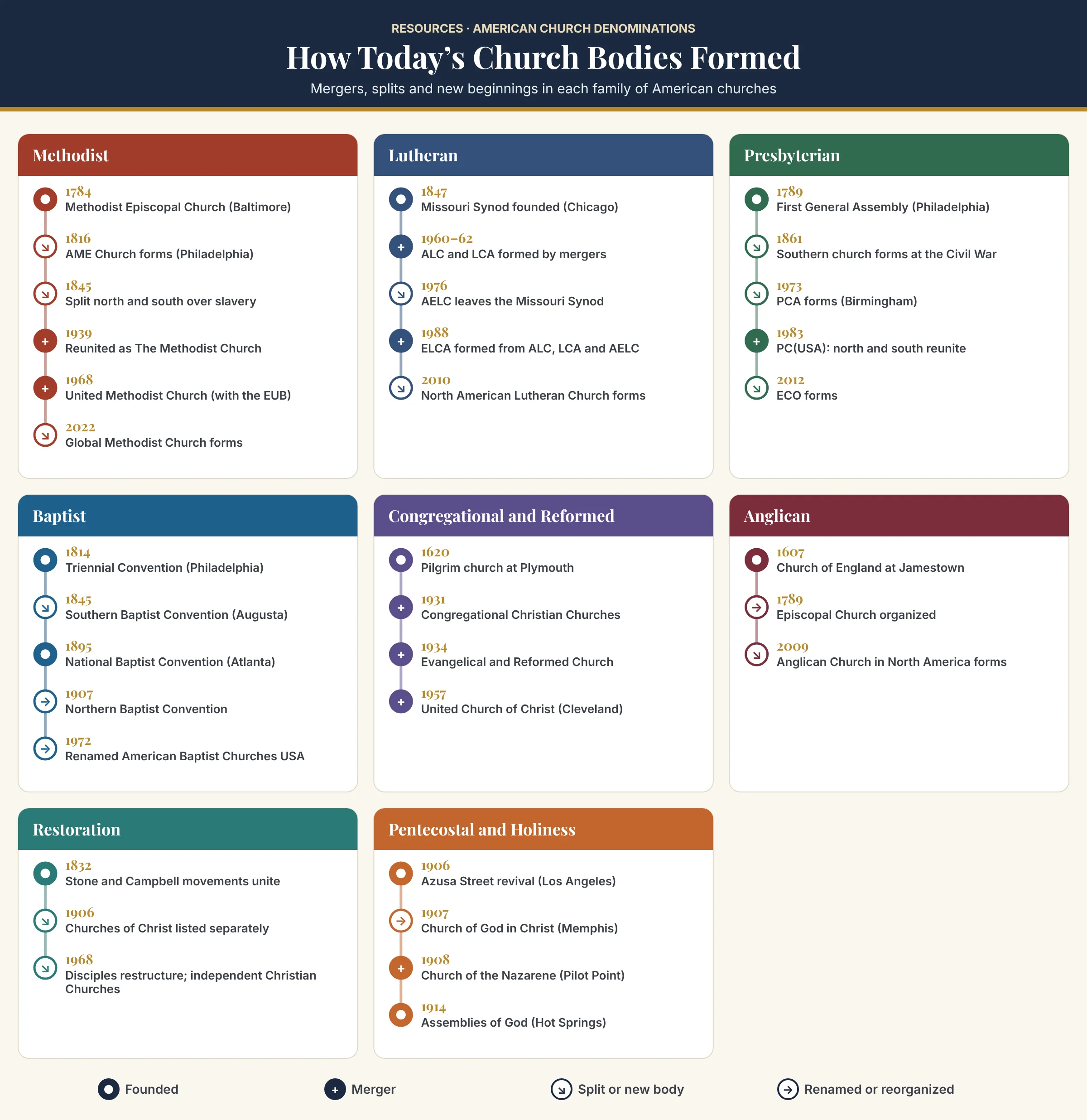
From the 1970s on, many congregations and members left the mainline bodies over the authority of Scripture and, more recently, over marriage and sexuality. They formed or joined bodies such as the PCA, the Anglican Church in North America and the Global Methodist Church. The chart “How Today’s Church Bodies Formed” below traces these changes.
About the Numbers
How to Read This Page
Membership figures come from each body’s own latest reports and are rounded. Positions are stated as each body states them, with a short note where a body has changed historic Christian teaching.
Churches count members differently: some count baptized children, others only adult members, and some publish only estimates. The figures here are rounded and are best used to compare general sizes. Each section gives the year of the report.
Each body is described fairly, in its own terms. Where a body has formally changed what Christians have taught for nearly two thousand years, a short note says so, as the Bereans tested what they heard by the Scriptures (Acts 17:11). Many faithful believers and congregations remain in every one of these bodies.
Key Verse
The Faith Once Delivered
“Beloved, when I gave all diligence to write unto you of the common salvation, it was needful for me to write unto you, and exhort you that ye should earnestly contend for the faith which was once delivered unto the saints.”
Jude 1:3 (KJV)
Chart 1 of 2
How Large Is Each Church Body?
Members in the United States reported by each body, rounded. The Southern Baptist Convention is larger than the next three bodies combined. Historically Black churches and some newer bodies do not publish comparable counts, so they are not shown.
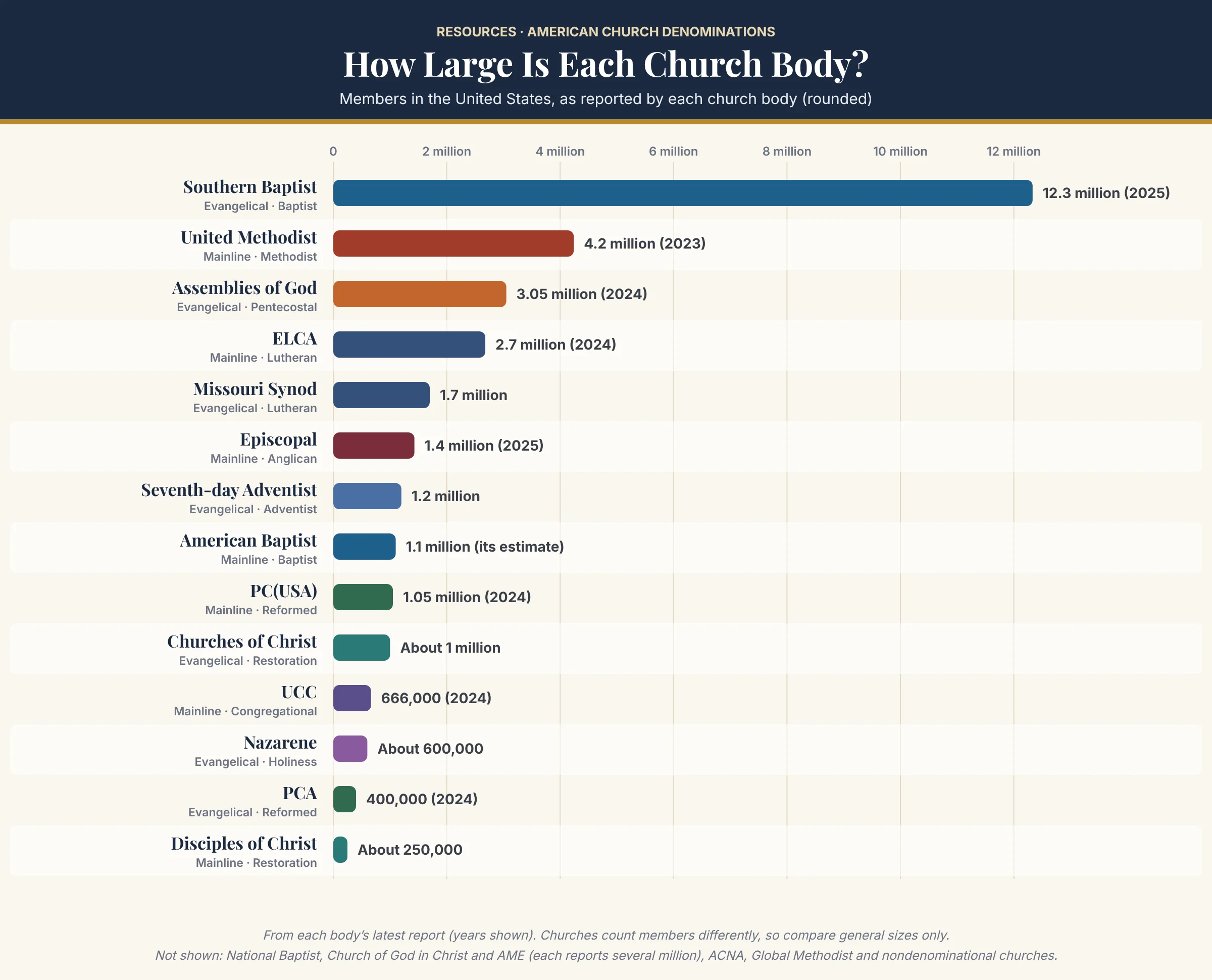
Chart 2 of 2
How Today’s Church Bodies Formed
The mergers and splits that produced today’s church bodies, family by family, from colonial times to today.
Family 1 of 3
Mainline Protestant Churches
The older, historic denominations that once stood at the center of American life. Most have grown smaller since the 1960s.
1 of 20 · Mainline Protestant
The United Methodist Church
For two centuries Methodists were the largest Protestant family in America. The United Methodist Church is still the largest mainline denomination.
United Methodist at a Glance
TraditionMethodist and Wesleyan Churches
Founded1968
WhereDallas, Texas
How it was formedUnion of the Methodist Church and the Evangelical United Brethren Church; roots in the Methodist Episcopal Church of 1784.
MembersAbout 4.2 million U.S. members (2023), after about 7,600 churches left in 2019–2023
CongregationsAbout 22,000 U.S. churches
The BibleScripture is primary, read with tradition, reason and experience
Women as pastorsYes, since 1956
MarriageSince 2024, clergy may perform same-sex weddings; each church decides
History
American Methodism began at the Christmas Conference in Baltimore in 1784, when the Methodist Episcopal Church was organized with Francis Asbury as bishop. It split over slavery in 1844–1845 into northern and southern churches, which reunited with the Methodist Protestants in 1939 as The Methodist Church. On April 23, 1968, in Dallas, it joined the Evangelical United Brethren, a German-speaking Wesleyan church, to form The United Methodist Church.
Beliefs and Worship
The church’s doctrinal standards are Wesley’s Articles of Religion, the EUB Confession of Faith, and Wesley’s Sermons and Notes. It baptizes infants and adults, keeps an open Communion table, and is governed by bishops and conferences, with pastors appointed to churches. More than half of its members now live outside the U.S., many in Africa.
Where It Stands Today
After decades of debate, the 2024 General Conference in Charlotte removed the church’s ban on ordaining “self-avowed practicing homosexuals” and on same-sex weddings, and rewrote its definition of marriage. Between 2019 and 2023 about a quarter of U.S. churches left, many joining the Global Methodist Church.
A Note on Traditional Teaching
This departs from the historic Christian teaching, held by the church for nearly two thousand years and by most Christians worldwide today, that marriage is the lifelong union of one man and one woman (Genesis 2:24; Matthew 19:4–6).
2 of 20 · Mainline Protestant
Evangelical Lutheran Church in America
The largest Lutheran church in America, formed in 1988 from churches founded by German and Scandinavian immigrants.
ELCA at a Glance
TraditionLutheran Churches
Founded1988
WhereColumbus, Ohio (constituting convention, 1987); offices in Chicago
How it was formedUnion of the Lutheran Church in America, the American Lutheran Church and the Association of Evangelical Lutheran Churches.
MembersAbout 2.7 million baptized members (2024)
CongregationsAbout 8,400 congregations
The BibleScripture as the inspired Word of God and source of the church’s teaching
Women as pastorsYes, since 1970 (in its parent churches)
MarriageSince 2009, allows pastors in same-sex relationships; congregations may bless same-sex marriages
History
Lutheran immigrants formed dozens of churches by language and region. Through a century of mergers these became three bodies, which united on January 1, 1988, after a constituting convention in Columbus, Ohio, in 1987. The ELCA’s offices are in Chicago.
Beliefs and Worship
The ELCA accepts the Lutheran Confessions in the Book of Concord. Worship follows the historic liturgy with weekly Communion in many churches. It is in “full communion” with the Episcopal Church, the PC(USA), the UCC, the Reformed Church in America, the Moravians and the United Methodist Church.
Where It Stands Today
In 2009 the ELCA’s Churchwide Assembly voted to allow pastors in committed same-sex relationships. Hundreds of congregations left, forming or joining the North American Lutheran Church and Lutheran Congregations in Mission for Christ.
A Note on Traditional Teaching
This departs from the historic Christian teaching, held by the church for nearly two thousand years and by most Christians worldwide today, that marriage is the lifelong union of one man and one woman (Genesis 2:24; Matthew 19:4–6).
3 of 20 · Mainline Protestant
The Episcopal Church
The American member of the worldwide Anglican Communion. Its members have included many Founding Fathers and presidents.
Episcopal at a Glance
TraditionAnglican and Episcopal Churches
Founded1789
WherePhiladelphia, Pennsylvania; offices in New York City
How it was formedOrganized after the American Revolution from the Church of England in the colonies.
MembersAbout 1.4 million members (2025)
CongregationsAbout 6,000 congregations
The BibleScripture “contains all things necessary to salvation” (Prayer Book), read with tradition and reason
Women as pastorsYes, priests since 1976; bishops since 1989
MarriageSince 2015, marriage rites for same-sex couples
History
When the Revolution cut American Anglicans off from England, they organized the Protestant Episcopal Church at a General Convention in Philadelphia in 1789. Its first bishop, Samuel Seabury, had been consecrated by Scottish bishops in Aberdeen in 1784. George Washington was an Anglican vestryman, and the Washington National Cathedral is an Episcopal church.
Beliefs and Worship
Worship follows the Book of Common Prayer (American edition 1979). The church holds the Apostles’ and Nicene Creeds, is governed by bishops and a General Convention, and is led by a Presiding Bishop.
Where It Stands Today
The church began ordaining women as priests in 1976. In 2003 it consecrated its first openly gay bishop, and in 2015 it approved marriage rites for same-sex couples. Many conservative parishes and four dioceses left, and in 2009 they formed the Anglican Church in North America.
A Note on Traditional Teaching
This departs from the historic Christian teaching, held by the church for nearly two thousand years and by most Christians worldwide today, that marriage is the lifelong union of one man and one woman (Genesis 2:24; Matthew 19:4–6).
4 of 20 · Mainline Protestant
Presbyterian Church (U.S.A.)
The largest Presbyterian body in America. Its roots go back to the first American presbytery, which met in Philadelphia in 1706.
PC(USA) at a Glance
TraditionReformed and Presbyterian Churches
Founded1983
WhereAtlanta, Georgia; offices in Louisville, Kentucky
How it was formedReunion of the northern United Presbyterian Church and the southern Presbyterian Church in the U.S., divided since 1861.
MembersAbout 1.05 million members (2024)
CongregationsAbout 8,400 congregations
The BibleScripture as the unique and authoritative witness to Christ, with the Book of Confessions
Women as pastorsYes, elders since 1930, ministers since 1956
MarriageSince 2015, defines marriage as between “two people”
History
American Presbyterians formed a General Assembly in 1789. The church divided north and south at the Civil War in 1861. The northern church joined the United Presbyterian Church of North America in 1958, and on June 10, 1983, in Atlanta, the northern and southern churches reunited as the Presbyterian Church (U.S.A.).
Beliefs and Worship
The PC(USA) is governed by elders in sessions, presbyteries, synods and a General Assembly. Its Book of Confessions includes the Nicene Creed, the Heidelberg Catechism and the Westminster Confession, along with modern statements.
Where It Stands Today
In 2011 the church removed its requirement that officers live in “fidelity in marriage between a man and a woman, or chastity in singleness,” and in 2015 it redefined marriage as between “two people.” Many congregations moved to the PCA, the Evangelical Presbyterian Church or ECO.
A Note on Traditional Teaching
This departs from the historic Christian teaching, held by the church for nearly two thousand years and by most Christians worldwide today, that marriage is the lifelong union of one man and one woman (Genesis 2:24; Matthew 19:4–6).
5 of 20 · Mainline Protestant
American Baptist Churches USA
The northern branch of America’s oldest Baptist family, with roots in Roger Williams’s church in Providence (1638).
American Baptist at a Glance
TraditionBaptist Churches
Founded1907
WhereWashington, D.C. (as the Northern Baptist Convention); offices near Valley Forge, Pennsylvania
How it was formedContinues the northern Baptist mission societies after the southern churches left in 1845; renamed in 1950 and 1972.
MembersAbout 1.1 million members (its own estimate)
CongregationsAbout 5,000 congregations
The BibleScripture as the divinely inspired Word of God, the final written authority
Women as pastorsYes
Marriage2005 statement: homosexual practice is incompatible with Christian teaching; each church is self-governing
History
American Baptists organized the Triennial Convention in Philadelphia in 1814 to support missionaries Adoniram and Ann Judson in Burma. In 1845 the southern churches left to form the Southern Baptist Convention. The northern societies formed the Northern Baptist Convention in 1907, renamed the American Baptist Convention in 1950 and American Baptist Churches USA in 1972.
Beliefs and Worship
American Baptists hold the historic Baptist convictions: believer’s baptism by immersion, the autonomy of each local church, soul liberty and the separation of church and state. Its churches are among the most racially diverse in America. It has no binding confession.
Where It Stands Today
In 2005 the General Board adopted a statement that “the practice of homosexuality is incompatible with Christian teaching.” Because each congregation governs itself, practice varies; some regions and churches left in the 2000s over the issue.
6 of 20 · Mainline Protestant
United Church of Christ
The heir of the Pilgrims and Puritans of New England, joined with German Reformed churches of the Midwest.
UCC at a Glance
TraditionCongregational Churches
Founded1957
WhereCleveland, Ohio
How it was formedUnion of the Congregational Christian Churches and the Evangelical and Reformed Church.
MembersAbout 666,000 members (2024)
CongregationsAbout 4,400 congregations
The Bible“God is still speaking”; no binding creed
Women as pastorsYes; Antoinette Brown, ordained 1853, was the first in America
MarriageSince 2005, affirms same-sex marriage
History
The Congregational churches of New England merged with the Christian Connection in 1931. The Evangelical and Reformed Church was formed in 1934 by German-American churches. On June 25, 1957, in Cleveland, the two united as the United Church of Christ. Plymouth Rock, Harvard and Yale all belong to its story.
Beliefs and Worship
The UCC is congregational: each church governs itself. It values historic creeds as “testimonies, not tests” of faith. It baptizes infants and adults and keeps an open Communion table.
Where It Stands Today
The UCC ordained its first openly gay minister in 1972 and in 2005 became the first large American denomination to endorse same-sex marriage. It is generally regarded as the most liberal of the mainline churches.
A Note on Traditional Teaching
This departs from the historic Christian teaching, held by the church for nearly two thousand years and by most Christians worldwide today, that marriage is the lifelong union of one man and one woman (Genesis 2:24; Matthew 19:4–6).
7 of 20 · Mainline Protestant
Christian Church (Disciples of Christ)
The mainline branch of the American Restoration Movement, known for weekly Communion open to all believers.
Disciples of Christ at a Glance
TraditionRestoration Movement (Stone-Campbell)
Founded1968
WhereKansas City (restructured as a denomination); offices in Indianapolis, Indiana
How it was formedGrew from the Stone-Campbell movement (1832); separated from the Churches of Christ (1906) and the independent Christian Churches (1968).
MembersAbout 250,000 members (2020s)
CongregationsAbout 3,000 congregations
The Bible“No creed but Christ”; members interpret Scripture freely
Women as pastorsYes, since 1888
MarriageSince 2013, welcomes all regardless of sexual orientation; each church decides on weddings
History
The Disciples grew from the union of the Stone and Campbell movements in Lexington, Kentucky, in 1832. The Churches of Christ, who reject instruments in worship, were counted separately in 1906. In 1968 the Disciples restructured as a denomination, and many conservative congregations stayed independent as Christian Churches and Churches of Christ. President James A. Garfield was a Disciples preacher.
Beliefs and Worship
Disciples celebrate the Lord’s Supper every Sunday at an open table, baptize believers by immersion and value Christian unity. Each congregation owns its property and calls its own minister.
Where It Stands Today
In 2013 the General Assembly called the church to welcome all people “regardless of race, ethnicity, gender, sexual orientation, gender identity.” Weddings are left to each congregation.
A Note on Traditional Teaching
This departs from the historic Christian teaching, held by the church for nearly two thousand years and by most Christians worldwide today, that marriage is the lifelong union of one man and one woman (Genesis 2:24; Matthew 19:4–6).
Family 2 of 3
Evangelical Protestant Churches
Churches that stress the authority of the Bible, the new birth, the cross and evangelism. Together they are the largest group of American Protestants.
8 of 20 · Evangelical Protestant
Southern Baptist Convention
The largest Protestant body in America and the largest Baptist convention in the world, known for its worldwide missions.
Southern Baptist at a Glance
TraditionBaptist Churches
Founded1845
WhereAugusta, Georgia; offices in Nashville, Tennessee
How it was formedFormed by southern Baptists who left the Triennial Convention.
MembersAbout 12.3 million members (2025)
CongregationsAbout 46,600 churches
The BibleThe Bible is “totally true and trustworthy,” without error
Women as pastorsThe office of pastor is limited to men (Baptist Faith and Message 2000)
MarriageMarriage is the union of one man and one woman
History
Southern Baptists organized in Augusta, Georgia, in May 1845, after the northern-led mission board refused to appoint slaveholders as missionaries. In 1995 the convention formally repented of its defense of slavery. From 1979 the “Conservative Resurgence” returned its seminaries and agencies to belief in the inerrancy of Scripture.
Beliefs and Worship
The Baptist Faith and Message (2000) sets out its beliefs: the Bible without error, salvation by grace through faith in Christ, believer’s baptism by immersion and the autonomy of each local church. Churches give through the Cooperative Program (1925) to support thousands of missionaries through the International Mission Board.
Where It Stands Today
The convention holds that marriage is between one man and one woman and that the office of pastor is limited to men. Since 2023 it has removed churches with women serving as pastors, and messengers have debated adding that rule to the convention’s constitution.
9 of 20 · Evangelical Protestant
The Lutheran Church–Missouri Synod
The second-largest Lutheran church in America, known for holding firmly to the Lutheran Confessions and for its large system of Christian schools.
Missouri Synod at a Glance
TraditionLutheran Churches
Founded1847
WhereChicago, Illinois; offices in St. Louis, Missouri
How it was formedFounded by German Lutheran immigrants (the Saxons of Perry County, Missouri, and others).
MembersAbout 1.7 million baptized members (2020s)
CongregationsAbout 6,000 congregations
The BibleThe Bible is the inspired, inerrant Word of God
Women as pastorsNo; pastors are men
MarriageMarriage is the union of one man and one woman
History
Saxon Lutherans who settled in Perry County, Missouri, in 1839 joined other German Lutherans to found the synod in Chicago in April 1847, with C. F. W. Walther as its first president. In 1974 most of the faculty of Concordia Seminary walked out over the authority of Scripture; the synod held to inerrancy, and the departing churches later joined the ELCA.
Beliefs and Worship
The LCMS accepts the whole Book of Concord because it agrees with Scripture. It practices close Communion, receiving at the altar those who share its confession. Its radio program, “The Lutheran Hour,” began in 1930.
Where It Stands Today
The synod ordains only men as pastors and teaches that marriage is between one man and one woman.
10 of 20 · Evangelical Protestant
Presbyterian Church in America
The largest conservative Presbyterian body in America, and one of the few Protestant denominations that has grown steadily.
PCA at a Glance
TraditionReformed and Presbyterian Churches
Founded1973
WhereBirmingham, Alabama; offices in Lawrenceville, Georgia
How it was formedFormed by conservative churches that left the southern Presbyterian Church in the U.S.
MembersAbout 400,000 members (2024)
CongregationsAbout 1,700 churches
The BibleThe Bible is the inerrant Word of God
Women as pastorsNo; elders and ministers are men
MarriageMarriage is the union of one man and one woman
History
Conservative churches concerned about the drift of the southern Presbyterian Church met at Briarwood Presbyterian Church in Birmingham, Alabama, in December 1973 to form what became the Presbyterian Church in America. In 1982 it received the Reformed Presbyterian Church, Evangelical Synod.
Beliefs and Worship
The PCA holds to the Westminster Confession and Catechisms. It is “faithful to the Scriptures, true to the Reformed faith, and obedient to the Great Commission.” Its ministers and elders must be men.
Where It Stands Today
The PCA teaches that marriage is between one man and one woman, and in recent years has strengthened the moral standards required of its officers.
11 of 20 · Evangelical Protestant
Anglican Church in North America
A biblically orthodox Anglican church formed by those who left the Episcopal Church, recognized by most of the world’s Anglicans.
ACNA at a Glance
TraditionAnglican and Episcopal Churches
Founded2009
WhereBedford, Texas
How it was formedFormed by parishes and dioceses that left the Episcopal Church and the Anglican Church of Canada.
MembersAbout 1,000 congregations (its own report)
CongregationsAbout 1,000 congregations
The BibleScripture as God’s Word written, with the Thirty-nine Articles
Women as pastorsBishops are men; each diocese decides on women priests
MarriageMarriage is the union of one man and one woman
History
After the Episcopal Church consecrated an openly gay bishop in 2003, conservative parishes and four dioceses left. With the support of Anglican archbishops in Africa, Asia and South America, they formed the Anglican Church in North America at Bedford, Texas, in June 2009.
Beliefs and Worship
The ACNA holds to the creeds, the Thirty-nine Articles and the Book of Common Prayer (its own edition, 2019). It has planted hundreds of new churches.
Where It Stands Today
The church teaches that marriage is between one man and one woman. Only men serve as bishops; each diocese decides whether to ordain women as priests.
12 of 20 · Evangelical Protestant
Global Methodist Church
The newest major American denomination, a traditional Wesleyan church for Methodists who left the United Methodist Church.
Global Methodist at a Glance
TraditionMethodist and Wesleyan Churches
Founded2022
WhereLaunched May 1, 2022
How it was formedFormed by traditional Methodists, largely congregations that left the United Methodist Church.
MembersMore than 4,000 congregations (its own report)
CongregationsMore than 4,000 congregations
The BibleThe Bible is the inspired Word of God and the final authority
Women as pastorsYes
MarriageMarriage is the union of one man and one woman
History
After years of debate in the United Methodist Church, traditional Methodists launched the Global Methodist Church on May 1, 2022. Thousands of congregations joined as they left the UMC, and it held its first General Conference in Costa Rica in 2024.
Beliefs and Worship
The GMC holds Wesley’s Articles of Religion and the historic creeds, and stresses the authority of Scripture, holiness and evangelism. It limits the terms of its bishops and lets congregations own their property.
Where It Stands Today
The church teaches that marriage is between one man and one woman and ordains both men and women.
13 of 20 · Evangelical Protestant
Assemblies of God
The largest Pentecostal denomination in America and, with its sister churches, the largest Pentecostal fellowship in the world.
Assemblies of God at a Glance
TraditionPentecostal and Charismatic Churches
Founded1914
WhereHot Springs, Arkansas; offices in Springfield, Missouri
How it was formedA fellowship of Pentecostal ministers and churches from the Azusa Street revival.
MembersAbout 3.05 million adherents (2024)
CongregationsAbout 13,000 churches
The BibleThe Bible is the inspired, infallible Word of God
Women as pastorsYes, women have been credentialed as ministers from its early years
MarriageMarriage is the union of one man and one woman
History
About 300 Pentecostal ministers met at Hot Springs, Arkansas, in April 1914 to form a fellowship for missions and training. Its “Statement of Fundamental Truths” dates from 1916. The worldwide fellowship now counts more than 85 million adherents, and its U.S. churches are among the most ethnically diverse.
Beliefs and Worship
The Assemblies of God hold evangelical beliefs and teach the baptism in the Holy Spirit with the initial sign of speaking in tongues (Acts 2:4), divine healing, and the imminent return of Christ.
Where It Stands Today
The church teaches that marriage is between one man and one woman and ordains women as ministers.
14 of 20 · Evangelical Protestant
Churches of Christ
Independent congregations with no headquarters, known for singing without instruments and observing the Lord’s Supper every Sunday.
Churches of Christ at a Glance
TraditionRestoration Movement (Stone-Campbell)
Founded1906
WhereSouthern and central United States (first listed separately in the 1906 census)
How it was formedThe conservative, a cappella branch of the Stone-Campbell movement.
MembersAbout 1 million members
CongregationsAbout 11,500 congregations
The BibleThe Bible as the only rule of faith and practice
Women as pastorsNo; elders and preachers are men
MarriageMarriage is the union of one man and one woman
History
The Churches of Christ grew from the Stone-Campbell movement of the early 1800s. They separated from the Disciples over instrumental music and missionary societies, which they found no warrant for in the New Testament, and were first listed separately in the U.S. religious census of 1906.
Beliefs and Worship
Each congregation is led by its own elders. Members are baptized by immersion for the forgiveness of sins, take the Lord’s Supper each Sunday and sing a cappella. Schools such as Abilene Christian, Pepperdine and Harding are associated with them.
Where It Stands Today
The churches teach that marriage is between one man and one woman; elders and preachers are men.
15 of 20 · Evangelical Protestant
Church of the Nazarene
The largest church of the Holiness movement, carrying on John Wesley’s teaching on holiness of heart and life.
Nazarene at a Glance
TraditionHoliness Churches
Founded1908
WherePilot Point, Texas; offices in Lenexa, Kansas
How it was formedUnion of holiness churches from the West, the East and the South.
MembersAbout 600,000 members in the U.S. and Canada; about 2.6 million worldwide
CongregationsAbout 4,800 U.S. and Canadian churches
The BibleThe Scriptures are inerrant in all things necessary to salvation
Women as pastorsYes, from its founding
MarriageMarriage is the union of one man and one woman
History
Phineas F. Bresee, a former Methodist pastor, began the Church of the Nazarene in Los Angeles in 1895 to preach holiness to the poor. Holiness churches from New England and the South joined it, and the union was completed at Pilot Point, Texas, in October 1908.
Beliefs and Worship
Nazarenes teach entire sanctification as a second work of God’s grace, holy living and worldwide evangelism. They baptize believers and infants and celebrate the Lord’s Supper.
Where It Stands Today
The church has ordained women since its founding and teaches that marriage is between one man and one woman.
16 of 20 · Evangelical Protestant
Seventh-day Adventist Church
A worldwide church that worships on Saturday and awaits the soon return of Christ. About 22 million members worldwide.
Seventh-day Adventist at a Glance
TraditionAdventist Churches
Founded1863
WhereBattle Creek, Michigan; world offices in Silver Spring, Maryland
How it was formedOrganized by Sabbath-keeping Adventists after the Millerite movement.
MembersAbout 1.2 million members in North America
CongregationsAbout 5,000 churches in North America
The BibleThe Bible is the inspired Word of God and the standard of all teaching
Women as pastorsWomen are not ordained as pastors by the world church (2015 vote)
MarriageMarriage is the union of one man and one woman
History
The church was organized at Battle Creek, Michigan, in May 1863, by Sabbath-keeping Adventists led by Joseph Bates and James and Ellen White. It built schools, publishing houses and hospitals, including Loma Linda University Health in California.
Beliefs and Worship
Adventists hold the Trinity and salvation by grace through faith, keep the seventh-day Sabbath, teach that the dead sleep until the resurrection, and follow a health message. Most evangelicals regard them as fellow believers, while differing on some distinctive teachings.
Where It Stands Today
In 2015 the General Conference voted not to let regional bodies ordain women as pastors. The church teaches that marriage is between one man and one woman.
17 of 20 · Evangelical Protestant
Nondenominational Churches
Independent evangelical churches with no denomination, from small Bible churches to some of the largest churches in the country.
Nondenominational at a Glance
TraditionNondenominational and Independent Evangelical Churches
Founded1960s–today
WhereAcross America (Calvary Chapel: Costa Mesa, California, 1965)
How it was formedIndependent congregations and networks such as Calvary Chapel (1965) and the Vineyard (1982).
MembersMillions of Americans; the fastest-growing group of Protestants
CongregationsTens of thousands of churches
The BibleMost hold the Bible to be the inspired, inerrant Word of God
Women as pastorsVaries by church
MarriageMost hold that marriage is the union of one man and one woman
History
Independent Bible churches multiplied after the 1920s. In 1965 Chuck Smith became pastor of Calvary Chapel in Costa Mesa, California, which grew with the Jesus Movement into a fellowship of more than a thousand churches. John Wimber’s Vineyard (1982) and many large community churches followed.
Beliefs and Worship
Most are evangelical, with contemporary worship, Bible teaching and small groups. Because each church sets its own beliefs, it is wise to read a church’s statement of faith before joining.
Where It Stands Today
Most nondenominational churches hold traditional teaching on marriage. Leadership by women varies.
Family 3 of 3
Historically Black Protestant Churches
Churches founded by Black Christians, often in the face of slavery and segregation. They were the heart of the civil rights movement.
18 of 20 · Historically Black Protestant
National Baptist Convention, USA
The largest historically Black denomination in America. Martin Luther King Sr. and Jr. were National Baptist pastors before 1961.
National Baptist at a Glance
TraditionBaptist Churches
Founded1895
WhereAtlanta, Georgia; offices in Nashville, Tennessee
How it was formedUnion of three Black Baptist conventions for missions and education.
MembersReports several million members
CongregationsThousands of churches
The BibleThe Bible as the inspired Word of God
Women as pastorsEach church decides; most pastors are men
MarriageMarriage is the union of one man and one woman
History
In September 1895 at Friendship Baptist Church in Atlanta, three conventions united: the Baptist Foreign Mission Convention (1880), the American National Baptist Convention (1886) and the Baptist National Educational Convention. The National Baptist Convention of America (1915) and the Progressive National Baptist Convention (1961) later formed from it.
Beliefs and Worship
National Baptists hold historic Baptist beliefs: believer’s baptism by immersion, the autonomy of the local church and salvation by grace through faith. Its churches are known for powerful preaching and gospel music.
Where It Stands Today
The convention holds traditional teaching on marriage. Each church calls its own pastor.
19 of 20 · Historically Black Protestant
Church of God in Christ
The largest Pentecostal denomination in America by its own count, and one of the largest historically Black churches.
Church of God in Christ at a Glance
TraditionPentecostal and Charismatic Churches
Founded1897 (Pentecostal from 1907)
WhereLexington, Mississippi; headquarters in Memphis, Tennessee
How it was formedFounded as a holiness church; reorganized as Pentecostal after the Azusa Street revival.
MembersReports several million members
CongregationsAbout 12,000 churches (its own report)
The BibleThe Bible is the inspired and infallible Word of God
Women as pastorsWomen serve as missionaries and evangelists; pastors are men
MarriageMarriage is the union of one man and one woman
History
Charles Harrison Mason and Charles Price Jones founded the church as a holiness body in 1897. Mason received the baptism in the Holy Spirit at Azusa Street in 1907 and reorganized the church as Pentecostal, with headquarters in Memphis. Martin Luther King Jr. gave his last speech at its Mason Temple on April 3, 1968.
Beliefs and Worship
COGIC holds the Trinity, salvation through Christ, the baptism in the Holy Spirit, holiness of life and divine healing. Its worship gave birth to much of modern gospel music.
Where It Stands Today
The church teaches that marriage is between one man and one woman; its bishops, pastors and elders are men.
20 of 20 · Historically Black Protestant
African Methodist Episcopal Church
The first independent Black denomination in America, founded by Richard Allen, a former slave who bought his freedom.
AME at a Glance
TraditionMethodist and Wesleyan Churches
Founded1816
WherePhiladelphia, Pennsylvania
How it was formedFormed by Black Methodists led by Richard Allen, after discrimination at St. George’s Methodist Church.
MembersReports about 2.5 million members worldwide
CongregationsAbout 7,000 churches worldwide
The BibleThe Bible as the Word of God; Methodist Articles of Religion
Women as pastorsYes; its first woman bishop was elected in 2000
Marriage2004 General Conference: marriage between a man and a woman
History
Richard Allen and other Black members walked out of St. George’s Methodist Church in Philadelphia after being pulled from their knees during prayer. Allen founded Bethel Church in 1794, and in April 1816 several Black Methodist churches united as the African Methodist Episcopal Church, with Allen as its first bishop. Its churches were stations on the Underground Railroad.
Beliefs and Worship
The AME Church holds Methodist doctrine and worship, with bishops and conferences. Its motto is “God our Father, Christ our Redeemer, the Holy Spirit our Comforter, Humankind our Family.”
Where It Stands Today
The church ordains women and in 2004 voted against same-sex marriage.
More Churches
Other Church Bodies
Smaller American Protestant bodies, many of them described in their tradition’s section on our Protestant Denominations page.
Wisconsin Evangelical Lutheran Synod
1850 · Milwaukee
A confessional Lutheran body of about 330,000 members, close in belief to the Missouri Synod.
North American Lutheran Church
2010 · Columbus, Ohio
Formed by congregations that left the ELCA after 2009, with Lutheran Congregations in Mission for Christ (2001).
Reformed Church in America
1628 · New Amsterdam
The oldest Protestant body in America with a continuous ministry, begun by Dutch settlers in New York.
Christian Reformed Church
1857 · Holland, Michigan
A Dutch Reformed church known for Calvin University and its confessional Reformed teaching.
Orthodox Presbyterian and EPC
1936 · 1981
The OPC was founded by J. Gresham Machen; the Evangelical Presbyterian Church has received many former PC(USA) churches.
Evangelical Free Church of America
1950 · Minneapolis
Formed by Swedish and Norwegian-Danish free churches, with a short evangelical statement of faith.
Evangelical Covenant Church
1885 · Chicago
A church of Swedish Pietist roots that stresses the new birth and the Bible as “the only perfect rule.”
Christian and Missionary Alliance
1887 · New York
Founded by A. B. Simpson; known for missions to unreached peoples.
Church of God (Cleveland, Tennessee)
1886 · Tennessee
One of the oldest Pentecostal churches, with holiness roots in the Appalachian mountains.
Foursquare Church
1927 · Los Angeles
Founded by evangelist Aimee Semple McPherson at Angelus Temple; Pentecostal and evangelical.
AME Zion and CME Churches
1821 · 1870
Historically Black Methodist churches begun in New York City (AME Zion) and Jackson, Tennessee (CME).
Progressive National Baptist Convention
1961 · Cincinnati
Formed by Black Baptist pastors, including Martin Luther King Jr., to support the civil rights movement.
Wesleyan, Free Methodist and Salvation Army
1843 · 1860 · 1880
Holiness churches of Wesleyan belief; the Salvation Army came to America in 1880.
Mennonite Church USA and the Amish
2002 · 1730s
Anabaptist churches of Pennsylvania and the Midwest. The Amish number about 400,000 in North America.
Friends (Quakers)
1682 · Pennsylvania
Friends United Meeting, Evangelical Friends and unprogrammed meetings carry on George Fox’s movement.
Moravian Church in America
1741 · Bethlehem, Pennsylvania
Heirs of Jan Hus and the Herrnhut renewal, known for missions, music and the Christmas lovefeast.
Choosing a Church
Finding a Faithful Church
A denomination’s name tells you its history, but not everything about a local church. Faithful congregations can be found in many of these bodies. Here are six questions to ask of any church.
1
The Bible as God’s Word
Does the church teach Scripture as God’s inspired, trustworthy Word, and preach from it?
“Preach the word; be instant in season, out of season; reprove, rebuke, exhort with all longsuffering and doctrine.”
2
Christ Crucified and Risen
Does it preach salvation by grace through faith in Jesus Christ alone?
“For I determined not to know any thing among you, save Jesus Christ, and Him crucified.”
3
The Historic Faith
Does it confess the Trinity and the creeds that Christians have always held?
“Beloved, when I gave all diligence to write unto you of the common salvation, it was needful for me to write unto you, and exhort you that ye should earnestly contend for the faith which was once delivered unto the saints.”
4
Tested by Scripture
Does it welcome questions and test its teaching by the Bible, like the Bereans?
“These were more noble than those in Thessalonica, in that they received the word with all readiness of mind, and searched the scriptures daily, whether those things were so.”
5
Fellowship and Care
Do its members pray together, share the Lord’s Supper and care for one another?
“And they continued stedfastly in the apostles’ doctrine and fellowship, and in breaking of bread, and in prayers.”
6
Sharing the Gospel
Does it reach its neighbors and the nations with the good news?
“Go ye therefore, and teach all nations, baptizing them in the name of the Father, and of the Son, and of the Holy Ghost:”
Questions
Questions About American Church Denominations
What does “mainline” mean?
The name probably comes from the Main Line, a string of wealthy suburbs on the Pennsylvania Railroad west of Philadelphia, where many of these older churches stood. It now means the historic Protestant denominations that were once at the center of American religious life.
Why did so many churches leave the United Methodist Church?
Between 2019 and 2023 about 7,600 U.S. congregations, roughly a quarter of the total, used a church rule that let them leave with their property. Most left because they expected the church to change its teaching on marriage and sexuality, which it did in 2024. Many joined the Global Methodist Church; others became independent.
What does “full communion” mean?
It is an agreement between denominations to recognize one another’s baptism, Communion and ministers, so that pastors may serve in either church. The ELCA, for example, is in full communion with the Episcopal Church, the PC(USA), the UCC and the United Methodist Church.
Which American church body is the largest?
The Roman Catholic Church is the largest single church in America. Among Protestants, the Southern Baptist Convention is the largest, followed by the United Methodist Church and the Assemblies of God. Taken together, nondenominational churches would rank near the top.
Are these membership numbers exact?
No. Each body counts differently, and some publish only estimates. Figures are rounded from each church’s latest report and are best used to compare general sizes. The historically Black churches report several million members each but do not publish detailed counts, so they are not shown on the chart.
How can I find out what a particular church believes?
Read its statement of faith (usually on its website), ask which denomination it belongs to, and talk with the pastor. Remember that a local church may be more or less traditional than its denomination.
Keep Studying
Related Studies
The history and beliefs of each Protestant tradition, from Luther to today.
How Christianity compares with the other religions of the world.
Continue Your Study
Scripture quotations and verse links are from the King James Version (KJV).