
Key Christian Terms · In Plain Words
Repentance: Turning Back to God
Repentance means changing your mind and turning around: turning away from sin and turning back to God.
Repentance is not about feeling bad for its own sake. It is about coming home. It is the first word of Jesus’ preaching and an open door, not a closed one.
“Repent ye therefore, and be converted, that your sins may be blotted out, when the times of refreshing shall come from the presence of the Lord.”
Acts 3:19 (KJV)
In Plain Words
What Does Repentance Mean?
In one sentence
Repentance means changing your mind and turning around: turning away from sin and turning back to God.
Imagine driving the wrong way down a road. Repentance is not just feeling sorry about it; it is turning the car around. In the Bible, repentance is a change of mind that leads to a change of direction: away from sin, and toward God.
It was the first thing Jesus preached: “The time is fulfilled, and the kingdom of God is at hand: repent ye, and believe the gospel” (Mark 1:15). Repentance and faith go together like two sides of one coin. We turn from sin, and we turn to Jesus.
The word itself: The Greek word metanoia means a change of mind. The Old Testament often uses the Hebrew shuv, to turn or return: “return unto the LORD, and he will have mercy upon him” (Isaiah 55:7).
What Repentance Involves
Seeing it
Being honest that what I did was wrong, not excusing it or blaming others. Like the lost son, coming to our senses.
Owning it
Godly sorrow: grieving that we have hurt God and others, and confessing it to him. This kind of sorrow leads to life, not despair.
Turning from it
Changing direction with God’s help. Real repentance shows up in changed choices, not just changed words.
An Everyday Picture
The Son Who Came Home
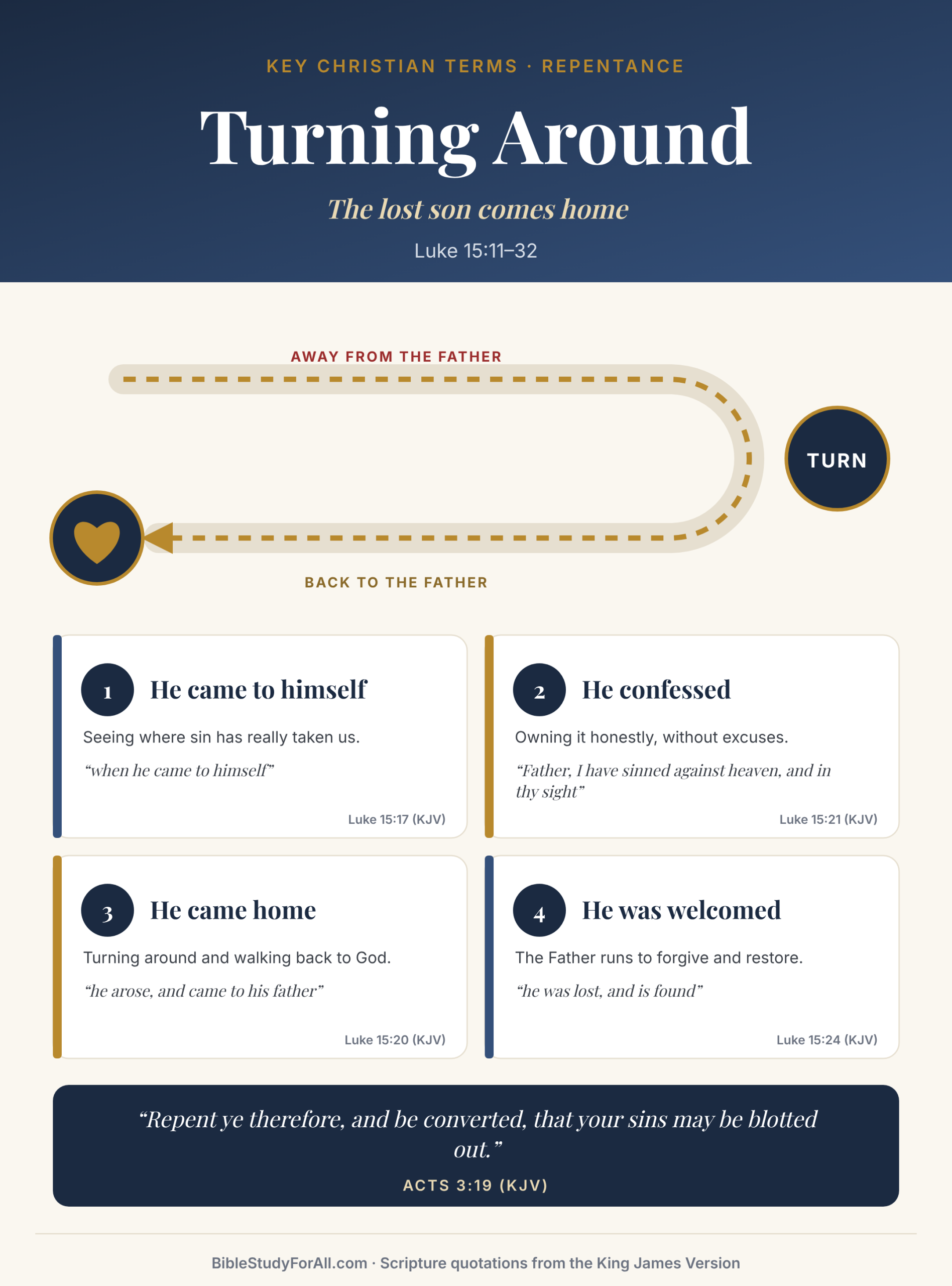
Jesus told a story about a young man who took his inheritance, left home and wasted it. Broke and starving, “he came to himself” (Luke 15:17). He decided to go back, confess, and ask to be a servant.
But “when he was yet a great way off, his father saw him, and had compassion, and ran, and fell on his neck, and kissed him” (Luke 15:20). That is repentance: we turn around, and we find the Father already running toward us.
Luke 15
Turning Around
The story of the lost son shows repentance in four simple steps, from the far country back to the Father’s arms.
What the Bible Says
Three Key Verses
Acts 3:19
“Repent ye therefore, and be converted, that your sins may be blotted out, when the times of refreshing shall come from the presence of the Lord.”
In plain words: When you turn back to God, your sins are wiped away and he refreshes you.
2 Peter 3:9
“The Lord is not slack concerning his promise, as some men count slackness; but is longsuffering to us-ward, not willing that any should perish, but that all should come to repentance.”
In plain words: God is patient because he wants everyone to turn back to him.
1 John 1:9
“If we confess our sins, he is faithful and just to forgive us our sins, and to cleanse us from all unrighteousness.”
In plain words: Confess your sins honestly, and God promises to forgive and clean you.
Clearing It Up
What It Is and What It Isn’t
A common mix-up
“Repentance is just feeling guilty.”
Feelings can come and go. Repentance is a turn in direction. “Godly sorrow worketh repentance to salvation” (2 Corinthians 7:10): sorrow is a doorway, not the destination.
A common mix-up
“I have to fix myself before God will take me.”
The lost son came home in rags. Jesus said, “I came not to call the righteous, but sinners to repentance” (Luke 5:32). We turn toward God, and he does the healing.
A common mix-up
“Repentance is a one-time thing.”
Turning to Christ happens at the start of the Christian life, but believers keep turning back whenever they stray. Jesus even told a church, “be zealous therefore, and repent” (Revelation 3:19).
How It Connects
Repentance and the Other Big Words
The Bible’s big words are not separate ideas. They are different angles on one story: what God has done for us in Jesus.
Turning to God is how we receive his rescue.
God’s kindness is what draws us to turn back.
Repentance is our turn; new birth is God’s work in us.
Faith
Repentance turns from sin; faith turns to Jesus.
Page coming soon
Those who turn and trust are declared “not guilty.”
Sanctification
A life of daily turning shapes us to be like Jesus.
Page coming soon
Living It Out
Putting It into Practice
1
Be honest with God
Take a few quiet minutes and ask God to show you anything you need to turn from (Psalm 139:23–24). Name it plainly.
2
Confess and receive forgiveness
Tell God what you did, and believe his promise to forgive. Where you have hurt someone, make it right if you can.
3
Take one step the other way
Repentance is practical. Remove a temptation, make a phone call, change a habit. Ask a trusted friend to help you keep going.
Questions
Quick Questions
Is repentance the same as being sorry?
Sorrow is part of it, but not all of it. Judas felt remorse (Matthew 27:3), but did not turn back to God. Peter wept bitterly and was restored (Luke 22:62; John 21:15–17). Real repentance is sorrow that turns toward God, not away from him.
Do I have to repent to be saved?
The New Testament joins repentance and faith together. Peter preached, “Repent ye therefore, and be converted, that your sins may be blotted out” (Acts 3:19). Repentance is not earning salvation; it is turning around to receive it. Even the desire to turn is a gift of God’s kindness (Romans 2:4).
Does God ever repent?
The KJV sometimes says God “repented” (for example Jonah 3:10). In those places the word means God relented or changed his course of action in response to people, as he had promised he would (Jeremiah 18:7–8). It never means God had sinned or made a mistake.
What if I keep falling into the same sin?
Keep coming back. God does not tire of forgiving those who turn to him honestly (1 John 1:9). Ask for help from mature Christians, look at what leads you into the sin, and remember that change is often slow. Jesus told Peter to forgive “seventy times seven” (Matthew 18:22); God’s patience with his children is no less.
Keep Reading
Continue Your Study
Read the key passages for yourself, then explore the Bible books and topics where repentance comes up most.
Scripture quotations are from the King James Version (KJV), which is in the public domain. Verse links open at BibleGateway.