
Old Testament · The Law · Book 1 of 66
Genesis
The book of beginnings: God creates the heaven and the earth, sin enters through Adam, judgment falls in the flood, and God begins His plan of redemption through His promise to Abraham, Isaac, Jacob and their seed. “In the beginning God created the heaven and the earth” (1:1).
Genesis at a Glance
Book Outline
Note: Scripture quotations and verse links on this site use the King James Version (KJV) because it is in the public domain, while most modern translations limit how much can be quoted online. Feel free to read along in the translation of your choice.
50 Chapters
1,533 verses
Author
Moses
Written
c. 1446–1406 B.C., in the wilderness
Covers
Creation to the death of Joseph
About the Name
Title
Genesis means “origin” or “beginning.” Its Hebrew title, Bereshith, is the book’s first word: “In the beginning.” It opens the five books of Moses, the Law.
The English name Genesis comes from the Greek translation of the Old Testament, which uses the word genesis (“origin,” “birth” or “generations”) in 2:4 and 5:1. The Latin Bible kept the name, and English Bibles followed it. The Hebrew title is Bereshith, “In the beginning,” taken from the book’s first word, as was the custom for naming the books of the Hebrew Bible.
Genesis is the first of the five books of the Law, called the Torah in Hebrew and the Pentateuch (“five scrolls”) in Greek, followed by Exodus, Leviticus, Numbers and Deuteronomy. The book is built around ten family records, each beginning “These are the generations of …” (2:4; 5:1; 6:9; 10:1; 11:10; 11:27; 25:12; 25:19; 36:1; 37:2).
Who Wrote It
Author Details
Written by Moses, who wrote the five books of the Law. Jesus spoke of “the book of Moses” (Mark 12:26) and said of him, “he wrote of Me” (John 5:46).
Genesis is the first of the five books that Scripture calls “the book of the law of Moses” (Joshua 8:31; Nehemiah 8:1). Jesus Himself named Moses as their author: “have ye not read in the book of Moses” (Mark 12:26), and “had ye believed Moses, ye would have believed Me: for he wrote of Me” (John 5:46). Beginning at Moses and all the prophets, the risen Lord expounded “the things concerning Himself” (Luke 24:27).
Moses was raised in Pharaoh’s household and “was learned in all the wisdom of the Egyptians” (Acts 7:22). God spoke with him “face to face, as a man speaketh unto his friend” (Exodus 33:11). The events of Genesis took place before Moses was born; God made them known to him, and the family histories of Abraham, Isaac and Jacob had been handed down in Israel. “All scripture is given by inspiration of God” (2 Timothy 3:16), and Genesis is the foundation for the rest of it.
When It Was Written
Date of Writing
Written c. 1446–1406 B.C., during Israel’s forty years in the wilderness, after the exodus from Egypt and before Israel crossed the Jordan into Canaan.
Moses wrote during the wilderness years, between the exodus and his death on Mount Nebo. First Kings 6:1 says Solomon began building the temple “in the four hundred and eightieth year after the children of Israel were come out of the land of Egypt,” in the fourth year of his reign, about 966 B.C. Counting back gives the exodus about 1446 B.C., so Genesis was written about 1446–1406 B.C., the year Israel crossed the Jordan.
The events reach from creation to the death of Joseph. Abraham was born about 2166 B.C. and was called to leave Haran at seventy-five (12:4). Jacob’s family went down to Egypt about 1876 B.C., 430 years before the exodus (Exodus 12:40), and Joseph died about 1806 B.C. Moses wrote it for the people of Israel as they prepared to enter the land God had promised to Abraham, Isaac and Jacob, to show them where they came from, who their God is, and why the land was theirs.
Key Verse
In the Beginning
“In the beginning God created the heaven and the earth.”
Genesis 1:1 (KJV)
Big Ideas
Key Themes
God the Creator
All things were made by God’s word, and made good.
1:1, 31
Man in God’s Image
Man and woman were made to know God and rule His world.
1:26–28; 2:7
Sin and Judgment
Sin brings death, and God judges it, as in the flood.
3:19; 6:5–7
Grace and Promise
God promises a Redeemer and saves those who trust Him.
3:15; 6:8
Covenant
God binds Himself by covenant to Noah and to Abraham’s seed.
9:13; 12:1–3; 17:7
Faith
Abraham believed God, and it was counted for righteousness.
15:6; 22:8
God’s Providence
God rules over all, even evil deeds, for good.
45:5–8; 50:20
The Chosen Line
From Seth to Abraham to Judah, God keeps the line of the promised seed.
4:25; 12:3; 49:10
A Land Promised
Canaan given to Abraham’s seed for an everlasting possession.
13:15; 17:8; 50:24
Overview
Genesis Summary
OverviewThe Book of Beginnings
Genesis is the book of beginnings. It opens with the words “In the beginning God created the heaven and the earth” (1:1) and tells how the world, mankind, marriage, sin, death, the nations, the languages and the people of Israel all began. It covers more time than any other book of the Bible, from creation to the death of Joseph in Egypt, and it lays the foundation for everything that follows. Without Genesis we would not know why the world needs a Saviour, who Israel is, or what God promised to do. The book falls into two parts: four great events (chapters 1–11: creation, the fall, the flood and Babel) and four great people (chapters 12–50: Abraham, Isaac, Jacob and Joseph).
Chapters 1–2Creation
God speaks, and the world comes into being: “And God said, Let there be light: and there was light” (1:3). In six days He forms the heavens, the seas and the dry land, and fills them with lights, fish, fowl and beasts. On the sixth day He makes man: “So God created man in His own image, in the image of God created He him; male and female created He them” (1:27). “And God saw every thing that He had made, and, behold, it was very good” (1:31), and on the seventh day He rested and blessed it (2:2–3). Chapter 2 looks closer at the sixth day. “The LORD God formed man of the dust of the ground, and breathed into his nostrils the breath of life; and man became a living soul” (2:7). God plants a garden eastward in Eden, gives one command, and makes the woman from the man’s rib, so that “they shall be one flesh” (2:24). See our study Creation: The Seven Days for a day-by-day look.
Chapters 3–5The Fall and the First Promise
The serpent asks, “Yea, hath God said …?” and tells the woman, “Ye shall not surely die” (3:1, 4). She eats of the forbidden tree, gives to her husband, “and he did eat” (3:6). At once they are ashamed and hide, and the LORD God calls, “Where art thou?” (3:9). Sin brings pain, toil and death: “for dust thou art, and unto dust shalt thou return” (3:19). Yet in the curse on the serpent God gives the first promise of a Redeemer: “And I will put enmity between thee and the woman, and between thy seed and her seed; it shall bruise thy head, and thou shalt bruise His heel” (3:15). The LORD God clothes Adam and his wife with coats of skins and sends them out of Eden. Sin spreads quickly: Cain kills his brother Abel (4:8), and chapter 5 repeats the sad refrain “and he died,” broken only by Enoch, who “walked with God: and he was not; for God took him” (5:24). See Man’s Fall in Eden for a closer study.
Chapters 6–9The Flood
“God saw that the wickedness of man was great in the earth, and that every imagination of the thoughts of his heart was only evil continually” (6:5). He resolved to destroy man from the face of the earth, “But Noah found grace in the eyes of the LORD” (6:8). Noah “was a just man and perfect in his generations, and Noah walked with God” (6:9). God told him to make an ark of gopher wood, and Noah did all that God commanded. Rain fell forty days and forty nights, and the waters covered “all the high hills, that were under the whole heaven” (7:19). All flesh died except those in the ark. Then “God remembered Noah” (8:1), the waters went down, and Noah came out and built an altar. God made a covenant never again to destroy the earth by a flood: “I do set My bow in the cloud, and it shall be for a token of a covenant between Me and the earth” (9:13). Read more in our study The Flood.
Chapters 10–11The Nations and Babel
Chapter 10, the Table of Nations, traces the families of Noah’s three sons, Shem, Ham and Japheth, “and by these were the nations divided in the earth after the flood” (10:32). Instead of filling the earth as God had commanded, the people gathered on a plain in Shinar and said, “Go to, let us build us a city and a tower, whose top may reach unto heaven; and let us make us a name” (11:4). The LORD came down and confounded their language and scattered them abroad: “Therefore is the name of it called Babel; because the LORD did there confound the language of all the earth” (11:9). Chapter 11 then narrows to one line, the generations of Shem, down to Terah and his son Abram, who moved with his father from Ur of the Chaldees to Haran.
Chapters 12–25Abraham, the Friend of God
Now God begins His plan to bless the whole world through one man and his family. “Get thee out of thy country, and from thy kindred, and from thy father’s house, unto a land that I will shew thee” (12:1). God promises Abram a land, a great nation, and a blessing for the world: “and in thee shall all families of the earth be blessed” (12:3). Abram obeys and goes to Canaan. When God promises him descendants as many as the stars, “he believed in the LORD; and He counted it to him for righteousness” (15:6). God seals His promise with a covenant (15; 17) and renames him Abraham, “a father of many nations” (17:5). After years of waiting, Sarah bears Isaac, “as He had said” (21:1). Then God tests Abraham, telling him to offer Isaac on Mount Moriah. Abraham says, “My son, God will provide Himself a lamb for a burnt offering” (22:8), and God provides a ram in Isaac’s place. Abraham dies “in a good old age” (25:8). See our study The Abrahamic Covenant for God’s promises to Abraham.
Chapters 24–36Isaac and Jacob
Abraham’s servant finds Rebekah as a wife for Isaac, and God renews the promise to Isaac: “in thy seed shall all the nations of the earth be blessed” (26:4). Isaac and Rebekah have twin sons, Esau and Jacob, and God says, “the elder shall serve the younger” (25:23). Esau sells his birthright for a meal, and Jacob, with his mother’s help, deceives his blind father to receive the blessing. Fleeing from Esau, Jacob dreams at Bethel of a ladder reaching to heaven, and God promises, “I am with thee, and will keep thee in all places whither thou goest” (28:15). For twenty years Jacob serves his uncle Laban, marries Leah and Rachel, and has eleven sons and a daughter. Returning home, he wrestles all night and is renamed: “Thy name shall be called no more Jacob, but Israel” (32:28). He is reconciled with Esau, returns to Bethel, and his twelfth son, Benjamin, is born as Rachel dies.
Chapters 37–50Joseph, from the Pit to the Palace
Jacob loves Joseph more than his other sons and gives him “a coat of many colours” (37:3). His jealous brothers sell him to traders, and he is taken to Egypt. There “the LORD was with Joseph” (39:2): he serves faithfully in Potiphar’s house, refuses the advances of Potiphar’s wife (“how then can I do this great wickedness, and sin against God?” 39:9), and is thrown into prison. God gives him the meaning of dreams, and when he explains Pharaoh’s dreams of seven years of plenty and seven years of famine, Pharaoh sets him over all the land of Egypt. The famine brings his brothers to Egypt to buy grain. Joseph tests them, sees that they have changed, and makes himself known: “God did send me before you to preserve life” (45:5). Jacob’s whole family, seventy souls, moves to Egypt (46:27). Before he dies, Jacob blesses his twelve sons, promising that “The sceptre shall not depart from Judah … until Shiloh come” (49:10).
Looking AheadGod Meant It unto Good
Genesis ends with Joseph’s words to his brothers: “But as for you, ye thought evil against me; but God meant it unto good, to bring to pass, as it is this day, to save much people alive” (50:20). Joseph dies in Egypt at a hundred and ten, sure that “God will surely visit you, and bring you out of this land unto the land which He sware to Abraham, to Isaac, and to Jacob” (50:24). The book closes with a coffin in Egypt, but also with a promise, and Exodus tells how God kept it. The promise of the woman’s seed (3:15) and of the blessing for all nations through Abraham’s seed (22:18) is fulfilled in Jesus Christ: “He saith not, And to seeds, as of many; but as of one, And to thy seed, which is Christ” (Galatians 3:16).
At a Glance
Genesis at a Glance
The whole book in short sections: its two parts, the topic studies on this site, the four great events, the days of creation, the four great people, two maps of the patriarchs’ journeys and the land, Jacob’s twelve sons, the ten “generations,” God’s promises, a timeline, and pictures of Christ in Genesis. Tap a topic to jump to it.
Printable Copy
Save or Print the Infographic
Everything in this section, with the key verse and key themes, is also on a printable infographic (seven pages). It opens in a new tab, where you can save it to your phone or computer, share it, or print it.
Structure
The Book in Two Parts
Genesis falls into two parts. Chapters 1–11 tell four great events that touch the whole human race; chapters 12–50 narrow to one family, through whom God prepares for the coming of the Redeemer.
Each bar shows that part’s share of the 1,533 verses.
I 1–11 · 299 verses
Entrance of Sin on Earth
Creation, the fall, the flood, and the nations and Babel.
II 12–50 · 1,234 verses
Preparation for the Redeemer
Abraham, Isaac, Jacob and Joseph.
Go Deeper
Topic Studies from Genesis
Four of the great subjects of Genesis have their own study pages on this site, with pictures, key verses and questions to think about.
GENESIS 1–2
Creation
The seven days of creation, day by day, and what they teach about God and about us.
Read the study →
GENESIS 3
Man’s Fall in Eden
The temptation, the first sin, its results, and God’s first promise of a Redeemer.
Read the study →
GENESIS 6–9
The Flood
Noah, the ark, the flood that covered the earth, and God’s covenant of the rainbow.
Read the study →
GENESIS 12–22
The Abrahamic Covenant
God’s promises to Abraham of a land, a people and a blessing for all nations.
Read the study →
Chapters 1–11
Four Great Events
The first eleven chapters cover the whole human race, from the first man to the scattering of the nations.
4 10–11
Babel
The LORD confounds the language of all the earth and scatters the nations (11:9).
“And God saw every thing that He had made, and, behold, it was very good.”Genesis 1:31 (KJV)
Genesis 1:1–2:3
The Days of Creation
On the first three days God forms the world; on the next three He fills it. On the seventh day He rests.
GOD FORMS
Day 1: Light, and the light divided from the darkness
1:3–5
GOD FILLS
Day 4: Sun, moon and stars, lights in the firmament
1:14–19
GOD FORMS
Day 2: The firmament divides the waters above from the waters below
1:6–8
GOD FILLS
Day 5: Creatures of the waters and fowl of the air
1:20–23
GOD FORMS
Day 3: Dry land, seas, grass, herbs and fruit trees
1:9–13
GOD FILLS
Day 6: Beasts of the earth, and man in God’s image
1:24–31
Day 7 · Genesis 2:2–3
God Rested
“And on the seventh day God ended His work which He had made; and He rested on the seventh day from all His work which He had made. And God blessed the seventh day, and sanctified it.”
For a day-by-day study with pictures, see Creation: The Seven Days.
Chapters 12–50
Four Great People
From chapter 12 the story narrows to one family, through whom God will bless the world.
1 12–25 · FAITH
Abraham
Called out of Ur and Haran, he believes God’s promise and is counted righteous.
“And he believed in the LORD; and He counted it to him for righteousness.”
15:6
2 21–35 · THE PROMISED SON
Isaac
The son of promise, laid on the altar and spared; God renews the covenant with him.
“God will provide Himself a lamb for a burnt offering”
22:8
3 25–50 · CHANGED BY GOD
Jacob (Israel)
A schemer whom God meets at Bethel and Peniel and renames Israel; father of the twelve tribes.
“for I have seen God face to face, and my life is preserved.”
32:30
4 37–50 · FAITHFUL IN TRIAL
Joseph
Sold as a slave, raised to rule Egypt, and used by God to save his family and many people.
“God did send me before you to preserve life.”
45:5
Genesis 11–50 · Map
The Journeys of the Patriarchs
God called Abram out of Ur of the Chaldees to a land He would show him. The map follows Abram by Haran into Canaan and down to Egypt, Jacob’s flight to Haran and back, and Jacob’s family going down to Goshen. The numbers match the cards below.
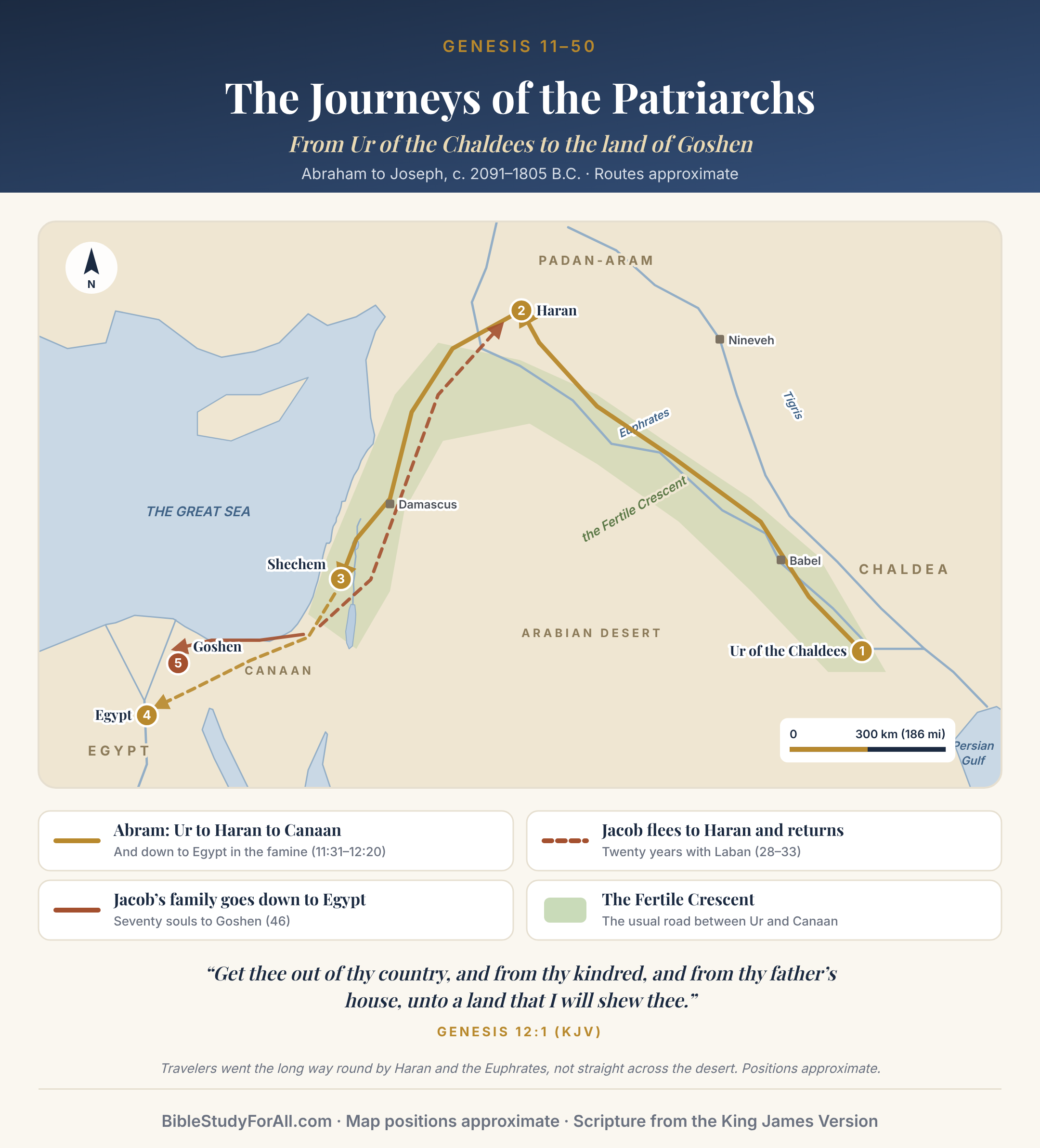
1 11:28–31; 15:7
Ur of the Chaldees
Abraham. Abram’s home city, which he left with Terah, Sarai and Lot.
2 11:31–12:5; 28:10; 29:4
Haran
Abraham. Terah dies; the LORD calls Abram on to Canaan. Later Jacob flees here to Laban.
3 12:6–7; 33:18
Shechem
Abraham. Abram’s first altar in the land: “Unto thy seed will I give this land.”
4 12:10–20
Egypt
Abraham. Abram goes down in a famine, and Pharaoh sends him away.
5 45:10; 46–47; 50
Goshen
Jacob and Joseph. Joseph brings Jacob’s family, seventy souls, to dwell in Goshen.
Genesis 12–37 · Map
The Patriarchs in the Land
Abraham, Isaac and Jacob lived as strangers in the land God promised them, moving between Shechem, Bethel, Hebron and Beer-sheba. The numbers match the cards below.
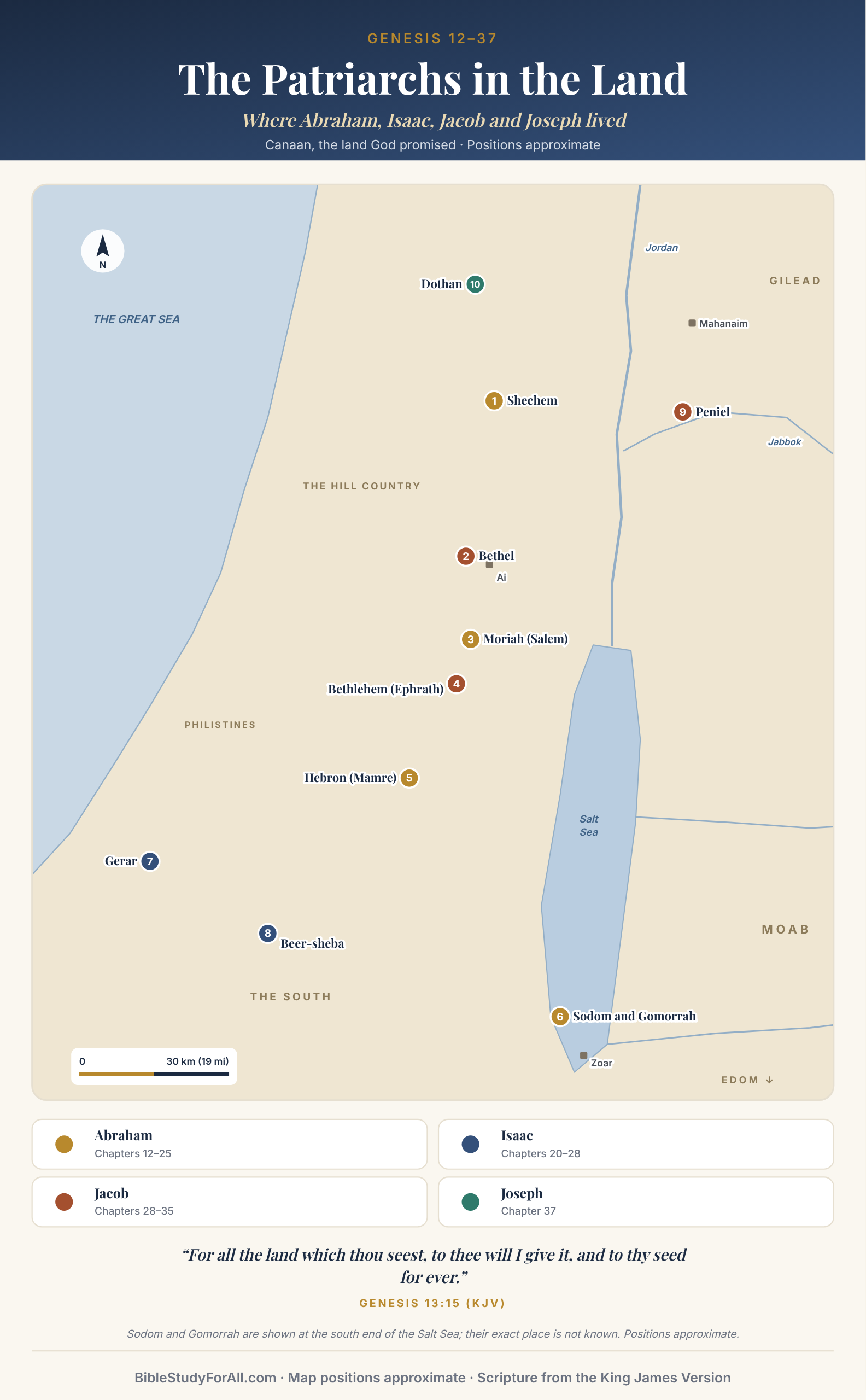
1 12:6–7; 33:18–20; 37:12–14
Shechem
Abraham. Abram builds his first altar; Jacob buys a field and builds an altar.
2 12:8; 28:10–22; 35:1–15
Bethel
Jacob. Abram’s altar between Bethel and Ai; Jacob’s ladder; God renames him Israel.
3 14:18–20; 22:1–14
Moriah (Salem)
Abraham. Melchizedek king of Salem blesses Abram; Abraham offers Isaac on mount Moriah.
4 35:16–20
Bethlehem (Ephrath)
Jacob. Rachel dies giving birth to Benjamin and is buried by the way.
5 13:18; 18; 23; 35:27; 50:13
Hebron (Mamre)
Abraham. Abraham dwells by the oaks of Mamre; the cave of Machpelah, the family grave.
6 13:10–13; 18:16–19:29
Sodom and Gomorrah
Abraham. The cities of the plain destroyed with fire and brimstone; Lot escapes to Zoar.
7 20; 26:1–22
Gerar
Isaac. Abraham and later Isaac sojourn with Abimelech; Isaac digs again the wells.
8 21:31–33; 26:23–33; 28:10; 46:1
Beer-sheba
Isaac. Abraham’s well and covenant; Isaac’s home; Jacob sets out from here twice.
9 32:22–32
Peniel
Jacob. By the ford Jabbok Jacob wrestles until daybreak: “I have seen God face to face.”
10 37:17–28
Dothan
Joseph. Joseph’s brothers cast him into a pit and sell him to the Ishmeelites.
Genesis 29–35; 49
The Twelve Sons of Jacob
Jacob’s twelve sons became the twelve tribes of Israel. Here they are in the order of their birth, with each one’s mother (35:23–26).
LEAH
Reuben
The firstborn (29:32)
LEAH
Simeon
“the LORD hath heard” (29:33)
LEAH
Levi
Father of the priestly tribe (29:34)
LEAH
Judah
“Now will I praise the LORD” (29:35)
BILHAH
Dan
Rachel’s maid’s son (30:6)
BILHAH
Naphtali
Rachel’s maid’s son (30:8)
ZILPAH
Gad
Leah’s maid’s son (30:11)
ZILPAH
Asher
Leah’s maid’s son (30:13)
LEAH
Issachar
Leah’s fifth son (30:18)
LEAH
Zebulun
Leah’s sixth son (30:20)
RACHEL
Joseph
Father of Ephraim and Manasseh (30:24; 48:5)
RACHEL
Benjamin
Born as Rachel died (35:18)
“The sceptre shall not depart from Judah, nor a lawgiver from between his feet, until Shiloh come; and unto Him shall the gathering of the people be.”Genesis 49:10 (KJV)
The Book’s Framework
The Ten “Generations”
Genesis is divided by ten headings, each beginning “These are the generations of …”
1 2:4
The Heavens and the Earth
2 5:1
Adam
3 6:9
Noah
4 10:1
The Sons of Noah
5 11:10
Shem
6 11:27
Terah (Abraham’s story)
7 25:12
Ishmael
8 25:19
Isaac (Jacob’s story)
9 36:1
Esau
10 37:2
Jacob (Joseph’s story)
Each heading opens what came from that person. The family lines not chosen (Cain, Ishmael, Esau) are told briefly; the chosen line is told in full.
The Covenant Promises
God’s Promises in Genesis
The story of Genesis, and of the whole Bible, rests on promises God made and kept.
“And I will put enmity between thee and the woman, and between thy seed and her seed; it shall bruise thy head, and thou shalt bruise His heel.”Genesis 3:15 (KJV)
9:8–17 · NOAH
Never Again a Flood
God’s covenant with Noah and every living creature, sealed by the bow in the cloud.
12:1–3 · ABRAHAM
A Land, a Nation, a Blessing
“in thee shall all families of the earth be blessed” (12:3).
15; 17 · THE COVENANT
Sealed and Signed
The covenant between the pieces, and circumcision as its token.
22:15–18 · BY OATH
Through Abraham’s Seed
“in thy seed shall all the nations of the earth be blessed” (22:18).
26:3–4 · ISAAC
Renewed to Isaac
“I will perform the oath which I sware unto Abraham thy father” (26:3).
28:13–15 · JACOB
Renewed to Jacob
“in thee and in thy seed shall all the families of the earth be blessed” (28:14).
See The Abrahamic Covenant for a full study of God’s covenant with Abraham.
Dates B.C. (Approximate)
Timeline of the Patriarchs
Dates follow the early exodus (c. 1446 B.C., 1 Kings 6:1) and the ages Genesis gives. Chapters 1–11 are not dated here.
c. 2166 B.C.
Abram Born
In Ur of the Chaldees (11:26–28)
c. 2091 B.C.
The Call
Abram leaves Haran at 75 (12:4)
c. 2066 B.C.
Isaac Born
Abraham is 100 (21:5)
c. 2006 B.C.
Jacob and Esau Born
Isaac is 60 (25:26)
c. 1916 B.C.
Joseph Born
In Padanaram (30:22–25)
c. 1899 B.C.
Joseph Sold
At seventeen (37:2, 28)
c. 1876 B.C.
Into Egypt
Jacob is 130 (47:9)
c. 1806 B.C.
Joseph Dies
At 110 years old (50:26)
Looking Forward
Pictures of Christ in Genesis
Jesus said that Moses “wrote of Me” (John 5:46). Genesis points ahead to Him again and again.
3:15
The Seed of the Woman
The first promise: one born of a woman will crush the serpent’s head (Galatians 4:4).
6–8
The Ark
One way of safety from judgment, with one door (1 Peter 3:20–21).
14:18
Melchizedek
King of Salem and “priest of the most high God,” a picture of Christ our High Priest (Hebrews 7).
22:8
The Lamb Provided
Abraham offers his only son, and God provides a substitute (John 1:29).
28:12
Jacob’s Ladder
Angels ascending and descending, fulfilled in the Son of man (John 1:51).
37–50
Joseph
Beloved, rejected by his brothers, then exalted to save many (Acts 7:9–14).
Book Outline
Genesis Outline
Fifty chapters in two parts: the entrance of sin on earth through four great events, creation, the fall, the flood and Babel (1–11), and God’s preparation for the coming of the Redeemer through four great people, Abraham, Isaac, Jacob and Joseph (12–50). For a closer look, see the topic studies Creation, Man’s Fall in Eden, The Flood and The Abrahamic Covenant. Tap a part below to jump to it, tap any section to expand it, and tap a verse reference to read it in the King James Version at BibleGateway.
Part I
Entrance of Sin on Earth
1:1–11:32 · Four great events: creation, the fall, the flood, and the nations and Babel
- “In the beginning God created the heaven and the earth” · 1:1–2
- Day one: “Let there be light” · 1:3–5
- Day two: the firmament divides the waters · 1:6–8
- Day three: dry land, seas, grass and trees · 1:9–13
- Day four: sun, moon and stars · 1:14–19
- Day five: creatures of the sea and fowl of the air · 1:20–23
- Day six: beasts of the earth, and man in the image of God · 1:24–31
- The seventh day: God rests, blesses it and sanctifies it · 2:1–3
- The LORD God forms man of the dust of the ground · 2:4–7
- The garden eastward in Eden, and God’s command · 2:8–17
- The woman is made: “they shall be one flesh” · 2:18–25
- The serpent’s temptation and the first sin · 3:1–7
- “Where art thou?” The man and woman hide from God · 3:8–13
- The curses, and the first promise of the woman’s seed · 3:14–19
- Coats of skins, and sent out of Eden · 3:20–24
- Cain slays Abel · 4:1–8
- “Am I my brother’s keeper?” Cain’s punishment and mark · 4:9–16
- Cain’s descendants and Lamech’s boast · 4:17–24
- Seth and Enos: “then began men to call upon the name of the LORD” · 4:25–26
- The generations of Adam, from Adam to Jared · 5:1–20
- “Enoch walked with God: and he was not; for God took him” · 5:21–24
- Methuselah, Lamech and Noah · 5:25–32
- Wickedness on the earth: “But Noah found grace in the eyes of the LORD” · 6:1–8
- God tells Noah to make an ark of gopher wood · 6:9–22
- Noah, his family and the animals enter the ark · 7:1–10
- The waters prevail upon the earth · 7:11–24
- “God remembered Noah,” and the waters go down · 8:1–14
- Out of the ark; Noah builds an altar unto the LORD · 8:15–22
- God blesses Noah; man made in the image of God · 9:1–7
- The covenant and the bow in the cloud · 9:8–17
- Noah’s sons and Noah’s death · 9:18–29
Part II
Preparation for the Coming of the Redeemer
12:1–50:26 · Four great people: Abraham, Isaac, Jacob and Joseph
- The call of Abram: “in thee shall all families of the earth be blessed” · 12:1–3
- Abram journeys to Canaan · 12:4–9
- Abram in Egypt · 12:10–20
- Abram and Lot separate · 13:1–13
- The land promised again · 13:14–18
- Abram rescues Lot · 14:1–16
- Melchizedek, “priest of the most high God,” blesses Abram · 14:17–24
- “And he believed in the LORD; and He counted it to him for righteousness” · 15:1–6
- The covenant between the pieces · 15:7–21
- Sarai and Hagar · 16:1–6
- The angel of the LORD finds Hagar; Ishmael is born · 16:7–16
- The covenant of circumcision; Abram becomes Abraham · 17:1–14
- Sarah is promised a son · 17:15–27
- Three visitors at Mamre: “Is any thing too hard for the LORD?” · 18:1–15
- Abraham pleads for Sodom · 18:16–33
- The angels in Sodom · 19:1–11
- Sodom and Gomorrah destroyed · 19:12–29
- Lot and his daughters · 19:30–38
- Abraham and Abimelech · 20:1–18
- Isaac is born · 21:1–7
- Hagar and Ishmael sent away · 21:8–21
- The covenant at Beersheba · 21:22–34
- God tests Abraham: “God will provide Himself a lamb” · 22:1–14
- The promise confirmed by oath · 22:15–19
- The sons of Nahor · 22:20–24
- Sarah’s death and burial at Machpelah · 23:1–20
- Abraham sends his servant to find a wife for Isaac · 24:1–9
- The servant meets Rebekah at the well · 24:10–27
- Rebekah agrees to go: “I will go” · 24:28–61
- Isaac takes Rebekah, and she becomes his wife · 24:62–67
- Abraham’s other sons · 25:1–6
- The death of Abraham · 25:7–11
- The generations of Ishmael · 25:12–18
- Jacob and Esau are born · 25:19–26
- Esau sells his birthright · 25:27–34
- God renews the promise to Isaac · 26:1–6
- Isaac and Abimelech · 26:7–11
- Strife over the wells; the LORD appears at Beersheba · 26:12–25
- The covenant with Abimelech · 26:26–33
- Esau’s wives · 26:34–35
- Jacob takes Esau’s blessing · 27:1–29
- Esau’s grief and blessing · 27:30–40
- Jacob is sent to Laban · 27:41–28:9
- Jacob’s ladder at Bethel: “Surely the LORD is in this place” · 28:10–22
- Jacob comes to Laban · 29:1–14
- Jacob marries Leah and Rachel · 29:15–30
- Jacob’s children are born · 29:31–30:24
- Jacob’s flocks increase · 30:25–43
- Jacob flees from Laban · 31:1–21
- Laban pursues Jacob · 31:22–42
- The covenant at Mizpah · 31:43–55
- Jacob prepares to meet Esau · 32:1–21
- Jacob wrestles until daybreak and is named Israel · 32:22–32
- Jacob and Esau meet · 33:1–20
- Dinah and the men of Shechem · 34:1–31
- Jacob returns to Bethel · 35:1–15
- The deaths of Rachel and Isaac · 35:16–29
- The generations of Esau · 36:1–19
- The sons of Seir the Horite · 36:20–30
- The kings and dukes of Edom · 36:31–43
- Joseph’s coat and Joseph’s dreams · 37:1–11
- Joseph is sold by his brethren · 37:12–36
- Judah and Tamar · 38:1–30
- “The LORD was with Joseph” in Potiphar’s house · 39:1–6
- Joseph refuses and is put in prison · 39:7–23
- The butler and the baker · 40:1–23
- Pharaoh’s dreams · 41:1–36
- Joseph is set over all the land of Egypt · 41:37–57
- The brethren’s first journey to Egypt · 42:1–24
- The brethren return to Canaan · 42:25–38
- The second journey, with Benjamin · 43:1–34
- The silver cup · 44:1–17
- Judah offers himself for Benjamin · 44:18–34
- Joseph makes himself known: “God did send me before you to preserve life” · 45:1–15
- Pharaoh invites the family to Egypt · 45:16–28
- God speaks to Jacob at Beersheba · 46:1–7
- Jacob’s family goes down to Egypt · 46:8–27
- Jacob and Joseph are reunited · 46:28–34
- The family settles in Goshen · 47:1–12
- Joseph and the famine · 47:13–26
- Jacob asks to be buried in Canaan · 47:27–31
- Jacob blesses Ephraim and Manasseh · 48:1–22
- Jacob blesses his twelve sons · 49:1–28
- Jacob’s death and burial · 49:29–50:14
- “Ye thought evil against me; but God meant it unto good” · 50:15–21
- The death of Joseph · 50:22–26
Continue Your Study
Scripture quotations and verse links are from the King James Version (KJV).