
Genesis 12–22 · Romans 4 · Galatians 3 · Bible Study
The Abrahamic Covenant
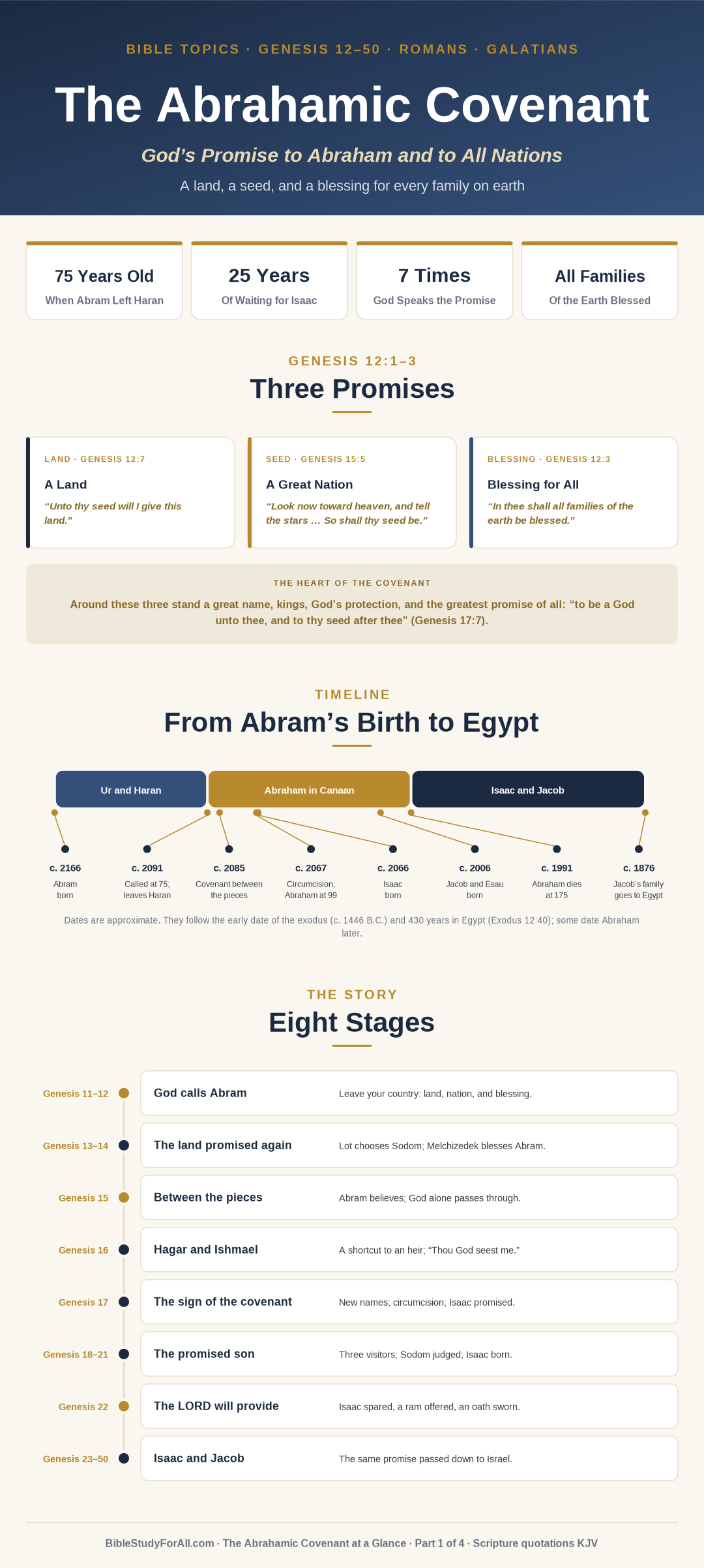
God called Abraham to leave his homeland and promised him a land, countless descendants, and a blessing for all nations. This covenant is the foundation of Israel’s story and of God’s plan of salvation. Follow the promise from Ur to Moriah, and see how it reaches you.
“And I will make of thee a great nation, and I will bless thee, and make thy name great; and thou shalt be a blessing.”
Genesis 12:2
75 Years Old
When Abram left Haran
25 Years
Of waiting for Isaac
7 Times
God speaks the promise
All Families
Of the earth to be blessed
At a Glance
From Ur to Moriah
The story moves in eight stages: God calls Abram, the land is promised again, God makes a covenant between the pieces, Hagar bears Ishmael, circumcision becomes the covenant sign, Isaac is born, Abraham offers Isaac on Moriah, and the covenant passes to Isaac and Jacob. Select a stage to jump straight to it.
Stage 1 · c. 2091 B.C.
Leave your country; I will give you a land, a nation, and a blessing for all.
Stage 2 · c. 2090–2085 B.C.
Abram gives Lot first choice; God gives Abram the whole land.
Stage 5 · c. 2067 B.C.
New names, an everlasting covenant, and circumcision as its sign.
Stage 7 · Isaac a young man
Abraham offers Isaac; God provides a ram and swears an oath.
Stage 8 · c. 2029–1876 B.C.
A burial cave, a bride for Isaac, and the same promise to Jacob.
The whole story in four parts. Save or print them to keep beside your Bible.
Before You Begin
Three Habits for This Study
You don’t need any background to follow along. These habits will help you get the most from each stage.
Mark the three promises
Every time God speaks to Abraham, look for the land, the seed, and the blessing. Start with Genesis 12:1–3 (KJV) and watch how each promise grows.
Follow the journey on a map
Abraham moved from Ur to Haran, then through Shechem, Bethel, Egypt, Hebron, Beersheba, and Moriah. The places below help you picture where each stage happens.
Read the New Testament alongside
Romans 4, Galatians 3, and Hebrews 11 explain what the covenant means for Christians. Read them after Genesis 15, 17, and 22.
The Heart of the Covenant
What God Promised
God’s promises to Abraham come down to three: land, seed, and blessing. Around them stand a great name, royal descendants, God’s protection, and, at the center, God himself.
Land
“Unto thy seed will I give this land.” Canaan, from the river of Egypt to the Euphrates, as “an everlasting possession” (Genesis 17:8).
Seed
Descendants as the stars of heaven and the sand of the sea shore, through a son of Abraham and Sarah: “in Isaac shall thy seed be called” (Genesis 21:12).
Blessing
“In thee shall all families of the earth be blessed.” God’s blessing on Abraham is meant to flow out to every nation.
A Great Name and Kings
“Make thy name great … kings shall come out of thee.” A royal line that leads to David, and to David’s greater Son.
Protection
“I will bless them that bless thee, and curse him that curseth thee.” “Fear not, Abram: I am thy shield.”
God Himself
The greatest promise of all: “to be a God unto thee, and to thy seed after thee … and I will be their God.”
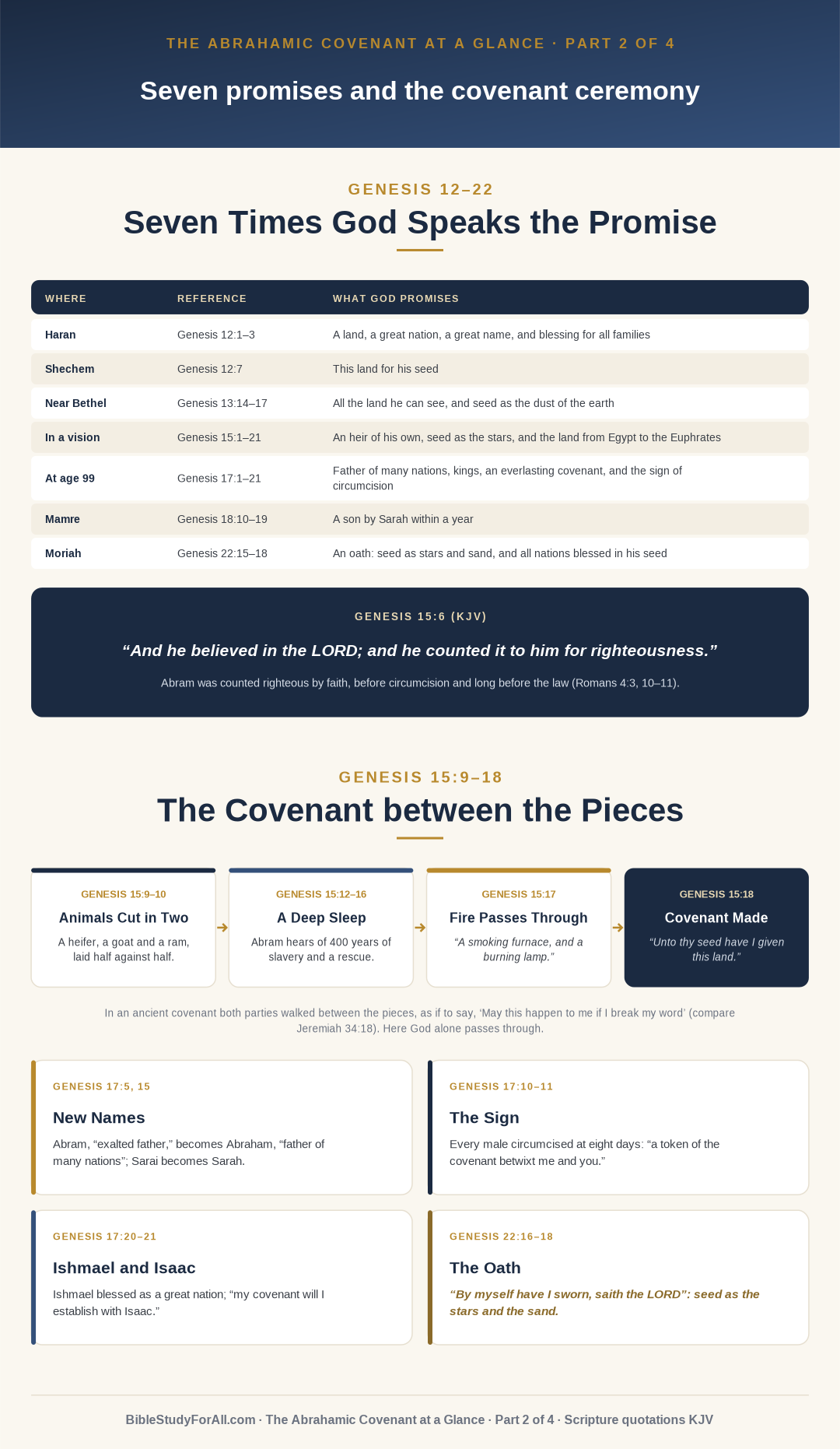
Seven Times God Speaks the Promise
Each time, God repeats and adds to what he said before, until he seals it with an oath on Moriah.
| # | Where | What God promises | In his words (KJV) |
|---|---|---|---|
| 1 | Haran Genesis 12:1–3 | A land, a great nation, a great name, and blessing for all families | “In thee shall all families of the earth be blessed” |
| 2 | Shechem Genesis 12:7 | This land for his seed | “Unto thy seed will I give this land” |
| 3 | Near Bethel Genesis 13:14–17 | All the land he can see, and seed as the dust of the earth | “To thee will I give it, and to thy seed for ever” |
| 4 | In a vision Genesis 15:1–21 | An heir of his own, seed as the stars, and the land from Egypt to the Euphrates | “So shall thy seed be” |
| 5 | At age 99 Genesis 17:1–21 | Father of many nations, kings, an everlasting covenant, and the sign of circumcision | “To be a God unto thee, and to thy seed after thee” |
| 6 | Mamre Genesis 18:10–19 | A son by Sarah within a year | “Is any thing too hard for the LORD?” |
| 7 | Moriah Genesis 22:15–18 | An oath: seed as stars and sand, and all nations blessed in his seed | “By myself have I sworn, saith the LORD” |
Stage 1 of 8 · Genesis 11:27–12:9
God Calls Abram
When: c. 2091 B.C.
“And I will bless them that bless thee, and curse him that curseth thee: and in thee shall all families of the earth be blessed.”Genesis 12:3 (KJV) · Read Genesis 11:27–12:9
What happens
Abram grows up in Ur of the Chaldees, in a family that “served other gods” (Joshua 24:2). His father Terah sets out for Canaan with Abram, his wife Sarai, and his nephew Lot, but they stop at Haran and settle there (Genesis 11:31). Sarai “was barren; she had no child” (Genesis 11:30).
Then the LORD speaks: “Get thee out of thy country, and from thy kindred, and from thy father’s house, unto a land that I will shew thee” (Genesis 12:1). With the command come the promises: a great nation, a great name, blessing, and “in thee shall all families of the earth be blessed.” So Abram goes, “seventy and five years old when he departed out of Haran” (Genesis 12:4). At Shechem the LORD appears again: “Unto thy seed will I give this land” (Genesis 12:7). Abram builds an altar there, and another near Bethel.
Look closer
These three verses (Genesis 12:1–3) hold the whole covenant in seed form: a land, a seed (descendants), and a blessing that reaches every family on earth. Everything else God says to Abraham fills in these three promises.
The call comes right after Babel, where people tried to “make us a name” (Genesis 11:4). Here God says to one man, “I will … make thy name great.” What people could not grab for themselves, God gives as a gift.
Think about it
Abram left what he knew with only God’s word to go on. What is God asking you to trust him with before you can see where it leads?
Stage 2 of 8 · Genesis 12:10–14:24
The Land Promised Again
When: c. 2090–2085 B.C.
“For all the land which thou seest, to thee will I give it, and to thy seed for ever.”Genesis 13:15 (KJV) · Read Genesis 12:10–14:24
What happens
A famine sends Abram to Egypt, where, afraid for his life, he passes Sarai off as his sister. God protects her anyway, and Pharaoh sends them away (Genesis 12:10–20). Back near Bethel, Abram and Lot have so many flocks that their herdsmen quarrel. Abram says, “Let there be no strife, I pray thee, between me and thee … for we be brethren” (Genesis 13:8), and lets Lot choose first. Lot picks the well-watered plain near Sodom.
Then God tells Abram to look north, south, east, and west: “all the land which thou seest, to thee will I give it.” His seed will be “as the dust of the earth” (Genesis 13:16). Abram settles at Mamre near Hebron. When raiding kings carry Lot away, Abram rescues him, and Melchizedek, “king of Salem” and “priest of the most high God,” blesses Abram, who gives him a tenth (Genesis 14:18–20).
Look closer
Abram refused to take even “a thread even to a shoelatchet” from the king of Sodom, “lest thou shouldest say, I have made Abram rich” (Genesis 14:23). He wanted it clear that his riches came from God.
Melchizedek appears only briefly, but Psalm 110:4 and Hebrews 7 see him as a picture of Christ, a priest-king greater even than Abraham.
Think about it
Abram let Lot take the best land because he trusted God to provide. Where could you let go of your rights, trusting that God sees and gives?
Stage 3 of 8 · Genesis 15
The Covenant between the Pieces
When: c. 2085 B.C.
“And he believed in the LORD; and he counted it to him for righteousness.”Genesis 15:6 (KJV) · Read Genesis 15
What happens
Abram is still childless. He asks, “Lord GOD, what wilt thou give me, seeing I go childless?” (Genesis 15:2). God takes him outside: “Look now toward heaven, and tell the stars, if thou be able to number them … So shall thy seed be” (Genesis 15:5). Abram believes God, and God counts that faith as righteousness.
When Abram asks how he can know he will inherit the land, God tells him to cut a heifer, a goat, and a ram in two and lay the halves opposite each other. Abram falls into a deep sleep and hears that his descendants will be strangers and slaves “four hundred years” before coming out “with great substance” (Genesis 15:13–14). After dark, “a smoking furnace, and a burning lamp … passed between those pieces.” “In the same day the LORD made a covenant with Abram, saying, Unto thy seed have I given this land, from the river of Egypt unto the great river, the river Euphrates” (Genesis 15:17–18).
Look closer
In the ancient world, people sealed a covenant by walking between cut animals, as if to say, ‘May this happen to me if I break my word.’ Jeremiah mentions the same custom: “when they cut the calf in twain, and passed between the parts thereof” (Jeremiah 34:18).
But here only God passes through, in the fire and smoke. Abram is asleep. God puts himself under the oath alone. Paul builds on Genesis 15:6 to show that we are made right with God by faith, not works: “Abraham believed God, and it was counted unto him for righteousness” (Romans 4:3).
Think about it
Abram was made right with God by believing his promise. What does it mean for you to rest on God’s word rather than your own record?
Stage 4 of 8 · Genesis 16
Hagar and Ishmael
When: c. 2080 B.C.
“And she called the name of the LORD that spake unto her, Thou God seest me.”Genesis 16:13 (KJV) · Read Genesis 16
What happens
Ten years in Canaan, and still no child. Sarai says, “Behold now, the LORD hath restrained me from bearing: I pray thee, go in unto my maid; it may be that I may obtain children by her” (Genesis 16:2). It was a common custom of the time, and Abram agrees. Hagar, Sarai’s Egyptian maid, conceives, and then looks down on her mistress. Sarai treats her harshly, and Hagar runs away into the wilderness.
There the angel of the LORD finds her by a spring. He tells her to go back, and he gives her a promise of her own: “I will multiply thy seed exceedingly” (Genesis 16:10). Her son will be called Ishmael, “God hears,” “because the LORD hath heard thy affliction.” Hagar gives God a name: “Thou God seest me.” Abram is eighty-six when Ishmael is born (Genesis 16:16).
Look closer
The plan to get an heir through Hagar was human wisdom, not faith, and it caused heartache in the family for years. Paul later uses Hagar and Sarah as a picture of two ways to relate to God: by our own effort, or by promise (Galatians 4:22–31).
Yet God did not abandon Hagar or her son. He saw her, heard her, and blessed Ishmael too (Genesis 17:20; 21:17–18).
Think about it
Sarai and Abram tried to make God’s promise happen their own way. Where are you tempted to take a shortcut instead of waiting on God?
Stage 5 of 8 · Genesis 17
Abraham and the Sign of the Covenant
When: c. 2067 B.C.
“And I will establish my covenant between me and thee and thy seed after thee in their generations for an everlasting covenant, to be a God unto thee, and to thy seed after thee.”Genesis 17:7 (KJV) · Read Genesis 17
What happens
Thirteen more years pass. When Abram is ninety-nine, God appears: “I am the Almighty God; walk before me, and be thou perfect” (Genesis 17:1). He changes Abram’s name, “exalted father,” to Abraham, “for a father of many nations have I made thee” (Genesis 17:5), and Sarai’s name to Sarah. “Kings shall come out of thee” (Genesis 17:6). The covenant is “an everlasting covenant,” and the land “an everlasting possession” (Genesis 17:7–8).
God gives the covenant a sign: every male is to be circumcised, at eight days old, “and it shall be a token of the covenant betwixt me and you” (Genesis 17:11). Abraham laughs at the thought of a son at a hundred. God answers that Sarah will bear a son, to be named Isaac, “he laughs,” and “my covenant will I establish with Isaac” (Genesis 17:21). That same day Abraham, Ishmael, and every male in the household are circumcised.
Look closer
Most of all, the covenant promises God himself: “to be a God unto thee, and to thy seed after thee.” That promise echoes all the way to Revelation: “they shall be his people, and God himself shall be with them, and be their God” (Revelation 21:3).
Paul notes that Abraham was declared righteous in Genesis 15, before he was circumcised in Genesis 17. Circumcision was “a seal of the righteousness of the faith which he had yet being uncircumcised: that he might be the father of all them that believe” (Romans 4:11).
Think about it
God gave Abraham a new name to match his promise. How does God’s word about you shape how you see yourself?
Stage 6 of 8 · Genesis 18–21
The Promised Son
When: c. 2067–2066 B.C.
“Is any thing too hard for the LORD? At the time appointed I will return unto thee, according to the time of life, and Sarah shall have a son.”Genesis 18:14 (KJV) · Read Genesis 18–21
What happens
Three visitors come to Abraham’s tent at Mamre, and he welcomes them with a meal. One of them is the LORD. He says that by this time next year Sarah will have a son. Sarah, listening behind the tent door, laughs to herself, and the LORD asks, “Is any thing too hard for the LORD?” Then the LORD tells Abraham that Sodom is about to be judged, and Abraham pleads for the city: “Shall not the Judge of all the earth do right?” (Genesis 18:25). Sodom is destroyed, but Lot is rescued (Genesis 19).
At last “the LORD visited Sarah as he had said” (Genesis 21:1). Abraham is a hundred years old when Isaac is born, twenty-five years after he left Haran. Later, when Ishmael mocks Isaac, God tells Abraham to send Hagar and Ishmael away, “for in Isaac shall thy seed be called” (Genesis 21:12). God cares for them in the wilderness and promises, “I will make him a great nation” (Genesis 21:18).
Look closer
God tells why he shares his plans with Abraham: “For I know him, that he will command his children and his household after him, and they shall keep the way of the LORD, to do justice and judgment” (Genesis 18:19). The covenant was meant to shape a family that lived God’s way.
Hebrews remembers Sarah’s faith too: she “judged him faithful who had promised” (Hebrews 11:11).
Think about it
Abraham and Sarah waited twenty-five years. What promise of God are you still waiting on, and what helps you keep trusting?
Stage 7 of 8 · Genesis 22
The LORD Will Provide
When: Isaac a young man
“And in thy seed shall all the nations of the earth be blessed; because thou hast obeyed my voice.”Genesis 22:18 (KJV) · Read Genesis 22
What happens
Then comes the hardest test: “Take now thy son, thine only son Isaac, whom thou lovest, and get thee into the land of Moriah; and offer him there for a burnt offering” (Genesis 22:2). Abraham rises early and goes. He tells his servants, “I and the lad will go yonder and worship, and come again to you” (Genesis 22:5). When Isaac asks, “where is the lamb for a burnt offering?”, Abraham answers, “My son, God will provide himself a lamb” (Genesis 22:7–8).
As Abraham raises the knife, the angel of the LORD calls out, “Lay not thine hand upon the lad.” Abraham sees “a ram caught in a thicket by his horns” and offers it “in the stead of his son” (Genesis 22:13). He names the place Jehovah-jireh, ‘the LORD will provide.’ Then God swears an oath: “By myself have I sworn, saith the LORD … in thy seed shall all the nations of the earth be blessed” (Genesis 22:16–18).
Look closer
Hebrews explains Abraham’s confidence. He reasoned “that God was able to raise him up, even from the dead; from whence also he received him in a figure” (Hebrews 11:19). God had promised that the covenant would go through Isaac, so Abraham believed God would keep that promise somehow.
Moriah is later the site of Solomon’s temple (2 Chronicles 3:1). Many Christians see in this chapter a picture of the Father giving his only Son, and of the Lamb God provided, “which taketh away the sin of the world” (John 1:29). The Bible does not give Isaac’s age; he was old enough to carry the wood up the mountain.
Think about it
Abraham held nothing back, not even the son of the promise. Is there anything you are holding more tightly than you hold God?
Stage 8 of 8 · Genesis 23–50
The Covenant Passes to Isaac and Jacob
When: c. 2029–1876 B.C.
“And thy seed shall be as the dust of the earth … and in thee and in thy seed shall all the families of the earth be blessed.”Genesis 28:14 (KJV) · Read Genesis 23–50
What happens
When Sarah dies, Abraham, who calls himself “a stranger and a sojourner,” buys the cave of Machpelah at Hebron (Genesis 23:4). It is the only piece of the promised land he ever owns. He sends his servant to find a wife for Isaac, trusting “the LORD God of heaven … that sware unto me, saying, Unto thy seed will I give this land” (Genesis 24:7). Abraham dies at 175 “in a good old age,” and Isaac and Ishmael bury him together (Genesis 25:7–9).
God repeats the covenant to Isaac: “I will perform the oath which I sware unto Abraham thy father” (Genesis 26:3). Of Isaac’s twin sons, the promise goes to the younger, Jacob (Genesis 25:23). At Bethel, Jacob dreams of a ladder to heaven, and the LORD says, “I am the LORD God of Abraham thy father, and the God of Isaac” and gives him the same promises (Genesis 28:13–15). Jacob’s twelve sons become the tribes of Israel, and Joseph’s last words look ahead to “the land which he sware to Abraham, to Isaac, and to Jacob” (Genesis 50:24).
Look closer
From now on God calls himself “the God of Abraham, the God of Isaac, and the God of Jacob” (Exodus 3:6). Jesus used those words to show that God’s people live on after death: “God is not the God of the dead, but of the living” (Matthew 22:32).
The story continues in The 12 Tribes of Israel and The Exodus, where God brings Israel out of Egypt because “God remembered his covenant with Abraham, with Isaac, and with Jacob” (Exodus 2:24).
Think about it
Abraham died owning only a grave in the land, yet he died in faith. How does God’s long view change the way you measure your own life?
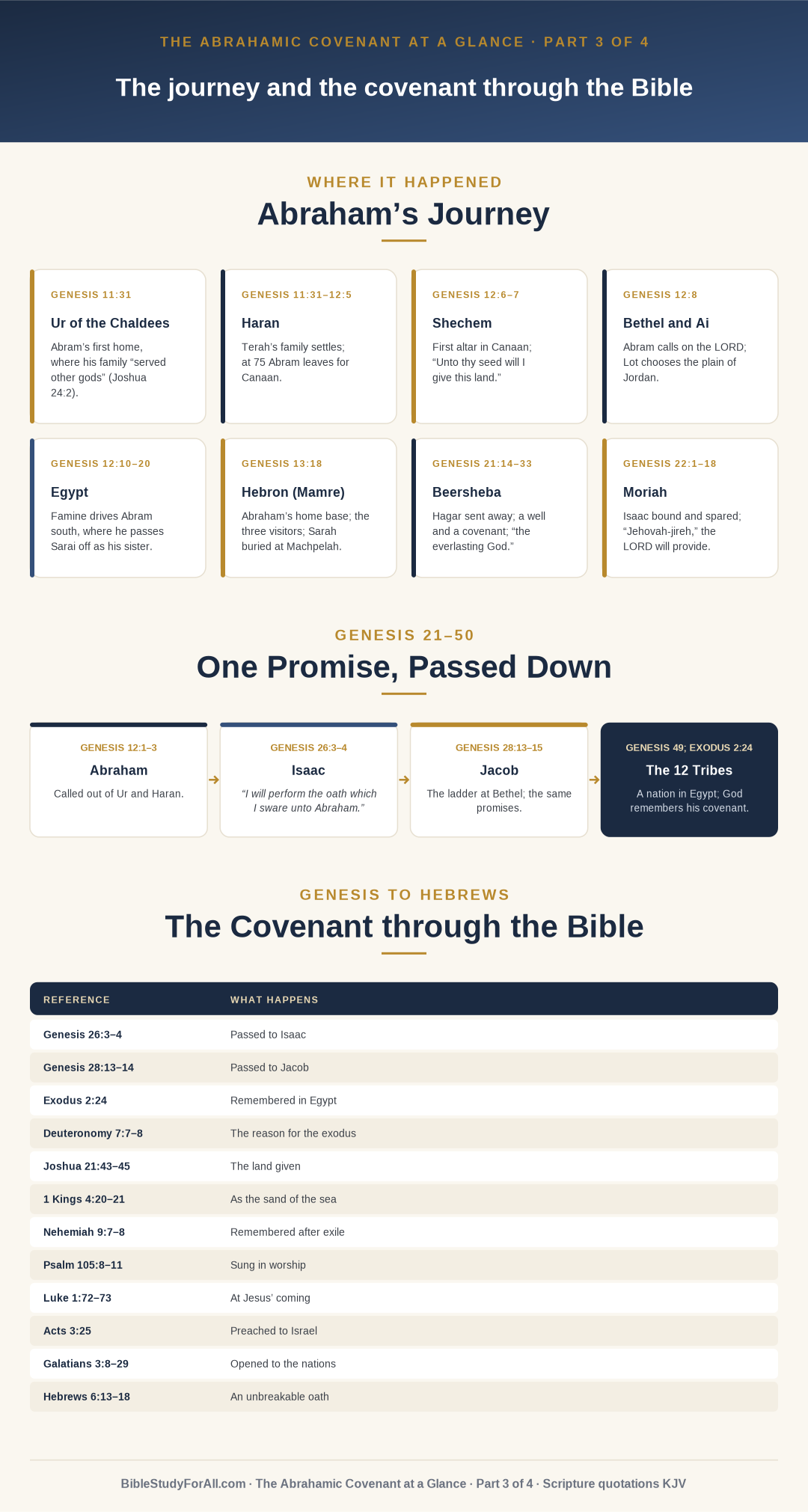
Where It Happened
Abraham’s Journey
Abraham spent his life “as in a strange country, dwelling in tabernacles” (Hebrews 11:9). These eight places trace his journey through the story.
1 · Genesis 11:31; 15:7
Ur of the Chaldees
Abram’s first home, where his family “served other gods” (Joshua 24:2).
4 · Genesis 12:8; 13:3–17
Bethel and Ai
Abram calls on the LORD; Lot chooses the plain of Jordan.
5 · Genesis 12:10–20
Egypt
Famine drives Abram south, where he passes Sarai off as his sister.
6 · Genesis 13:18; 18; 23
Hebron (Mamre)
Abraham’s home base; the three visitors; Sarah buried at Machpelah.
7 · Genesis 21:14–33; 22:19
Beersheba
Hagar sent away; a well and a covenant; “the everlasting God.”
8 · Genesis 22:1–18
Moriah
Isaac bound and spared; “Jehovah-jireh,” the LORD will provide.
Genesis to Hebrews
The Covenant through the Bible
Once God made his promise to Abraham, the rest of the Bible keeps coming back to it. God remembers it in Egypt, keeps it in the land, and opens it to the nations in Christ.
| Where | What happens | In the text (KJV) |
|---|---|---|
| Genesis 26:3–4 Read | Passed to Isaac | “I will perform the oath which I sware unto Abraham thy father.” |
| Genesis 28:13–14 Read | Passed to Jacob | “In thee and in thy seed shall all the families of the earth be blessed.” |
| Exodus 2:24 Read | Remembered in Egypt | “God remembered his covenant with Abraham, with Isaac, and with Jacob.” |
| Deuteronomy 7:7–8 Read | The reason for the exodus | God brought Israel out “because he would keep the oath which he had sworn unto your fathers.” |
| Joshua 21:43–45 Read | The land given | “The LORD gave unto Israel all the land which he sware to give unto their fathers.” |
| 1 Kings 4:20–21 Read | As the sand of the sea | Under Solomon Israel was “as the sand which is by the sea in multitude.” |
| Nehemiah 9:7–8 Read | Remembered after exile | “And madest a covenant with him … and hast performed thy words; for thou art righteous.” |
| Psalm 105:8–11 Read | Sung in worship | “He hath remembered his covenant for ever.” |
| Luke 1:72–73 Read | At Jesus’ coming | “To remember his holy covenant; the oath which he sware to our father Abraham.” |
| Acts 3:25 Read | Preached to Israel | “And in thy seed shall all the kindreds of the earth be blessed.” |
| Galatians 3:8–29 Read | Opened to the nations | “And if ye be Christ’s, then are ye Abraham’s seed, and heirs according to the promise.” |
| Hebrews 6:13–18 Read | An unbreakable oath | “Because he could swear by no greater, he sware by himself.” |
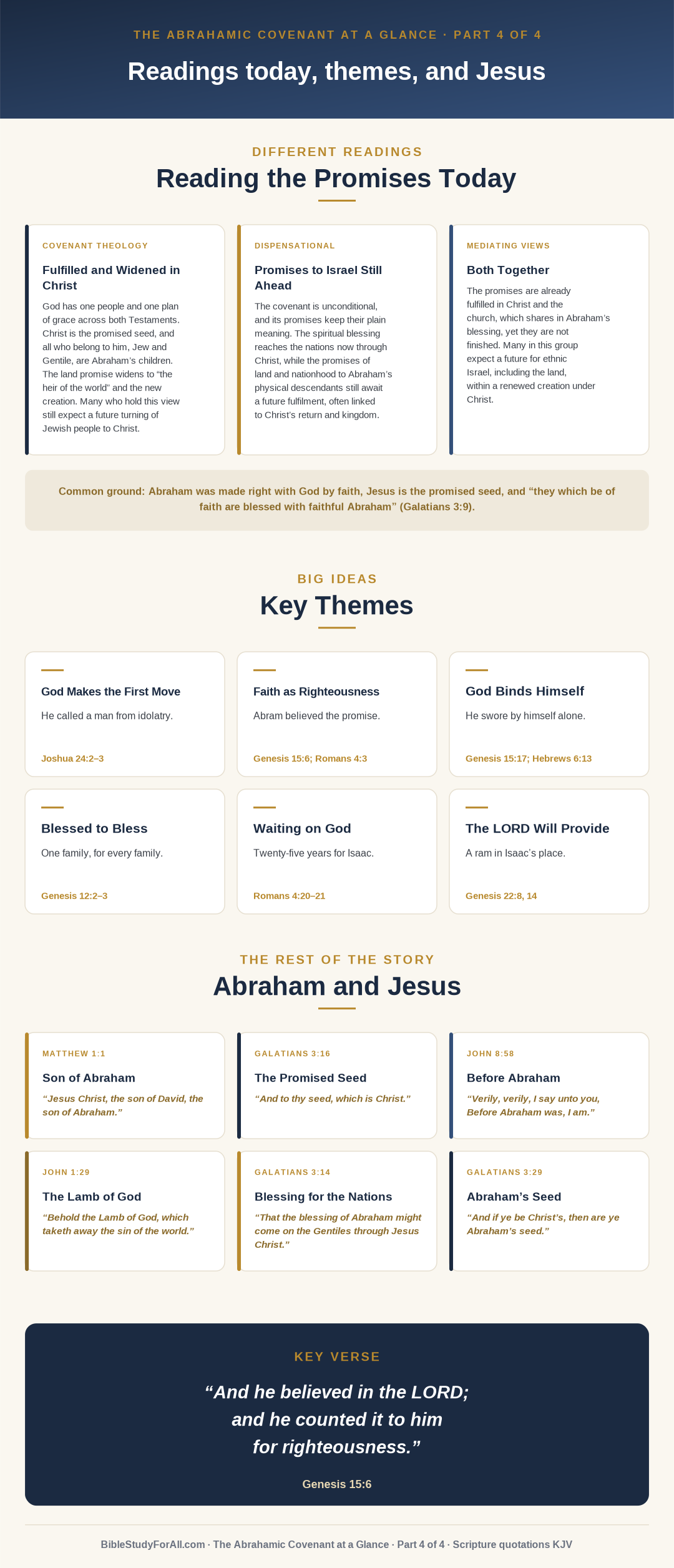
Different Readings
Reading the Promises Today
Christians agree that the covenant with Abraham is fulfilled in Jesus and that its blessing now reaches all nations. They differ on how the promises of land and nationhood relate to the people of Israel and to the church. Here are the main readings, in the words of those who hold them.
Covenant theology and many Reformed readers
Fulfilled and Widened in Christ
God has one people and one plan of grace across both Testaments. Christ is the promised seed, and all who belong to him, Jew and Gentile, are Abraham’s children. The land promise widens to “the heir of the world” and the new creation. Many who hold this view still expect a future turning of Jewish people to Christ.
Key passages: Galatians 3:16, 29; Romans 4:13; Hebrews 11:10, 16
Dispensational readers
Promises to Israel Still Ahead
The covenant is unconditional, and its promises keep their plain meaning. The spiritual blessing reaches the nations now through Christ, while the promises of land and nationhood to Abraham’s physical descendants still await a future fulfilment, often linked to Christ’s return and kingdom.
Key passages: Genesis 17:8; Jeremiah 33:25–26; Romans 11:26–29
Progressive dispensational and other mediating views
Both Together
The promises are already fulfilled in Christ and the church, which shares in Abraham’s blessing, yet they are not finished. Many in this group expect a future for ethnic Israel, including the land, within a renewed creation under Christ.
Key passages: Romans 15:8; 2 Corinthians 1:20; Romans 11:28–29
Common ground
All three readings agree that Abraham was made right with God by faith (Genesis 15:6; Romans 4:3), that Jesus is the promised seed (Galatians 3:16), that “the gifts and calling of God are without repentance” (Romans 11:29), and that everyone who believes shares in Abraham’s blessing: “they which be of faith are blessed with faithful Abraham” (Galatians 3:9).
Big Ideas
Six Themes of the Covenant
God makes the first move
Abraham’s family served other gods when God called him (Joshua 24:2–3; Genesis 12:1).
Faith counted as righteousness
Abraham believed God’s promise, and God counted it as righteousness (Genesis 15:6; Romans 4:3).
God binds himself
God alone passed between the pieces and swore by himself (Genesis 15:17; Hebrews 6:13).
Blessed to be a blessing
God blessed one family so that every family on earth could be blessed (Genesis 12:2–3).
Waiting on God’s time
Twenty-five years passed before Isaac was born, and Abraham “staggered not” (Romans 4:20).
The LORD will provide
On Moriah God provided the ram in Isaac’s place (Genesis 22:8, 14).
The Rest of the Story
Abraham and Jesus
Paul says the gospel was “preached before … unto Abraham” (Galatians 3:8). Jesus is Abraham’s promised seed, the Lamb God provided, and the one through whom the blessing reaches every nation.
Matthew 1:1
The son of Abraham
“The book of the generation of Jesus Christ, the son of David, the son of Abraham.”
Galatians 3:16
The promised seed
“He saith not, And to seeds, as of many; but as of one, And to thy seed, which is Christ.”
John 8:56–58
Before Abraham was
“Your father Abraham rejoiced to see my day … Before Abraham was, I am.”
John 1:29
The Lamb God provides
“Behold the Lamb of God, which taketh away the sin of the world.”
Galatians 3:14
Blessing for the nations
“That the blessing of Abraham might come on the Gentiles through Jesus Christ”
2 Corinthians 1:20
Every promise kept
“For all the promises of God in him are yea, and in him Amen”
Verses to Remember
Key Verses about the Covenant
Along with the verses in each stage above, these are worth reading slowly, and memorizing.
Genesis 12:1–3
“Now the LORD had said unto Abram, Get thee out of thy country, and from thy kindred, and from thy father’s house, unto a land that I will shew thee …”
Genesis 15:6
“And he believed in the LORD; and he counted it to him for righteousness.”
Genesis 17:7
“And I will establish my covenant between me and thee and thy seed after thee in their generations for an everlasting covenant …”
Genesis 22:14
“And Abraham called the name of that place Jehovah-jireh: as it is said to this day, In the mount of the LORD it shall be seen.”
Romans 4:20–21
“He staggered not at the promise of God through unbelief; but was strong in faith, giving glory to God; and being fully persuaded that, what he had promised, he was able also to perform.”
Galatians 3:29
“And if ye be Christ’s, then are ye Abraham’s seed, and heirs according to the promise.”
Hebrews 11:8
“By faith Abraham, when he was called to go out into a place which he should after receive for an inheritance, obeyed; and he went out, not knowing whither he went.”
James 2:23
“Abraham believed God, and it was imputed unto him for righteousness: and he was called the Friend of God.”
Summary
Five Things to Remember
1
Land, seed, blessing
God promised Abraham a land, countless descendants, and blessing for all families of the earth (Genesis 12:1–3).
2
Faith, not works
Abraham believed God and was counted righteous before he was circumcised (Genesis 15:6; Romans 4:11).
3
God bound himself
God alone passed between the pieces, then swore by himself (Genesis 15:17; 22:16; Hebrews 6:13).
4
Through Isaac and Jacob
The covenant went to Isaac, not Ishmael, and to Jacob, not Esau (Genesis 17:21; 28:13–14).
5
Open to every nation
In Christ the blessing of Abraham reaches the Gentiles (Galatians 3:8, 14, 29).
Questions
Common Questions about the Covenant
What is a covenant?
A covenant is a solemn, binding agreement that sets up a relationship, sealed with an oath or a sign. Some covenants in the ancient world were between equals; others were granted by a king to a servant. In the Bible, God makes covenants with Noah, Abraham, Israel at Sinai, and David, and promises a new covenant (Jeremiah 31:31). The covenant with Abraham is the root of the ones that follow.
Was the covenant conditional or unconditional?
Both sides appear in Genesis. God alone passed between the pieces (Genesis 15:17) and swore by himself (Genesis 22:16), which many read as an unconditional promise that rests on God. Yet God also said, “walk before me, and be thou perfect” (Genesis 17:1), commanded circumcision (Genesis 17:9–14), and later said he blessed Isaac “because that Abraham obeyed my voice” (Genesis 26:5). Many Christians conclude that the promise itself is sure, while each generation enjoys its blessings by faith and obedience. Interpreters weigh these texts differently.
What about Ishmael?
God heard Abraham’s prayer for Ishmael: “I have blessed him … twelve princes shall he beget, and I will make him a great nation” (Genesis 17:20). God cared for Hagar and Ishmael in the wilderness (Genesis 21:17–20), and Ishmael helped bury his father (Genesis 25:9). But the covenant line went through Isaac: “my covenant will I establish with Isaac” (Genesis 17:21).
Has the land promise been fulfilled?
Joshua says, “the LORD gave unto Israel all the land which he sware to give unto their fathers” (Joshua 21:43), Solomon ruled “from the river unto the land of the Philistines” (1 Kings 4:21), and Nehemiah says God “hast performed thy words” (Nehemiah 9:8). Yet Hebrews says the patriarchs “died in faith, not having received the promises” and looked for “a better country, that is, an heavenly” (Hebrews 11:13, 16). Christians differ on whether a further fulfilment for the nation of Israel is still ahead; see Reading the Promises Today.
How can Christians be children of Abraham?
Paul says Abraham is “the father of all them that believe” (Romans 4:11). “Know ye therefore that they which are of faith, the same are the children of Abraham” (Galatians 3:7), and “if ye be Christ’s, then are ye Abraham’s seed, and heirs according to the promise” (Galatians 3:29). Gentiles who were once “strangers from the covenants of promise” are now “made nigh by the blood of Christ” (Ephesians 2:12–13).
Why does Galatians say the law came 430 years after the covenant?
Paul writes that the law came “four hundred and thirty years after” the covenant (Galatians 3:17). On this page’s dates, Israel spent 430 years in Egypt (Exodus 12:40), so the law came about 645 years after Abram’s call. Many explain that Paul counts from the last time God confirmed the promise, to Jacob as he went down to Egypt (Genesis 46:3–4). Others note that the Greek Old Testament reading of Exodus 12:40 includes the years in Canaan, giving 430 years from Abraham. Either way Paul’s point stands: a later law cannot cancel an earlier promise.
When did Abraham live?
Following the early date of the exodus (c. 1446 B.C.) and the Bible’s own numbers, Abram was born about 2166 B.C., left Haran about 2091, and died about 1991 B.C. This page uses those dates. Scholars who count the 430 years differently, or who date the exodus later, place Abraham in the 1900s or 1800s B.C. The Bible itself does not give B.C. dates, and the story reads the same either way.
Why did God test Abraham by asking for Isaac?
Genesis says plainly that “God did tempt Abraham,” that is, tested him (Genesis 22:1), and that God never meant for Isaac to die: he stopped Abraham and provided the ram. The test showed that Abraham trusted God above everything, “now I know that thou fearest God” (Genesis 22:12). Later the law forbade child sacrifice outright (Deuteronomy 12:31). Hebrews says Abraham believed God could raise Isaac from the dead (Hebrews 11:19).
Keep Reading
Continue Your Study
Read the key chapters for yourself with the promise table beside you. Then see how the New Testament opens the covenant to every nation.
Scripture quotations are from the King James Version (KJV), which is in the public domain. Verse links open at BibleGateway. Dates are approximate and follow the early date of the exodus (c. 1446 B.C.) with 430 years in Egypt; other datings are noted in the questions above.