
Genesis · Numbers · Joshua · Revelation · Bible Study
The 12 Tribes of Israel
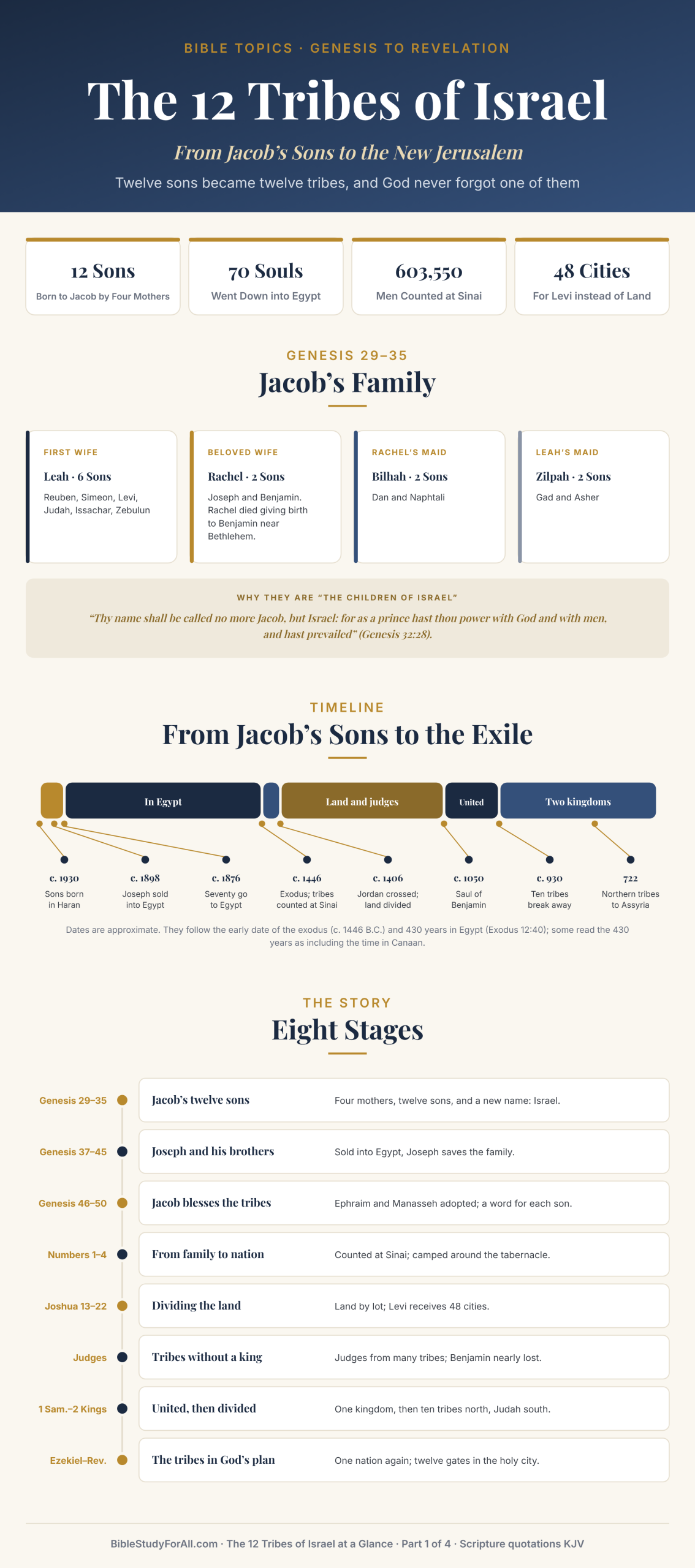
Jacob’s twelve sons became the twelve tribes of Israel. Each tribe received its own land and role, and together they formed the nation through which God worked out His purposes. Follow the tribes from one family in Haran to the gates of the New Jerusalem, and meet each one.
“All these are the twelve tribes of Israel: and this is it that their father spake unto them, and blessed them; every one according to his blessing he blessed them.”
Genesis 49:28
12 Sons
Born to Jacob by four mothers
70 Souls
Went down into Egypt
603,550 Men
Counted at Sinai
48 Cities
For Levi instead of land
At a Glance
From One Family to Twelve Tribes
The story moves in eight stages: Jacob’s sons are born, Joseph saves the family, Jacob blesses each son, the family becomes a nation, the land is divided, the tribes live without a king, the kingdom unites and divides, and the prophets and apostles look ahead. Select a stage to jump straight to it.
Stage 2 · c. 1898–1876 B.C.
Sold by his brothers, Joseph saves the family that will become a nation.
Stage 3 · c. 1876–1859 B.C.
Ephraim and Manasseh adopted; a word for each son about his future.
Stage 4 · c. 1876–1445 B.C.
Seventy become a nation; the tribes are counted and camp around the tabernacle.
Stage 5 · c. 1406–1399 B.C.
Land by lot for each tribe; Levi receives cities, and the LORD as inheritance.
Stage 6 · c. 1380–1050 B.C.
Unfinished conquest, judges from many tribes, and a civil war.
Stage 7 · c. 1050–586 B.C.
One king over all the tribes, then ten in the north and Judah in the south.
Stage 8 · c. 538 B.C. and beyond
Promised reunion, the tribes in the New Testament, and twelve gates.
The first of four summary graphics; the other three sit with their sections below. Save or print them to keep beside your Bible.
Before You Begin
Three Habits for This Study
You don’t need any background to follow along. These habits will help you get the most from each stage.
Keep a family tree handy
Twelve sons, four mothers, and two grandsons who became tribes can be hard to keep straight. Start with Genesis 29:31–30:24 (KJV), and use the family chart below.
Read the two blessings side by side
Jacob blessed his sons in Genesis 49, and Moses blessed the tribes in Deuteronomy 33. Compare what each says about a tribe, and watch how it comes true.
Notice who is counted
Lists of the twelve tribes are not all the same. Sometimes Levi is in and Joseph is one tribe; sometimes Levi is out and Joseph is two. The section on the lists explains why.
Stage 1 of 8 · Genesis 29–35
Jacob Becomes Israel
When: c. 1930–1900 B.C.
“Thy name shall be called no more Jacob, but Israel: for as a prince hast thou power with God and with men, and hast prevailed.”Genesis 32:28 (KJV) · Read Genesis 29–35
What happens
Jacob runs from his brother Esau to his uncle Laban in Haran. He works seven years for Rachel, but Laban gives him her older sister Leah first, and then Rachel after another week (Genesis 29). A painful rivalry follows. Leah has sons while Rachel has none, so Rachel gives Jacob her maid Bilhah, and Leah answers with her maid Zilpah. Eleven sons and a daughter, Dinah, are born in Haran, and each mother names her sons for what she is feeling: “Surely the LORD hath looked upon my affliction” (Genesis 29:32), “Now will I praise the LORD” (Genesis 29:35).
On the way home Jacob wrestles all night with a man at Peniel and receives a new name, Israel (Genesis 32:28). At Bethel God repeats His promise: “a nation and a company of nations shall be of thee, and kings shall come out of thy loins” (Genesis 35:11). Near Bethlehem, Rachel dies giving birth to the twelfth son, Benjamin. Genesis then counts them: “Now the sons of Jacob were twelve” (Genesis 35:22).
Look closer
The twelve tribes are named after these twelve sons, so every Israelite could say whose child he was: “the children of Israel” means, quite literally, the sons of Jacob.
God’s promise to Abraham, “I will make of thee a great nation” (Genesis 12:2), now rests on a family full of jealousy and favoritism. The Bible does not hide it. God builds His nation out of people who need His grace.
Think about it
God built His nation out of a quarrelling, imperfect family. What does that tell you about the people He chooses to use today?
Stage 2 of 8 · Genesis 37–45
Joseph and His Brothers
When: c. 1898–1876 B.C.
“Now therefore be not grieved, nor angry with yourselves, that ye sold me hither: for God did send me before you to preserve life.”Genesis 45:5 (KJV) · Read Genesis 37–45
What happens
Jacob loves Joseph, Rachel’s firstborn, more than the others and gives him a coat of many colours. Joseph dreams that his brothers will bow to him, and “they hated him yet the more” (Genesis 37:8). At Dothan they plot to kill him. Reuben talks them out of it, and Judah suggests selling him instead, so Joseph goes to Egypt for twenty pieces of silver (Genesis 37:21–28).
In Egypt, Joseph is a slave, then a prisoner, and then, after he interprets Pharaoh’s dreams, governor of the land. When famine drives his brothers to Egypt for grain, he tests them. Judah, the brother who once sold Joseph, now offers to stay as a slave in Benjamin’s place (Genesis 44:33). Joseph can hold back no longer: “I am Joseph your brother, whom ye sold into Egypt” (Genesis 45:4).
Look closer
The brothers who will lead the tribes are changed men by the end of the story, and Judah most of all. Genesis 38, the story of Judah and Tamar, also matters: their son Pharez is the ancestor of Boaz and David (Ruth 4:18–22).
Joseph saw God’s hand in all of it. Years later he told his brothers, “ye thought evil against me; but God meant it unto good, to bring to pass, as it is this day, to save much people alive” (Genesis 50:20).
Think about it
Judah went from selling one brother to offering himself for another. Where is God changing your heart toward your own family?
Stage 3 of 8 · Genesis 46–50
Jacob Blesses the Tribes
When: c. 1876–1859 B.C.
“The sceptre shall not depart from Judah, nor a lawgiver from between his feet, until Shiloh come; and unto Him shall the gathering of the people be.”Genesis 49:10 (KJV) · Read Genesis 48–49
What happens
Jacob’s family, “threescore and ten” in all (Genesis 46:27), moves to Egypt and settles in Goshen. Near the end of his life Jacob adopts Joseph’s two sons: “Ephraim and Manasseh … as Reuben and Simeon, they shall be mine” (Genesis 48:5). He crosses his hands to put the younger, Ephraim, first.
Then he calls his sons together to tell them “that which shall befall you in the last days” (Genesis 49:1). Reuben, the firstborn, loses first place because he slept with his father’s concubine. Simeon and Levi will be scattered for their violence at Shechem. Judah receives the sceptre, and Joseph a rich blessing as “a fruitful bough.” Jacob dies and is buried with Abraham and Isaac in the cave of Machpelah (Genesis 50:13).
Look closer
The firstborn’s rights were split up. “The birthright was Joseph’s” (1 Chronicles 5:2), which is why Joseph became two tribes, but leadership went to Judah, “for Judah prevailed above his brethren, and of him came the chief ruler.”
“Until Shiloh come” has been read in different ways. Many Jewish and Christian interpreters have taken it as a name for the coming Messiah; others translate it ‘until He comes to whom it belongs,’ or take it as the town of Shiloh. Either way, the verse points to a king from Judah to whom the nations will gather.
Think about it
Jacob was honest about each son’s past, but his words also looked ahead. How does God’s grace change the way your past shapes your future?
Stage 4 of 8 · Exodus 1; Numbers 1–4
From Family to Nation
When: c. 1876–1445 B.C.
“And the children of Israel were fruitful, and increased abundantly, and multiplied, and waxed exceeding mighty; and the land was filled with them.”Exodus 1:7 (KJV) · Read Numbers 1–2
What happens
In Egypt the seventy grow into a great people, and a new Pharaoh makes them slaves. After God brings them out (about 1446 B.C.), Moses counts the men of each tribe at Sinai “from twenty years old and upward, all that were able to go forth to war” (Numbers 1:3). The total is 603,550 (Numbers 1:46). Each tribe has its own leader and its own standard.
The tribes camp in a square around the tabernacle, three on each side, with Judah on the east toward the sunrise, leading the march (Numbers 2; 10:14). The Levites are not counted with the others. They camp closest to the tabernacle, carry it when Israel moves, and belong to God in place of the firstborn: “the Levites shall be Mine” (Numbers 3:12).
Look closer
The high priest carried the tribes with him into God’s presence. Their names were engraved on two onyx stones on his shoulders and on twelve stones on his breastplate: “Aaron shall bear the names of the children of Israel in the breastplate of judgment upon his heart” (Exodus 28:29).
A second census forty years later, on the plains of Moab, came to 601,730 (Numbers 26:51). Most tribes held steady or grew. Simeon fell from 59,300 to 22,200, after the sin at Baal-peor that was led by a Simeonite prince (Numbers 25:14).
Think about it
Every tribe pitched its tents facing the tabernacle, with God dwelling in the middle. What sits at the center of your life?
Stage 5 of 8 · Numbers 32; Joshua 13–22
Dividing the Land
When: c. 1406–1399 B.C.
“There failed not ought of any good thing which the LORD had spoken unto the house of Israel; all came to pass.”Joshua 21:45 (KJV) · Read Joshua 13–21
What happens
Before crossing the Jordan, Reuben, Gad, and half of Manasseh ask for the rich grazing land east of the river. Moses agrees, as long as their men cross over and fight with their brothers (Numbers 32). After the main battles of the conquest, Joshua divides the land west of the Jordan by lot, first at Gilgal and then at Shiloh, where the tabernacle now stands (Joshua 14:2; 18:10). Caleb, at eighty-five, claims Hebron (Joshua 14:10–14).
Simeon receives towns inside Judah’s large territory (Joshua 19:1–9). Levi receives no territory but forty-eight cities spread through all the tribes, including six cities of refuge (Joshua 20–21). When the work is done, Joshua 21:45 sums it up: not one of God’s good promises had failed.
Look closer
Jacob’s words came true. Jacob had said of Simeon and Levi, “I will divide them in Jacob, and scatter them in Israel” (Genesis 49:7): Simeon was absorbed into Judah, and Levi lived among all the tribes. Yet for Levi the scattering became a blessing, “the LORD God of Israel was their inheritance” (Joshua 13:33), and they could teach God’s law in every corner of the land.
The lot was not chance. “The lot is cast into the lap; but the whole disposing thereof is of the LORD” (Proverbs 16:33).
Think about it
Levi had no land because the LORD Himself was their inheritance. What would it look like for God to be your portion?
Stage 6 of 8 · Judges 1–21
Tribes without a King
When: c. 1380–1050 B.C.
“In those days there was no king in Israel: every man did that which was right in his own eyes.”Judges 21:25 (KJV) · Read Judges 1
What happens
Judges opens with a tribe-by-tribe report: Judah and Simeon fight together, but Manasseh, Ephraim, Zebulun, Asher, and Naphtali do not drive out the Canaanites, and Dan is pushed back into the hills (Judges 1). God raises up judges from many tribes: Othniel of Judah, Ehud of Benjamin, Barak of Naphtali with Deborah, Gideon of Manasseh, Tola of Issachar, Elon of Zebulun, and Samson of Dan.
Deborah’s song praises the tribes who came to fight and shames those who stayed home: “For the divisions of Reuben there were great searchings of heart” (Judges 5:16). The tribe of Dan leaves its land, captures Laish in the far north, and sets up an idol (Judges 18). Worst of all, after a terrible crime at Gibeah, the other tribes go to war against Benjamin and nearly wipe it out: “There is one tribe cut off from Israel this day” (Judges 21:6).
Look closer
The tribes often acted more like rivals than brothers. Ephraim quarrelled with Gideon and fought Jephthah’s men, who caught Ephraimites at the Jordan by asking them to say “Shibboleth” (Judges 8:1; 12:1–6).
The book’s refrain explains why: “there was no king in Israel.” Each tribe, and each person, did what seemed right to them. The closing chapters set the stage for the kings, starting with Saul of Benjamin.
Think about it
The tribes kept fighting each other instead of standing together. Where do you need to choose unity with God’s people over rivalry?
Stage 7 of 8 · 1 Samuel–2 Kings
United, Then Divided
When: c. 1050–586 B.C.
“Take thee ten pieces: for thus saith the LORD, the God of Israel, Behold, I will rend the kingdom out of the hand of Solomon, and will give ten tribes to thee.”1 Kings 11:31 (KJV) · Read 1 Kings 11:29–39
What happens
Israel’s first king, Saul, comes from Benjamin, the smallest tribe (1 Samuel 9:21). After his death David rules Judah at Hebron for seven years, until all the tribes come to him: “Behold, we are thy bone and thy flesh” (2 Samuel 5:1). Under David and Solomon the twelve tribes are one kingdom with one capital and one temple.
After Solomon, the prophet Ahijah tears his cloak into twelve pieces and gives ten to Jeroboam of Ephraim. Ten tribes follow Jeroboam as the northern kingdom of Israel. Judah and Benjamin stay with David’s line in the south, and many Levites and faithful people from the north move to Jerusalem to worship (2 Chronicles 11:13–16). Assyria carries away the tribes east of the Jordan and then the rest of the north (1 Chronicles 5:26; 2 Kings 17:6). Babylon takes Judah in 586 B.C.
Look closer
The split was never total. When King Hezekiah invited all Israel to keep the Passover in Jerusalem, many mocked, “Nevertheless divers of Asher and Manasseh and of Zebulun humbled themselves, and came to Jerusalem” (2 Chronicles 30:11).
For the full story of these centuries, king by king, see the Kings of Israel study.
Think about it
Ten tribes walked away from the place where God had put His name. What draws people away from worship today, and what draws them back?
Stage 8 of 8 · Ezekiel 37 to Revelation 21
The Tribes in God’s Plan
When: c. 538 B.C. and beyond
“And I will make them one nation in the land upon the mountains of Israel; and one king shall be king to them all: and they shall be no more two nations, neither shall they be divided into two kingdoms any more at all.”Ezekiel 37:22 (KJV) · Read Revelation 7
What happens
In exile, Ezekiel joins two sticks, one for Judah and one for Joseph, into one stick in his hand, a picture of the tribes made one again under one king (Ezekiel 37:16–22). His vision ends with the land shared out among all twelve tribes and a city with twelve gates named for them (Ezekiel 48). When the exiles return and dedicate the rebuilt temple, they offer “twelve he goats, according to the number of the tribes of Israel” (Ezra 6:17).
In the New Testament the tribes are still known. Jesus is from Judah, Anna the prophetess from Asher, Paul from Benjamin, and Barnabas is a Levite. Jesus chooses twelve apostles and promises them “twelve thrones, judging the twelve tribes of Israel” (Matthew 19:28). James writes “to the twelve tribes which are scattered abroad” (James 1:1). Revelation sees twelve thousand sealed from each tribe (Revelation 7:4–8) and a holy city whose twelve gates bear “the names of the twelve tribes of the children of Israel” (Revelation 21:12).
Look closer
Paul spoke of the promise “unto which promise our twelve tribes, instantly serving God day and night, hope to come” (Acts 26:7). He did not think of ten tribes as lost.
Christians read Revelation 7 in different ways. Some take the 144,000 as Jewish believers from the tribes of Israel; others see them as a symbol of the whole people of God, the same as the great multitude that follows (Revelation 7:9). In the New Jerusalem the twelve tribes and the twelve apostles appear together, the gates and the foundations of one city (Revelation 21:12–14).
Think about it
God never forgot a single tribe, even after centuries of scattering. What does that tell you about how He remembers you?
Who’s Who
Meet Every Tribe
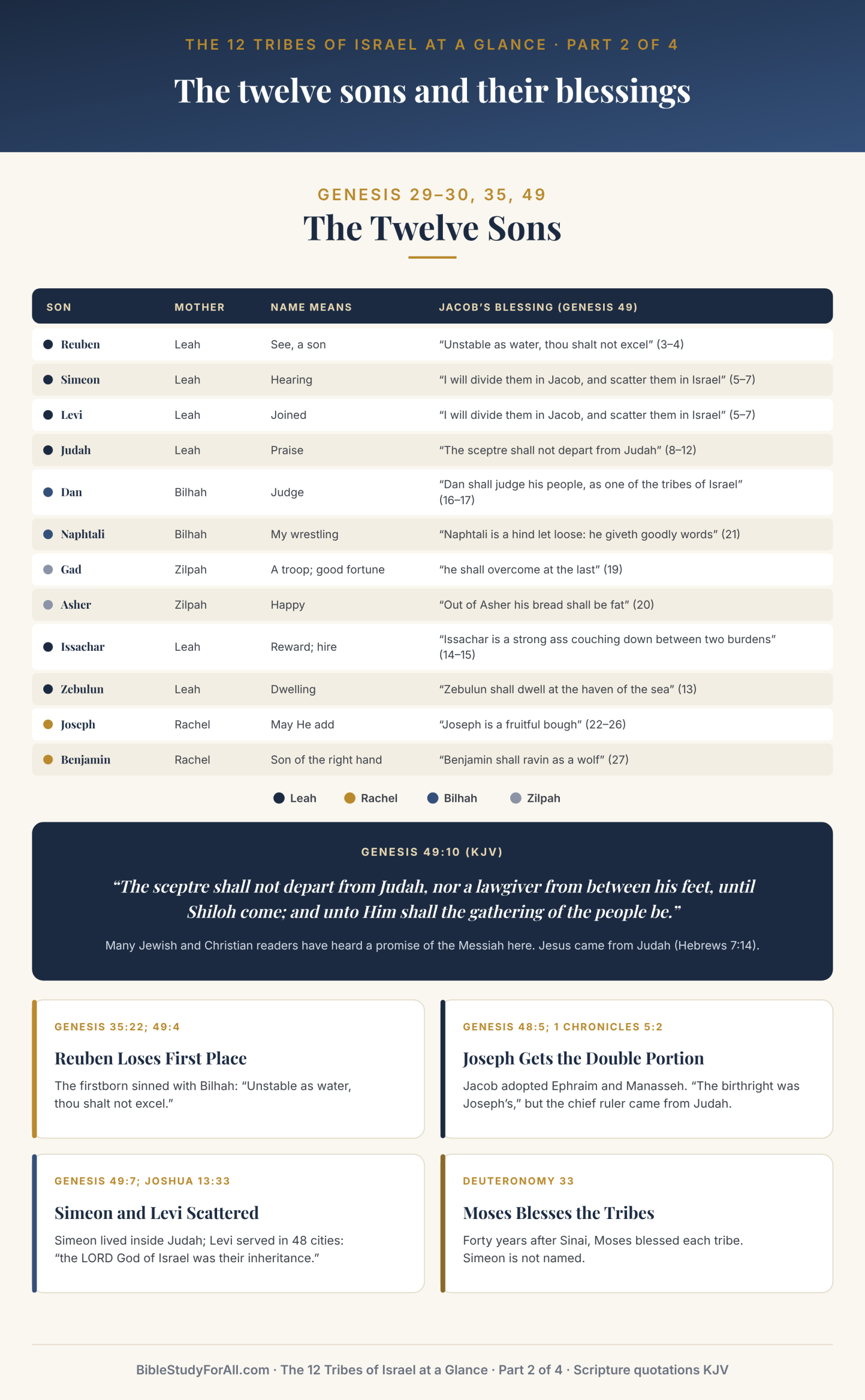
Jacob had twelve sons by four mothers. Each card gives the meaning of the son’s name as his mother explained it, Jacob’s blessing (Genesis 49), Moses’ blessing (Deuteronomy 33), and what the tribe is remembered for. Joseph’s tribe became two, Ephraim and Manasseh.
Jacob’s Family
The Twelve Sons
In order of birth. Quotations are from the King James Version.
Son 1 · Leah
Reuben
Name means: See, a son
“Surely the LORD hath looked upon my affliction” (Genesis 29:32)
Jacob: “Unstable as water, thou shalt not excel” (Genesis 49:3–4)
Moses: “Let Reuben live, and not die” (Deuteronomy 33:6)
Jacob’s firstborn, but he lost the birthright by sleeping with Bilhah (Genesis 35:22; 1 Chronicles 5:1). Dathan and Abiram rebelled with Korah (Numbers 16).
Son 2 · Leah
Simeon
Name means: Hearing
“Because the LORD hath heard that I was hated” (Genesis 29:33)
Jacob: “I will divide them in Jacob, and scatter them in Israel” (Genesis 49:5–7)
Moses: not named in Deuteronomy 33.
With Levi he massacred Shechem (Genesis 34). Left out of Moses’ blessing; the tribe later lived inside Judah’s land (Joshua 19:1).
Son 3 · Leah
Levi
Name means: Joined
“Now this time will my husband be joined unto me” (Genesis 29:34)
Jacob: “I will divide them in Jacob, and scatter them in Israel” (Genesis 49:5–7)
Moses: “They shall teach Jacob Thy judgments, and Israel Thy law” (Deuteronomy 33:10)
The priestly tribe of Moses, Aaron, and Miriam. Their zeal at the golden calf turned the scattering into a blessing (Exodus 32:26–29).
Son 4 · Leah
Judah
Name means: Praise
“Now will I praise the LORD” (Genesis 29:35)
Jacob: “The sceptre shall not depart from Judah” (Genesis 49:8–12)
Moses: “Hear, LORD, the voice of Judah” (Deuteronomy 33:7)
Offered himself for Benjamin (Genesis 44:33). The tribe of Caleb, David, Solomon, the kings of Judah, and Jesus (Hebrews 7:14).
Son 5 · Bilhah
Dan
Name means: Judge
“God hath judged me, and hath also heard my voice” (Genesis 30:6)
Jacob: “Dan shall judge his people, as one of the tribes of Israel” (Genesis 49:16–17)
Moses: “Dan is a lion’s whelp” (Deuteronomy 33:22)
Samson the judge (Judges 13:2) and Aholiab the craftsman (Exodus 31:6). The tribe moved north and set up an idol (Judges 18).
Son 6 · Bilhah
Naphtali
Name means: My wrestling
“With great wrestlings have I wrestled with my sister” (Genesis 30:8)
Jacob: “Naphtali is a hind let loose: he giveth goodly words” (Genesis 49:21)
Moses: “O Naphtali, satisfied with favour” (Deuteronomy 33:23)
Barak, who led Israel with Deborah (Judges 4:6). Its land by the Sea of Galilee saw a “great light” (Isaiah 9:1–2; Matthew 4:13–16).
Son 7 · Zilpah
Gad
Name means: A troop; good fortune
“A troop cometh” (Genesis 30:11)
Jacob: “he shall overcome at the last” (Genesis 49:19)
Moses: “Blessed be he that enlargeth Gad” (Deuteronomy 33:20)
Settled east of the Jordan (Numbers 32). Gadite warriors “whose faces were like the faces of lions” joined David (1 Chronicles 12:8).
Son 8 · Zilpah
Asher
Name means: Happy
“Happy am I, for the daughters will call me blessed” (Genesis 30:13)
Jacob: “Out of Asher his bread shall be fat” (Genesis 49:20)
Moses: “Let Asher be blessed with children” (Deuteronomy 33:24)
Anna the prophetess, who greeted the baby Jesus in the temple, was “of the tribe of Aser” (Luke 2:36).
Son 9 · Leah
Issachar
Name means: Reward; hire
“God hath given me my hire” (Genesis 30:18)
Jacob: “Issachar is a strong ass couching down between two burdens” (Genesis 49:14–15)
Moses: “and, Issachar, in thy tents” (Deuteronomy 33:18)
Tola the judge (Judges 10:1). Its men “had understanding of the times, to know what Israel ought to do” (1 Chronicles 12:32).
Son 10 · Leah
Zebulun
Name means: Dwelling
“now will my husband dwell with me” (Genesis 30:20)
Jacob: “Zebulun shall dwell at the haven of the sea” (Genesis 49:13)
Moses: “Rejoice, Zebulun, in thy going out” (Deuteronomy 33:18)
Elon the judge (Judges 12:11). Praised for risking their lives with Deborah and Barak (Judges 5:18).
Son 11 · Rachel
Joseph
Name means: May He add
“The LORD shall add to me another son” (Genesis 30:24)
Jacob: “Joseph is a fruitful bough” (Genesis 49:22–26)
Moses: “the ten thousands of Ephraim … the thousands of Manasseh” (Deuteronomy 33:17)
Received the double portion through his sons Ephraim and Manasseh (Genesis 48:5). Ephraim gave Israel Joshua; Manasseh gave Gideon.
Son 12 · Rachel
Benjamin
Name means: Son of the right hand
“she called his name Ben-oni: but his father called him Benjamin” (Genesis 35:18)
Jacob: “Benjamin shall ravin as a wolf” (Genesis 49:27)
Moses: “The beloved of the LORD shall dwell in safety by Him” (Deuteronomy 33:12)
Ehud the judge, King Saul, Mordecai and Esther, and the apostle Paul (Judges 3:15; 1 Samuel 9:1–2; Esther 2:5; Philippians 3:5).
Numbers 1–4 and 26
The Camp and the Census
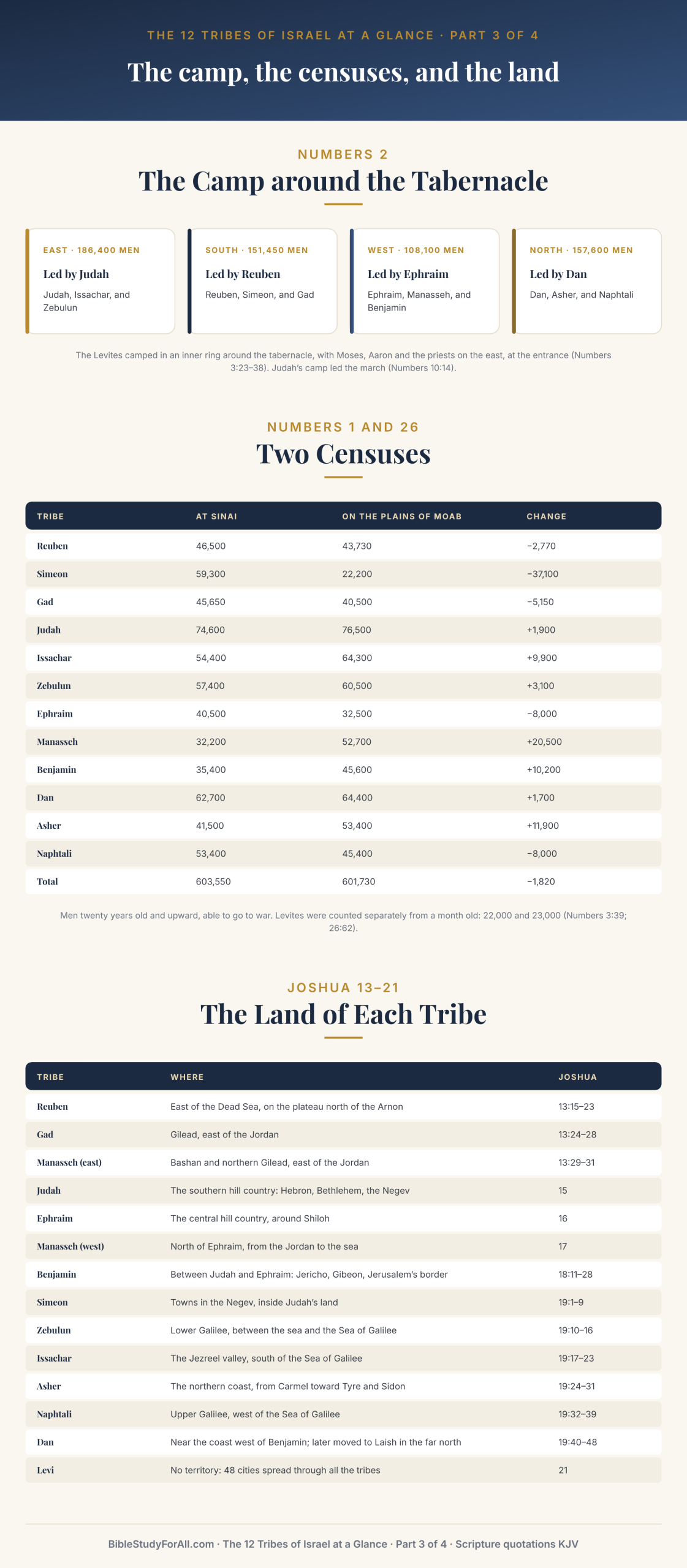
In the wilderness the tribes camped in a square around the tabernacle, “Every man of the children of Israel shall pitch by his own standard, with the ensign of their father’s house” (Numbers 2:2). The Levites camped in an inner ring, closest to God’s dwelling. The men of each tribe were counted twice, at Sinai and forty years later on the plains of Moab.
Levi, counted separately from a month old: 22,000 at Sinai (Numbers 3:39) and 23,000 on the plains of Moab (Numbers 26:62).
| Tribe | Numbers 1 (Sinai) | Numbers 26 (Moab) | Change |
|---|---|---|---|
| Reuben | 46,500 | 43,730 | −2,770 |
| Simeon | 59,300 | 22,200 | −37,100 |
| Gad | 45,650 | 40,500 | −5,150 |
| Judah | 74,600 | 76,500 | +1,900 |
| Issachar | 54,400 | 64,300 | +9,900 |
| Zebulun | 57,400 | 60,500 | +3,100 |
| Ephraim | 40,500 | 32,500 | −8,000 |
| Manasseh | 32,200 | 52,700 | +20,500 |
| Benjamin | 35,400 | 45,600 | +10,200 |
| Dan | 62,700 | 64,400 | +1,700 |
| Asher | 41,500 | 53,400 | +11,900 |
| Naphtali | 53,400 | 45,400 | −8,000 |
| Total | 603,550 | 601,730 | −1,820 |
Joshua 13–21
The Land of Each Tribe
Two and a half tribes settled east of the Jordan; the rest received their land by lot west of the river. Levi received cities instead of a territory. Read the chapters with a Bible map open to see how the tribes fit together.
| Tribe | Where | Read (KJV) |
|---|---|---|
| Reuben | East of the Dead Sea, on the plateau north of the Arnon | Joshua 13:15–23 |
| Gad | Gilead, east of the Jordan | Joshua 13:24–28 |
| Manasseh (east) | Bashan and northern Gilead, east of the Jordan | Joshua 13:29–31 |
| Judah | The southern hill country: Hebron, Bethlehem, the Negev | Joshua 15 |
| Ephraim | The central hill country, around Shiloh | Joshua 16 |
| Manasseh (west) | North of Ephraim, from the Jordan to the sea | Joshua 17 |
| Benjamin | Between Judah and Ephraim: Jericho, Gibeon, Jerusalem’s border | Joshua 18:11–28 |
| Simeon | Towns in the Negev, inside Judah’s land | Joshua 19:1–9 |
| Zebulun | Lower Galilee, between the sea and the Sea of Galilee | Joshua 19:10–16 |
| Issachar | The Jezreel valley, south of the Sea of Galilee | Joshua 19:17–23 |
| Asher | The northern coast, from Carmel toward Tyre and Sidon | Joshua 19:24–31 |
| Naphtali | Upper Galilee, west of the Sea of Galilee | Joshua 19:32–39 |
| Dan | Near the coast west of Benjamin; later moved to Laish in the far north | Joshua 19:40–48 |
| Levi | No territory: 48 cities spread through all the tribes | Joshua 21 |
The colour beside each tribe matches its territory on the map below.
Joshua 13–19 · Map
Map of the Twelve Tribes’ Land
Each colour is one tribe’s inheritance. Reuben, Gad, and the east half of Manasseh settled east of the Jordan; the other tribes received their land by lot west of the river, at Gilgal and then at Shiloh (Joshua 14:2; 18:10). Joseph’s double portion appears as two tribes, Ephraim and Manasseh, and Manasseh is shown on both sides of the Jordan in the same green. Simeon’s towns lay inside Judah, and Dan later moved to Laish in the far north (Judges 18). Levi has no colour, because “the LORD God of Israel was their inheritance” (Joshua 13:33); the stars mark the six cities of refuge, all of them Levite cities.
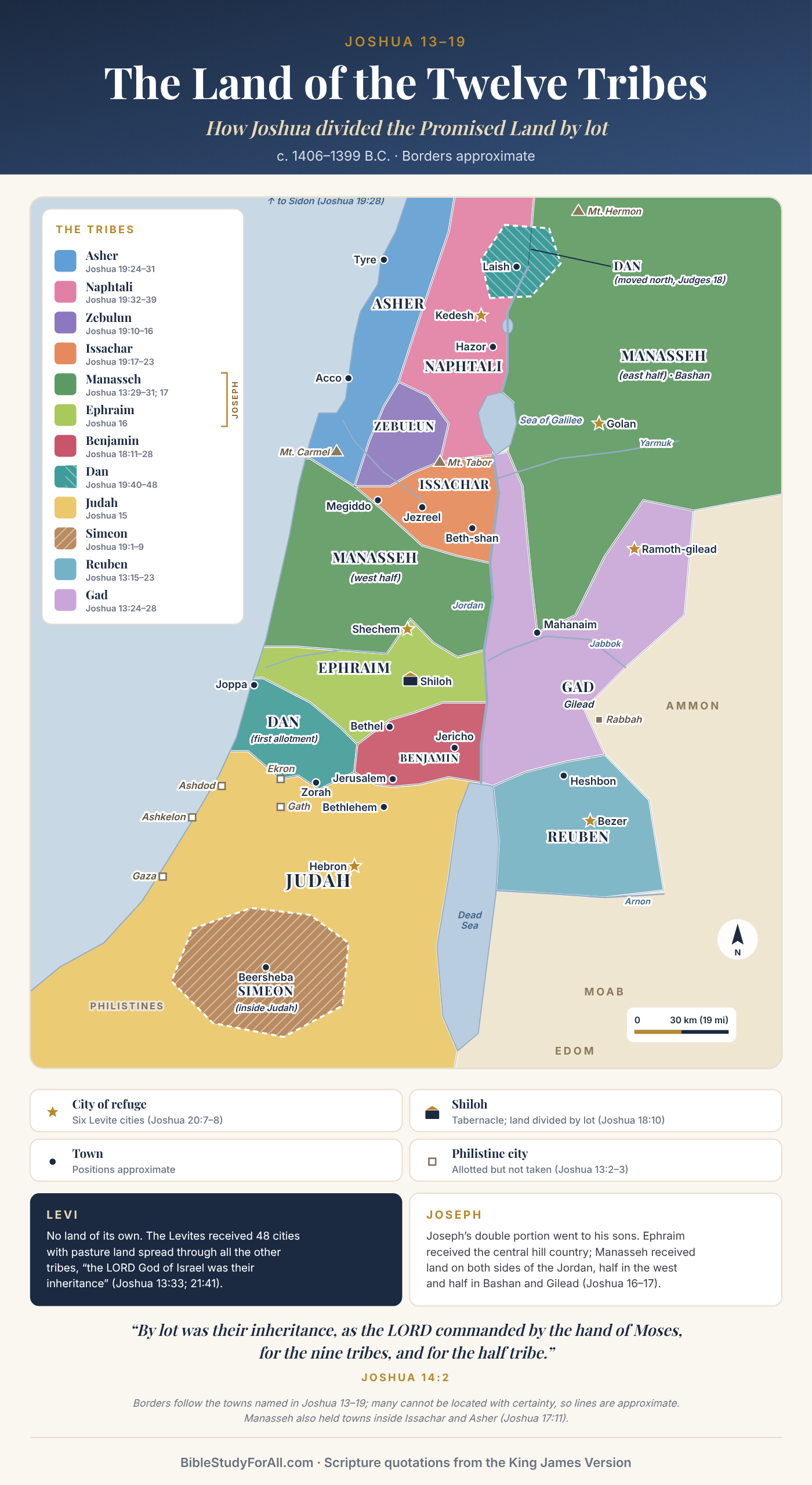
Borders are approximate. Joshua traces them by towns, hills, and brooks, and many of those places cannot be located with certainty today.
Counting to Twelve
Why the Lists of Tribes Differ
There are thirteen names to fit into twelve places, because Joseph became two tribes. So the Bible counts the twelve in different ways, depending on the purpose. When Levi is counted, Joseph is usually one tribe; when Levi is left out because it has no land, Ephraim and Manasseh are listed separately.
Genesis 49
Jacob’s sons
Numbers 1–2
The census and camp
Joshua 13–19
The land
Ezekiel 48:31–34
Ezekiel’s city gates
Revelation 7:4–8
The 144,000 sealed
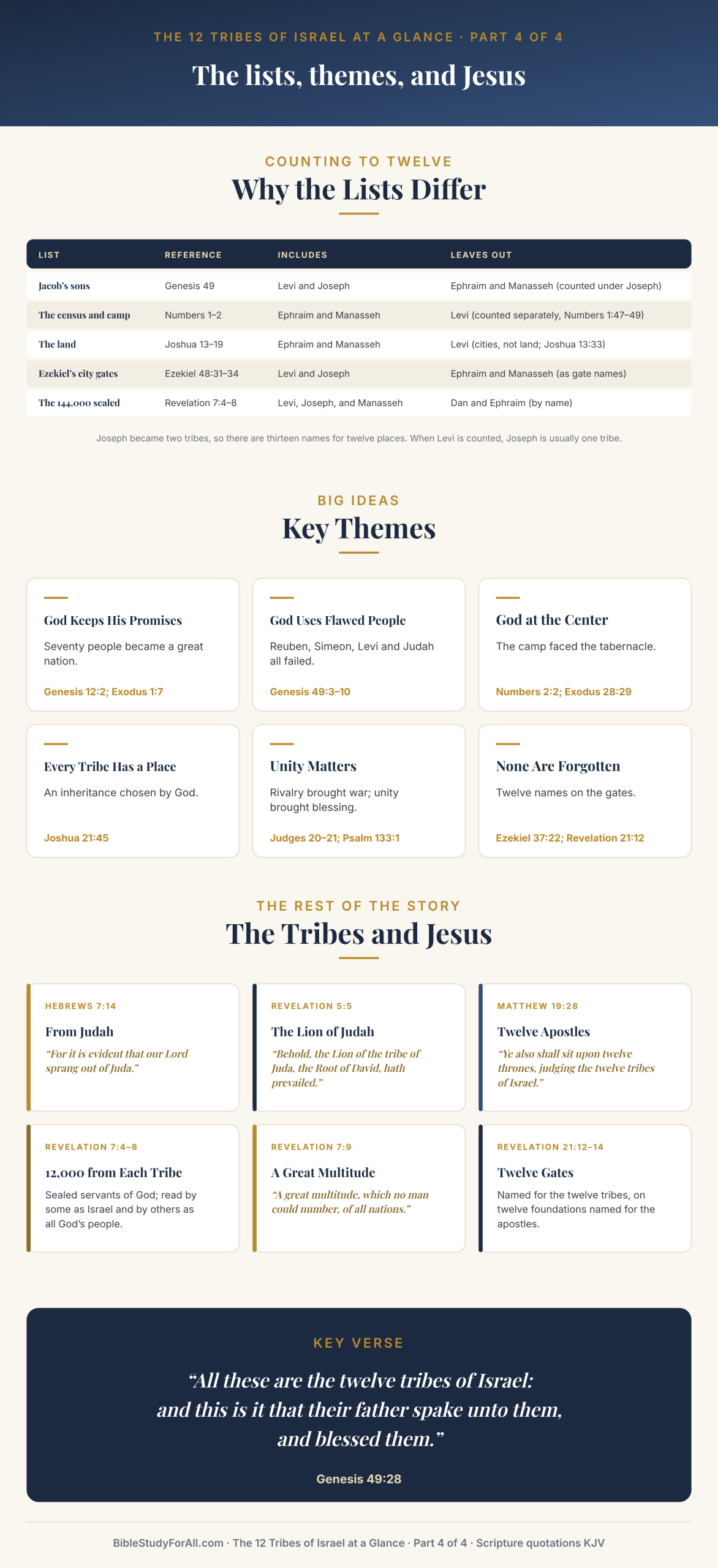
Big Ideas
Six Themes of the Tribes
God keeps His promises
He promised Abraham a great nation, and seventy people became a nation of tribes (Genesis 12:2; Exodus 1:7).
God works through flawed people
Reuben, Simeon, Levi, and Judah all failed badly, yet God used every tribe (Genesis 49:3–10).
God at the center
The tribes camped around the tabernacle and the high priest carried their names on his heart (Numbers 2:2; Exodus 28:29).
Every tribe has a place
Each received its own inheritance by God’s choice, “all came to pass” (Joshua 21:45).
Unity matters
When the tribes stood together they prospered; when they turned on each other they suffered (Judges 20–21; Psalm 133:1).
None are forgotten
The prophets promised reunion, and the New Jerusalem bears all twelve names (Ezekiel 37:22; Revelation 21:12).
The Rest of the Story
The Tribes and Jesus
Jacob promised the sceptre to Judah “until Shiloh come” (Genesis 49:10). Jesus was born of that tribe, in David’s line. He did what no priest of Levi could do, and He gathered twelve apostles as the foundation of a renewed people of God.
Hebrews 7:14
The Lion of Judah
“For it is evident that our Lord sprang out of Juda”
Revelation 5:5
The promised King
“Behold, the Lion of the tribe of Juda, the Root of David, hath prevailed to open the book”
Matthew 10:6
Sent to all Israel
“But go rather to the lost sheep of the house of Israel.”
Matthew 19:28
Twelve apostles
“Ye also shall sit upon twelve thrones, judging the twelve tribes of Israel.”
Hebrews 7:26–27
A better High Priest
“For such an high priest became us, who is holy, harmless, undefiled, separate from sinners”
Revelation 21:12–14
One city, twelve gates
“… names written thereon, which are the names of the twelve tribes of the children of Israel”
Verses to Remember
Key Verses about the Tribes
Along with the verses in each stage above, these are worth reading slowly, and memorizing.
Genesis 12:2
“And I will make of thee a great nation, and I will bless thee, and make thy name great; and thou shalt be a blessing.”
Genesis 50:20
“But as for you, ye thought evil against me; but God meant it unto good, to bring to pass, as it is this day, to save much people alive.”
Exodus 28:29
“And Aaron shall bear the names of the children of Israel in the breastplate of judgment upon his heart, when he goeth in unto the holy place, for a memorial before the LORD continually.”
Deuteronomy 33:29
“Happy art thou, O Israel: who is like unto thee, O people saved by the LORD, the shield of thy help …”
Joshua 13:33
“But unto the tribe of Levi Moses gave not any inheritance: the LORD God of Israel was their inheritance, as He said unto them.”
Psalm 122:4
“Whither the tribes go up, the tribes of the LORD, unto the testimony of Israel, to give thanks unto the name of the LORD.”
Psalm 133:1
“Behold, how good and how pleasant it is for brethren to dwell together in unity!”
Revelation 7:9
“After this I beheld, and, lo, a great multitude, which no man could number, of all nations, and kindreds, and people, and tongues, stood before the throne, and before the Lamb …”
Summary
Five Things to Remember
1
Twelve sons, one family
The tribes are named after Jacob’s sons, born to Leah, Rachel, Bilhah, and Zilpah (Genesis 35:22–26).
2
Joseph counts twice
Jacob adopted Ephraim and Manasseh, giving Joseph the double portion of the firstborn (Genesis 48:5; 1 Chronicles 5:1–2).
3
Levi is set apart
Levi served God instead of holding land, with forty-eight cities among the tribes (Numbers 3:12; Joshua 21:41).
4
Judah leads
Kings came from Judah, and so did Jesus, the Lion of the tribe of Juda (Genesis 49:10; Revelation 5:5).
5
God remembers them all
From the high priest’s breastplate to the gates of the New Jerusalem, all twelve names are kept (Exodus 28:21; Revelation 21:12).
Questions
Common Questions about the Tribes
Were there twelve tribes or thirteen?
Both, depending on how you count. Jacob had twelve sons, but he adopted Joseph’s two sons, Ephraim and Manasseh, as his own (Genesis 48:5), so there are thirteen tribal names. Because Levi received no territory, the land was still divided into twelve portions. Most lists keep the number at twelve by counting either Levi and Joseph, or Ephraim and Manasseh, but not all four.
Why was Reuben not the leading tribe?
Reuben was the firstborn, but he slept with Bilhah, his father’s concubine (Genesis 35:22). Jacob said, “Unstable as water, thou shalt not excel” (Genesis 49:4). 1 Chronicles 5:1–2 explains that the birthright went to Joseph, while leadership went to Judah.
Why did Levi receive no land?
God set the Levites apart to serve at the tabernacle in place of Israel’s firstborn (Numbers 3:12). Instead of a territory they received forty-eight cities with pasture land among the other tribes and a share of the tithes (Numbers 18:21; 35:1–8). “The LORD God of Israel was their inheritance” (Joshua 13:33). This also fulfilled Jacob’s word that Levi would be scattered in Israel (Genesis 49:7).
What happened to Simeon?
Simeon shrank from 59,300 men to 22,200 in the wilderness (Numbers 1:23; 26:14), was left out of Moses’ blessing, and received towns inside Judah’s land (Joshua 19:1, 9). Over time it seems to have blended into Judah, though Simeonites are still named in the days of Hezekiah and Asa (1 Chronicles 4:41–43; 2 Chronicles 15:9).
How long were the tribes in Egypt?
Exodus 12:40 says “the sojourning of the children of Israel, who dwelt in Egypt, was four hundred and thirty years.” Taking that as the time in Egypt, and following the early date of the exodus (about 1446 B.C.), Jacob’s family arrived about 1876 B.C. This page uses those dates. Some read the 430 years as counting from Abraham’s time in Canaan (compare Galatians 3:17), which would leave about 215 years in Egypt.
Are the ten northern tribes lost?
Assyria carried many northerners away after 722 B.C. (2 Kings 17:6). But people from the northern tribes had already moved south to Judah (2 Chronicles 11:16; 30:11), and the New Testament still knows them: Anna was “of the tribe of Aser” (Luke 2:36), and Paul speaks of “our twelve tribes” (Acts 26:7). Some believe the northern tribes mostly blended into Judah and the nations; others look for their later descendants. The prophets promised that God would one day gather them as one people (Ezekiel 37:21–22).
Why are Dan and Ephraim missing in Revelation 7?
The Bible does not say. Some suggest Dan was left out because of its early idolatry (Judges 18:30) and Ephraim because it led the northern kingdom into idolatry, with Joseph standing in its place. Others note that lists of the tribes vary throughout Scripture and see no special meaning. Dan does receive a portion and a gate in Ezekiel’s vision (Ezekiel 48:1, 32).
Who are the 144,000?
Revelation 7:4–8 describes 12,000 sealed from each of twelve tribes. Some read them as Jewish believers, perhaps in the last days; others see the number as a symbol of the complete people of God, the same group John then sees as “a great multitude, which no man could number, of all nations” (Revelation 7:9). Christians who hold either view agree that God knows and protects every one of His people.
Keep Reading
Continue Your Study
Read the key chapters for yourself with the tribe cards beside you. Then dig deeper into each book on its own overview page.
Scripture quotations are from the King James Version (KJV), which is in the public domain. Verse links open at BibleGateway. Dates are approximate; the exodus date follows the early view (c. 1446 B.C.), with the Jordan crossed c. 1406 B.C.