
Acts 1 · Matthew 24–25 · 1 Thessalonians 4 · Revelation 21–22 · Bible Study
Jesus Returning
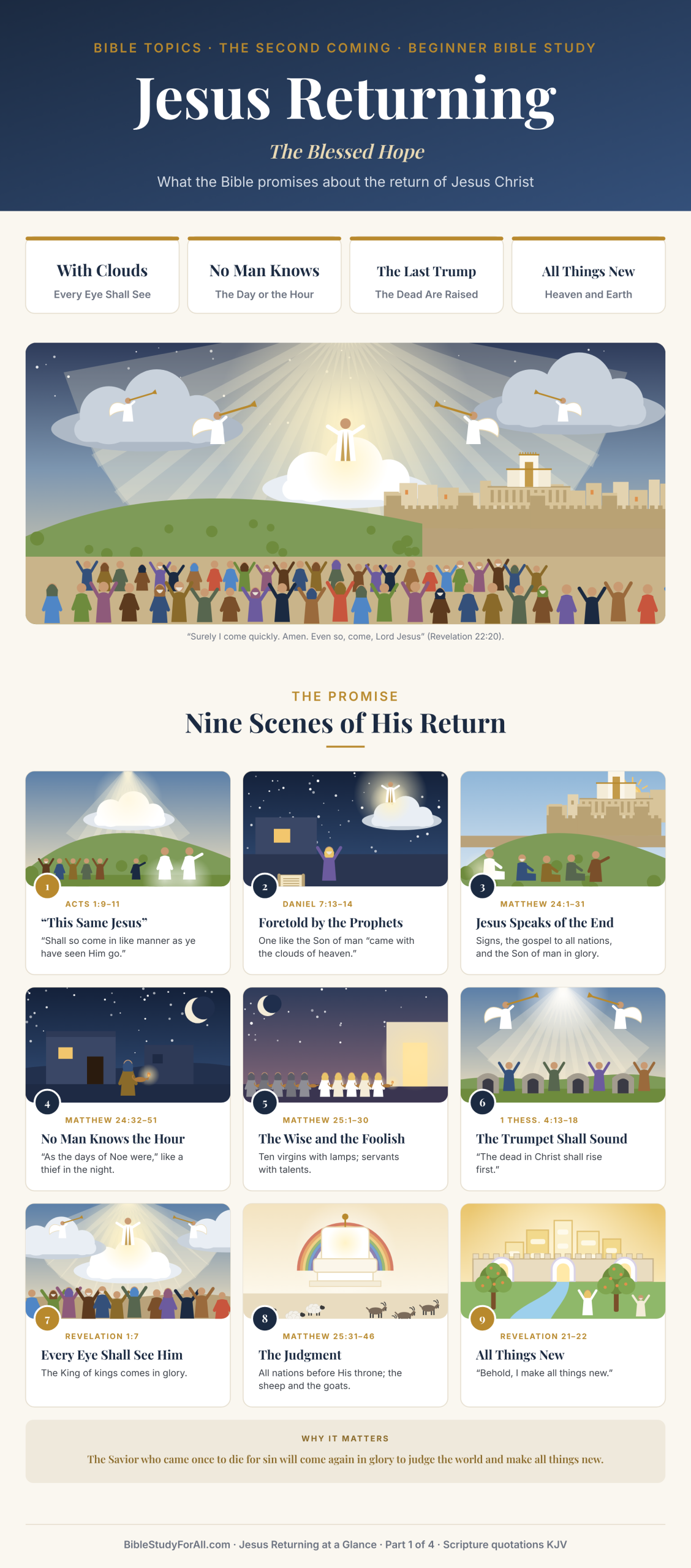
The New Testament promises that Jesus will return in glory to judge the living and the dead and to make all things new. Believers are called to live faithfully and watchfully until that day. Walk through what the Bible says about His coming, scene by scene, and see where Christians agree and where they read the details differently.
“Surely I come quickly. Amen. Even so, come, Lord Jesus.”
Revelation 22:20
With the Clouds
Visible to every eye
No Man Knows
The day or the hour
The Last Trump
The dead in Christ rise
All Things New
A new heaven and earth
Why His Return Matters
The Blessed Hope

The return of Jesus is mentioned hundreds of times in the New Testament. Every book but a few short letters looks forward to it. The earliest Christians greeted one another with an Aramaic prayer, “Maran-atha” (1 Corinthians 16:22), “our Lord, come.” The creeds the church has confessed for centuries say of Jesus, “He shall come to judge the quick and the dead.”
His return is the end of the story the whole Bible tells. The Savior who came once to die for sin will appear “the second time without sin unto salvation” for those who wait for Him (Hebrews 9:28). The Judge will set every wrong right. And the King will make all things new. Christians call it “that blessed hope” (Titus 2:13): not fear of the future, but confidence in the One who holds it.
At a Glance
Jesus’ Return in Nine Scenes
The Bible’s teaching about the Second Coming moves in nine scenes: the promise at the ascension, the prophets, Jesus’ teaching on the Mount of Olives, the unknown hour, the parables of readiness, the trumpet and the resurrection, every eye seeing Him, the judgment, and all things made new. Select a scene to jump straight to it.
Scene 1 · Acts 1:9–11; John 14:1–3
As the disciples watch Jesus go, two men in white promise He will come back.
Scene 2 · Daniel 7:13–14; Zechariah 14:4
Daniel sees one like the Son of man coming with the clouds of heaven.
Scene 3 · Matthew 24:1–31
On the Mount of Olives, Jesus tells His disciples what will come before His return.
Scene 4 · Matthew 24:32–51
He will come as in the days of Noah, like a thief in the night.
Scene 5 · Matthew 25:1–30
Ten virgins wait with lamps; five are ready when the bridegroom comes.
Scene 6 · 1 Thessalonians 4:13–18; 1 Corinthians 15:51–58
The dead in Christ rise, the living are changed, and all meet the Lord.
Scene 7 · Revelation 1:7; 19:11–16
The King of kings comes in glory, and the whole world sees Him.
Scene 8 · Matthew 25:31–46; Revelation 20:11–15
All nations gathered before His throne; the sheep and the goats.
Scene 9 · Revelation 21–22
A new heaven and a new earth, where God dwells with His people.
The overview comes in four illustrated parts. Part 1 is below, and parts 2 to 4 sit further down the page, each in the section it belongs to.
Before You Begin
Three Habits for This Study
You don’t need any background to follow along. These habits will help you study a subject that has sometimes been made confusing.
Start with what is clear
Some parts of prophecy are hard; the main promises are not. Build on the plain verses (Acts 1:11; John 14:3) before you puzzle over the details.
Read in context
Most passages about His return were written to comfort or to warn real churches. Read the whole chapter, such as 1 Thessalonians 4:13–5:11.
Hold views humbly
Faithful Christians read Revelation and the millennium differently. Know why you believe what you do, and keep fellowship with those who differ.
Scene 1 of 9 · Acts 1:9–11; John 14:1–3
The Promise at the Ascension
When: Forty days after the resurrection
“Ye men of Galilee, why stand ye gazing up into heaven? this same Jesus, which is taken up from you into heaven, shall so come in like manner as ye have seen Him go into heaven.”Acts 1:11 (KJV) · Read Acts 1:9–11
What happens
On the night before He died, Jesus comforted His disciples: “Let not your heart be troubled … In My Father’s house are many mansions … I go to prepare a place for you. And if I go and prepare a place for you, I will come again, and receive you unto Myself; that where I am, there ye may be also” (John 14:1–3).
Forty days after the resurrection, on the Mount of Olives, He was “taken up; and a cloud received Him out of their sight” (Acts 1:9). As the disciples stood staring into the sky, two men in white stood beside them with a promise. The same Jesus they had known, crucified and risen, would come back, and in the same way: bodily, visibly, with the clouds.
Look closer
“This same Jesus” matters. The one who returns is not a stranger or a mere spirit, but the Jesus who walked with them, ate with them, and still bore the marks of the nails (John 20:27). He went up bodily; He will return bodily.
Notice what the angels did with the disciples’ gazing. They did not let them stand there. The promise of His return sent them back to Jerusalem to pray and wait for the Spirit (Acts 1:12–14). Hope in His coming is meant to move us, not freeze us. See our Church Is Created study for what happened next.
Think about it
Jesus said, “I will come again, and receive you unto Myself.” What does it mean to you that He is preparing a place for you?
Scene 2 of 9 · Daniel 7:13–14; Zechariah 14:4
Foretold by the Prophets
When: Centuries before Christ
“I saw in the night visions, and, behold, one like the Son of man came with the clouds of heaven, and came to the Ancient of days, and they brought Him near before Him.”Daniel 7:13 (KJV) · Read Daniel 7:13–14
What happens
Long before Jesus was born, the prophets spoke of a day when God would come to set the world right. Daniel saw four beasts rise from the sea, pictures of earthly empires. Then he saw thrones set up and the Ancient of days seated in judgment, and “one like the Son of man” coming with the clouds of heaven. “And there was given Him dominion, and glory, and a kingdom, that all people, nations, and languages, should serve Him: His dominion is an everlasting dominion, which shall not pass away” (Daniel 7:14).
Zechariah spoke of the LORD coming to fight for His people: “And His feet shall stand in that day upon the mount of Olives, which is before Jerusalem on the east” (Zechariah 14:4), “and the LORD shall be king over all the earth” (Zechariah 14:9). Job, in his suffering, declared, “For I know that my redeemer liveth, and that He shall stand at the latter day upon the earth” (Job 19:25).
Look closer
“Son of man” was Jesus’ favorite name for Himself. At His trial the high priest asked if He was the Christ, and Jesus answered with Daniel 7: “Hereafter shall ye see the Son of man sitting on the right hand of power, and coming in the clouds of heaven” (Matthew 26:64). The high priest tore his clothes, because he understood exactly what Jesus was claiming.
Many prophecies of the Messiah blend His two comings, the way distant mountain peaks seem to stand side by side. Jesus fulfilled the prophecies of suffering at His first coming (Isaiah 53); the prophecies of glory and judgment wait for His second.
Think about it
Jesus fulfilled the prophecies of His first coming exactly. How does that strengthen your confidence in the promises of His return?
Scene 3 of 9 · Matthew 24:1–31
Jesus Speaks of the End
When: The week before the cross, c. A.D. 30
“And they shall see the Son of man coming in the clouds of heaven with power and great glory.”Matthew 24:30 (KJV) · Read Matthew 24:1–31
What happens
As they leave the temple, the disciples admire its great stones. Jesus tells them, “There shall not be left here one stone upon another” (Matthew 24:2). On the Mount of Olives they ask Him privately, “when shall these things be? and what shall be the sign of Thy coming, and of the end of the world?” (Matthew 24:3).
Jesus warns first against deception: “Take heed that no man deceive you. For many shall come in My name, saying, I am Christ” (Matthew 24:4–5). There will be wars, famines, earthquakes, persecution, and lawlessness, but “the end is not yet” (Matthew 24:6). “And this gospel of the kingdom shall be preached in all the world for a witness unto all nations; and then shall the end come” (Matthew 24:14). After great tribulation, the sun and moon will be darkened, and “they shall see the Son of man coming in the clouds of heaven with power and great glory. And He shall send His angels with a great sound of a trumpet, and they shall gather together His elect from the four winds” (Matthew 24:29–31).
Look closer
This teaching is called the Olivet Discourse (also in Mark 13 and Luke 21). The disciples asked about two things, the destruction of the temple and the end of the age, and Jesus answered both. The temple was destroyed by the Romans in A.D. 70. Christians differ on how much of the chapter was fulfilled then and how much is still future; see Reading the End Times.
Jesus called these troubles “the beginning of sorrows” (Matthew 24:8), literally birth pains. They are not signs that the world is out of control, but that something new is about to be born. His coming will be unmistakable: “as the lightning cometh out of the east, and shineth even unto the west” (Matthew 24:27).
Think about it
Jesus’ first warning was “Take heed that no man deceive you.” How can you stay grounded in the Bible when you hear confident claims about the end times?
Scene 4 of 9 · Matthew 24:32–51
No Man Knows the Hour
When: Unknown to all but the Father
“But of that day and hour knoweth no man, no, not the angels of heaven, but My Father only.”Matthew 24:36 (KJV) · Read Matthew 24:32–51
What happens
Jesus says plainly that no one knows the day or hour of His return, not even the angels. It will come as the Flood came: “For as in the days that were before the flood they were eating and drinking, marrying and giving in marriage, until the day that Noe entered into the ark, and knew not until the flood came, and took them all away; so shall also the coming of the Son of man be” (Matthew 24:38–39). Ordinary life will be going on as usual.
“Watch therefore: for ye know not what hour your Lord doth come” (Matthew 24:42). If the owner of a house knew when a thief was coming, he would stay awake. “Therefore be ye also ready: for in such an hour as ye think not the Son of man cometh” (Matthew 24:44). Jesus ends with two servants: the faithful one found doing his work when the master returns, and the evil one who says, “My lord delayeth his coming,” and begins to mistreat others (Matthew 24:45–51).
Look closer
Paul and Peter both repeat Jesus’ picture: “the day of the Lord so cometh as a thief in the night” (1 Thessalonians 5:2; 2 Peter 3:10). A thief does not announce himself. But Paul adds that believers, as “children of light,” will not be caught off guard in the same way, because they are awake and expecting Him (1 Thessalonians 5:4–6).
Over the centuries many people have predicted dates for Jesus’ return, and every date has passed. Jesus’ words are clear enough to make date-setting unwise. The question He leaves us with is not “When?” but “Will you be ready?”
Think about it
If Jesus came back today, would He find you doing what He has given you to do? What would you want to change?
Scene 5 of 9 · Matthew 25:1–30
The Wise and the Foolish
When: The same evening on the Mount of Olives
“Watch therefore, for ye know neither the day nor the hour wherein the Son of man cometh.”Matthew 25:13 (KJV) · Read Matthew 25:1–30
What happens
Jesus tells two parables about waiting well. Ten virgins take their lamps and go out to meet the bridegroom. Five are wise and bring extra oil; five are foolish and bring none. The bridegroom is delayed, and they all fall asleep. “And at midnight there was a cry made, Behold, the bridegroom cometh; go ye out to meet him” (Matthew 25:6). The foolish ones’ lamps are going out, and while they go to buy oil, the bridegroom arrives, “and they that were ready went in with him to the marriage: and the door was shut” (Matthew 25:10).
Then Jesus tells of a man who travels to a far country and entrusts his servants with talents, large sums of money. Two put their talents to work and double them. The third buries his in the ground. “After a long time the lord of those servants cometh, and reckoneth with them” (Matthew 25:19). To the faithful ones he says, “Well done, thou good and faithful servant … enter thou into the joy of thy lord” (Matthew 25:21).
Look closer
Both parables include a delay: “the bridegroom tarried” (Matthew 25:5) and “after a long time” (Matthew 25:19). Jesus prepared His followers for a longer wait than they might expect. Readiness is not a burst of excitement but steady faithfulness over time.
The oil could not be borrowed at the last minute (Matthew 25:8–9). No one can be ready on someone else’s behalf. And the servant with one talent was not condemned for losing money, but for doing nothing with what he had been given, because he did not trust his master’s heart (Matthew 25:24–26).
Think about it
Jesus has entrusted you with gifts, time, and opportunities. What is one “talent” you could put to work for Him this week?
Scene 6 of 9 · 1 Thessalonians 4:13–18; 1 Corinthians 15:51–58
The Trumpet Shall Sound
When: The moment of His coming
“For the Lord Himself shall descend from heaven with a shout, with the voice of the archangel, and with the trump of God: and the dead in Christ shall rise first.”1 Thessalonians 4:16 (KJV) · Read 1 Thessalonians 4:13–18
What happens
The young church in Thessalonica was grieving. Some believers had died, and the others worried they would miss the Lord’s return. Paul writes so “that ye sorrow not, even as others which have no hope” (1 Thessalonians 4:13). When Jesus comes, the believers who have died will rise first. “Then we which are alive and remain shall be caught up together with them in the clouds, to meet the Lord in the air: and so shall we ever be with the Lord. Wherefore comfort one another with these words” (1 Thessalonians 4:17–18).
To the Corinthians Paul explains what will happen to our bodies: “We shall not all sleep, but we shall all be changed, In a moment, in the twinkling of an eye, at the last trump: for the trumpet shall sound, and the dead shall be raised incorruptible, and we shall be changed” (1 Corinthians 15:51–52). Then the old enemy is defeated: “O death, where is thy sting? O grave, where is thy victory?” (1 Corinthians 15:55).
Look closer
Paul calls death “sleep” for believers, not because the soul is unconscious (Paul longed “to depart, and to be with Christ,” Philippians 1:23), but because death is not the end. Sleep is followed by waking.
The phrase “caught up” (Latin rapiemur) is where the word “rapture” comes from. Christians agree that believers will meet the Lord when He comes; they differ on how this relates to the tribulation (see Reading the End Times). Paul’s purpose is clear in any reading: “comfort one another with these words.”
Think about it
Paul wrote about Jesus’ return to comfort grieving people. Who do you know who needs the hope of these verses?
Scene 7 of 9 · Revelation 1:7; 19:11–16
Every Eye Shall See Him
When: The day of His appearing
“Behold, He cometh with clouds; and every eye shall see Him, and they also which pierced Him: and all kindreds of the earth shall wail because of Him. Even so, Amen.”Revelation 1:7 (KJV) · Read Revelation 1:7
What happens
The book of Revelation opens with this announcement: Jesus is coming, and everyone will see Him, even those who crucified Him. It will not be a secret event or a rumor that has to be checked. The whole earth will know.
Near the end of the book, John sees heaven opened and a rider on a white horse. “He that sat upon him was called Faithful and True, and in righteousness He doth judge and make war. His eyes were as a flame of fire, and on His head were many crowns” (Revelation 19:11–12). The armies of heaven follow Him. “And He hath on His vesture and on His thigh a name written, KING OF KINGS, AND LORD OF LORDS” (Revelation 19:16). Every power that has opposed God is overthrown.
Look closer
At His first coming, Jesus rode into Jerusalem on a donkey, “meek, and sitting upon an ass” (Matthew 21:5). At His second coming He rides a white horse as conqueror. He came first to save; He comes again to judge and to reign. Both comings are the same Jesus.
Revelation is full of symbols drawn from the Old Testament (the sword from His mouth in Revelation 19:15 recalls Isaiah 11:4 and 49:2). Christians read many of its details differently, but its main message is plain: Jesus wins, and all who belong to Him share His victory (Revelation 17:14).
Think about it
Jesus came first in humility and will come again in glory. How should knowing He is “King of kings” shape your loyalties today?
Scene 8 of 9 · Matthew 25:31–46; Revelation 20:11–15
The Judgment
When: When the Son of man comes in His glory
“When the Son of man shall come in His glory, and all the holy angels with Him, then shall He sit upon the throne of His glory.”Matthew 25:31 (KJV) · Read Matthew 25:31–46
What happens
Jesus describes the day when all nations will be gathered before Him, “and He shall separate them one from another, as a shepherd divideth his sheep from the goats” (Matthew 25:32). To those on His right He says, “Come, ye blessed of My Father, inherit the kingdom prepared for you from the foundation of the world” (Matthew 25:34). They fed Him, welcomed Him, clothed Him, and visited Him, and they are surprised. “Inasmuch as ye have done it unto one of the least of these My brethren, ye have done it unto Me” (Matthew 25:40). Those on His left had ignored Him in the needy, and “these shall go away into everlasting punishment: but the righteous into life eternal” (Matthew 25:46).
John sees the same day in Revelation: “I saw a great white throne, and Him that sat on it” (Revelation 20:11). The dead, small and great, stand before God, “and the dead were judged out of those things which were written in the books, according to their works” (Revelation 20:12). Another book is opened, the book of life.
Look closer
The judge is Jesus Himself. “For the Father judgeth no man, but hath committed all judgment unto the Son” (John 5:22). God “hath appointed a day, in the which He will judge the world in righteousness by that man whom He hath ordained” (Acts 17:31).
Being judged “according to their works” does not mean anyone earns salvation. Scripture is clear that we are saved by grace through faith (Ephesians 2:8–9). Works are the evidence of a living faith. The sheep did not even know they had served Jesus; their kindness flowed from hearts He had changed. For those who trust Christ, “There is therefore now no condemnation” (Romans 8:1).
Think about it
Jesus said that what we do for “the least of these” we do for Him. Who are “the least” around you, and how could you serve Jesus in them?
Scene 9 of 9 · Revelation 21–22
All Things New
When: Forever
“And God shall wipe away all tears from their eyes; and there shall be no more death, neither sorrow, nor crying, neither shall there be any more pain: for the former things are passed away.”Revelation 21:4 (KJV) · Read Revelation 21–22
What happens
“And I saw a new heaven and a new earth: for the first heaven and the first earth were passed away” (Revelation 21:1). John sees the holy city, new Jerusalem, coming down from God “as a bride adorned for her husband,” and hears a great voice: “Behold, the tabernacle of God is with men, and He will dwell with them, and they shall be His people, and God Himself shall be with them, and be their God” (Revelation 21:2–3). The one on the throne says, “Behold, I make all things new” (Revelation 21:5).
The city shines with the glory of God; its gates are pearls and its street is pure gold (Revelation 21:21). There is no temple, “for the Lord God Almighty and the Lamb are the temple of it,” and no need of the sun (Revelation 21:22–23). A river of the water of life flows from the throne, and on either side grows the tree of life, “and the leaves of the tree were for the healing of the nations” (Revelation 22:1–2). “And they shall see His face” (Revelation 22:4). The Bible ends with Jesus’ promise, “Surely I come quickly,” and the church’s answer: “Amen. Even so, come, Lord Jesus” (Revelation 22:20).
Look closer
The Bible ends where it began, but better. Genesis opens with a garden, a river, and the tree of life (Genesis 2:9–10); Revelation closes with a garden city, the river of life, and the tree of life. What was lost in Eden (see our Fall in Eden study) is restored and more: “And there shall be no more curse” (Revelation 22:3).
The Christian hope is not floating forever on clouds, but a renewed, physical creation with resurrected bodies, where God lives with His people. Paul says creation itself “shall be delivered from the bondage of corruption into the glorious liberty of the children of God” (Romans 8:21). Isaiah foresaw it too: “For, behold, I create new heavens and a new earth” (Isaiah 65:17).
Think about it
“They shall see His face.” Of everything promised in Revelation 21–22, what are you most looking forward to?
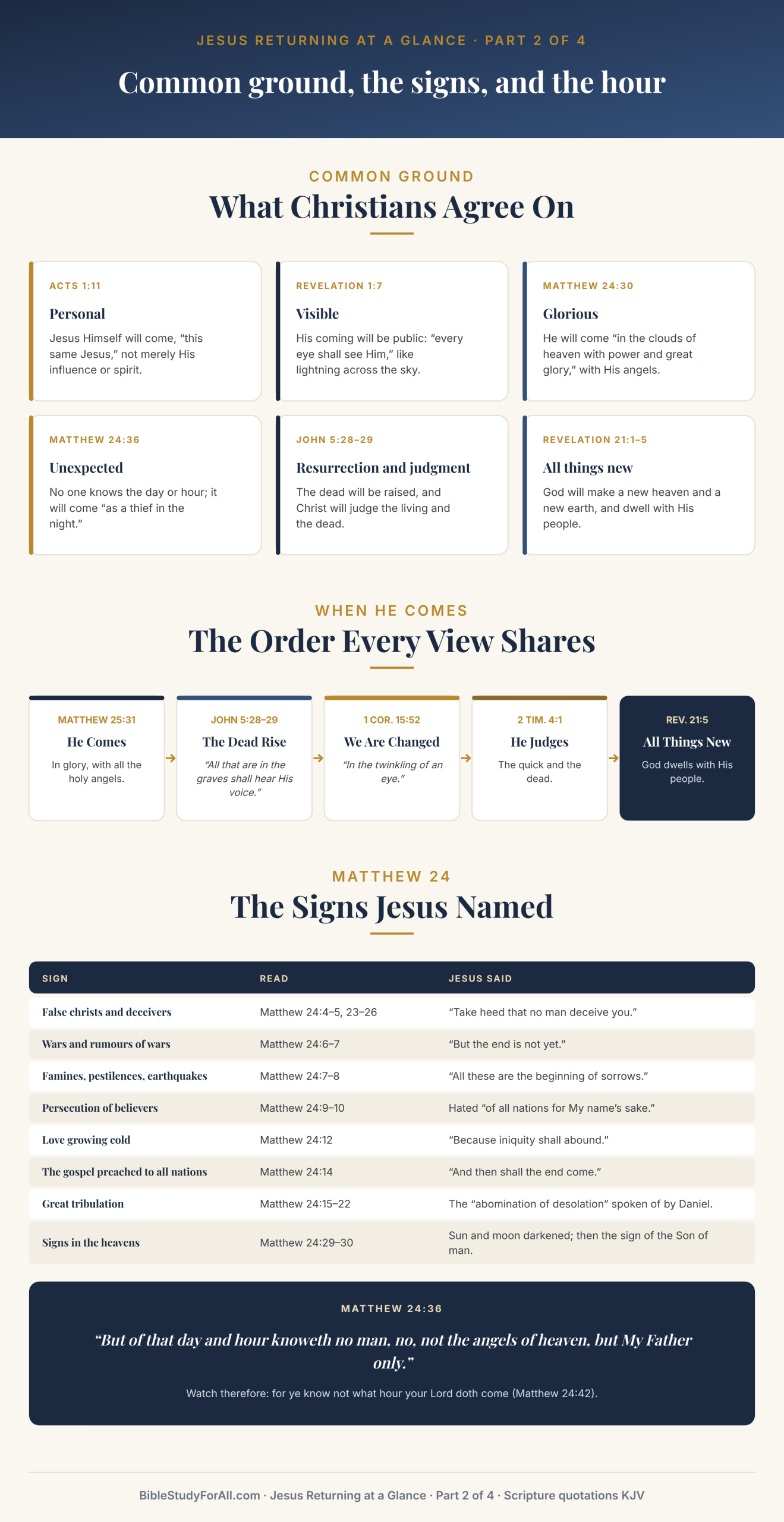
Common Ground
What Christians Agree On
Christians have debated the order of end-time events for centuries. But on the heart of the matter, the church has spoken with one voice since the beginning. Jesus’ return will be:
Acts 1:11
Personal
Jesus Himself will come, “this same Jesus,” not merely His influence or spirit.
Revelation 1:7
Visible
His coming will be public: “every eye shall see Him,” like lightning across the sky.
Matthew 24:30
Glorious
He will come “in the clouds of heaven with power and great glory,” with His angels.
Matthew 24:36; 1 Thessalonians 5:2
Unexpected
No one knows the day or hour; it will come “as a thief in the night.”
John 5:28–29; 2 Timothy 4:1
Resurrection and judgment
The dead will be raised, and Christ will judge the living and the dead.
Revelation 21:1–5
All things new
God will make a new heaven and a new earth, and dwell with His people.
What happens when He comes
Putting the passages together, Christians of every tradition expect these things when Jesus appears: He comes in glory with His angels (Matthew 25:31); the dead are raised, “all that are in the graves shall hear His voice, And shall come forth” (John 5:28–29); believers are changed “in the twinkling of an eye” and gathered to Him (1 Corinthians 15:52); He judges the living and the dead (2 Timothy 4:1); and God makes all things new (Revelation 21:5). How these fit together in time is where the views below differ.
Matthew 24
The Signs Jesus Named
Jesus described what the world would be like before His return. Many of these have marked every generation since; Jesus called them “the beginning of sorrows,” not a countdown.
| Sign | Read | Jesus said |
|---|---|---|
| False christs and deceivers | Matthew 24:4–5, 23–26 | “Take heed that no man deceive you.” |
| Wars and rumours of wars | Matthew 24:6–7 | “But the end is not yet.” |
| Famines, pestilences, earthquakes | Matthew 24:7–8 | “All these are the beginning of sorrows.” |
| Persecution of believers | Matthew 24:9–10 | Hated “of all nations for My name’s sake.” |
| Love growing cold | Matthew 24:12 | “Because iniquity shall abound.” |
| The gospel preached to all nations | Matthew 24:14 | “And then shall the end come.” |
| Great tribulation | Matthew 24:15–22 | The “abomination of desolation” spoken of by Daniel. |
| Signs in the heavens | Matthew 24:29–30 | Sun and moon darkened; then the sign of the Son of man. |
2 Thessalonians 2:1–12
The Man of Sin
Paul told a church that thought the day had already come that it would not come “except there come a falling away first, and that man of sin be revealed” (2 Thessalonians 2:3). John speaks of “antichrist” and of “many antichrists” already at work (1 John 2:18).
2 Peter 3:3–9
Why the Wait?
Scoffers ask, “Where is the promise of His coming?” Peter answers that “one day is with the Lord as a thousand years,” and that God “is longsuffering to us-ward, not willing that any should perish” (2 Peter 3:8–9).
Luke 21:28
Look Up
Jesus did not give signs to frighten His people but to steady them: “when these things begin to come to pass, then look up, and lift up your heads; for your redemption draweth nigh.”
Revelation 20 · 1 Thessalonians 4
Reading the End Times
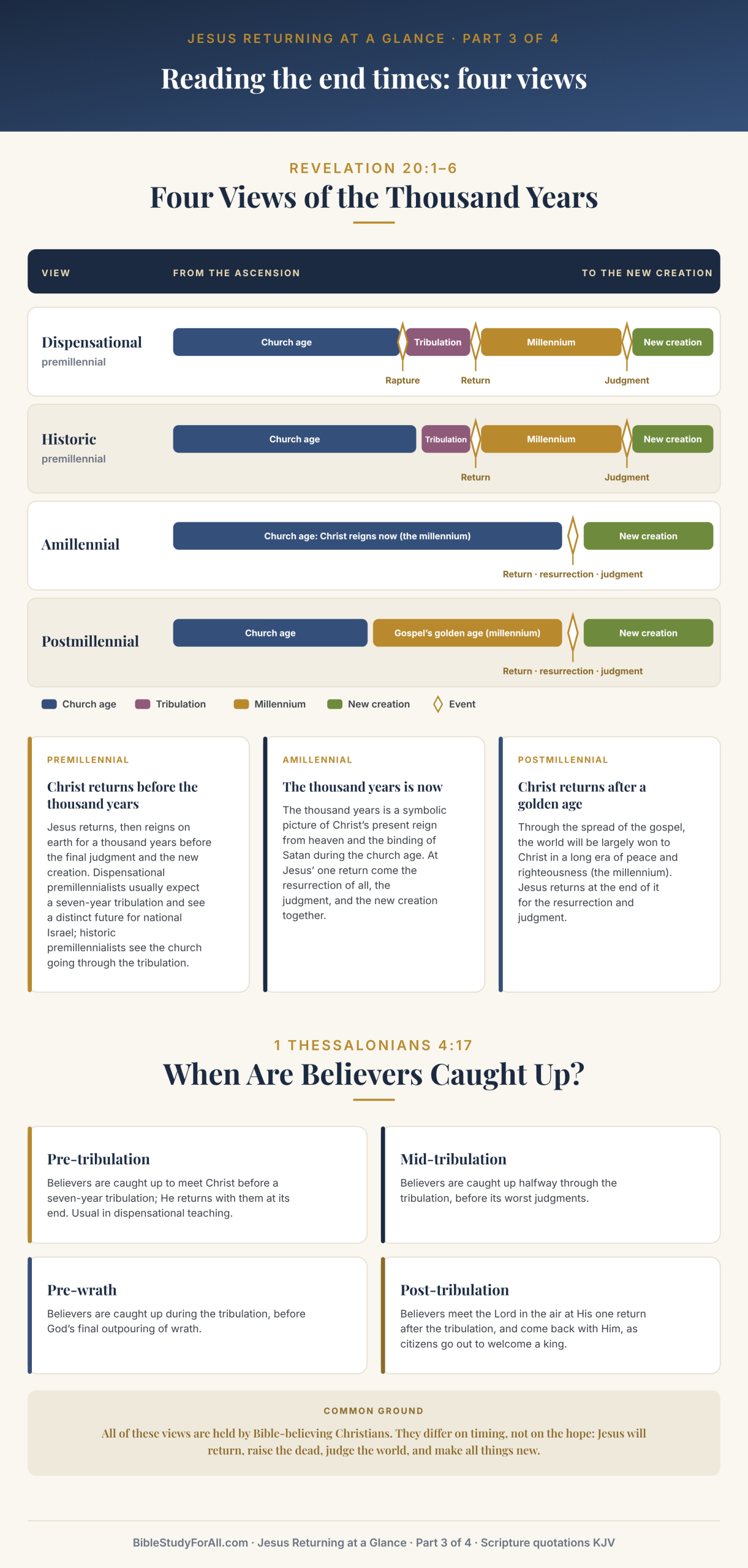
Revelation 20:1–6 speaks of Satan bound and of believers who “lived and reigned with Christ a thousand years.” Christians understand this “millennium,” and the timing of the events around Jesus’ return, in several ways. All of the views below are held by Bible-believing Christians. This page does not take sides; here is what each view teaches.
The Thousand Years
| View | What it teaches | Held by |
|---|---|---|
| Premillennial | Christ returns before the thousand years. Jesus returns, then reigns on earth for a thousand years before the final judgment and the new creation. Dispensational premillennialists usually expect a seven-year tribulation and see a distinct future for national Israel; historic premillennialists see the church going through the tribulation. | Many early church fathers (historic form); many evangelical and Bible churches (dispensational form, popular since the 1800s). |
| Amillennial | The thousand years is now. The thousand years is a symbolic picture of Christ’s present reign from heaven and the binding of Satan during the church age. At Jesus’ one return come the resurrection of all, the judgment, and the new creation together. | Augustine and much of church history; many Reformed, Lutheran, Anglican, Roman Catholic and Orthodox Christians. |
| Postmillennial | Christ returns after a golden age. Through the spread of the gospel, the world will be largely won to Christ in a long era of peace and righteousness (the millennium). Jesus returns at the end of it for the resurrection and judgment. | Many Puritans and leaders of the great awakenings, such as Jonathan Edwards; some Reformed Christians today. |
When Are Believers “Caught Up”?
Those who expect a future seven-year tribulation (often drawn from Daniel 9:27) differ on when believers meet the Lord in the air (1 Thessalonians 4:17).
Pre-tribulation
Believers are caught up to meet Christ before a seven-year tribulation; He returns with them at its end. Usual in dispensational teaching.
Mid-tribulation
Believers are caught up halfway through the tribulation, before its worst judgments.
Pre-wrath
Believers are caught up during the tribulation, before God’s final outpouring of wrath.
Post-tribulation
Believers meet the Lord in the air at His one return after the tribulation, and come back with Him, as citizens go out to welcome a king.
Four Ways of Reading Revelation
Futurist
Most of Revelation (chapters 4–22) describes events still to come just before Jesus returns.
Preterist
Much of Revelation and Matthew 24 was fulfilled in the first century, especially the fall of Jerusalem in A.D. 70. Partial preterists still expect Jesus’ future bodily return.
Historicist
Revelation pictures the whole history of the church from the apostles to the end, in order.
Idealist
Revelation shows timeless truths about the battle between Christ and evil in every age, ending in His victory.
Common ground
These are real differences, and they matter to many believers. But they are differences about the order and timing of events, not about the hope itself. Every one of these views confesses that Jesus will personally return, raise the dead, judge the world in righteousness, and make all things new. Many readers combine elements of the four ways of reading Revelation. Whatever your view, Jesus’ own instruction is the same: “Watch therefore” (Matthew 24:42).

Until He Comes
Living in the Light of His Return
The New Testament never teaches about Jesus’ return just to satisfy curiosity. Almost every passage ends with a call to live differently now.
1 Thessalonians 4:13–18
Comfort one another
Grieve with hope for believers who have died.
1 Corinthians 11:26
Remember at the table
The Lord’s Supper proclaims His death “till He come.”
Big Ideas
Six Themes of Jesus’ Return
Jesus keeps His word
He said, “I will come again,” and He will (John 14:3).
Hope, not fear
Believers look for Him as “that blessed hope” (Titus 2:13).
Watchfulness
No one knows the hour, so be ready always (Matthew 24:42–44).
Justice at last
He will judge the world in righteousness (Acts 17:31).
Death defeated
The dead in Christ will rise; death loses its sting (1 Corinthians 15:55).
God with us forever
The tabernacle of God is with men (Revelation 21:3).
Promises to Hold
“I Will Come Again”
Jesus and His apostles returned to this promise again and again. Here are eight of the clearest.
John 14:3
I will come again
“And if I go and prepare a place for you, I will come again, and receive you unto Myself; that where I am, there ye may be also.”
Acts 1:11
This same Jesus
“This same Jesus, which is taken up from you into heaven, shall so come in like manner as ye have seen Him go into heaven.”
Philippians 3:20
Our citizenship
“For our conversation is in heaven; from whence also we look for the Saviour, the Lord Jesus Christ.”
Titus 2:13
The blessed hope
“Looking for that blessed hope, and the glorious appearing of the great God and our Saviour Jesus Christ.”
Hebrews 9:28
The second time
“Unto them that look for Him shall He appear the second time without sin unto salvation.”
James 5:8
Be patient
“Be ye also patient; stablish your hearts: for the coming of the Lord draweth nigh.”
1 John 3:2
We shall be like Him
“When He shall appear, we shall be like Him; for we shall see Him as He is.”
Revelation 22:20
Surely I come quickly
“Surely I come quickly. Amen. Even so, come, Lord Jesus.”
Verses to Remember
Key Verses about Jesus’ Return
Along with the verses in each scene above, these are worth reading slowly, and memorizing.
John 14:3
“I will come again, and receive you unto Myself; that where I am, there ye may be also.”
Acts 1:11
“This same Jesus, which is taken up from you into heaven, shall so come in like manner as ye have seen Him go into heaven.”
Matthew 24:44
“Therefore be ye also ready: for in such an hour as ye think not the Son of man cometh.”
1 Thessalonians 4:16–17
“For the Lord Himself shall descend from heaven with a shout, with the voice of the archangel, and with the trump of God: and the dead in Christ shall rise first: Then we which are alive and remain shall be caught up together with them in the clouds, to meet the Lord in the air: and so shall we ever be with the Lord.”
Titus 2:13
“Looking for that blessed hope, and the glorious appearing of the great God and our Saviour Jesus Christ.”
1 John 3:2–3
“When He shall appear, we shall be like Him; for we shall see Him as He is. And every man that hath this hope in Him purifieth himself, even as He is pure.”
Revelation 21:4
“And God shall wipe away all tears from their eyes; and there shall be no more death, neither sorrow, nor crying, neither shall there be any more pain.”
Revelation 22:20
“He which testifieth these things saith, Surely I come quickly. Amen. Even so, come, Lord Jesus.”
Summary
Five Things to Remember
1
He will come
The same Jesus who ascended will return bodily and visibly (Acts 1:11).
2
No one knows when
Not the day or the hour, so be ready always (Matthew 24:36, 44).
3
The dead will rise
Believers who have died will be raised and all believers changed (1 Thessalonians 4:16–17).
4
He will judge
Every person will stand before Christ, the righteous Judge (Matthew 25:31–46).
5
All things new
God will dwell with His people in a new heaven and earth (Revelation 21:1–5).
For Reflection
Questions to Think About
- Why do you think the angels told the disciples to stop “gazing up into heaven” (Acts 1:11)? What does waiting well look like?
- Jesus said no one knows the day or hour (Matthew 24:36). Why might God have kept the date hidden?
- In the parable of the ten virgins, what does the oil represent to you, and how do you keep your lamp burning (Matthew 25:1–13)?
- Paul says to comfort one another with the hope of the resurrection (1 Thessalonians 4:18). How does this hope change the way Christians grieve?
- If you truly believed Jesus could return this year, what would you do differently?
Questions
Common Questions about Jesus’ Return
When will Jesus return?
No one knows. Jesus said, “of that day and hour knoweth no man, no, not the angels of heaven, but My Father only” (Matthew 24:36), and after His resurrection, “It is not for you to know the times or the seasons” (Acts 1:7). Many people throughout history have set dates, and all have been wrong. The Bible calls us to be ready at all times rather than to calculate.
Has the Second Coming already happened?
No. Christians of every tradition expect a future, bodily, visible return of Jesus. Some passages, especially parts of Matthew 24, are seen by many as fulfilled in the destruction of Jerusalem in A.D. 70. But Jesus’ coming “with clouds” for resurrection and judgment is still ahead. Paul warned against those who taught “that the resurrection is past already” (2 Timothy 2:18).
What does “this generation shall not pass” mean?
In Matthew 24:34 Jesus said, “This generation shall not pass, till all these things be fulfilled.” Christians read it in several ways: as referring to the generation then living, who saw the temple destroyed in A.D. 70 (the events of verses 4–28); as the generation alive when the final signs begin; or as “this race” or kind of people continuing until the end. Each reading takes Jesus’ words seriously while explaining how the chapter fits together.
What is the rapture?
“Rapture” comes from the Latin word for “caught up” in 1 Thessalonians 4:17: believers “shall be caught up together with them in the clouds, to meet the Lord in the air.” All Christians believe this will happen when Jesus comes. They differ on timing: some believe it happens before a seven-year tribulation, some in the middle, and some at Jesus’ one return after it. See Reading the End Times.
What is the tribulation?
Jesus spoke of “great tribulation, such as was not since the beginning of the world” (Matthew 24:21). Many Christians, drawing on Daniel 9:24–27 and Revelation 6–19, expect a future seven-year period of intense trouble before Jesus returns. Others see tribulation as the experience of God’s people throughout the church age, intensifying near the end (John 16:33; Acts 14:22), or see Jesus’ words as fulfilled largely in A.D. 70.
What is the millennium?
The word means “thousand years” and comes from Revelation 20:1–7, where Satan is bound and believers reign with Christ. Premillennialists believe Jesus returns before a literal thousand-year reign on earth. Amillennialists believe the thousand years symbolizes Christ’s present reign during the church age. Postmillennialists believe the gospel will bring a long golden age before Jesus returns. All three are held by faithful Christians.
Who is the Antichrist?
John writes that “antichrist shall come” and that “even now are there many antichrists” (1 John 2:18): anyone who denies the Father and the Son (1 John 2:22). Paul speaks of a “man of sin” who will exalt himself before the Lord’s coming (2 Thessalonians 2:3–4), and many link him with the beast of Revelation 13. Christians differ on whether this is one future individual, a system, or a recurring spirit. Attempts to name a particular person have repeatedly proved wrong.
What happens to believers who die before He returns?
They go to be with the Lord. Paul says that to be “absent from the body” is to be “present with the Lord” (2 Corinthians 5:8), and that to depart and be with Christ is “far better” (Philippians 1:23). Jesus told the thief on the cross, “To day shalt thou be with Me in paradise” (Luke 23:43). When Jesus returns, their bodies will be raised and reunited with them, made new like His glorious body (Philippians 3:21).
What happens to those who do not believe?
Jesus spoke of judgment honestly: “these shall go away into everlasting punishment: but the righteous into life eternal” (Matthew 25:46). Revelation speaks of the book of life and the lake of fire (Revelation 20:15). That is why the delay of His coming is mercy. God “is longsuffering to us-ward, not willing that any should perish, but that all should come to repentance” (2 Peter 3:9). Today is the day to trust Christ.
Will we recognize each other?
The Bible suggests we will. Paul comforts the Thessalonians that they will be caught up “together with them” (1 Thessalonians 4:17), and he expects to rejoice in the believers he served when Jesus comes (1 Thessalonians 2:19). At the transfiguration, Moses and Elijah were known (Matthew 17:3–4), and Jesus spoke of sitting down with Abraham, Isaac, and Jacob (Matthew 8:11).
What does “Maran-atha” mean?
It is an Aramaic phrase Paul uses in 1 Corinthians 16:22. It is usually understood as “Our Lord, come!” (a prayer) or “Our Lord has come.” The same prayer closes the Bible in Greek: “Even so, come, Lord Jesus” (Revelation 22:20). It shows that from the start, Christians did not dread Jesus’ return but longed for it.
Keep Reading
Continue Your Journey
Read the promises for yourself, then explore what it means to be made right with God through Jesus while we wait for Him.
Scripture quotations are from the King James Version (KJV), which is in the public domain. Verse links open at BibleGateway. Views on the millennium, the rapture and Revelation are described as their own teachers describe them; this page does not take a side.