
Old Testament · Major Prophets · Book 27 of 66
Daniel
Faithful in exile: Daniel and his friends stand firm in Babylon, and God shows that He rules over every king and kingdom, and that His kingdom will never end. “The God of heaven set up a kingdom, which shall never be destroyed” (2:44).
Daniel at a Glance
Book Outline
Note: Scripture quotations and verse links on this site use the King James Version (KJV) because it is in the public domain, while most modern translations limit how much can be quoted online. Feel free to read along in the translation of your choice.
12 Chapters
357 verses
Author
Daniel the prophet
Written
c. 536–530 B.C., in Babylon
Key Phrase
“The most High ruleth” (4:17)
About the Name
Title
Named for Daniel, whose name means “God is my judge.” In Babylon he was renamed Belteshazzar (1:7). Jesus spoke of “Daniel the prophet” (Matthew 24:15).
The book is named for its main character and author, Daniel, whose Hebrew name means “God is my judge.” In Babylon the prince of the eunuchs gave him the name Belteshazzar, and his friends Hananiah, Mishael and Azariah were renamed Shadrach, Meshach and Abed-nego (1:7). The Lord Jesus spoke of “the abomination of desolation, spoken of by Daniel the prophet” (Matthew 24:15).
In English Bibles Daniel is the last of the five Major Prophets, after Ezekiel. The book is written in two languages: Hebrew in 1:1–2:4 and chapters 8–12, and Aramaic, the common language of the Babylonian and Persian empires, from 2:4 (“O king, live for ever”) to the end of chapter 7, the part that speaks most of the nations of the world.
Who Wrote It
Author Details
Written by Daniel, who was taken to Babylon as a young man and served its kings for about seventy years. He “wrote the dream” (7:1), and Jesus called him “Daniel the prophet.”
Daniel was taken to Babylon as a young man of the king’s seed and of the princes of Judah (1:3–6) and served Nebuchadnezzar and the kings after him “even unto the first year of king Cyrus” (1:21), receiving his last vision in Cyrus’s third year (10:1). From chapter 7 on he speaks in the first person: “I Daniel” (7:15; 8:1; 9:2; 10:2). The book says he “wrote the dream, and told the sum of the matters” (7:1), and he was told to “seal the book, even to the time of the end” (12:4).
The Lord Jesus named him as a prophet and his book as Scripture, quoting “the abomination of desolation, spoken of by Daniel the prophet” (Matthew 24:15), and called Himself the “Son of man” who comes “in the clouds of heaven” (Matthew 26:64; Daniel 7:13). Ezekiel, who lived in the same years, names Daniel with Noah and Job as a righteous man (Ezekiel 14:14) and as a byword for wisdom (Ezekiel 28:3). “All scripture is given by inspiration of God” (2 Timothy 3:16).
When It Was Written
Date of Writing
The events run from 605 B.C., when Daniel was carried to Babylon, to the third year of Cyrus, about 536 B.C. Daniel wrote near the end of his long life, about 536–530 B.C.
The book begins “In the third year of the reign of Jehoiakim king of Judah,” when Nebuchadnezzar besieged Jerusalem and carried Daniel and others away, about 605 B.C. (1:1–6). Daniel served in Babylon through the whole exile. He saw Babylon fall to the Medes and Persians in 539 B.C. (5:30–31), served under Darius the Median and Cyrus the Persian (6:28), and received his last vision “In the third year of Cyrus king of Persia” (10:1), about 536 B.C.
He wrote the book near the end of his life, about 536–530 B.C., in Babylon. The first readers were God’s people living under foreign rule. They needed to know that God was still in control, that He would keep His promise to bring them home after seventy years (9:2; Jeremiah 25:11), and that one day He would set up a kingdom that shall never be destroyed.
Key Verse
A Kingdom That Shall Never Be Destroyed
“And in the days of these kings shall the God of heaven set up a kingdom, which shall never be destroyed: and the kingdom shall not be left to other people, but it shall break in pieces and consume all these kingdoms, and it shall stand for ever.”
Daniel 2:44 (KJV)
Big Ideas
Key Themes
God Rules History
He removes kings and sets up kings.
2:21; 4:17, 34–35
Faithfulness Under Pressure
Stand firm for God, whatever it costs.
1:8; 3:16–18; 6:10
Prayer
Daniel prays three times a day, in trouble and in confession.
2:17–23; 6:10; 9:3–19
Pride Humbled
God is able to abase those who walk in pride.
4:30–37; 5:20–23
God Reveals Secrets
There is a God in heaven that revealeth secrets.
2:22, 28, 47
The Kingdom of God
A kingdom that shall never be destroyed.
2:44; 7:14, 27
The Son of Man
One like the Son of man receives the everlasting kingdom.
7:13–14
Messiah the Prince
Cut off, but not for Himself.
9:24–26
Resurrection
Many that sleep in the dust shall awake.
12:2–3, 13
Overview
Daniel Summary
OverviewThe Most High Ruleth
Daniel was carried to Babylon as a young man and lived there for about seventy years, serving under Babylonian and Persian kings. His book has two halves. Chapters 1–6 are stories of Daniel and his friends standing firm for God in a pagan court, and of proud kings humbled. Chapters 7–12 are visions of the empires to come, of the Son of man who receives an everlasting kingdom, and of the time of the end. The message of both halves is the same: “the most High ruleth in the kingdom of men” (4:17). Kingdoms rise and fall, but “the God of heaven” will “set up a kingdom, which shall never be destroyed” (2:44).
Chapter 1Faithful in the King’s Court
In 605 B.C. Nebuchadnezzar takes Daniel, Hananiah, Mishael and Azariah to Babylon to be trained for the king’s service. They are given new names and the king’s food, but “Daniel purposed in his heart that he would not defile himself with the portion of the king’s meat” (1:8). He asks for pulse and water for ten days, and at the end they look healthier than all the others. “As for these four children, God gave them knowledge and skill in all learning and wisdom: and Daniel had understanding in all visions and dreams” (1:17). The king finds them ten times better than all his wise men (1:20).
Chapter 2The Great Image and the Stone
Nebuchadnezzar dreams a dream and demands that his wise men tell him both the dream and its meaning. They cannot, and he orders all the wise men slain. Daniel and his friends pray, and God reveals the secret. Daniel praises God: “He changeth the times and the seasons: He removeth kings, and setteth up kings” (2:21). He tells the king, “there is a God in heaven that revealeth secrets” (2:28). The king saw a great image with a head of gold, breast and arms of silver, belly and thighs of brass, legs of iron and feet of iron and clay, and a stone cut out without hands that struck the image and became a great mountain filling the whole earth. The head of gold is Nebuchadnezzar; three kingdoms will follow, and then “the God of heaven set up a kingdom, which shall never be destroyed” (2:44).
Chapter 3The Burning Fiery Furnace
Nebuchadnezzar sets up a golden image sixty cubits high and commands all to worship it. Shadrach, Meshach and Abed-nego refuse: “our God whom we serve is able to deliver us from the burning fiery furnace … But if not, be it known unto thee, O king, that we will not serve thy gods” (3:17–18). The furnace is heated seven times hotter, and they are cast in bound. But the king sees four men loose, walking in the fire, “and the form of the fourth is like the Son of God” (3:25). They come out without even the smell of fire on them, and the king blesses their God, “who hath sent His angel, and delivered His servants that trusted in Him” (3:28).
Chapters 4–5Proud Kings Humbled
Nebuchadnezzar tells in his own words how he dreamed of a great tree cut down. Daniel warns him to break off his sins, but a year later the king boasts, “Is not this great Babylon, that I have built … by the might of my power” (4:30). At once he is driven out to eat grass like oxen for seven times, “till thou know that the most High ruleth in the kingdom of men” (4:32). When his reason returns he praises “the King of heaven, all whose works are truth … and those that walk in pride He is able to abase” (4:37). Years later King Belshazzar holds a feast and drinks from the vessels taken from God’s temple. A hand writes on the wall: MENE, MENE, TEKEL, UPHARSIN. Daniel reads it: “Thou art weighed in the balances, and art found wanting” (5:27). “In that night was Belshazzar the king of the Chaldeans slain” (5:30), and Babylon falls to the Medes and Persians in 539 B.C.
Chapter 6Daniel in the Lions’ Den
Under Darius the Median, Daniel is so faithful that his rivals can find no fault in him “except we find it against him concerning the law of his God” (6:5). They persuade the king to sign a decree that for thirty days no one may pray to any god or man except the king. Daniel goes home, opens his windows toward Jerusalem, and “kneeled upon his knees three times a day, and prayed, and gave thanks before his God, as he did aforetime” (6:10). He is cast into the den of lions, and in the morning he tells the anxious king, “My God hath sent His angel, and hath shut the lions’ mouths” (6:22). Darius decrees that all men “tremble and fear before the God of Daniel: for He is the living God, and stedfast for ever” (6:26).
Chapters 7–8Four Beasts and the Son of Man
In the first year of Belshazzar, Daniel sees four great beasts come up from the sea: a lion with eagle’s wings, a bear, a leopard, and a fourth beast “dreadful and terrible” with ten horns and a little horn speaking great things. These are four kingdoms, matching the image of chapter 2: Babylon, Medo-Persia, Greece and Rome. Then the Ancient of days sits in judgment, and “one like the Son of man came with the clouds of heaven … And there was given Him dominion, and glory, and a kingdom, that all people, nations, and languages, should serve Him: His dominion is an everlasting dominion” (7:13–14). Jesus took this title as His own (Mark 14:62). In chapter 8 a ram with two horns, “the kings of Media and Persia,” is broken by a he goat with a great horn, “the king of Grecia” (8:20–21), Alexander the Great, out of whose kingdom comes a little horn that defiles the sanctuary.
Chapter 9Daniel’s Prayer and the Seventy Weeks
Reading Jeremiah, Daniel understands that the desolation of Jerusalem will last seventy years (9:2), and he prays a great prayer of confession: “To the Lord our God belong mercies and forgivenesses, though we have rebelled against Him” (9:9), and “O Lord, hear; O Lord, forgive” (9:19). While he is still praying, Gabriel comes with the prophecy of the seventy weeks, seventy sevens of years: “to make an end of sins, and to make reconciliation for iniquity, and to bring in everlasting righteousness” (9:24). From the commandment to restore and build Jerusalem “unto the Messiah the Prince” will be sixty-nine weeks, and then “shall Messiah be cut off, but not for Himself” (9:25–26), fulfilled when Christ died for the sins of His people. The last week belongs to the time of the end.
Chapters 10–12The Time of the End
In the third year of Cyrus, after three weeks of mourning and prayer, Daniel sees a man clothed in linen and learns of the unseen spiritual battle behind the nations (10). Chapter 11 foretells in detail the wars of the Persian and Greek kings, the kings of the north and the south, and the persecutor Antiochus who defiles the temple, yet “the people that do know their God shall be strong, and do exploits” (11:32). The prophecy then looks beyond him to the final enemy of God’s people at the time of the end. Chapter 12 promises a time of trouble such as never was, deliverance for everyone “found written in the book,” and the resurrection: “many of them that sleep in the dust of the earth shall awake, some to everlasting life, and some to shame and everlasting contempt” (12:2). “They that turn many to righteousness” shall shine “as the stars for ever and ever” (12:3), and Daniel is told, “thou shalt rest, and stand in thy lot at the end of the days” (12:13).
At a Glance
Daniel at a Glance
The whole book in short sections: its four parts, the kings Daniel served, a map of Daniel’s world, faithfulness in Babylon, the great image, the four kingdoms, the fiery furnace and the lions’ den, the Son of man, the seventy weeks, the time of the end, and Christ in Daniel. Tap a topic to jump to it.
Printable Copy
Save or Print the Infographic
Everything in this section, with the key verse and key themes, is also on a printable infographic (six pages). It opens in a new tab, where you can save it to your phone or computer, share it, or print it.
Structure
The Book in Four Parts
Daniel has two halves: stories of faithfulness in Babylon (1–6) and visions of the kingdoms and the time of the end (7–12). The stories show God ruling the kings of Daniel’s day; the visions show Him ruling all of history.
Each bar shows that part’s share of the 357 verses.
I 1–2 · 70 verses
Faithful in Babylon; the Great Image
Daniel and his friends refuse the king’s meat; God reveals the king’s dream.
II 3–6 · 126 verses
God Rules over the Kings
The fiery furnace, the tree cut down, the writing on the wall, the lions’ den.
III 7–9 · 82 verses
Visions of the Kingdoms
Four beasts and the Son of man, the ram and the he goat, the seventy weeks.
IV 10–12 · 79 verses
The Time of the End
The man clothed in linen, the kings of the north and south, the resurrection.
Dates B.C. (Approximate)
The Kings Daniel Served
Daniel lived through the whole exile, from Nebuchadnezzar to Cyrus: “And Daniel continued even unto the first year of king Cyrus” (1:21).
605 B.C.
Carried to Babylon
Third year of Jehoiakim (1:1)
605–562 B.C.
Nebuchadnezzar
The image, the furnace, the tree (1–4)
c. 553 B.C.
Belshazzar’s First Year
The four beasts (7:1)
539 B.C.
Babylon Falls
The writing on the wall (5:30–31)
539 B.C.
Darius the Median
The seventy weeks; the lions’ den (6; 9:1)
538 B.C.
Cyrus’s Decree
The Jews may go home (Ezra 1:1–3)
c. 536 B.C.
Third Year of Cyrus
The final vision (10:1)
c. 536–530 B.C.
The Book Written
Near the end of Daniel’s life
Daniel 1; 5–11 · Map
Daniel’s World
Daniel was carried from Jerusalem to Babylon as a young man and served there under Babylon and Persia. His visions reach across the whole map, from Grecia in the west to Persia in the east. The numbers match the cards below.
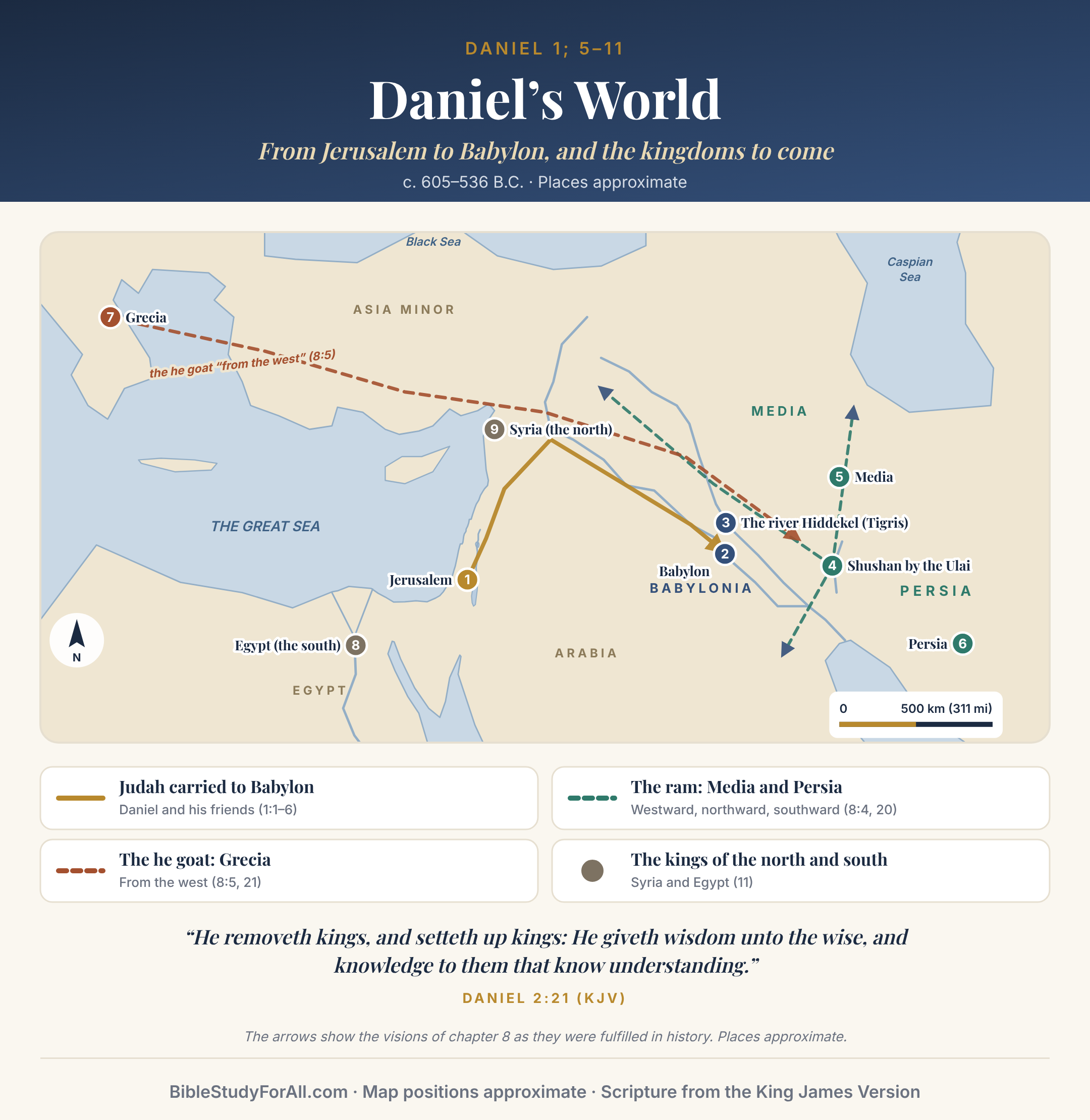
1 1:1–2; 6:10; 9:2, 16–27
Jerusalem
Besieged by Nebuchadnezzar; Daniel prays toward it and is told of its rebuilding.
2 1–5; 7
Babylon
Daniel serves in the king’s court for about seventy years; the writing on the wall.
3 10:4
The river Hiddekel (Tigris)
By the great river Daniel sees a man clothed in linen.
4 8:2, 16
Shushan by the Ulai
In vision Daniel sees the ram and the he goat beside the river Ulai.
5 5:28, 31; 6:8; 8:20; 9:1
Media
Darius the Median takes the kingdom; the law of the Medes and Persians.
6 8:20; 10:1, 13, 20; 11:2
Persia
Cyrus king of Persia; the ram with two horns is “the kings of Media and Persia.”
7 8:5–8, 21; 10:20; 11:2–4
Grecia
The rough goat is “the king of Grecia”; his great horn is broken and four come up.
8 11:5–9, 40–43
Egypt (the south)
The king of the south, at war again and again with the king of the north.
9 11:6–15, 21–31
Syria (the north)
The king of the north, who would come against the glorious land.
Daniel 1
Faithful in a Foreign Land
Four young men from Judah are given new names, new learning and the king’s food, but they keep their hearts for God.
DANIEL
Belteshazzar
Daniel means “God is my judge”
HANANIAH
Shadrach
Hananiah means “the LORD is gracious”
MISHAEL
Meshach
Mishael means “who is like God?”
AZARIAH
Abed-nego
Azariah means “the LORD helps”
“But Daniel purposed in his heart that he would not defile himself with the portion of the king’s meat, nor with the wine which he drank.”Daniel 1:8 (KJV)
Their Hebrew names honoured the LORD; the new Babylonian names honoured Babylon’s gods. After ten days of pulse and water they were “fairer and fatter in flesh” than all the others (1:15).
Daniel 2 and 7
The Great Image and the Four Beasts
Nebuchadnezzar’s dream (2) and Daniel’s vision (7) show the same four kingdoms, followed by the kingdom of God.
THE IMAGE (CHAPTER 2)
Head of gold: Babylon, “Thou art this head of gold”
2:37–38
THE BEASTS (CHAPTER 7)
A lion with eagle’s wings
7:4
THE IMAGE (CHAPTER 2)
Breast and arms of silver: Medo-Persia
2:39
THE BEASTS (CHAPTER 7)
A bear raised up on one side
7:5
THE IMAGE (CHAPTER 2)
Belly and thighs of brass: Greece
2:39
THE BEASTS (CHAPTER 7)
A leopard with four wings and four heads
7:6
THE IMAGE (CHAPTER 2)
Legs of iron, feet of iron and clay: Rome
2:40–43
THE BEASTS (CHAPTER 7)
A fourth beast, dreadful and terrible, with ten horns
7:7–8
Daniel 2:44
The Stone Cut Out Without Hands
“And in the days of these kings shall the God of heaven set up a kingdom, which shall never be destroyed: and the kingdom shall not be left to other people, but it shall break in pieces and consume all these kingdoms, and it shall stand for ever.”
Daniel 3 and 6
The Fiery Furnace and the Lions’ Den
Two tests of faith, two refusals to bow, and two deliverances that make pagan kings praise the God of Israel.
THE FIERY FURNACE (3)
King: Nebuchadnezzar
3:1
THE LIONS’ DEN (6)
King: Darius the Median
6:1
THE FIERY FURNACE (3)
The test: bow to the golden image
3:4–6
THE LIONS’ DEN (6)
The test: pray to no one but the king
6:7
THE FIERY FURNACE (3)
“we will not serve thy gods”
3:18
THE LIONS’ DEN (6)
“he kneeled upon his knees three times a day”
6:10
THE FIERY FURNACE (3)
“the form of the fourth is like the Son of God”
3:25
THE LIONS’ DEN (6)
“My God hath sent His angel, and hath shut the lions’ mouths”
6:22
“Our God whom we serve is able to deliver us from the burning fiery furnace, and He will deliver us out of thine hand, O king. But if not, … we will not serve thy gods.”Daniel 3:17–18 (KJV)
Daniel 4–5
Proud Kings Humbled
One king learns humility and praises God; the next mocks God and loses his kingdom that same night.
1 4 · NEBUCHADNEZZAR
The Tree Cut Down
Driven out to eat grass like oxen until he knows that the most High rules; then restored.
“those that walk in pride He is able to abase”
4:37
2 5 · BELSHAZZAR
The Writing on the Wall
He drinks from the temple vessels; Babylon falls that night.
“Thou art weighed in the balances, and art found wanting”
5:27
5:26
MENE
God hath numbered thy kingdom, and finished it.
5:27
TEKEL
Thou art weighed in the balances, and art found wanting.
5:28
PERES
Thy kingdom is divided, and given to the Medes and Persians.
Daniel 7:9–14
The Ancient of Days and the Son of Man
After the four beasts, Daniel sees the throne of God and one like the Son of man receiving the everlasting kingdom.
Daniel 7:13–14
One Like the Son of Man
“I saw in the night visions, and, behold, one like the Son of man came with the clouds of heaven, and came to the Ancient of days, and they brought Him near before Him. And there was given Him dominion, and glory, and a kingdom, that all people, nations, and languages, should serve Him: His dominion is an everlasting dominion, which shall not pass away.”
MARK 14:61–62
Jesus’ Answer
“ye shall see the Son of man sitting on the right hand of power, and coming in the clouds of heaven.”
MATTHEW 24:30
His Coming
“they shall see the Son of man coming in the clouds of heaven with power and great glory.”
REVELATION 1:13–14
John’s Vision
“one like unto the Son of man … His hairs were white like wool.”
Daniel 9:24–27
The Seventy Weeks
Seventy “weeks” of years (70 × 7 = 490 years) are determined for Daniel’s people and the holy city.
“Seventy weeks are determined upon thy people and upon thy holy city, to finish the transgression, and to make an end of sins, and to make reconciliation for iniquity, and to bring in everlasting righteousness.”Daniel 9:24 (KJV)
7 9:25 · 49 YEARS
Seven Weeks
From the commandment to restore and build Jerusalem; “the street shall be built again, and the wall.”
62 9:25–26 · 434 YEARS
Threescore and Two Weeks
“unto the Messiah the Prince”: then “shall Messiah be cut off, but not for Himself.”
1 9:27 · 7 YEARS
The Last Week
Belongs to the time of the end, with the abomination of desolation (Matthew 24:15).
Daniel’s prayer of confession (9:3–19) came first: he read Jeremiah’s seventy years (Jeremiah 25:11) and sought the Lord “by prayer and supplications, with fasting.”
Daniel 10–12
The Time of the End
Daniel’s last vision reaches from the Persian kings to the resurrection of the dead.
1 10
The Man Clothed in Linen
After three weeks of prayer, Daniel learns of the unseen battle behind the nations: “O man greatly beloved, fear not” (10:19).
2 11:1–35
Kings of the North and South
Persian and Greek kings, and the persecutor who defiles the sanctuary, foretold in detail.
3 11:36–45
The Wilful King
A final king who “shall exalt himself … above every god” at the time of the end.
4 12:1–3
Trouble, Deliverance, Resurrection
Michael stands up; all found written in the book are delivered; the dead awake.
“And many of them that sleep in the dust of the earth shall awake, some to everlasting life, and some to shame and everlasting contempt.”Daniel 12:2 (KJV)
Looking Forward
Christ in Daniel
Daniel’s visions point to the Lord Jesus Christ and His everlasting kingdom.
2:34–35, 44–45
The Stone
Cut out without hands, it becomes a mountain that fills the whole earth (compare Luke 20:17–18).
3:25
The Fourth Man in the Fire
“like the Son of God”: the Lord with His servants in the furnace.
7:13–14
The Son of Man
Receives everlasting dominion; the title Jesus used most for Himself.
9:25–26
Messiah the Prince
Comes at the appointed time and is “cut off, but not for Himself.”
Book Outline
Daniel Outline
Twelve chapters in four parts: faithful in Babylon and the great image (1–2), God rules over the kings (3–6), visions of the kingdoms (7–9), and the final vision of the time of the end (10–12). Chapters 1–6 are stories of Daniel and his friends; chapters 7–12 are Daniel’s visions. Tap a part below to jump to it, tap any section to expand it, and tap a verse reference to read it in the King James Version at BibleGateway.
Part I
Faithful in Babylon and the Great Image
1:1–2:49 · Daniel and his friends refuse the king’s meat, and God reveals the king’s dream
Part II
God Rules over the Kings
3:1–6:28 · The fiery furnace, the tree cut down, the writing on the wall and the lions’ den
Part III
Visions of the Kingdoms
7:1–9:27 · Four beasts and the Son of man, the ram and the he goat, and the seventy weeks
Part IV
The Final Vision: The Time of the End
10:1–12:13 · The man clothed in linen, the kings of the north and south, and the resurrection
Continue Your Study
Scripture quotations and verse links are from the King James Version (KJV).