
Old Testament · Minor Prophets · Book 28 of 66
Hosea
God tells His prophet to marry an unfaithful wife and love her still, a living picture of His love for unfaithful Israel. “I will heal their backsliding, I will love them freely” (14:4).
Hosea at a Glance
Note: Scripture quotations and verse links on this site use the King James Version (KJV) because it is in the public domain, while most modern translations limit how much can be quoted online. Feel free to read along in the translation of your choice.
14 Chapters
197 verses
Author
Hosea the son of Beeri (1:1)
Ministry
c. 755–715 B.C., to Israel
Key Verse
“I desired mercy, and not sacrifice” (6:6)
About the Name
Title
Named for the prophet Hosea, whose name means “salvation.” It is the first of the twelve Minor Prophets.
The book is named for its prophet, Hosea, whose Hebrew name means “salvation,” the same root as Joshua and Jesus. Paul calls him Osee (Romans 9:25).
Hosea is the first of the twelve Minor Prophets, “minor” because the books are shorter, not less important. In the Hebrew Bible the twelve were written on one scroll, called “The Twelve.”
Who Wrote It
Author Details
Written by Hosea the son of Beeri (1:1), a prophet to the northern kingdom of Israel, who married Gomer at the LORD’s command.
“The word of the LORD that came unto Hosea, the son of Beeri” (1:1). He is the only writing prophet who came from the northern kingdom and spoke mainly to it, calling it Ephraim and Samaria. He knew its towns, its shrines and its politics from the inside.
At the LORD’s command Hosea married Gomer the daughter of Diblaim (1:3), who became unfaithful to him. He loved her still and bought her back (3:1–2). His own heartbreak let him feel and tell how the LORD loved His unfaithful people.
When It Was Written
Date of Writing
Hosea prophesied for about forty years, c. 755–715 B.C., from Jeroboam II to Hezekiah, and saw Samaria fall in 722 B.C.
Hosea prophesied “in the days of Uzziah, Jotham, Ahaz, and Hezekiah, kings of Judah, and in the days of Jeroboam the son of Joash, king of Israel” (1:1). That is a long ministry, about 755–715 B.C.
He began in the prosperous last years of Jeroboam II, when Israel was rich but faithless, and lived through six quick kings, the turn to Assyria and Egypt (7:11), and the fall of Samaria to Assyria in 722 B.C. (2 Kings 17:6).
Key Verse
Mercy, Not Sacrifice
“For I desired mercy, and not sacrifice; and the knowledge of God more than burnt offerings.”
Hosea 6:6 (KJV)
Big Ideas
Key Themes
God’s Faithful Love
He loves the unfaithful.
3:1; 11:8
Spiritual Adultery
Idolatry is unfaithfulness.
1:2; 4:12
Knowing God
Destroyed for lack of knowledge.
4:6; 6:3
Mercy over Ritual
Not sacrifice.
6:6
Reaping What Is Sown
Wind and whirlwind.
8:7; 10:12
False Trust
Egypt and Assyria cannot save.
7:11; 14:3
Repentance
Return unto the LORD.
6:1; 14:1
Healing
I will heal their backsliding.
14:4
Victory over Death
O death, I will be thy plagues.
13:14
Overview
Hosea Summary
OverviewA Love That Will Not Let Go
Hosea is a love story with a broken heart at its centre. Israel had prospered under Jeroboam II, but it worshipped Baal and golden calves, trusted in Egypt and Assyria, and forgot the LORD who had brought it out of Egypt. God told Hosea to live out His message: to marry a wife who would be unfaithful, to give his children names of judgment, and then to love her and buy her back. Through it all one truth shines: God’s people have been unfaithful, but His love has not let them go.
Chapters 1–3Hosea’s Marriage
“Go, take unto thee a wife of whoredoms” (1:2). Hosea married Gomer, and their children were given names that preached: Jezreel, for the judgment on Jehu’s house; Lo-ruhamah, “not having obtained mercy”; and Lo-ammi, “not My people” (1:4–9). Yet at once God promises to reverse the names: “in the place where it was said unto them, Ye are not My people, there it shall be said unto them, Ye are the sons of the living God” (1:10). He will lead Israel into the wilderness, “and speak comfortably unto her,” and make the valley of Achor “a door of hope” (2:14–15): “I will betroth thee unto Me for ever” (2:19). Then the LORD says, “Go yet, love a woman … according to the love of the LORD toward the children of Israel” (3:1), and Hosea buys Gomer back for fifteen pieces of silver and a homer and a half of barley (3:2).
Chapters 4–7The LORD’s Controversy
“The LORD hath a controversy with the inhabitants of the land, because there is no truth, nor mercy, nor knowledge of God in the land” (4:1). Swearing, lying, killing, stealing and adultery fill the land. The priests have rejected knowledge: “My people are destroyed for lack of knowledge” (4:6). The people say, “Come, and let us return unto the LORD” (6:1), but their goodness is “as a morning cloud” (6:4), and God answers, “For I desired mercy, and not sacrifice; and the knowledge of God more than burnt offerings” (6:6). Ephraim is “a cake not turned” and “a silly dove without heart: they call to Egypt, they go to Assyria” (7:8, 11).
Chapters 8–10Sow the Wind
Israel made kings without God and a calf in Samaria; “they have sown the wind, and they shall reap the whirlwind” (8:7). Their altars multiplied, “for Israel hath forgotten his Maker” (8:14). The days of visitation are come (9:7): they will go back to “Egypt” in Assyria, and the calves of Beth-aven will be carried away (9:3; 10:5–6). Yet even here the call stands: “Sow to yourselves in righteousness, reap in mercy; break up your fallow ground: for it is time to seek the LORD” (10:12).
Chapter 11How Shall I Give Thee Up?
Then God speaks as a father: “When Israel was a child, then I loved him, and called My son out of Egypt” (11:1). He taught Ephraim to walk and drew them “with cords of a man, with bands of love” (11:3–4). They would not return, and judgment must come, yet the Father’s heart cries out: “How shall I give thee up, Ephraim? how shall I deliver thee, Israel? … Mine heart is turned within Me” (11:8). “I will not execute the fierceness of Mine anger … for I am God, and not man” (11:9).
Chapters 12–13Jacob and Ephraim
Israel is like its father Jacob, a deceiver who yet “had power with God” and wept and prayed (12:3–4): “Therefore turn thou to thy God: keep mercy and judgment, and wait on thy God continually” (12:6). But Ephraim trusts in “the balances of deceit” (12:7) and kisses the calves (13:2). “O Israel, thou hast destroyed thyself; but in Me is thine help” (13:9). Even over death God promises victory: “I will ransom them from the power of the grave; I will redeem them from death: O death, I will be thy plagues; O grave, I will be thy destruction” (13:14).
Chapter 14Return unto the LORD
The book ends with an invitation: “O Israel, return unto the LORD thy God” (14:1). God even gives the words to pray: “Take away all iniquity, and receive us graciously” (14:2). And He answers, “I will heal their backsliding, I will love them freely: for Mine anger is turned away from him” (14:4). Israel will grow like the lily and the cedars of Lebanon. “For the ways of the LORD are right, and the just shall walk in them” (14:9).
At a Glance
Hosea at a Glance
The whole book in short sections: its three parts, the names of Hosea’s children, the marriage as a picture, the charges against Israel, the map, the Father’s love, the call to return, and Christ in Hosea. Tap a topic to jump to it.
Printable Copy
Save or Print the Infographic
Everything in this section, with the key verse and key themes, is also on a printable infographic (five pages). It opens in a new tab, where you can save it to your phone or computer, share it, or print it.
Structure
The Book in Three Parts
Hosea’s home life (1–3) shows in a picture what the rest of the book (4–14) says in words.
Each bar shows that part’s share of the 197 verses.
I 1–3 · 39 verses
The Marriage
An unfaithful wife, three named children, a love that buys her back.
II 4:1–11:11 · 118 verses
God’s Charges
No truth, nor mercy, nor knowledge of God; yet “How shall I give thee up?”
III 11:12–14:9 · 40 verses
Return
Jacob’s example, Samaria’s fall, and healing for the backslider.
Hosea 1–2
Names That Preach
Each of Hosea’s children carried a message, and God promised to turn every name around.
THE NAME
Jezreel: “God scatters”, judgment on Jehu’s house
1:4
TURNED AROUND
“Great shall be the day of Jezreel”: God sows
1:11; 2:22
THE NAME
Lo-ruhamah: “no more mercy”
1:6
TURNED AROUND
“I will have mercy upon her that had not obtained mercy”
2:23
THE NAME
Lo-ammi: “Ye are not My people”
1:9
TURNED AROUND
“Thou art My people; and they shall say, Thou art my God”
2:23
Hosea 1–3
A Picture of God’s Love
Hosea’s marriage showed Israel what its unfaithfulness looked like to God, and how far His love would go.
1 1:2–3
Married
Hosea takes Gomer as his wife
2 2:5
Unfaithful
She goes after her lovers
3 3:1
Loved Still
“Go yet, love a woman”
4 3:2
Bought Back
Fifteen pieces of silver and barley
“And I will betroth thee unto Me for ever; yea, I will betroth thee unto Me in righteousness, and in judgment, and in lovingkindness, and in mercies.”Hosea 2:19 (KJV)
Hosea 4–10
The LORD’s Controversy
God brings His case against Israel like a lawsuit.
4:1
No Knowledge of God
No truth, nor mercy in the land.
4:6
Destroyed
“For lack of knowledge.”
4:17
Joined to Idols
“Let him alone.”
6:4
A Morning Cloud
Goodness that soon goes away.
7:11
A Silly Dove
Calling to Egypt, going to Assyria.
8:7
The Whirlwind
Sow the wind, reap the whirlwind.
“For I desired mercy, and not sacrifice; and the knowledge of God more than burnt offerings.”Hosea 6:6 (KJV)
Map
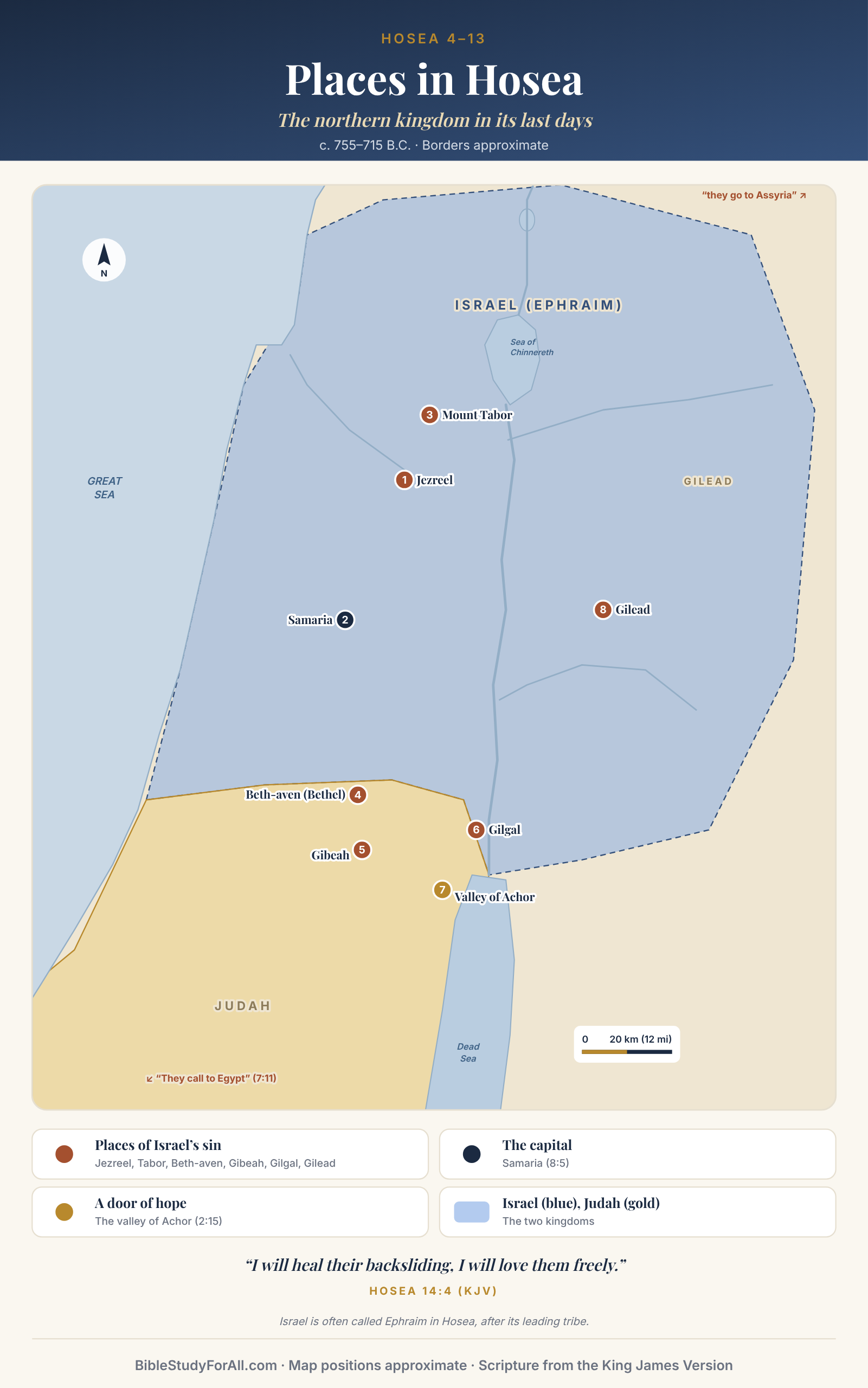
Places in Hosea
Hosea names the places where Israel sinned, and one where God would open a door of hope. Rust marks places of sin, navy the capital, and gold the valley of Achor. The numbers match the cards below.
1 1:4–5, 11
Jezreel
A place of sin. Hosea’s first son was named for the blood Jehu shed here; “great shall be the day of Jezreel.”
2 8:5–6; 13:16
Samaria
The capital. Israel’s capital: “Thy calf, O Samaria, hath cast thee off.”
3 5:1
Mount Tabor
A place of sin. The rulers were “a net spread upon Tabor.”
4 4:15; 10:5
Beth-aven (Bethel)
A place of sin. Bethel, “house of God,” became Beth-aven, “house of vanity,” for its golden calf.
5 9:9; 10:9
Gibeah
A place of sin. “Thou hast sinned from the days of Gibeah” (Judges 19–20).
6 4:15; 9:15
Gilgal
A place of sin. “All their wickedness is in Gilgal.”
7 2:15
Valley of Achor
A door of hope. Once the place of Achan’s trouble, made “a door of hope.”
8 6:8; 12:11
Gilead
A place of sin. “Gilead is a city of them that work iniquity.”
Hosea 11
How Shall I Give Thee Up?
God speaks of Israel as a father speaks of a wayward son.
11:1
Called
“Called My son out of Egypt”
11:3
Taught
“I taught Ephraim also to go”
11:4
Drawn
“With bands of love”
11:8
Yearned Over
“Mine heart is turned within Me”
Hosea 14
Return unto the LORD
The book closes with an invitation, the words to pray, and God’s promise.
ISRAEL PRAYS
“Take away all iniquity, and receive us graciously”
14:2
GOD ANSWERS
“I will heal their backsliding”
14:4
ISRAEL PRAYS
“Asshur shall not save us”
14:3
GOD ANSWERS
“I will love them freely”
14:4
ISRAEL PRAYS
“In Thee the fatherless findeth mercy”
14:3
GOD ANSWERS
“I will be as the dew unto Israel”
14:5
Looking Forward
Christ in Hosea
Hosea’s message of a love that redeems the unfaithful is fulfilled in Jesus Christ.
11:1 · MATTHEW 2:15
Out of Egypt
“Out of Egypt have I called My son,” fulfilled in the child Jesus.
6:6 · MATTHEW 9:13
Mercy, Not Sacrifice
Jesus said, “Go ye and learn what that meaneth.”
1:10; 2:23 · ROMANS 9:25–26
My People
Paul quotes Hosea of all God calls in Christ, Jews and Gentiles.
13:14 · 1 CORINTHIANS 15:55
Death Defeated
“O death, where is thy sting? O grave, where is thy victory?”
Book Outline
Hosea Outline
Fourteen chapters in three parts: Hosea’s marriage as a picture of God and Israel (1–3), the LORD’s charges against Israel and His persistent love (4:1–11:11), and unfaithfulness, judgment and the call to return (11:12–14:9). Tap a part below to jump to it, tap any section to expand it, and tap a verse reference to read it in the King James Version at BibleGateway.
Part I
Hosea’s Marriage: A Picture of God and Israel
1:1–3:5 · An unfaithful wife, three children with message names, and a love that buys her back
- Names reversed: Ammi and Ru-hamah · 2:1
- Rebuke of the unfaithful mother · 2:2–5
- Her way hedged up with thorns · 2:6–8
- The gifts she gave to Baal taken back · 2:9–13
- Into the wilderness: the valley of Achor “for a door of hope” · 2:14–15
- “I will betroth thee unto Me for ever” · 2:16–20
- The earth answers: “Thou art My people” · 2:21–23
Part II
Charges Against Israel and God’s Persistent Love
4:1–11:11 · The LORD’s controversy with priests, kings and people, and His heart for His son
- Plotters hot as an oven · 7:1–7
- Ephraim, “a cake not turned” and “a silly dove” · 7:8–12
- Woe unto them; a deceitful bow · 7:13–16
- The trumpet sounds: covenant broken · 8:1–3
- Kings without God and the calf of Samaria · 8:4–6
- “They have sown the wind, and they shall reap the whirlwind” · 8:7–10
- Altars multiplied; Israel “hath forgotten his Maker” · 8:11–14
- No more joy: return to Egypt · 9:1–6
- “The days of visitation are come”; the prophet called a fool · 9:7–9
- “Like grapes in the wilderness,” then Baal-peor · 9:10–14
- Wickedness in Gilgal; wanderers among the nations · 9:15–17
- A spreading vine with many altars · 10:1–4
- The calves of Beth-aven carried to Assyria · 10:5–8
- Sin since the days of Gibeah · 10:9–10
- “Break up your fallow ground” · 10:11–15
Part III
Unfaithfulness, Judgment and the Call to Return
11:12–14:9 · Lessons from Jacob, the fall of Samaria and the promise of healing
- Lies and deceit: “Ephraim feedeth on wind” · 11:12–12:2
- Jacob had power with God: “turn thou to thy God” · 12:3–6
- “The balances of deceit are in his hand” · 12:7–9
- Prophets sent, yet bitter provocation · 12:10–14
- Baal and the calves: “as the morning cloud” · 13:1–3
- The God who cared for them in the wilderness · 13:4–8
- “I will be thy king: where is any other that may save thee?” · 13:9–11
- “The iniquity of Ephraim is bound up” · 13:12–13
- “O death, I will be thy plagues” · 13:14
- The east wind and the fall of Samaria · 13:15–16
Continue Your Study
Scripture quotations and verse links are from the King James Version (KJV).