
1 & 2 Samuel · 1 & 2 Kings · 1 & 2 Chronicles · Bible Study
The Kings of Israel
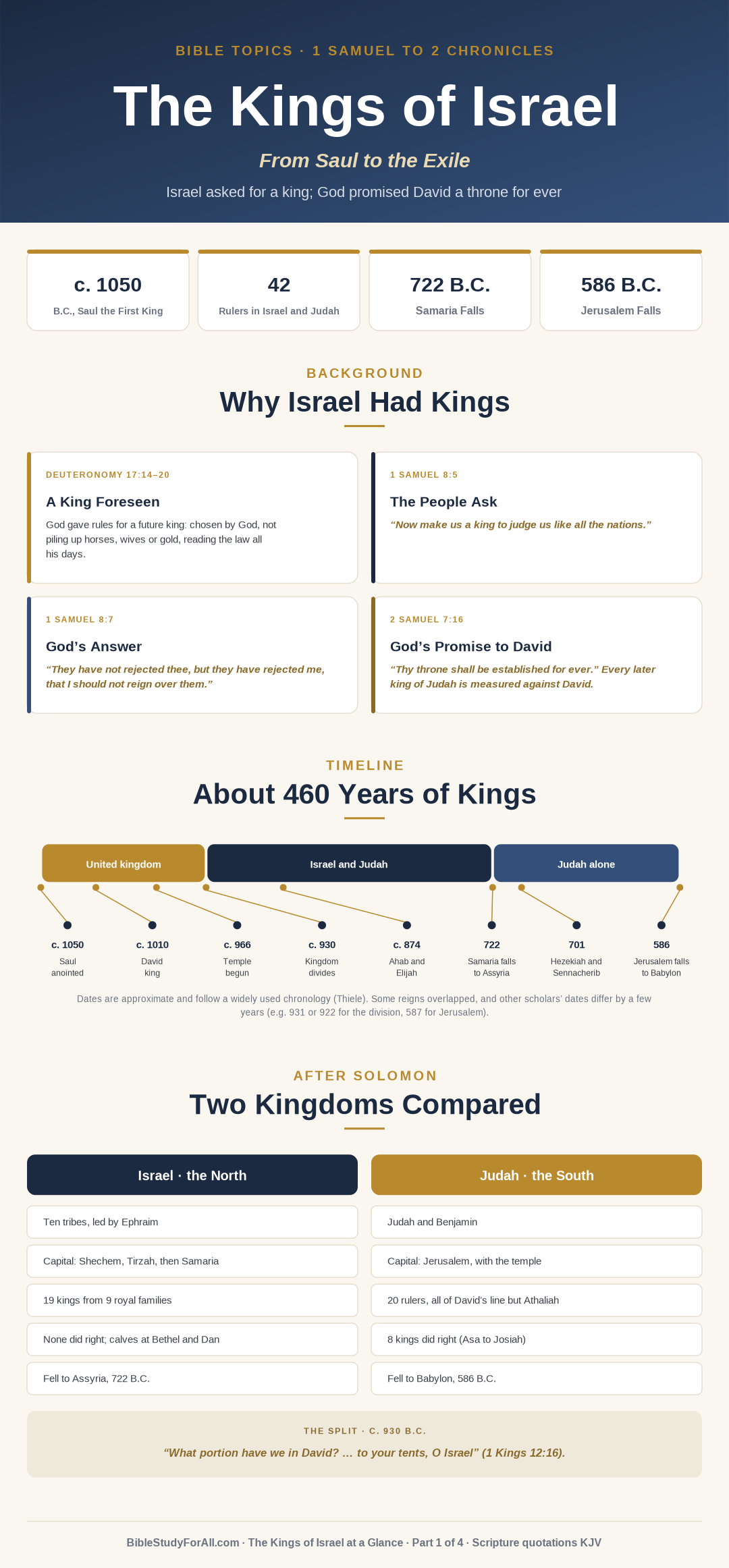
Israel asked for a king, and God gave them Saul, then David, then Solomon. After Solomon the kingdom divided, and for almost 350 years the kings of Israel and Judah led the people toward God or away from him. Follow the story era by era, and meet every king.
“And thine house and thy kingdom shall be established for ever before thee: thy throne shall be established for ever.”
2 Samuel 7:16
c. 1050 B.C.
Saul, the first king
About 460 Years
From Saul to the exile
42 Rulers
3 united · 19 Israel · 20 Judah
6 Books
1 Samuel to 2 Chronicles
At a Glance
From Saul to the Exile
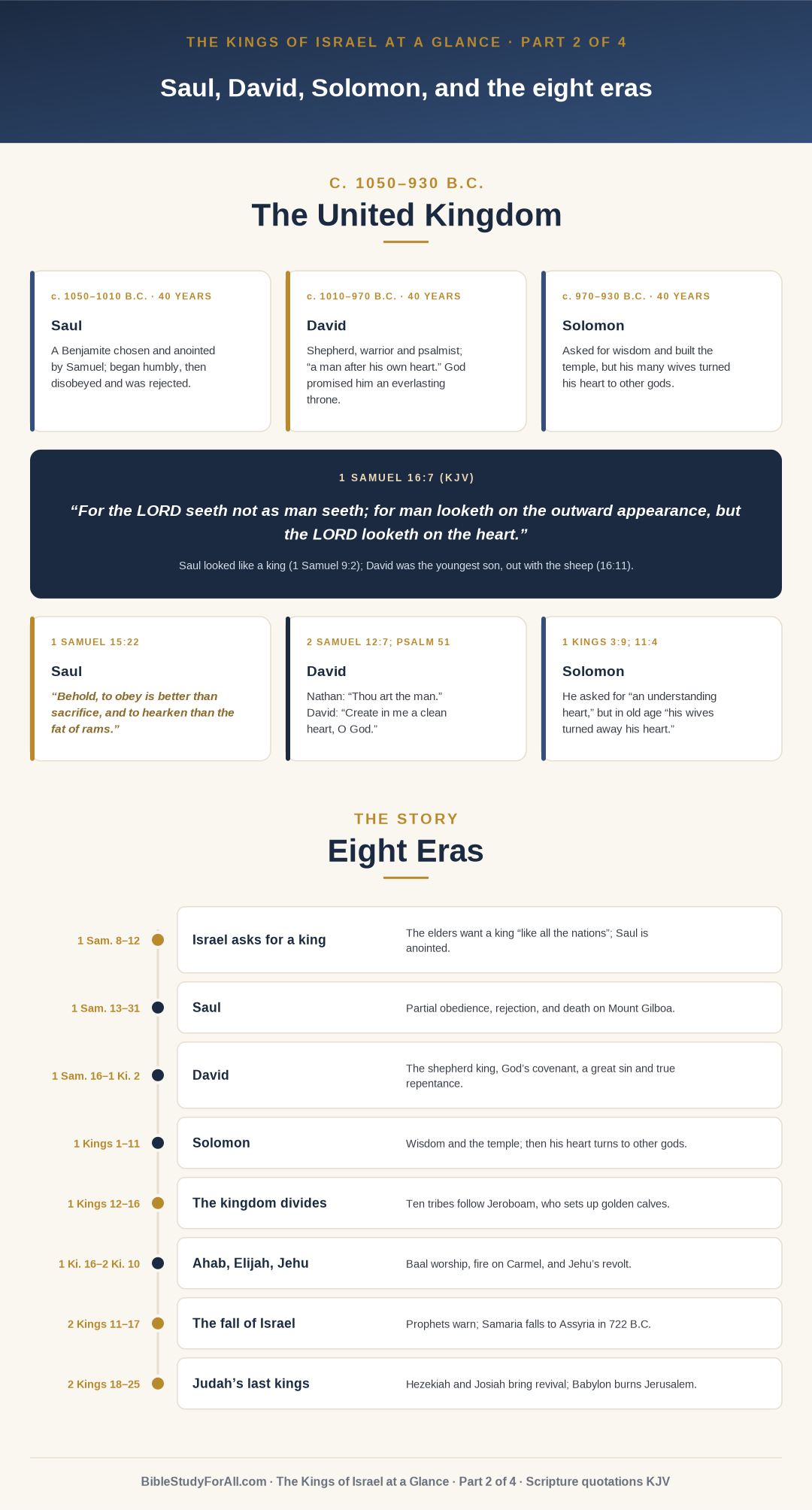
The story moves in eight eras: the people ask for a king, the three kings of the united kingdom, the split into two kingdoms, and the long road to exile, first for Israel and then for Judah. Select an era to jump straight to it.
Era 1 · c. 1050 B.C.
The elders want “a king to judge us like all the nations.”
Era 2 · c. 1050–1010 B.C.
A promising start, partial obedience, and a tragic end on Mount Gilboa.
Era 3 · c. 1010–970 B.C.
The shepherd king, God’s everlasting promise, a great sin, and true repentance.
Era 4 · c. 970–930 B.C.
Wisdom, the temple, and Israel’s golden age, then a heart that drifts.
Era 5 · c. 930–874 B.C.
Ten tribes follow Jeroboam; Judah stays with David’s line.
Era 6 · c. 874–814 B.C.
Baal worship in Samaria, fire on Mount Carmel, and Jehu’s revolt.
Era 7 · c. 841–722 B.C.
Prosperity, prophets, assassinations, and Samaria’s fall to Assyria.
Era 8 · c. 715–586 B.C.
Hezekiah and Josiah bring revival, but Jerusalem falls to Babylon.
The whole story in four parts. Save or print them to keep beside your Bible.
Before You Begin
Three Habits for This Study
You don’t need any background to follow along. These habits will help you get the most from each era.
Read Kings with Chronicles
Samuel and Kings tell the story of both kingdoms. Chronicles retells Judah’s story with extra details. Start with 1 Samuel 8 (KJV), where Israel asks for a king.
Listen for the verdict
Kings sums up nearly every reign the same way: he “did that which was right in the sight of the LORD,” or he “did evil.” Watch for it, and for what made the difference.
Keep the prophets in view
Behind almost every king stands a prophet: Samuel, Nathan, Elijah, Elisha, Isaiah, Jeremiah. The kings had power, but God’s word had the last say (2 Kings 17:13).
Era 1 of 8 · 1 Samuel 8–12
Israel Asks for a King
When: c. 1050 B.C.
“Hearken unto the voice of the people in all that they say unto thee: for they have not rejected thee, but they have rejected me, that I should not reign over them.”1 Samuel 8:7 (KJV) · Read 1 Samuel 8–12
What happens
Samuel is old, and his sons take bribes. The elders of Israel come to him at Ramah and say, “now make us a king to judge us like all the nations” (1 Samuel 8:5). Samuel is displeased, but God tells him to listen. The people are not rejecting Samuel; they are rejecting God as their King.
Samuel warns them what a king will cost: he will take their sons for his chariots, their daughters for his kitchens, their best fields, and a tenth of their flocks (1 Samuel 8:11–17). The people answer, “Nay; but we will have a king over us; That we also may be like all the nations” (1 Samuel 8:19–20). God then leads Saul, a tall young Benjamite out looking for his father’s lost donkeys, to Samuel, who anoints him (1 Samuel 9–10). Saul wins a great victory at Jabesh-gilead, and the kingdom is confirmed at Gilgal (1 Samuel 11). In his farewell, Samuel urges, “Only fear the LORD, and serve him in truth with all your heart” (1 Samuel 12:24).
Look closer
A king was not a surprise to God. He had promised Abraham, “kings shall come out of thee” (Genesis 17:6), and Deuteronomy 17:14–20 gave rules for a future king: one God chooses, who does not pile up horses, wives, or gold, and who writes out his own copy of the law and reads it “all the days of his life.”
The problem was the reason they asked. They wanted to be like the nations and to have a king who would “go out before us, and fight our battles” (1 Samuel 8:20), forgetting that the LORD had always fought for them. Samuel reminded them that they asked for a king “when the LORD your God was your king” (1 Samuel 12:12).
Think about it
Israel wanted to be “like all the nations.” Where are you tempted to trust what everyone else trusts instead of God?
Era 2 of 8 · 1 Samuel 13–31
Saul: The People’s Choice
When: c. 1050–1010 B.C.
“Behold, to obey is better than sacrifice, and to hearken than the fat of rams.”1 Samuel 15:22 (KJV) · Read 1 Samuel 13–31
What happens
Saul begins well, but cracks soon show. At Gilgal, with the Philistines gathering and his army slipping away, he will not wait for Samuel and offers the burnt offering himself (1 Samuel 13:8–12). Samuel tells him his kingdom will not continue: “the LORD hath sought him a man after his own heart” (1 Samuel 13:14). It is Saul’s son Jonathan who shows real faith: “there is no restraint to the LORD to save by many or by few” (1 Samuel 14:6).
Sent to destroy Amalek, Saul spares King Agag and the best animals, then claims they were kept for sacrifice. Samuel answers that obeying matters more than sacrifice, and God rejects Saul as king (1 Samuel 15). From then on Saul is troubled, jealous of David, and tries again and again to kill him. He even has the priests of Nob put to death (1 Samuel 22). On the night before his last battle he consults a medium at Endor, and the next day he and three of his sons die on Mount Gilboa (1 Samuel 28; 31).
Look closer
Saul’s failure was not one great crime but a pattern of half-obedience and excuses. When finally confronted, he admitted, “I feared the people, and obeyed their voice” (1 Samuel 15:24).
How long did Saul reign? The Hebrew text of 1 Samuel 13:1 seems to be missing its numbers, so translations differ (the KJV reads “Saul reigned one year; and when he had reigned two years over Israel”). Paul says God gave Israel Saul “by the space of forty years” (Acts 13:21), and most date his reign about 1050–1010 B.C.
Think about it
Saul kept explaining why partial obedience was good enough. Is there an area where you are offering God “sacrifice” instead of obedience?
Era 3 of 8 · 1 Samuel 16–1 Kings 2
David: A Man after God’s Own Heart
When: c. 1010–970 B.C.
“And thine house and thy kingdom shall be established for ever before thee: thy throne shall be established for ever.”2 Samuel 7:16 (KJV) · Read 2 Samuel 7
What happens
God sends Samuel to Bethlehem to anoint the youngest son of Jesse, a shepherd boy, because “the LORD looketh on the heart” (1 Samuel 16:7). David kills Goliath, serves in Saul’s court, and then spends years on the run, twice sparing Saul’s life. After Saul dies, David reigns seven and a half years over Judah at Hebron and thirty-three years over all Israel and Judah in Jerusalem, the city he captures from the Jebusites and where he brings the ark of God (2 Samuel 5–6).
When David wants to build God a house, God promises instead to build David a “house,” a royal line, with a throne established for ever (2 Samuel 7). Then David falls: he takes Bathsheba and has her husband Uriah killed. The prophet Nathan confronts him, “Thou art the man” (2 Samuel 12:7), and David repents (Psalm 51). Trouble follows in his family, including Absalom’s revolt, but before he dies David sees his son Solomon crowned (1 Kings 1).
Look closer
God’s covenant with David is one of the great promises of the Bible. His sons would be disciplined when they sinned, but “my mercy shall not depart away from him, as I took it from Saul” (2 Samuel 7:15). For the rest of Judah’s history, kings are measured against “David his father.”
When the kingdom later fell, the prophets kept the promise alive: “I will raise unto David a righteous Branch, and a King shall reign and prosper” (Jeremiah 23:5; see also Isaiah 9:7).
Think about it
David sinned terribly, yet he is still called a man after God’s own heart. What does his answer to Nathan teach about the way back to God?
Era 4 of 8 · 1 Kings 1–11
Solomon: Wisdom, Glory, and a Divided Heart
When: c. 970–930 B.C.
“For it came to pass, when Solomon was old, that his wives turned away his heart after other gods: and his heart was not perfect with the LORD his God, as was the heart of David his father.”1 Kings 11:4 (KJV) · Read 1 Kings 1–11
What happens
At Gibeon God says to the young king, “Ask what I shall give thee” (1 Kings 3:5). Solomon asks for “an understanding heart to judge thy people” (1 Kings 3:9), and God gives him wisdom, riches, and honour besides. In the fourth year of his reign he begins the temple in Jerusalem, finishing it seven years later. When it is dedicated, “the glory of the LORD had filled the house of the LORD” (1 Kings 8:11), and Solomon prays, “will God indeed dwell on the earth?” (1 Kings 8:27). The queen of Sheba comes to test his wisdom and leaves amazed.
But Solomon gathers horses from Egypt, great piles of gold, and seven hundred wives and three hundred concubines (1 Kings 10–11). In his old age his wives turn his heart to their gods. God tells him he will tear the kingdom away, leaving his son one tribe “for David my servant’s sake” (1 Kings 11:11–13).
Look closer
Compare Solomon with the king’s law in Deuteronomy 17:16–17: the king “shall not multiply horses … Neither shall he multiply wives to himself, that his heart turn not away: neither shall he greatly multiply to himself silver and gold.” Solomon did all three.
1 Kings 6:1 says the temple was begun “in the four hundred and eightieth year” after the exodus. Counting back from about 966 B.C. gives the early date of the exodus that this site follows, about 1446 B.C. Those who hold a later exodus (about 1270 B.C.) read the 480 years as twelve generations of forty years.
Think about it
Solomon had more wisdom than anyone, but wisdom did not keep his heart. What guards your heart from drifting slowly?
Era 5 of 8 · 1 Kings 12–16
The Kingdom Divides
When: c. 930–874 B.C.
“What portion have we in David? neither have we inheritance in the son of Jesse: to your tents, O Israel: now see to thine own house, David.”1 Kings 12:16 (KJV) · Read 1 Kings 12–16
What happens
At Shechem the people ask Solomon’s son Rehoboam to lighten their heavy load. He ignores the old men’s advice and follows his young friends: “my father also chastised you with whips, but I will chastise you with scorpions” (1 Kings 12:14). Ten tribes break away and make Jeroboam their king. Judah, with Benjamin, stays with Rehoboam. God tells Rehoboam not to fight, “for this thing is from me” (1 Kings 12:24).
Jeroboam fears that if his people go to Jerusalem to worship, they will turn back to Rehoboam. So he sets up two golden calves, at Bethel and Dan, and says, “behold thy gods, O Israel, which brought thee up out of the land of Egypt” (1 Kings 12:28). He appoints his own priests and feasts. This becomes “the sins of Jeroboam,” and every king of Israel after him keeps it. The north soon sees murder and coups, from Nadab to Zimri, until Omri takes power and builds a new capital, Samaria (1 Kings 16:24).
Look closer
The split was announced ahead of time. The prophet Ahijah tore his new cloak into twelve pieces and gave Jeroboam ten (1 Kings 11:29–31). God even offered Jeroboam a lasting dynasty “as I built for David,” if he would obey (1 Kings 11:38).
From here on, “Israel” in Kings usually means the northern kingdom (also called Ephraim or Samaria), and “Judah” the southern kingdom with its capital at Jerusalem. The north went through nine royal families in about two hundred years; Judah kept David’s line for nearly three hundred and fifty.
Think about it
Jeroboam’s calves were convenient: closer than Jerusalem, and “too much for you to go up.” Where does convenience shape the way you worship?
Era 6 of 8 · 1 Kings 16:29–2 Kings 10
Ahab, Elijah, and Jehu
When: c. 874–814 B.C.
“How long halt ye between two opinions? if the LORD be God, follow him: but if Baal, then follow him.”1 Kings 18:21 (KJV) · Read 1 Kings 18
What happens
Omri’s son Ahab marries Jezebel, a princess of Sidon, and builds a temple to Baal in Samaria. He “did evil in the sight of the LORD above all that were before him” (1 Kings 16:30). The prophet Elijah announces a drought, and after three years he calls Israel to Mount Carmel. Baal’s prophets cry out all day with no answer; Elijah prays once, and fire falls from heaven. The people fall on their faces: “The LORD, he is the God” (1 Kings 18:39). Later Ahab and Jezebel have Naboth killed for his vineyard (1 Kings 21), and Ahab dies in battle at Ramoth-gilead, just as the prophet Micaiah warned (1 Kings 22).
Elijah is taken up to heaven, and Elisha carries on his work through the reigns of Ahab’s sons (2 Kings 2–8). Then Elisha sends a young prophet to anoint Jehu, an army commander, as king. Jehu kills Joram of Israel, Ahaziah of Judah, and Jezebel, and wipes out Baal worship in Israel (2 Kings 9–10).
Look closer
Even Ahab found mercy when he humbled himself: “because he humbleth himself before me, I will not bring the evil in his days” (1 Kings 21:29).
Jehu is a mixed figure. God commended him for ending Ahab’s house, “But Jehu took no heed to walk in the law of the LORD God of Israel with all his heart” (2 Kings 10:30–31). Meanwhile, in Judah, Ahab’s daughter Athaliah seized the throne and killed the royal heirs. Only baby Joash survived, hidden in the temple for six years (2 Kings 11). David’s line hung by a thread, but God kept his promise “to give him alway a light” (2 Kings 8:19).
Think about it
“How long halt ye between two opinions?” Where are you trying to keep one foot in each camp?
Era 7 of 8 · 2 Kings 11–17
The Fall of Israel
When: c. 841–722 B.C.
“Yet the LORD testified against Israel, and against Judah, by all the prophets, and by all the seers, saying, Turn ye from your evil ways, and keep my commandments and my statutes …”2 Kings 17:13 (KJV) · Read 2 Kings 17
What happens
In Judah, young Joash repairs the temple, and Amaziah, Uzziah (Azariah), and Jotham follow with long, mostly faithful reigns. In Israel, Jeroboam II restores the old borders, as the prophet Jonah foretold (2 Kings 14:25), and the land grows rich. But the prophets Amos and Hosea condemn its injustice and idolatry.
After Jeroboam II the north falls apart. Four of its last six kings are assassinated. Assyria rises in the east: Tiglath-pileser takes Galilee and Gilead (2 Kings 15:29). Israel’s last king, Hoshea, stops paying tribute and looks to Egypt for help. Assyria besieges Samaria for three years, and in 722 B.C. the city falls. The people are carried away to Assyria, and foreigners are settled in their towns (2 Kings 17:6, 24).
Look closer
2 Kings 17 is the Bible’s own explanation of the fall. Israel was not defeated because Assyria was strong, but because “the children of Israel had sinned against the LORD their God, which had brought them up out of the land of Egypt” (2 Kings 17:7). God had warned them for two hundred years through prophets like Elijah, Elisha, Amos, and Hosea.
The mixed people who later lived in the region of Samaria, with their mixed worship (2 Kings 17:24–41), are part of the background to the Samaritans of the New Testament.
Think about it
Israel had two centuries of warnings. Is there a warning God has given you that you keep putting off?
Era 8 of 8 · 2 Kings 18–25
Judah’s Last Kings and the Exile
When: c. 715–586 B.C.
“He trusted in the LORD God of Israel; so that after him was none like him among all the kings of Judah, nor any that were before him.”2 Kings 18:5 (KJV) · Read 2 Kings 18–25
What happens
Hezekiah tears down the high places and even breaks the bronze serpent from Moses’ day, because the people were burning incense to it (2 Kings 18:4). When Sennacherib of Assyria surrounds Jerusalem in 701 B.C., Hezekiah spreads the enemy’s letter before the LORD and prays, “save thou us out of his hand, that all the kingdoms of the earth may know that thou art the LORD God, even thou only” (2 Kings 19:19). That night the angel of the LORD strikes the Assyrian camp.
His son Manasseh undoes it all in a fifty-five-year reign of idols and bloodshed (2 Kings 21). His grandson Josiah finds the book of the law in the temple, tears his clothes, renews the covenant, and destroys Jeroboam’s altar at Bethel (2 Kings 22–23). But Josiah dies at Megiddo in 609 B.C., and his sons are pawns of Egypt and Babylon. Nebuchadnezzar takes captives to Babylon, including Daniel and later Ezekiel, and in 586 B.C. his army burns the temple and the city (2 Kings 25:9).
Look closer
Kings does not end in total darkness. In the thirty-seventh year of the exile, the king of Babylon brings Jehoiachin out of prison and gives him a place at his table “all the days of his life” (2 Kings 25:27–30). David’s line is still alive.
Most date Jerusalem’s fall to 586 B.C.; some prefer 587. Chronicles closes with Cyrus of Persia allowing the exiles to go home and rebuild the temple (2 Chronicles 36:22–23), the story picked up in Ezra and Nehemiah.
Think about it
Josiah’s reform began when he simply heard God’s word read. What would change if you took God’s word that seriously?
Who’s Who
Meet Every King
Forty-two rulers in all: three over the united kingdom, nineteen over Israel in the north, and twenty over Judah in the south (nineteen kings and one queen). The verdicts are the ones the book of Kings gives. Dates are approximate and some reigns overlap, because sons often ruled alongside their fathers.
The United Kingdom
c. 1050–1010 B.C. · 40 years (Acts 13:21)
Saul
Mixed
A Benjamite chosen and anointed by Samuel; began humbly, then disobeyed and was rejected.
c. 1010–970 B.C. · 40 years (2 Samuel 5:4)
David
Did right
Shepherd, warrior and psalmist; “a man after his own heart.” God promised him an everlasting throne.
c. 970–930 B.C. · 40 years (1 Kings 11:42)
Solomon
Mixed
Asked for wisdom and built the temple, but his many wives turned his heart to other gods.
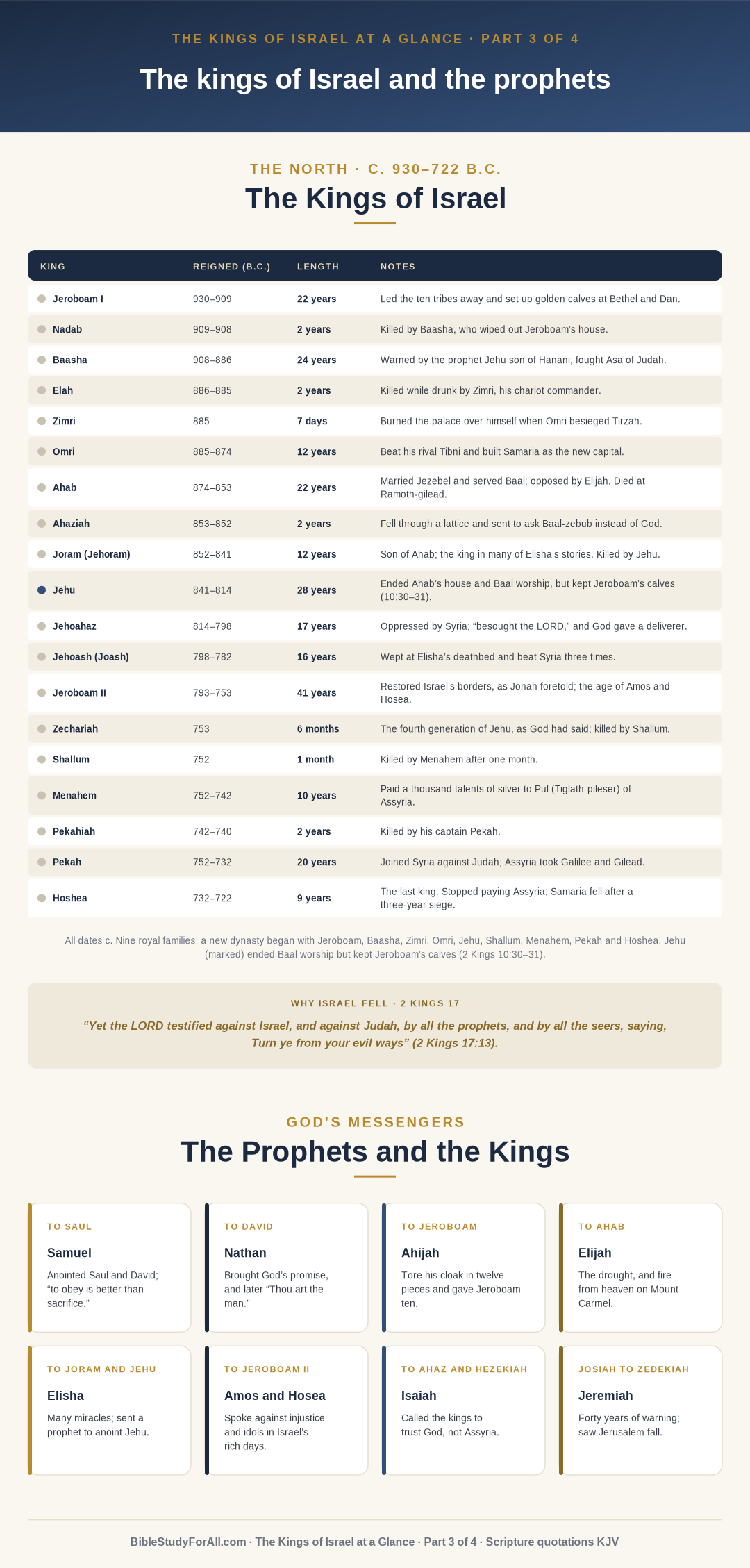
The Kings of Israel (the North)
Capital: Shechem, then Tirzah, then Samaria. Nine royal families in about 210 years. Every king kept Jeroboam’s golden calves, and the kingdom fell to Assyria in 722 B.C.
| # | King | Reigned (B.C.) | Verdict | Read (KJV) | Dynasty · notes |
|---|---|---|---|---|---|
| 1 | Jeroboam I 22 years | c. 930–909 | Did evil | 1 Kings 12:20–14:20 | DYNASTY 1 Led the ten tribes away and set up golden calves at Bethel and Dan. |
| 2 | Nadab 2 years | c. 909–908 | Did evil | 1 Kings 15:25–31 | DYNASTY 1 Killed by Baasha, who wiped out Jeroboam’s house. |
| 3 | Baasha 24 years | c. 908–886 | Did evil | 1 Kings 15:32–16:7 | DYNASTY 2 Warned by the prophet Jehu son of Hanani; fought Asa of Judah. |
| 4 | Elah 2 years | c. 886–885 | Did evil | 1 Kings 16:8–14 | DYNASTY 2 Killed while drunk by Zimri, his chariot commander. |
| 5 | Zimri 7 days | c. 885 | Did evil | 1 Kings 16:15–20 | DYNASTY 3 Burned the palace over himself when Omri besieged Tirzah. |
| 6 | Omri 12 years | c. 885–874 | Did evil | 1 Kings 16:21–28 | DYNASTY 4 Beat his rival Tibni and built Samaria as the new capital. |
| 7 | Ahab 22 years | c. 874–853 | Did evil | 1 Kings 16:29–22:40 | DYNASTY 4 Married Jezebel and served Baal; opposed by Elijah. Died at Ramoth-gilead. |
| 8 | Ahaziah 2 years | c. 853–852 | Did evil | 1 Kings 22:51–2 Kings 1:18 | DYNASTY 4 Fell through a lattice and sent to ask Baal-zebub instead of God. |
| 9 | Joram (Jehoram) 12 years | c. 852–841 | Did evil | 2 Kings 3 | DYNASTY 4 Son of Ahab; the king in many of Elisha’s stories. Killed by Jehu. |
| 10 | Jehu 28 years | c. 841–814 | Did evil | 2 Kings 9–10 | DYNASTY 5 Ended Ahab’s house and Baal worship, but kept Jeroboam’s calves (10:30–31). |
| 11 | Jehoahaz 17 years | c. 814–798 | Did evil | 2 Kings 13:1–9 | DYNASTY 5 Oppressed by Syria; “besought the LORD,” and God gave a deliverer. |
| 12 | Jehoash (Joash) 16 years | c. 798–782 | Did evil | 2 Kings 13:10–25 | DYNASTY 5 Wept at Elisha’s deathbed and beat Syria three times. |
| 13 | Jeroboam II 41 years | c. 793–753 | Did evil | 2 Kings 14:23–29 | DYNASTY 5 Restored Israel’s borders, as Jonah foretold; the age of Amos and Hosea. |
| 14 | Zechariah 6 months | c. 753 | Did evil | 2 Kings 15:8–12 | DYNASTY 5 The fourth generation of Jehu, as God had said; killed by Shallum. |
| 15 | Shallum 1 month | c. 752 | Did evil | 2 Kings 15:13–15 | DYNASTY 6 Killed by Menahem after one month. |
| 16 | Menahem 10 years | c. 752–742 | Did evil | 2 Kings 15:16–22 | DYNASTY 7 Paid a thousand talents of silver to Pul (Tiglath-pileser) of Assyria. |
| 17 | Pekahiah 2 years | c. 742–740 | Did evil | 2 Kings 15:23–26 | DYNASTY 7 Killed by his captain Pekah. |
| 18 | Pekah 20 years | c. 752–732 | Did evil | 2 Kings 15:27–31 | DYNASTY 8 Joined Syria against Judah; Assyria took Galilee and Gilead. |
| 19 | Hoshea 9 years | c. 732–722 | Did evil | 2 Kings 17:1–6 | DYNASTY 9 The last king. Stopped paying Assyria; Samaria fell after a three-year siege. |
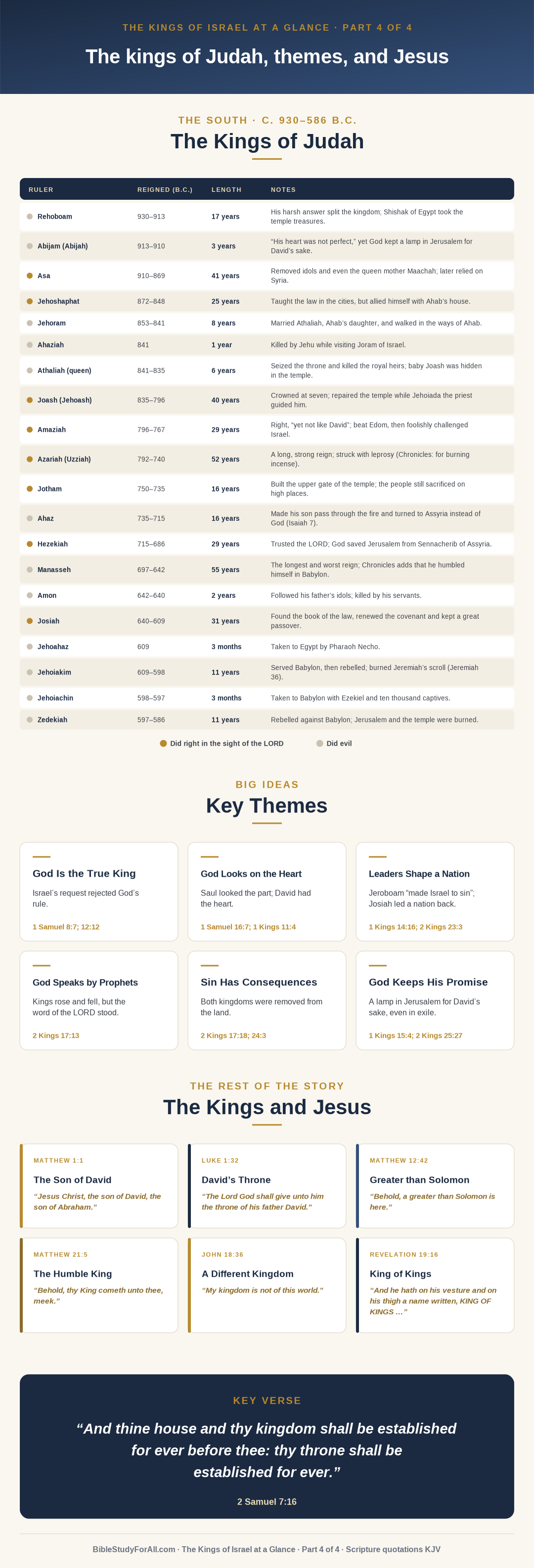
The Kings of Judah (the South)
Capital: Jerusalem, with the temple. One royal family, David’s, for about 345 years, broken only by Queen Athaliah. Eight kings did right. Judah fell to Babylon in 586 B.C.
| # | King | Reigned (B.C.) | Verdict | Read (KJV) | Notes · Chronicles |
|---|---|---|---|---|---|
| 1 | Rehoboam 17 years | c. 930–913 | Did evil | 1 Kings 14:21–31 | His harsh answer split the kingdom; Shishak of Egypt took the temple treasures. 2 CHR. 10–12 |
| 2 | Abijam (Abijah) 3 years | c. 913–910 | Did evil | 1 Kings 15:1–8 | “His heart was not perfect,” yet God kept a lamp in Jerusalem for David’s sake. 2 CHR. 13 |
| 3 | Asa 41 years | c. 910–869 | Did right | 1 Kings 15:9–24 | Removed idols and even the queen mother Maachah; later relied on Syria. 2 CHR. 14–16 |
| 4 | Jehoshaphat 25 years | c. 872–848 | Did right | 1 Kings 22:41–50 | Taught the law in the cities, but allied himself with Ahab’s house. 2 CHR. 17–20 |
| 5 | Jehoram 8 years | c. 853–841 | Did evil | 2 Kings 8:16–24 | Married Athaliah, Ahab’s daughter, and walked in the ways of Ahab. 2 CHR. 21 |
| 6 | Ahaziah 1 year | c. 841 | Did evil | 2 Kings 8:25–29 | Killed by Jehu while visiting Joram of Israel. 2 CHR. 22:1–9 |
| 7 | Athaliah (queen) 6 years | c. 841–835 | Did evil | 2 Kings 11 | Seized the throne and killed the royal heirs; baby Joash was hidden in the temple. 2 CHR. 22:10–23:21 |
| 8 | Joash (Jehoash) 40 years | c. 835–796 | Did right | 2 Kings 12 | Crowned at seven; repaired the temple while Jehoiada the priest guided him. 2 CHR. 24 |
| 9 | Amaziah 29 years | c. 796–767 | Did right | 2 Kings 14:1–22 | Right, “yet not like David”; beat Edom, then foolishly challenged Israel. 2 CHR. 25 |
| 10 | Azariah (Uzziah) 52 years | c. 792–740 | Did right | 2 Kings 15:1–7 | A long, strong reign; struck with leprosy (Chronicles: for burning incense). 2 CHR. 26 |
| 11 | Jotham 16 years | c. 750–735 | Did right | 2 Kings 15:32–38 | Built the upper gate of the temple; the people still sacrificed on high places. 2 CHR. 27 |
| 12 | Ahaz 16 years | c. 735–715 | Did evil | 2 Kings 16 | Made his son pass through the fire and turned to Assyria instead of God (Isaiah 7). 2 CHR. 28 |
| 13 | Hezekiah 29 years | c. 715–686 | Did right | 2 Kings 18–20 | Trusted the LORD; God saved Jerusalem from Sennacherib of Assyria. 2 CHR. 29–32 |
| 14 | Manasseh 55 years | c. 697–642 | Did evil | 2 Kings 21:1–18 | The longest and worst reign; Chronicles adds that he humbled himself in Babylon. 2 CHR. 33:1–20 |
| 15 | Amon 2 years | c. 642–640 | Did evil | 2 Kings 21:19–26 | Followed his father’s idols; killed by his servants. 2 CHR. 33:21–25 |
| 16 | Josiah 31 years | c. 640–609 | Did right | 2 Kings 22:1–23:30 | Found the book of the law, renewed the covenant and kept a great passover. 2 CHR. 34–35 |
| 17 | Jehoahaz 3 months | c. 609 | Did evil | 2 Kings 23:31–34 | Taken to Egypt by Pharaoh Necho. 2 CHR. 36:1–4 |
| 18 | Jehoiakim 11 years | c. 609–598 | Did evil | 2 Kings 23:35–24:7 | Served Babylon, then rebelled; burned Jeremiah’s scroll (Jeremiah 36). 2 CHR. 36:5–8 |
| 19 | Jehoiachin 3 months | c. 598–597 | Did evil | 2 Kings 24:8–17 | Taken to Babylon with Ezekiel and ten thousand captives. 2 CHR. 36:9–10 |
| 20 | Zedekiah 11 years | c. 597–586 | Did evil | 2 Kings 24:18–25:7 | Rebelled against Babylon; Jerusalem and the temple were burned. 2 CHR. 36:11–21 |
Did right did “that which was right in the sight of the LORD” Mixed began or ended differently Did evil “did evil in the sight of the LORD”
After Solomon
Two Kingdoms Compared
From about 930 B.C. there were two kingdoms side by side, sometimes at war with each other and sometimes allies. Here is how they compare.
About 930–722 B.C.
Israel (the North)
- The ten northern tribes, led by Ephraim
- Capitals: Shechem, Tirzah, then Samaria
- 19 kings from 9 royal families
- None did right; all followed “the sins of Jeroboam”
- Worship at golden calves in Bethel and Dan
- Fell to Assyria in 722 B.C. (2 Kings 17)
About 930–586 B.C.
Judah (the South)
- Judah and Benjamin, joined by Levites and faithful people from the north (2 Chronicles 11:16)
- Capital: Jerusalem, with the temple
- 19 kings and one queen, all of David’s line except Athaliah
- 8 kings did right, including Hezekiah and Josiah
- Revivals and relapses, warned by Isaiah and Jeremiah
- Fell to Babylon in 586 B.C. (2 Kings 25)
God’s Messengers
The Prophets and the Kings
Israel’s kings were never meant to have the final word. God sent prophets to anoint them, guide them, and confront them. “Yet the LORD testified against Israel, and against Judah, by all the prophets” (2 Kings 17:13).
To Saul
Samuel
Anointed Israel’s first two kings and told Saul, “to obey is better than sacrifice.”
To David
Nathan
Brought God’s promise to David, and later his rebuke: “Thou art the man.”
To Jeroboam II
Amos and Hosea
Spoke against injustice and idolatry in Israel’s richest days.
To Ahaz and Hezekiah
Isaiah
Urged Ahaz to trust God, and assured Hezekiah that God would save Jerusalem.
Big Ideas
Six Themes of the Kings
God is the true King
Israel’s request was a rejection of God’s rule, “when the LORD your God was your king” (1 Samuel 8:7; 12:12).
God looks on the heart
Saul looked the part; David had the heart; Solomon’s heart was turned away (1 Samuel 16:7; 1 Kings 11:4).
Leaders shape a nation
Jeroboam “made Israel to sin,” while Josiah led all the people to stand to the covenant (1 Kings 14:16; 2 Kings 23:3).
God speaks through his prophets
Kings rose and fell, but the word of the LORD stood, warning and promising (2 Kings 17:13; 23:16).
Sin has consequences
Both kingdoms were removed from the land because they would not turn back (2 Kings 17:18; 24:3).
God keeps his promise to David
He kept “a lamp in Jerusalem” for David’s sake, even through the exile (1 Kings 15:4; 2 Kings 25:27–30).
The Rest of the Story
The Kings and Jesus
Every king of Israel and Judah fell short, even the best of them. But God had promised David a son whose throne would last for ever (2 Samuel 7:16), and the prophets kept looking for him (Isaiah 9:7; Jeremiah 23:5). The New Testament opens by announcing that he has come.
Matthew 1:1
The son of David
“The book of the generation of Jesus Christ, the son of David, the son of Abraham.”
Luke 1:32–33
The throne of David
“The Lord God shall give unto him the throne of his father David: And he shall reign over the house of Jacob for ever; and of his kingdom there shall be no end.”
Matthew 12:42
Greater than Solomon
“She came from the uttermost parts of the earth to hear the wisdom of Solomon; and, behold, a greater than Solomon is here.”
Matthew 21:5
The humble King
“Behold, thy King cometh unto thee, meek, and sitting upon an ass, and a colt the foal of an ass.”
John 18:36
A different kingdom
“My kingdom is not of this world: if my kingdom were of this world, then would my servants fight …”
Revelation 19:16
King of kings
“And he hath on his vesture and on his thigh a name written, KING OF KINGS, AND LORD OF LORDS.”
Verses to Remember
Key Verses about the Kings
Along with the verses in each era above, these are worth reading slowly, and memorizing.
1 Samuel 12:24
“Only fear the LORD, and serve him in truth with all your heart: for consider how great things he hath done for you.”
1 Samuel 16:7
“… for the LORD seeth not as man seeth; for man looketh on the outward appearance, but the LORD looketh on the heart.”
2 Samuel 23:3
“He that ruleth over men must be just, ruling in the fear of God.”
Psalm 51:10
“Create in me a clean heart, O God; and renew a right spirit within me.”
2 Chronicles 16:9
“For the eyes of the LORD run to and fro throughout the whole earth, to shew himself strong in the behalf of them whose heart is perfect toward him.”
2 Kings 19:19
“Now therefore, O LORD our God, I beseech thee, save thou us out of his hand, that all the kingdoms of the earth may know that thou art the LORD God, even thou only.”
Psalm 20:7
“Some trust in chariots, and some in horses: but we will remember the name of the LORD our God.”
Proverbs 21:1
“The king’s heart is in the hand of the LORD, as the rivers of water: he turneth it whithersoever he will.”
Summary
Five Things to Remember
1
God wants to be King
Israel’s deepest problem was not who sat on the throne but that they had rejected God’s rule (1 Samuel 8:7).
2
God looks at the heart
Saul’s height, Solomon’s wisdom, and Jeroboam’s cleverness could not replace a heart turned to God (1 Samuel 16:7).
3
One choice affects many
Jeroboam’s calves led a nation astray for two centuries; Josiah’s obedience turned a nation back (1 Kings 14:16; 2 Kings 23:3).
4
God warns before he judges
He sent prophet after prophet for hundreds of years before the exile (2 Kings 17:13–14).
5
God keeps his promises
He kept David’s line alive through every crisis until the true Son of David came (2 Samuel 7:16; Luke 1:32–33).
Questions
Common Questions about the Kings
How many kings did Israel have?
This study counts forty-two rulers: three over the united kingdom (Saul, David, and Solomon), nineteen kings of Israel in the north, and twenty rulers of Judah in the south, which is nineteen kings plus Queen Athaliah. Some lists also count Saul’s son Ish-bosheth, who ruled the northern tribes for two years while David ruled Judah (2 Samuel 2:8–10), and Tibni, who claimed the throne against Omri (1 Kings 16:21–22).
Why don’t the reign lengths add up to the dates?
Several reasons. Some sons ruled alongside their fathers for years; for example, Jotham governed while his father Uzziah had leprosy (2 Kings 15:5). Rival kings sometimes reigned at the same time, as Pekah seems to have done. And Israel and Judah did not always count a king’s first partial year the same way. The dates on this page follow a widely used chronology based on the work of Edwin Thiele. Other scholars’ dates differ by a few years; some place the division of the kingdom at 931 or 922 B.C. instead of 930.
Was it wrong for Israel to ask for a king?
God had planned for a king (Genesis 17:6; Deuteronomy 17:14–20), so having one was not the problem. The problem was the reason. Israel wanted to be “like all the nations” and to have a king fight their battles, rejecting God as their King (1 Samuel 8:7, 20). Later, Hosea looked back on the northern kings and heard God say, “I gave thee a king in mine anger, and took him away in my wrath” (Hosea 13:11).
Were any of the northern kings good?
Kings says that every one of them did evil and kept Jeroboam’s calves. A few had better moments: Ahab humbled himself after Naboth’s death (1 Kings 21:29), Jehu ended Baal worship and was commended for it (2 Kings 10:30), and Jehoahaz “besought the LORD” when Syria oppressed Israel (2 Kings 13:4). None of them, though, led Israel back to the worship God had commanded.
How long did Saul reign?
The Hebrew text of 1 Samuel 13:1 appears to be missing its numbers, so English translations differ. Paul says God gave Saul “by the space of forty years” (Acts 13:21), and most date his reign to about 1050–1010 B.C. Some think the forty years is a round number, or includes the short reign of his son Ish-bosheth.
Why do Kings and Chronicles tell the story differently?
They were written for different times. Kings was finished during the exile and explains why both kingdoms fell, so it follows Israel and Judah side by side. Chronicles was written after the return from Babylon and focuses on Judah, David’s line, and the temple, to encourage the people rebuilding Jerusalem. It leaves out most of the northern kings and many of David’s and Solomon’s failures, and it adds details such as Manasseh’s repentance (2 Chronicles 33:12–13). Christians read the two as complementary accounts of the same history.
Why do several kings have the same name?
The two royal families intermarried and used family names. There was a Jehoram (or Joram) in both kingdoms at the same time, an Ahaziah in each, a Jehoash (or Joash) in each, and a Jehoahaz in each. Israel also had two Jeroboams. The tables above give the other spellings in brackets, and the dates help keep them apart.
What happened to the ten northern tribes?
Assyria carried many of them away and settled other peoples in their land (2 Kings 17:6, 24). But not all were lost: people from the northern tribes moved to Judah over the years (2 Chronicles 11:16; 30:11), and in the New Testament Anna the prophetess is “of the tribe of Aser” (Luke 2:36). Some believe the northern tribes mostly blended into Judah or into the nations; others look for their later descendants. The prophets promised that God would one day make them “one nation” again under one king (Ezekiel 37:22).
Keep Reading
Continue Your Study
Read the story for yourself, one era at a time, with the king tables beside you. Then dig deeper into each book on its own overview page.
Scripture quotations are from the King James Version (KJV), which is in the public domain. Verse links open at BibleGateway. Dates are approximate and follow a common chronology with overlapping reigns; the exodus date follows the early view (c. 1446 B.C.).