
Old Testament · History · Book 11 of 66
Book of 1 Kings
Solomon asks God for wisdom, builds the temple, and Israel reaches its height. Then “his wives turned away his heart” (11:4), the kingdom splits in two, and the prophet Elijah stands against Ahab and Baal: “if the LORD be God, follow Him” (18:21).
1 Kings at a Glance
Book Outline
Note: Scripture quotations and verse links on this site use the King James Version (KJV) because it is in the public domain, while most modern translations limit how much can be quoted online. Feel free to read along in the translation of your choice.
22 Chapters
816 verses
Author
Jeremiah the prophet
Time Covered
c. 970–853 B.C.
Key Word
“Heart” (3:9; 8:61; 11:4)
About the Name
Title
Named Kings for the kings of Israel and Judah whose story it tells. First and Second Kings were one book in the Hebrew Bible, divided in two by the Greek translators.
In the Hebrew Bible 1 and 2 Kings are a single book called Kings (Melakim), which tells the story of Israel’s kings from the last days of David to the fall of Jerusalem. The Greek Old Testament divided it into two scrolls and counted Samuel and Kings as four books of “Kingdoms,” which is why the King James Bible also calls this book “The First Book of the Kings, commonly called The Third Book of the Kings.”
In the Hebrew Bible, Kings belongs to the Former Prophets (Joshua, Judges, Samuel and Kings), because it is history written by a prophet: every king is measured by whether he kept the covenant, and prophets such as Nathan, Ahijah, Micaiah and Elijah bring God’s word to them. In English Bibles it stands among the books of history.
Who Wrote It
Author Details
Written by the prophet Jeremiah, as the Jewish Talmud records, using the official court records of the kings of Israel and Judah.
The Talmud (Baba Bathra 15a) states that “Jeremiah wrote his own book, the book of Kings, and Lamentations.” Jeremiah was a priest and prophet in Jerusalem through the last forty years of Judah’s kings, and the close of Kings matches the close of his own book word for word (2 Kings 24:18–25:30; Jeremiah 52).
The writer names the records he drew on: “the book of the acts of Solomon” (11:41), “the book of the chronicles of the kings of Israel” (14:19) and “the book of the chronicles of the kings of Judah” (14:29). Guided by the Holy Spirit, he chose from them what showed God’s faithfulness to His covenant and His word. “All scripture is given by inspiration of God” (2 Timothy 3:16).
When It Was Written
Date of Writing
Covers about 120 years, from Solomon’s crowning about 970 B.C. to Ahab’s death about 853 B.C. Kings was completed during the Babylonian exile.
1 Kings opens with Solomon made king about 970 B.C. and ends just after the death of Ahab at Ramoth-gilead about 853 B.C. Solomon began the temple “in the four hundred and eightieth year after the children of Israel were come out of the land of Egypt, in the fourth year of Solomon’s reign” (6:1), about 966 B.C., which places the exodus about 1446 B.C. The kingdom divided at Solomon’s death, about 930 B.C.
The whole book of Kings closes with King Jehoiachin released from prison in Babylon (2 Kings 25:27–30), so it was completed during the exile, about 560 B.C. Its first readers were the Jews in captivity, who needed to understand why the kingdom had fallen and to remember that God keeps His promises to the house of David.
Key Verse
If the LORD Be God, Follow Him
“How long halt ye between two opinions? if the LORD be God, follow Him: but if Baal, then follow him.”
1 Kings 18:21 (KJV)
Big Ideas
Key Themes
Wisdom from God
Ask God for an understanding heart.
3:9–12
Prayer and the Temple
God hears prayer made toward His house.
8:27–30
A Whole Heart
Let your heart be perfect with the LORD.
8:61; 11:4
Sin Divides
Solomon’s idolatry tears the kingdom in two.
11:11; 12:28
God’s Word Comes True
Every word of the prophets is fulfilled.
13:2; 22:28
The LORD Alone Is God
Choose whom you will follow.
18:21, 39
God Keeps His Promises
Not one word of His good promise failed.
8:56
A Faithful Remnant
Seven thousand who never bowed to Baal.
19:18
Mercy to the Humble
God delays judgment when Ahab humbles himself.
21:29
Overview
1 Kings Summary
OverviewGlory, Then Division
1 Kings tells how Israel rose to its greatest glory under Solomon and then split in two. The book falls into two halves. In chapters 1–11 Solomon becomes king, asks God for wisdom, builds the temple, and rules in peace and splendor, but in his old age turns to other gods. In chapters 12–22 the kingdom divides into Israel in the north and Judah in the south, and the writer follows the kings of both, judging each by one question: did he do “right in the eyes of the LORD” as David did, or walk in the sins of Jeroboam? The last six chapters are dominated by the prophet Elijah and his struggle against Ahab, Jezebel and the worship of Baal.
Chapters 1–2Solomon Becomes King
As David lies old and weak, his son Adonijah has himself proclaimed king. The prophet Nathan and Bathsheba remind David of his promise, and David has Solomon anointed at Gihon: “all the people said, God save king Solomon” (1:39). Before he dies David charges his son: “I go the way of all the earth: be thou strong therefore, and shew thyself a man; And keep the charge of the LORD thy God, to walk in His ways” (2:2–3). Solomon then secures his throne, removing Adonijah, Joab and Shimei, and sending the priest Abiathar home to Anathoth, fulfilling the word spoken against the house of Eli (2:27).
Chapters 3–4An Understanding Heart
At Gibeon the LORD appears to Solomon in a dream and says, “Ask what I shall give thee.” Solomon asks, “Give therefore Thy servant an understanding heart to judge Thy people, that I may discern between good and bad” (3:9). God is pleased and gives him wisdom, and riches and honour as well. The famous judgment between two women who both claim the same baby shows “the wisdom of God was in him, to do judgment” (3:28). Under Solomon “Judah and Israel dwelt safely, every man under his vine and under his fig tree” (4:25), and “God gave Solomon wisdom and understanding exceeding much, and largeness of heart, even as the sand that is on the sea shore” (4:29). He spoke three thousand proverbs and a thousand and five songs (4:32).
Chapters 5–7The House of the LORD
With cedar from Hiram king of Tyre, Solomon builds the house of the LORD that David had prepared for. The temple was begun “in the four hundred and eightieth year after the children of Israel were come out of the land of Egypt” (6:1) and finished in seven years (6:38). It was sixty cubits long, twenty wide and thirty high (6:2), lined with cedar and overlaid with gold, with two great cherubim in the most holy place. Solomon spent thirteen years on his own palace (7:1). Hiram, a craftsman of Tyre, cast the bronze pillars Jachin and Boaz, the great molten sea, and the lavers and vessels (7:13–47).
Chapters 8:1–9:9The Glory Fills the Temple
At the dedication the priests bring the ark into the most holy place, and “the glory of the LORD had filled the house of the LORD” (8:11). Solomon kneels before the altar and prays one of the great prayers of the Bible: “But will God indeed dwell on the earth? behold, the heaven and heaven of heavens cannot contain Thee; how much less this house that I have builded?” (8:27). He asks God to hear prayer made toward this house in war, drought, famine, sin and even exile, and to hear the foreigner who comes “for Thy name’s sake” (8:41–43). Then he blesses the people: “there hath not failed one word of all His good promise” (8:56), and urges them, “Let your heart therefore be perfect with the LORD our God” (8:61). The LORD appears to Solomon a second time with a promise and a warning: if he walks “in integrity of heart,” his throne will stand, but if Israel turns to other gods, the temple will become “a proverb and a byword” (9:4–7).
Chapters 9:10–11:43Splendour and a Divided Heart
Solomon’s fame spreads. The queen of Sheba comes to test him with hard questions and says, “the half was not told me: thy wisdom and prosperity exceedeth the fame which I heard” (10:7). “So king Solomon exceeded all the kings of the earth for riches and for wisdom” (10:23). But he also multiplied horses, gold and wives, the very things the law warned a king against (Deuteronomy 17:16–17). He had seven hundred wives and three hundred concubines, “For it came to pass, when Solomon was old, that his wives turned away his heart after other gods: and his heart was not perfect with the LORD his God, as was the heart of David his father” (11:4). The LORD says, “I will surely rend the kingdom from thee” (11:11), but for David’s sake one tribe will be left to his son. The prophet Ahijah tears his new garment into twelve pieces and gives ten to Jeroboam (11:29–31).
Chapters 12–13The Kingdom Torn in Two
After Solomon’s death, the people ask his son Rehoboam to lighten their heavy yoke. He rejects the old men’s counsel and follows the young men: “my father hath chastised you with whips, but I will chastise you with scorpions” (12:11). The northern tribes cry, “What portion have we in David? … to your tents, O Israel” (12:16), and make Jeroboam king. Only Judah and Benjamin stay with Rehoboam. To keep his people from going up to Jerusalem, Jeroboam sets up two calves of gold at Bethel and Dan: “behold thy gods, O Israel, which brought thee up out of the land of Egypt” (12:28). A man of God from Judah cries against the altar at Bethel and names a king to come, “Josiah by name” (13:2), fulfilled about three hundred years later (2 Kings 23:15–16).
Chapters 14–16Kings of Judah and Israel
Chapters 14–16 move quickly through the kings of both kingdoms. In Judah, Rehoboam and Abijam do evil, but Asa does “that which was right in the eyes of the LORD, as did David his father” (15:11) and removes the idols. In Israel, every king walks in “the way of Jeroboam,” and the throne passes by murder from family to family: Nadab, Baasha, Elah, Zimri (who reigns seven days) and Omri, who builds Samaria as his capital. Then “Ahab the son of Omri did evil in the sight of the LORD above all that were before him” (16:30). He marries Jezebel of Sidon, builds a temple for Baal in Samaria, and Jericho is rebuilt at the cost Joshua had foretold (16:34; Joshua 6:26).
Chapters 17–19Elijah and the God Who Answers by Fire
Into these dark days comes Elijah the Tishbite: “As the LORD God of Israel liveth, before whom I stand, there shall not be dew nor rain these years, but according to my word” (17:1). Ravens feed him by the brook Cherith, and at Zarephath a widow’s “barrel of meal wasted not, neither did the cruse of oil fail” (17:16), and her son is raised to life. On Mount Carmel Elijah faces 450 prophets of Baal: “How long halt ye between two opinions? if the LORD be God, follow Him” (18:21). Fire falls from heaven, and the people cry, “The LORD, He is the God” (18:39); then the rain returns. When Jezebel threatens his life, Elijah flees to Horeb and asks to die, but God comes to him in “a still small voice” (19:12) and tells him, “Yet I have left Me seven thousand in Israel, all the knees which have not bowed unto Baal” (19:18). Elijah calls Elisha to follow him.
Chapters 20–22Naboth’s Vineyard and Ahab’s End
Ahab defeats the Syrians twice but spares their king, against the word of the LORD (20:42). He and Jezebel have Naboth killed for his vineyard, and Elijah meets the king there with God’s sentence: “In the place where dogs licked the blood of Naboth shall dogs lick thy blood” (21:19). When Ahab humbles himself, God delays the judgment (21:29), a picture of His mercy even to the wicked. At last the prophet Micaiah, who will speak only “what the LORD saith unto me” (22:14), warns Ahab not to go up to Ramoth-gilead. Ahab goes in disguise, but “a certain man drew a bow at a venture” (22:34), and the king dies as the LORD had said. The book closes with good Jehoshaphat in Judah and wicked Ahaziah in Israel.
At a Glance
1 Kings at a Glance
The whole book in short sections: its four parts, a timeline, the places on the map, Solomon’s wisdom, the temple, the kingdom torn in two, the kings until Ahab, Elijah, and Christ in 1 Kings. Tap a topic to jump to it.
Printable Copy
Save or Print the Infographic
Everything in this section, with the key verse and key themes, is also on a printable infographic (five pages). It opens in a new tab, where you can save it to your phone or computer, share it, or print it.
Structure
The Book in Four Parts
The first half follows Solomon and the temple (1–11); the second follows the divided kingdom (12–16) and the prophet Elijah (17–22).
Each bar shows that part’s share of the 816 verses.
I 1–4 · 161 verses
Solomon’s Wisdom
David’s charge, Solomon made king, and an understanding heart.
II 5:1–9:9 · 182 verses
The Temple
Built in seven years, filled with glory, and dedicated with prayer.
III 9:10–16:34 · 257 verses
Splendour and Division
The queen of Sheba, Solomon’s fall, and the kingdom torn in two.
IV 17–22 · 216 verses
Elijah and Ahab
Drought, Mount Carmel, Horeb, Naboth, and Ahab’s death.
Dates B.C. (Approximate)
From Solomon to Ahab
The dates follow the 480 years of 6:1 and the reigns recorded in Kings.
1:39
c. 970
Solomon anointed king
6:1
c. 966
Temple begun in Solomon’s fourth year
6:38
c. 959
Temple finished after seven years
12:19–20
c. 930
The kingdom divides
16:23–24
c. 880
Omri builds Samaria
16:29
c. 874
Ahab becomes king of Israel
18:19–40
c. 860
Elijah on Mount Carmel
22:35
c. 853
Ahab dies at Ramoth-gilead
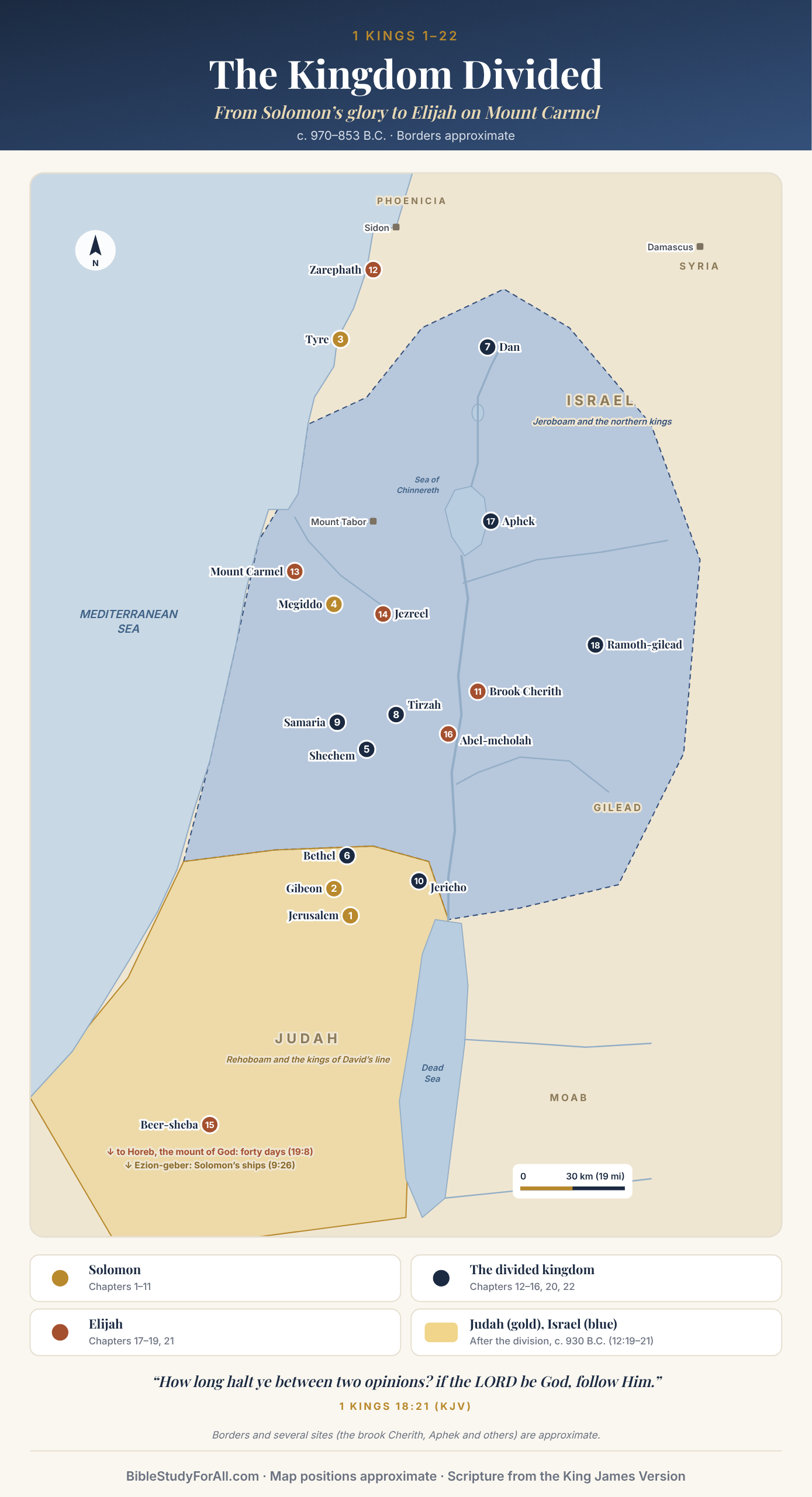
Map
The Kingdom Divided
The places of 1 Kings in the order they appear. Gold markers belong to Solomon, navy to the divided kingdom, and rust to Elijah. The numbers match the cards below.
1 1:38–39; 6–8
Jerusalem
Solomon. Solomon anointed at Gihon; the temple built and dedicated.
2 3:4–15
Gibeon
Solomon. The LORD appears in a dream: “Ask what I shall give thee.”
3 5:1–12
Tyre
Solomon. Hiram king of Tyre sends cedar and fir for the house of the LORD.
4 9:15
Megiddo
Solomon. With Hazor and Gezer, one of Solomon’s fortified cities.
5 12:1–20
Shechem
The divided kingdom. Israel rejects Rehoboam and makes Jeroboam king.
6 12:28–13:5
Bethel
The divided kingdom. Jeroboam’s golden calf; the man of God cries against the altar.
7 12:29–30
Dan
The divided kingdom. The second golden calf, at the northern edge of the land.
8 14:17; 15:33; 16:23
Tirzah
The divided kingdom. Royal city of Israel’s kings before Samaria.
9 16:24, 32
Samaria
The divided kingdom. Omri builds Samaria; Ahab builds a house of Baal there.
10 16:34
Jericho
The divided kingdom. Rebuilt by Hiel at the cost Joshua had foretold.
11 17:2–6
Brook Cherith
Elijah. The ravens feed Elijah bread and flesh, morning and evening.
12 17:8–24
Zarephath
Elijah. The widow’s meal and oil do not fail; her son lives again.
13 18:19–40
Mount Carmel
Elijah. Fire falls from heaven: “The LORD, He is the God.”
14 18:45–46; 21
Jezreel
Elijah. Elijah runs before Ahab; Naboth’s vineyard is taken.
15 19:3
Beer-sheba
Elijah. Elijah flees from Jezebel on his way to Horeb, the mount of God.
16 19:16, 19–21
Abel-meholah
Elijah. Home of Elisha, called from the plough.
17 20:26–34
Aphek
The divided kingdom. Ahab defeats Ben-hadad of Syria, then spares him.
18 22:29–37
Ramoth-gilead
The divided kingdom. Ahab dies by “a bow at a venture,” as Micaiah warned.
1 Kings 3–4
Solomon’s Wisdom
Solomon asked for an understanding heart, and God gave him more than he asked.
1 3:5
“Ask What I Shall Give Thee”
The LORD appears to Solomon in a dream at Gibeon.
2 3:9
An Understanding Heart
“Give therefore Thy servant an understanding heart to judge Thy people”
3 3:12–13
Riches and Honour Too
God adds what Solomon did not ask for.
4 3:16–28
The Two Mothers
“Divide the living child in two”: the true mother is revealed.
“And God gave Solomon wisdom and understanding exceeding much, and largeness of heart, even as the sand that is on the sea shore.”1 Kings 4:29 (KJV)
Solomon spoke three thousand proverbs and a thousand and five songs (4:32). James writes, “If any of you lack wisdom, let him ask of God” (James 1:5).
1 Kings 5–9
The House of the LORD
David prepared; Solomon built. For the first time Israel had a permanent house for the ark and the name of the LORD.
6:1
480 Years
after the exodus, Solomon’s fourth year
6:2
60 × 20 × 30
cubits long, wide and high
6:7
No Hammer
stones made ready before they were brought
6:38
Seven Years
to build, lined with cedar and gold
“The glory of the LORD had filled the house of the LORD.”1 Kings 8:11 (KJV)
1 Kings 8:27
Solomon’s Prayer
“But will God indeed dwell on the earth? behold, the heaven and heaven of heavens cannot contain Thee; how much less this house that I have builded?” Solomon asks God to hear every prayer made toward this house, in war, drought, sin and even exile (8:30–50).
IF YOU WALK BEFORE ME
“I will establish the throne of thy kingdom upon Israel for ever”
9:4–5
IF YOU TURN AWAY
Israel cut off; the house a proverb and a byword
9:6–7
1 Kings 11–12
The Kingdom Torn in Two
Solomon’s divided heart led to a divided kingdom.
1 11:4
A Heart Turned Away
Solomon’s many wives turn his heart after other gods.
2 11:29–31
Twelve Pieces
Ahijah tears his garment and gives ten pieces to Jeroboam.
3 12:13–16
Whips and Scorpions
Rehoboam answers roughly: “To your tents, O Israel.”
4 12:28–29
Two Golden Calves
Jeroboam sets them in Bethel and Dan.
5 13:1–3
The Man of God
He names Josiah three hundred years ahead (2 Kings 23:15–16).
6 11:36
A Light in Jerusalem
One tribe kept for David’s sake, as God had promised.
JUDAH (SOUTH)
Rehoboam, son of Solomon
12:17
ISRAEL (NORTH)
Jeroboam son of Nebat
12:20
JUDAH (SOUTH)
Two tribes: Judah and Benjamin
12:21
ISRAEL (NORTH)
Ten tribes
11:31
JUDAH (SOUTH)
Capital: Jerusalem, with the temple
14:21
ISRAEL (NORTH)
Capitals: Shechem, Tirzah, then Samaria
12:25; 16:24
JUDAH (SOUTH)
One royal family, the house of David
15:4
ISRAEL (NORTH)
Throne taken by force again and again
15:27; 16:9–10
1 Kings 14–22
The Kings Until Ahab
Every king is measured by one question: did he do right in the eyes of the LORD, as David did?
JUDAH · 14:21–15:24
Rehoboam, Abijam, Asa
Rehoboam and Abijam do evil; Asa removes the idols, “Asa’s heart was perfect with the LORD all his days” (15:14).
JUDAH · 22:41–50
Jehoshaphat
“He turned not aside from it, doing that which was right in the eyes of the LORD” (22:43).
ISRAEL · 15:25–16:22
Nadab, Baasha, Elah, Zimri
Each walks in “the way of Jeroboam”; Zimri reigns seven days.
ISRAEL · 16:23–34
Omri and Ahab
Omri builds Samaria; Ahab marries Jezebel and serves Baal, doing “more to provoke the LORD God of Israel to anger” than all before him (16:33).
1 Kings 17–21
Elijah the Tishbite
One man stood for the LORD when a nation followed Baal.
1 17:1
No Rain
“According to my word”: three and a half years of drought (James 5:17).
2 17:2–16
Ravens and a Widow
God feeds His prophet at Cherith and at Zarephath.
3 17:17–24
The Widow’s Son
The child lives: “the word of the LORD in thy mouth is truth.”
4 18:21–39
Mount Carmel
Fire from heaven: “The LORD, He is the God.”
5 19:11–12
A Still Small Voice
At Horeb, God is not in the wind, the earthquake or the fire.
6 21:17–29
Naboth’s Vineyard
“Hast thou killed, and also taken possession?”
“Then the fire of the LORD fell, and consumed the burnt sacrifice, and the wood, and the stones, and the dust, and licked up the water that was in the trench.”1 Kings 18:38 (KJV)
Looking Forward
Christ in 1 Kings
Solomon, the temple and Elijah all point beyond themselves to Jesus Christ.
10:1–7 · MATTHEW 12:42
A Greater Than Solomon
“The queen of the south … came from the uttermost parts of the earth to hear the wisdom of Solomon; and, behold, a greater than Solomon is here.”
8:10–11 · JOHN 2:19–21
The True Temple
The glory filled Solomon’s house; Jesus “spake of the temple of His body.”
17:8–16 · LUKE 4:25–26
The Widow of Zarephath
Jesus pointed to Elijah’s visit to show God’s grace reaching the Gentiles.
2:4; 11:36 · LUKE 1:32–33
David’s Throne
God kept a lamp for David in Jerusalem until the Son of David came, “and of His kingdom there shall be no end.”
Book Outline
1 Kings Outline
Twenty-two chapters in four parts: Solomon becomes king and asks for wisdom (1–4), the temple is built and dedicated (5:1–9:9), Solomon’s splendour, his decline and the divided kingdom (9:10–16:34), and Elijah in the days of Ahab (17–22). Tap a part below to jump to it, tap any section to expand it, and tap a verse reference to read it in the King James Version at BibleGateway.
Part I
Solomon’s Accession and Wisdom
1:1–4:34 · David’s last days, Solomon made king, his prayer for wisdom, and his kingdom
Part II
The Temple
5:1–9:9 · The temple and palace built, the ark brought in, Solomon’s prayer, and God’s answer
Part III
Splendor, Decline and Division
9:10–16:34 · Solomon’s glory and his turning away, the kingdom torn in two, and the kings until Ahab
- Rehoboam king of Judah · 14:21–31
- Abijam (Abijah) king of Judah · 15:1–8
- Asa king of Judah · 15:9–24
- Nadab king of Israel · 15:25–32
- Baasha king of Israel · 15:33–16:7
- Elah king of Israel · 16:8–14
- Zimri king of Israel, seven days · 16:15–20
- Omri king of Israel; Samaria built · 16:21–28
- Ahab becomes king of Israel · 16:29–34
Part IV
Elijah and Ahab
17:1–22:53 · Drought, Mount Carmel, Horeb, Naboth’s vineyard, and Ahab’s death
Continue Your Study
Scripture quotations and verse links are from the King James Version (KJV).