
Old Testament · History · Book 14 of 66
Book of 2 Chronicles
Solomon builds the temple and God fills it with His glory. Then the kings of Judah are weighed by one test: did they seek the LORD? “If My people … shall humble themselves, and pray, and seek My face … then will I hear from heaven” (7:14).
2 Chronicles at a Glance
Book Outline
Note: Scripture quotations and verse links on this site use the King James Version (KJV) because it is in the public domain, while most modern translations limit how much can be quoted online. Feel free to read along in the translation of your choice.
36 Chapters
822 verses
Author
Ezra the scribe
Time Covered
c. 970–538 B.C.
Key Words
“Seek” and “humble” (7:14)
About the Name
Title
The second half of the one Hebrew book of Dibre Hayyamim, “the words of the days,” called Chronicles in English. It is the last book of the Hebrew Bible.
The Hebrew title, Dibre Hayyamim, means “the events of the days,” the annals of the kings. The Greek translators divided the book in two and called it Paraleipomena, “things left out,” because it adds much that Samuel and Kings do not tell. The English name Chronicles comes from Jerome, who called it a chronicle of the whole of sacred history.
In the Hebrew Bible, Chronicles comes last, so the Old Testament in Hebrew closes with Cyrus’s decree that God’s people may go up to build His house: “The LORD his God be with him, and let him go up” (36:23).
Who Wrote It
Author Details
Written by Ezra the priest and scribe, as the Jewish Talmud records. Its last two verses open the book of Ezra.
The Talmud (Baba Bathra 15a) records that Ezra wrote the genealogies of Chronicles and carried the history on. Ezra was a priest and “a ready scribe in the law of Moses” (Ezra 7:6), and Chronicles shares his love for the temple, the priests and Levites, the passover, and the law. The last two verses of 2 Chronicles (36:22–23) are the first verses of Ezra (1:1–3).
The writer names his sources again and again: the book of Nathan the prophet, the prophecy of Ahijah, the visions of Iddo the seer (9:29), the book of Jehu son of Hanani (20:34), the vision of Isaiah the prophet (32:32), and “the book of the kings of Judah and Israel” (16:11). Guided by the Holy Spirit, he chose what would encourage the returned exiles to seek the LORD.
When It Was Written
Date of Writing
Covers about 430 years, from Solomon’s reign about 970 B.C. to the decree of Cyrus in 538 B.C. Ezra wrote about 450–430 B.C.
2 Chronicles opens with Solomon established in his kingdom about 970 B.C. and closes with the first year of Cyrus king of Persia over Babylon, 538 B.C., when he let the Jews return. Along the way it tells of the division of the kingdom (about 930 B.C.), the reigns of the kings of Judah, and the burning of Jerusalem in 586 B.C.
Ezra came to Jerusalem in 458 B.C. and wrote in the years that followed, about 450–430 B.C. His readers had come home to a small, poor land. Chronicles reminded them that when Judah humbled itself and sought the LORD, He heard and helped; and that God’s house and God’s promises to David still stood.
Key Verse
If My People Shall Humble Themselves
“If My people, which are called by My name, shall humble themselves, and pray, and seek My face, and turn from their wicked ways; then will I hear from heaven, and will forgive their sin, and will heal their land.”
2 Chronicles 7:14 (KJV)
Big Ideas
Key Themes
Seek the LORD
Those who sought Him prospered.
15:2; 26:5
Humble Yourselves
God hears the humble.
7:14; 33:12–13
Prayer
Our eyes are upon Thee.
14:11; 20:12
Worship
Praise, singing and the passover.
5:13; 30:21
God’s House
The temple at the heart of the nation.
7:16
Trust, Not Alliances
Rely on the LORD, not on kings.
16:7–9
God Watches the Heart
His eyes run to and fro.
16:9
Grace to the Repentant
Even Manasseh was restored.
33:12–13
Hope After Exile
The LORD stirred up Cyrus.
36:22–23
Overview
2 Chronicles Summary
OverviewSeeking the LORD, from Solomon to Cyrus
2 Chronicles continues 1 Chronicles and carries the story from Solomon to the exile and the decree of Cyrus. Chapters 1–9 tell of Solomon, mostly of the temple he built. Chapters 10–36 follow the kings of Judah only; the northern kingdom appears only where it touches Judah, because the Chronicler is following the line of David and the house of God in Jerusalem. Again and again he shows that when a king and people sought the LORD and humbled themselves, God helped them, and when they forsook Him, trouble came. Nearly a third of the book is given to four reforming kings: Asa, Jehoshaphat, Hezekiah and Josiah.
Chapters 1–6Solomon Builds the Temple
At Gibeon God says to Solomon, “Ask what I shall give thee,” and Solomon answers, “Give me now wisdom and knowledge, that I may go out and come in before this people” (1:10). He builds the temple “at Jerusalem in mount Moriah, where the Lord appeared unto David his father, in the place that David had prepared in the threshingfloor of Ornan the Jebusite” (3:1). When the ark is brought in and the singers praise the LORD, “For He is good; for His mercy endureth for ever,” “the house was filled with a cloud” (5:13), “for the glory of the LORD had filled the house of God” (5:14). Solomon prays, “But will God in very deed dwell with men on the earth? behold, heaven and the heaven of heavens cannot contain Thee; how much less this house which I have built!” (6:18), and fire comes down from heaven on the sacrifices (7:1).
Chapters 7–9God’s Answer and Solomon’s Glory
The LORD appears to Solomon by night with the best-known promise in the book: “If My people, which are called by My name, shall humble themselves, and pray, and seek My face, and turn from their wicked ways; then will I hear from heaven, and will forgive their sin, and will heal their land” (7:14). He also warns that if they forsake Him, the house will become “a proverb and a byword” (7:20). The queen of Sheba visits and says, “the one half of the greatness of thy wisdom was not told me” (9:6). Unlike Kings, Chronicles does not tell of Solomon’s wives turning his heart, for its readers already knew that story; it moves to his death (9:29–31).
Chapters 10–16The Kingdom Divides; Abijah and Asa
Rehoboam answers the people harshly, and the northern tribes cry, “What portion have we in David? … every man to your tents, O Israel” (10:16). Priests and Levites from the north come to Jerusalem, and many who “set their hearts to seek the LORD God of Israel” follow them (11:16). When Rehoboam forsakes the law, Shishak of Egypt plunders Jerusalem, but “when he humbled himself, the wrath of the LORD turned from him” (12:12). Abijah faces Jeroboam’s much larger army and declares, “God Himself is with us for our captain” (13:12), and Judah wins. King Asa cries out against a vast Ethiopian army, “help us, O LORD our God; for we rest on Thee” (14:11), and the prophet Azariah tells him, “The LORD is with you, while ye be with Him; and if ye seek Him, He will be found of you; but if ye forsake Him, He will forsake you” (15:2). Late in his reign, though, Asa relies on the king of Syria, and the seer Hanani rebukes him: “For the eyes of the LORD run to and fro throughout the whole earth, to shew Himself strong in the behalf of them whose heart is perfect toward Him” (16:9).
Chapters 17–20Jehoshaphat Seeks the LORD
Jehoshaphat sends officials and Levites to teach “the book of the law of the LORD” through Judah (17:9), and he appoints judges, saying, “let the fear of the LORD be upon you” (19:7). He makes the mistake of allying with Ahab (18:1–34), but when Moab, Ammon and others come against Judah, he prays, “neither know we what to do: but our eyes are upon Thee” (20:12). God answers through a Levite: “the battle is not yours, but God’s” (20:15). Jehoshaphat tells the people, “Believe in the LORD your God, so shall ye be established; believe His prophets, so shall ye prosper” (20:20). The singers go out before the army, praising God, and the enemies destroy one another (20:21–24).
Chapters 21–28Kings Who Turned Away
Jehoram marries Ahab’s daughter and walks in the ways of Ahab’s house; he dies of a painful disease and departs “without being desired” (21:20). After Ahaziah is killed, his mother Athaliah seizes the throne, but the infant Joash is hidden in the temple for six years and crowned by Jehoiada the priest. Joash does right while Jehoiada lives and repairs the temple, but after Jehoiada’s death he turns to idols. When Jehoiada’s son Zechariah warns the people, “Why transgress ye the commandments of the LORD, that ye cannot prosper?” (24:20), Joash has him stoned in the temple court; Jesus refers to this murder in Matthew 23:35 and Luke 11:51. Amaziah does “right in the sight of the LORD, but not with a perfect heart” (25:2). Uzziah prospers “as long as he sought the LORD” (26:5), but “when he was strong, his heart was lifted up to his destruction” (26:16), and he is struck with leprosy for burning incense in the temple. Ahaz closes the doors of the temple and sets up altars in every corner of Jerusalem (28:24).
Chapters 29–32Hezekiah’s Revival
Hezekiah opens the doors of the temple in the first month of his reign, cleanses it and restores the worship (29:3–36). He invites all Israel, even the survivors in the north, to a great passover: “the LORD your God is gracious and merciful, and will not turn away His face from you, if ye return unto Him” (30:9). There was great joy, “for since the time of Solomon … there was not the like in Jerusalem” (30:26). When Sennacherib invades, Hezekiah encourages the people: “With him is an arm of flesh; but with us is the LORD our God to help us, and to fight our battles” (32:8), and the LORD sends an angel who cuts off the Assyrian army (32:21).
Chapters 33–35Manasseh Humbled; Josiah’s Passover
Manasseh does great evil, but Chronicles adds what Kings does not: taken captive to Babylon by the Assyrians, “he besought the LORD his God, and humbled himself greatly,” and God “brought him again to Jerusalem into his kingdom. Then Manasseh knew that the LORD He was God” (33:12–13). He removes the idols he had set up. His grandson Josiah begins to seek God at sixteen and purges the land; when the book of the law is found, he makes a covenant “with all his heart, and with all his soul” (34:31) and keeps a passover so great that “there was no passover like to that kept in Israel from the days of Samuel the prophet” (35:18). Josiah dies in battle against Pharaoh Necho at Megiddo, and Jeremiah lamented for him (35:25).
Chapter 36Exile and the Decree of Cyrus
The last kings of Judah are quickly told. The people and priests “mocked the messengers of God, and despised His words, and misused His prophets, until the wrath of the LORD arose against His people, till there was no remedy” (36:16). Nebuchadnezzar’s army burns the temple and breaks down the walls of Jerusalem, and the survivors are carried to Babylon “to fulfil the word of the LORD by the mouth of Jeremiah, until the land had enjoyed her sabbaths … to fulfil threescore and ten years” (36:21). But the book ends with hope. In the first year of Cyrus king of Persia, the LORD stirs his spirit to proclaim: “Who is there among you of all his people? The LORD his God be with him, and let him go up” (36:23).
At a Glance
2 Chronicles at a Glance
The whole book in short sections: its four parts, a timeline, the places on the map, the temple and its glory, God’s answer to Solomon, the kings of Judah, Jehoshaphat’s battle, Hezekiah’s revival, Manasseh’s repentance, and Christ in 2 Chronicles. Tap a topic to jump to it.
Printable Copy
Save or Print the Infographic
Everything in this section, with the key verse and key themes, is also on a printable infographic (five pages). It opens in a new tab, where you can save it to your phone or computer, share it, or print it.
Structure
The Book in Four Parts
Solomon’s temple (1–9) and then the kings of Judah, weighed by whether they sought the LORD (10–36).
Each bar shows that part’s share of the 822 verses.
II 10–20 · 229 verses
Seeking God
The kingdom divides; Abijah, Asa and Jehoshaphat.
IV 29–36 · 225 verses
Revival and Exile
Hezekiah, Manasseh, Josiah, the fall, and Cyrus.
Dates B.C. (Approximate)
From Solomon to Cyrus
About 430 years of Judah’s history, from the temple built to the temple decreed again.
3:1–2
966
Temple begun on mount Moriah
10:16–19
c. 930
The kingdom divides
20:20–24
c. 853
Jehoshaphat’s victory with praise
26:16–21
c. 750
Uzziah struck with leprosy
30:1–27
c. 715
Hezekiah’s great passover
35:1–19
622
Josiah’s passover
36:19
586
Jerusalem and the temple burned
36:22–23
538
Cyrus: “let him go up”
Map
Judah’s Kings and Their Battles
The places of 2 Chronicles. Gold markers belong to Solomon and the temple, navy to kings who sought the LORD and were helped, and rust to times they forsook Him. The numbers match the cards below.
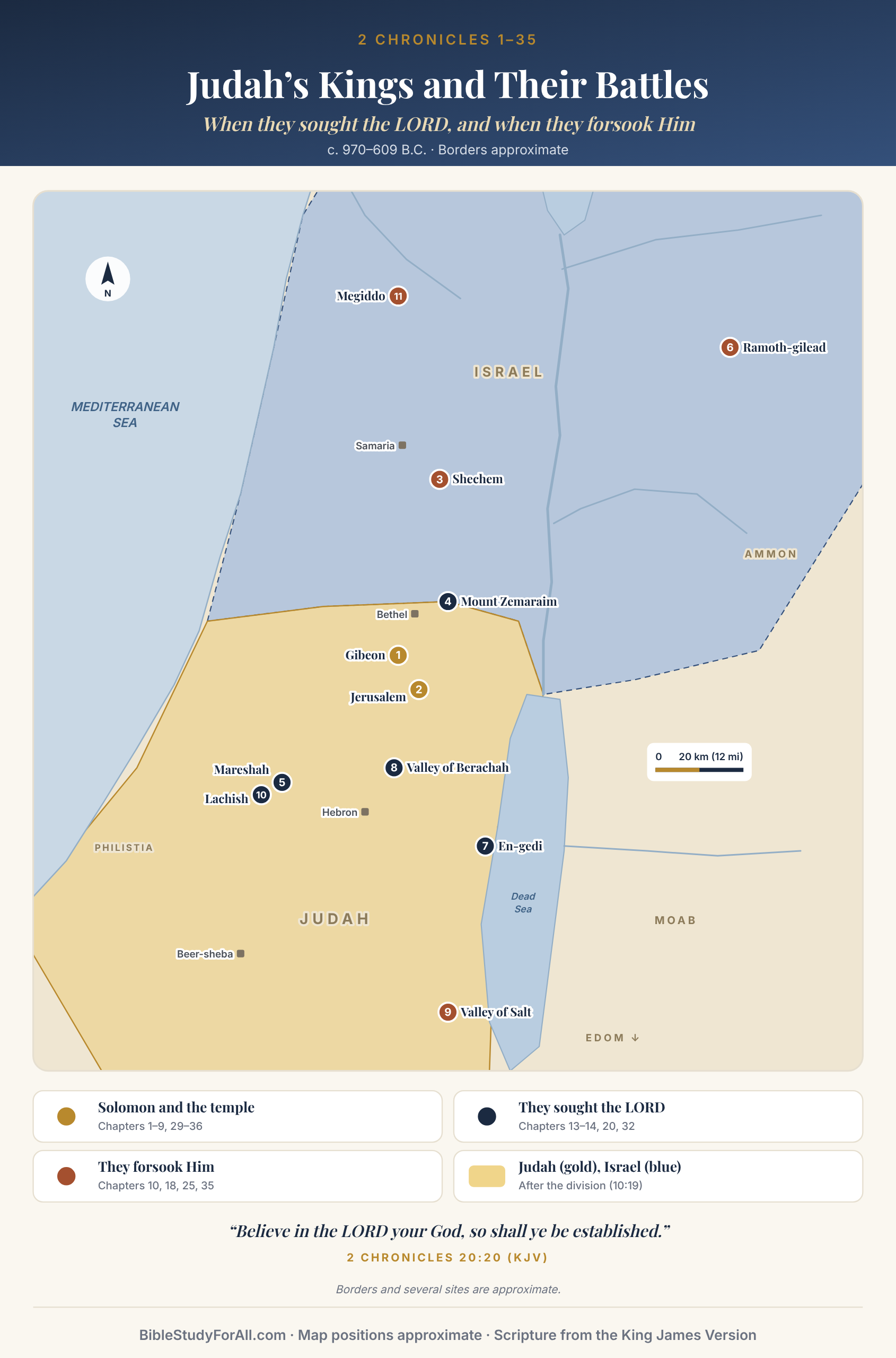
1 1:3–13
Gibeon
Solomon and the temple. Solomon asks for “wisdom and knowledge.”
2 3:1; 5–7; 29–30; 36:19
Jerusalem
Solomon and the temple. The temple built on mount Moriah; Hezekiah’s great passover; the city burned.
3 10:1–19
Shechem
They forsook Him. Israel turns from Rehoboam: “every man to your tents.”
4 13:4–18
Mount Zemaraim
They sought the LORD. Abijah: “God Himself is with us for our captain.”
5 14:9–15
Mareshah
They sought the LORD. Asa cries to the LORD, and the Ethiopians flee.
6 18:28–34
Ramoth-gilead
They forsook Him. Jehoshaphat joins Ahab in battle; Ahab is slain.
7 20:1–2
En-gedi
They sought the LORD. Moab, Ammon and mount Seir gather against Judah.
8 20:20–26
Valley of Berachah
They sought the LORD. The singers go first; the enemy is destroyed; “Berachah,” blessing.
9 25:11–14
Valley of Salt
They forsook Him. Amaziah smites Edom, then bows to Edom’s gods.
10 11:9; 32:9
Lachish
They sought the LORD. Fortified by Rehoboam; Sennacherib’s camp when he threatens Jerusalem.
11 35:20–24
Megiddo
They forsook Him. Josiah goes out against Pharaoh Necho and is slain.
2 Chronicles 2–7
The Temple and the Glory
Solomon built a house for the name of the LORD, and God filled it with His glory.
1 1:10
Wisdom and Knowledge
Solomon asks for these to lead God’s people.
2 3:1
Mount Moriah
Built where the LORD appeared to David.
3 5:13–14
The Cloud
As the singers praised, “the house was filled with a cloud.”
4 6:18
Heaven Cannot Contain Thee
Solomon’s prayer of dedication.
5 7:1
Fire from Heaven
The fire consumes the sacrifices.
6 7:3
For His Mercy
“For He is good; for His mercy endureth for ever.”
2 Chronicles 7:12–22
God’s Answer to Solomon
The LORD appeared to Solomon by night with the promise that sums up the whole book.
2 Chronicles 7:14
If My People
“If My people, which are called by My name, shall humble themselves, and pray, and seek My face, and turn from their wicked ways; then will I hear from heaven, and will forgive their sin, and will heal their land.”
HUMBLE
Humble Yourselves
Rehoboam, Hezekiah, Manasseh, Josiah
PRAY
Pray
Asa, Jehoshaphat, Hezekiah
SEEK
Seek My Face
“Seek” is the book’s key word
TURN
Turn from Sin
Idols broken, the house cleansed
2 Chronicles 10–36
The Kings of Judah
Twenty rulers sat on David’s throne in Jerusalem, from Rehoboam to Zedekiah. Chronicles gives most space to the kings who sought the LORD.
THEY SOUGHT THE LORD
Asa: “LORD, it is nothing with Thee to help”
14:11
THEY FORSOOK HIM
Asa later relies on the king of Syria and on physicians
16:7, 12
THEY SOUGHT THE LORD
Jehoshaphat: “our eyes are upon Thee”
20:12
THEY FORSOOK HIM
Jehoram walks in the ways of Ahab
21:6
THEY SOUGHT THE LORD
Joash repairs the house of the LORD
24:4
THEY FORSOOK HIM
Joash slays Zechariah the prophet
24:20–22
THEY SOUGHT THE LORD
Uzziah: “as long as he sought the LORD, God made him to prosper”
26:5
THEY FORSOOK HIM
Uzziah, lifted up, burns incense and is struck
26:16–19
THEY SOUGHT THE LORD
Hezekiah opens the doors of the house of the LORD
29:3
THEY FORSOOK HIM
Ahaz shuts up the doors of the house of the LORD
28:24
2 Chronicles 20
The Battle Is Not Yours
When a great army came against Judah, Jehoshaphat called a fast and prayed, and God fought for His people.
1 20:3
He Feared and Sought
“Jehoshaphat feared, and set himself to seek the LORD.”
2 20:12
Our Eyes Are upon Thee
“Neither know we what to do.”
3 20:15
God’s Battle
“The battle is not yours, but God’s.”
4 20:20
Believe
“Believe in the LORD your God, so shall ye be established.”
5 20:21–22
Singers in Front
As they began to praise, the LORD set ambushments.
6 20:26
Berachah
The valley of blessing.
2 Chronicles 29–32
Hezekiah’s Revival
In the first month of his reign, Hezekiah opened the doors of the house of the LORD.
29:3–19
Cleansed
The house of the LORD made clean
29:20–36
Worship
Sacrifices and singing restored
30:1–27
Passover
All Israel invited; great joy
32:20–22
Delivered
An angel cuts off the Assyrians
“With him is an arm of flesh; but with us is the LORD our God to help us, and to fight our battles.”2 Chronicles 32:8 (KJV)
2 Chronicles 33
Manasseh Humbled
Judah’s most wicked king was taken in chains to Babylon, and there he humbled himself. Only Chronicles tells this story of grace.
33:1–9
Great Evil
Altars to Baal, an idol in God’s house, his children through the fire.
33:11
Taken in Chains
The Assyrian captains bind him and carry him to Babylon.
33:12–13
He Humbled Himself
“Then Manasseh knew that the LORD He was God.”
33:15–16
Repentance Shown
He removes the idols and repairs the altar of the LORD.
Looking Forward
Christ in 2 Chronicles
The temple, the throne of David and the promise of return all find their fulfilment in Jesus.
5:14 · JOHN 1:14
The Glory Dwells
The cloud filled the temple; “the Word was made flesh, and dwelt among us, (and we beheld His glory …).”
6:18 · MATTHEW 1:23
God with Us
Heaven cannot contain God, yet He came as Emmanuel.
24:20–21 · LUKE 11:51
The Blood of Zacharias
Jesus named this martyr at the close of the Hebrew Bible.
36:23 · LUKE 1:32
David’s Throne
Cyrus let the people go up; the Son of David will reign for ever.
Book Outline
2 Chronicles Outline
Thirty-six chapters in four parts: Solomon and the temple (1–9), Rehoboam to Jehoshaphat (10–20), Jehoram to Ahaz (21–28), and Hezekiah to the exile and the decree of Cyrus (29–36). Tap a part below to jump to it, tap any section to expand it, and tap a verse reference to read it in the King James Version at BibleGateway.
Part I
Solomon and the Temple
1:1–9:31 · Wisdom given, the temple built and dedicated, God’s answer, and Solomon’s splendor
Part II
Rehoboam to Jehoshaphat
10:1–20:37 · The kingdom divides; Abijah, Asa and Jehoshaphat seek the LORD
- Abijah king of Judah: “God Himself is with us for our captain” · 13:1–14:1
- Jehoshaphat reigns in Judah and teaches the law · 17:1–19
- Jehoshaphat allies with Ahab; Micaiah’s warning · 18:1–27
- The defeat and death of Ahab · 18:28–34
- Jehoshaphat appoints judges · 19:1–11
- Jehoshaphat’s prayer: “the battle is not yours, but God’s” · 20:1–23
- The LORD delivers Judah · 20:24–34
- The end of Jehoshaphat’s reign · 20:35–37
Part III
Jehoram to Ahaz
21:1–28:27 · Athaliah and Joash, Amaziah, Uzziah, Jotham, and Ahaz
Part IV
Hezekiah to the Exile
29:1–36:23 · Hezekiah’s revival, Manasseh humbled, Josiah’s passover, the fall of Jerusalem, and Cyrus
- Hezekiah reigns · 29:1–2
- Hezekiah cleanses the temple · 29:3–19
- Temple worship restored · 29:20–36
- The passover celebrated: “the LORD your God is gracious and merciful” · 30:1–27
- Hezekiah organizes the priests and Levites · 31:1–21
- Sennacherib invades: “with us is the LORD our God” · 32:1–8
- Sennacherib blasphemes · 32:9–19
- The LORD delivers Jerusalem · 32:20–23
- Hezekiah’s pride and achievements · 32:24–33
Continue Your Study
Scripture quotations and verse links are from the King James Version (KJV).