
Old Testament · History · Book 9 of 66
The Book of 1 Samuel
Israel moves from the judges to the kings. Samuel the prophet anoints Saul, the people’s choice, who falls through disobedience, and then David, the shepherd after God’s own heart. “The LORD seeth not as man seeth … the LORD looketh on the heart” (16:7).
1 Samuel at a Glance
Book Outline
Note: Scripture quotations and verse links on this site use the King James Version (KJV) because it is in the public domain, while most modern translations limit how much can be quoted online. Feel free to read along in the translation of your choice.
31 Chapters
810 verses
Author
Samuel; completed by Nathan and Gad
Time Covered
c. 1105–1010 B.C.
Key Word
“King” (8:5; 16:1)
About the Name
Title
Named for Samuel, the prophet who anointed Israel’s first two kings. First and Second Samuel were one book in the Hebrew Bible; the Greek Old Testament divided it in two.
The book bears the name of Samuel, whose name sounds like the Hebrew for “heard of God,” for his mother said, “I have asked him of the LORD” (1:20). He was the last of the judges, a prophet and a priest, and the man God used to anoint both Saul and David. In the Hebrew Bible 1 and 2 Samuel were a single book.
The Greek Old Testament divided it into two and called them the first and second books of Kingdoms (with 1 and 2 Kings as the third and fourth), so some older Bibles call it “The First Book of the Kings.” It tells how Israel became a kingdom, and it carries the story on from Judges and Ruth to the reign of David.
Who Wrote It
Author Details
Written by Samuel, and completed after his death by the prophets Nathan and Gad, who wrote the acts of David (1 Chronicles 29:29).
Samuel was a writing prophet: he told the people “the manner of the kingdom, and wrote it in a book, and laid it up before the LORD” (10:25). Jewish tradition, recorded in the Talmud, says Samuel wrote the book up to his death (25:1), and that the prophets Nathan and Gad finished it. Scripture itself names their writings: the acts of David “are written in the book of Samuel the seer, and in the book of Nathan the prophet, and in the book of Gad the seer” (1 Chronicles 29:29).
Gad was with David in his years as a fugitive (22:5), and Nathan served him as king (2 Samuel 7; 12). All three were eyewitnesses of what they wrote. “All scripture is given by inspiration of God” (2 Timothy 3:16).
When It Was Written
Date of Writing
The book runs from Samuel’s birth, about 1105 B.C., to Saul’s death, about 1010 B.C. Saul reigned forty years (Acts 13:21), about 1050–1010 B.C.
Samuel was born near the end of the time of the judges, about 1105 B.C., and judged Israel “all the days of his life” (7:15). Paul says God gave Israel “Saul the son of Cis … by the space of forty years” (Acts 13:21), so Saul reigned about 1050–1010 B.C. David was born about 1040 B.C. and was thirty when he became king after Saul died (2 Samuel 5:4).
Samuel wrote during his own lifetime, and Nathan and Gad completed the record during David’s reign, about 1010–970 B.C. The first readers were Israelites under David, who needed to see why God had rejected Saul and chosen David.
Key Verse
The LORD Looketh on the Heart
“For the LORD seeth not as man seeth; for man looketh on the outward appearance, but the LORD looketh on the heart.”
1 Samuel 16:7 (KJV)
Big Ideas
Key Themes
God Looks on the Heart
Not appearance, but a heart toward God.
16:7
Obedience
To obey is better than sacrifice.
15:22–23
Prayer
Hannah prays, Samuel intercedes for Israel.
1:10–11; 7:5; 12:23
God’s Sovereignty
The LORD brings low and lifts up kings.
2:6–8; 15:28
Honour God
Them that honour Me I will honour.
2:30
The Battle Is the LORD’s
Victory comes by faith, not size.
14:6; 17:47
Faithful Friendship
Jonathan’s covenant love for David.
18:1–4; 20:42
Waiting on God
David will not seize the throne by force.
24:6; 26:10–11
God’s Word
The LORD reveals Himself by His word.
3:1, 19–21
Overview
1 Samuel Summary
OverviewFrom Judges to Kings
First Samuel tells how Israel became a kingdom. It follows three men: Samuel, the last judge and a faithful prophet; Saul, the tall, impressive king the people asked for, who disobeyed God and lost the kingdom; and David, the shepherd boy God chose because He looks on the heart. The book shows that God honours those who honour Him, that obedience matters more than outward religion, and that God is preparing a king after His own heart. “Them that honour Me I will honour, and they that despise Me shall be lightly esteemed” (2:30).
Chapters 1–3Hannah’s Prayer and Samuel’s Call
Hannah, childless and provoked by her rival, pours out her soul at the tabernacle in Shiloh and vows that if the LORD gives her a son she will give him to the LORD “all the days of his life” (1:11). God answers, and she brings little Samuel to serve under Eli the priest: “For this child I prayed; and the LORD hath given me my petition” (1:27). Her song rejoices, “There is none holy as the LORD” (2:2). Eli’s sons are wicked, and God warns that the priesthood will pass from his house. One night the LORD calls, “Samuel, Samuel,” and the boy answers, “Speak; for Thy servant heareth” (3:10). Soon all Israel “from Dan even to Beer-sheba” knew that Samuel was a prophet of the LORD (3:20).
Chapters 4–7The Ark Taken and Returned
Israel takes the ark of the covenant into battle as a good-luck charm against the Philistines, and loses. The ark is captured, Eli’s sons are killed, and Eli falls and dies. His daughter-in-law names her son Ichabod: “The glory is departed from Israel: for the ark of God is taken” (4:22). But in Ashdod the idol Dagon falls on its face before the ark, and plagues strike each Philistine city that holds it, until they send it back on a new cart. Twenty years later Samuel calls Israel to put away their idols at Mizpeh. God thunders against the Philistines, and Samuel sets up a stone named Ebenezer: “Hitherto hath the LORD helped us” (7:12).
Chapters 8–12Give Us a King
When Samuel is old and his sons are corrupt, the elders demand, “make us a king to judge us like all the nations” (8:5). God tells Samuel, “they have not rejected thee, but they have rejected Me, that I should not reign over them” (8:7), yet He grants their request. Saul of Benjamin, “a choice young man,” taller than anyone in Israel (9:2), goes looking for his father’s lost asses and finds Samuel instead, who anoints him privately. He is chosen by lot at Mizpeh, wins his first victory by rescuing Jabesh-gilead, and the kingdom is renewed at Gilgal. In his farewell Samuel says, “God forbid that I should sin against the LORD in ceasing to pray for you” (12:23).
Chapters 13–15Saul’s Disobedience
Saul soon shows that his heart is not wholly the LORD’s. At Gilgal, impatient for Samuel, he offers the burnt offering himself, and Samuel tells him, “thy kingdom shall not continue: the LORD hath sought Him a man after His own heart” (13:14). His son Jonathan, trusting that “there is no restraint to the LORD to save by many or by few” (14:6), routs the Philistines at Michmash. Then Saul is told to destroy Amalek utterly, but he spares King Agag and the best of the flocks. Samuel answers his excuses: “Behold, to obey is better than sacrifice, and to hearken than the fat of rams … Because thou hast rejected the word of the LORD, He hath also rejected thee from being king” (15:22–23).
Chapters 16–17David Anointed; Goliath Falls
God sends Samuel to Bethlehem to anoint one of Jesse’s sons. Samuel is impressed by the tall eldest son, but the LORD says, “the LORD seeth not as man seeth; for man looketh on the outward appearance, but the LORD looketh on the heart” (16:7). He chooses the youngest, David, who is keeping the sheep, and “the Spirit of the LORD came upon David from that day forward” (16:13). David comes to court to play the harp for troubled Saul. When the giant Goliath defies the armies of Israel in the valley of Elah, David answers, “I come to thee in the name of the LORD of hosts … for the battle is the LORD’s” (17:45, 47), and with a sling and a stone he brings the giant down.
Chapters 18–20Saul’s Jealousy and Jonathan’s Love
The soul of Jonathan, Saul’s son, “was knit with the soul of David” (18:1), and the two make a covenant. But when the women sing, “Saul hath slain his thousands, and David his ten thousands” (18:7), Saul grows jealous and afraid, “because the LORD was with him, and was departed from Saul” (18:12). He throws his javelin at David, sends him on dangerous missions, and plots his death. David marries Saul’s daughter Michal, who helps him escape through a window. Jonathan warns David with arrows in a field, and the friends part in tears: “The LORD be between me and thee, and between my seed and thy seed for ever” (20:42).
Chapters 21–27David the Fugitive
For years David lives as an outlaw. He flees to Nob, where Saul later kills the priests; to Gath, where he feigns madness; and to the cave of Adullam, where about four hundred men in distress, in debt or discontented gather to him (22:2). Twice Saul is delivered into his hands, in a cave at En-gedi and in his camp at night, and twice David refuses to harm him: “The LORD forbid that I should do this thing unto my master, the LORD’s anointed” (24:6). Abigail’s wisdom keeps him from avenging himself on Nabal (25). Samuel dies and is buried at Ramah (25:1). At last David takes refuge among the Philistines, and Achish gives him Ziklag (27:6).
Chapters 28–31The End of Saul
With the Philistines gathered against him and no answer from God, Saul disguises himself and seeks a woman with a familiar spirit at Endor, a thing he had himself forbidden. He hears that he and his sons will die the next day (28:19). Meanwhile the Philistine lords send David away, and he returns to find Ziklag burned and the families taken; “but David encouraged himself in the LORD his God” (30:6), pursued the raiders and recovered all. On Mount Gilboa Israel is defeated. Jonathan and his brothers are slain, and Saul, badly wounded, falls on his own sword: “So Saul died, and his three sons, and his armourbearer, and all his men, that same day together” (31:6). The men of Jabesh-gilead bravely recover and bury their bodies.
At a Glance
1 Samuel at a Glance
The whole book in short sections: its four parts, a timeline, the places on the map, Hannah and Samuel, the ark of God, Israel asks for a king, Saul’s rise and fall, David and Goliath, David and Jonathan, David spares Saul, and Christ the Son of David. Tap a topic to jump to it.
Printable Copy
Save or Print the Infographic
Everything in this section, with the key verse and key themes, is also on a printable infographic (five pages). It opens in a new tab, where you can save it to your phone or computer, share it, or print it.
Structure
The Book in Four Parts
The book follows three leaders: Samuel (1–7), Saul (8–15), and David, first in Saul’s court (16–20) and then as a fugitive while Saul falls (21–31).
Each bar shows that part’s share of the 810 verses.
I 1–7 · 157 verses
Samuel, the Last Judge
Hannah’s prayer, Samuel’s call, the ark lost and returned.
II 8–15 · 226 verses
Israel’s First King
The people ask for a king; Saul chosen, then rejected.
III 16–20 · 177 verses
David in Saul’s Court
Anointed, Goliath, Jonathan, and Saul’s jealousy.
IV 21–31 · 250 verses
David the Fugitive
On the run, sparing Saul, and Saul’s death on Gilboa.
Dates B.C. (Approximate)
From Samuel to Saul’s Death
Dates follow Saul’s forty years (Acts 13:21) and David’s age (2 Samuel 5:4).
1:20
c. 1105
Samuel born to Hannah
4:11
c. 1085
The ark taken; Eli dies
7:2
c. 1065
Twenty years later: Mizpeh and Ebenezer
10:1, 24
c. 1050
Saul anointed and made king
2 SAMUEL 5:4
c. 1040
David born in Bethlehem
16:13
c. 1025
David anointed by Samuel
25:1
c. 1015
Samuel dies at Ramah
31:6
c. 1010
Saul and Jonathan die on Gilboa
Map
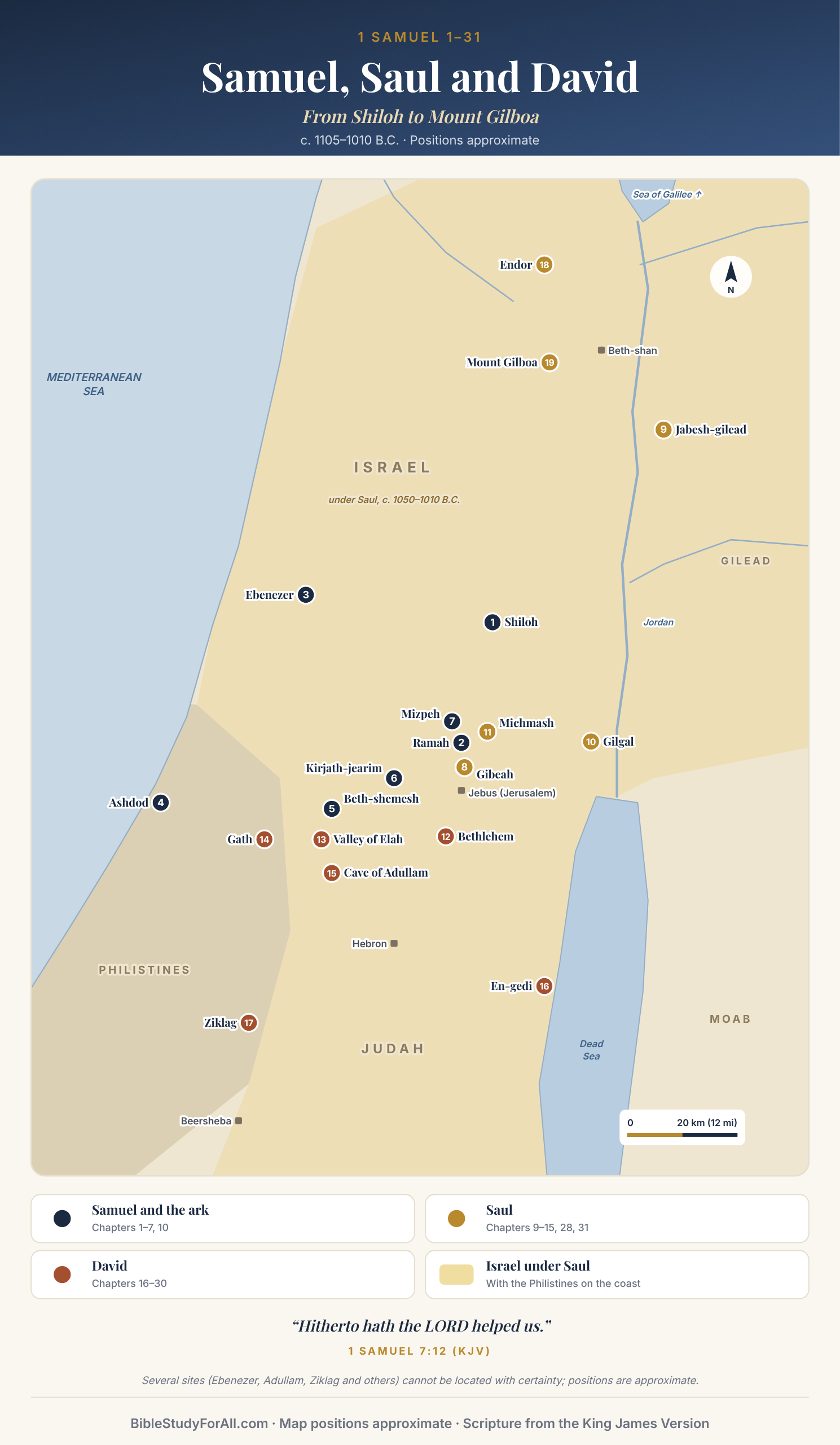
Samuel, Saul and David
The places of 1 Samuel, in the order they appear. Navy markers belong to Samuel and the ark, gold to Saul, and rust to David. The numbers match the cards below.
1 1–3
Shiloh
Samuel and the ark. Hannah prays; the LORD calls the child Samuel at the tabernacle.
2 1:19; 7:15–17
Ramah
Samuel and the ark. Samuel’s home, where he judged Israel and built an altar.
3 4
Ebenezer
Samuel and the ark. Israel defeated; the ark of God taken by the Philistines.
4 5:1–7
Ashdod
Samuel and the ark. Dagon falls before the ark of the LORD.
5 6:12–19
Beth-shemesh
Samuel and the ark. The kine bring the ark home on a new cart.
6 7:1–2
Kirjath-jearim
Samuel and the ark. The ark stays twenty years in the house of Abinadab.
7 7:5–12; 10:17–24
Mizpeh
Samuel and the ark. Israel repents; “Hitherto hath the LORD helped us”; Saul chosen by lot.
8 10:26; 15:34
Gibeah
Saul. Saul’s home and royal city.
9 11; 31:11–13
Jabesh-gilead
Saul. Saul’s first victory; later its men bury Saul.
10 11:14–15; 13:8–14; 15
Gilgal
Saul. The kingdom renewed; Saul’s disobedience and rejection.
11 13–14
Michmash
Saul. Jonathan and his armourbearer rout the Philistines.
12 16:1–13
Bethlehem
David. Samuel anoints David, the youngest son of Jesse.
13 17
Valley of Elah
David. David slays Goliath “in the name of the LORD of hosts.”
14 21:10–15; 27:1–4
Gath
David. David flees to Achish king of Gath.
15 22:1–2
Cave of Adullam
David. About four hundred men gather to David.
16 24
En-gedi
David. David spares Saul in the cave: “the LORD’s anointed.”
17 27:5–7; 30
Ziklag
David. Given to David by Achish; raided, and all recovered.
18 28
Endor
Saul. Saul seeks a woman with a familiar spirit.
19 31
Mount Gilboa
Saul. Saul and Jonathan fall in battle.
1 Samuel 1–3
Hannah’s Prayer and Samuel’s Call
A praying mother, a child given back to God, and a boy who learned to listen.
1 1:10–11
Hannah Prays
In bitterness of soul she vows her son to the LORD.
2 1:27–28
Lent to the LORD
“For this child I prayed; and the LORD hath given me my petition”
3 2:1–10
Hannah’s Song
“There is none holy as the LORD: for there is none beside Thee”
4 3:10
Samuel Hears
“Speak; for Thy servant heareth”
Mary’s song in Luke 1:46–55 echoes Hannah’s: the LORD “bringeth low, and lifteth up” (2:7).
1 Samuel 4–7
The Ark of God
Israel treated the ark like a charm and lost it; God showed His power among the Philistines and brought it home.
1 4:3–11
Taken at Ebenezer
Thirty thousand fall; Hophni and Phinehas are slain.
2 4:21–22
Ichabod
“The glory is departed from Israel.”
3 5:1–5
Dagon Falls
The idol falls on its face before the ark, twice.
4 6:7–14
The New Cart
Two milch kine carry the ark straight to Beth-shemesh.
5 7:1–2
Kirjath-jearim
The ark stays in Abinadab’s house twenty years.
6 7:3–12
Ebenezer
Israel repents at Mizpeh, and God thunders on the Philistines.
“Then Samuel took a stone, and set it between Mizpeh and Shen, and called the name of it Eben-ezer, saying, Hitherto hath the LORD helped us.”1 Samuel 7:12 (KJV)
1 Samuel 8–12
Israel Asks for a King
Israel wanted a king “like all the nations.” God gave them what they asked, and warned them what it would cost.
“They have not rejected thee, but they have rejected Me, that I should not reign over them.”1 Samuel 8:7 (KJV)
8:11–18
The Warning
A king will take your sons, fields and flocks
10:1
Anointed
Samuel anoints Saul in private
10:24
Chosen
“God save the king” at Mizpeh
12:23
Samuel’s Promise
“I will teach you the good and the right way”
1 Samuel 9–31
Saul’s Rise and Fall
Saul began humble and promising, but he would not wholly obey.
SAUL AT THE START
“Am not I a Benjamite, of the smallest of the tribes?”
9:21
SAUL AT THE END
Builds a monument to himself at Carmel
15:12
SAUL AT THE START
Hid among the stuff when chosen
10:22
SAUL AT THE END
Seeks a woman with a familiar spirit
28:7
SAUL AT THE START
“The Spirit of God came upon Saul”
11:6
SAUL AT THE END
“The Spirit of the LORD departed from Saul”
16:14
1 Samuel 15:22
To Obey Is Better Than Sacrifice
“Hath the LORD as great delight in burnt offerings and sacrifices, as in obeying the voice of the LORD? Behold, to obey is better than sacrifice, and to hearken than the fat of rams.”
1 Samuel 16–17
David and Goliath
God chose the youngest son, and the shepherd boy trusted God against a giant.
1 16:7
God Looks on the Heart
Not the tallest brother, but the one keeping the sheep.
2 17:4–10
The Giant
Goliath of Gath, six cubits and a span, defies Israel forty days.
3 17:34–37
The Lion and the Bear
“He will deliver me out of the hand of this Philistine.”
4 17:40
Five Smooth Stones
A staff, a sling, and stones from the brook.
5 17:45–47
In the Name of the LORD
“The battle is the LORD’s.”
6 17:49–51
The Giant Falls
One stone, and the Philistines flee.
“Thou comest to me with a sword, and with a spear, and with a shield: but I come to thee in the name of the LORD of hosts, the God of the armies of Israel.”1 Samuel 17:45 (KJV)
1 Samuel 18–20; 23:16–18
David and Jonathan
The king’s son loved the man who would take the throne, and stood by him against his own father.
18:1–4
Knit Together
Jonathan gives David his robe, sword, bow and girdle.
19:1–7
Speaking Up
Jonathan pleads with Saul for David’s life.
20:35–42
The Arrows
A signal in the field, and a tearful parting in peace.
23:16–17
Strength in God
Jonathan “strengthened his hand in God”: “thou shalt be king over Israel.”
“The LORD be between me and thee, and between my seed and thy seed for ever.”1 Samuel 20:42 (KJV)
1 Samuel 24 and 26
David Spares Saul Twice
Twice David could have killed the king who hunted him, and twice he left judgment to God.
IN THE CAVE AT EN-GEDI (24)
David cuts off the skirt of Saul’s robe
24:4
IN SAUL’S CAMP AT NIGHT (26)
David takes Saul’s spear and cruse of water
26:12
IN THE CAVE AT EN-GEDI (24)
“The LORD forbid that I should do this thing unto my master, the LORD’s anointed”
24:6
IN SAUL’S CAMP AT NIGHT (26)
“I would not stretch forth mine hand against the LORD’s anointed”
26:23
IN THE CAVE AT EN-GEDI (24)
Saul weeps: “Thou art more righteous than I”
24:17
IN SAUL’S CAMP AT NIGHT (26)
Saul: “I have sinned … I have played the fool”
26:21
In between, Abigail’s wise words keep David from avenging himself on Nabal (25:32–33). Paul writes, “Avenge not yourselves … Vengeance is Mine; I will repay, saith the Lord” (Romans 12:19).
Looking Forward
Christ, the Son of David
First Samuel brings the first “anointed” kings, and points ahead to the Anointed One, the Messiah.
2:10
His Anointed
Hannah’s song first speaks of the LORD’s king and “His anointed” (Hebrew Messiah).
16:1, 13 · MATTHEW 2:6
Born in Bethlehem
David was anointed in Bethlehem, where Christ, his Son, was born.
17 · COLOSSIANS 2:15
The Champion
David defeated the giant for Israel; Christ triumphed over every enemy for us.
13:14 · ACTS 13:22–23
After God’s Own Heart
“Of this man’s seed hath God according to His promise raised unto Israel a Saviour, Jesus.”
Book Outline
1 Samuel Outline
Thirty-one chapters in four parts: Samuel, the last judge (1–7), Saul, Israel’s first king (8–15), David in Saul’s court (16–20), and David the fugitive and Saul’s end (21–31). Tap a part below to jump to it, tap any section to expand it, and tap a verse reference to read it in the King James Version at BibleGateway.
Part I
Samuel, the Last Judge
1:1–7:17 · Samuel’s birth and call, the ark captured and returned, and victory at Mizpah
Part II
Israel’s First King
8:1–15:35 · Israel asks for a king, Saul is chosen and confirmed, and the LORD rejects him
- Samuel rebukes Saul: “a man after His own heart” · 13:1–15
- Israel without weapons · 13:16–22
- Jonathan attacks the Philistines: “no restraint to the LORD to save by many or by few” · 13:23–14:14
- Israel routs the Philistines · 14:15–23
- Saul’s oath and Jonathan’s honey · 14:24–46
- Summary of Saul’s kingship · 14:47–52
Part III
David in Saul’s Court
16:1–20:42 · David is anointed, kills Goliath, and flees Saul’s jealousy
- The setting of the war: Goliath’s challenge · 17:1–11
- David at home · 17:12–19
- David in the ranks of Israel · 17:20–30
- David volunteers: “The LORD that delivered me out of the paw of the lion” · 17:31–39
- The fight: “I come to thee in the name of the LORD of hosts” · 17:40–54
- David’s family made known to Saul · 17:55–58
- Jonathan loves David; “Saul hath slain his thousands, and David his ten thousands” · 18:1–9
- Saul’s spear; “the LORD was with him” · 18:10–16
- Saul gives Michal to David as a snare · 18:17–30
- Jonathan speaks for David · 19:1–7
- Saul tries to kill David; Michal helps him escape · 19:8–17
- David with Samuel at Naioth; Saul prophesies · 19:18–24
Part IV
David the Fugitive; Saul’s End
21:1–31:13 · David on the run, sparing Saul twice, among the Philistines, and Saul’s death on Gilboa
- David at Nob: the hallowed bread and Goliath’s sword · 21:1–9
- David at Gath feigns madness · 21:10–15
- David at Adullam and Mizpeh of Moab · 22:1–5
- Saul kills the priests of Nob; Abiathar escapes · 22:6–23
- David delivers Keilah · 23:1–6
- Saul pursues David; Jonathan “strengthened his hand in God” · 23:7–29
Continue Your Study
Scripture quotations and verse links are from the King James Version (KJV).