
Old Testament · The Law · Book 4 of 66
Numbers
Israel is numbered and set in order at Sinai, but at the edge of the promised land the people refuse to go in. For forty years God leads them through the wilderness, faithful to an unfaithful people, and brings a new generation to the plains of Moab. “God is not a man, that He should lie” (23:19).
Numbers at a Glance
Book Outline
Note: Scripture quotations and verse links on this site use the King James Version (KJV) because it is in the public domain, while most modern translations limit how much can be quoted online. Feel free to read along in the translation of your choice.
36 Chapters
1,288 verses
Author
Moses
Written
c. 1445–1406 B.C., in the wilderness
Time Covered
About 39 years
About the Name
Title
Numbers takes its name from the two numberings of Israel (chapters 1 and 26). Its Hebrew title, Bemidbar (“In the wilderness”), comes from its first verse and tells where the whole book takes place.
The English name comes, through the Latin Bible (Numeri), from the Greek Old Testament title Arithmoi, “Numbers,” because the book opens and closes its story with a census: the men of war of the old generation at Sinai (1:46) and of the new generation on the plains of Moab (26:51). The Hebrew title is Bemidbar, “In the wilderness,” from the opening words: “And the LORD spake unto Moses in the wilderness of Sinai” (1:1).
Numbers is the fourth of the five books of Moses, the Law (the Pentateuch). It carries the story from Mount Sinai, where Leviticus left Israel, to the plains of Moab across the Jordan from Jericho, where Deuteronomy begins. Paul wrote that “all these things happened unto them for ensamples: and they are written for our admonition” (1 Corinthians 10:11).
Who Wrote It
Author Details
Written by Moses: “Moses wrote their goings out according to their journeys by the commandment of the LORD” (33:2). The book closes with the commandments given “by the hand of Moses” (36:13).
Numbers names Moses as its writer: “And Moses wrote their goings out according to their journeys by the commandment of the LORD” (33:2). More than eighty times it says that “the LORD spake unto Moses,” and it ends, “These are the commandments and the judgments, which the LORD commanded by the hand of Moses unto the children of Israel in the plains of Moab by Jordan near Jericho” (36:13).
The Lord Jesus spoke of an event in Numbers as Moses’ own act: “as Moses lifted up the serpent in the wilderness, even so must the Son of man be lifted up” (John 3:14). Numbers belongs to “the book of the law of Moses” (Joshua 8:31), and “all scripture is given by inspiration of God” (2 Timothy 3:16).
When It Was Written
Date of Writing
Numbers covers about 39 years, from the second month of the second year after the exodus (1:1), about 1445 B.C., to the plains of Moab in the fortieth year, about 1406 B.C.
The book opens “on the first day of the second month, in the second year after they were come out of the land of Egypt” (1:1), and Aaron died on mount Hor “in the fortieth year” (33:38). Following the early date of the exodus, about 1446 B.C. (1 Kings 6:1), that is from about 1445 to 1406 B.C. Most of the thirty-eight years in between, when the unbelieving generation died in the wilderness, pass in silence (14:33–34).
Moses wrote during the journey and finished on the plains of Moab, in the last months before his death and Israel’s crossing of the Jordan in 1406 B.C. The first readers were the new generation who were about to enter the land, and who needed to learn from their fathers’ unbelief.
Key Verse
God Is Not a Man, That He Should Lie
“God is not a man, that He should lie; neither the son of man, that He should repent: hath He said, and shall He not do it? or hath He spoken, and shall He not make it good?”
Numbers 23:19 (KJV)
Big Ideas
Key Themes
God’s Faithfulness
God keeps His word to an unfaithful people.
14:18; 23:19
Unbelief
Unbelief kept a whole generation out of the land.
14:11, 22–23; Hebrews 3:19
God’s Guidance
The cloud and the ark led Israel every step.
9:15–23; 10:33–36
Order and Holiness
A camp set in order around God’s dwelling.
2:2; 5:1–4
Murmuring
Complaining against God brings His judgment.
11:1; 14:27; 21:5
Leadership
God upholds His chosen leaders: Moses, Aaron, Joshua.
12:7–8; 17:8; 27:18
Blessing
No one can curse whom God has blessed.
6:24–26; 23:8, 20
Sin Is Found Out
Sin brings consequences, even for Moses.
20:12; 32:23
A New Generation
God’s promise passes to the children.
14:31; 26:63–65
Overview
Numbers Summary
OverviewFaithful God, Faithless People
Numbers tells the story of Israel in the wilderness, from Mount Sinai to the plains of Moab. It begins with a people set in perfect order around the tabernacle, ready to march to the promised land in a matter of weeks. But at Kadesh-barnea they refuse to go in, and God sentences that generation to wander forty years until it dies in the wilderness. The book ends with their children numbered and camped across the Jordan from Jericho, ready at last to enter. Through it all God is faithful: He feeds them, leads them by the cloud, judges their rebellion and keeps His promise. “God is not a man, that He should lie … hath He said, and shall He not do it?” (23:19).
Chapters 1–4Numbered and Set in Order
One month after the tabernacle was set up, God tells Moses to number every man “from twenty years old and upward, all that are able to go forth to war” (1:3). They number 603,550 (1:46), besides the Levites, who are set apart to carry and keep the tabernacle. God arranges the camp: “Every man of the children of Israel shall pitch by his own standard … far off about the tabernacle of the congregation shall they pitch” (2:2), three tribes on each side, with Judah on the east toward the sunrise. The Levites camp closest, and the families of Gershon, Kohath and Merari are each given their part in carrying the tabernacle.
5:1–10:10A Holy Camp Ready to March
The unclean are put out of the camp, wrongs are confessed and repaid, and men or women may make the vow of a Nazarite, separating themselves unto the LORD (6). God gives Aaron the blessing for the people: “The LORD bless thee, and keep thee: The LORD make His face shine upon thee, and be gracious unto thee: The LORD lift up His countenance upon thee, and give thee peace” (6:24–26). The twelve princes bring their offerings, the Levites are cleansed, and Israel keeps the passover. The cloud over the tabernacle leads them: “At the commandment of the LORD the children of Israel journeyed, and at the commandment of the LORD they pitched” (9:18).
10:11–12:16Murmuring on the Way
On the twentieth day of the second month the cloud lifts, and Israel sets out with the ark before them. Moses prays, “Rise up, LORD, and let Thine enemies be scattered” (10:35). But within days the people complain. Fire burns at Taberah; then the mixed multitude longs for the fish, cucumbers, melons, leeks, onions and garlick of Egypt: “there is nothing at all, beside this manna, before our eyes” (11:6). God gives the Spirit to seventy elders to share Moses’ burden, sends quails, and judges their lust. Even Miriam and Aaron speak against Moses, but the LORD defends His servant, “faithful in all Mine house” (12:7).
Chapters 13–14Twelve Spies and a Fatal Refusal
From the wilderness of Paran Moses sends twelve men, one from each tribe, to search Canaan. After forty days they return with a cluster of grapes so large two men carry it on a staff, and report that the land “floweth with milk and honey” (13:27). But ten say, “We be not able to go up against the people … we were in our own sight as grasshoppers” (13:31, 33). Caleb and Joshua plead, “the LORD is with us: fear them not” (14:9), and the people want to stone them. Moses prays, and God pardons, but declares that this generation will wander forty years, a year for each day the spies searched the land, until they die in the wilderness, all except Caleb and Joshua (14:30–34).
Chapters 15–19Rebellion and the Priesthood
During the years of wandering God still speaks of the day “when ye be come into the land” (15:2). Korah, a Levite, with Dathan and Abiram, rebels against Moses and Aaron: “Ye take too much upon you” (16:3). The earth opens and swallows them, and fire consumes the 250 men offering incense. When a plague breaks out, Aaron runs with his censer, “and he stood between the dead and the living; and the plague was stayed” (16:48). God confirms Aaron’s priesthood when his rod “brought forth buds, and bloomed blossoms, and yielded almonds” overnight (17:8). He gives laws for the priests and Levites, and the ashes of a red heifer for cleansing from the dead (19).
Chapters 20–21Meribah, Mount Hor and the Brasen Serpent
In the fortieth year Israel is back at Kadesh. Miriam dies. When the people chide for water, God tells Moses to speak to the rock, but Moses strikes it twice in anger. The water comes, but God says, “Because ye believed Me not, to sanctify Me in the eyes of the children of Israel, therefore ye shall not bring this congregation into the land” (20:12). Edom refuses passage, and Aaron dies on mount Hor. Going around Edom, the people speak against God, and fiery serpents bite them. God tells Moses to make a serpent of brass on a pole: “if a serpent had bitten any man, when he beheld the serpent of brass, he lived” (21:9). Then Israel defeats Sihon and Og east of the Jordan.
Chapters 22–25Balaam’s Blessings and Baal-peor
Camped on the plains of Moab, Israel terrifies Balak king of Moab, who hires the prophet Balaam to curse them. On the way an angel of the LORD stands in the road, and Balaam’s ass speaks (22:28). Three times Balak builds altars, and three times God puts blessing in Balaam’s mouth instead: “How shall I curse, whom God hath not cursed?” (23:8). Balaam even foresees a coming King: “there shall come a Star out of Jacob, and a Sceptre shall rise out of Israel” (24:17). Yet Balaam’s counsel later leads Israel into idolatry and immorality with Moab at Baal-peor (25; 31:16), until the zeal of Phinehas turns away God’s wrath.
Chapters 26–36A New Generation Ready to Enter
God numbers Israel again: 601,730 (26:51). “There was not left a man of them, save Caleb the son of Jephunneh, and Joshua the son of Nun” (26:65). The daughters of Zelophehad receive their father’s inheritance, and God appoints Joshua to lead, “that the congregation of the LORD be not as sheep which have no shepherd” (27:17). Laws for offerings and vows follow, then the war on Midian. Reuben, Gad and half of Manasseh receive land east of the Jordan if they fight with their brethren: “be sure your sin will find you out” (32:23). Moses records the journeys from Egypt (33), and God sets the borders of Canaan, cities for the Levites and six cities of refuge (34–35).
At a Glance
Numbers at a Glance
The whole book in short sections: its four parts, a timeline, the camp of Israel (with a diagram), the two numberings, the route from Sinai to Moab (with a map), murmuring in the wilderness, the twelve spies, the brasen serpent, Balaam’s blessings, and Christ in Numbers. Tap a topic to jump to it.
Printable Copy
Save or Print the Infographic
Everything in this section, with the key verse and key themes, is also on a printable infographic (six pages). It opens in a new tab, where you can save it to your phone or computer, share it, or print it.
Structure
The Book in Four Parts
Numbers moves through three places: Mount Sinai (1–10), the wilderness between Kadesh and Moab (10–25), and the plains of Moab (26–36). It also tells of two generations: the old one that died in unbelief, and the new one that would enter the land.
Each bar shows that part’s share of the 1,288 verses.
I 1:1–10:10 · 394 verses
Set in Order at Sinai
The census, the camp, the Levites, and the cloud.
II 10:11–14:45 · 155 verses
From Sinai to Kadesh
Murmuring, the spies, and the refusal to enter.
III 15–25 · 336 verses
The Wilderness Years
Korah, Meribah, the brasen serpent, Balaam.
Dates B.C. (Approximate)
Thirty-Nine Years in Numbers
Dates follow the early exodus (c. 1446 B.C., 1 Kings 6:1) and the months Numbers gives.
1:1
c. 1445
Second year, second month: the first numbering at Sinai
10:11
c. 1445
Twentieth day: the cloud lifts; Israel sets out
13–14
c. 1445
Kadesh-barnea: the spies, and forty years decreed
14:33
c. 1445–1407
About 38 years: the old generation dies in the wilderness
20:1
c. 1407
First month, fortieth year: back at Kadesh; Miriam dies
33:38
c. 1407
Fifth month: Aaron dies on mount Hor
22:1
c. 1406
The plains of Moab, across from Jericho
26
c. 1406
The second numbering: a new generation
Numbers 2–3 · Diagram
The Camp of Israel
God set the twelve tribes around the tabernacle, three on each side, with the Levites camped closest. The diagram shows each tribe, its leader and its number.
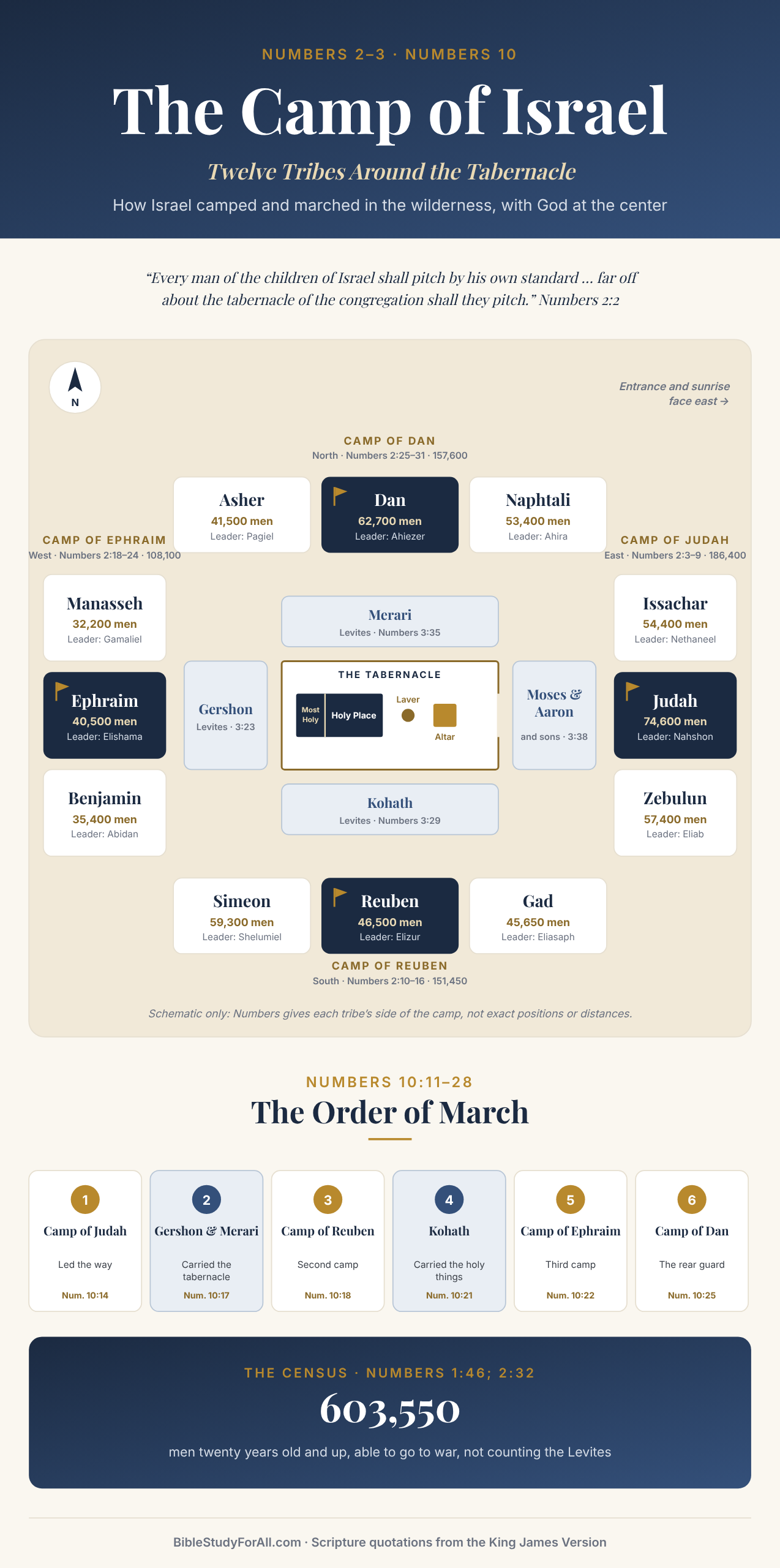
EAST · 2:3–9
Camp of Judah
Judah, Issachar, Zebulun: 186,400. Marched first.
SOUTH · 2:10–16
Camp of Reuben
Reuben, Simeon, Gad: 151,450. Marched second.
WEST · 2:18–24
Camp of Ephraim
Ephraim, Manasseh, Benjamin: 108,100. Marched third.
NORTH · 2:25–31
Camp of Dan
Dan, Asher, Naphtali: 157,600. The rear guard.
“Every man of the children of Israel shall pitch by his own standard, with the ensign of their father’s house: far off about the tabernacle of the congregation shall they pitch.”Numbers 2:2 (KJV)
Numbers 1 and 26
Two Numberings, Two Generations
The men “from twenty years old and upward, all that are able to go forth to war” were counted twice, about thirty-nine years apart.
AT SINAI (1:46)
603,550 men of war
second year
ON THE PLAINS OF MOAB (26:51)
601,730 men of war
fortieth year
AT SINAI (1:46)
The generation that came out of Egypt
1:1–3
ON THE PLAINS OF MOAB (26:51)
Their children, who would enter the land
26:63–64
AT SINAI (1:46)
Refused to enter at Kadesh
14:1–4
ON THE PLAINS OF MOAB (26:51)
“There was not left a man of them, save Caleb … and Joshua”
26:65
The Levites were counted separately, every male from a month old: 22,000 at Sinai (3:39) and 23,000 on the plains of Moab (26:62).
Numbers 10–36 · Map
From Sinai to the Plains of Moab
The map follows the journeys of Numbers. The gold line is the second year, the navy line the fortieth year, and the shaded circle the long years in the wilderness of Paran. The numbers match the cards below.
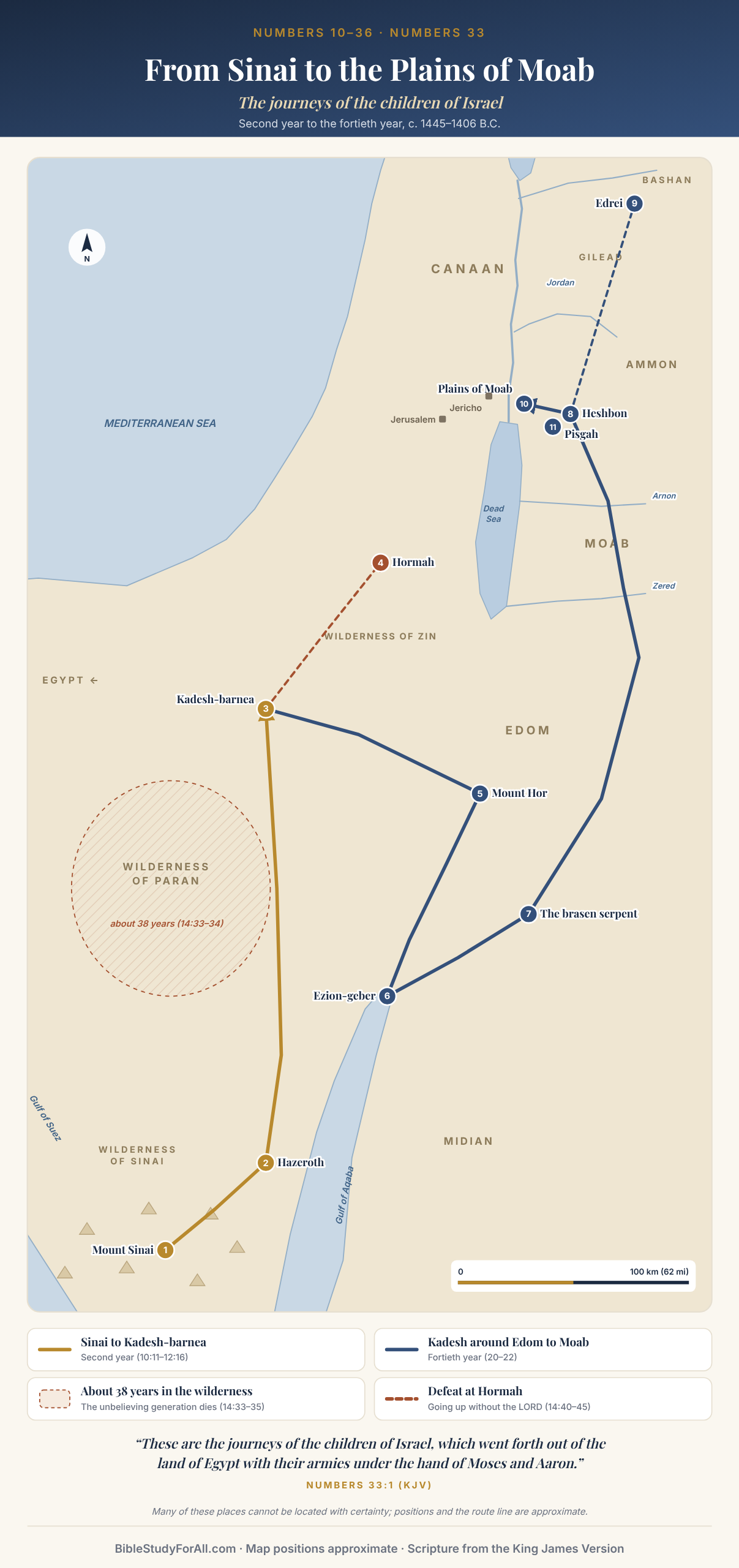
1 10:11–12
Mount Sinai
The cloud is taken up; Israel sets out in the second year.
2 11:35–12:16
Hazeroth
Miriam and Aaron speak against Moses.
3 13:26; 14
Kadesh-barnea
The twelve spies return; the people refuse to go up.
4 14:44–45
Hormah
Going up without the LORD, they are smitten.
5 20:22–29
Mount Hor
Aaron dies; Eleazar wears his garments.
6 21:4; 33:35
By the Way of the Red Sea
Edom refuses passage, so Israel goes around.
7 21:4–9
The Brasen Serpent
Bitten by fiery serpents, “when he beheld the serpent of brass, he lived.”
8 21:21–31
Heshbon
Sihon king of the Amorites defeated.
9 21:33–35
Edrei
Og king of Bashan defeated.
10 22:1
The Plains of Moab
Camped by Jordan, over against Jericho.
11 22:41–24:25
Pisgah and the High Places
Balaam, hired to curse Israel, blesses them.
A Warning for Us
Murmuring in the Wilderness
Again and again the people complained, and each time God answered with judgment and with mercy. Paul says “these things happened unto them for ensamples” (1 Corinthians 10:11).
1 11:1–3
Taberah
They complained, and fire burned in the camp until Moses prayed.
2 11:4–34
Kibroth-hattaavah
Tired of manna, they lusted for flesh; quails, then a plague.
3 12
Miriam and Aaron
They spoke against Moses; Miriam was leprous seven days.
4 14:1–4
Kadesh
“Would God that we had died in the land of Egypt!”
5 16
Korah
Rebellion against Moses and Aaron; the earth opened.
6 21:5–6
The Way around Edom
“Our soul loatheth this light bread”: fiery serpents.
“The LORD is longsuffering, and of great mercy, forgiving iniquity and transgression.”Numbers 14:18 (KJV)
Numbers 13–14
The Twelve Spies
Twelve men saw the same land. Ten saw giants; two saw God.
THE TEN
“We be not able to go up against the people”
13:31
CALEB AND JOSHUA
“Let us go up at once, and possess it; for we are well able to overcome it”
13:30
THE TEN
“We were in our own sight as grasshoppers”
13:33
CALEB AND JOSHUA
“If the LORD delight in us, then He will bring us into this land”
14:8
THE TEN
Died by the plague before the LORD
14:37
CALEB AND JOSHUA
Lived to enter the land
14:38; Joshua 14:6–14
Numbers 14:24
He Followed Me Fully
“But My servant Caleb, because he had another spirit with him, and hath followed Me fully, him will I bring into the land whereinto he went.”
“So we see that they could not enter in because of unbelief” (Hebrews 3:19).
Numbers 21:4–9
The Serpent of Brass
When the people spoke against God, fiery serpents bit them. God’s remedy was simple: look and live.
“Make thee a fiery serpent, and set it upon a pole: and it shall come to pass, that every one that is bitten, when he looketh upon it, shall live.”Numbers 21:8 (KJV)
John 3:14–15
Jesus Explains It
“And as Moses lifted up the serpent in the wilderness, even so must the Son of man be lifted up: That whosoever believeth in Him should not perish, but have eternal life.”
Numbers 22–24
Balaam: Hired to Curse, Made to Bless
Balak king of Moab paid Balaam to curse Israel from the high places. Each time, God turned the curse into a blessing.
1 23:7–10
The First Parable
“How shall I curse, whom God hath not cursed?”
2 23:18–24
The Second Parable
“God is not a man, that He should lie”
3 24:3–9
The Third Parable
“How goodly are thy tents, O Jacob, and thy tabernacles, O Israel!”
4 24:15–19
The Fourth Parable
“there shall come a Star out of Jacob, and a Sceptre shall rise out of Israel”
Balaam blessed with his mouth but loved money in his heart. His counsel led Israel into sin at Baal-peor (31:16), and the New Testament warns against “the way of Balaam … who loved the wages of unrighteousness” (2 Peter 2:15).
Looking Forward
Christ in Numbers
The New Testament points to Numbers again and again to show who Jesus is.
21:9 · JOHN 3:14–15
Lifted Up
Like the serpent on the pole, the Son of man was lifted up, and all who look to Him in faith live.
11:7–9 · JOHN 6:32–33
The True Bread
The manna pointed to “the true bread from heaven,” Jesus Himself.
20:11 · 1 CORINTHIANS 10:4
The Rock
“They drank of that spiritual Rock that followed them: and that Rock was Christ.”
24:17 · MATTHEW 2:2
The Star out of Jacob
The King foretold by Balaam; the wise men followed His star.
35:11 · HEBREWS 6:18
Our Refuge
Like the cities of refuge, Christ is the hope “we … have fled for refuge to lay hold upon.”
16:48 · HEBREWS 7:25
Between the Dead and the Living
Like Aaron with his censer, Christ “ever liveth to make intercession” for His people.
Book Outline
Numbers Outline
Thirty-six chapters in four parts, following the journey: the old generation set in order at Sinai (1:1–10:10), from Sinai to Kadesh and the refusal to enter (10:11–14:45), the wilderness years and the road to Moab (15–25), and the new generation on the plains of Moab (26–36). For the whole route from Egypt, see The Exodus Journey. Tap a part below to jump to it, tap any section to expand it, and tap a verse reference to read it in the King James Version at BibleGateway.
Part I
Set in Order at Sinai
1:1–10:10 · The census, the camp, the Levites, a pure camp, the princes’ offerings, the passover and the cloud
- On the east: the camp of Judah, with Issachar and Zebulun · 2:1–9
- On the south: the camp of Reuben, with Simeon and Gad · 2:10–16
- The tabernacle sets forward in the midst of the camp · 2:17
- On the west: the camp of Ephraim, with Manasseh and Benjamin · 2:18–24
- On the north: the camp of Dan, with Asher and Naphtali · 2:25–31
- “So they pitched by their standards” · 2:32–34
- Aaron’s sons, and the Levites taken instead of the firstborn · 3:1–13
- Gershon, Kohath and Merari: their places and their charge · 3:14–39
- The firstborn of Israel redeemed · 3:40–51
- The Kohathites carry the most holy things · 4:1–20
- The Gershonites carry the curtains and hangings · 4:21–28
- The Merarites carry the boards, bars and pillars · 4:29–33
- The Levites from thirty to fifty years old numbered · 4:34–49
Part II
From Sinai to Kadesh
10:11–14:45 · Setting out, murmuring, Miriam and Aaron, the twelve spies, and the refusal to enter the land
Part III
The Wilderness Years and the Road to Moab
15:1–25:18 · Korah’s rebellion, Aaron’s rod, the waters of Meribah, the brasen serpent, Balaam, and Baal-peor
- The water of separation for cleansing from the dead · 19:1–22
- Balak king of Moab sends for Balaam to curse Israel · 22:1–21
- The angel of the LORD and Balaam’s ass · 22:22–35
- The first parable: “How shall I curse, whom God hath not cursed?” · 22:36–23:12
- The second parable: “God is not a man, that He should lie” · 23:13–26
- The third parable: “How goodly are thy tents, O Jacob” · 23:27–24:13
- The last parables: “there shall come a Star out of Jacob” · 24:14–25
Continue Your Study
Scripture quotations and verse links are from the King James Version (KJV).