
Exodus · Numbers · Deuteronomy · Joshua 1–5 · Bible Study
The Exodus Journey
From slavery in Egypt to the edge of the Promised Land. Follow Israel’s forty-year journey stage by stage, with maps, key people, themes, and verses, and see how the whole story points to Jesus.
“I am the LORD thy God, which have brought thee out of the land of Egypt, out of the house of bondage.”
Exodus 20:2
c. 1446 B.C.
Israel leaves Egypt
40 Years
In the wilderness
4 Books
Exodus to Joshua 5
12 Stages
From Egypt to Canaan
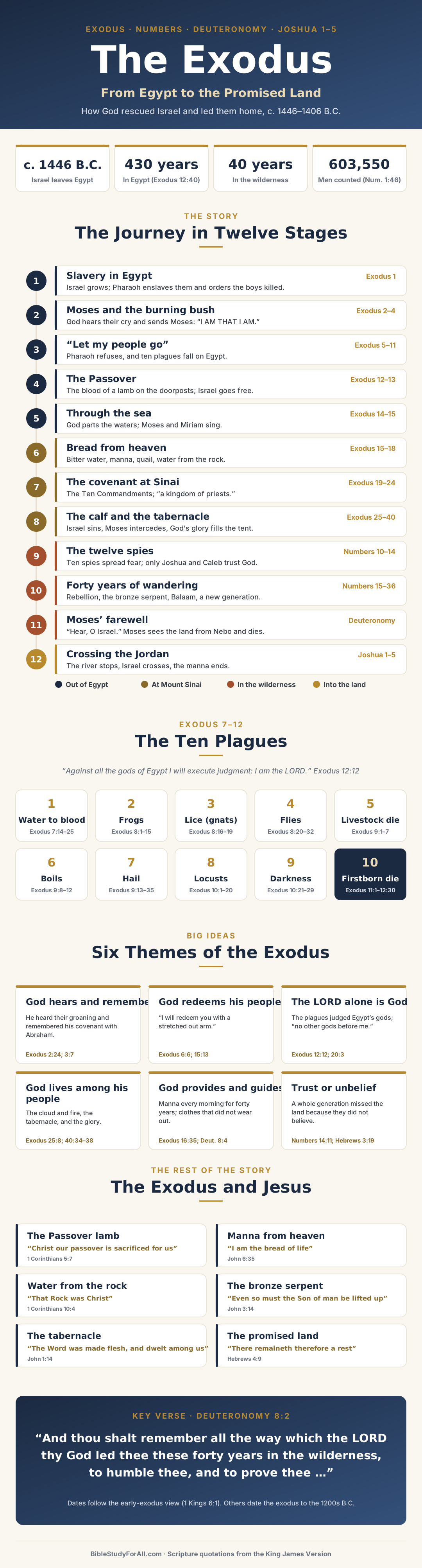
The Journey at a Glance
From Egypt to the Promised Land
The story moves in twelve stages, from slavery and rescue, to the covenant at Mount Sinai, through forty years in the wilderness, to the crossing of the Jordan. Select a stage to jump straight to it.
Stage 1 · Exodus 1
Israel grows into a nation, and a new Pharaoh makes them slaves.
Stage 2 · Exodus 2–4
God hears his people’s cry and calls Moses from a burning bush.
Stage 8 · Exodus 25–40
Israel breaks the covenant, Moses pleads, and God comes to live among them.
Stage 11 · Deuteronomy
Moses retells the journey, renews the covenant, and dies on Mount Nebo.
The whole journey on one page. Save or print it to keep beside your Bible.
Maps
Follow the Route
This map follows one traditional route: south from Egypt along the Gulf of Suez to Mount Sinai, north to Kadesh-barnea, then around Edom to the plains of Moab and across the Jordan. Many of the places named in Exodus and Numbers cannot be located with certainty today, so other routes have been proposed. The map marks the main alternatives for the sea crossing and for Mount Sinai.
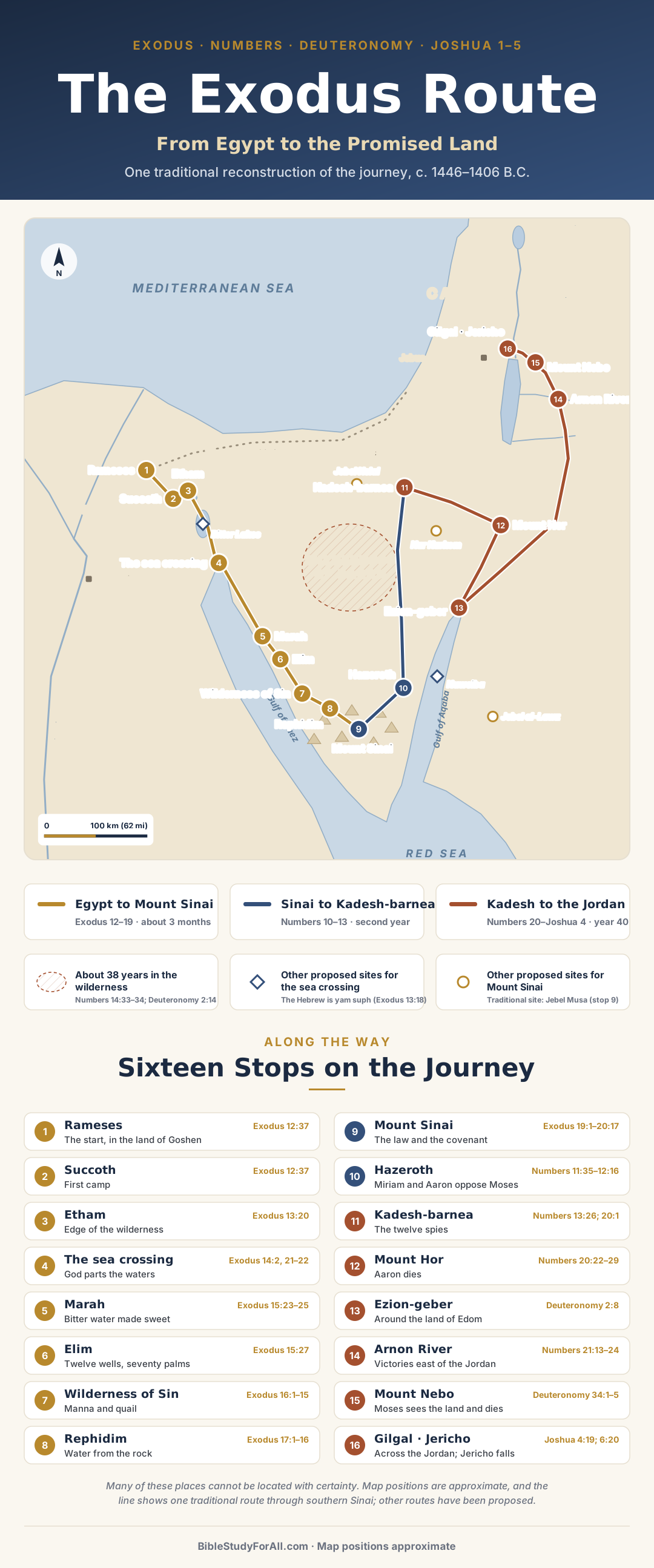
Out of Egypt
Rameses to Mount Sinai in about three months: the sea crossing, Marah, Elim, the manna, and water from the rock (Exodus 12–19).
Sinai to Kadesh
After almost a year at Sinai, Israel travels north to Kadesh-barnea and sends out the twelve spies (Numbers 10–13).
Around to the Jordan
After the years of wandering, Israel goes around Edom and Moab to the plains of Moab across from Jericho (Numbers 20–22; Joshua 3).
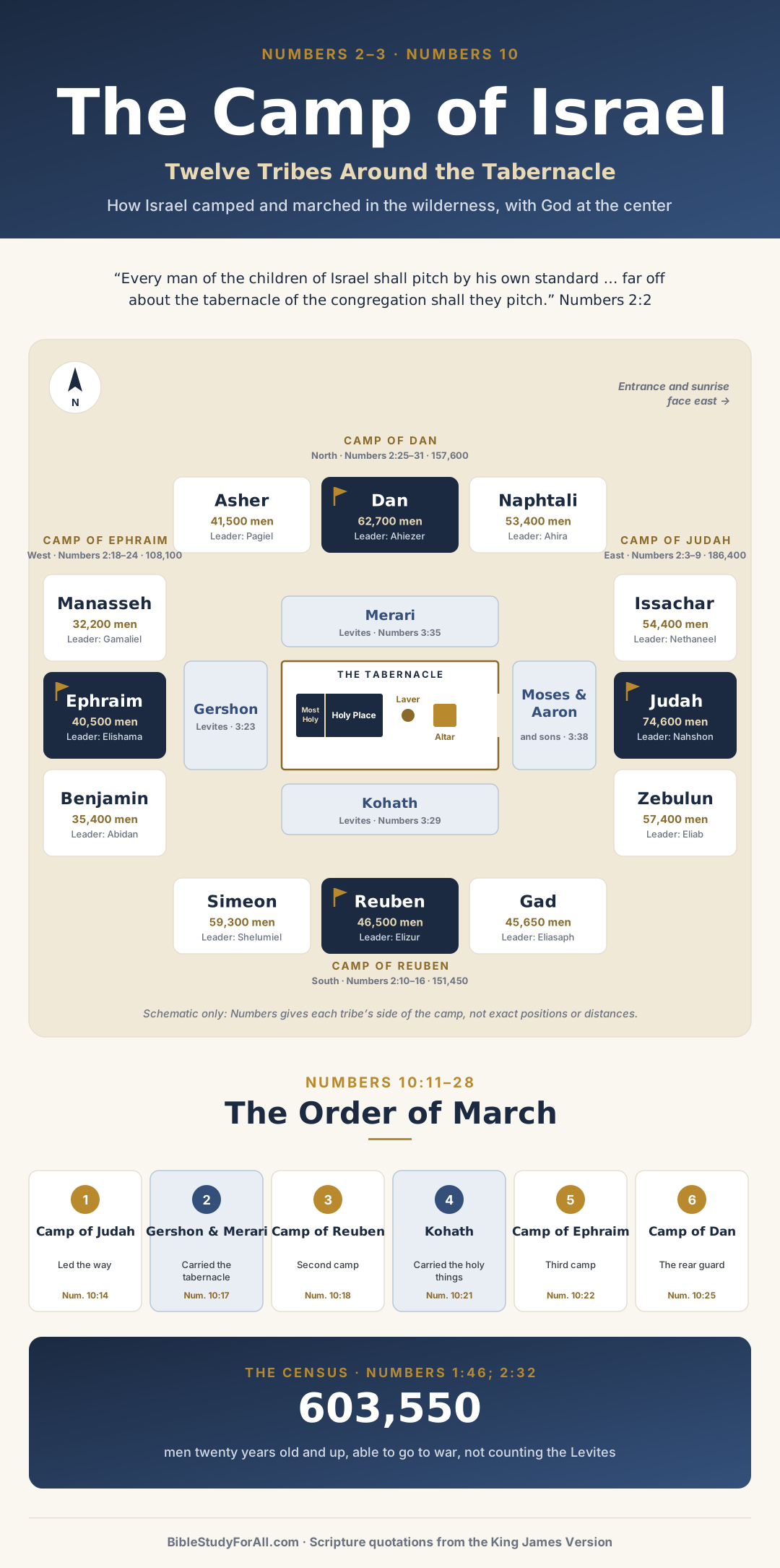
The Camp Around the Tabernacle
Israel did not travel as a crowd but as an organized nation. Numbers 2 places three tribes on each side of the tabernacle, with the Levites camped closest and God’s presence in the middle. Numbers 10 gives the order they marched in, with Judah in the lead.
Before You Begin
Three Habits for This Study
You don’t need any background to follow along. These habits will help you get the most from each stage.
Read in big pieces
The story reads best in large sections. Try Exodus 1–15 in one sitting; it takes about an hour. Read Exodus 1–15 (KJV)
Keep the map handy
Look back at the route map as you read each stage. Knowing where Israel is, in Egypt, at Sinai, or on the edge of Canaan, makes each chapter easier to follow.
Watch for God’s presence
Notice the burning bush, the cloud and fire, the glory on Sinai, and the tabernacle. The whole journey is about God bringing his people to himself (Exodus 19:4).
Stage 1 of 12 · Exodus 1
Slavery in Egypt
Where: Goshen, in the Nile Delta
“But the more they afflicted them, the more they multiplied and grew. And they were grieved because of the children of Israel.”Exodus 1:12 (KJV) · Read all of Exodus 1
What happens
Genesis ended with Jacob’s family, seventy people, settling in Egypt under Joseph’s protection. Exodus opens many years later. The family has become a nation, “and the land was filled with them” (Exodus 1:7).
Then “there arose up a new king over Egypt, which knew not Joseph” (Exodus 1:8). Afraid of Israel’s numbers, he forces them into hard labor building the store cities Pithom and Raamses. When that fails to stop their growth, he orders every Hebrew baby boy thrown into the Nile. Two midwives, Shiphrah and Puah, fear God and refuse to obey.
Look closer
Israel’s growth is a promise being kept. God told Abraham his offspring would be as many as the stars (Genesis 15:5), and also warned that they would be “afflicted four hundred years” in a land not their own, then come out “with great substance” (Genesis 15:13–14). Exodus 12:40 says Israel lived in Egypt 430 years.
The Bible never names this Pharaoh. Christians who hold the early date for the exodus (c. 1446 B.C.) often link the oppression with Thutmose III; those who hold a later date often point to Seti I or Ramesses II.
Think about it
The harder Pharaoh pushed, the more Israel grew. Where have you seen God at work in a hard season?
Stage 2 of 12 · Exodus 2–4
Moses and the Burning Bush
Where: Egypt, Midian, and Mount Horeb
“And God said unto Moses, I AM THAT I AM: and he said, Thus shalt thou say unto the children of Israel, I AM hath sent me unto you.”Exodus 3:14 (KJV) · Read all of Exodus 2–4
What happens
A Levite mother hides her baby in a basket among the reeds of the Nile. Pharaoh’s own daughter finds him, adopts him, and names him Moses. He grows up in the palace, but at forty he kills an Egyptian who was beating a Hebrew and flees to Midian (Acts 7:23–29). There he marries Zipporah and tends sheep for forty years.
Meanwhile Israel cries out, “and God heard their groaning, and God remembered his covenant with Abraham, with Isaac, and with Jacob” (Exodus 2:24). At Horeb, the mountain of God, a bush burns without burning up. God speaks from it, tells Moses his name, and sends him back to Egypt. Moses offers excuse after excuse, so God gives him signs and sends his brother Aaron to speak with him.
Look closer
“I AM THAT I AM” is connected to the Hebrew verb “to be.” It is the root of God’s personal name, written in most English Bibles as “the LORD” in small capitals (Yahweh). It speaks of a God who simply is, who depends on no one, and who will be present with his people.
Jesus later used the same words of himself: “Before Abraham was, I am” (John 8:58).
Think about it
Moses felt completely unqualified. What does God’s answer, “Certainly I will be with thee” (Exodus 3:12), say to your own excuses?
Stage 3 of 12 · Exodus 5–11
“Let My People Go”
Where: Egypt
“And afterward Moses and Aaron went in, and told Pharaoh, Thus saith the LORD God of Israel, Let my people go, that they may hold a feast unto me in the wilderness.”Exodus 5:1 (KJV) · Read all of Exodus 5–11
What happens
Pharaoh’s first answer is scornful: “Who is the LORD, that I should obey his voice?” (Exodus 5:2). He makes the slaves gather their own straw and still make the same number of bricks.
God answers with ten plagues. The Nile turns to blood, then come frogs, lice, flies, disease on the livestock, boils, hail, locusts, and three days of darkness. Again and again Pharaoh seems to give in, then changes his mind once the plague is lifted. The tenth plague, the death of the firstborn, is announced in Exodus 11.
Look closer
The plagues were a contest with Egypt’s gods. God said, “against all the gods of Egypt I will execute judgment” (Exodus 12:12). Egypt worshiped the Nile, frogs, cattle, and the sun, and each plague showed them powerless.
The text says both that Pharaoh hardened his own heart (Exodus 8:15, 32) and that the LORD hardened it (Exodus 9:12; 10:20). Christians explain how these fit together in different ways, but all agree Pharaoh was responsible for his choices and God was in control of the outcome (Romans 9:17).
Think about it
Pharaoh kept promising to change once the pressure was off. Is there an area where you have done the same?
Stage 4 of 12 · Exodus 12–13
The Passover
Where: Egypt, then Rameses to Succoth
“And the blood shall be to you for a token upon the houses where ye are: and when I see the blood, I will pass over you, and the plague shall not be upon you to destroy you, when I smite the land of Egypt.”Exodus 12:13 (KJV) · Read all of Exodus 12–13
What happens
God tells each Israelite family to kill a lamb without blemish, put its blood on the doorposts, and eat the meal dressed and ready to travel, with unleavened bread and bitter herbs. At midnight the LORD strikes the firstborn of Egypt, from Pharaoh’s palace to the prison, but passes over every house marked by the blood.
Pharaoh finally lets them go. About 600,000 men on foot, besides women and children, leave Rameses for Succoth (Exodus 12:37), along with “a mixed multitude” (Exodus 12:38). The Egyptians even give them silver, gold, and clothing. Moses carries Joseph’s bones with him, as Joseph had asked (Exodus 13:19; Genesis 50:25).
Look closer
The Passover became Israel’s most important feast and the start of their calendar (Exodus 12:2). Every year they would tell their children, “It is the sacrifice of the LORD’s passover, who passed over the houses of the children of Israel in Egypt” (Exodus 12:27).
Jesus died at Passover time, and the New Testament says, “For even Christ our passover is sacrificed for us” (1 Corinthians 5:7). John notes that, like the Passover lamb, none of his bones were broken (John 19:36; Exodus 12:46).
Think about it
Israel was not saved by being better than Egypt, but by the blood on the door. What does that teach about how God saves?
Stage 5 of 12 · Exodus 14:1–15:21
Through the Sea
Where: The sea (Hebrew yam suph)
“Fear ye not, stand still, and see the salvation of the LORD, which he will shew to you to day … The LORD shall fight for you, and ye shall hold your peace.”Exodus 14:13–14 (KJV) · Read all of Exodus 14:1–15:21
What happens
God does not lead Israel by the short coastal road, “the way of the land of the Philistines,” in case they lose heart at the sight of war (Exodus 13:17). He leads them by a pillar of cloud by day and a pillar of fire by night. Then he has them camp by the sea, and Pharaoh, changing his mind again, chases them with six hundred chariots.
Trapped between the army and the water, the people panic. Moses stretches out his hand, a strong east wind blows all night, and the waters divide. Israel walks through “upon the dry ground: and the waters were a wall unto them on their right hand, and on their left” (Exodus 14:22). When the Egyptians follow, the waters return. On the far shore Moses leads the first song in the Bible, and Miriam leads the women with tambourines (Exodus 15).
Look closer
The Hebrew name of the sea is yam suph. Older translations say “Red Sea,” following the Greek Old Testament. Many modern scholars translate it “Sea of Reeds,” since suph means reeds (Exodus 2:3). The same name is used for the Gulf of Aqaba (1 Kings 9:26).
The exact crossing place is unknown. Suggestions include the area of the Bitter Lakes or Lake Timsah, the northern tip of the Gulf of Suez, and the Gulf of Aqaba near Nuweiba. Whatever the place, the Bible presents the crossing as a mighty act of God, not just a natural event.
Think about it
“Stand still, and see.” When you are trapped and afraid, what would it look like to trust God to fight for you?
Stage 6 of 12 · Exodus 15:22–18:27
Bread from Heaven
Where: Marah, Elim, Wilderness of Sin, Rephidim
“Then said the LORD unto Moses, Behold, I will rain bread from heaven for you; and the people shall go out and gather a certain rate every day, that I may prove them, whether they will walk in my law, or no.”Exodus 16:4 (KJV) · Read all of Exodus 15:22–18:27
What happens
Only three days after the sea, the people complain at Marah because the water is bitter. God shows Moses a tree that makes it sweet. At Elim they rest by twelve springs and seventy palm trees. In the Wilderness of Sin they grumble about food, and God sends quail in the evening and manna every morning, a “small round thing” that tasted “like wafers made with honey” (Exodus 16:14, 31).
At Rephidim there is no water, and the people nearly stone Moses. God tells him to strike the rock at Horeb, and water flows out. Then Amalek attacks. Joshua leads the fighting while Moses holds up his hands on the hill, with Aaron and Hur holding his arms steady. Moses’ father-in-law Jethro visits and helps him set up judges to share the load.
Look closer
The manna came with rules. Gather just enough for each day; anything kept overnight spoiled. On the sixth day gather twice as much, because no manna fell on the Sabbath. God was teaching his people to trust him one day at a time.
Moses later explained the lesson: God fed them with manna “that he might make thee know that man doth not live by bread only, but by every word that proceedeth out of the mouth of the LORD” (Deuteronomy 8:3). Jesus quoted those words when he was tempted (Matthew 4:4).
Think about it
Manna could not be stored up. What “daily bread” are you learning to trust God for right now?
Stage 7 of 12 · Exodus 19–24
The Covenant at Sinai
Where: Mount Sinai (Horeb)
“Now therefore, if ye will obey my voice indeed, and keep my covenant, then ye shall be a peculiar treasure unto me above all people: for all the earth is mine: And ye shall be unto me a kingdom of priests, and an holy nation.”Exodus 19:5–6 (KJV) · Read all of Exodus 19–24
What happens
In the third month after leaving Egypt, Israel camps at the foot of Mount Sinai (Exodus 19:1). God reminds them, “Ye have seen … how I bare you on eagles’ wings, and brought you unto myself” (Exodus 19:4). The mountain shakes and smokes, and the people hear God speak the Ten Commandments (Exodus 20).
Terrified, they ask Moses to speak with God for them. God gives further laws for daily life (Exodus 21–23), the people promise, “All that the LORD hath said will we do” (Exodus 24:3), and the covenant is sealed with sacrifice. Moses goes up the mountain for forty days to receive the stone tablets.
Look closer
Notice the order. The Ten Commandments begin, “I am the LORD thy God, which have brought thee out of the land of Egypt” (Exodus 20:2). God rescued Israel first, then gave them his law. The law was not a way to earn rescue; it was the way of life for a people already rescued.
Mount Sinai’s location is uncertain. Since at least the fourth century A.D., Christians have pointed to Jebel Musa in southern Sinai. Others have proposed sites in northern Sinai, the Negev (Har Karkom), or northwest Arabia (Jebel al-Lawz), partly because Moses had lived in Midian and Paul speaks of “mount Sinai in Arabia” (Galatians 4:25).
Think about it
God saved first and gave his commands second. How does that change the way you think about obeying him?
Stage 8 of 12 · Exodus 25–40
The Golden Calf and the Tabernacle
Where: Mount Sinai
“And let them make me a sanctuary; that I may dwell among them.”Exodus 25:8 (KJV) · Read all of Exodus 25–40
What happens
On the mountain, God gives Moses detailed plans for the tabernacle, a portable tent where he would live among his people. At the foot of the mountain, the people grow impatient, and Aaron makes them a golden calf. “These be thy gods, O Israel,” they say (Exodus 32:4).
Moses breaks the tablets, judges the sin, and then pleads for the people. God renews the covenant and reveals himself as “merciful and gracious, longsuffering, and abundant in goodness and truth” (Exodus 34:6). The people give generously, the tabernacle is built exactly as God showed Moses, and on the first day of the second year “the glory of the LORD filled the tabernacle” (Exodus 40:34).
Look closer
The book of Leviticus follows directly. It is God’s instructions, given from the tabernacle, for how a holy God and a sinful people can live together: offerings, priests, the Day of Atonement, and clean living.
From now on the camp is arranged around the tabernacle, with God literally at the center (Numbers 2). When the cloud lifted from the tent, Israel moved; when it stayed, they stayed (Numbers 9:17–23).
Think about it
Moses said, “If thy presence go not with me, carry us not up hence” (Exodus 33:15). How much do you value God’s presence over his gifts?
Stage 9 of 12 · Numbers 10–14
The Twelve Spies
Where: Sinai to Kadesh-barnea
“Only rebel not ye against the LORD, neither fear ye the people of the land; for they are bread for us: their defence is departed from them, and the LORD is with us: fear them not.”Numbers 14:9 (KJV) · Read all of Numbers 10–14
What happens
After almost a year at Sinai, the cloud lifts and Israel sets out (Numbers 10:11). The journey is marked by more complaining: about hardship, about manna, even Miriam and Aaron against Moses (Numbers 11–12).
At Kadesh-barnea, on the edge of Canaan, Moses sends twelve men to spy out the land. They return after forty days with a cluster of grapes so large two men carry it on a pole. All agree the land “floweth with milk and honey,” but ten say the cities are too strong and the people are giants. Only Joshua and Caleb urge the people to trust God. The people weep all night and talk of going back to Egypt.
Look closer
God’s judgment matches their fear. They said their children would die in the wilderness; instead, the adults would die there, and their children would enter the land. Israel would wander one year for each of the forty days the spies were in the land (Numbers 14:31–34).
Deuteronomy 1:2 notes that the trip from Horeb to Kadesh-barnea was only “eleven days’ journey.” Unbelief turned eleven days into forty years.
Think about it
The ten spies saw the same land as Joshua and Caleb. What made the difference? What giants make you forget God’s promises?
Stage 10 of 12 · Numbers 15–36
Forty Years in the Wilderness
Where: Wilderness of Paran and Zin, around Edom, to Moab
“And the LORD said unto Moses, Make thee a fiery serpent, and set it upon a pole: and it shall come to pass, that every one that is bitten, when he looketh upon it, shall live.”Numbers 21:8 (KJV) · Read all of Numbers 15–36
What happens
Numbers says little about most of the thirty-eight years of wandering. It records Korah’s rebellion against Moses and Aaron, and Aaron’s staff that budded as a sign that God had chosen him (Numbers 16–17).
In the fortieth year, Miriam dies at Kadesh. When the people complain about water, Moses strikes the rock in anger instead of speaking to it, and God tells him he will not enter the land (Numbers 20:12). Aaron dies on Mount Hor. Edom refuses to let Israel pass, so they go the long way around. When the people complain again, venomous snakes bite them, and God tells Moses to set a bronze serpent on a pole; whoever looks at it lives. On the plains of Moab, King Balak hires the prophet Balaam to curse Israel, but Balaam can only bless (Numbers 22–24). A new census shows the new generation ready to enter the land (Numbers 26).
Look closer
Jesus pointed to the bronze serpent to explain his own death: “And as Moses lifted up the serpent in the wilderness, even so must the Son of man be lifted up: That whosoever believeth in him should not perish, but have eternal life” (John 3:14–15).
Numbers 33 lists about forty camps from Rameses to the plains of Moab. Many of these places can no longer be identified with confidence.
Think about it
The cure for the snake bites was simply to look and trust. Why do you think God made rescue that simple?
Stage 11 of 12 · Deuteronomy
Moses’ Farewell
Where: The plains of Moab and Mount Nebo
“Hear, O Israel: The LORD our God is one LORD: And thou shalt love the LORD thy God with all thine heart, and with all thy soul, and with all thy might.”Deuteronomy 6:4–5 (KJV) · Read all of Deuteronomy
What happens
In the eleventh month of the fortieth year, on the plains of Moab, Moses speaks to the new generation (Deuteronomy 1:3). He retells the journey, repeats the Ten Commandments, and calls the people to love God with all their heart. He sets before them “life and good, and death and evil,” and urges them, “therefore choose life” (Deuteronomy 30:15, 19).
Moses lays his hands on Joshua as the new leader. Then he climbs Mount Nebo, and God shows him the whole land. Moses dies there at 120, “his eye was not dim, nor his natural force abated,” and God himself buries him (Deuteronomy 34:5–7).
Look closer
Deuteronomy 6:4–5 is called the Shema, from its first Hebrew word, “Hear.” Jews have recited it daily for centuries. Jesus called it the first and great commandment (Mark 12:29–30).
Moses did not enter the land in his lifetime, but he did stand in it later. On the Mount of Transfiguration he appeared with Elijah, talking with Jesus about his coming “decease,” literally his exodus, at Jerusalem (Luke 9:30–31).
Think about it
Moses told the people to remember the whole journey (Deuteronomy 8:2). What has God brought you through that you need to remember?
Stage 12 of 12 · Joshua 1–5
Crossing the Jordan
Where: The Jordan River, Gilgal, near Jericho
“Have not I commanded thee? Be strong and of a good courage; be not afraid, neither be thou dismayed: for the LORD thy God is with thee whithersoever thou goest.”Joshua 1:9 (KJV) · Read all of Joshua 1–5
What happens
God speaks to Joshua: “as I was with Moses, so I will be with thee” (Joshua 1:5). Two spies go to Jericho, where Rahab hides them because she has heard what God did at the sea (Joshua 2:10).
The Jordan is at flood stage, but when the priests carrying the ark step into the water, the river stops and piles up upstream. The whole nation crosses on dry ground, forty years after crossing the sea. They set up twelve stones at Gilgal as a memorial, renew circumcision, and keep the Passover in the land. The next day the manna stops, “and they did eat of the fruit of the land of Canaan that year” (Joshua 5:12).
Look closer
The two crossings frame the journey. The sea crossing brought Israel out of Egypt; the Jordan crossing brought them into the land. Joshua says the stones are there so “that all the people of the earth might know the hand of the LORD, that it is mighty” (Joshua 4:24).
The book of Hebrews uses Israel’s entry into the land as a picture of the rest God offers to all who believe: “There remaineth therefore a rest to the people of God” (Hebrews 4:9).
Think about it
The twelve stones were there so children would ask, “What mean ye by these stones?” What “stones” of God’s faithfulness can you point to?
Exodus 7–12
The Ten Plagues
Each plague showed that the LORD, not Pharaoh or Egypt’s gods, rules over the river, the land, the animals, the sky, and life itself. “And the Egyptians shall know that I am the LORD” (Exodus 7:5).
Who’s Who
Key People in the Journey
Moses
Exodus 2–Deuteronomy 34
Raised in Pharaoh’s palace, a shepherd in Midian, then the leader God used to bring Israel out and give them the law. “There arose not a prophet since in Israel like unto Moses” (Deuteronomy 34:10).
Aaron
Exodus 4:14–16; 28; 32
Moses’ older brother and spokesman, and Israel’s first high priest. He also made the golden calf. He died on Mount Hor (Numbers 20:28).
Miriam
Exodus 15:20–21
Sister of Moses and Aaron, called a prophetess. She led the women in song after the sea crossing and died at Kadesh (Numbers 20:1).
Pharaoh
Exodus 5–14
The king of Egypt who refused to let Israel go. The Bible never gives his name; the early-date view often suggests Amenhotep II, and the later-date view Ramesses II.
Jethro
Exodus 2:16–22; 18
Priest of Midian and Moses’ father-in-law, also called Reuel. He praised the LORD for the rescue and advised Moses to appoint judges.
Joshua
Exodus 17; Numbers 14; Joshua 1
Moses’ assistant, the commander against Amalek, one of the two faithful spies, and the leader who brought Israel across the Jordan.
Caleb
Numbers 13–14; Joshua 14
The other faithful spy, from the tribe of Judah. God said he “hath followed me fully” (Numbers 14:24). At 85 he asked for the hill country of Hebron.
Balaam
Numbers 22–24
A prophet hired by King Balak of Moab to curse Israel. Each time he opened his mouth, God turned the curse into a blessing (Deuteronomy 23:5).
Big Ideas
Six Themes of the Exodus
God hears and remembers
He heard Israel’s groaning and remembered his promise to Abraham, Isaac, and Jacob (Exodus 2:24; 3:7).
God redeems his people
“I will redeem you with a stretched out arm, and with great judgments” (Exodus 6:6; 15:13).
The LORD alone is God
The plagues judged the gods of Egypt, and the first commandment says, “Thou shalt have no other gods before me” (Exodus 12:12; 20:3).
God lives among his people
The cloud, the fire, and the tabernacle show a holy God choosing to dwell with his people (Exodus 25:8; 40:34–38).
God provides and guides
Manna every morning for forty years, water from the rock, and clothes that did not wear out (Exodus 16:35; Deuteronomy 8:4).
Trust or unbelief
A whole generation missed the land because they would not believe God’s promise (Numbers 14:11; Hebrews 3:19).
The Rest of the Story
The Exodus and Jesus
The New Testament reads the Exodus as a pattern of an even greater rescue. Paul says these things “happened unto them for ensamples: and they are written for our admonition” (1 Corinthians 10:11). Jesus brings his people out of slavery to sin and leads them home to God.
1 Corinthians 5:7
The Passover lamb
“For even Christ our passover is sacrificed for us.”
John 6:35
Bread from heaven
“I am the bread of life: he that cometh to me shall never hunger; and he that believeth on me shall never thirst.”
1 Corinthians 10:4
Water from the rock
“And did all drink the same spiritual drink: for they drank of that spiritual Rock that followed them: and that Rock was Christ.”
John 3:14–15
The bronze serpent
“And as Moses lifted up the serpent in the wilderness, even so must the Son of man be lifted up: That whosoever believeth in him should not perish, but have eternal life.”
John 1:14
The tabernacle
“And the Word was made flesh, and dwelt among us, (and we beheld his glory, the glory as of the only begotten of the Father,) full of grace and truth.”
Hebrews 4:9
The promised rest
“There remaineth therefore a rest to the people of God.”
Verses to Remember
Key Verses from the Journey
Along with the verses in each stage above, these are worth reading slowly, and memorizing.
Exodus 6:7
“And I will take you to me for a people, and I will be to you a God: and ye shall know that I am the LORD your God, which bringeth you out from under the burdens of the Egyptians.”
Exodus 15:2
“The LORD is my strength and song, and he is become my salvation: he is my God, and I will prepare him an habitation; my father’s God, and I will exalt him.”
Exodus 20:2–3
“I am the LORD thy God, which have brought thee out of the land of Egypt, out of the house of bondage. Thou shalt have no other gods before me.”
Exodus 33:14
“And he said, My presence shall go with thee, and I will give thee rest.”
Exodus 34:6
“The LORD, The LORD God, merciful and gracious, longsuffering, and abundant in goodness and truth.”
Numbers 6:24–26
“The LORD bless thee, and keep thee: The LORD make his face shine upon thee, and be gracious unto thee: The LORD lift up his countenance upon thee, and give thee peace.”
Deuteronomy 8:3
“… man doth not live by bread only, but by every word that proceedeth out of the mouth of the LORD doth man live.”
Deuteronomy 31:6
“Be strong and of a good courage, fear not, nor be afraid of them: for the LORD thy God, he it is that doth go with thee; he will not fail thee, nor forsake thee.”
Summary
Five Things to Remember
1
God hears his people
He heard Israel’s cry in Egypt, and he still hears those who call on him (Exodus 2:24; 3:7).
2
Rescue comes from God
Israel was saved under the blood of the lamb and through the sea by God’s power, not their own (Exodus 12:13; 14:14).
3
God provides daily
Manna came one day at a time, teaching trust in God and his word (Exodus 16; Deuteronomy 8:3).
4
Unbelief has a cost
Fear at Kadesh turned an eleven-day trip into forty years (Numbers 14; Hebrews 3:19).
5
God keeps his promises
The land promised to Abraham was given to his children, just as God said (Genesis 15:13–14; Joshua 21:45).
Questions
Common Questions about the Exodus
When did the Exodus happen?
This study follows the early date, about 1446 B.C. It is based on 1 Kings 6:1, which says Solomon began the temple in the 480th year after Israel came out of Egypt (around 966 B.C.). Judges 11:26 fits this date as well. Many scholars prefer a later date, around 1270–1260 B.C. in the reign of Ramesses II, partly because Exodus 1:11 names a store city “Raamses.” Those who hold the early date usually see that name as the later, updated name of the place. Christians hold both views.
Who was the Pharaoh of the Exodus?
The Bible doesn’t say. Exodus simply calls him “Pharaoh,” the title of Egypt’s king. Those who hold the early date often suggest Amenhotep II; those who hold the later date usually suggest Ramesses II. The story’s focus is not on which king it was, but on the LORD showing himself greater than Egypt’s most powerful man.
Was it the Red Sea or the Sea of Reeds?
The Hebrew is yam suph. Older English Bibles follow the Greek translation and say “Red Sea.” Many newer ones note that suph means reeds and suggest “Sea of Reeds.” The same Hebrew name is used for the Gulf of Aqaba, an arm of the Red Sea (1 Kings 9:26). Proposed crossing places include the Bitter Lakes or Lake Timsah, the north end of the Gulf of Suez, and the Gulf of Aqaba. In every case, the Bible describes walls of water and dry ground, a mighty act of God (Exodus 14:21–22).
Where is Mount Sinai?
No one knows for certain. The traditional site is Jebel Musa (“Mountain of Moses”) in southern Sinai, honored by Christians since at least the fourth century A.D. and home to St. Catherine’s Monastery. Other proposals include mountains in northern Sinai, Har Karkom in the Negev, and Jebel al-Lawz in northwest Saudi Arabia, the old land of Midian. The map on this page shows the traditional site and marks the others.
How many Israelites left Egypt?
Exodus 12:37 counts “about six hundred thousand on foot that were men, beside children,” and the census in Numbers 1:46 gives 603,550 fighting men. Read in the usual way, that suggests two million people or more. Some scholars think the Hebrew word eleph, normally “thousand,” can also mean a clan or military unit, which would give a smaller number. Either way, the Bible presents a whole nation being fed and led by God in the wilderness.
Why did the journey take forty years?
Not because of the distance. Deuteronomy 1:2 says the trip from Horeb to Kadesh-barnea took eleven days. At Kadesh the people refused to enter the land, so God said that generation would wander one year for each of the forty days the spies had explored it, until a new generation was ready (Numbers 14:33–34).
Why couldn’t Moses enter the Promised Land?
At Meribah, God told Moses to speak to the rock, but Moses struck it twice in anger and said, “must we fetch you water out of this rock?” God said, “Because ye believed me not, to sanctify me in the eyes of the children of Israel,” Moses would not lead them in (Numbers 20:7–12). God still let him see the whole land from Mount Nebo before he died (Deuteronomy 34:1–4).
What does “God hardened Pharaoh’s heart” mean?
Exodus says both that Pharaoh hardened his own heart (Exodus 8:15, 32) and that God hardened it (Exodus 9:12; 10:20, 27). Some Christians read this as God confirming the choice Pharaoh had already made; others stress God’s sovereign purpose, as Paul does in Romans 9:17. All agree that Pharaoh was responsible for his actions and that God used even his stubbornness to show his power.
Keep Reading
Continue Your Study
Read the story for yourself, one stage at a time, and keep the map beside you. Then dig deeper into each book on its own overview page.
Scripture quotations are from the King James Version (KJV), which is in the public domain. Verse links open at BibleGateway. Dates follow the early-exodus view (c. 1446 B.C.).