
Genesis 6–9 · Hebrews 11:7 · 1 Peter 3:20 · Bible Study
The Flood
God’s judgment on a violent world, his grace to one faithful family, and his covenant promise to every living creature. The Flood is one of the great turning points of the Bible: the old world ends, and the story starts again with Noah. Walk through it scene by scene, and see how it points to Jesus.
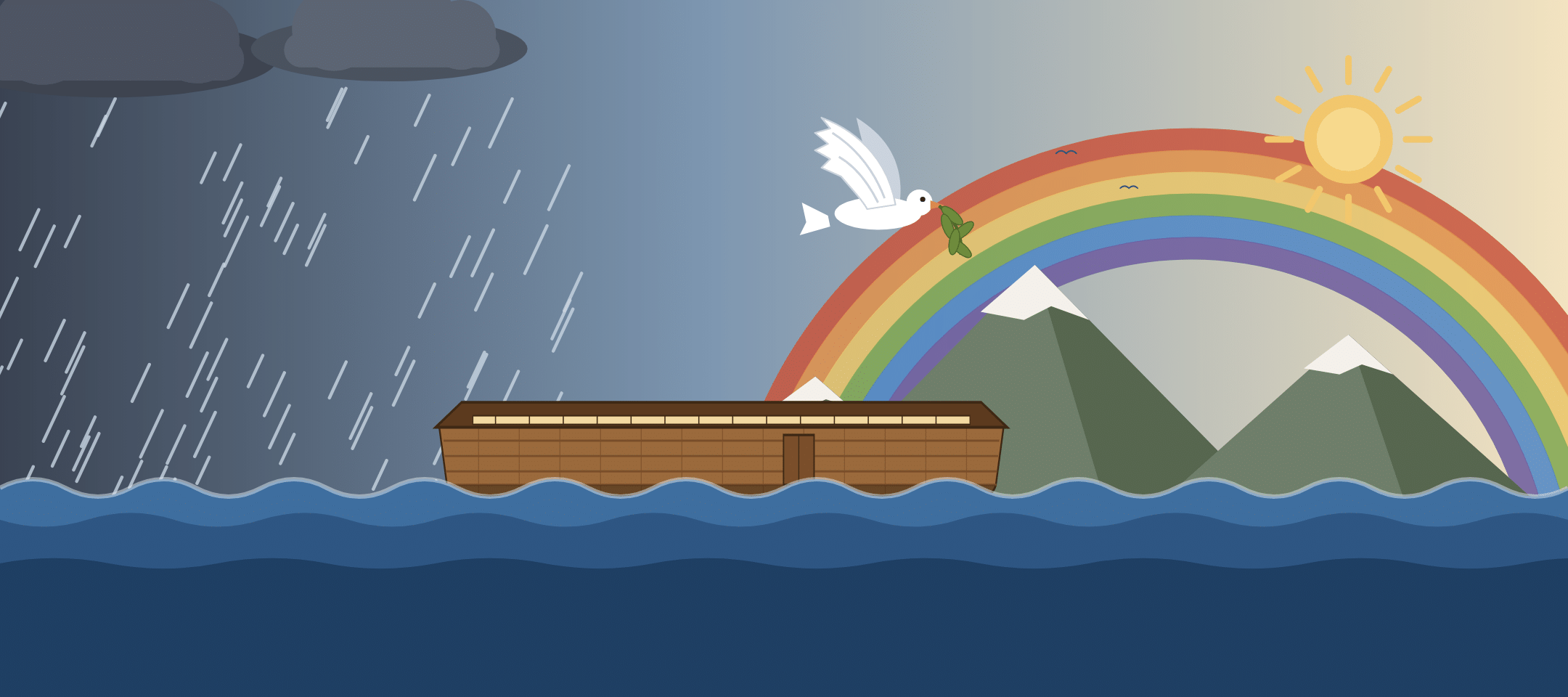
“But Noah found grace in the eyes of the LORD.”
Genesis 6:8
40 Days
And forty nights of rain
150 Days
The waters prevailed
8 People
Saved in the ark
1 Year, 10 Days
From the flood to dry ground
Why the Flood Matters
A Turning Point for the Whole World
The Flood is one of the most familiar stories in Scripture, and one of the most important. Everything before it, from creation and the fall to the spread of sin, leads up to it. Everything after it, from the nations to Abraham, Israel, and Jesus, comes out of the family that God saved in the ark.
The story shows three things about God at once. He is holy, and he takes sin seriously enough to judge it. He is gracious, and he provides a way of rescue before judgment falls. And he is faithful: he remembers Noah, keeps every living creature in his care, and binds himself with a promise that still holds every time a rainbow appears. Jesus himself pointed back to “the days of Noe” (Matthew 24:37), and Peter saw in the ark a picture of salvation (1 Peter 3:20–21).
At a Glance
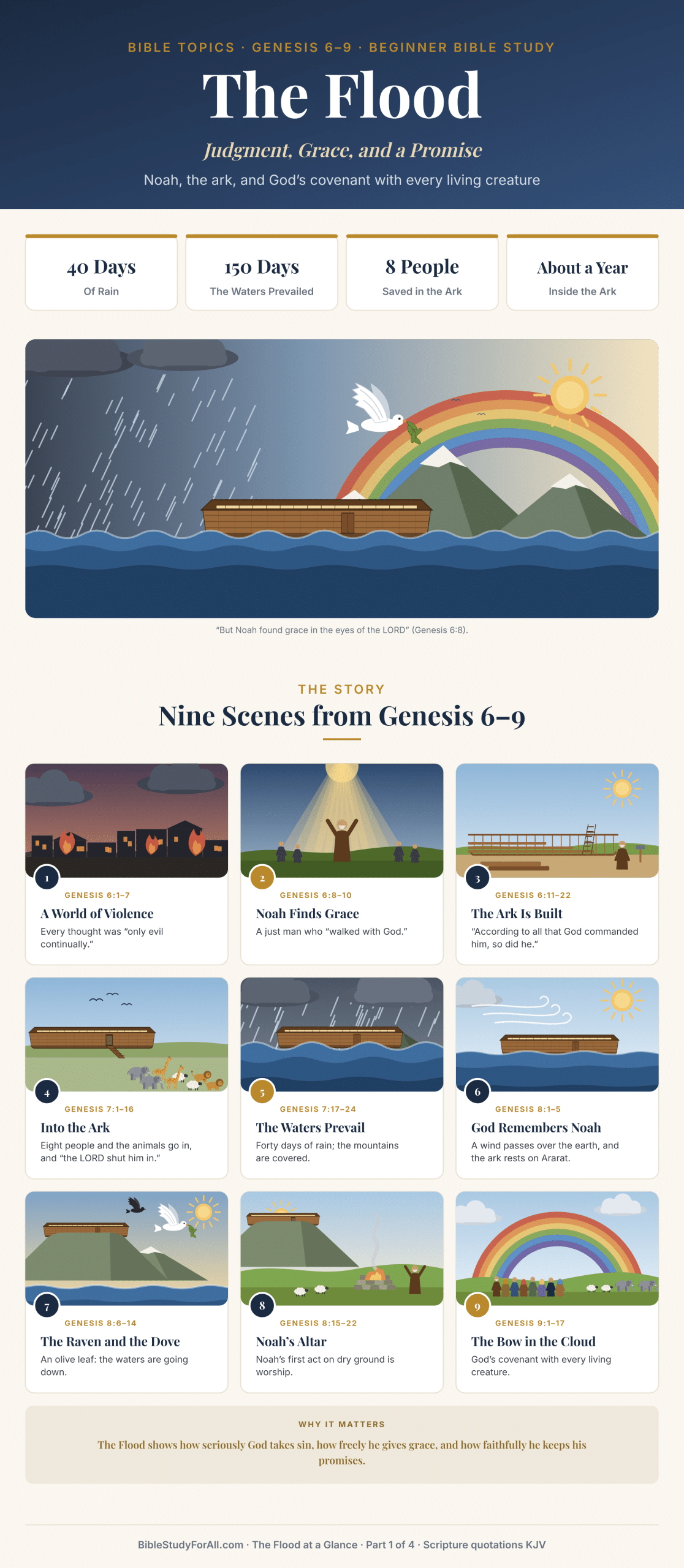
The Flood in Nine Scenes
The account moves in nine scenes: a world filled with violence, Noah finding grace, the ark built, the family and the animals going in, the waters prevailing, God remembering Noah, the raven and the dove, Noah’s altar, and the rainbow covenant. Select a scene to jump straight to it.
Scene 1 · Genesis 6:1–7
Sin has spread from one garden to the whole earth, and God is grieved.
Scene 4 · Genesis 7:1–16
Eight people and the animals go in, and the LORD shuts the door.
Scene 5 · Genesis 7:11–24
Forty days of rain; the mountains are covered; only the ark remains.
Scene 8 · Genesis 8:15–22
Noah’s first act on dry ground is worship, and God makes a promise.
Scene 9 · Genesis 9:1–17
God’s covenant with every living creature, and its sign.
The whole story in four illustrated parts. Save or print them to keep beside your Bible.
Before You Begin
Three Habits for This Study
You don’t need any background to follow along. These habits will help you get the most from each scene.
Read it as one story
Genesis 6–9 is a single account in four chapters. Read Genesis 6–9 (KJV) straight through once before you study each scene.
Watch for the turning point
The story builds to one line in the middle, “And God remembered Noah” (Genesis 8:1). Notice how the second half mirrors the first as the waters go down.
Look for the dates
Genesis gives a day, month, and year for the key moments. Track them in the timeline below and you will see how long Noah waited on God.
Scene 1 of 9 · Genesis 6:1–7
A World Filled with Violence
When: Ten generations after Adam
“And GOD saw that the wickedness of man was great in the earth, and that every imagination of the thoughts of his heart was only evil continually.”Genesis 6:5 (KJV) · Read Genesis 6:1–7
What happens
Genesis 5 traces ten generations from Adam to Noah, and the refrain “and he died” runs through the list. People multiply on the earth, but so does sin. Genesis 6 opens with the strange account of “the sons of God” taking “the daughters of men” as wives, and of the “giants in the earth in those days” (Genesis 6:2, 4).
Then God looks, and what he sees is total: “every imagination of the thoughts of his heart was only evil continually.” The earth “was corrupt before God, and the earth was filled with violence” (Genesis 6:11). The response is not cold anger but grief: “it repented the LORD that he had made man on the earth, and it grieved him at his heart” (Genesis 6:6). God announces that he will wipe out man and beast from the face of the earth.
Look closer
Only five chapters earlier, God looked at his world and saw that it was “very good” (Genesis 1:31). Now he looks again and sees corruption. Cain’s one murder (Genesis 4:8) has grown into a world “filled with violence.”
In Genesis 6:3 God says, “My spirit shall not always strive with man … yet his days shall be an hundred and twenty years.” Many read this as 120 years of patience before the Flood; others as a new limit on the human lifespan. Either way, judgment does not come without warning. Peter speaks of the time “when once the longsuffering of God waited in the days of Noah” (1 Peter 3:20).
Think about it
God grieved over sin before he judged it. How does it change your view of sin to know that it grieves God’s heart?
Scene 2 of 9 · Genesis 6:8–10
Noah Finds Grace
When: Noah 500 years old and more (Genesis 5:32)
“But Noah found grace in the eyes of the LORD.”Genesis 6:8 (KJV) · Read Genesis 6:8–10
What happens
Against that dark background comes one of the Bible’s great turning words: “But.” “But Noah found grace in the eyes of the LORD.” Then Genesis introduces him: “Noah was a just man and perfect in his generations, and Noah walked with God. And Noah begat three sons, Shem, Ham, and Japheth” (Genesis 6:9–10).
Noah’s father Lamech had named him with a hope: “This same shall comfort us concerning our work and toil of our hands, because of the ground which the LORD hath cursed” (Genesis 5:29). Noah’s great-grandfather Enoch had also “walked with God” (Genesis 5:24). In a world that had forgotten God, this family had not.
Look closer
Notice the order. Genesis first says that Noah found grace, and only then that he was just and walked with God. Grace is not a reward for Noah’s goodness; Noah’s goodness grows out of God’s grace. The word “grace” appears here for the first time in the King James Bible.
“Perfect in his generations” does not mean sinless (Genesis 9:21 makes that plain). It means whole-hearted and blameless among the people of his day. Hebrews says Noah “became heir of the righteousness which is by faith” (Hebrews 11:7).
Think about it
Noah walked with God when almost no one else did. What helps you keep walking with God when the people around you are not?
Scene 3 of 9 · Genesis 6:11–22
God Commands the Ark
When: Before Noah’s 600th year
“Thus did Noah; according to all that God commanded him, so did he.”Genesis 6:22 (KJV) · Read Genesis 6:11–22
What happens
God tells Noah what is coming: “I, even I, do bring a flood of waters upon the earth, to destroy all flesh” (Genesis 6:17). Then he tells him how to be saved. “Make thee an ark of gopher wood; rooms shalt thou make in the ark, and shalt pitch it within and without with pitch” (Genesis 6:14). The ark is to be three hundred cubits long, fifty wide, and thirty high, with a window, a door in the side, and three stories (Genesis 6:15–16).
With the command comes a promise, the first time the Bible uses the word covenant: “But with thee will I establish my covenant; and thou shalt come into the ark, thou, and thy sons, and thy wife, and thy sons’ wives with thee” (Genesis 6:18). Noah is to bring two of every kind of living thing and food for all. And Noah simply obeys.
Look closer
The word for “ark” is used only one other time in the Bible: for the little basket of bulrushes that saved baby Moses from the waters of the Nile (Exodus 2:3). Both times God saves someone from death in water inside a vessel covered with pitch.
The ark was a barge, not a sailing ship. It had no sail, rudder, or oars. It was built to float and to keep its passengers safe, and its course was in God’s hands. See The Ark below for its size and shape.
Think about it
Noah obeyed God about something he had never seen. Where is God asking you to obey him before you can see why?
Scene 4 of 9 · Genesis 7:1–16
Into the Ark
When: Noah’s 600th year, 2nd month
“And they that went in, went in male and female of all flesh, as God had commanded him: and the LORD shut him in.”Genesis 7:16 (KJV) · Read Genesis 7:1–16
What happens
When the ark is ready, the LORD says, “Come thou and all thy house into the ark; for thee have I seen righteous before me in this generation” (Genesis 7:1). Clean animals and birds go in “by sevens,” other animals by pairs (Genesis 7:2–3). God gives seven more days of warning: “For yet seven days, and I will cause it to rain upon the earth forty days and forty nights” (Genesis 7:4).
Noah is six hundred years old. He goes in with his wife, his sons Shem, Ham, and Japheth, and their three wives: eight people in all (Genesis 7:13). The animals come “two and two unto Noah into the ark, the male and the female” (Genesis 7:9). Then comes a quiet line with great weight: “and the LORD shut him in.”
Look closer
Noah did not have to round up the animals; they “went in unto Noah into the ark” (Genesis 7:15). The God who made them brought them.
“The LORD shut him in.” Noah did not close the door himself. Those inside were safe because God had closed it, and the same door that kept them safe also closed out everyone who had refused to come. Jesus said, “I am the door: by me if any man enter in, he shall be saved” (John 10:9).
Think about it
The door of the ark stood open for seven days before the rain began. What does God’s patience before judgment say about his heart?
Scene 5 of 9 · Genesis 7:11–24
The Waters Prevail
When: Year 600, month 2, day 17, for 150 days
“The same day were all the fountains of the great deep broken up, and the windows of heaven were opened.”Genesis 7:11 (KJV) · Read Genesis 7:11–24
What happens
Genesis gives the exact date: “in the six hundredth year of Noah’s life, in the second month, the seventeenth day of the month.” Water comes from below, as “the fountains of the great deep” break up, and from above, as “the windows of heaven” open. “The rain was upon the earth forty days and forty nights” (Genesis 7:12).
The waters rise and lift the ark “above the earth” (Genesis 7:17). “All the high hills, that were under the whole heaven, were covered. Fifteen cubits upward did the waters prevail; and the mountains were covered” (Genesis 7:19–20). Every land creature and every person outside the ark dies. “Noah only remained alive, and they that were with him in the ark. And the waters prevailed upon the earth an hundred and fifty days” (Genesis 7:23–24).
Look closer
In Genesis 1, God separated the waters above from the waters below and gathered the seas so dry land could appear (Genesis 1:6–10). In the Flood those waters come back together. It is creation running in reverse, the world returned to the watery deep of Genesis 1:2.
Fifteen cubits is about 22 feet. Many note that this is half the ark’s height of thirty cubits, deep enough for a loaded ark to float clear of the highest ground.
Think about it
Only those inside the ark were saved. Where are you placing your trust for safety when God judges the world?
Scene 6 of 9 · Genesis 8:1–5
God Remembers Noah
When: Year 600, months 7–10
“And God remembered Noah, and every living thing, and all the cattle that was with him in the ark: and God made a wind to pass over the earth, and the waters asswaged.”Genesis 8:1 (KJV) · Read Genesis 8:1–5
What happens
Right at the center of the story comes the turning point: “And God remembered Noah.” God sends a wind over the earth. The fountains of the deep and the windows of heaven are stopped, the rain is held back, and the waters begin to go down (Genesis 8:1–3).
“And the ark rested in the seventh month, on the seventeenth day of the month, upon the mountains of Ararat” (Genesis 8:4). The waters keep falling, and on the first day of the tenth month “were the tops of the mountains seen” (Genesis 8:5).
Look closer
When the Bible says God “remembered,” it does not mean he had forgotten. It means he acted on his promise. God “remembered” Abraham and rescued Lot (Genesis 19:29), and he “remembered his covenant” and brought Israel out of Egypt (Exodus 2:24).
The wind over the waters echoes Genesis 1:2, where “the Spirit of God moved upon the face of the waters.” A new beginning is starting. “Ararat” is the ancient land of Urartu, in the mountains of eastern Turkey and Armenia. Genesis names the range, not a single peak.
Think about it
God remembered Noah after months of silence on the waters. When God seems silent, what reminds you that he has not forgotten you?
Scene 7 of 9 · Genesis 8:6–14
The Raven and the Dove
When: Year 600, month 11 to year 601, month 2
“And the dove came in to him in the evening; and, lo, in her mouth was an olive leaf pluckt off: so Noah knew that the waters were abated from off the earth.”Genesis 8:11 (KJV) · Read Genesis 8:6–14
What happens
Forty days after the mountain tops appear, Noah opens the window and sends out a raven, “which went forth to and fro, until the waters were dried up from off the earth” (Genesis 8:7). Then he sends a dove, but “the dove found no rest for the sole of her foot,” and Noah reaches out his hand and pulls her back in (Genesis 8:9).
Seven days later he sends her again, and she comes back in the evening with a fresh olive leaf in her beak. Seven days after that, he sends her out once more, and she does not come back (Genesis 8:12). On the first day of the first month of Noah’s 601st year, Noah removes the covering of the ark and sees that the ground is dry. By the twenty-seventh day of the second month, “was the earth dried” (Genesis 8:14).
Look closer
A raven eats carrion and could live off what floated on the water, so it never needed to come back. A dove needs dry ground and green plants. The olive leaf told Noah that trees were growing again on lower ground.
Noah waited patiently even after the ark had rested. He did not leave when the ground looked dry; he waited for God to say “Go forth” (Genesis 8:16). The dove with an olive branch has become a picture of peace in many cultures, and the story starts here.
Think about it
Noah waited for God’s word before he left the ark. Is there a decision where you need to wait for God’s timing rather than rush ahead?
Scene 8 of 9 · Genesis 8:15–22
Out of the Ark: Noah’s Altar
When: Year 601, month 2, day 27
“While the earth remaineth, seedtime and harvest, and cold and heat, and summer and winter, and day and night shall not cease.”Genesis 8:22 (KJV) · Read Genesis 8:15–22
What happens
God says, “Go forth of the ark, thou, and thy wife, and thy sons, and thy sons’ wives with thee” (Genesis 8:16), and he sends the animals out to “be fruitful, and multiply upon the earth” (Genesis 8:17). After a year and ten days inside, the family steps onto a washed world.
The first thing Noah does is build an altar. He offers burnt offerings from every clean animal and bird (Genesis 8:20). “And the LORD smelled a sweet savour; and the LORD said in his heart, I will not again curse the ground any more for man’s sake” (Genesis 8:21). He promises that the seasons and the days will keep their rhythm as long as the earth remains.
Look closer
Here is why the clean animals went in by sevens: Noah could offer some in thanks without wiping out a kind.
God’s reason for the promise is surprising: “for the imagination of man’s heart is evil from his youth” (Genesis 8:21). That is almost the same reason given for the Flood in Genesis 6:5. The Flood did not change the human heart. From now on God will deal with sin by patience and, in the end, by a Savior, not by another flood. Paul writes that Christ “hath given himself for us an offering and a sacrifice to God for a sweetsmelling savour” (Ephesians 5:2).
Think about it
Every sunrise and every harvest is a promise kept. What everyday gift could you thank God for today?
Scene 9 of 9 · Genesis 9:1–17
The Covenant and the Rainbow
When: After the Flood
“I do set my bow in the cloud, and it shall be for a token of a covenant between me and the earth.”Genesis 9:13 (KJV) · Read Genesis 9:1–17
What happens
God blesses Noah and his sons with the words of creation: “Be fruitful, and multiply, and replenish the earth” (Genesis 9:1). He gives them animals for food as well as plants, but forbids eating blood, and he declares that human life is sacred: “Whoso sheddeth man’s blood, by man shall his blood be shed: for in the image of God made he man” (Genesis 9:6).
Then God makes his covenant “with you, and with your seed after you; and with every living creature” (Genesis 9:9–10): “neither shall all flesh be cut off any more by the waters of a flood” (Genesis 9:11). He gives a sign. “I do set my bow in the cloud.” Whenever clouds gather, “the bow shall be seen in the cloud: and I will remember my covenant” (Genesis 9:14–15).
Look closer
This covenant asks nothing of Noah in return. It is made with every living creature, even the animals, and it lasts “for perpetual generations” (Genesis 9:12). It rests entirely on God.
The word for “bow” is the ordinary word for a warrior’s bow. Many see a picture in this: God hangs up his bow in the sky, pointed away from the earth. And notice who looks at the rainbow: “I will look upon it, that I may remember the everlasting covenant” (Genesis 9:16). When you see a rainbow, God sees it too, and remembers.
Think about it
The rainbow is God’s reminder to himself. How does it help to know that God’s promises depend on his faithfulness, not on yours?
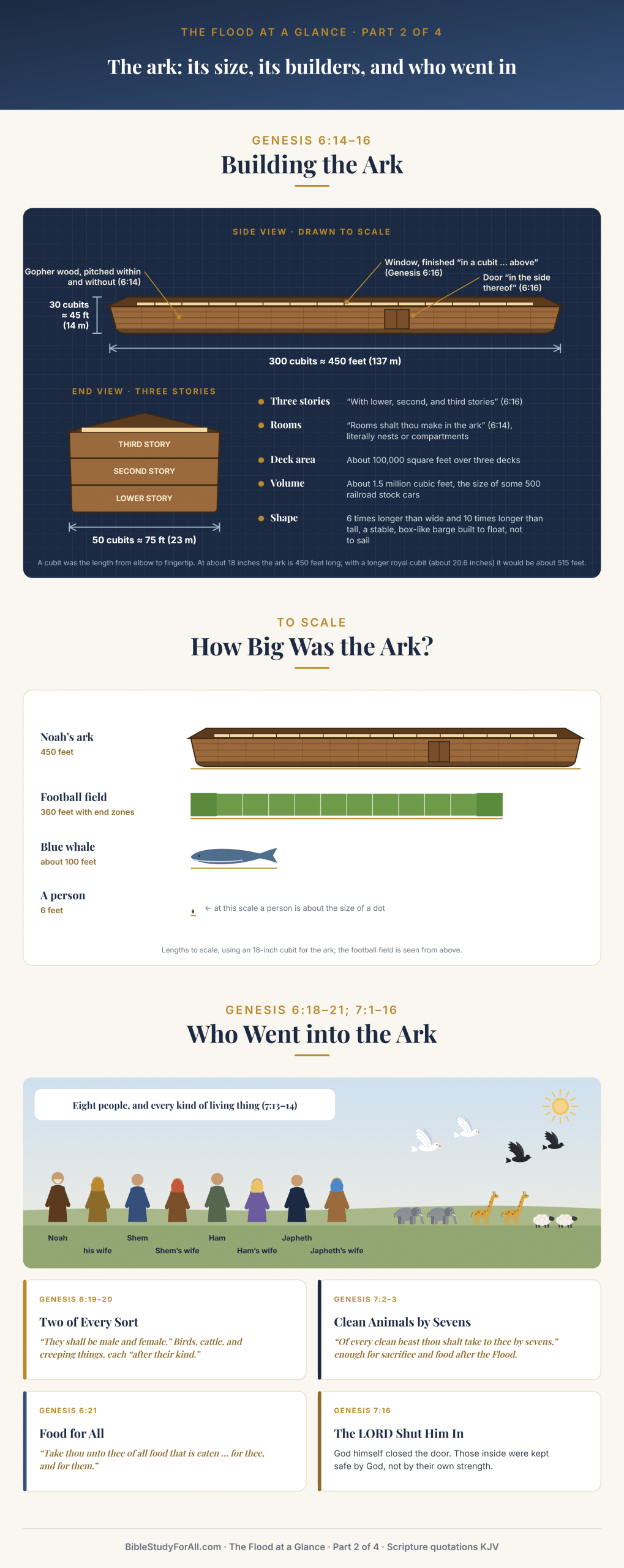
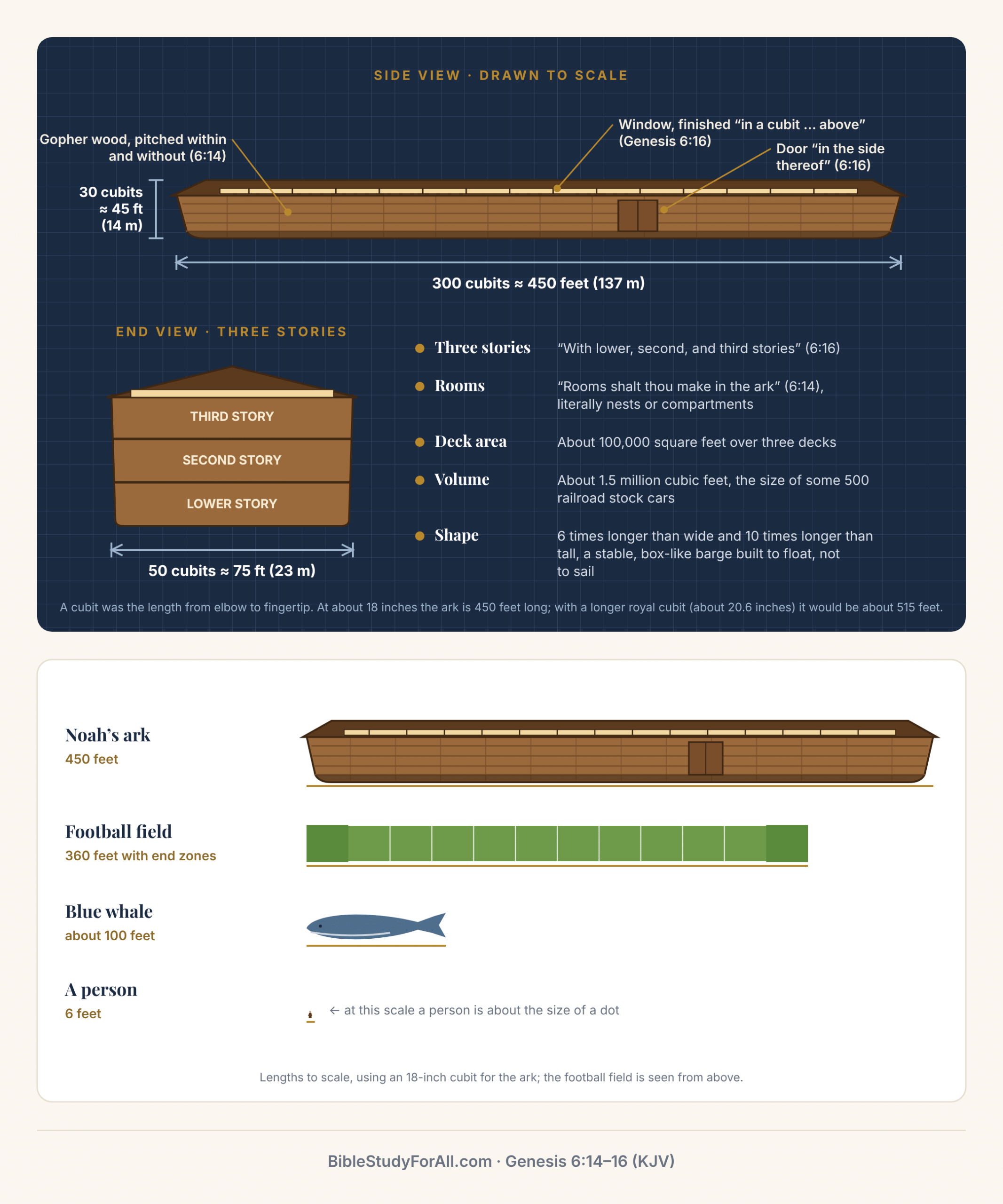
Genesis 6:14–16
The Ark
God gave Noah the plan in three verses. The measurements are in cubits, the length from elbow to fingertip, about 18 inches. The result was a huge wooden barge built to float safely, not to sail anywhere.
300 cubits
Length
About 450 feet (137 m), longer than a football field with both end zones.
50 cubits
Breadth
About 75 feet (23 m). Six times longer than wide, a shape that resists rolling.
30 cubits
Height
About 45 feet (14 m), with lower, second, and third stories inside.
Genesis 6:14
Gopher wood
A wood named only here. Its exact kind is unknown; many suggest cypress or a resinous timber.
Genesis 6:14
Pitch
“Pitch it within and without with pitch”: sealed inside and out to keep the water out.
Genesis 6:16
Window and door
A window “in a cubit … above” to let in light and air, and one door in the side.
Who went in
Eight people: Noah and his wife, and their sons Shem, Ham, and Japheth with their wives (Genesis 7:13). Peter calls them “eight souls” (1 Peter 3:20).
Animals: two of every kind of land animal and bird, “male and female” (Genesis 6:19–20), and seven pairs of each clean animal and bird (Genesis 7:2–3). Sea creatures are not mentioned; the ark was for those “in whose nostrils was the breath of life” on dry land (Genesis 7:22).
Food: “of all food that is eaten,” for the family and the animals (Genesis 6:21).
Genesis 7:11–8:16
A Year in the Ark
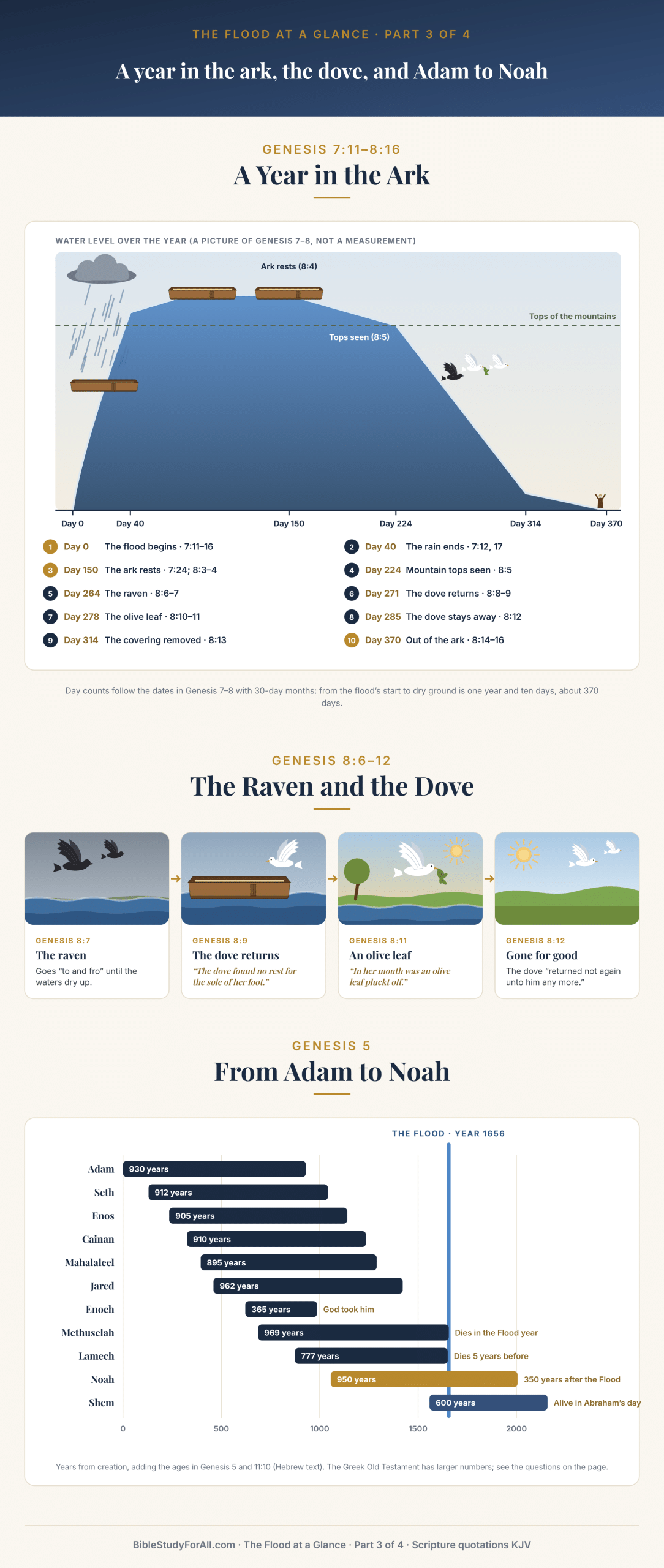
Genesis dates the Flood by Noah’s life, as a diary would. Counting 30-day months, Noah’s family was inside the ark for one year and ten days, about 370 days, and the rain itself lasted only the first forty.
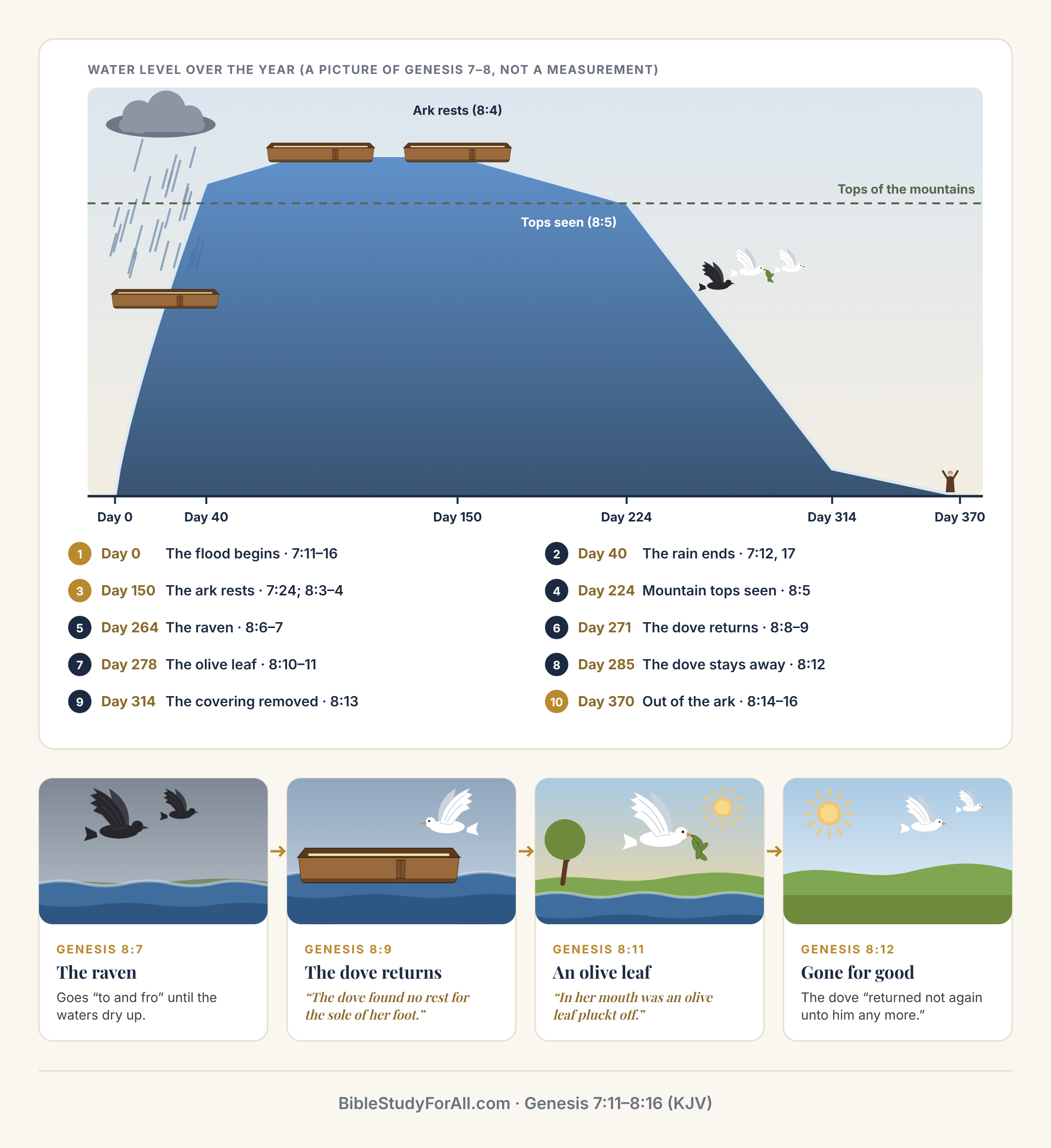
| Day | Noah’s calendar | What happens | Reference |
|---|---|---|---|
| -7 | Year 600 · month 2 · day 10 | Seven days’ warning. God tells Noah that in seven days the rain will come | Genesis 7:4, 10 |
| 0 | Year 600 · month 2 · day 17 | The flood begins. The fountains of the deep break up and the windows of heaven open; Noah’s family and the animals go in, and the LORD shuts them in | Genesis 7:11–16 |
| 40 | Forty days later | The rain ends. Rain falls forty days and forty nights, and the waters bear up the ark | Genesis 7:12, 17 |
| 150 | Year 600 · month 7 · day 17 | The ark rests. The waters prevail 150 days; the ark rests on the mountains of Ararat | Genesis 7:24; 8:3–4 |
| 224 | Year 600 · month 10 · day 1 | Mountain tops seen. The waters keep going down, and the tops of the mountains appear | Genesis 8:5 |
| 264 | Forty days later | The raven. Noah opens the window and sends out a raven, which goes to and fro | Genesis 8:6–7 |
| 271 | About a week later | The dove returns. The dove finds no rest for her foot and comes back | Genesis 8:8–9 |
| 278 | Seven days later | The olive leaf. The dove returns in the evening with an olive leaf | Genesis 8:10–11 |
| 285 | Seven days later | The dove stays away. The dove does not return | Genesis 8:12 |
| 314 | Year 601 · month 1 · day 1 | The covering removed. The waters are dried up; Noah removes the covering and sees dry ground | Genesis 8:13 |
| 370 | Year 601 · month 2 · day 27 | Out of the ark. The earth is dry, and God says, “Go forth of the ark” | Genesis 8:14–16 |
Day numbers count from the day the fountains of the deep broke up. Genesis does not say how long Noah waited before the first dove; about a week is a common estimate.
Genesis 5
From Adam to Noah
Genesis 5 links Adam to Noah in ten generations, giving each father’s age when his son was born and how long he lived. Added together, the Hebrew numbers place the Flood 1,656 years after creation. Long lives overlapped: Noah’s father Lamech was born while Adam was still alive.
| Name | Born (year) | Age at son | Lived | Died (year) | Note |
|---|---|---|---|---|---|
| Adam | 0 | 130 | 930 | 930 | – |
| Seth | 130 | 105 | 912 | 1042 | – |
| Enos | 235 | 90 | 905 | 1140 | – |
| Cainan | 325 | 70 | 910 | 1235 | – |
| Mahalaleel | 395 | 65 | 895 | 1290 | – |
| Jared | 460 | 162 | 962 | 1422 | – |
| Enoch | 622 | 65 | 365 | 987 | God took him |
| Methuselah | 687 | 187 | 969 | 1656 | Dies in the Flood year |
| Lamech | 874 | 182 | 777 | 1651 | Dies 5 years before |
| Noah | 1056 | 502 | 950 | 2006 | 350 years after the Flood |
| Shem | 1558 | 100 (at Arphaxad, 2 years after the Flood) | 600 | 2158 | Alive in Abraham’s day |
Two things to notice
Enoch “walked with God: and he was not; for God took him” (Genesis 5:24). He is the one name in the list without “and he died.”
Methuselah, the longest-lived man in the Bible at 969 years, died in the year of the Flood. God’s patience stretched to the very end. On these numbers Noah’s son Shem was still alive in the time of Abraham.
Years from creation, from the Hebrew text of Genesis 5 and 11:10. The Greek Old Testament (Septuagint) gives larger ages for several fathers, which places the Flood earlier; see the questions below.
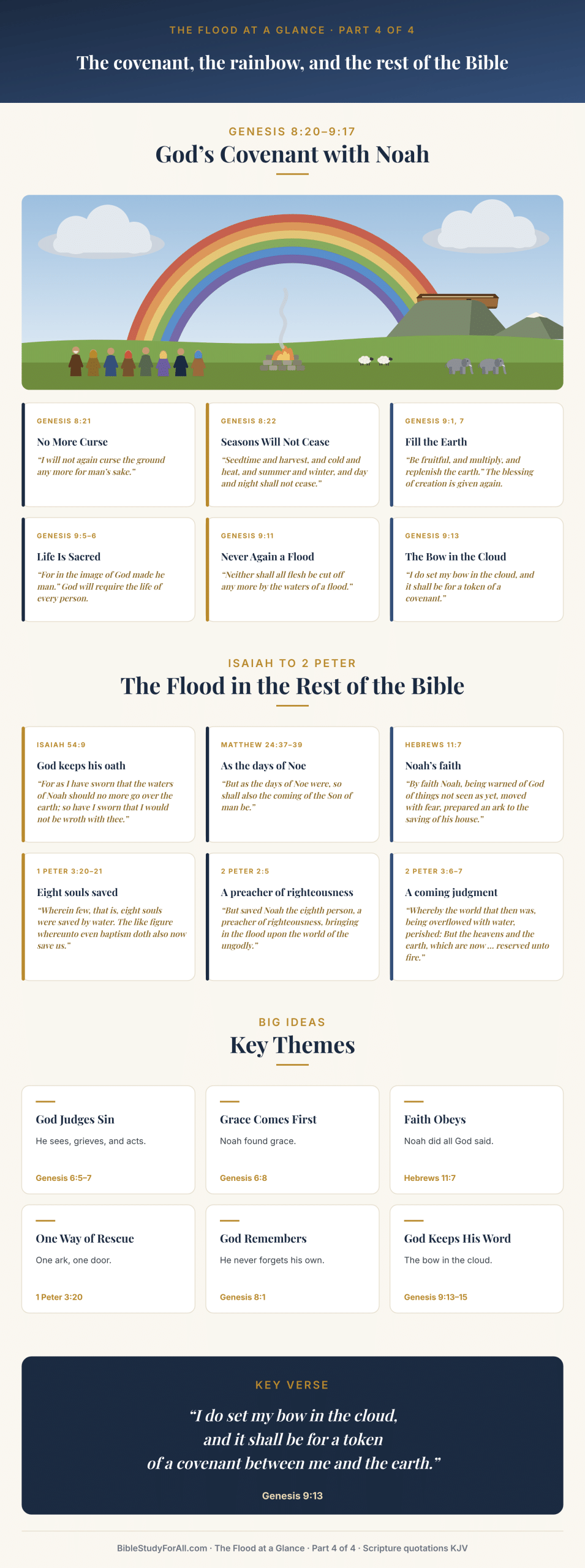
Genesis 8:20–9:17
God’s Covenant with Noah
The first covenant named in the Bible is made with Noah, his descendants, and every living creature. It is a promise God keeps by himself, and it still stands.
GENESIS 8:21
No More Curse
“I will not again curse the ground any more for man’s sake.”
GENESIS 8:22
Seasons Will Not Cease
“Seedtime and harvest, and cold and heat, and summer and winter, and day and night shall not cease.”
GENESIS 9:1, 7
Fill the Earth
“Be fruitful, and multiply, and replenish the earth.” The blessing of creation is given again.
GENESIS 9:5–6
Life Is Sacred
“For in the image of God made he man.” God will require the life of every person.
GENESIS 9:11
Never Again a Flood
“Neither shall all flesh be cut off any more by the waters of a flood.”
GENESIS 9:13
The Bow in the Cloud
“I do set my bow in the cloud, and it shall be for a token of a covenant.”
Every rainbow
The covenant with Noah is the reason we can plant crops, plan for next year, and expect the sun to rise. Isaiah uses it to show how sure God’s love is: “For as I have sworn that the waters of Noah should no more go over the earth; so have I sworn that I would not be wroth with thee” (Isaiah 54:9). In Revelation, John sees “a rainbow round about the throne” of God (Revelation 4:3).
Genesis 9:18–11:9
After the Flood
The account closes honestly. Noah plants a vineyard, drinks too much wine, and lies uncovered in his tent. Ham sees his father’s shame and tells his brothers, while Shem and Japheth walk in backward and cover him (Genesis 9:20–23). Noah then speaks a curse on Ham’s son Canaan and a blessing on Shem and Japheth (Genesis 9:25–27). Even the man who found grace was still a sinner who needed God’s mercy. The Flood washed away a wicked world, but it did not wash sin out of the human heart.
“These are the three sons of Noah: and of them was the whole earth overspread” (Genesis 9:19). Genesis 10 lists the nations that came from Shem, Ham, and Japheth, and Genesis 11 tells how they were scattered at Babel. Then the story narrows again to one line, from Shem to Terah to Abram. The God who saved one family in the ark is about to bless “all families of the earth” through one man (Genesis 12:3).
Genesis 10:2–5
Japheth
Peoples of the coastlands and the north, from Greece to the Black Sea.
Genesis 10:6–20
Ham
Peoples of Egypt, Cush, Canaan, and the cities of Mesopotamia.
Genesis 10:21–31; 11:10–26
Shem
The Semitic peoples, and the line that leads to Abraham and to Israel.
Reading Genesis 6–9
How Far Did the Waters Reach?
Christians agree that the Flood is part of God’s inspired Word and that it really happened. This site reads it as a global, catastrophic Flood. Some Christians understand it as a vast regional flood. Here is what each reading points to.
This site’s reading
A Global Flood
The text says that “all the high hills, that were under the whole heaven, were covered” and that the waters stood fifteen cubits above the mountains (Genesis 7:19–20). Every land creature outside the ark died (Genesis 7:21–23), the waters prevailed for five months, and God promised that such a flood would never come again (Genesis 9:11–15). Peter speaks of “the world that then was, being overflowed with water” (2 Peter 3:6). A huge ark full of animals would hardly be needed for a local flood.
For more detail, one good place to start is Answers in Genesis on the Flood.
Another reading
A Regional Flood
Some Christians read “the earth” as “the land,” the world Noah could see and the people who lived in it. They note that the same Hebrew word often means a land or region, and that phrases like “all countries” in Genesis 41:57 describe a wide area rather than every place on the globe. On this reading the Flood destroyed all of humanity outside the ark in a vast but limited area.
Those who hold it still agree that the Flood was a real, devastating judgment of God, and that only Noah’s family survived.
Common ground
Wherever you land, the central message is the same: God judges sin, saves by grace, and keeps his promises. Jesus and the apostles treated Noah and the Flood as real history (Matthew 24:37–39; Hebrews 11:7; 2 Peter 2:5).
Big Ideas
Six Themes of the Flood
God judges sin
He saw that wickedness was great, and it grieved him at his heart (Genesis 6:5–7).
Grace comes first
Noah found grace before we are told he was just (Genesis 6:8–9).
Faith obeys
Noah built the ark for a flood he had never seen (Genesis 6:22; Hebrews 11:7).
One way of rescue
There was one ark with one door, and the LORD shut it (Genesis 7:16).
God remembers
God remembered Noah and every creature with him (Genesis 8:1).
God keeps his word
The rainbow is God’s sign to every generation (Genesis 9:12–16).
The Rest of the Story
Noah, the Flood, and Jesus
The prophets, Jesus, and the apostles all come back to Noah. Jesus used the Flood to warn about his return, and Peter saw the ark as a picture of being saved through Christ.
Isaiah 54:9
God keeps his oath
“For as I have sworn that the waters of Noah should no more go over the earth; so have I sworn that I would not be wroth with thee.”
Ezekiel 14:14
A righteous man
“Though these three men, Noah, Daniel, and Job, were in it, they should deliver but their own souls by their righteousness.”
Matthew 24:37–39
As the days of Noe
“But as the days of Noe were, so shall also the coming of the Son of man be.”
Luke 17:26–27
Life as usual
“They did eat, they drank, they married wives … until the day that Noe entered into the ark, and the flood came, and destroyed them all.”
Hebrews 11:7
Noah’s faith
“By faith Noah, being warned of God of things not seen as yet, moved with fear, prepared an ark to the saving of his house.”
1 Peter 3:20–21
Eight souls saved
“Wherein few, that is, eight souls were saved by water. The like figure whereunto even baptism doth also now save us.”
2 Peter 2:5
A preacher of righteousness
“But saved Noah the eighth person, a preacher of righteousness, bringing in the flood upon the world of the ungodly.”
2 Peter 3:6–7
A coming judgment
“Whereby the world that then was, being overflowed with water, perished: But the heavens and the earth, which are now … reserved unto fire.”
Jesus, our ark
Many Christians see the ark as a picture of Christ. God provided one place of safety before judgment fell; Jesus is the one Savior from the judgment to come (Acts 4:12). Noah and his family were saved because they were inside the ark, not because of their own strength; Christians are saved by being “in Christ” (Romans 8:1). And the waters that judged the world bore up the ark, just as Christ bore God’s judgment for those who trust him: “For Christ also hath once suffered for sins, the just for the unjust, that he might bring us to God” (1 Peter 3:18).
Verses to Remember
Key Verses about the Flood
Along with the verses in each scene above, these are worth reading slowly, and memorizing.
Genesis 6:8
“But Noah found grace in the eyes of the LORD.”
Genesis 6:22
“Thus did Noah; according to all that God commanded him, so did he.”
Genesis 8:1
“And God remembered Noah, and every living thing, and all the cattle that was with him in the ark.”
Genesis 8:22
“While the earth remaineth, seedtime and harvest, and cold and heat, and summer and winter, and day and night shall not cease.”
Genesis 9:13
“I do set my bow in the cloud, and it shall be for a token of a covenant between me and the earth.”
Hebrews 11:7
“By faith Noah, being warned of God of things not seen as yet, moved with fear, prepared an ark to the saving of his house; by the which he condemned the world, and became heir of the righteousness which is by faith.”
Matthew 24:38–39
“For as in the days that were before the flood they were eating and drinking, marrying and giving in marriage, until the day that Noe entered into the ark, and knew not until the flood came, and took them all away.”
1 Peter 3:20
“When once the longsuffering of God waited in the days of Noah, while the ark was a preparing, wherein few, that is, eight souls were saved by water.”
Summary
Five Things to Remember
1
God hates sin
The Flood shows that God sees evil, grieves over it, and judges it (Genesis 6:5–7).
2
God saves by grace
Noah “found grace,” and his faith showed in obedience (Genesis 6:8, 22).
3
One door of rescue
Eight people were saved inside the ark, and the LORD shut them in (Genesis 7:16).
4
God keeps his promises
The rainbow is the sign that a flood will never again destroy all flesh (Genesis 9:11–13).
5
It points to Jesus
Jesus warned that his return will come as the Flood did, and he is the ark of safety (Matthew 24:37; 1 Peter 3:18–21).
For Reflection
Questions to Think About
- Why do you think Genesis says that Noah found grace before it describes his righteousness (Genesis 6:8–9)?
- What might Noah have faced while building the ark for years as others watched and doubted?
- The LORD shut the door (Genesis 7:16). What comfort and what warning are in that line?
- How can the rainbow strengthen your trust in God’s promises?
- In what ways is Jesus a refuge for believers, as the ark was for Noah?
Questions
Common Questions about the Flood
How old was Noah when the Flood came?
Genesis 7:6 says, “Noah was six hundred years old when the flood of waters was upon the earth.” He lived 350 years after the Flood and died at 950 (Genesis 9:28–29).
Who was on the ark?
Eight people: Noah, his wife, and his three sons Shem, Ham, and Japheth with their wives (Genesis 7:13; 1 Peter 3:20). The Bible does not give the wives’ names.
How long was Noah in the ark?
From the day the Flood began (year 600, month 2, day 17) to the day God told Noah to go out (year 601, month 2, day 27) is one year and ten days, about 370 days with 30-day months (Genesis 7:11; 8:14–16). The rain lasted forty days; the waters prevailed for 150 days. See A Year in the Ark.
Where did the ark land?
“Upon the mountains of Ararat” (Genesis 8:4). Ararat is the ancient kingdom of Urartu, in the highlands of eastern Turkey, Armenia, and northwest Iran. Genesis names the mountain range, not a single peak. Many link it with the tall peak now called Mount Ararat in Turkey, but the exact landing place is not known.
How could all the animals fit?
The ark held about 1.5 million cubic feet. Genesis speaks of two of every “kind” (Genesis 6:20), which many understand as a broad group of related animals rather than every modern species. Those who have studied the question point out that most land animals are small, that young animals would take less room and food, and that the three decks gave about 100,000 square feet of floor space. Christians who hold a regional flood see fewer animals involved. Either way, Genesis says that the animals came to Noah (Genesis 6:20; 7:9, 15).
Who were the “sons of God” in Genesis 6?
Christians have read Genesis 6:2–4 in three main ways. Some see fallen angels who took human wives (compare Jude 6–7 and 2 Peter 2:4). Others see the godly line of Seth marrying into the ungodly line of Cain. Others see kings or powerful rulers taking whatever wives they chose. The “giants” (Hebrew Nephilim) were “mighty men … men of renown” (Genesis 6:4). The passage is brief, and the main point is clear in any reading: sin had spread through every part of human life.
What do the 120 years in Genesis 6:3 mean?
“Yet his days shall be an hundred and twenty years.” Many read this as a 120-year countdown, God’s patience before the Flood while the ark was built (compare 1 Peter 3:20). Others read it as a new limit on human lifespans, which do shorten after the Flood. The text allows either reading.
When did the Flood happen?
The Bible does not give a B.C. date. Adding the ages in Genesis 5, the Flood came 1,656 years after creation. Counting back from Abraham, born about 2166 B.C. on the dates used on our Abrahamic Covenant page, the ages in Genesis 11 place the Flood about 2500 B.C. The well-known date of 2348 B.C. comes from Archbishop Ussher, who counted slightly differently. The Greek Old Testament gives larger ages and an earlier date, and some Christians hold that the genealogies have gaps and do not allow a precise date.
Are there flood stories in other cultures?
Yes. Flood stories are found among many peoples around the world. The best known is in the ancient Mesopotamian Epic of Gilgamesh, where a man builds a boat, saves animals, lands on a mountain, and sends out birds. Many Christians see these stories as distant memories of the real event, told in other ways. The differences are just as striking: in Genesis there is one holy God who judges sin justly, saves by grace, and makes a lasting covenant.
Why was Canaan cursed, not Ham?
Genesis does not explain fully. Noah’s words in Genesis 9:25–27 are a prophecy about Canaan’s descendants, the Canaanites, whose land Israel later received. The curse was not on Ham, and it was never on any race of people. The use of this passage to defend slavery was a serious misreading of Scripture.
Will God ever flood the earth again?
No. God promised, “neither shall there any more be a flood to destroy the earth” (Genesis 9:11), and the rainbow is the sign of that promise. The Bible does speak of a future judgment, when “the heavens and the earth, which are now … are kept in store, reserved unto fire” (2 Peter 3:7), and it calls everyone to find refuge in Christ before that day.
Keep Reading
Continue Your Journey
Read the full account in Genesis 6–9, then explore the next great moment in the Bible’s story: God’s covenant with Abraham.
Scripture quotations are from the King James Version (KJV), which is in the public domain. Verse links open at BibleGateway. Years from creation follow the Hebrew text of Genesis 5; day counts follow Genesis 7–8 with 30-day months.