
Genesis 2:4–3:24 · Beginner Bible Study
Man’s Fall in Eden
How sin entered God’s good world, what it broke, and the first promise of a Savior. Walk through the story step by step, see what the Bible says, and learn what it means for us today.
“And the LORD God called unto Adam, and said unto him, Where art thou?”
Genesis 3:9
2 Chapters
Genesis 2:4–3:24
9 Steps
From the garden to exile
One Command
Genesis 2:16–17
First Promise
Genesis 3:15
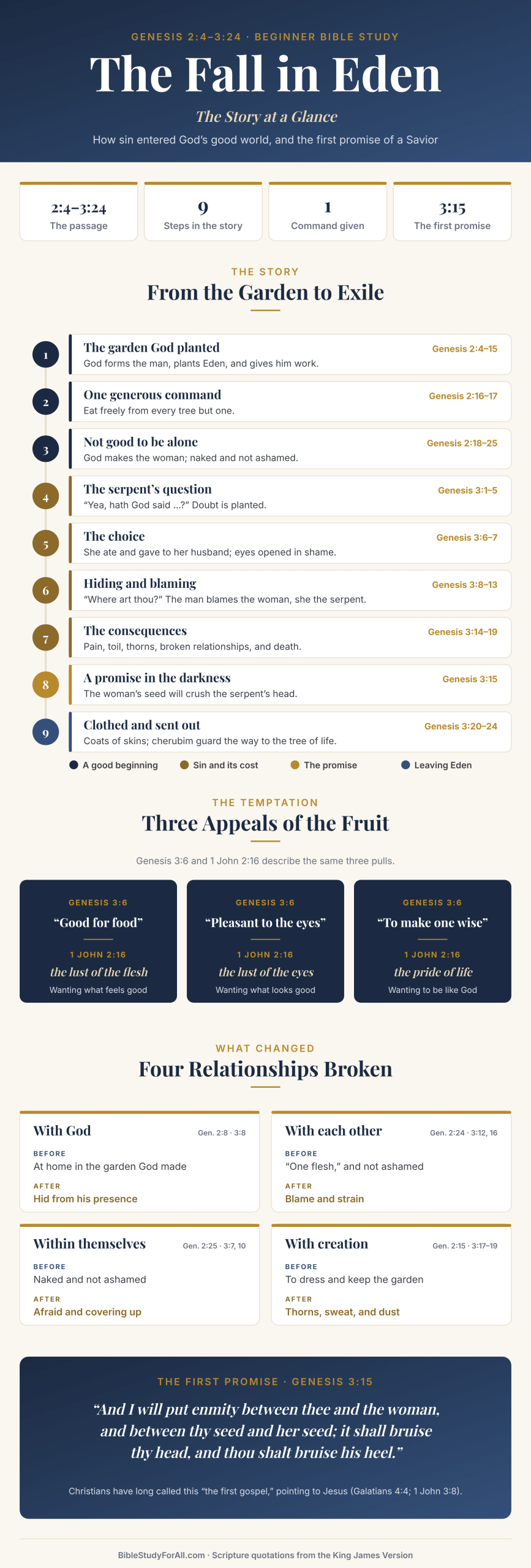
The Story at a Glance
From the Garden to Exile
The story of the fall moves in nine steps, from a perfect home to a closed gate, with a promise of hope in the middle. Select a step to jump straight to it.
The whole story on one page. Save or print it to keep beside your Bible.
Before You Begin
Three Habits for This Study
You don’t need any background to follow along. These habits will help you get the most from each step.
Read the passage first
Open your Bible to Genesis 2:4–3:24 and read it straight through. It takes about ten minutes, and everything below will make more sense. Read it online (KJV)
Listen for the questions
God asks four questions in Genesis 3: “Where art thou?”, “Who told thee that thou wast naked?”, “Hast thou eaten of the tree?” and “What is this that thou hast done?” Watch how the man and woman answer.
Remember the good beginning
Genesis 3 only makes sense after Genesis 1–2. Keep in mind that God made everything “very good” (Genesis 1:31). The fall is a story about what was lost, and what God will restore.
Step 1 of 9 · Genesis 2:4–15
The Garden God Planted
“And the LORD God formed man of the dust of the ground, and breathed into his nostrils the breath of life; and man became a living soul. And the LORD God planted a garden eastward in Eden; and there he put the man whom he had formed.”Genesis 2:7–8 (KJV) · Read all of Genesis 2:4–15
What happens
Genesis 2 slows down and zooms in on the sixth day. God shapes the first man from the dust and breathes life into him, which is close and personal, like a potter at work. Then God plants a garden in Eden, fills it with trees that are “pleasant to the sight, and good for food,” and waters it with a river that splits into four.
Two trees stand in the middle of the garden: the tree of life and the tree of the knowledge of good and evil (Genesis 2:9). God puts the man in the garden “to dress it and to keep it” (Genesis 2:15). Work is part of paradise from the very start.
Look closer
Hebrew has a wordplay that English loses. The man is adam, and the ground is adamah. His name reminds him where he came from, and it sets up the sad words of Genesis 3:19: “unto dust shalt thou return.”
You will also see a new name for God here, “the LORD God.” LORD in capital letters stands for God’s personal name (Yahweh). Genesis 1 shows God as the mighty Creator; Genesis 2 shows the same God close to the people he made.
Think about it
Work was part of God’s good design before anything went wrong. How might that change the way you see your own daily work?
Step 2 of 9 · Genesis 2:16–17
One Generous Command
“And the LORD God commanded the man, saying, Of every tree of the garden thou mayest freely eat: But of the tree of the knowledge of good and evil, thou shalt not eat of it: for in the day that thou eatest thereof thou shalt surely die.”Genesis 2:16–17 (KJV)
What happens
God’s first words to the man are an invitation: eat freely from every tree. Only one tree is off limits, and God is honest about why. Eating from it will bring death.
The command gives the man a real choice. He can trust that God is good and knows what is best, or he can decide for himself what is good and evil.
Look closer
Adam did not drop dead the day he ate. He lived to 930 (Genesis 5:5). Christians usually explain “in the day … thou shalt surely die” in two ways that fit together. That same day, the relationship with God was broken, which the Bible calls spiritual death (Ephesians 2:1). And from that day, physical death became certain. The Hebrew literally reads “dying thou shalt die.”
Think about it
Do you tend to think of God’s commands as generous or as restrictive? What does this passage suggest?
Step 3 of 9 · Genesis 2:18–25
Not Good to Be Alone
“And the LORD God said, It is not good that the man should be alone; I will make him an help meet for him … And they were both naked, the man and his wife, and were not ashamed.”Genesis 2:18, 25 (KJV)
What happens
For the first time, something is “not good.” The man names the animals, but none of them is a partner for him. So God puts the man into a deep sleep, takes one of his ribs, and builds the woman. Adam responds with the first poem in the Bible: “This is now bone of my bones, and flesh of my flesh” (Genesis 2:23).
The chapter ends with a picture of trust. The man and woman are together, open with each other, and unashamed.
Look closer
“Help meet” is old English for “a helper suited to him.” The Hebrew word for helper, ezer, is often used for God himself: “My help cometh from the LORD” (Psalm 121:2). It does not mean someone lesser. It means someone who brings what is missing.
Jesus quotes Genesis 2:24 when he teaches about marriage (Matthew 19:4–6).
Think about it
“Not ashamed” describes a relationship with nothing to hide. What makes that kind of openness hard for people today?
Step 4 of 9 · Genesis 3:1–5
The Serpent’s Question
“Now the serpent was more subtil than any beast of the field which the LORD God had made. And he said unto the woman, Yea, hath God said, Ye shall not eat of every tree of the garden?”Genesis 3:1 (KJV)
What happens
A crafty serpent starts a conversation with the woman. He doesn’t begin with a lie. He begins with a question that makes God sound stingy: did God really say you can’t eat from any tree?
When the woman answers, the serpent flatly contradicts God: “Ye shall not surely die” (Genesis 3:4). Then he suggests God is holding something back: “ye shall be as gods, knowing good and evil” (Genesis 3:5).
Look closer
Compare the words. God said “freely eat” of every tree; the serpent asks about “not … every tree.” The woman adds “neither shall ye touch it,” which God had not said. Small shifts in what God said opened the door.
Genesis doesn’t name the serpent, but the rest of the Bible does: “that old serpent, called the Devil, and Satan” (Revelation 12:9; see also 2 Corinthians 11:3).
Think about it
Where do you hear the question “Did God really say?” in your own life or in the world around you?
Step 5 of 9 · Genesis 3:6–7
The Choice
“And when the woman saw that the tree was good for food, and that it was pleasant to the eyes, and a tree to be desired to make one wise, she took of the fruit thereof, and did eat, and gave also unto her husband with her; and he did eat.”Genesis 3:6 (KJV)
What happens
The woman looks at the tree, and it seems good in every way. She eats, and she gives some to her husband, who is “with her.” He eats too.
Their eyes are opened, just as the serpent said, but what they see is not godlike wisdom. They see that they are naked, and they feel shame for the first time. They try to cover themselves with fig leaves.
Look closer
The pull of the fruit came in three parts: good for food, pleasant to the eyes, and desired to make one wise. Many readers compare this with 1 John 2:16: “the lust of the flesh, and the lust of the eyes, and the pride of life.” The same patterns of temptation are still around today.
Notice too that Adam was “with her.” He was there and said nothing. The New Testament speaks of the fall as Adam’s responsibility (Romans 5:12).
Think about it
Temptation usually promises something that looks good. Which of the three appeals tends to pull on you the most?
Step 6 of 9 · Genesis 3:8–13
Hiding and Blaming
“And the LORD God called unto Adam, and said unto him, Where art thou? And he said, I heard thy voice in the garden, and I was afraid, because I was naked; and I hid myself.”Genesis 3:9–10 (KJV)
What happens
In the cool of the day, God comes walking in the garden. Instead of running to meet him, the man and woman hide among the trees. God calls out, “Where art thou?”
God asks questions, and each answer passes the blame along. The man says, “The woman whom thou gavest to be with me, she gave me of the tree” (Genesis 3:12). The woman says, “The serpent beguiled me” (Genesis 3:13). Nobody simply says, “I did it.”
Look closer
God knows where Adam is. His questions are not for information; they are an invitation to come out of hiding and tell the truth. The first question God asks in the Bible is a seeking question.
The same invitation stands today: “If we confess our sins, he is faithful and just to forgive us our sins, and to cleanse us from all unrighteousness” (1 John 1:9).
Think about it
When you have done wrong, are you more likely to hide, to blame, or to confess? What would coming out of hiding look like?
Step 7 of 9 · Genesis 3:14–19
The Consequences
“… cursed is the ground for thy sake; in sorrow shalt thou eat of it all the days of thy life … In the sweat of thy face shalt thou eat bread, till thou return unto the ground; for out of it wast thou taken: for dust thou art, and unto dust shalt thou return.”Genesis 3:17, 19 (KJV) · Read all of Genesis 3:14–19
What happens
God speaks to each one in turn. The serpent is cursed and will crawl in the dust. The woman will have pain in childbirth and strain in her marriage. The man will struggle to grow food from ground that now brings “thorns also and thistles” (Genesis 3:18), and in the end he will die and return to the dust.
Everything good in Genesis 2 is touched: work, marriage, family, and life itself.
Look closer
God curses the serpent and the ground, but he never says “cursed art thou” to the man or the woman. Even in judgment, there is restraint.
Genesis 3:16 says, “thy desire shall be to thy husband, and he shall rule over thee.” Christians read the “desire” in different ways, either as a deep longing for the husband or as a wish to control him (the same words appear in Genesis 4:7). Either way, the verse describes a broken relationship, not God’s original design in Genesis 2.
Think about it
Where do you see the effects of Genesis 3 in the world today, in work, in relationships, or in creation?
Step 8 of 9 · Genesis 3:15
A Promise in the Darkness
“And I will put enmity between thee and the woman, and between thy seed and her seed; it shall bruise thy head, and thou shalt bruise his heel.”Genesis 3:15 (KJV)
What happens
Tucked inside the curse on the serpent is the first promise of rescue in the Bible. There will be a long conflict between the serpent’s side and the woman’s offspring (her “seed”). One day a descendant of the woman will strike the serpent’s head, a fatal blow, while the serpent strikes only his heel.
Before God says a word about pain and thorns, he says that evil will not win.
Look closer
Since the early church, Christians have called this verse the protoevangelium, “the first gospel.” Most read it as pointing to Jesus, who was “made of a woman” (Galatians 4:4) and who came to “destroy the works of the devil” (1 John 3:8; see also Hebrews 2:14 and Romans 16:20). Some also see a wider meaning in the ongoing struggle between humanity and evil, finally won by Christ.
Think about it
God gave this promise before he named a single consequence. What does that tell you about his heart toward people who have failed?
Step 9 of 9 · Genesis 3:20–24
Clothed and Sent Out
“Unto Adam also and to his wife did the LORD God make coats of skins, and clothed them … So he drove out the man; and he placed at the east of the garden of Eden Cherubims, and a flaming sword which turned every way, to keep the way of the tree of life.”Genesis 3:21, 24 (KJV) · Read all of Genesis 3:20–24
What happens
Adam names his wife Eve, “because she was the mother of all living” (Genesis 3:20). Under a sentence of death, he chooses a name full of life, as if he believes God’s promise.
Then God does something tender. He replaces their flimsy fig leaves with garments of skin. Finally, he sends them out of the garden, and cherubim with a flaming sword guard the way back to the tree of life.
Look closer
Many readers see the coats of skins as the first hint of sacrifice: an animal died so that the people could be covered. The text doesn’t explain it, but the Bible later speaks of God clothing his people with “the robe of righteousness” (Isaiah 61:10).
Leaving Eden was also a mercy. God did not want them to live forever in a broken state (Genesis 3:22). The tree of life appears again on the Bible’s last page, open to God’s people with “no more curse” (Revelation 22:2–3).
Think about it
The story ends east of Eden, but not without hope. Where do you see God’s care for Adam and Eve even as they leave?
What Changed
Four Relationships Broken
Before the fall, the man and woman lived at peace in four directions. One act of disobedience damaged all four. This is why Christians speak of a world that is good but broken.
With God
They hid from the One who made them and walked with them (Genesis 3:8).
With each other
Openness turned to blame and strain (Genesis 3:12, 16).
Within themselves
Freedom from shame turned to fear and covering up (Genesis 3:7, 10).
With creation
The ground was cursed, work became toil, and death entered (Genesis 3:17–19).
The Rest of the Story
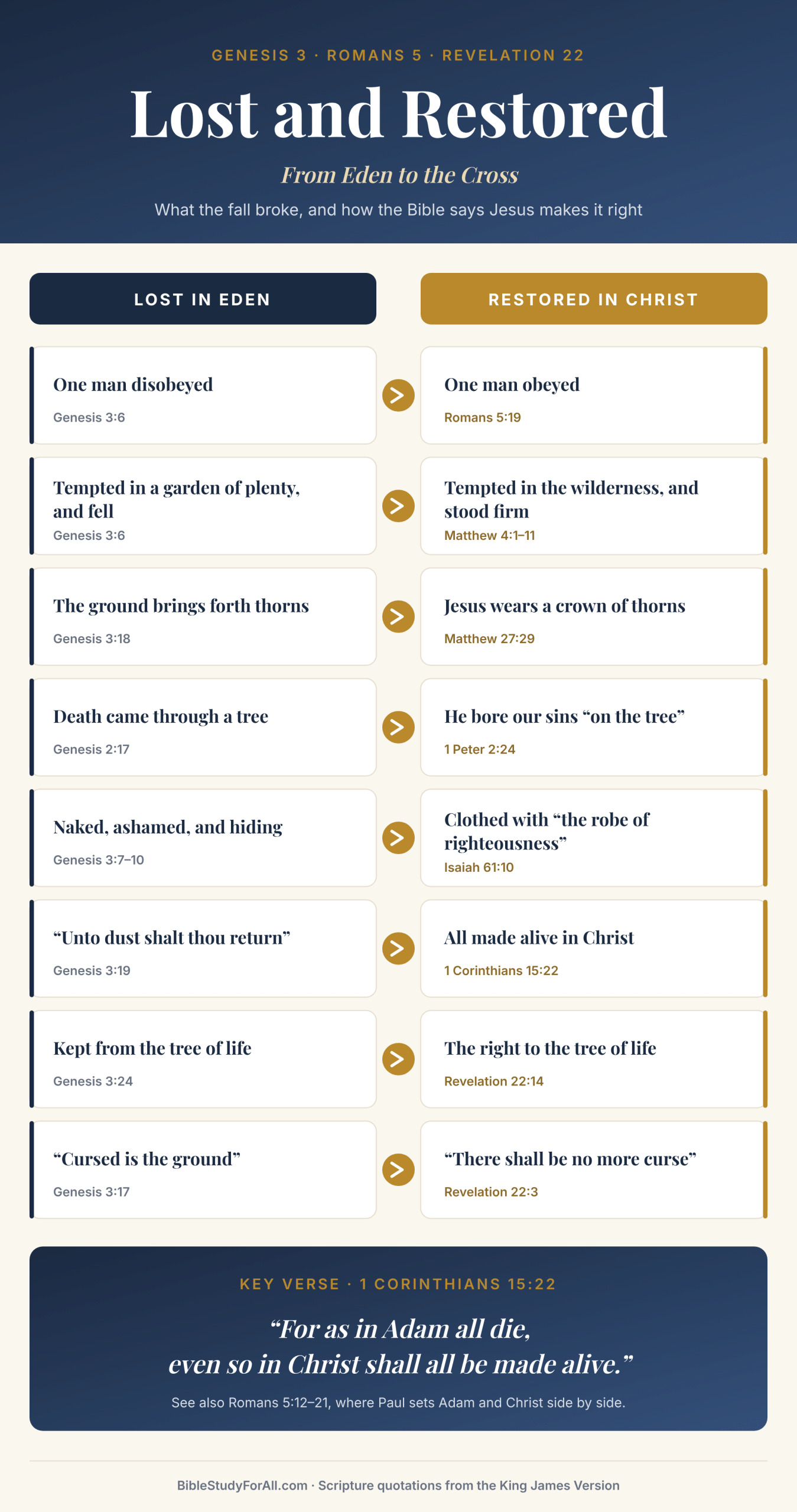
From Eden to the Cross
The fall is not the end of the story. The rest of the Bible traces God’s plan to undo what happened in Eden. The New Testament presents Jesus as a second Adam: where the first Adam disobeyed in a garden of plenty, Jesus obeyed, even in a wilderness and on a cross (Matthew 4:1–11; Philippians 2:8).
Romans 5:12
Sin entered through one man
“Wherefore, as by one man sin entered into the world, and death by sin; and so death passed upon all men, for that all have sinned.”
Romans 5:19
One man’s obedience
“For as by one man’s disobedience many were made sinners, so by the obedience of one shall many be made righteous.”
1 Corinthians 15:22
Made alive in Christ
“For as in Adam all die, even so in Christ shall all be made alive.”
Revelation 22:3
No more curse
“And there shall be no more curse: but the throne of God and of the Lamb shall be in it; and his servants shall serve him.”
What was lost in Eden and what is restored in Christ, side by side.
Summary
Five Things to Remember
1
God’s design was good
Life, work, marriage, and fellowship with God were gifts from the start (Genesis 2).
2
Sin starts with doubting God
The serpent’s first move was to question God’s word and his goodness (Genesis 3:1).
3
Sin breaks everything it touches
Our relationship with God, with others, with ourselves, and with creation (Genesis 3:7–19).
4
God seeks the lost
“Where art thou?” God came looking for Adam, and he still seeks people today (Luke 19:10).
5
Hope came on the same day
The promise of Genesis 3:15 points to Jesus, who crushes the serpent’s head.
Questions
Common Questions from Beginners
Was the forbidden fruit an apple?
The Bible never says what kind of fruit it was. The apple idea came much later, possibly from a Latin wordplay: malum means both “evil” and “apple.” The point of the story is not the fruit but the choice to disobey God.
Who was the serpent?
Genesis 3 simply calls it a serpent that was “more subtil than any beast of the field.” The New Testament identifies it with Satan, “that old serpent, called the Devil” (Revelation 12:9; also Revelation 20:2 and 2 Corinthians 11:3).
Why did God put the tree in the garden at all?
The Bible doesn’t give a full answer, but many Christians point out that love requires a real choice. The tree gave the man and woman a way to trust and obey God freely. Without any choice, obedience would not mean much.
Did Adam and Eve die the day they ate?
They did not die physically that day. Adam lived 930 years (Genesis 5:5). But that day their relationship with God was broken, they were sent away from the tree of life, and death became certain. The Bible calls being cut off from God a kind of death (Ephesians 2:1).
Were Adam and Eve real people?
Yes, they were real people. The New Testament speaks of Adam (Luke 3:38; Romans 5:12–19; 1 Timothy 2:13–14). All agree on its message: people were made good, sinned, and need the rescue God provides.
What is “original sin”?
“Original sin” is the term Christians use for the effect of Adam’s sin on everyone after him. Romans 5:12 says “by one man sin entered into the world, and death by sin.” Churches explain the details differently, but they agree that every person is affected by sin and needs God’s grace (Romans 3:23).
Is there hope after the fall?
Yes. The hope begins in Genesis 3:15 and runs through the whole Bible. Jesus came to undo the damage of the fall: “For as in Adam all die, even so in Christ shall all be made alive” (1 Corinthians 15:22). The Bible ends with the tree of life restored and “no more curse” (Revelation 22:2–3).
Keep Reading
Continue Your Study
Read Genesis 2 and 3 again on your own and write down one thing that stands out to you in each step. Then follow the story into the next chapter of the Bible’s big picture.
Scripture quotations are from the King James Version (KJV), which is in the public domain. Verse links open at BibleGateway.