
Old Testament · Major Prophets · Book 23 of 66
Book of Isaiah
The prophet who saw the Lord “high and lifted up” calls Judah to turn from sin, foretells a virgin-born King and a suffering Servant, and comforts God’s people with the promise of new heavens and a new earth. “Comfort ye, comfort ye My people, saith your God” (40:1).
Isaiah at a Glance
Book Outline
Note: Scripture quotations and verse links on this site use the King James Version (KJV) because it is in the public domain, while most modern translations limit how much can be quoted online. Feel free to read along in the translation of your choice.
66 Chapters
1,292 verses
Author
Isaiah the son of Amoz
Ministry
c. 740–681 B.C.
Key Title
“The Holy One of Israel”
About the Name
Title
Named for the prophet Isaiah, whose name means “the LORD is salvation.” It is the first of the Major Prophets and the Old Testament book most often quoted in the New.
The book is named for its author, Isaiah (Hebrew Yesha’yahu), whose name means “the LORD is salvation,” the great message of his book. In the New Testament he is called Esaias in the King James Version, the Greek form of his name (Matthew 3:3; Luke 4:17).
Isaiah is the first of the five Major Prophets (Isaiah, Jeremiah, Lamentations, Ezekiel and Daniel), “major” because of their length. It is quoted or echoed in the New Testament more than any other prophet. Its 66 chapters fall into two great halves: chapters 1–39, mostly judgment, and chapters 40–66, mostly comfort, beginning “Comfort ye, comfort ye My people.” The name it uses most for God, “the Holy One of Israel,” appears about twenty-five times, in both halves.
Who Wrote It
Author Details
Written by Isaiah the son of Amoz (1:1). The New Testament quotes both halves of the book as his words, and John says Isaiah “saw His glory, and spake of Him” (John 12:41).
The book opens, “The vision of Isaiah the son of Amoz, which he saw concerning Judah and Jerusalem in the days of Uzziah, Jotham, Ahaz, and Hezekiah, kings of Judah” (1:1). Isaiah lived in Jerusalem, was married to “the prophetess” and had two sons whose names were signs (7:3; 8:3, 18). He had ready access to the kings, counselling Ahaz (7) and Hezekiah (37–39), and he wrote other records of the kings as well (2 Chronicles 26:22; 32:32).
The New Testament names Isaiah as the writer of the whole book. John quotes chapter 53 and chapter 6 side by side as the words of “Esaias the prophet,” and adds, “These things said Esaias, when he saw His glory, and spake of Him” (John 12:38–41). Jesus read from chapter 61 in “the book of the prophet Esaias” (Luke 4:17), and Paul quotes chapters 10, 53 and 65 as Isaiah’s words (Romans 9:27; 10:16, 20). “All scripture is given by inspiration of God” (2 Timothy 3:16), and God foretold through Isaiah even the name of Cyrus (44:28), to show that He alone declares “the end from the beginning” (46:10).
When It Was Written
Date of Writing
Isaiah prophesied for about sixty years, c. 740–681 B.C., from “the year that king Uzziah died” (6:1) into the reign of Manasseh. He wrote the book during those years.
Isaiah’s call came “In the year that king Uzziah died” (6:1), about 740 B.C. He prophesied through the reigns of Jotham, Ahaz and Hezekiah (1:1), and he records the death of the Assyrian king Sennacherib (37:38), which took place in 681 B.C. Jewish tradition says he was put to death under Hezekiah’s son Manasseh (compare Hebrews 11:37, “sawn asunder”).
These were dangerous years. Assyria destroyed the northern kingdom of Israel in 722 B.C. and in 701 B.C. Sennacherib invaded Judah and threatened Jerusalem, until “the angel of the LORD went forth, and smote in the camp of the Assyrians” (37:36). Isaiah also foretold that Judah would be carried to Babylon (39:6), which took place in 586 B.C., and that God would bring His people home through Cyrus, who decreed the return in 538 B.C. (44:28; Ezra 1:1–3).
Key Verse
Wounded for Our Transgressions
“But He was wounded for our transgressions, He was bruised for our iniquities: the chastisement of our peace was upon Him; and with His stripes we are healed.”
Isaiah 53:5 (KJV)
Big Ideas
Key Themes
The Holy One of Israel
God is holy, high and lifted up.
1:4; 6:3; 57:15
Judgment on Sin
Judah and the nations are judged for pride and idolatry.
1:2–4; 5; 13–23
Salvation
Isaiah’s name and message: the LORD is salvation.
12:2; 45:22; 52:10
The Messiah
Virgin-born King, Branch of Jesse, Suffering Servant.
7:14; 9:6–7; 11:1; 53
Trust the LORD
Not Egypt or Assyria, but the LORD alone.
26:3–4; 30:15; 31:1
The Only God
Idols are nothing; beside Him there is no God.
44:6–20; 45:5; 46:9
Comfort
God comforts and restores His people.
40:1–2; 49:13; 66:13
A Remnant
A faithful remnant shall return.
10:20–22; 37:31–32
New Creation
New heavens and a new earth, and joy for ever.
65:17–25; 66:22
Overview
Isaiah Summary
OverviewThe Holy One of Israel
Isaiah is the prophet of God’s holiness and God’s salvation. In about sixty years of ministry in Jerusalem he warned Judah that their sin would bring judgment, called them to trust the LORD rather than Assyria or Egypt, and foretold the coming of the Messiah more fully than any other prophet: His virgin birth, His reign on David’s throne, His suffering for our sins, and His glorious kingdom. The book falls into two great halves. Chapters 1–39 are mostly judgment, with bright promises of the King; chapters 40–66 are mostly comfort, with the Servant of the LORD and new heavens and a new earth. Through it all God is “the Holy One of Israel.”
Chapters 1–5Judah’s Sin and God’s Invitation
Isaiah begins like a court case: “Hear, O heavens, and give ear, O earth … I have nourished and brought up children, and they have rebelled against Me” (1:2). Judah offers sacrifices but lives in sin, yet God invites them: “Come now, and let us reason together, saith the LORD: though your sins be as scarlet, they shall be as white as snow” (1:18). In the last days the nations will come to the mountain of the LORD, and “they shall beat their swords into plowshares” (2:4). The song of the vineyard (5) shows God’s care for Israel and the wild grapes it bore, and six woes follow, including “Woe unto them that call evil good, and good evil” (5:20).
Chapter 6Isaiah Sees the Lord
“In the year that king Uzziah died I saw also the Lord sitting upon a throne, high and lifted up, and His train filled the temple” (6:1). The seraphims cry, “Holy, holy, holy, is the LORD of hosts: the whole earth is full of His glory” (6:3). Isaiah cries, “Woe is me! for I am undone; because I am a man of unclean lips” (6:5). A seraph touches his mouth with a live coal from the altar, and his iniquity is taken away. Then the Lord asks, “Whom shall I send, and who will go for us?” and Isaiah answers, “Here am I; send me” (6:8). John tells us that Isaiah here saw the glory of Christ (John 12:41).
Chapters 7–12Immanuel and the Coming King
When King Ahaz fears the kings of Syria and Israel, Isaiah calls him to trust God, and the Lord gives a sign: “Behold, a virgin shall conceive, and bear a son, and shall call His name Immanuel” (7:14), “God with us” (Matthew 1:23). The promise grows: “For unto us a child is born, unto us a son is given: and the government shall be upon His shoulder: and His name shall be called Wonderful, Counsellor, The mighty God, The everlasting Father, The Prince of Peace” (9:6). Assyria is God’s rod to punish Israel, but it too will be judged (10). Then “there shall come forth a rod out of the stem of Jesse, and a Branch shall grow out of his roots” (11:1), on whom the Spirit of the LORD rests, and “the earth shall be full of the knowledge of the LORD, as the waters cover the sea” (11:9). Chapter 12 is a song: “God is my salvation; I will trust, and not be afraid” (12:2).
Chapters 13–27The Nations and the Whole Earth
Isaiah carries God’s “burdens” to the nations around Judah: Babylon, Assyria, Philistia, Moab, Damascus, Ethiopia, Egypt, Edom, Arabia and Tyre (13–23). The LORD rules them all, and proud Babylon will fall: “How art thou fallen from heaven, O Lucifer, son of the morning!” (14:12). Even Egypt and Assyria will one day worship with Israel (19:23–25). Chapters 24–27 look to the end, when the LORD judges the whole earth and reigns in mount Zion. He will make a feast for all people and “swallow up death in victory; and the Lord GOD will wipe away tears from off all faces” (25:8; 1 Corinthians 15:54). His people sing, “Thou wilt keep him in perfect peace, whose mind is stayed on Thee: because he trusteth in Thee” (26:3).
Chapters 28–35Woes and the King in His Beauty
Six woes warn the leaders of Ephraim and Jerusalem, who scorn God’s word and look to Egypt for help instead of to the LORD (28–33). “In returning and rest shall ye be saved; in quietness and in confidence shall be your strength: and ye would not” (30:15). Yet God lays in Zion “a precious corner stone, a sure foundation: he that believeth shall not make haste” (28:16; 1 Peter 2:6). “Behold, a King shall reign in righteousness” (32:1), and “Thine eyes shall see the King in His beauty” (33:17). Chapter 34 tells of judgment on the nations, and chapter 35 of the joy of the redeemed: “Then the eyes of the blind shall be opened, and the ears of the deaf shall be unstopped” (35:5), and “the ransomed of the LORD shall return, and come to Zion with songs” (35:10).
Chapters 36–39King Hezekiah and the Assyrians
These chapters tell history. In 701 B.C. the Assyrian king Sennacherib takes the fenced cities of Judah, and his officer Rabshakeh mocks the LORD before Jerusalem’s walls (36). Hezekiah spreads the threatening letter before the LORD and prays: “O LORD of hosts, God of Israel, that dwellest between the cherubims, Thou art the God, even Thou alone, of all the kingdoms of the earth” (37:16). God answers through Isaiah, and that night the angel of the LORD smites 185,000 in the Assyrian camp (37:36). When Hezekiah is sick unto death, God hears his prayer and adds fifteen years to his life, with the sign of the shadow going back ten degrees (38). But when Hezekiah shows his treasures to envoys from Babylon, Isaiah foretells that all will “be carried to Babylon” (39:6), which leads into the comfort of chapters 40–66.
Chapters 40–48Comfort Ye My People
The second half opens with comfort: “Comfort ye, comfort ye My people, saith your God” (40:1). A voice cries, “Prepare ye the way of the LORD” (40:3), words fulfilled in John the Baptist (Matthew 3:3). “The grass withereth, the flower fadeth: but the word of our God shall stand for ever” (40:8). The Creator who never faints gives strength to the weary: “they that wait upon the LORD shall renew their strength; they shall mount up with wings as eagles” (40:31). Idols are mocked as wood that cannot save, while the LORD says, “I am the first, and I am the last; and beside Me there is no God” (44:6). He names Cyrus, more than a century before he was born, as the shepherd who will say to Jerusalem, “Thou shalt be built” (44:28), and He calls, “Look unto Me, and be ye saved, all the ends of the earth” (45:22).
Chapters 49–66The Suffering Servant and the New Creation
The Servant of the LORD will be “a light to the Gentiles” (49:6). He gives His back to the smiters (50:6), and in the fourth Servant Song (52:13–53:12) He suffers for His people: “He is despised and rejected of men; a man of sorrows, and acquainted with grief” (53:3). “But He was wounded for our transgressions, He was bruised for our iniquities: the chastisement of our peace was upon Him; and with His stripes we are healed” (53:5). The New Testament applies this chapter to Jesus (Acts 8:32–35; 1 Peter 2:24). Then comes the great invitation, “Ho, every one that thirsteth, come ye to the waters” (55:1). The Anointed One proclaims “good tidings unto the meek” (61:1), words Jesus read in Nazareth and said were fulfilled (Luke 4:18–21). The book ends with God’s promise: “For, behold, I create new heavens and a new earth” (65:17; Revelation 21:1).
At a Glance
Isaiah at a Glance
The whole book in short sections: its four parts, the kings of Isaiah’s day, Isaiah’s vision, the promises of the coming King, a map of the nations, the burdens of the nations, Hezekiah and Sennacherib, comfort and the one true God, the four Servant Songs, Isaiah 53, and Isaiah in the New Testament. Tap a topic to jump to it.
Printable Copy
Save or Print the Infographic
Everything in this section, with the key verse and key themes, is also on a printable infographic (six pages). It opens in a new tab, where you can save it to your phone or computer, share it, or print it.
Structure
The Book in Four Parts
Isaiah has two great halves. Chapters 1–39 are mostly judgment, with promises of the coming King; chapters 40–66 are mostly comfort, with the Servant of the LORD and the new creation.
Each bar shows that part’s share of the 1,292 verses.
I 1–12 · 252 verses
Judgment and Promise for Judah
Sin exposed, Isaiah’s call, Immanuel, and the Branch of Jesse.
II 13–27 · 258 verses
The Nations and the Whole Earth
Burdens on the nations, then judgment and joy for all the earth.
III 28–39 · 256 verses
Woes, Trust and Hezekiah
Six woes, the King in His beauty, and the Assyrian crisis.
IV 40–66 · 526 verses
Comfort and the New Creation
Comfort, the one true God, the Suffering Servant, and new heavens and earth.
Isaiah 1:1
The Kings of Isaiah’s Day
Isaiah prophesied “in the days of Uzziah, Jotham, Ahaz, and Hezekiah, kings of Judah” (1:1). Dates B.C. are approximate.
c. 740 B.C.
Uzziah Dies
Isaiah sees the Lord (6:1)
c. 735 B.C.
Ahaz
Immanuel promised (7:14)
722 B.C.
Samaria Falls
Assyria takes Israel captive (2 Kings 17:6)
c. 715 B.C.
Hezekiah
A king who trusted the LORD
701 B.C.
Sennacherib
Jerusalem saved (37:36)
c. 701 B.C.
Fifteen Years
Hezekiah healed (38:5)
681 B.C.
Sennacherib Dies
Slain by his sons (37:38)
Foretold
Babylon and Cyrus
Exile (39:6) and return (44:28)
Isaiah 6
Isaiah Sees the Lord
Isaiah’s call shows what every true servant of God needs: a sight of God, a sight of self, cleansing, and a willing heart.
“Holy, holy, holy, is the LORD of hosts: the whole earth is full of His glory.”Isaiah 6:3 (KJV)
1 6:1–4
The Lord on His Throne
“high and lifted up”
2 6:5
“Woe Is Me!”
“I am a man of unclean lips”
3 6:6–7
Cleansed
A live coal from the altar
4 6:8
Sent
“Here am I; send me.”
“These things said Esaias, when he saw His glory, and spake of Him” (John 12:41): Isaiah saw the glory of Christ.
Isaiah 7–11
Promises of the Coming King
In the dark days of Ahaz, God gives Isaiah some of the clearest promises of the Messiah in the Old Testament.
7:14 · MATTHEW 1:23
Born of a Virgin
“Behold, a virgin shall conceive, and bear a son, and shall call His name Immanuel”
9:1–2 · MATTHEW 4:15–16
Light in Galilee
“The people that walked in darkness have seen a great light”
11:1–2 · ROMANS 15:12
The Branch of Jesse
“And the spirit of the LORD shall rest upon Him”
Isaiah 9:6
Unto Us a Child Is Born
“For unto us a child is born, unto us a son is given: and the government shall be upon His shoulder: and His name shall be called Wonderful, Counsellor, The mighty God, The everlasting Father, The Prince of Peace.”
Isaiah 7–48 · Map
The Nations in Isaiah’s Day
Isaiah spoke to Judah, but also to the nations around it, from Babylon and Assyria to Egypt and Ethiopia. The map shows the nations of his burdens, Sennacherib’s march against Judah, and the way home from Babylon that God promised. The numbers match the cards below.
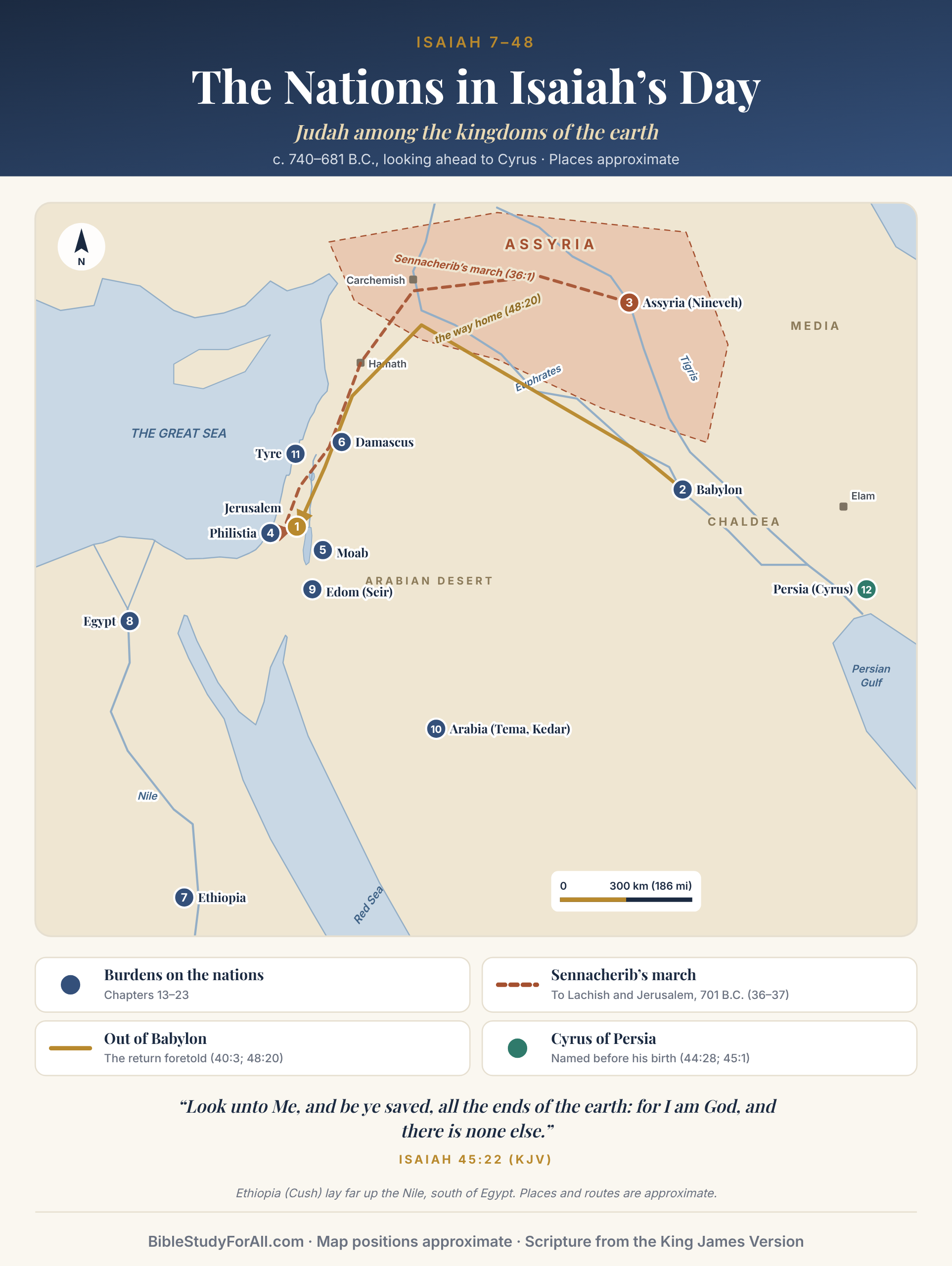
1 1:1; 22; 36–37
Jerusalem
Isaiah’s city, “the valley of vision”; delivered when the angel of the LORD smote the Assyrian camp.
2 13–14; 21:1–10; 39; 47
Babylon
“Babylon is fallen, is fallen” (21:9); Hezekiah shows his treasures to her envoys.
3 10:5–19; 14:24–27; 37:37
Assyria (Nineveh)
“O Assyrian, the rod of Mine anger”; Sennacherib returns home to Nineveh.
4 14:28–32; 20:1
Philistia
A burden in the year that king Ahaz died; Ashdod taken by the Assyrians.
5 15–16
Moab
“My heart shall cry out for Moab.”
6 7:1–9; 17
Damascus
Syria and Israel plot against Judah; “Damascus is taken away from being a city.”
7 18; 20:3–6; 37:9
Ethiopia
The land “beyond the rivers of Ethiopia”; Tirhakah king of Ethiopia comes out to fight.
8 19–20; 30:1–7; 31:1
Egypt
“Woe to them that go down to Egypt for help”; yet “Blessed be Egypt My people” (19:25).
9 21:11–12; 34; 63:1
Edom (Seir)
“Watchman, what of the night?”; “Who is this that cometh from Edom?”
10 21:13–17
Arabia (Tema, Kedar)
A burden upon Arabia: the travelling companies of Dedanim and the glory of Kedar.
11 23
Tyre
“Howl, ye ships of Tarshish”; the proud merchant city laid waste.
12 44:28; 45:1–4
Persia (Cyrus)
God names Cyrus, “My shepherd,” to set the captives free and say to Jerusalem, “Thou shalt be built.”
Isaiah 13–27
Burdens on the Nations
God rules over every nation. Isaiah carries His “burden” (a heavy message of judgment) to Judah’s neighbours.
13:1–14:23
Babylon
14:24–27
Assyria
14:28–32
Philistia
15–16
Moab
17
Damascus
18; 20
Ethiopia
19–20
Egypt
21:1–10
Babylon Again
21:11–12
Dumah (Edom)
21:13–17
Arabia
22
Jerusalem, the Valley of Vision
23
Tyre
Chapters 24–27 widen to the whole earth: judgment, then a feast for all people on mount Zion, where the LORD “will swallow up death in victory” (25:8).
Isaiah 36–39
Hezekiah and the Assyrians
The only long stretch of history in the book shows what happens when a king turns to the LORD in trouble.
1 36
Rabshakeh’s Taunts
The Assyrian officer mocks Hezekiah’s trust in the LORD before the walls of Jerusalem.
2 37:14–20
Hezekiah’s Prayer
He spreads the letter before the LORD: “Thou art the God, even Thou alone.”
3 37:36–38
The LORD Delivers
The angel of the LORD smites 185,000 Assyrians; Sennacherib goes home.
4 38
Fifteen More Years
“I have heard thy prayer, I have seen thy tears” (38:5); the shadow goes back ten degrees.
5 39
Envoys from Babylon
Hezekiah shows his treasures; Isaiah foretells the Babylonian captivity.
Isaiah 40–48
Comfort Ye My People
To a people facing exile, God shows Himself as the Creator, the only Saviour, and the Lord of history.
40:8
His Word Stands
“The grass withereth, the flower fadeth: but the word of our God shall stand for ever”
40:31
New Strength
“they that wait upon the LORD shall renew their strength”
41:10
Fear Not
“Fear thou not; for I am with thee: be not dismayed; for I am thy God”
43:11
The Only Saviour
“I, even I, am the LORD; and beside Me there is no saviour”
44:9–20
Idols Mocked
A man burns half a tree for fire and makes a god of the other half.
44:28–45:1
Cyrus Named
About 150 years before he decreed the return (Ezra 1:1–3).
“Look unto Me, and be ye saved, all the ends of the earth: for I am God, and there is none else.”Isaiah 45:22 (KJV)
The Servant of the LORD
The Four Servant Songs
Four passages describe the Servant of the LORD, fulfilled in Jesus Christ (Matthew 12:17–21; Acts 8:32–35).
1 42:1–9
God’s Chosen Servant
“Behold My servant, whom I uphold; Mine elect, in whom My soul delighteth”
2 49:1–13
A Light to the Gentiles
“I will also give Thee for a light to the Gentiles”
3 50:4–11
The Obedient Servant
“I gave My back to the smiters, and My cheeks to them that plucked off the hair”
4 52:13–53:12
The Suffering Servant
“Behold, My servant shall deal prudently, He shall be exalted and extolled, and be very high”
Isaiah 52:13–53:12
Isaiah 53: The Suffering Servant
Written about seven hundred years before the cross, this chapter tells why Jesus died.
Isaiah 53:5–6
He Was Wounded for Our Transgressions
“But He was wounded for our transgressions, He was bruised for our iniquities: the chastisement of our peace was upon Him; and with His stripes we are healed. All we like sheep have gone astray; we have turned every one to his own way; and the LORD hath laid on Him the iniquity of us all.”
53:3 · JOHN 1:11
Rejected
“despised and rejected of men; a man of sorrows.”
53:7 · MATTHEW 27:12–14
Silent
“as a sheep before her shearers is dumb, so He openeth not His mouth.”
53:9 · MATTHEW 27:57–60
Buried with the Rich
“and with the rich in His death.”
53:10 · ROMANS 4:25
An Offering for Sin
“He shall prolong His days”: risen again.
53:11 · ROMANS 5:19
Justifies Many
“by His knowledge shall My righteous servant justify many.”
53:12 · LUKE 23:34
Intercedes
“numbered with the transgressors; … and made intercession for the transgressors.”
Fulfilled in Christ
Isaiah in the New Testament
The New Testament quotes Isaiah by name more than twenty times, from both halves of the book.
40:3 · MATTHEW 3:3
The Voice in the Wilderness
John the Baptist prepares the way of the Lord.
61:1–2 · LUKE 4:17–21
Jesus Reads Isaiah
“This day is this scripture fulfilled in your ears.”
53:1; 6:10 · JOHN 12:38–41
Unbelief Foretold
“These things said Esaias, when he saw His glory.”
53:7–8 · ACTS 8:32–35
The Ethiopian Eunuch
Philip “preached unto him Jesus” from Isaiah 53.
28:16 · 1 PETER 2:6
The Corner Stone
“he that believeth on Him shall not be confounded.”
65:17 · REVELATION 21:1
New Heaven and New Earth
“the first heaven and the first earth were passed away.”
Book Outline
Isaiah Outline
Sixty-six chapters in four parts: judgment and promise for Judah (1–12), the burdens of the nations and the whole earth (13–27), woes, trust and King Hezekiah (28–39), and comfort for God’s people, the Servant of the LORD and the new creation (40–66). Tap a part below to jump to it, tap any section to expand it, and tap a verse reference to read it in the King James Version at BibleGateway.
Part II
The Nations and the Whole Earth
13:1–27:13 · Burdens on the nations from Babylon to Tyre, then judgment and deliverance for all the earth
Part III
Woes, Trust and King Hezekiah
28:1–39:8 · Six woes, a King who reigns in righteousness, and the Assyrian crisis
- The LORD will defend Jerusalem · 31:1–9
- The righteous King and the outpoured Spirit · 32:1–20
- Distress and help: “thine eyes shall see the king in His beauty” · 33:1–24
- The LORD’s indignation; Idumea (Edom) laid waste · 34:1–17
- The desert blossoms; the way of holiness · 35:1–10
- Hezekiah shows his treasures; Babylon foretold · 39:1–8
Part IV
Comfort and the New Creation
40:1–66:24 · Comfort for God’s people, the Servant of the LORD, and new heavens and a new earth
- The Spirit poured out on Jacob’s seed · 44:1–8
- The folly of idols · 44:9–20
- “I have blotted out … thy transgressions” · 44:21–23
- Cyrus, the LORD’s shepherd and anointed · 44:24–45:13
- “Look unto Me, and be ye saved, all the ends of the earth” · 45:14–25
- Strangers and eunuchs who hold fast; a house of prayer for all people · 56:1–8
- Blind watchmen and idolatry rebuked · 56:9–57:13
- Peace for the contrite; no peace to the wicked · 57:14–21
- The LORD comes from Edom: the day of vengeance · 63:1–6
- The LORD’s lovingkindnesses remembered · 63:7–14
- A prayer for mercy: “we are the clay, and Thou our potter” · 63:15–64:12
Continue Your Study
Scripture quotations and verse links are from the King James Version (KJV).