
Old Testament · Poetry and Wisdom · Book 22 of 66
Song of Solomon
A love song between a bride and her beloved, full of gardens, vineyards and springtime. It celebrates the gift of love and ends with its strength: “for love is strong as death … Many waters cannot quench love, neither can the floods drown it” (8:6–7).
8 Chapters
117 verses of poetry
Author
Solomon, by tradition (1:1)
Written
c. 965 B.C. (debated)
Key Theme
“Love is strong as death” (8:6)
Overview
Song of Solomon Summary
The Song of Solomon is a love poem. In a series of songs a young woman and her beloved speak to each other and about each other, with her friends, the “daughters of Jerusalem,” joining in. They praise each other’s beauty, long for each other when apart, and rejoice when they are together, in pictures drawn from gardens, vineyards, flocks, spices and the springtime of Israel. The book celebrates love between a man and a woman as a good gift of God, kept for its proper time (2:7) and sealed in faithful marriage (8:6–7). Readers have also long heard in it the love between God and his people, as the prophets describe Israel as the LORD’s bride and the New Testament calls the church the bride of Christ.
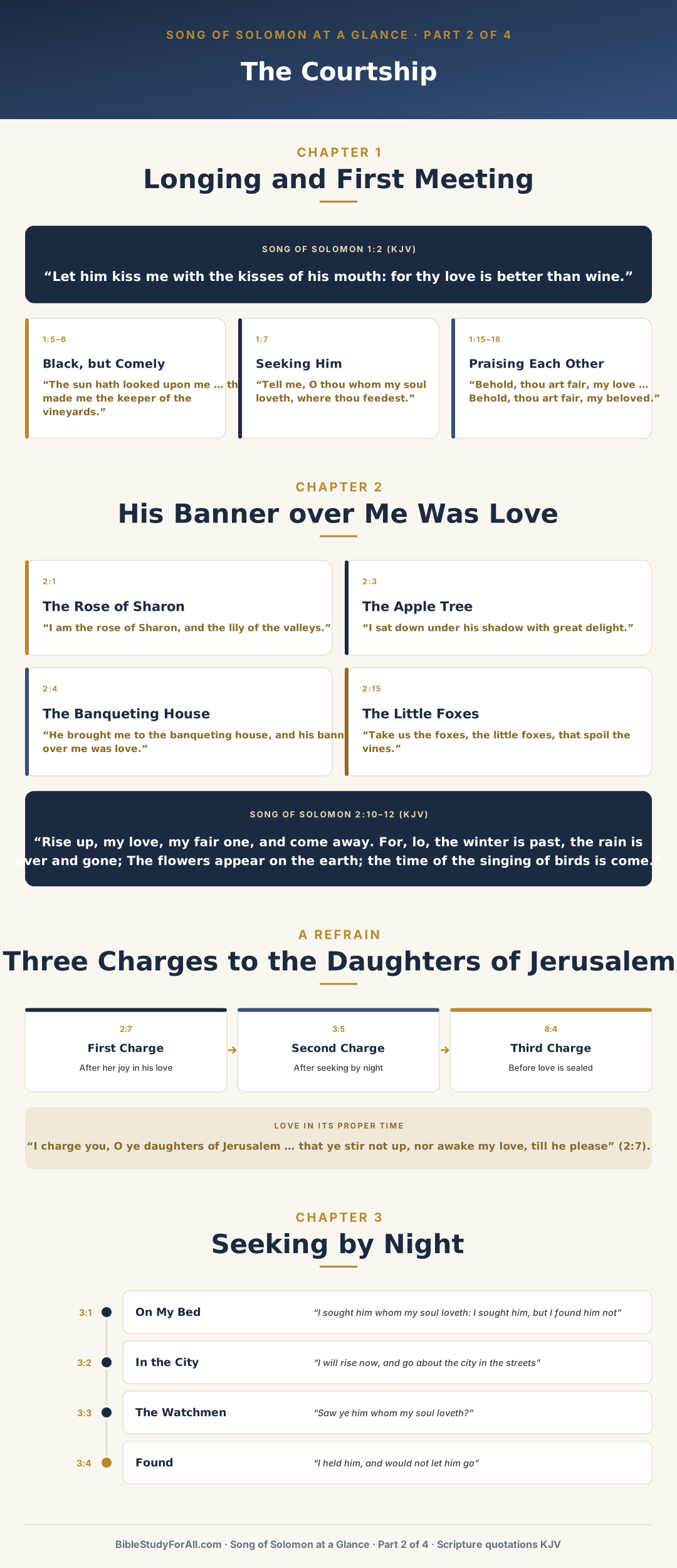
The song opens with the woman’s longing: “Let him kiss me with the kisses of his mouth: for thy love is better than wine” (1:2). She is shy of her sun-darkened skin, since her brothers made her “the keeper of the vineyards” (1:6): “I am black, but comely, O ye daughters of Jerusalem” (1:5). She asks where her shepherd feeds his flock, and the two begin to praise each other: “Behold, thou art fair, my love; behold, thou art fair; thou hast doves’ eyes” (1:15). She answers, “I am the rose of Sharon, and the lily of the valleys” (2:1), and he replies, “As the lily among thorns, so is my love among the daughters” (2:2).
She rejoices in his love: “He brought me to the banqueting house, and his banner over me was love” (2:4). Then comes the first of three charges to her friends: “I charge you, O ye daughters of Jerusalem … that ye stir not up, nor awake my love, till he please” (2:7; 3:5; 8:4), that is, do not awaken love before its time. In spring he comes “leaping upon the mountains” (2:8) and calls her: “Rise up, my love, my fair one, and come away. For, lo, the winter is past, the rain is over and gone; The flowers appear on the earth; the time of the singing of birds is come” (2:10–12). They must guard their love from trouble: “Take us the foxes, the little foxes, that spoil the vines” (2:15). “My beloved is mine, and I am his” (2:16).
At night she longs for him: “By night on my bed I sought him whom my soul loveth: I sought him, but I found him not” (3:1). She goes through the city streets, asks the watchmen, and finds him: “I held him, and would not let him go” (3:4). Then a royal procession comes up from the wilderness: “Who is this that cometh out of the wilderness like pillars of smoke, perfumed with myrrh and frankincense?” (3:6). It is King Solomon’s carriage, guarded by sixty valiant men, and the daughters of Zion are called to “behold king Solomon with the crown wherewith his mother crowned him in the day of his espousals, and in the day of the gladness of his heart” (3:11).
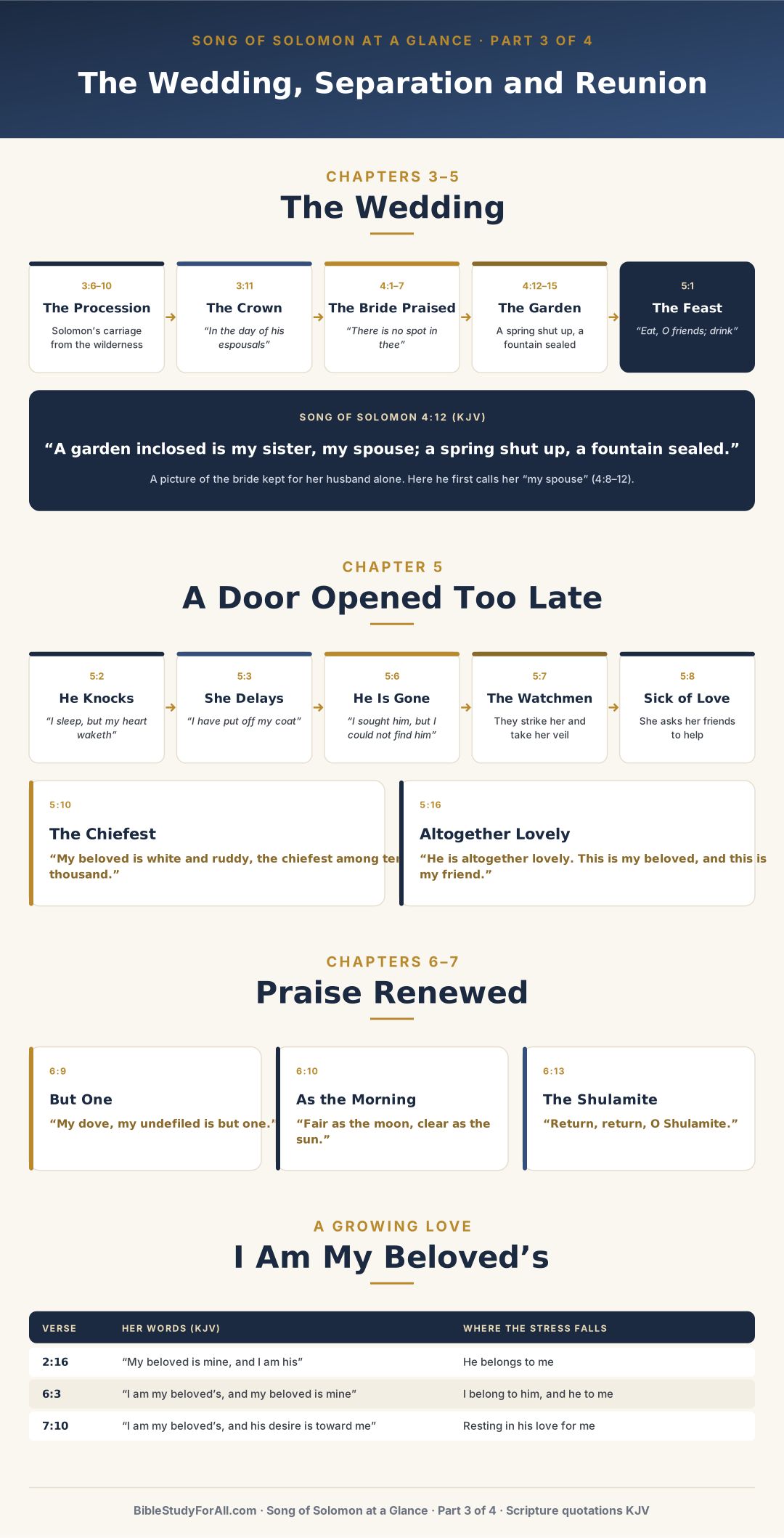
On the wedding day the bridegroom praises his bride from her eyes to her neck, “like the tower of David” (4:4), and says, “Thou art all fair, my love; there is no spot in thee” (4:7). For the first time he calls her “my spouse” (4:8). “Thou hast ravished my heart, my sister, my spouse” (4:9); “how much better is thy love than wine!” (4:10). He pictures her as a garden kept for him alone: “A garden inclosed is my sister, my spouse; a spring shut up, a fountain sealed” (4:12), full of pomegranates, spikenard, saffron and cinnamon. She invites him, “Let my beloved come into his garden, and eat his pleasant fruits” (4:16), and he answers, “I am come into my garden, my sister, my spouse” (5:1). A voice blesses the couple: “eat, O friends; drink, yea, drink abundantly, O beloved” (5:1).
The third section begins with a troubled night: “I sleep, but my heart waketh: it is the voice of my beloved that knocketh, saying, Open to me, my sister, my love, my dove, my undefiled” (5:2). She is slow to rise, and when she opens, “my beloved had withdrawn himself, and was gone” (5:6). She searches the city; the watchmen strike her and take her veil. She begs her friends, “if ye find my beloved, that ye tell him, that I am sick of love” (5:8). When they ask what makes him better than any other, she describes him: “My beloved is white and ruddy, the chiefest among ten thousand” (5:10), his head “as the most fine gold” (5:11). “His mouth is most sweet: yea, he is altogether lovely. This is my beloved, and this is my friend” (5:16).
She knows where he is, in his garden, and her trust returns: “I am my beloved’s, and my beloved is mine” (6:3). He meets her with praise as warm as before: she is “beautiful … as Tirzah, comely as Jerusalem” (6:4); among “threescore queens, and fourscore concubines, and virgins without number” (6:8), “My dove, my undefiled is but one” (6:9). The women ask, “Who is she that looketh forth as the morning, fair as the moon, clear as the sun, and terrible as an army with banners?” (6:10). They call her by name: “Return, return, O Shulamite” (6:13). In chapter 7 he praises her beauty once more: “How fair and how pleasant art thou, O love, for delights!” (7:6).
She answers with a word of settled security: “I am my beloved’s, and his desire is toward me” (7:10). Compared with 2:16 and 6:3, her words have grown from “my beloved is mine” to resting in his love for her. She invites him to the countryside: “Come, my beloved, let us go forth into the field; let us lodge in the villages” (7:11), among the vineyards and pomegranates. She longs to be free to show her love openly (8:1–2), and gives her friends the third charge not to awaken love “until he please” (8:4). Then the friends see the couple coming home together: “Who is this that cometh up from the wilderness, leaning upon her beloved?” (8:5).
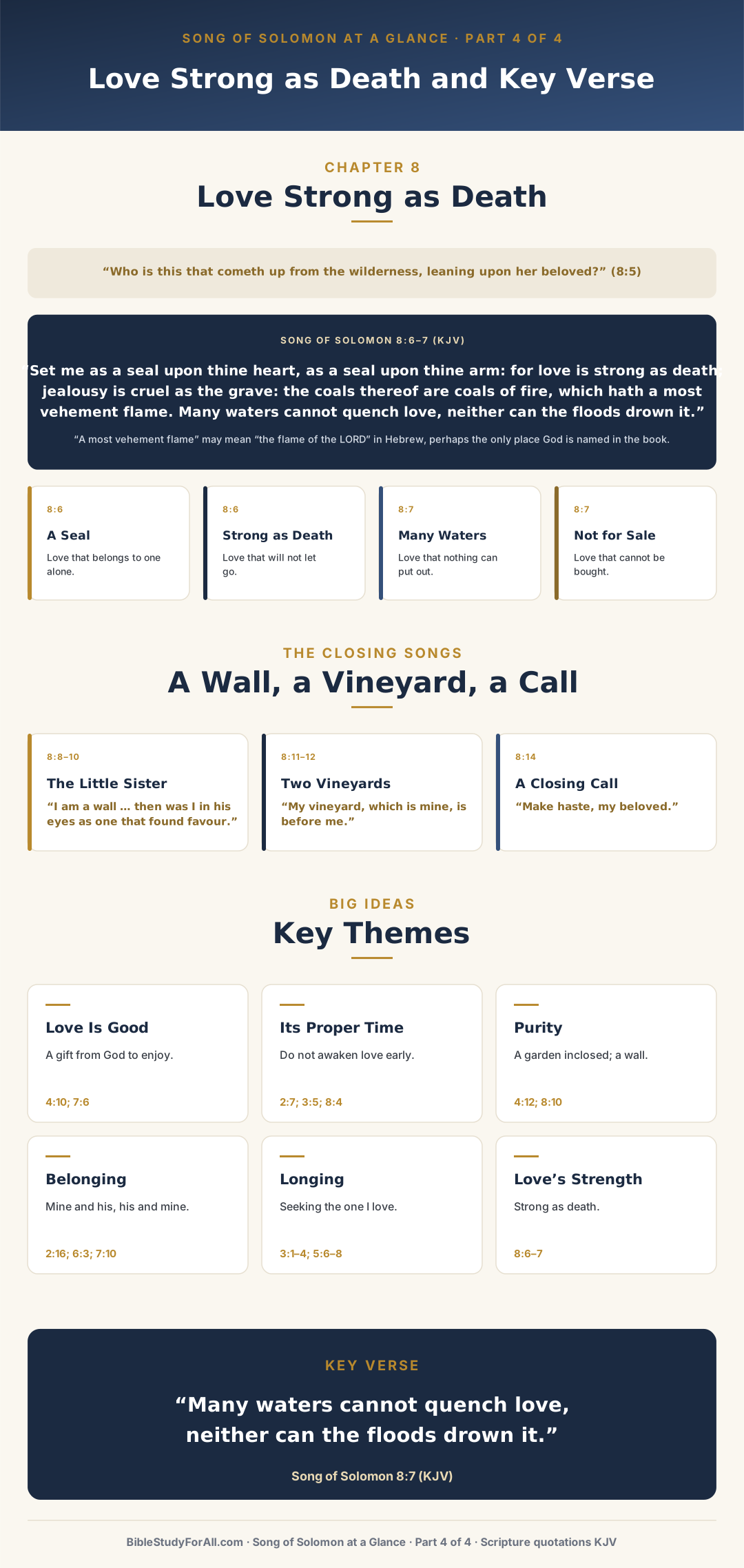
The high point of the book follows: “Set me as a seal upon thine heart, as a seal upon thine arm: for love is strong as death; jealousy is cruel as the grave: the coals thereof are coals of fire, which hath a most vehement flame. Many waters cannot quench love, neither can the floods drown it: if a man would give all the substance of his house for love, it would utterly be contemned” (8:6–7). Her brothers recall their care for their “little sister” (8:8–9), and she answers, “I am a wall” (8:10): she has kept herself pure. Solomon has a great vineyard at Baal-hamon, but she says, “My vineyard, which is mine, is before me” (8:12), given freely in love. The song ends with her call: “Make haste, my beloved, and be thou like to a roe or to a young hart upon the mountains of spices” (8:14). Key themes: the goodness of love as God’s gift (4:10; 7:6); love in its proper time (2:7; 3:5; 8:4); purity and faithfulness (4:12; 8:10); belonging to each other (2:16; 6:3; 7:10); longing and seeking (3:1–4; 5:6–8); and love strong as death (8:6–7). Readers understand the Song in different ways: many read it as a celebration of married love; Jewish tradition long read it as an allegory of the LORD and Israel, and many Christians (Origen, Bernard of Clairvaux, the chapter headings of the 1611 King James Bible) as Christ and his church; others see both, the human love pointing beyond itself. Some read it as a story with two main characters, Solomon and the Shulamite, others with three, a country girl who stays true to her shepherd though Solomon courts her; still others see a collection of love poems. Where each section begins and who speaks each line are also understood differently. This outline simply follows the text.
Infographics
Song of Solomon at a Glance
The whole book in four infographics. Tap a title to jump to it, or scroll down to see all four in order.
Infographic 1 of 4
Background, Readings and Structure
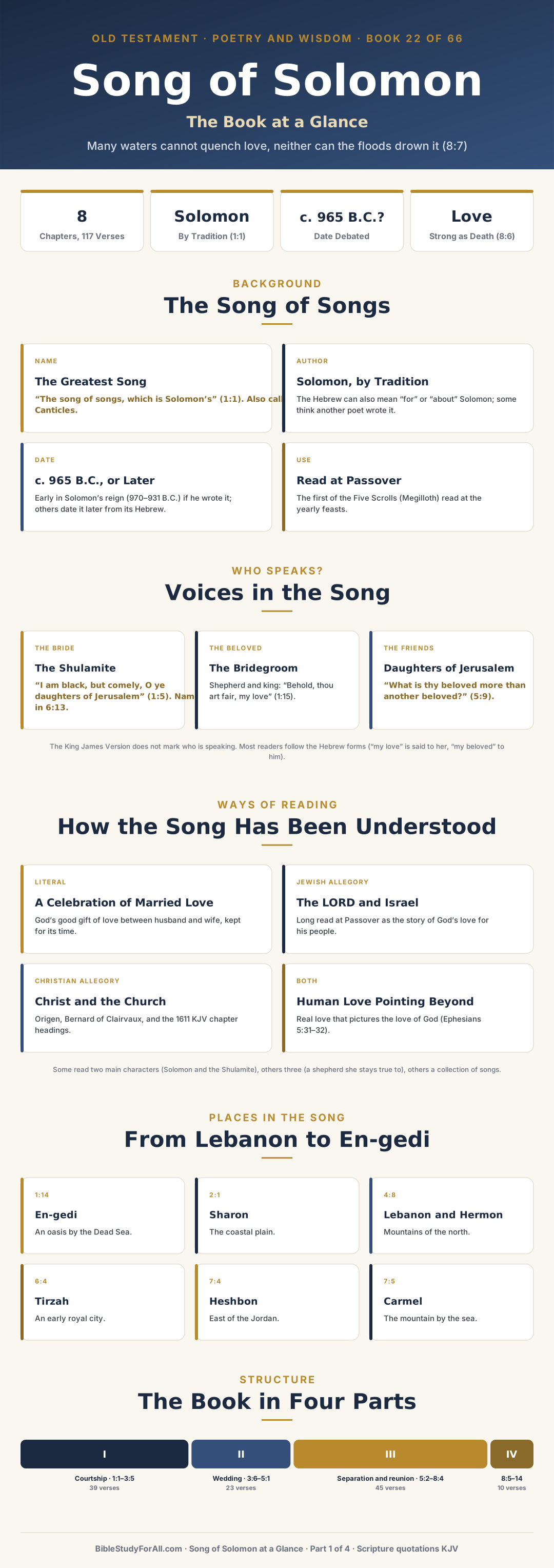
Key facts; the name, author, date and use of the book; who speaks; four ways the Song has been read; and the book in four parts.
Infographic 2 of 4
The Courtship
Longing and first meeting, the rose of Sharon, the three charges to the daughters of Jerusalem, a springtime call, and seeking by night.
Infographic 3 of 4
The Wedding, Separation and Reunion
The royal procession, the bride praised, a garden inclosed, a door opened too late, “he is altogether lovely,” and love renewed.
Infographic 4 of 4
Love Strong as Death, Themes and Key Verse
Set me as a seal upon thine heart, many waters cannot quench love, the little sister, two vineyards, six themes and the key verse.
About the Name
Title
From its first line, “The song of songs, which is Solomon’s” (1:1), meaning the greatest song. Also called the Song of Songs or Canticles. Jews read it at Passover.
The book’s first line gives its title: “The song of songs, which is Solomon’s” (1:1). In Hebrew, “song of songs” (Shir hashirim) means the best or greatest song, as “holy of holies” means the most holy place. English Bibles call it the Song of Solomon or the Song of Songs; older books also call it Canticles, from its Latin name Canticum Canticorum. Solomon “spake three thousand proverbs: and his songs were a thousand and five” (1 Kings 4:32); this one was counted the finest.
In the Hebrew Bible the Song stands in the Writings as the first of the Five Scrolls (Megilloth) read at the yearly feasts: the Song of Solomon at Passover, Ruth at Pentecost, Lamentations on the ninth of Ab, Ecclesiastes at the Feast of Tabernacles, and Esther at Purim. In English Bibles it is the last of the books of poetry and wisdom, after Ecclesiastes and before Isaiah. The name of God appears at most once, in the “most vehement flame” of 8:6, which in Hebrew may mean “the flame of the LORD.”
Who Wrote It
Author Details
The title calls it “Solomon’s,” and tradition names Solomon. The Hebrew can also mean “for” or “about” Solomon, so some think another poet wrote it. This page names both views.
The title says the song is “Solomon’s” (1:1), and Solomon is named seven times (1:1, 5; 3:7, 9, 11; 8:11, 12). Jewish and Christian tradition long held that Solomon wrote it, and the book’s many plants, animals and places, from Lebanon and Hermon to En-gedi, Heshbon and Tirzah, fit a king who “spake of trees … also of beasts, and of fowl” (1 Kings 4:33). The Talmud says that Hezekiah and his company “wrote” the Song, which is usually taken to mean they copied or edited it.
The Hebrew words translated “which is Solomon’s” can mean by Solomon, for Solomon, or about Solomon, so some scholars think another poet wrote it, perhaps in a collection dedicated to him. They point to some late Hebrew forms and the Persian loanword pardes (“orchard,” 4:13). Others answer that these can come from northern dialect or later spelling, and that the book’s mention of Tirzah alongside Jerusalem (6:4) suggests a time before Omri moved Israel’s capital to Samaria. This page names both views.
When It Was Written
Date of Writing
If Solomon wrote it, during his reign (970–931 B.C.), probably about 965 B.C.; others date it later from its Hebrew. This page uses c. 965 B.C. (debated).
If Solomon wrote it, the Song comes from his reign (about 970–931 B.C.), probably early, around 965 B.C., before his many marriages turned his heart away (1 Kings 11:1–4). Those who think it was written later usually place it in the Persian period (about 500–330 B.C.) because of its Hebrew. This page uses c. 965 B.C. (debated).
The book names no first readers. It speaks often to the “daughters of Jerusalem” (1:5; 2:7; 3:5; 5:8, 16; 8:4), the bride’s friends, and warns them three times “that ye stir not up, nor awake my love, till he please” (2:7; 3:5; 8:4). Its setting moves between the countryside of vineyards and flocks and the city and palace of Jerusalem.
Study Guide
Song of Solomon Outline
Eight chapters of poetry in four parts: the courtship (1:1–3:5), the wedding (3:6–5:1), separation and reunion (5:2–8:4), and love strong as death (8:5–14). The King James Version does not mark who is speaking; the outline names the speakers as most readers understand them. Tap a part below to jump to it, tap any section to expand it, and tap a verse reference to read it in the King James Version at BibleGateway.
Part III
Separation and Reunion
5:2–8:4 · A door opened too late, “he is altogether lovely,” praise renewed, and love restored
Part IV
Love Strong as Death
8:5–14 · “Set me as a seal upon thine heart,” the little sister, two vineyards, and a closing call
Continue Your Study
Scripture quotations and verse links are from the King James Version (KJV).