
Old Testament · Poetry and Wisdom · Book 21 of 66
Ecclesiastes
A king who had everything searches for what lasts “under the sun.” The Preacher faces death, injustice and the limits of wisdom honestly, and ends: “Fear God, and keep his commandments: for this is the whole duty of man” (12:13).
12 Chapters
222 verses of wisdom
Author
“The Preacher” (Solomon, by tradition)
Written
c. 935 B.C. (debated)
Key Phrase
“Under the sun”
Overview
Ecclesiastes Summary
Ecclesiastes is the record of a search. “The Preacher, the son of David, king in Jerusalem” (1:1) sets out to find what lasting good a person can gain from life “under the sun,” that is, life as we see it here on earth. His keyword is the Hebrew hebel, “vapour” or “breath,” which the King James Version translates “vanity”; other versions use “meaningless” or “futility.” The book opens and closes with the same cry: “Vanity of vanities, saith the Preacher, vanity of vanities; all is vanity” (1:2; 12:8). With Job and Proverbs it belongs to the Bible’s wisdom books, but where Proverbs gives the general rules of a wise life, Ecclesiastes looks hard at the cases that do not fit them.
The Preacher begins with a question: “What profit hath a man of all his labour which he taketh under the sun?” (1:3). Generations come and go, the sun rises and sets, the wind goes round, and “All the rivers run into the sea; yet the sea is not full” (1:7). Nothing satisfies, and “there is no new thing under the sun” (1:9). He gives his heart to “seek and search out by wisdom concerning all things that are done under heaven” (1:13), but finds that “in much wisdom is much grief: and he that increaseth knowledge increaseth sorrow” (1:18).
Next he tests pleasure, laughter and wine, then great works: houses, vineyards, gardens, orchards and pools, servants, singers, “silver and gold, and the peculiar treasure of kings” (2:8). “Whatsoever mine eyes desired I kept not from them” (2:10), yet looking back he says, “all was vanity and vexation of spirit, and there was no profit under the sun” (2:11). Wisdom is better than folly, “as far as light excelleth darkness” (2:13), but death comes to both: “how dieth the wise man? as the fool” (2:16). Even his labour must be left to someone who may be a fool. Then comes the first of several calls to enjoy life as God’s gift: “There is nothing better for a man, than that he should eat and drink, and that he should make his soul enjoy good in his labour. This also I saw, that it was from the hand of God” (2:24).
Chapter 3 opens with the best-known passage in the book: “To every thing there is a season, and a time to every purpose under the heaven” (3:1), followed by fourteen pairs of times, “a time to be born, and a time to die … a time to weep, and a time to laugh” (3:2–8). God “hath made every thing beautiful in his time: also he hath set the world in their heart” (3:11; many versions read “eternity”), so people long to understand what they cannot fully find out. Whatever God does “shall be for ever … and God doeth it, that men should fear before him” (3:14). The Preacher sees wickedness in the place of judgment and trusts that “God shall judge the righteous and the wicked” (3:17), yet he also sees that man and beast alike die: “all are of the dust, and all turn to dust again” (3:20).
In chapters 4–5 he weeps with the oppressed, who “had no comforter” (4:1), and sees work driven by envy and the lonely man who never stops labouring. Companionship is better: “Two are better than one … and a threefold cord is not quickly broken” (4:9–12). He warns worshippers to come before God humbly: “Keep thy foot when thou goest to the house of God … for God is in heaven, and thou upon earth: therefore let thy words be few” (5:1–2), and to pay what they vow. Riches do not satisfy: “He that loveth silver shall not be satisfied with silver” (5:10), and as a man came naked from the womb, “naked shall he return” (5:15). To enjoy one’s food and work “is the gift of God” (5:19).
Chapters 6–8 ask “who knoweth what is good for man in this life?” (6:12). Some have wealth and honour but no power to enjoy them. A string of “better” sayings follows: “A good name is better than precious ointment” (7:1); it is better to go to the house of mourning than to a feast; “Better is the end of a thing than the beginning thereof” (7:8). “In the day of prosperity be joyful, but in the day of adversity consider” (7:14). “For there is not a just man upon earth, that doeth good, and sinneth not” (7:20); “God hath made man upright; but they have sought out many inventions” (7:29). The Preacher counsels obedience to the king, grieves that “sentence against an evil work is not executed speedily” (8:11), yet holds that “it shall be well with them that fear God” (8:12). Even the wise cannot “find out the work that is done under the sun” (8:17).
Chapters 9–11 face the fact that “there is one event to the righteous, and to the wicked” (9:2), and so urge, “Go thy way, eat thy bread with joy, and drink thy wine with a merry heart; for God now accepteth thy works” (9:7) and “Whatsoever thy hand findeth to do, do it with thy might” (9:10). “The race is not to the swift, nor the battle to the strong … but time and chance happeneth to them all” (9:11). A poor wise man saves a city and is forgotten, yet “Wisdom is better than strength” (9:16). Chapter 10 gathers proverbs about wisdom and folly in daily life. Chapter 11 calls for bold, generous work in an uncertain world: “Cast thy bread upon the waters: for thou shalt find it after many days” (11:1). The young are to rejoice in their youth, “but know thou, that for all these things God will bring thee into judgment” (11:9).
Chapter 12 calls, “Remember now thy Creator in the days of thy youth, while the evil days come not” (12:1). A chain of pictures, often read as the failing body in old age (trembling “keepers of the house,” “grinders” that cease, “windows” darkened, the flowering “almond tree”), leads to death, when “the silver cord be loosed, or the golden bowl be broken” (12:6). “Then shall the dust return to the earth as it was: and the spirit shall return unto God who gave it” (12:7). After a last “Vanity of vanities” (12:8), an epilogue praises the Preacher’s teaching, warns that “of making many books there is no end” (12:12), and gives the conclusion: “Fear God, and keep his commandments: for this is the whole duty of man. For God shall bring every work into judgment, with every secret thing, whether it be good, or whether it be evil” (12:13–14).
Several themes run through Ecclesiastes. Vanity: life apart from God is a vapour that cannot be held (1:2; 12:8). Under the sun: what can be seen from earth does not answer every question (1:3; 8:17). The fear of God: reverence and obedience are the right response (3:14; 5:7; 12:13). Joy as God’s gift: food, work and love are to be received from his hand (2:24; 3:13; 5:18–20; 9:7–10). Wisdom and its limits: wisdom is better than folly but cannot master death or the ways of God (2:13–16; 7:23–24). Judgment: God will judge every deed (3:17; 11:9; 12:14). Readers understand some parts in different ways. Author and date: tradition names Solomon, c. 935 B.C.; many scholars think a later sage wrote in his voice, perhaps 450–250 B.C. “Vanity”: some read hebel as “meaningless,” others as “fleeting” or “beyond our grasp.” The joy passages: some see them as resigned advice for a hard world, others as the book’s real answer. The voices: some think the epilogue (12:9–14) is a second voice framing the Preacher’s words; others read the whole as one message. Life after death: sayings such as “the dead know not any thing” (9:5) and the question of 3:21 are read by some as the limited view “under the sun,” by others as the Preacher’s own uncertainty, before 12:7 and 12:14. Paul echoes the book when he writes that “the creature was made subject to vanity … in hope” (Romans 8:20). This outline simply follows the text.
Infographics
Ecclesiastes at a Glance
The whole book in four infographics. Tap a title to jump to it, or scroll down to see all four in order.
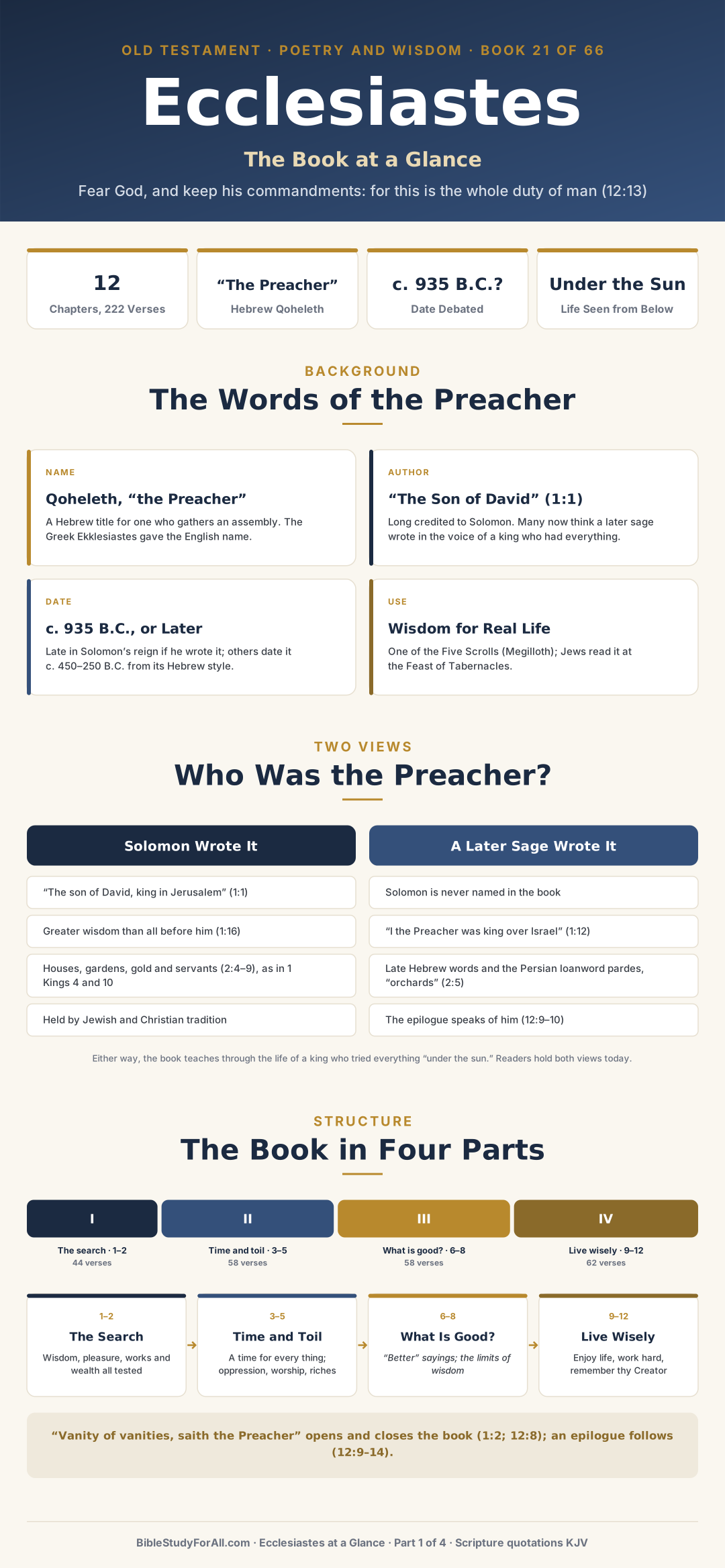
Infographic 1 of 4
Background, Authorship and Structure
Key facts; the name, author, date and use of the book; two views of who the Preacher was; and the book in four parts.
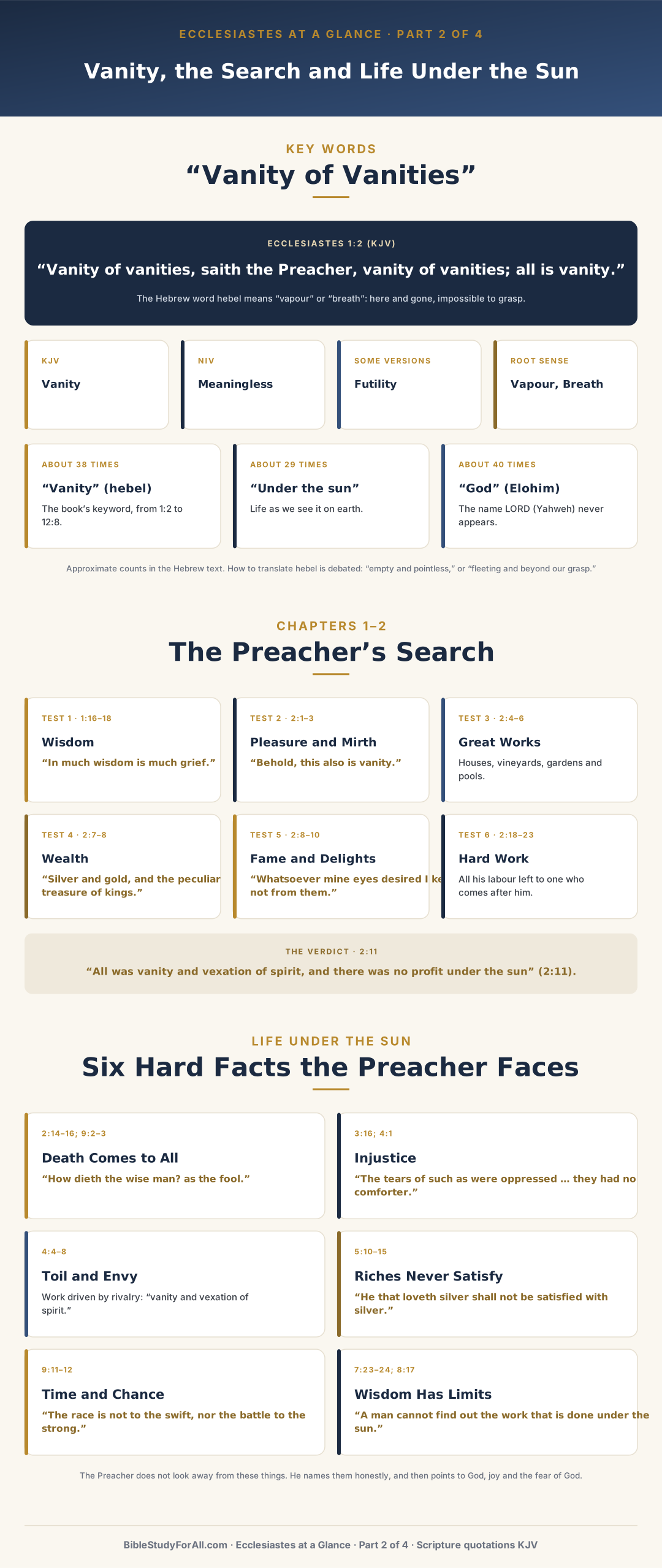
Infographic 2 of 4
Vanity, the Search and Life Under the Sun
The key word “vanity” (Hebrew hebel), the Preacher’s six tests in chapters 1–2, and six hard facts of life under the sun.
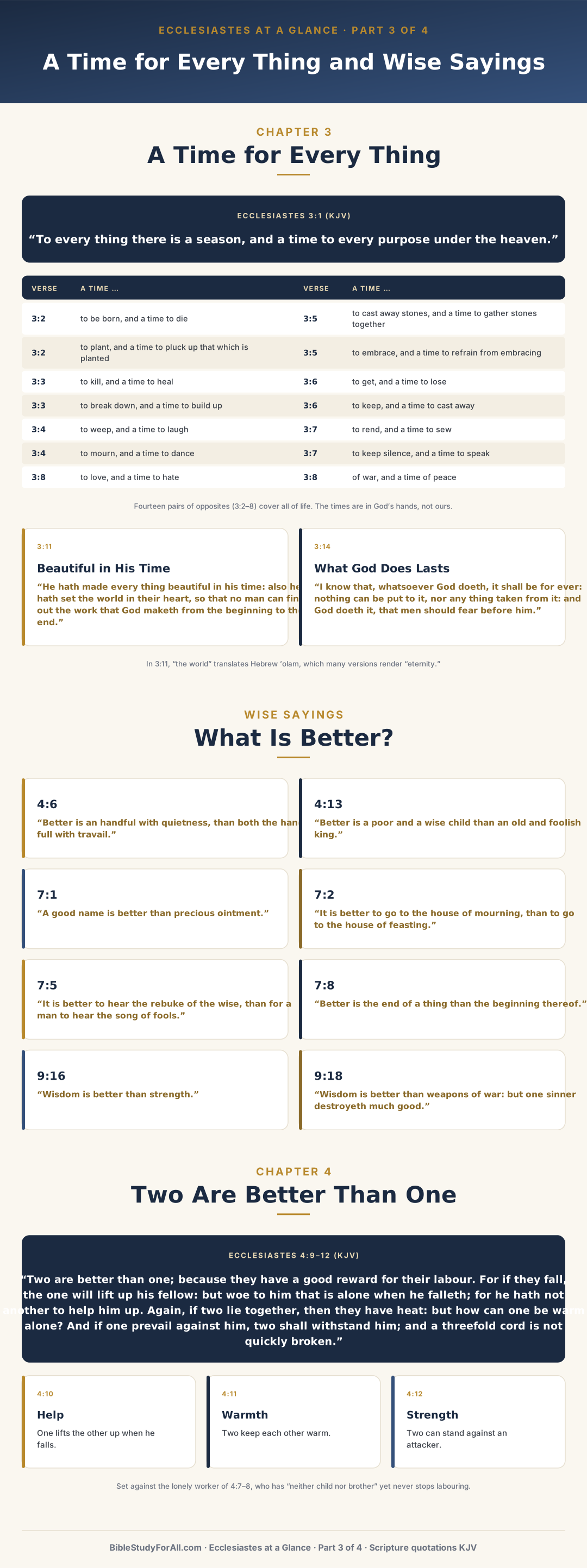
Infographic 3 of 4
A Time for Every Thing and Wise Sayings
The fourteen times of chapter 3, God’s work in 3:11 and 3:14, eight “better” sayings, and two are better than one (4:9–12).
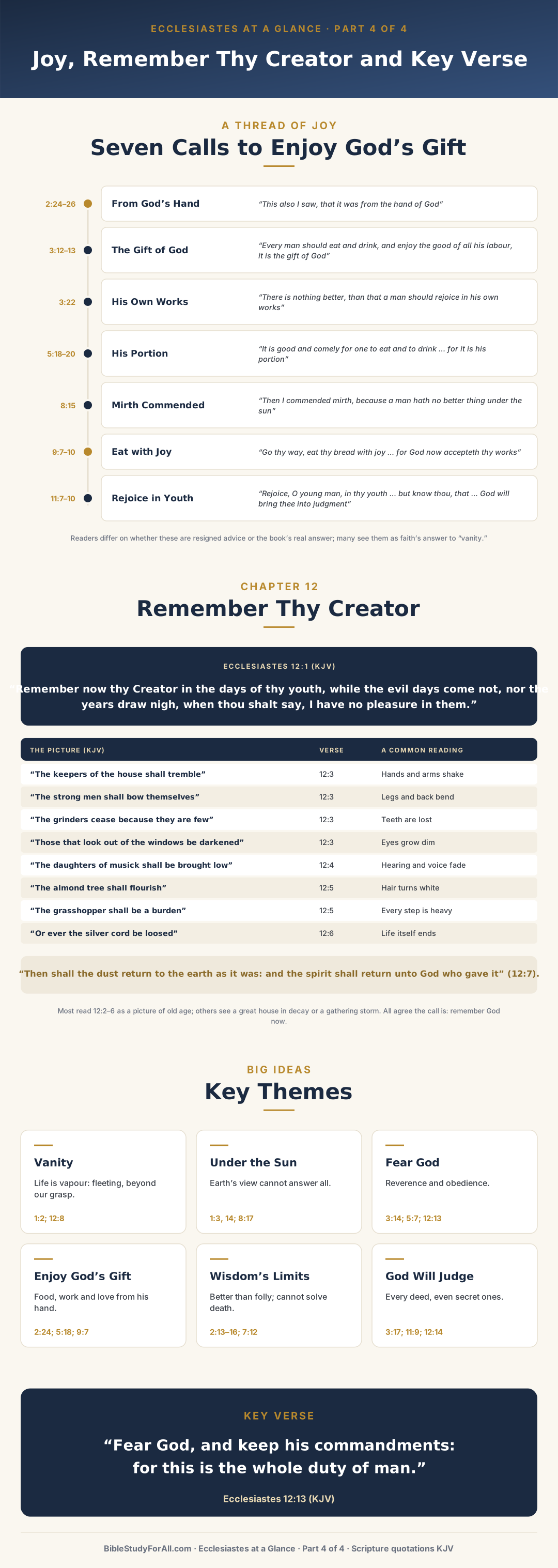
Infographic 4 of 4
Joy, Remember Thy Creator, Themes and Key Verse
Seven calls to enjoy God’s gift, the picture of old age in chapter 12, six themes, and the key verse.
About the Name
Title
The Hebrew title Qoheleth means one who gathers an assembly to teach. The Greek Ekklesiastes gave the English name; the King James Version calls him “the Preacher.”
The Hebrew title is Qoheleth (also spelled Koheleth), the word the writer uses for himself seven times (1:1, 2, 12; 7:27; 12:8, 9, 10). It comes from qahal, “assembly,” and seems to mean one who gathers people together to teach them. The Greek translation (the Septuagint) rendered it Ekklesiastes, “one who belongs to or speaks to an assembly,” from ekklesia, the word later used for the church. The Latin Bible kept the Greek name, and English Bibles followed. The King James Version translates the title “the Preacher”; other versions use “the Teacher” or “the Speaker.”
Who Wrote It
Author Details
The writer is “the son of David, king in Jerusalem” (1:1). Tradition names Solomon; many scholars think a later sage wrote in Solomon’s voice. This page names both views.
The writer calls himself “the Preacher, the son of David, king in Jerusalem” (1:1), says “I the Preacher was king over Israel in Jerusalem” (1:12), and describes great wisdom, building projects, gardens, servants, singers, silver and gold (1:16; 2:4–9), much as 1 Kings 4 and 10 describe Solomon. Jewish and Christian tradition long credited the book to Solomon, some reading it as the lesson of his later years after his turn to other gods (1 Kings 11). The Talmud says that King Hezekiah and his company “wrote” Ecclesiastes along with Proverbs and the Song of Solomon, which is usually taken to mean they copied or edited it (compare Proverbs 25:1).
When It Was Written
Date of Writing
If Solomon wrote it, about 935 B.C., late in his reign; others date it 450–250 B.C. from its Hebrew. This page uses c. 935 B.C. (debated). Written for anyone seeking life’s meaning.
If Solomon wrote it, Ecclesiastes comes from late in his reign (about 970–931 B.C.), around 935 B.C. Those who hold the later view usually place it in the Persian period (about 450–330 B.C.) or the early Greek period (about 300–250 B.C.), mainly because of its Hebrew. Fragments of Ecclesiastes were found among the Dead Sea Scrolls in a copy from about 175–150 B.C., and the book of Sirach (about 190 B.C.) seems to know it, so it was written before then. This page uses c. 935 B.C. (debated).
Study Guide
Ecclesiastes Outline
Twelve chapters in four parts: the Preacher’s search (1–2), time, toil and the fear of God (3–5), what is good for man (6–8), and how to live wisely and remember your Creator (9–12). Tap a part below to jump to it, tap any section to expand it, and tap a verse reference to read it in the King James Version at BibleGateway.
Part I
The Preacher’s Search
1:1–2:26 · The theme, the endless round of nature, and wisdom, pleasure, works and wealth put to the test
Part II
Time, Toil and the Fear of God
3:1–5:20 · A time for every thing, injustice and oppression, two better than one, worship and riches
Part III
What Is Good for Man?
6:1–8:17 · Wealth without joy, “better” sayings, no one righteous, and the limits of wisdom
Part IV
Live Wisely and Remember Your Creator
9:1–12:14 · One event to all, enjoy life, wise sayings, remember thy Creator, and the conclusion
Continue Your Study
Scripture quotations and verse links are from the King James Version (KJV).