
Matthew · Mark · Luke · John · Acts · Bible Study
The 12 Apostles of Jesus
That They Should Be with Him
Jesus chose twelve men to be with Him and to be sent out with His message. Fishermen, a tax collector, a zealot, a doubter and a traitor, the 12 apostles walked with Jesus for about three years, saw Him risen from the dead, and carried the gospel to the world.
About the Apostles
The Apostles at a Glance
Bible Study
Note: Scripture quotations and verse links on this site use the King James Version (KJV) because it is in the public domain, while most modern translations limit how much can be quoted online. Feel free to read along in the translation of your choice.
12 Apostles
Chosen after a night of prayer (Luke 6:12–13)
4 Lists
Matthew, Mark, Luke and Acts
3 Closest
Peter, James and John
1 Replacement
Matthias, chosen by lot (Acts 1:26)
About the Apostles
Who Were the Apostles?
What an Apostle Is
Ones Who Are Sent
The word apostle means one who is sent. Jesus had many disciples, but He chose twelve of them, “whom also He named apostles,” to be with Him and to be sent out with His authority.
Mark gives two reasons for the choice: “that they should be with Him, and that He might send them forth to preach” (Mark 3:14). First they lived with Jesus, heard His teaching and watched His miracles. Then they were sent out in His name.
An apostle in this first sense had to be an eyewitness of the risen Jesus, one who had been with Him “Beginning from the baptism of John” (Acts 1:22). So every apostle was a disciple, but not every disciple was one of the Twelve.
Why Twelve
Twelve, for a Reason
Israel had twelve tribes. By choosing twelve, Jesus showed that He was gathering and renewing God’s people. He promised that the Twelve would sit on twelve thrones, judging the twelve tribes of Israel.
Before choosing them Jesus went up a mountain “and continued all night in prayer to God” (Luke 6:12). He told them, “ye also shall sit upon twelve thrones, judging the twelve tribes of Israel” (Matthew 19:28). That is why the eleven filled Judas’ place before Pentecost (Acts 1:15–26).
In John’s vision the New Jerusalem has twelve gates named for the tribes of Israel and “twelve foundations, and in them the names of the twelve apostles of the Lamb” (Revelation 21:14).
Why It Matters
From Fishermen to Foundations
Jesus chose ordinary, flawed men on purpose, taught them patiently, restored them when they failed, and built His church on their witness. The church still stands on what they saw and taught.
When the council saw the boldness of Peter and John, “they marvelled; and they took knowledge of them, that they had been with Jesus” (Acts 4:13). Their courage came from time with Jesus, not from training. Their message was never about themselves: “we cannot but speak the things which we have seen and heard” (Acts 4:20).
The church is “built upon the foundation of the apostles and prophets, Jesus Christ Himself being the chief corner stone” (Ephesians 2:20). Matthew and John wrote Gospels, Peter wrote two letters, and John wrote three letters and Revelation.
Key Verse
Chosen to Be with Him
“And He ordained twelve, that they should be with Him, and that He might send them forth to preach.”
Mark 3:14 (KJV)
Key Themes
Six Themes of the Apostles
These six truths run through the whole story of the Twelve.
1
Jesus Chooses Ordinary People
Working men, known for having been with Jesus.
“they took knowledge of them, that they had been with Jesus.”
ACTS 4:13
2
Following Comes First
Chosen first to be with Him, then sent.
“that they should be with Him”
MARK 3:14
3
Greatness Means Serving
The first must be servant of all.
“If any man desire to be first, the same shall be last of all, and servant of all.”
MARK 9:35
4
Failure Is Not the End
All fled; the risen Jesus restored them.
“Feed My sheep.”
JOHN 21:17
5
Witnesses of the Resurrection
Their message rested on what they had seen.
“For we cannot but speak the things which we have seen and heard.”
ACTS 4:20
6
Sent to the Whole World
From Jerusalem to the ends of the earth.
“Go ye therefore, and teach all nations”
MATTHEW 28:19
From the First Call to the Church
What the Bible Says About the 12 Apostles
John 1:35–51The First Followers
Near the Jordan, John the Baptist pointed to Jesus: “Behold the Lamb of God!” Two of his disciples followed Jesus. One was Andrew, who at once found his brother Simon: “We have found the Messias” (John 1:41). Jesus named Simon Cephas, “A stone.” The next day Jesus found Philip and said, “Follow Me,” and Philip brought Nathanael with three simple words: “Come and see” (John 1:46). Each one who met Jesus brought another.
Matthew 4:18–22 · 9:9–13Called from Nets and Tables
By the Sea of Galilee Jesus called Simon and Andrew, then James and John: “Follow Me, and I will make you fishers of men” (Matthew 4:19). They left their nets, their boat and their father. After a great catch of fish Peter fell at His knees: “Depart from me; for I am a sinful man, O Lord” (Luke 5:8). Then Jesus called Matthew, a tax collector for Rome: “Follow Me. And he arose, and followed Him” (Matthew 9:9).
Luke 6:12–16 · Mark 3:13–19Chosen as the Twelve
Jesus prayed all night on a mountain, and “when it was day, He called unto Him His disciples: and of them He chose twelve, whom also He named apostles” (Luke 6:13). They were an unlikely mix: four fishermen, a tax collector who had worked for Rome, a zealot who may have wanted Rome driven out, a doubter and a betrayer. Jesus chose them all on purpose, “that they should be with Him, and that He might send them forth to preach” (Mark 3:14).
Matthew 10 · Mark 6:7–13Sent Out Two by Two
Jesus gave the Twelve “power against unclean spirits, to cast them out, and to heal all manner of sickness” (Matthew 10:1) and sent them out in pairs to the towns of Israel. “And as ye go, preach, saying, The kingdom of heaven is at hand” (Matthew 10:7). They were to travel light and trust God to provide. Jesus was honest about the danger: “Behold, I send you forth as sheep in the midst of wolves” (Matthew 10:16).
Matthew 16:13–28Learning Who Jesus Is
The apostles watched Jesus calm the storm, feed five thousand and walk on the water. Near Caesarea Philippi He asked, “But whom say ye that I am?” Peter answered, “Thou art the Christ, the Son of the living God” (Matthew 16:15–16). When others left, Peter spoke for the Twelve: “Lord, to whom shall we go? Thou hast the words of eternal life” (John 6:68). Yet they were slow learners, arguing about who was greatest, and Jesus kept teaching them.
John 13 · Matthew 26The Last Night
On the night before He died Jesus washed the apostles’ feet: “If I then, your Lord and Master, have washed your feet; ye also ought to wash one another’s feet” (John 13:14). He broke bread with them and gave a new commandment: “By this shall all men know that ye are My disciples, if ye have love one to another” (John 13:35). That night Judas betrayed Him, Peter denied Him three times, and all of them fled.
John 20–21 · Acts 1Witnesses of the Risen Lord
On the first Easter evening Jesus stood among them: “Peace be unto you: as My Father hath sent Me, even so send I you” (John 20:21). Thomas would not believe until he saw the nail prints, then confessed, “My Lord and my God” (John 20:28). By the sea Jesus asked Peter three times, “lovest thou Me?” and charged him, “Feed My sheep” (John 21:17). Before Pentecost “the lot fell upon Matthias; and he was numbered with the eleven apostles” (Acts 1:26).
Acts 2–12Foundations of the Church
At Pentecost Peter stood up “with the eleven” and preached Christ, and about three thousand believed (Acts 2:14, 41). The new church “continued stedfastly in the apostles’ doctrine” (Acts 2:42). Ordered to stop, the apostles answered, “We ought to obey God rather than men” (Acts 5:29), and left rejoicing “that they were counted worthy to suffer shame for His name” (Acts 5:41). Herod killed James with the sword, the first of the Twelve to die for Christ (Acts 12:2).
Ephesians 2:20 · Revelation 21:14The Apostles’ Teaching
The apostles’ witness became the New Testament. Matthew and John wrote Gospels; Mark’s Gospel records Peter’s preaching; Peter wrote two letters, and John three letters and Revelation. The risen Lord later called Paul as “one born out of due time” (1 Corinthians 15:8), but the Twelve stand alone, named on the twelve foundations of the holy city. The church is still built “upon the foundation of the apostles and prophets, Jesus Christ Himself being the chief corner stone” (Ephesians 2:20).
At a Glance
The Apostles at a Glance
The 12 apostles on one page: eight stages of their story, a chart of the Twelve, each apostle in turn, the four lists and the inner circle, where they went after Acts, the Twelve and Jesus, and lessons for today. Tap a topic to jump to it.
Printable Copy
Save or Print the Infographic
Everything in this section, with the key verse and key themes, is also on a printable infographic (eight pages). It opens in a new tab, where you can save it to your phone or computer, share it, or print it.
c. A.D. 27–30 and Beyond
From Fishermen to Foundations
The story of the Twelve moves in eight stages.
1
The First Followers
Andrew brings Peter; Philip brings Nathanael.
JOHN 1:35–51
2
Called from Nets
Fishermen leave their boats; Matthew leaves his booth.
MATTHEW 4:18–22
3
Chosen as the Twelve
After a night of prayer, twelve are named apostles.
LUKE 6:12–16
4
Sent Two by Two
They preach and heal on their first mission.
MATTHEW 10
5
Learning Who He Is
Peter’s confession and hard lessons about greatness.
MATTHEW 16:13–28
6
The Last Night
Feet washed, a betrayal, a denial, a scattering.
JOHN 13
7
Witnesses of the Risen Lord
Thomas believes, Peter is restored, Matthias chosen.
JOHN 20–21
8
Foundations of the Church
Pentecost, bold preaching, and the first martyr of the Twelve.
ACTS 2–12
Chart
Meet the Twelve Chart
The Twelve in the order Matthew lists them, in the three groups of four that appear in every list, with Matthias who took Judas’ place.
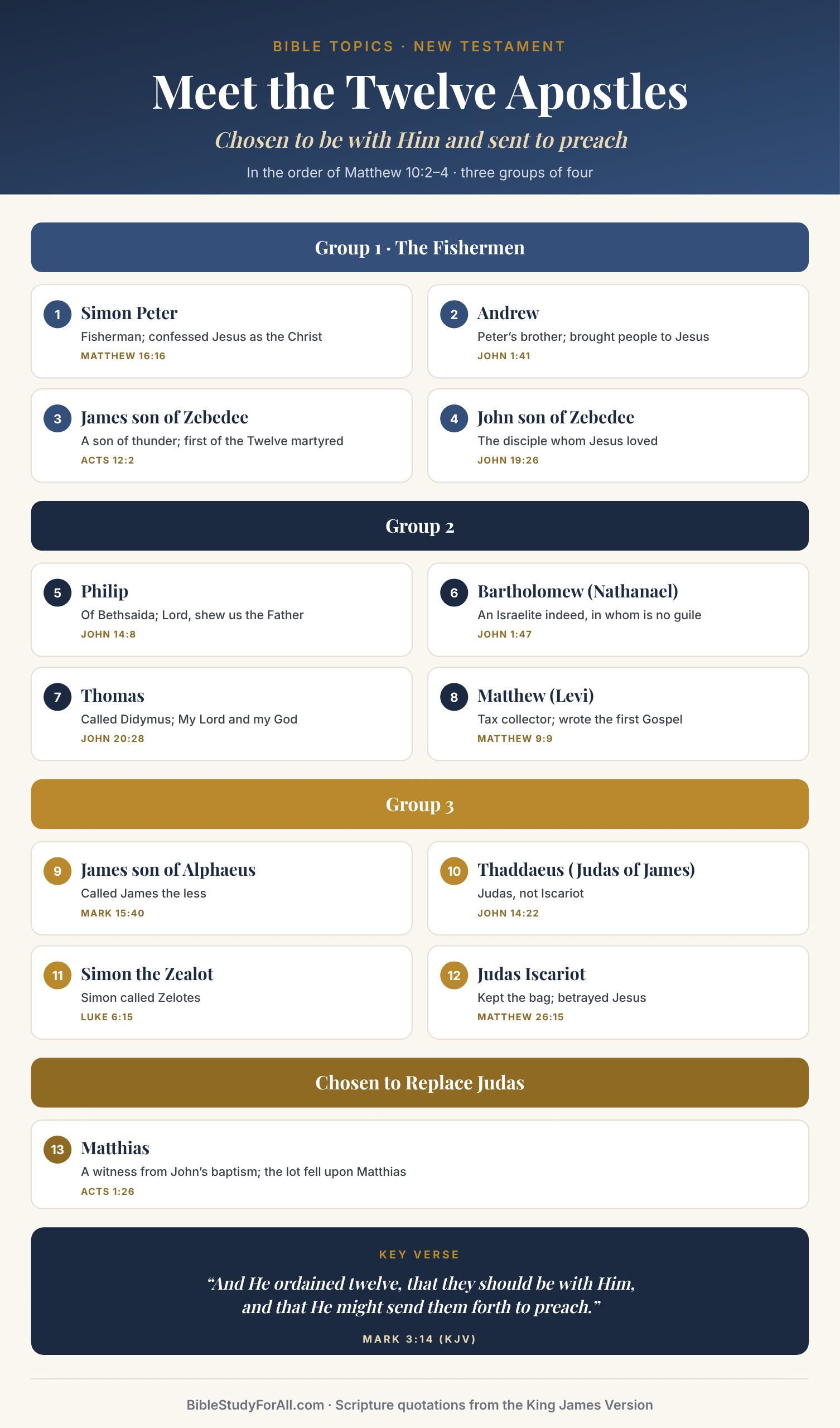
Each apostle is described, with verses, in the section below this chart.
Matthew 10:2
The Four Fishermen
The first four in every list. Peter, James and John were Jesus’ inner circle.
1 CEPHAS · A STONE
Simon Peter
A fisherman from Bethsaida, always named first. He walked on the water, confessed Jesus as the Christ, denied Him three times, and was restored: “Feed My sheep.” He preached at Pentecost and wrote two letters. Tradition: crucified in Rome under Nero, about A.D. 64–68.
“Thou art the Christ, the Son of the living God.”
MATTHEW 16:16
2 PETER’S BROTHER
Andrew
First a disciple of John the Baptist, he brought his brother to Jesus, then the boy with five loaves (John 6:8–9) and the Greeks who wanted to see Jesus (John 12:20–22). Tradition: preached in Greece and died at Patras.
“We have found the Messias, which is, being interpreted, the Christ.”
JOHN 1:41
3 A SON OF THUNDER
James son of Zebedee
Called from mending nets in his father’s boat. With Peter and John he saw Jairus’ daughter raised, the transfiguration and Gethsemane. Herod killed him with the sword about A.D. 44, the first of the Twelve to die for Christ.
“And he killed James the brother of John with the sword.”
ACTS 12:2
4 THE DISCIPLE WHOM JESUS LOVED
John son of Zebedee
He leaned on Jesus at supper, stood at the cross and was given Mary to care for. He wrote the Gospel of John, three letters and Revelation. Tradition: lived to old age in Ephesus after exile on Patmos.
“That which we have seen and heard declare we unto you”
1 JOHN 1:3
Matthew 10:3
Philip, Bartholomew, Thomas and Matthew
The second group of four, led by Philip in every list.
5 OF BETHSAIDA
Philip
Jesus found him and said, “Follow Me”; Philip at once found Nathanael. At the Last Supper his request drew Jesus’ answer, “he that hath seen Me hath seen the Father” (John 14:9). Tradition: ministered and died at Hierapolis in Asia Minor.
“Lord, shew us the Father, and it sufficeth us.”
JOHN 14:8
6 ALSO CALLED NATHANAEL
Bartholomew
Always paired with Philip in the lists; John calls him Nathanael. He doubted that any good thing could come out of Nazareth, but Jesus called him “an Israelite indeed, in whom is no guile!” Tradition: preached in India and was martyred in Armenia.
“Rabbi, Thou art the Son of God; Thou art the King of Israel.”
JOHN 1:49
7 DIDYMUS · THE TWIN
Thomas
Brave enough to say, “Let us also go, that we may die with Him” (John 11:16), honest enough to ask the way, and slow to believe until he saw the nail prints. Then he made one of the clearest confessions in the Gospels. Tradition: took the gospel to Parthia and India.
“My Lord and my God.”
JOHN 20:28
8 LEVI · THE PUBLICAN
Matthew
A tax collector in Capernaum who left everything to follow Jesus and threw a feast for his friends. Jesus said, “I am not come to call the righteous, but sinners to repentance” (Matthew 9:13). He wrote the Gospel of Matthew.
“Follow Me. And he arose, and followed Him.”
MATTHEW 9:9
Matthew 10:3–4 · Acts 1:26
James, Thaddaeus, Simon, Judas and Matthias
The least known group, led by James son of Alphaeus. Judas Iscariot is always named last, and Matthias took his place.
9 JAMES THE LESS
James son of Alphaeus
Named ninth in every list, with no words of his recorded. He is a different man from James son of Zebedee and from James the Lord’s brother, who led the church in Jerusalem (Galatians 1:19).
“Mary the mother of James the less and of Joses”
MARK 15:40
10 JUDAS THE BROTHER OF JAMES
Thaddaeus
Matthew and Mark call him Thaddaeus (Lebbaeus); Luke and Acts call him “Judas the brother of James.” John marks him off from the betrayer. Tradition: preached in Edessa and Persia.
“Lord, how is it that Thou wilt manifest Thyself unto us, and not unto the world?”
JOHN 14:22
11 SIMON THE CANAANITE
Simon the Zealot
The KJV’s “Canaanite” comes from the Aramaic word for zealous. Jesus put a zealous man like Simon in the same band as Matthew, who had worked for Rome. Tradition: preached in Persia.
“Simon called Zelotes”
LUKE 6:15
12 WHICH ALSO WAS THE TRAITOR
Judas Iscariot
He kept the money bag and stole from it (John 12:6). He sold Jesus for thirty pieces of silver and betrayed Him with a kiss. Filled with remorse, he hanged himself before the resurrection (Matthew 27:3–5).
“What will ye give me, and I will deliver Him unto you?”
MATTHEW 26:15
13 CHOSEN TO REPLACE JUDAS
Matthias
A follower of Jesus from John’s baptism, a witness of the resurrection. The believers prayed and cast lots, and he was numbered with the eleven. Tradition: preached in Judæa.
“and the lot fell upon Matthias; and he was numbered with the eleven apostles.”
ACTS 1:26
+ CALLED LATER
Paul
The risen Jesus called Paul on the Damascus road to carry His name “before the Gentiles” (Acts 9:15). Paul called himself “the least of the apostles” (1 Corinthians 15:9). See The Apostle Paul.
Matthew 10 · Mark 3 · Luke 6 · Acts 1
The Four Lists and the Inner Circle
The New Testament names the Twelve four times. The names fall into the same three groups of four every time, and each group always begins with the same man: Peter, Philip, and James son of Alphaeus.
GROUP 1 · LED BY PETER
Peter, Andrew, James, John
The four fishermen, the first called.
MATTHEW 10:2
GROUP 2 · LED BY PHILIP
Philip, Bartholomew, Thomas, Matthew
The order changes inside the group, but these four always stand fifth to eighth.
MATTHEW 10:3
GROUP 3 · LED BY JAMES
James, Thaddaeus, Simon, Judas
Judas Iscariot is always last, with a note that he betrayed Jesus.
MATTHEW 10:3–4
The Inner Circle
MARK 5:37
Jairus’ Daughter
Only Peter, James and John go in when Jesus raises the girl.
MATTHEW 17:1–2
The Transfiguration
The three see His face “shine as the sun.”
MARK 13:3
The Mount of Olives
Peter, James, John and Andrew ask about the end.
MARK 14:33
Gethsemane
The three are taken further in as Jesus prays.
After the Book of Acts
Where Did the Apostles Go?
The Bible records the deaths of only two of the Twelve: Judas (Matthew 27:5) and James son of Zebedee (Acts 12:2). For the rest we rely on early church writers such as Clement of Rome and Eusebius. This is history from tradition, not Scripture.
PETER
Rome
Crucified under Nero, about A.D. 64–68 (see John 21:18–19).
ANDREW
Greece
Preached around the Black Sea and Greece; died at Patras.
JAMES
Jerusalem
Killed by Herod about A.D. 44.
ACTS 12:2
JOHN
Patmos and Ephesus
Exiled to Patmos; died in old age at Ephesus.
REVELATION 1:9
PHILIP
Hierapolis
Ministered and died in Asia Minor.
BARTHOLOMEW
India and Armenia
Preached in India; martyred in Armenia.
THOMAS
Parthia and India
The Christians of south India trace their church to him.
MATTHEW
The First Gospel
Wrote his Gospel and preached in the east.
THADDAEUS AND SIMON
Edessa and Persia
Preached together in the east.
The Heart of the Story
The Twelve and Jesus
The story of the apostles is really the story of their Teacher. Jesus chose them, taught them, prayed for them, forgave them and sent them out.
Chosen as Friends
“Ye have not chosen Me, but I have chosen you, and ordained you, that ye should go and bring forth fruit”
JOHN 15:16
The Servant King
“For even the Son of man came not to be ministered unto, but to minister, and to give His life a ransom for many.”
MARK 10:45
He Prays for Them
“But I have prayed for thee, that thy faith fail not: and when thou art converted, strengthen thy brethren.”
LUKE 22:32
He Prays for Us
“Neither pray I for these alone, but for them also which shall believe on Me through their word”
JOHN 17:20
He Sends Them Out
“and, lo, I am with you alway, even unto the end of the world.”
MATTHEW 28:20
Apostles of the Lamb
“And the wall of the city had twelve foundations, and in them the names of the twelve apostles of the Lamb.”
REVELATION 21:14
For Today
Six Things to Remember
The apostles doubted, argued, boasted and ran away, and Jesus kept teaching them. Here is what their story teaches us.
1
Twelve, for a Reason
Chosen after a night of prayer, like the twelve tribes of a renewed Israel.
LUKE 6:12–13
2
With Him, Then Sent
First called to be with Jesus, then sent out.
MARK 3:14
3
An Unlikely Team
Fishermen, a tax collector, a zealot, a doubter and a betrayer, chosen on purpose.
MATTHEW 10:2–4
4
Restored, Not Replaced
All failed on the last night, and Jesus restored them; Matthias took only Judas’ place.
JOHN 21:15–17
5
Eyewitnesses Who Changed the World
Their testimony to the risen Jesus is the foundation of the church.
EPHESIANS 2:20
6
Bring Someone
Andrew’s first act was to bring his brother.
“Come and see.”
JOHN 1:46
Think About It
Questions for Reflection
Andrew’s first act as a follower of Jesus was to bring his brother: who could you invite to “come and see”? Jesus asked, “But whom say ye that I am?” How would you answer Him today? Jesus washed the feet of the man who would deny Him and the man who would betray Him: whom might God be asking you to serve? Jesus asked Peter, “lovest thou Me?” before He gave him work to do. What is your honest answer?
Bible Study
Read About the Apostles in Scripture
The story of the Twelve runs through the four Gospels and Acts, and their teaching fills the letters. These passages gather the key ones in five parts. Tap a part below to jump to it, tap any section to expand it, and tap a verse reference to read it in the King James Version at BibleGateway.
Part I
Called and Chosen
John 1 · Matthew 4 · Luke 5–6 · The first followers, the call by the sea, and the choosing of the Twelve.
- Andrew brings his brother Simon · John 1:35–42
- Philip and Nathanael · John 1:43–51
- Fishers of men · Matthew 4:18–22
- The great catch of fish · Luke 5:1–11
- Matthew the tax collector · Matthew 9:9–13
- After a night of prayer · Luke 6:12–16
- That they should be with Him · Mark 3:13–19
- The names of the twelve apostles · Matthew 10:1–4
Part II
Sent Out and Taught
Matthew 10–17 · The first mission and lessons about who Jesus is.
- Sheep in the midst of wolves · Matthew 10:5–23
- Two by two · Mark 6:7–13
- The seventy sent out · Luke 10:1–20
- What manner of man is this? · Mark 4:35–41
- Peter walks on the water · Matthew 14:22–33
- Thou art the Christ · Matthew 16:13–28
- The transfiguration · Matthew 17:1–13
- To whom shall we go? · John 6:66–71
- Servant of all · Mark 9:33–37
- James and John ask for seats · Mark 10:35–45
Part III
The Last Night
John 13–18 · Matthew 26 · Feet washed, bread broken, a betrayal and a denial.
- Jesus washes their feet · John 13:1–17
- One of you shall betray Me · John 13:21–35
- Shew us the Father · John 14:1–14
- Neither pray I for these alone · John 17:6–26
- I have prayed for thee · Luke 22:24–34
- Thirty pieces of silver · Matthew 26:14–16
- All the disciples forsook Him · Matthew 26:47–56
- Peter wept bitterly · Matthew 26:69–75
- The end of Judas · Matthew 27:3–10
Part IV
Witnesses of the Risen Lord
John 20–21 · Acts 1 · Doubt turned to faith, Peter restored and Matthias chosen.
- As My Father hath sent Me · John 20:19–23
- My Lord and my God · John 20:24–29
- Breakfast by the sea · John 21:1–14
- Feed My sheep · John 21:15–25
- Go ye therefore, and teach all nations · Matthew 28:16–20
- The eleven in the upper room · Acts 1:12–14
- The lot fell upon Matthias · Acts 1:15–26
Part V
Foundations of the Church
Acts · The Letters · Revelation · The apostles preach, suffer and teach.
- Peter standing up with the eleven · Acts 2:14–42
- They had been with Jesus · Acts 4:1–22
- Obey God rather than men · Acts 5:17–42
- James killed, Peter freed · Acts 12:1–19
- Peter writes to the scattered believers · 1 Peter 1:1–9
- That which we have seen and heard · 1 John 1:1–4
- Built upon the foundation of the apostles · Ephesians 2:19–22
- The twelve apostles of the Lamb · Revelation 21:10–14
Questions
Questions About the Apostles
What is the difference between a disciple and an apostle?
A disciple is a learner or follower; Jesus had many disciples, men and women, including the seventy He sent out (Luke 10:1) and the women who traveled with Him (Luke 8:1–3). An apostle is one who is sent. Jesus chose twelve of His disciples, “whom also He named apostles” (Luke 6:13), to be with Him and to be sent out with His authority.
Why did Jesus choose exactly twelve?
The number matches the twelve tribes of Israel. Jesus told the Twelve they would “sit upon twelve thrones, judging the twelve tribes of Israel” (Matthew 19:28; Luke 22:30). That is why the eleven filled Judas’ place before Pentecost (Acts 1:15–26), and why the New Jerusalem has twelve gates named for the tribes and twelve foundations named for the apostles (Revelation 21:12–14).
Is Bartholomew the same person as Nathanael?
Yes. Matthew, Mark and Luke always pair Bartholomew with Philip and never mention Nathanael; John never mentions Bartholomew but tells how Philip brought Nathanael to Jesus (John 1:45) and names Nathanael among the apostles at the Sea of Galilee (John 21:2). Bartholomew means son of Tolmai, a family name; Nathanael was his own name.
Why do the lists name Thaddaeus or Judas?
They are two names for one man. Matthew and Mark name Thaddaeus (Matthew adds Lebbaeus), while Luke and Acts have “Judas the brother of James” in the same place (Luke 6:16). With Judas Iscariot in the group, it was natural to call him by another name. John is careful to say “Judas … not Iscariot” (John 14:22).
Was James son of Alphaeus the brother of Jesus?
No. Jesus’ brothers, James, Joses, Simon and Judas (Matthew 13:55), did not believe in Him during His ministry (John 7:5), so they were not among the Twelve. James the Lord’s brother believed after the resurrection (1 Corinthians 15:7), led the church in Jerusalem (Acts 15:13) and wrote the letter of James.
Who was “the disciple whom Jesus loved”?
The apostle John, son of Zebedee. He leaned on Jesus at the Last Supper, stood at the cross, ran to the tomb with Peter, and is the one who “testifieth of these things, and wrote these things” (John 21:20–24). He never names himself in his own Gospel.
Why did Judas betray Jesus?
John says Judas “was a thief, and had the bag” (John 12:6). Matthew shows him asking the priests, “What will ye give me?” (Matthew 26:15). Luke and John say Satan entered into him (Luke 22:3; John 13:27). Afterward he was filled with remorse but did not turn back to Jesus; he went and hanged himself (Matthew 27:5), and Acts 1:18 tells what became of his body.
Are there still apostles today?
Not in the sense of the Twelve. Their office was unique: an apostle had to be an eyewitness of the risen Jesus, with Him from the beginning (Acts 1:21–22), and their teaching became the foundation of the church (Ephesians 2:20). The Twelve stand alone as “the twelve apostles of the Lamb” (Revelation 21:14). Every believer today is still sent to be Christ’s witness (Matthew 28:19–20).
Keep Studying
Related Studies
Continue Your Study
Scripture quotations and verse links are from the King James Version (KJV).