
Leviticus 23 · Exodus 12 · Acts 2 · Bible Study
The Seven Feasts of Israel
A Shadow of Things to Come
God gave Israel seven yearly feasts in Leviticus 23, from Passover in the spring to Tabernacles in the fall. Each one marked a harvest or a memory of His saving work, and each one points to the Lord Jesus Christ, His death, His resurrection, the Holy Spirit and His coming again.
About the Feasts
The Feasts at a Glance
Bible Study
Note: Scripture quotations and verse links on this site use the King James Version (KJV) because it is in the public domain, while most modern translations limit how much can be quoted online. Feel free to read along in the translation of your choice.
Seven Feasts
The feasts of the LORD (Leviticus 23)
Four in the Spring
Passover to Pentecost
Three in the Fall
Trumpets, Atonement, Tabernacles
All Point to Christ
“Christ our passover” (1 Corinthians 5:7)
About the Feasts
What Are the Feasts of Israel?
What They Are
The Feasts of the LORD
The feasts of Israel are seven holy days and seasons God commanded in Leviticus 23. God called them “My feasts” (Leviticus 23:2), times when Israel stopped work to worship Him.
“These are the feasts of the LORD, even holy convocations, which ye shall proclaim in their seasons” (Leviticus 23:4). A holy convocation was a sacred gathering, a day of rest and worship. The seven are Passover, Unleavened Bread, Firstfruits, Pentecost (the feast of weeks), Trumpets, the Day of Atonement and Tabernacles.
Three times a year every man of Israel was to go up to the place God chose, later Jerusalem: “in the feast of unleavened bread, and in the feast of weeks, and in the feast of tabernacles” (Deuteronomy 16:16). Jesus Himself went up to these feasts (Luke 2:41–42; John 7:10).
When They Were Kept
Spring and Fall
Four feasts came in the spring, in the first and third months, at the barley and wheat harvests. Three came in the fall, in the seventh month, when the fruit harvest was gathered in.
Israel’s year began in the spring month of Abib, later called Nisan (Exodus 12:2; Esther 3:7). Passover fell on the fourteenth day of that month, Unleavened Bread began the next day, and Firstfruits came on the morrow after the sabbath. Pentecost followed fifty days later.
The seventh month, Tishri, held the fall feasts: Trumpets on the first day, the Day of Atonement on the tenth, and Tabernacles from the fifteenth for seven days, with a holy eighth day (Leviticus 23:24–36). The weekly sabbath, kept every seventh day, stood behind them all (23:3).
Why They Matter
Pictures of Christ
Paul says the holy days were “a shadow of things to come; but the body is of Christ” (Colossians 2:17). The spring feasts were fulfilled at His first coming; the fall feasts point to His return.
Jesus died at Passover as “Christ our passover” (1 Corinthians 5:7), lay in the tomb during Unleavened Bread, and rose on the day of Firstfruits as “the firstfruits of them that slept” (1 Corinthians 15:20). Fifty days later, on Pentecost, the Holy Spirit came (Acts 2:1–4).
The fall feasts look ahead: the trumpet that gathers God’s people (1 Thessalonians 4:16), the day when Israel will look upon Him whom they pierced and mourn (Zechariah 12:10), and the time when the nations will go up to Jerusalem to worship the King and keep the feast of tabernacles (Zechariah 14:16).
Key Verse
A Shadow of Things to Come
“Let no man therefore judge you in meat, or in drink, or in respect of an holyday, or of the new moon, or of the sabbath days: which are a shadow of things to come; but the body is of Christ.”
Colossians 2:16–17 (KJV)
Key Themes
Six Truths the Feasts Teach
The feasts were Israel’s calendar of worship, and they tell the story of redemption from start to finish.
1
Saved by the Blood
The lamb died so the firstborn could live.
“when I see the blood, I will pass over you”
EXODUS 12:13
2
Called to Holiness
Put away the old leaven of sin.
“Purge out therefore the old leaven, that ye may be a new lump”
1 CORINTHIANS 5:7
3
Raised to Life
Christ is the firstfruits of the resurrection.
“But now is Christ risen from the dead, and become the firstfruits of them that slept.”
1 CORINTHIANS 15:20
4
Filled with the Spirit
The harvest of souls began at Pentecost.
“And they were all filled with the Holy Ghost”
ACTS 2:4
5
Waiting for the Trumpet
The Lord will come for His people.
“and the dead shall be raised incorruptible, and we shall be changed.”
1 CORINTHIANS 15:52
6
God Dwelling with Us
The feast of tabernacles looks to His kingdom.
“Behold, the tabernacle of God is with men, and He will dwell with them”
REVELATION 21:3
From Passover to Tabernacles
What the Bible Says About the Feasts of Israel
Leviticus 23:1–4The Feasts of the LORD
God told Moses, “Speak unto the children of Israel, and say unto them, Concerning the feasts of the LORD, which ye shall proclaim to be holy convocations, even these are My feasts” (Leviticus 23:2). They began with the weekly sabbath, “the sabbath of the LORD in all your dwellings” (23:3), and then followed the farming year. Each feast was a time to remember what God had done and to thank Him for the harvest He gave.
Exodus 12 · Leviticus 23:5Passover
“In the fourteenth day of the first month at even is the LORD’s passover” (Leviticus 23:5). On the night God judged Egypt, each family killed a lamb without blemish and put its blood on the doorposts. God said, “when I see the blood, I will pass over you” (Exodus 12:13). Jesus ate the Passover with His disciples the night before He died, and He became the true Lamb of God: “For even Christ our passover is sacrificed for us” (1 Corinthians 5:7). Not a bone of the Passover lamb was broken, and not a bone of His was broken (Exodus 12:46; John 19:36).
Leviticus 23:6–8Unleavened Bread
“And on the fifteenth day of the same month is the feast of unleavened bread unto the LORD: seven days ye must eat unleavened bread” (Leviticus 23:6). Israel left Egypt in haste with no time for the dough to rise (Exodus 12:39). In Scripture leaven often pictures sin spreading quietly. The sinless body of Jesus lay in the tomb during this feast, and believers are called to keep it “with the unleavened bread of sincerity and truth” (1 Corinthians 5:8).
Leviticus 23:9–14Firstfruits
When Israel reaped the first barley in the land, the priest waved a sheaf before the LORD “on the morrow after the sabbath” (Leviticus 23:11). The first part of the harvest was given to God as a pledge of the rest to come. Jesus rose from the dead on that very day, the first day of the week after the Passover sabbath. “But now is Christ risen from the dead, and become the firstfruits of them that slept” (1 Corinthians 15:20). His resurrection promises the resurrection of all who belong to Him (15:23).
Leviticus 23:15–22Pentecost, the Feast of Weeks
Israel counted seven weeks from Firstfruits, “even unto the morrow after the seventh sabbath shall ye number fifty days” (Leviticus 23:16). The Greek word for fiftieth gives us the name Pentecost. Two loaves of the new wheat were waved before the LORD. Fifty days after Jesus rose, “when the day of Pentecost was fully come” (Acts 2:1), the Holy Spirit came upon the disciples, Peter preached, and about three thousand souls were saved that day (2:41), the firstfruits of a great harvest.
Leviticus 23:23–25The Feast of Trumpets
“In the seventh month, in the first day of the month, shall ye have a sabbath, a memorial of blowing of trumpets, an holy convocation” (Leviticus 23:24). Trumpets called Israel to gather and announced that the holy month had begun. It points ahead to the trumpet that will call God’s people home: “For the Lord Himself shall descend from heaven with a shout, with the voice of the archangel, and with the trump of God: and the dead in Christ shall rise first” (1 Thessalonians 4:16).
Leviticus 16 · 23:26–32The Day of Atonement
On the tenth day of the seventh month the high priest went alone into the holy of holies with blood, “to make an atonement for the children of Israel for all their sins once a year” (Leviticus 16:34). It was the most solemn day of the year, when the people afflicted their souls (23:27). Christ, our great High Priest, entered heaven itself “by His own blood” and “obtained eternal redemption for us” (Hebrews 9:12). The day also looks ahead to Israel’s national repentance when the Lord returns: “they shall look upon Me whom they have pierced, and they shall mourn for Him” (Zechariah 12:10).
Leviticus 23:33–43The Feast of Tabernacles
“The fifteenth day of this seventh month shall be the feast of tabernacles for seven days unto the LORD” (Leviticus 23:34). Israel lived in booths made of branches to remember the wilderness, “That your generations may know that I made the children of Israel to dwell in booths” (23:43). It was the most joyful feast of the year. On its last great day Jesus cried, “If any man thirst, let him come unto Me, and drink” (John 7:37). The prophets say the nations will one day go up to Jerusalem “to worship the King, the LORD of hosts, and to keep the feast of tabernacles” (Zechariah 14:16).
Colossians 2:16–17 · Hebrews 10Fulfilled in Christ
Christians are not required to keep Israel’s feast days: “Let no man therefore judge you … in respect of an holyday” (Colossians 2:16). They were “a shadow of things to come; but the body is of Christ” (2:17). The law had “a shadow of good things to come” (Hebrews 10:1), and Christ is the substance. Studying the feasts helps believers see how carefully God planned His work of salvation and how surely He will finish it.
At a Glance
The Feasts at a Glance
The seven feasts of Israel on one page: Israel’s calendar of worship, a chart of all seven feasts and how they point to Christ, the spring feasts, the fall feasts, the three pilgrim feasts, and what they mean for us today. Tap a topic to jump to it.
Printable Copy
Save or Print the Infographic
Everything in this section, with the key verse and key themes, is also on a printable infographic (six pages). It opens in a new tab, where you can save it to your phone or computer, share it, or print it.
Leviticus 23
Israel’s Calendar of Worship
The feasts followed the seasons of the land, from the barley harvest in spring to the fruit harvest in the fall.
EVERY WEEK
The Sabbath
The seventh day of rest behind every feast.
“but the seventh day is the sabbath of rest, an holy convocation”
LEVITICUS 23:3
MONTH 1, DAY 14
Passover
The lamb slain in the evening.
“In the fourteenth day of the first month at even is the LORD’s passover.”
LEVITICUS 23:5
MONTH 1, DAYS 15–21
Unleavened Bread
Seven days without leaven.
“seven days ye must eat unleavened bread.”
LEVITICUS 23:6
SPRING · 50 DAYS
Firstfruits to Pentecost
From the first sheaf to the new loaves.
“shall ye number fifty days”
LEVITICUS 23:16
MONTH 7, DAYS 1 AND 10
Trumpets and Atonement
A holy month begins with trumpets.
“a memorial of blowing of trumpets, an holy convocation.”
LEVITICUS 23:24
MONTH 7, DAYS 15–22
Tabernacles
Seven days in booths, then a holy eighth day.
“Ye shall dwell in booths seven days”
LEVITICUS 23:42
Chart
The Seven Feasts Chart
All seven feasts of Leviticus 23 in the order of Israel’s year, each with its date and how it points to the Lord Jesus Christ.
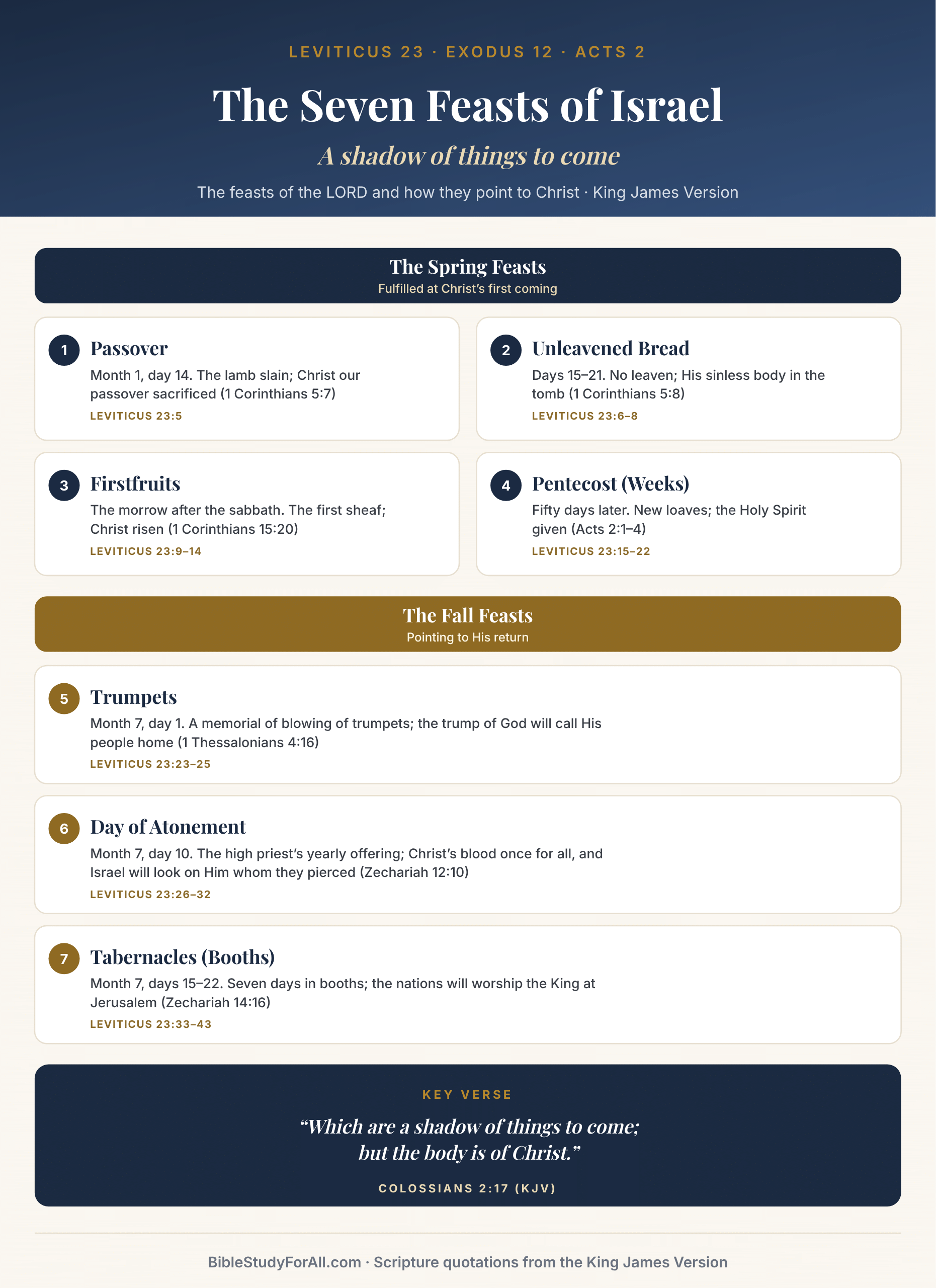
Months are counted from the spring month Abib (Nisan), as in Exodus 12:2.
THE SPRING FEASTS
Fulfilled at His First Coming
Passover, Unleavened Bread, Firstfruits and Pentecost: His death, burial, resurrection and the gift of the Spirit.
“For even Christ our passover is sacrificed for us”
1 CORINTHIANS 5:7
THE FALL FEASTS
Pointing to His Return
Trumpets, Atonement and Tabernacles: the gathering of His people, Israel’s repentance and His reign.
“and to keep the feast of tabernacles.”
ZECHARIAH 14:16
Fulfilled at His First Coming
The Spring Feasts and the Cross
Jesus died, was buried and rose again on the very feasts God had set in the spring, and the Spirit came on Pentecost.
The Feast
Passover: “when I see the blood, I will pass over you”
EXODUS 12:13
Fulfilled in Christ
“For even Christ our passover is sacrificed for us”
1 CORINTHIANS 5:7
The Feast
“neither shall ye break a bone thereof”
EXODUS 12:46
Fulfilled in Christ
“A bone of Him shall not be broken.”
JOHN 19:36
The Feast
Unleavened Bread: “seven days ye must eat unleavened bread”
LEVITICUS 23:6
Fulfilled in Christ
“with the unleavened bread of sincerity and truth.”
1 CORINTHIANS 5:8
The Feast
Firstfruits: “a sheaf of the firstfruits of your harvest”
LEVITICUS 23:10
Fulfilled in Christ
“Christ the firstfruits; afterward they that are Christ’s at His coming.”
1 CORINTHIANS 15:23
The Feast
Pentecost: “shall ye number fifty days”
LEVITICUS 23:16
Fulfilled in Christ
“And when the day of Pentecost was fully come”
ACTS 2:1
The Feast
“two wave loaves … the firstfruits unto the LORD”
LEVITICUS 23:17
Fulfilled in Christ
“and the same day there were added unto them about three thousand souls.”
ACTS 2:41
“Behold the Lamb of God, which taketh away the sin of the world.”John 1:29 (KJV)
Pointing to His Return
The Fall Feasts and His Coming
The three feasts of the seventh month have not yet been fulfilled. They look ahead to the Lord’s return for His church, Israel’s turning to Him, and His reign on earth.
TRUMPETS
The Trumpet Will Sound
A memorial of blowing of trumpets.
“a memorial of blowing of trumpets”
LEVITICUS 23:24
THE TRUMP OF GOD
Caught Up to Meet Him
The Lord will come for His church.
“and with the trump of God: and the dead in Christ shall rise first”
1 THESSALONIANS 4:16
ATONEMENT
Once a Year
The high priest entered with blood.
“to make an atonement for the children of Israel for all their sins once a year.”
LEVITICUS 16:34
ISRAEL’S DAY
They Shall Look upon Me
Israel will mourn and turn to Christ.
“and they shall look upon Me whom they have pierced, and they shall mourn for Him”
ZECHARIAH 12:10
TABERNACLES
Rejoice Seven Days
Booths to remember the wilderness.
“and ye shall rejoice before the LORD your God seven days.”
LEVITICUS 23:40
THE KINGDOM
Worship the King
The nations will come to Jerusalem.
“to worship the King, the LORD of hosts, and to keep the feast of tabernacles.”
ZECHARIAH 14:16
“And so all Israel shall be saved: as it is written, There shall come out of Sion the Deliverer, and shall turn away ungodliness from Jacob.”Romans 11:26 (KJV)
Deuteronomy 16 · The Gospels
The Three Pilgrim Feasts and Jesus
Three times a year Israel went up to Jerusalem. The Gospels show Jesus at these feasts again and again.
THE COMMAND
Three Times a Year
Unleavened Bread, Weeks and Tabernacles.
“Three times in a year shall all thy males appear before the LORD thy God”
DEUTERONOMY 16:16
AGE TWELVE
Jesus in the Temple
At the Passover with Mary and Joseph.
“And when He was twelve years old, they went up to Jerusalem after the custom of the feast.”
LUKE 2:42
TABERNACLES
Living Water
On the last great day of the feast.
“If any man thirst, let him come unto Me, and drink.”
JOHN 7:37
TABERNACLES
The Light of the World
Spoken in the temple at the feast.
“I am the light of the world”
JOHN 8:12
THE LAST PASSOVER
The Lord’s Supper
He gave the bread and the cup.
“With desire I have desired to eat this passover with you before I suffer”
LUKE 22:15
PENTECOST
The Spirit Poured Out
Jews from every nation in Jerusalem.
“And there were dwelling at Jerusalem Jews, devout men, out of every nation under heaven.”
ACTS 2:5
For Today
What the Feasts Mean for Us Today
Christians do not keep the feasts as law, but every one of them teaches us about our Saviour.
1
Trust the Lamb
Shelter under His blood.
“Behold the Lamb of God, which taketh away the sin of the world.”
JOHN 1:29
2
Remember His Death
The Lord’s Supper replaces the Passover meal.
“this do in remembrance of Me.”
LUKE 22:19
3
Put Away Sin
Live as a new lump without leaven.
“Purge out therefore the old leaven”
1 CORINTHIANS 5:7
4
Hope in the Resurrection
He rose first; we will follow.
“Christ the firstfruits; afterward they that are Christ’s at His coming.”
1 CORINTHIANS 15:23
5
Walk in the Spirit
The gift of Pentecost is for every believer.
“Walk in the Spirit”
GALATIANS 5:16
6
Look Up
The trumpet could sound any day.
“For the Lord Himself shall descend from heaven with a shout”
1 THESSALONIANS 4:16
Bible Study
Read About the Feasts in Scripture
The feasts are listed in Leviticus 23 and kept throughout the Bible. These passages gather the key ones in five parts, from the law to their fulfilment in Christ. Tap a part below to jump to it, tap any section to expand it, and tap a verse reference to read it in the King James Version at BibleGateway.
Part I
The Feasts of the LORD
Leviticus 23 · All seven feasts in one chapter.
- Passover and Unleavened Bread · Leviticus 23:1–8
- Firstfruits · Leviticus 23:9–14
- The feast of weeks · Leviticus 23:15–22
- Trumpets · Leviticus 23:23–25
- The Day of Atonement · Leviticus 23:26–32
- Tabernacles · Leviticus 23:33–44
Part II
Passover and Atonement
Exodus 12 · Leviticus 16 · The lamb and the mercy seat.
- When I see the blood · Exodus 12:1–14
- What mean ye by this service? · Exodus 12:21–28
- Into the holy place · Leviticus 16:1–19
- The scapegoat · Leviticus 16:20–34
Part III
Keeping the Feasts
Deuteronomy 16 · Nehemiah 8 · Israel goes up to worship.
- Three times in a year · Deuteronomy 16:1–17
- Hezekiah’s Passover · 2 Chronicles 30:1–27
- Josiah’s Passover · 2 Chronicles 35:1–19
- Very great gladness · Nehemiah 8:13–18
Part IV
Jesus and the Feasts
The Gospels · Acts 2 · Fulfilled at His first coming.
- In His Father’s house · Luke 2:41–52
- Rivers of living water · John 7:37–39
- The feast of the dedication · John 10:22–30
- This do in remembrance of Me · Luke 22:7–20
- A bone of Him shall not be broken · John 19:31–37
- Christ the firstfruits · 1 Corinthians 15:20–23
- When the day of Pentecost was fully come · Acts 2:1–13
- About three thousand souls · Acts 2:37–41
Part V
Shadows and Things to Come
Epistles · Prophets · Christ is the substance.
- The body is of Christ · Colossians 2:16–17
- By His own blood · Hebrews 9:6–14
- Christ our passover · 1 Corinthians 5:6–8
- The trump of God · 1 Thessalonians 4:13–18
- At the last trump · 1 Corinthians 15:51–58
- They shall look upon Me · Zechariah 12:10–14
- All Israel shall be saved · Romans 11:25–27
- The feast of tabernacles · Zechariah 14:9–21
Questions
Questions About the Feasts of Israel
What are the seven feasts of Israel?
Leviticus 23 lists them in order: Passover, Unleavened Bread, Firstfruits, Pentecost (the feast of weeks), the Feast of Trumpets, the Day of Atonement and the Feast of Tabernacles (also called booths or ingathering). God called them “the feasts of the LORD” (Leviticus 23:4).
What are the Hebrew names of the feasts?
Passover is Pesach, Unleavened Bread is Chag HaMatzot, Firstfruits is Bikkurim, Pentecost is Shavuot (weeks), Trumpets is known today as Rosh Hashanah, the Day of Atonement is Yom Kippur, and Tabernacles is Sukkot (booths). The Bible itself uses the English names in the King James Version.
How do the feasts point to Jesus?
The spring feasts were fulfilled at His first coming: He died at Passover as “Christ our passover” (1 Corinthians 5:7), His sinless body lay in the tomb during Unleavened Bread, He rose on Firstfruits as “the firstfruits of them that slept” (1 Corinthians 15:20), and the Holy Spirit came on Pentecost (Acts 2:1). The fall feasts point to His return, Israel’s repentance and His kingdom.
What will the fall feasts fulfil?
The Feast of Trumpets points to the trumpet that will sound when the Lord comes for His church: “the dead in Christ shall rise first” (1 Thessalonians 4:16). The Day of Atonement points to the day when Israel “shall look upon Me whom they have pierced” and mourn (Zechariah 12:10), “And so all Israel shall be saved” (Romans 11:26). Tabernacles points to Christ’s reign on earth, when the nations go up “to worship the King” (Zechariah 14:16). See Jesus Returning.
Do Christians have to keep the feasts?
No. Paul wrote, “Let no man therefore judge you in meat, or in drink, or in respect of an holyday” (Colossians 2:16), because the feasts “are a shadow of things to come; but the body is of Christ” (2:17). Christians remember the Lord’s death in the Lord’s Supper (1 Corinthians 11:23–26). Learning the feasts is still a great help in understanding the Bible.
Did Jesus keep the feasts?
Yes. He went up to Jerusalem for the Passover as a boy (Luke 2:41–42), attended the feast of tabernacles (John 7:10, 37) and the feast of the dedication (John 10:22), and ate His last Passover with His disciples the night before He died (Luke 22:15).
Are Purim and Hanukkah feasts of Israel?
They are later Jewish holidays, not among the seven feasts God gave in Leviticus 23. Purim celebrates God’s rescue of the Jews in the days of Esther (Esther 9:26–28). Hanukkah remembers the cleansing of the temple in 164 B.C. and is called “the feast of the dedication” in John 10:22, when Jesus walked in the temple.
Keep Studying
Related Studies
Continue Your Study
Scripture quotations and verse links are from the King James Version (KJV).