
Exodus 25–40 · Leviticus 16 · Numbers 2 · Hebrews 8–10 · Bible Study
The Tabernacle
God Dwelling with His People
The tabernacle was the holy tent God told Moses to build at Mount Sinai, so that He could dwell among Israel. Every part was made by God’s pattern, and every part points to Jesus Christ, who “dwelt among us” (John 1:14).
About the Tabernacle
The Tabernacle at a Glance
Bible Study
Note: Scripture quotations and verse links on this site use the King James Version (KJV) because it is in the public domain, while most modern translations limit how much can be quoted online. Feel free to read along in the translation of your choice.
Set Up at Sinai
First month, second year, c. 1445 B.C. (Exodus 40:17)
Court 100 × 50 Cubits
About 150 × 75 feet (Exodus 27:18)
Seven Holy Pieces
Altar, laver, table, lampstand, incense, Ark, mercy seat
The Glory Came
“The glory of the LORD filled the tabernacle” (Exodus 40:34)
About the Tabernacle
What Was the Tabernacle?
What It Was
A Holy Tent in the Wilderness
The tabernacle was a portable tent of gold-covered boards, fine linen curtains and skins, set in a court of white linen hangings. Israel carried it through the wilderness for about forty years.
The word tabernacle means a tent or dwelling. The KJV also calls it “the tabernacle of the congregation” (Exodus 40:34), the tent where God met with His people. It stood in a court about 100 cubits long and 50 cubits wide, which is about 150 by 75 feet (Exodus 27:18).
The tent itself was 30 cubits long and 10 wide (about 45 by 15 feet), made of 48 boards of shittim wood overlaid with gold, standing in sockets of silver (Exodus 26:15–25). A veil divided it into two rooms: the Holy Place and the Most Holy Place, where the Ark of the Covenant stood (26:33).
Why It Was Built
That I May Dwell Among Them
God wanted to live among His people. The tabernacle was His dwelling in the middle of Israel’s camp, the place where He met with them and where sin could be covered by blood.
God said, “And let them make Me a sanctuary; that I may dwell among them” (Exodus 25:8). The tribes camped on all four sides of it, with the tabernacle in the middle (Numbers 2:2), and the cloud of God’s presence rested on it by day and fire by night (Exodus 40:38).
Because God is holy and people are sinful, they could not simply walk in. Sacrifices were offered at the altar, the priests washed at the laver, and only the high priest entered the Most Holy Place, once a year, with blood (Leviticus 16:2, 14). The tabernacle showed both God’s nearness and His holiness.
Why It Matters
A Shadow of the Saviour
Hebrews calls the tabernacle “the example and shadow of heavenly things.” Its one door, its altar, its bread, light and veil all point to Jesus Christ, the only way into God’s presence.
God told Moses to make everything “according to the pattern shewed to thee in the mount” (Hebrews 8:5), because the earthly tent was a copy of the true one in heaven. Christ came “by a greater and more perfect tabernacle, not made with hands” (Hebrews 9:11).
John says that the Word “dwelt among us” (John 1:14), using a Greek word that means He pitched His tent among us. Jesus is the door (John 10:9), the sacrifice (John 1:29), the bread of life (John 6:35) and the light of the world (John 8:12). When He died, the veil was torn (Matthew 27:51), and the way into God’s presence was opened for all who believe.
Key Verse
That I May Dwell Among Them
“And let them make Me a sanctuary; that I may dwell among them. According to all that I shew thee, after the pattern of the tabernacle, and the pattern of all the instruments thereof, even so shall ye make it.”
Exodus 25:8–9 (KJV)
Key Themes
Six Truths the Tabernacle Teaches
The tabernacle teaches six truths about God and the way to Him that run through the whole Bible.
1
God Wants to Dwell with Us
He chose to live in the middle of His people.
“And I will dwell among the children of Israel, and will be their God.”
EXODUS 29:45
2
God Is Holy
Walls, a veil and priests guarded His presence.
“that he come not at all times into the holy place within the vail”
LEVITICUS 16:2
3
Worship God’s Way
Every detail followed His pattern.
“Thus did Moses: according to all that the LORD commanded him, so did he.”
EXODUS 40:16
4
Sin Requires Blood
The way in began at the altar.
“and without shedding of blood is no remission.”
HEBREWS 9:22
5
God Leads His People
The cloud on the tabernacle guided every move.
“For the cloud of the LORD was upon the tabernacle by day, and fire was on it by night”
EXODUS 40:38
6
Fulfilled in Christ
Jesus is God dwelling with us.
“And the Word was made flesh, and dwelt among us”
JOHN 1:14
From Sinai to the Temple
What the Bible Says About the Tabernacle
Exodus 25:1–9God Asks for a Sanctuary
At Mount Sinai, after giving the Ten Commandments, God told Moses, “Speak unto the children of Israel, that they bring Me an offering: of every man that giveth it willingly with his heart ye shall take My offering” (Exodus 25:2). They were to bring gold, silver, brass, blue, purple and scarlet yarn, fine linen, goats’ hair, skins, shittim wood, oil, spices and precious stones (25:3–7). God’s purpose was plain: “And let them make Me a sanctuary; that I may dwell among them” (25:8).
Exodus 25–31Made by God’s Pattern
God did not leave the design to Moses. He said, “According to all that I shew thee, after the pattern of the tabernacle, and the pattern of all the instruments thereof, even so shall ye make it” (Exodus 25:9). Seven chapters give every measurement, from the Ark to the pins of the court. Hebrews explains why: the priests served “unto the example and shadow of heavenly things” (Hebrews 8:5). The earthly tent was a copy of the true sanctuary in heaven.
Exodus 35–36Willing Hearts and Skilled Hands
The people gave so freely that the workmen told Moses, “The people bring much more than enough for the service of the work” (Exodus 36:5), and Moses had to tell them to stop. God filled Bezaleel of the tribe of Judah “with the spirit of God, in wisdom, and in understanding, and in knowledge, and in all manner of workmanship” (31:3), and gave him Aholiab of the tribe of Dan as his helper (31:6). Many “wise hearted” men and women worked with them (35:25; 36:1).
Exodus 27 · 30The Court, the Altar and the Laver
A fence of fine white linen hangings, five cubits high, surrounded a court 100 cubits by 50 (Exodus 27:9–18). There was one gate, on the east side, twenty cubits wide, of blue, purple, scarlet and fine twined linen (27:16). Inside the gate stood the altar of burnt offering, five cubits square and overlaid with brass, where the sacrifices were offered (27:1–8). Between the altar and the tent stood the laver of brass, where the priests washed their hands and feet “that they die not” (30:18–21).
Exodus 25:23–40 · 30:1–10The Holy Place
The first room of the tent was the Holy Place, 20 cubits long. On the north side stood the table of shewbread, overlaid with gold, holding twelve loaves set “before the LORD continually” (Leviticus 24:5–8). On the south side stood the golden candlestick, beaten from a talent of pure gold, with seven lamps fed with pure olive oil “to cause the lamp to burn always” (Exodus 27:20). Before the veil stood the golden altar of incense, where sweet incense was burned every morning and evening (30:7–8).
Exodus 26:31–34 · Leviticus 16The Most Holy Place
A veil “of blue, and purple, and scarlet, and fine twined linen” with cherubim woven into it divided the Holy Place from “the most holy” (Exodus 26:31–33). That inner room was a perfect cube, ten cubits each way. In it stood only the Ark of the Covenant with the mercy seat on top, where God said, “there I will meet with thee” (25:22). Once a year, on the Day of Atonement, the high priest went in with blood and sprinkled it “upon the mercy seat, and before the mercy seat” (Leviticus 16:15).
Exodus 26:1–14Curtains, Coverings and Boards
The tent was covered with four layers. The inner one was ten curtains of fine twined linen in blue, purple and scarlet, with cherubim woven in (Exodus 26:1). Over it were curtains of goats’ hair (26:7), then “a covering for the tent of rams’ skins dyed red, and a covering above of badgers’ skins” (26:14). The walls were 48 upright boards of shittim wood overlaid with gold, each set in two sockets of silver (26:15–25). The silver came from the half shekel every man paid as “atonement money” (30:16; 38:25–27).
Exodus 40The Glory Fills the Tabernacle
“And it came to pass in the first month in the second year, on the first day of the month, that the tabernacle was reared up” (Exodus 40:17), about 1445 B.C. Moses set every piece in its place, and eight times the chapter says it was done “as the LORD commanded Moses.” Then “a cloud covered the tent of the congregation, and the glory of the LORD filled the tabernacle” (40:34). The glory was so great that “Moses was not able to enter” (40:35).
Numbers 2 · 9 · 10At the Center of the Camp
God arranged the twelve tribes around the tabernacle, three on each side, “far off about the tabernacle of the congregation shall they pitch” (Numbers 2:2), with Judah on the east and the Levites camped close around it (1:53). When the cloud was taken up, Israel moved; when it rested, they camped: “At the commandment of the LORD the children of Israel journeyed, and at the commandment of the LORD they pitched” (9:18). The Levites took the tabernacle down, carried it and set it up again at every stop (1:51).
Joshua 18 · 1 Kings 8 · John 1From Shiloh to Solomon, and to Christ
In the Promised Land the tabernacle was set up at Shiloh (Joshua 18:1), and later it stood at Gibeon (1 Chronicles 16:39). About 959 B.C. Solomon’s temple took its place, and the priests “brought up the ark of the LORD, and the tabernacle of the congregation, and all the holy vessels” into the new house (1 Kings 8:4). But the greatest dwelling came when God the Son became man: “the Word was made flesh, and dwelt among us” (John 1:14). One day John’s vision will be complete: “Behold, the tabernacle of God is with men, and He will dwell with them” (Revelation 21:3).
At a Glance
The Tabernacle at a Glance
The tabernacle on one page: how it was made, a labelled diagram of its layout, the seven holy pieces of furniture, the coverings and walls, how Israel camped around it, how each part points to Christ, and what it means for us today. Tap a topic to jump to it.
Printable Copy
Save or Print the Infographic
Everything in this section, with the key verse and key themes, is also on a printable infographic (six pages). It opens in a new tab, where you can save it to your phone or computer, share it, or print it.
Exodus 25 · 35–40
How the Tabernacle Was Made
God gave the plan, the people gave the materials, and Spirit-filled workers built it.
THE PLAN
God’s Own Pattern
Every detail came from God on the mount.
“And look that thou make them after their pattern, which was shewed thee in the mount.”
EXODUS 25:40
THE GIFTS
Willing Offerings
The people gave freely from the heart.
“The people bring much more than enough for the service of the work”
EXODUS 36:5
THE BUILDERS
Bezaleel and Aholiab
Craftsmen filled with God’s Spirit.
“And I have filled him with the spirit of God, in wisdom, and in understanding”
EXODUS 31:3
THE GOLD
About 29 Talents of Gold
Plus about 100 talents of silver and 70 of brass.
“twenty and nine talents, and seven hundred and thirty shekels”
EXODUS 38:24
THE DAY
Reared Up
The first day of the second year, c. 1445 B.C.
“on the first day of the month, that the tabernacle was reared up.”
EXODUS 40:17
THE GLORY
The Cloud Came Down
God showed He had come to dwell there.
“and the glory of the LORD filled the tabernacle.”
EXODUS 40:34
Diagram
The Tabernacle Diagram
A labelled plan of the tabernacle and its court, drawn to the Bible’s measurements, with the seven holy pieces of furniture numbered in the order a priest would come to them, and the four coverings of the tent.
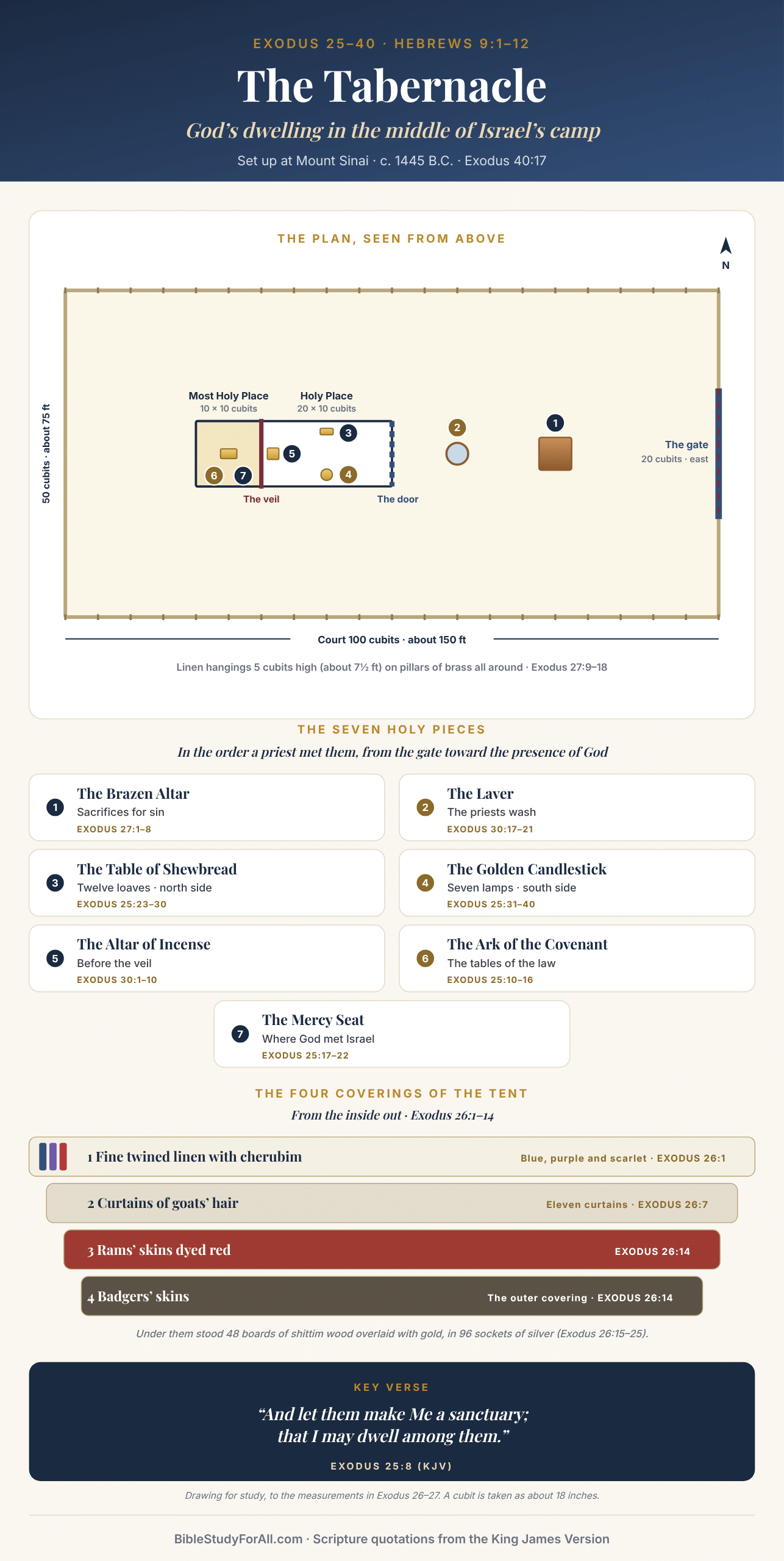
Drawing for study, drawn to the measurements in Exodus 26–27 with a cubit of about 18 inches. North is at the top and the gate faces east.
Exodus 25–30
The Seven Holy Pieces of Furniture
Coming in through the gate, a priest met each piece in this order, moving from the court toward the presence of God.
1 THE COURT
The Brazen Altar
Shittim wood overlaid with brass, 5 cubits square. Sacrifices for sin.
“And thou shalt make an altar of shittim wood, five cubits long, and five cubits broad”
EXODUS 27:1
2 THE COURT
The Laver
A basin of brass for the priests to wash.
“Thou shalt also make a laver of brass, and his foot also of brass, to wash withal”
EXODUS 30:18
3 THE HOLY PLACE
The Table of Shewbread
Twelve loaves, one for each tribe, on the north side.
“And thou shalt set upon the table shewbread before Me alway.”
EXODUS 25:30
4 THE HOLY PLACE
The Golden Candlestick
Seven lamps of pure gold on the south side.
“And thou shalt make a candlestick of pure gold”
EXODUS 25:31
5 THE HOLY PLACE
The Altar of Incense
Sweet incense burned morning and evening before the veil.
“And thou shalt put it before the vail that is by the ark of the testimony”
EXODUS 30:6
6 THE MOST HOLY PLACE
The Ark of the Covenant
A gold-covered chest holding the tables of the law.
“And they shall make an ark of shittim wood”
EXODUS 25:10
7 THE MOST HOLY PLACE
The Mercy Seat
The lid of pure gold with two cherubim, where God met Israel.
“And thou shalt make a mercy seat of pure gold”
EXODUS 25:17
For a full study of the Ark and the mercy seat, with a labelled drawing and a map of the Ark’s journey, see The Ark of the Covenant.
Exodus 26 · 27
The Coverings, Walls and Court
From the outside the tabernacle looked plain. Its beauty was all on the inside.
COVERING 1 · INSIDE
Fine Linen with Cherubim
Ten curtains of blue, purple and scarlet.
“with cherubims of cunning work shalt thou make them.”
EXODUS 26:1
COVERING 2
Goats’ Hair
Eleven curtains laid over the linen.
“And thou shalt make curtains of goats’ hair to be a covering upon the tabernacle”
EXODUS 26:7
COVERINGS 3 AND 4
Rams’ Skins and Badgers’ Skins
Red rams’ skins, then a tough outer layer.
“a covering for the tent of rams’ skins dyed red, and a covering above of badgers’ skins.”
EXODUS 26:14
THE WALLS
48 Gold-Covered Boards
Each 10 cubits tall, in two sockets of silver.
“And thou shalt make boards for the tabernacle of shittim wood standing up.”
EXODUS 26:15
THE VEIL
Between Holy and Most Holy
Blue, purple and scarlet, with cherubim.
“and the vail shall divide unto you between the holy place and the most holy.”
EXODUS 26:33
THE COURT
Linen Hangings and One Gate
100 × 50 cubits; a 20-cubit gate on the east.
“The length of the court shall be an hundred cubits, and the breadth fifty every where”
EXODUS 27:18
Numbers 2 · 3
How Israel Camped Around the Tabernacle
God placed His dwelling in the middle of the camp. Three tribes camped on each side, and the Levites camped closest of all.
EAST · TOWARD THE SUNRISING
Judah, Issachar, Zebulun
Judah led the march. Moses, Aaron and the priests camped before the gate.
NUMBERS 2:3–9 · 3:38
SOUTH
Reuben, Simeon, Gad
The Levite family of Kohath, who carried the holy furniture, camped on this side.
NUMBERS 2:10–16 · 3:29
WEST
Ephraim, Manasseh, Benjamin
The Levite family of Gershon, who carried the curtains, camped on this side.
NUMBERS 2:18–24 · 3:23
NORTH
Dan, Asher, Naphtali
The Levite family of Merari, who carried the boards, camped on this side.
NUMBERS 2:25–31 · 3:35
“Every man of the children of Israel shall pitch by his own standard, with the ensign of their father’s house: far off about the tabernacle of the congregation shall they pitch.”Numbers 2:2 (KJV)
The New Testament
How the Tabernacle Points to Jesus
Hebrews calls the tabernacle “a figure for the time then present” (Hebrews 9:9). Each part finds its meaning in Christ.
The Tabernacle
One gate into the court
EXODUS 27:16
Fulfilled in Christ
“I am the door: by Me if any man enter in, he shall be saved”
JOHN 10:9
The Tabernacle
The brazen altar of sacrifice
EXODUS 27:1
Fulfilled in Christ
“Behold the Lamb of God, which taketh away the sin of the world.”
JOHN 1:29
The Tabernacle
The laver for washing
EXODUS 30:19
Fulfilled in Christ
“by the washing of regeneration, and renewing of the Holy Ghost”
TITUS 3:5
The Tabernacle
The bread on the table
LEVITICUS 24:5
Fulfilled in Christ
“I am the bread of life”
JOHN 6:35
The Tabernacle
The golden candlestick
EXODUS 25:37
Fulfilled in Christ
“I am the light of the world”
JOHN 8:12
The Tabernacle
The incense rising before God
EXODUS 30:8
Fulfilled in Christ
“He ever liveth to make intercession for them.”
HEBREWS 7:25
The Tabernacle
The veil before the Most Holy Place
EXODUS 26:31
Fulfilled in Christ
“through the veil, that is to say, His flesh”
HEBREWS 10:20
The Tabernacle
The mercy seat and the blood
LEVITICUS 16:14
Fulfilled in Christ
“Whom God hath set forth to be a propitiation through faith in His blood”
ROMANS 3:25
“But Christ being come an high priest of good things to come, by a greater and more perfect tabernacle, not made with hands, that is to say, not of this building.”Hebrews 9:11 (KJV)
For Today
What the Tabernacle Teaches Us Today
The tent is gone, but the God who dwelt in it now lives in His people.
1
There Is One Way to God
One gate, one door, one Saviour.
“I am the way, the truth, and the life: no man cometh unto the Father, but by Me.”
JOHN 14:6
2
Come Boldly Through Jesus
The veil is open to every believer.
“Having therefore, brethren, boldness to enter into the holiest by the blood of Jesus”
HEBREWS 10:19
3
You Are God’s Temple
The Spirit now dwells in His people.
“Know ye not that ye are the temple of God, and that the Spirit of God dwelleth in you?”
1 CORINTHIANS 3:16
4
Give Willingly
Israel gave so freely they had to be stopped.
“for God loveth a cheerful giver.”
2 CORINTHIANS 9:7
5
Follow His Leading
Move when God moves; rest when He rests.
“In all thy ways acknowledge Him, and He shall direct thy paths.”
PROVERBS 3:6
6
Look Forward to Heaven
God will dwell with His people for ever.
“Behold, the tabernacle of God is with men, and He will dwell with them”
REVELATION 21:3
Bible Study
Read About the Tabernacle in Scripture
The tabernacle fills the last sixteen chapters of Exodus, shapes Leviticus and Numbers, and is explained in the book of Hebrews. These passages gather the key ones in five parts. Tap a part below to jump to it, tap any section to expand it, and tap a verse reference to read it in the King James Version at BibleGateway.
Part I
The Pattern Given
Exodus 25–27 · God shows Moses the plan on the mount.
- Make Me a sanctuary · Exodus 25:1–9
- I will dwell among them · Exodus 29:42–46
- The Ark and the mercy seat · Exodus 25:10–22
- The table of shewbread · Exodus 25:23–30
- The golden candlestick · Exodus 25:31–40
- Curtains and coverings · Exodus 26:1–14
- Boards and sockets · Exodus 26:15–30
- The veil and the door · Exodus 26:31–37
- The altar of burnt offering · Exodus 27:1–8
- The court and its gate · Exodus 27:9–19
- Oil for the lamp · Exodus 27:20–21
Part II
Priests and Holy Things
Exodus 28–31 · The priests, the incense altar and the builders.
- Holy garments for Aaron · Exodus 28:1–4
- The priests consecrated · Exodus 29:1–9
- The altar of incense · Exodus 30:1–10
- The atonement money · Exodus 30:11–16
- The laver of brass · Exodus 30:17–21
- The anointing oil and incense · Exodus 30:22–38
- Bezaleel and Aholiab · Exodus 31:1–11
Part III
Built and Filled
Exodus 35–40 · Israel gives, builds and sets it up.
- The people’s offering · Exodus 35:4–29
- More than enough · Exodus 36:1–7
- The tent made · Exodus 36:8–38
- The furniture made · Exodus 37:1–29
- The altar, laver and court · Exodus 38:1–20
- The gold, silver and brass · Exodus 38:21–31
- Moses blesses the work · Exodus 39:32–43
- The tabernacle reared up · Exodus 40:1–33
- The glory fills the tabernacle · Exodus 40:34–38
Part IV
Worship and Wilderness
Leviticus – 1 Kings · The Day of Atonement, the camp and the land.
- Fire from the LORD · Leviticus 9:22–24
- The Day of Atonement · Leviticus 16:1–34
- The lamps and the shewbread · Leviticus 24:1–9
- The Levites keep the tabernacle · Numbers 1:47–54
- The tribes around it · Numbers 2:1–34
- Carrying the tabernacle · Numbers 4:1–33
- The cloud leads Israel · Numbers 9:15–23
- Set up at Shiloh · Joshua 18:1
- The tabernacle at Gibeon · 1 Chronicles 16:37–40
- Brought into Solomon’s temple · 1 Kings 8:1–11
Part V
Fulfilled in Christ
John – Revelation · The true tabernacle and God dwelling with men.
- The Word made flesh · John 1:14–18
- The temple of His body · John 2:18–22
- The veil rent in twain · Matthew 27:50–51
- The pattern shewed in the mount · Hebrews 8:1–6
- A greater and more perfect tabernacle · Hebrews 9:1–14
- Into heaven itself · Hebrews 9:23–28
- A new and living way · Hebrews 10:19–25
- Ye are the temple of God · 1 Corinthians 3:16–17
- The tabernacle of God is with men · Revelation 21:1–7
Questions
Questions About the Tabernacle
What was the tabernacle in the Bible?
It was the holy tent God told Moses to build at Mount Sinai, so that He could dwell among Israel (Exodus 25:8). It had a court of linen hangings, an altar and a laver, and a gold-covered tent with two rooms, the Holy Place and the Most Holy Place. Israel carried it through the wilderness and set it up wherever the cloud of God’s presence rested.
How big was the tabernacle?
The court was 100 cubits long and 50 cubits wide, with hangings 5 cubits high (Exodus 27:18), about 150 by 75 feet with walls about 7½ feet high. The tent was 30 cubits long, 10 wide and 10 high, about 45 by 15 by 15 feet. The Holy Place took 20 cubits of its length, and the Most Holy Place was a cube of 10 cubits (about 15 feet) each way.
What furniture was in the tabernacle?
Seven holy pieces: in the court, the brazen altar of burnt offering and the laver of brass; in the Holy Place, the table of shewbread, the golden candlestick and the golden altar of incense; and in the Most Holy Place, the Ark of the Covenant with the mercy seat on top (Exodus 25–30; Hebrews 9:2–5).
Why did God give such exact details?
Because the tabernacle was a copy of something real in heaven, and a picture of Christ. Moses was told, “See, saith He, that thou make all things according to the pattern shewed to thee in the mount” (Hebrews 8:5). The exact details also taught Israel that God must be worshipped His way, not man’s way.
What happened to the tabernacle?
After Israel entered the land it was set up at Shiloh (Joshua 18:1) and later stood at Gibeon (1 Chronicles 21:29). When Solomon finished the temple about 959 B.C., the priests brought up “the tabernacle of the congregation, and all the holy vessels that were in the tabernacle” into the temple (1 Kings 8:4). The temple took its place as God’s house in Jerusalem.
What is the difference between the tabernacle and the temple?
The tabernacle was a portable tent made in the wilderness by Moses, about 1445 B.C. The temple was a permanent house of stone and cedar built in Jerusalem by Solomon, about 959 B.C. (1 Kings 6). The temple followed the same plan, a court, a Holy Place and a Most Holy Place, but on a larger scale.
How does the tabernacle point to Jesus?
John says the Word “was made flesh, and dwelt among us” (John 1:14), literally pitched His tent among us. Jesus is the one door (John 10:9), the sacrifice on the altar (Hebrews 10:10), the bread of life (John 6:35), the light of the world (John 8:12) and our High Priest who “ever liveth to make intercession” (Hebrews 7:25). His body was the true veil, torn so that we may enter God’s presence (Hebrews 10:19–20).
Keep Studying
Related Studies
From Egypt to Mount Sinai, where God gave Moses the pattern of the tabernacle.
The gold-covered chest in the Most Holy Place, with a map of its journey.
Continue Your Study
Scripture quotations and verse links are from the King James Version (KJV).