
Key Christian Terms · In Plain Words
Incarnation: God Became a Man
The incarnation means that God the Son became a real human being, Jesus, without ceasing to be God.
At Christmas we celebrate the most surprising event in history: the Creator stepped into his creation as a baby. Jesus is not part God and part man, but fully both.
“And the Word was made flesh, and dwelt among us, (and we beheld his glory, the glory as of the only begotten of the Father,) full of grace and truth.”
John 1:14 (KJV)
In Plain Words
What Does Incarnation Mean?
In one sentence
The incarnation means that God the Son became a real human being, Jesus, without ceasing to be God.
The word comes from Latin and means “in the flesh.” It describes what John says in one short sentence: “the Word was made flesh, and dwelt among us” (John 1:14). The eternal Son of God, who “was with God, and … was God” (John 1:1), took on a human body and a human life.
He did not stop being God, and he did not just look human. He was born, grew up, got tired, felt hunger, wept and died. Yet he forgave sins, calmed storms and rose from the dead. In Jesus, “dwelleth all the fulness of the Godhead bodily” (Colossians 2:9).
The word itself: “Incarnation” comes from the Latin in carne, in the flesh. The idea is in the Greek of John 1:14, ho logos sarx egeneto, “the Word became flesh.” Isaiah’s prophecy gave him the name Immanuel, “God with us” (Matthew 1:23).
Three Things the Bible Says About Jesus
Truly God
Jesus existed before Abraham, forgave sins, received worship, and was called “My Lord and my God.”
Truly man
He was born of Mary, grew in wisdom and stature, got tired, hungry and thirsty, and wept at a friend’s grave.
For us
He became like us to save us: to die in our place, to understand our weakness, and to show us the Father.
An Everyday Picture
A King Who Moved In
Imagine a king who hears that people in the poorest part of his kingdom are suffering. Instead of sending a message, he leaves the palace, lays aside his royal robes, and moves into their street. He eats their food, shares their hardships and fights for them from the inside.
That is a faint picture of the incarnation. Jesus “though he was rich, yet for your sakes he became poor, that ye through his poverty might be rich” (2 Corinthians 8:9). He did not stop being King; he chose to come close.
John 1:14 · Colossians 2:9
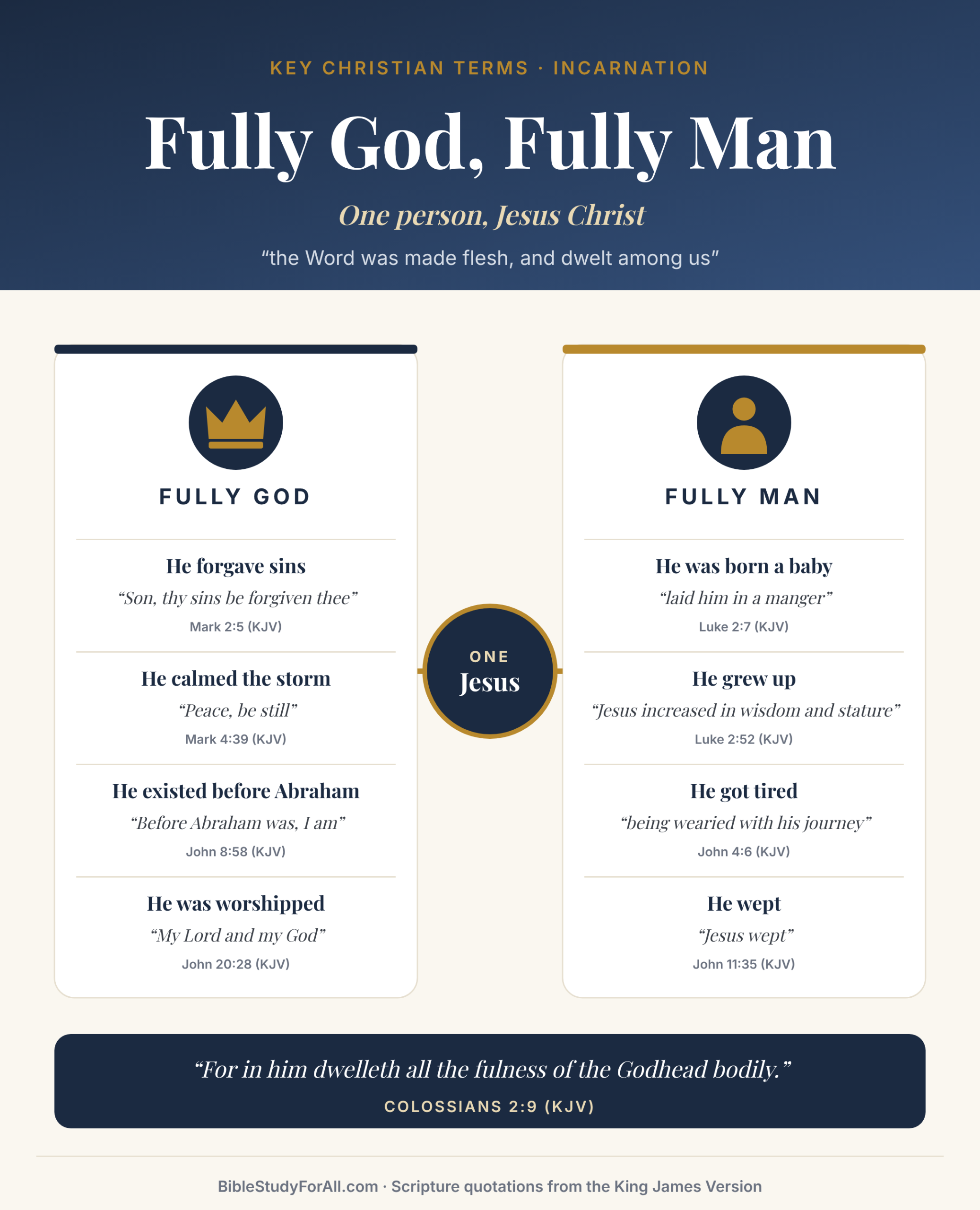
Fully God, Fully Man
The Gospels show both sides of who Jesus is, often in the same story. Here they are side by side.
What the Bible Says
Three Key Verses
John 1:14
“And the Word was made flesh, and dwelt among us, (and we beheld his glory, the glory as of the only begotten of the Father,) full of grace and truth.”
In plain words: God did not stay far away. He became one of us and lived among us.
Philippians 2:7
“But made himself of no reputation, and took upon him the form of a servant, and was made in the likeness of men.”
In plain words: Jesus humbled himself and became a servant, fully human.
Hebrews 4:15
“For we have not an high priest which cannot be touched with the feeling of our infirmities; but was in all points tempted like as we are, yet without sin.”
In plain words: Jesus understands our weakness from the inside, yet he never sinned.
Clearing It Up
What It Is and What It Isn’t
A common mix-up
“Jesus was a great man, but not God.”
Jesus accepted Thomas’s words “My Lord and my God” (John 20:28) and said, “Before Abraham was, I am” (John 8:58), using God’s own name.
A common mix-up
“Jesus was God who only seemed human.”
The Bible insists he was truly flesh. “Every spirit that confesseth that Jesus Christ is come in the flesh is of God” (1 John 4:2). He really hungered, thirsted, suffered and died.
A common mix-up
“He stopped being God while on earth.”
He set aside his glory and rights, not his nature. “In him dwelleth all the fulness of the Godhead bodily” (Colossians 2:9).
How It Connects
Incarnation and the Other Big Words
The Bible’s big words are not separate ideas. They are different angles on one story: what God has done for us in Jesus.
The Son, one person of the Trinity, became man.
He became human so he could die in our place.
“Thou shalt call his name JESUS: for he shall save his people.”
Our kinsman-redeemer had to become our kin.
The incarnation is grace: God coming to us.
Jesus is the promised Son of David, the forever King.
Living It Out
Putting It into Practice
1
Worship Jesus as God
Read John 1:1–18 slowly and thank God that the Word became flesh. Let Christmas be about him all year long.
2
Bring him your weakness
Jesus knows what it is to be tired, tempted and grieving. Pray honestly, knowing he understands (Hebrews 4:15–16).
3
Follow his humility
“Let this mind be in you, which was also in Christ Jesus” (Philippians 2:5). Look for a humble way to serve someone this week.
Questions
Quick Questions
How can Jesus be both God and man?
It is a mystery: “great is the mystery of godliness: God was manifest in the flesh” (1 Timothy 3:16). In A.D. 451 the Council of Chalcedon summed up what the Bible teaches: Jesus is one person with two natures, fully divine and fully human, not mixed and not divided. Catholic, Orthodox and Protestant churches hold this teaching.
What is the virgin birth?
The Bible teaches that Jesus was conceived by the Holy Spirit and born of Mary, a virgin, without a human father. The angel told her, “The Holy Ghost shall come upon thee, and the power of the Highest shall overshadow thee: therefore also that holy thing which shall be born of thee shall be called the Son of God” (Luke 1:35). Matthew connects it with Isaiah 7:14 (Matthew 1:22–23).
Is Jesus still human now?
Yes. Jesus rose bodily, ate with his disciples, and ascended in his resurrected body (Luke 24:39–43; Acts 1:9–11). He remains the God-man forever, our high priest who understands us, and he will return “in like manner” (Acts 1:11).
Why did God become a man?
To save us. Only a human could rightly stand in our place, and only God could pay sin’s full price and defeat death. Hebrews says he took “part of the same; that through death he might destroy him that had the power of death” (Hebrews 2:14). He also came to show us what God is like: “he that hath seen me hath seen the Father” (John 14:9).
Keep Reading
Continue Your Study
Read the key passages for yourself, then explore the Bible books and topics where incarnation comes up most.
Scripture quotations are from the King James Version (KJV), which is in the public domain. Verse links open at BibleGateway.