
Matthew 13 · Mark 4 · Luke 10 · Luke 15 · Matthew 25 · Bible Study
The Parables of Jesus
Earthly Stories with Heavenly Meaning
Jesus often taught in parables, short stories from everyday life such as a farmer sowing seed, a lost sheep or a son who came home. Each one carries a truth about the kingdom of God, His grace to sinners, and how His people should live and wait for His return.
About the Parables
The Parables at a Glance
Bible Study
Note: Scripture quotations and verse links on this site use the King James Version (KJV) because it is in the public domain, while most modern translations limit how much can be quoted online. Feel free to read along in the translation of your choice.
About Forty Parables
In Matthew, Mark and Luke
The First Great One
The sower (Matthew 13:3)
The Best Loved
The prodigal son (Luke 15:11–32)
Jesus’ Call
“Who hath ears to hear, let him hear” (Matthew 13:9)
About the Parables
What Is a Parable?
What a Parable Is
An Earthly Story with a Heavenly Meaning
A parable is a short story taken from everyday life that is laid beside a spiritual truth to teach it. The word comes from a Greek word meaning to throw alongside.
Jesus used things His hearers saw every day: seed and soil, sheep and shepherds, coins, bread, weddings, vineyards and servants. A farmer could not watch a sower again without remembering the parable of the sower. The Old Testament has parables too, as when the prophet Nathan told David about a rich man who took a poor man’s lamb, and then said, “Thou art the man” (2 Samuel 12:7).
Matthew says, “All these things spake Jesus unto the multitude in parables; and without a parable spake He not unto them” (Matthew 13:34). He taught this way to fulfil what was written: “I will open My mouth in parables” (13:35; Psalm 78:2).
Why Jesus Used Them
To Reveal and to Conceal
Parables opened the truth to those who wanted it and hid it from those who had hardened their hearts. Jesus explained them privately to His disciples, who came asking.
The disciples asked, “Why speakest Thou unto them in parables?” Jesus answered, “Because it is given unto you to know the mysteries of the kingdom of heaven, but to them it is not given” (Matthew 13:10–11). “Therefore speak I to them in parables: because they seeing see not; and hearing they hear not, neither do they understand” (13:13).
A parable is a test of the heart. Those who were hungry for truth came back and asked, and “when they were alone, He expounded all things to His disciples” (Mark 4:34). Those who did not care went home with only a story. So Jesus kept saying, “Who hath ears to hear, let him hear” (Matthew 13:9).
How to Read One
Look for the Main Point
Look for the one main lesson Jesus is teaching, often stated just before or after the story. Not every detail carries a hidden meaning. Let Jesus’ own explanation guide you.
Read what led up to the parable. Luke 15 begins with the Pharisees complaining, “This man receiveth sinners, and eateth with them” (Luke 15:2), and the three parables that follow answer them. Luke 18 tells us the purpose before the story: “that men ought always to pray, and not to faint” (18:1).
When Jesus explains a parable Himself, as He did the sower (Matthew 13:18–23) and the tares (13:36–43), that explanation is the key. Then ask how the truth applies to you, as Jesus told the lawyer after the good Samaritan: “Go, and do thou likewise” (Luke 10:37).
Key Verse
I Will Open My Mouth in Parables
“All these things spake Jesus unto the multitude in parables; and without a parable spake He not unto them: that it might be fulfilled which was spoken by the prophet, saying, I will open My mouth in parables; I will utter things which have been kept secret from the foundation of the world.”
Matthew 13:34–35 (KJV)
Key Themes
Six Truths the Parables Teach
Jesus told many parables, but they return again and again to six great truths.
1
The Kingdom Grows
From a tiny seed to a great tree.
“The kingdom of heaven is like to a grain of mustard seed”
MATTHEW 13:31
2
Hear and Bear Fruit
The heart is the soil where God’s Word grows.
“But he that received seed into the good ground is he that heareth the word, and understandeth it; which also beareth fruit”
MATTHEW 13:23
3
God Seeks the Lost
Heaven rejoices over one sinner who repents.
“there is joy in the presence of the angels of God over one sinner that repenteth.”
LUKE 15:10
4
Grace, Not Merit
The humble sinner goes home justified.
“God be merciful to me a sinner.”
LUKE 18:13
5
Love Your Neighbour
Show mercy to anyone in need.
“Go, and do thou likewise.”
LUKE 10:37
6
Be Ready for His Return
Watch, and be faithful until He comes.
“Watch therefore, for ye know neither the day nor the hour wherein the Son of man cometh.”
MATTHEW 25:13
From the Sower to the Talents
What the Bible Says About the Parables of Jesus
Matthew 13:1–9The Parable of the Sower
One day Jesus sat in a boat and taught the crowd on the shore: “Behold, a sower went forth to sow” (Matthew 13:3). Some seed fell by the way side and the birds ate it; some fell on stony places and withered; some fell among thorns and was choked; “But other fell into good ground, and brought forth fruit, some an hundredfold, some sixtyfold, some thirtyfold” (13:8). Jesus explained that the seed is “the word of the kingdom” (13:19) and the soils are the hearts of those who hear it.
Matthew 13:10–17Why Jesus Spoke in Parables
The disciples asked why He taught this way. Jesus said the parables fulfilled Isaiah’s words about people whose hearts had grown hard: “By hearing ye shall hear, and shall not understand” (Matthew 13:14). To those who came to Him, more would be given. “But blessed are your eyes, for they see: and your ears, for they hear” (13:16). Many prophets and righteous men had longed to see what the disciples saw, and had not seen it (13:17).
Matthew 13:24–52The Kingdom of Heaven Is Like…
In Matthew 13 Jesus told seven parables of the kingdom. The tares sown among the wheat show good and evil growing together until the harvest at “the end of the world” (13:39–40). The mustard seed and the leaven show the kingdom starting small and spreading everywhere (13:31–33). The hidden treasure and the pearl of great price show that the kingdom is worth more than everything we own (13:44–46). The net that gathered every kind shows that the angels will “sever the wicked from among the just” (13:49).
Luke 15The Lost Sheep, the Lost Coin and the Lost Son
When the Pharisees grumbled that Jesus received sinners, He told three parables. A shepherd leaves ninety-nine sheep to find one, and “joy shall be in heaven over one sinner that repenteth” (Luke 15:7). A woman sweeps her house to find one lost piece of silver (15:8–10). A younger son wastes his inheritance, comes to himself and goes home, and “when he was yet a great way off, his father saw him, and had compassion, and ran, and fell on his neck, and kissed him” (15:20). The elder brother who would not rejoice is a picture of the grumbling Pharisees (15:28–32).
Luke 10:25–37The Good Samaritan
A lawyer asked Jesus, “And who is my neighbour?” (Luke 10:29). Jesus told of a man beaten by thieves on the road from Jerusalem to Jericho. A priest and a Levite passed by on the other side, “But a certain Samaritan, as he journeyed, came where he was: and when he saw him, he had compassion on him” (10:33). He bound up his wounds, took him to an inn and paid for his care. The neighbour is the one who shows mercy, and Jesus said, “Go, and do thou likewise” (10:37).
Luke 11 · 18Parables About Prayer
Jesus taught His disciples to keep praying. A man knocks at his friend’s door at midnight to borrow three loaves, and the friend gets up and gives them “because of his importunity” (Luke 11:8). So, said Jesus, “Ask, and it shall be given you; seek, and ye shall find; knock, and it shall be opened unto you” (11:9). A widow kept coming to an unjust judge until he gave her justice, and Jesus asked, “And shall not God avenge His own elect, which cry day and night unto Him?” (18:7).
Luke 18:9–14 · Matthew 20Grace for the Humble
Jesus told a parable “unto certain which trusted in themselves that they were righteous” (Luke 18:9). A Pharisee in the temple thanked God that he was not like other men, but a publican stood far off, beat upon his breast and prayed, “God be merciful to me a sinner” (18:13). Jesus said the publican “went down to his house justified rather than the other” (18:14). In the parable of the labourers in the vineyard, those hired at the last hour received the same wage as those who worked all day, for God gives by grace: “So the last shall be first, and the first last” (Matthew 20:16).
Luke 12 · Matthew 18Riches and Forgiveness
A rich farmer planned to pull down his barns and build greater, and said to his soul, “take thine ease, eat, drink, and be merry.” “But God said unto him, Thou fool, this night thy soul shall be required of thee” (Luke 12:19–20). “So is he that layeth up treasure for himself, and is not rich toward God” (12:21). In another parable a servant forgiven a debt of ten thousand talents would not forgive a fellowservant a hundred pence, and his lord said, “Shouldest not thou also have had compassion on thy fellowservant, even as I had pity on thee?” (Matthew 18:33).
Matthew 21–22Parables of Warning
In the last week before the cross Jesus told parables to the religious leaders in the temple. Two sons were told to work in the vineyard; the one who said no but later went did his father’s will (Matthew 21:28–31). Wicked husbandmen beat the owner’s servants and killed his son, and Jesus warned, “The stone which the builders rejected, the same is become the head of the corner” (21:42). A king made a marriage for his son, but those invited would not come: “For many are called, but few are chosen” (22:14).
Matthew 24–25Ready for the Master’s Return
On the Mount of Olives Jesus taught His disciples to be ready for His coming. Five wise virgins had oil in their lamps when the bridegroom came at midnight, and five foolish ones did not; “and the door was shut” (Matthew 25:10). “Watch therefore, for ye know neither the day nor the hour wherein the Son of man cometh” (25:13). In the parable of the talents, servants who used what their lord gave them heard, “Well done, thou good and faithful servant” (25:21). Until Christ returns, His people are to be watchful and faithful with all He has given them.
At a Glance
The Parables at a Glance
The parables of Jesus on one page: what a parable is and why Jesus used them, a chart of thirty parables, the parables of the kingdom, the parables of grace and the lost, how to love your neighbour and pray, the parables about His return, and what they mean for us today. Tap a topic to jump to it.
Printable Copy
Save or Print the Infographic
Everything in this section, with the key verse and key themes, is also on a printable infographic (five pages). It opens in a new tab, where you can save it to your phone or computer, share it, or print it.
Matthew 13 · Mark 4
Why Jesus Taught in Parables
The Gospels tell us plainly why Jesus taught this way and how His hearers were to listen.
FORETOLD
Spoken by the Prophet
The Messiah would teach in parables.
“I will open My mouth in a parable: I will utter dark sayings of old”
PSALM 78:2
TO REVEAL
Given to the Disciples
Truth for those who come to Him.
“it is given unto you to know the mysteries of the kingdom of heaven”
MATTHEW 13:11
TO CONCEAL
Hidden from Hard Hearts
Those who refused the light lost it.
“because they seeing see not; and hearing they hear not, neither do they understand.”
MATTHEW 13:13
EXPLAINED
Opened in Private
He explained them to all who asked.
“and when they were alone, He expounded all things to His disciples.”
MARK 4:34
TO REMEMBER
Pictures from Daily Life
Seed, sheep, coins and bread.
“Behold, a sower went forth to sow”
MATTHEW 13:3
TO OBEY
Ears to Hear
A parable calls for a response.
“Who hath ears to hear, let him hear.”
MATTHEW 13:9
Chart
The Parables of Jesus Chart
Thirty of Jesus’ parables in four groups, each with its main lesson and where to read it in the King James Version.
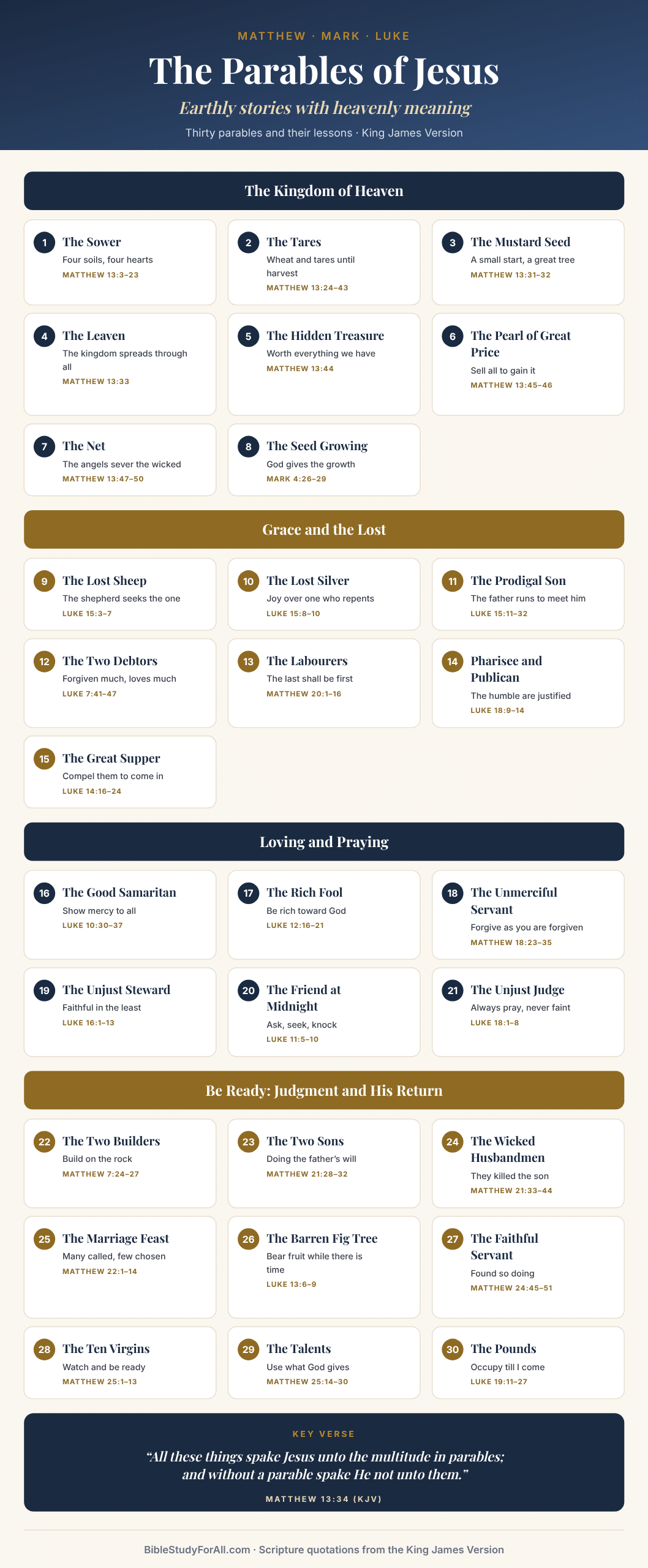
Matthew 13
The Parables of the Kingdom
In one day by the sea Jesus told seven parables about the kingdom of heaven: how it comes, how it grows, and how much it is worth.
THE SOWER
Four Kinds of Ground
Only the good ground bears fruit.
“But other fell into good ground, and brought forth fruit”
MATTHEW 13:8
THE TARES
Wheat and Tares
Good and evil grow together until the harvest.
“Let both grow together until the harvest”
MATTHEW 13:30
THE MUSTARD SEED
Small Beginnings
The smallest seed becomes a tree.
“The kingdom of heaven is like to a grain of mustard seed, which a man took, and sowed in his field”
MATTHEW 13:31
THE LEAVEN
Quiet Growth
The kingdom works its way through all.
“till the whole was leavened.”
MATTHEW 13:33
THE TREASURE AND THE PEARL
Worth Everything
Gladly give all to have it.
“and for joy thereof goeth and selleth all that he hath, and buyeth that field.”
MATTHEW 13:44
THE NET
The Final Sorting
The angels will separate the wicked from the just.
“So shall it be at the end of the world”
MATTHEW 13:49
Luke 15 · Luke 18
Parables of Grace and the Lost
These parables show the heart of God, who seeks sinners, forgives freely and welcomes the humble.
THE LOST SHEEP
The Shepherd Seeks the One
He leaves the ninety and nine.
“and go after that which is lost, until he find it?”
LUKE 15:4
THE LOST SILVER
Sweep Until It Is Found
One lost coin matters.
“there is joy in the presence of the angels of God over one sinner that repenteth.”
LUKE 15:10
THE PRODIGAL SON
The Father Runs
A son comes home to a welcome.
“For this my son was dead, and is alive again; he was lost, and is found.”
LUKE 15:24
THE TWO DEBTORS
Forgiven Much
The one forgiven most loves most.
“Her sins, which are many, are forgiven; for she loved much”
LUKE 7:47
THE PHARISEE AND THE PUBLICAN
The Humble Go Home Justified
God hears the sinner who asks for mercy.
“and he that humbleth himself shall be exalted.”
LUKE 18:14
THE GREAT SUPPER
Come, for All Is Ready
The invitation goes out to all.
“Go out into the highways and hedges, and compel them to come in”
LUKE 14:23
“For the Son of man is come to seek and to save that which was lost.”Luke 19:10 (KJV)
Luke 10 · 11 · 12 · 16 · 18
Parables About Loving and Praying
Jesus used parables to show how His people should treat others, use their money and keep on praying.
THE GOOD SAMARITAN
Who Is My Neighbour?
Anyone who needs our mercy.
“and when he saw him, he had compassion on him”
LUKE 10:33
THE RICH FOOL
Rich Toward God
Life is more than possessions.
“So is he that layeth up treasure for himself, and is not rich toward God.”
LUKE 12:21
THE UNMERCIFUL SERVANT
Forgive from the Heart
We have been forgiven far more.
“Shouldest not thou also have had compassion on thy fellowservant, even as I had pity on thee?”
MATTHEW 18:33
THE UNJUST STEWARD
Faithful in Little
Use earthly things with heaven in view.
“He that is faithful in that which is least is faithful also in much”
LUKE 16:10
THE FRIEND AT MIDNIGHT
Keep Asking
Bold, persistent prayer.
“Ask, and it shall be given you; seek, and ye shall find; knock, and it shall be opened unto you.”
LUKE 11:9
THE UNJUST JUDGE
Never Give Up
God will answer His people.
“that men ought always to pray, and not to faint”
LUKE 18:1
Matthew 21–25 · Luke 19
Parables About Judgment and His Return
Many of Jesus’ last parables warn the proud and call His followers to be ready and faithful until He comes again.
THE TWO BUILDERS
Build on the Rock
Hear Jesus’ words and do them.
“I will liken him unto a wise man, which built his house upon a rock”
MATTHEW 7:24
THE WICKED HUSBANDMEN
The Rejected Stone
The leaders rejected God’s Son.
“The stone which the builders rejected, the same is become the head of the corner”
MATTHEW 21:42
THE MARRIAGE FEAST
Many Are Called
Come in the garment the King provides.
“For many are called, but few are chosen.”
MATTHEW 22:14
THE TEN VIRGINS
Keep Your Lamp Burning
The bridegroom came at midnight.
“and they that were ready went in with him to the marriage: and the door was shut.”
MATTHEW 25:10
THE TALENTS
Well Done
Use what the Master has given you.
“Well done, thou good and faithful servant”
MATTHEW 25:21
THE POUNDS
Occupy Till I Come
Stay busy for the absent King.
“Occupy till I come.”
LUKE 19:13
“Blessed is that servant, whom his lord when he cometh shall find so doing.”Matthew 24:46 (KJV)
For Today
What the Parables Teach Us Today
Jesus did not tell stories only to be enjoyed. Each one calls for a response.
1
Be Good Ground
Receive the Word and let it grow.
“But be ye doers of the word, and not hearers only”
JAMES 1:22
2
Come Home to the Father
No one is too far gone.
“I will arise and go to my father”
LUKE 15:18
3
Seek the Kingdom First
It is worth more than anything.
“But seek ye first the kingdom of God, and His righteousness”
MATTHEW 6:33
4
Show Mercy
Be a neighbour to those in need.
“Blessed are the merciful: for they shall obtain mercy.”
MATTHEW 5:7
5
Forgive Freely
As God for Christ’s sake forgave you.
“forgiving one another, even as God for Christ’s sake hath forgiven you.”
EPHESIANS 4:32
6
Watch and Be Faithful
Live ready for His return.
“Therefore be ye also ready: for in such an hour as ye think not the Son of man cometh.”
MATTHEW 24:44
Bible Study
Read the Parables in Scripture
The parables are found in Matthew, Mark and Luke. These passages gather the key ones in five parts, in the order of the chart above. Tap a part below to jump to it, tap any section to expand it, and tap a verse reference to read it in the King James Version at BibleGateway.
Part I
Parables of the Kingdom
Matthew 13 · Mark 4 · How the kingdom comes and grows.
- A sower went forth to sow · Matthew 13:1–9
- Why speakest Thou in parables? · Matthew 13:10–17
- The sower explained · Matthew 13:18–23
- The seed growing secretly · Mark 4:26–29
- The mustard seed and the leaven · Matthew 13:31–35
- The tares among the wheat · Matthew 13:24–30
- The tares explained · Matthew 13:36–43
- The treasure and the pearl · Matthew 13:44–46
- The net · Matthew 13:47–52
Part II
Grace and the Lost
Luke 7 · 14 · 15 · God seeks and welcomes sinners.
- The lost sheep · Luke 15:1–7
- The lost piece of silver · Luke 15:8–10
- The prodigal son · Luke 15:11–32
- The two debtors · Luke 7:36–50
- The great supper · Luke 14:15–24
- The labourers in the vineyard · Matthew 20:1–16
- The Pharisee and the publican · Luke 18:9–14
Part III
Loving and Praying
Luke 10–18 · Matthew 18 · Mercy, money and persistent prayer.
- The good Samaritan · Luke 10:25–37
- The unmerciful servant · Matthew 18:21–35
- The rich fool · Luke 12:13–21
- The unjust steward · Luke 16:1–13
- The friend at midnight · Luke 11:5–13
- The unjust judge · Luke 18:1–8
Part IV
Parables of Warning
Matthew 7 · 21–22 · Luke 13 · Hear, obey and bear fruit.
- The wise and foolish builders · Matthew 7:24–29
- The barren fig tree · Luke 13:6–9
- The two sons · Matthew 21:28–32
- The wicked husbandmen · Matthew 21:33–46
- The marriage of the king’s son · Matthew 22:1–14
- Nathan: Thou art the man · 2 Samuel 12:1–13
- I will open My mouth in a parable · Psalm 78:1–4
Part V
Ready for His Return
Matthew 24–25 · Luke 19 · Watch, and be faithful until He comes.
- The faithful and wise servant · Matthew 24:42–51
- The ten virgins · Matthew 25:1–13
- The talents · Matthew 25:14–30
- The pounds · Luke 19:11–27
- No man knoweth the day · Matthew 24:36–41
- Let your loins be girded · Luke 12:35–40
Questions
Questions About the Parables of Jesus
What is a parable?
A parable is a short story from everyday life that teaches a spiritual truth. It is often called an earthly story with a heavenly meaning. Jesus spoke of seed, sheep, coins, servants and feasts so that people could picture the truth and remember it.
How many parables did Jesus tell?
The Gospels record about forty, depending on how the shorter sayings are counted. They are found in Matthew, Mark and Luke. Some appear in all three, such as the sower and the mustard seed, and some only in one, such as the good Samaritan and the prodigal son in Luke. The chart on this page lists thirty of the best known.
Why did Jesus speak in parables?
Jesus said the parables revealed the truth to His disciples and hid it from those whose hearts were hard: “it is given unto you to know the mysteries of the kingdom of heaven, but to them it is not given” (Matthew 13:11). They also fulfilled Psalm 78:2, “I will open My mouth in a parable” (Matthew 13:35). Those who wanted to understand came to Him and asked, and He explained all things to them (Mark 4:34).
What is the most famous parable?
The prodigal son (Luke 15:11–32) and the good Samaritan (Luke 10:30–37) are the best known. The prodigal son shows the Father’s love running to welcome a sinner who comes home. The good Samaritan shows that a true neighbour is anyone who shows mercy to someone in need.
What does the parable of the sower mean?
Jesus explained it Himself (Matthew 13:18–23). The seed is the word of God. The way side is the heart that hears but does not understand, so the devil snatches it away. The stony ground is the one who receives it with joy but falls away in trouble. The thorny ground is the one choked by the cares of this world and riches. The good ground is the one who hears, understands and bears fruit.
Do the parables teach that we are saved by good works?
No. Several parables teach that salvation is by God’s grace: the publican who could only pray “God be merciful to me a sinner” went home justified (Luke 18:13–14), and the prodigal was welcomed before he could earn anything (Luke 15:20–24). Other parables, like the talents and the good Samaritan, show how saved people live. Good works are the fruit of salvation, not the root (Ephesians 2:8–10).
What do the parables teach about Jesus’ return?
The ten virgins, the faithful servant, the talents and the pounds all teach that Jesus is coming back and that no one knows when: “Watch therefore, for ye know neither the day nor the hour wherein the Son of man cometh” (Matthew 25:13). His people are to be ready and to use faithfully what He has given them until He comes. See Jesus Returning.
Keep Studying
Related Studies
Jesus taught, healed the sick and called His disciples, from His baptism to the Last Supper.
The Gospel with the good Samaritan, the prodigal son and many parables found nowhere else.
Watch and be ready: what the Bible says about His second coming.
Continue Your Study
Scripture quotations and verse links are from the King James Version (KJV).