
Matthew · Mark · Luke · John · Bible Study
Jesus’ Ministry
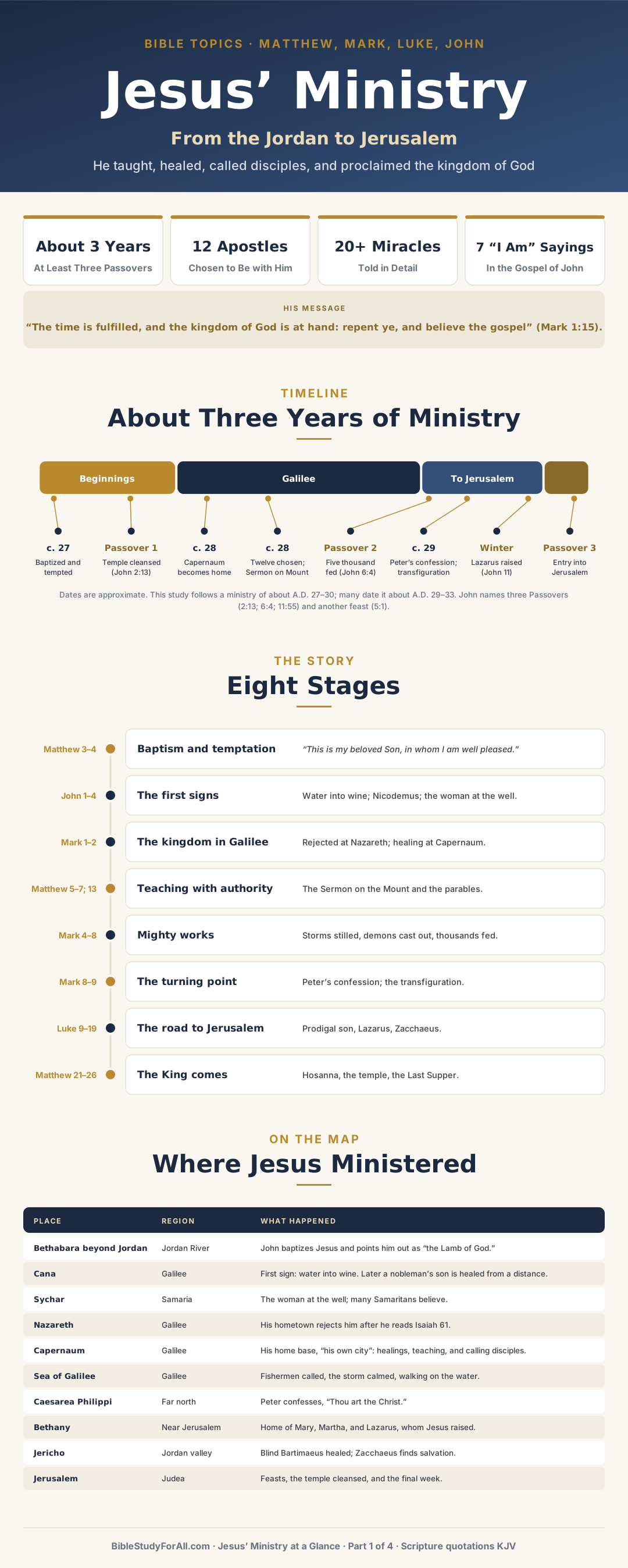
Jesus taught, healed the sick, and called twelve disciples. Through parables, miracles, and the Sermon on the Mount, he proclaimed the Kingdom of God and revealed who he is. Follow his ministry from the Jordan River to the gates of Jerusalem, in eight stages, with his miracles, parables, and “I am” sayings.
“How God anointed Jesus of Nazareth with the Holy Ghost and with power: who went about doing good, and healing all that were oppressed of the devil; for God was with him.”
Acts 10:38
About 3 Years
At least three Passovers in John
12 Apostles
Chosen to be with him
20+ Miracles
Told in detail in the Gospels
7 “I Am” Sayings
In the Gospel of John
At a Glance
From the Jordan to Jerusalem
The ministry moves in eight stages: Jesus is baptized and tempted, shows his first signs, brings the kingdom to Galilee, teaches with authority, does mighty works, reaches a turning point at Peter’s confession, sets out for Jerusalem, and enters the city as King. Select a stage to jump straight to it.
Stage 1 · c. A.D. 27
John baptizes Jesus; the Father speaks; Jesus overcomes temptation.
Stage 2 · c. A.D. 27–28
Water into wine, the temple cleansed, Nicodemus, and a Samaritan woman.
Stage 3 · c. A.D. 28
Rejected at Nazareth, Jesus makes Capernaum his home and heals many.
Stage 4 · c. A.D. 28–29
The Sermon on the Mount and parables of the kingdom.
Stage 5 · c. A.D. 28–29
Storms stilled, demons cast out, the sick healed, and thousands fed.
Stage 6 · c. A.D. 29
Peter’s confession, the first prediction of the cross, and the transfiguration.
Stage 7 · c. A.D. 29–30
The good Samaritan, the prodigal son, Lazarus raised, and Zacchaeus.
Stage 8 · Passover week, c. A.D. 30
Palms and hosannas, the temple cleansed, last teachings, and the Last Supper.
The whole story in four parts. Save or print them to keep beside your Bible.
Before You Begin
Three Habits for This Study
You don’t need any background to follow along. These habits will help you get the most from each stage.
Use all four Gospels
Matthew, Mark, and Luke tell many of the same events and are often read side by side. John adds much that they leave out, especially Jesus’ visits to Jerusalem. Each stage below gives a main passage to start with.
Ask “Who is this?”
The people who met Jesus kept asking who he was. The Gospels were written so “that ye might believe that Jesus is the Christ, the Son of God” (John 20:31). Keep that question in mind as you read.
Read slowly, then act
Jesus’ teaching is simple to read and hard to live. Take one saying or parable at a time, and ask what it would look like to obey it this week.
Stage 1 of 8 · Matthew 3–4; Luke 3–4
Baptism and Temptation
When: c. A.D. 27
“And lo a voice from heaven, saying, This is my beloved Son, in whom I am well pleased.”Matthew 3:17 (KJV) · Read Matthew 3:13–4:11
What happens
John the Baptist preaches in the wilderness by the Jordan, calling Israel to repent, just as Isaiah had said: “Prepare ye the way of the Lord” (Matthew 3:3). Jesus, “about thirty years of age” (Luke 3:23), comes from Nazareth to be baptized. John protests that he needs to be baptized by Jesus, but Jesus insists, “to fulfil all righteousness” (Matthew 3:15). As he comes up from the water, the Spirit descends like a dove and the Father speaks from heaven.
The Spirit then leads Jesus into the wilderness, where he fasts forty days and is tempted by the devil. Three times the tempter tries to turn him from the Father’s way: bread from stones, a leap from the temple, and all the kingdoms of the world for one act of worship. Three times Jesus answers from Deuteronomy: “It is written, Man shall not live by bread alone, but by every word that proceedeth out of the mouth of God” (Matthew 4:4).
Look closer
At the baptism all three persons of the Trinity appear together: the Son in the water, the Spirit like a dove, and the Father’s voice from heaven. Jesus had no sins to confess, but he stood with sinners from the very start of his ministry.
Where Israel failed in forty years in the wilderness, Jesus stood firm in forty days, using the very words Moses had spoken to Israel (Deuteronomy 8:3; 6:13, 16).
Think about it
Jesus answered every temptation with Scripture. Which verses could you hold on to when you are tempted?
Stage 2 of 8 · John 1:19–4:54
The First Signs
When: c. A.D. 27–28
“For God so loved the world, that he gave his only begotten Son, that whosoever believeth in him should not perish, but have everlasting life.”John 3:16 (KJV) · Read John 2:1–11
What happens
John the Baptist points to Jesus: “Behold the Lamb of God, which taketh away the sin of the world” (John 1:29), and his first followers begin to gather. At a wedding in Cana, Jesus turns water into wine, the “beginning of miracles,” and “his disciples believed on him” (John 2:11). At Passover in Jerusalem he drives the traders out of the temple: “make not my Father’s house an house of merchandise” (John 2:16).
A Pharisee named Nicodemus comes by night and hears that “Except a man be born again, he cannot see the kingdom of God” (John 3:3). On the way back to Galilee, Jesus sits by a well in Samaria and offers a Samaritan woman “living water.” When she says the Messiah is coming, he answers, “I that speak unto thee am he” (John 4:26). Many in her town believe and say, “this is indeed the Christ, the Saviour of the world” (John 4:42).
Look closer
Only John tells about these early months. Matthew, Mark, and Luke pick up the story when Jesus returns to Galilee after John the Baptist is put in prison (Mark 1:14).
John records a temple cleansing at the start of the ministry, and the other Gospels one in the final week. Many readers think Jesus cleansed the temple twice; others think John placed the one event early to make a point. Either way, Jesus claimed the temple as “my Father’s house.”
Think about it
Jesus spoke with a respected teacher by night and an outcast woman at noon. Is there anyone you think is too far from God to hear the good news?
Stage 3 of 8 · Mark 1–2; Luke 4–5
The Kingdom Comes to Galilee
When: c. A.D. 28
“And saying, The time is fulfilled, and the kingdom of God is at hand: repent ye, and believe the gospel.”Mark 1:15 (KJV) · Read Mark 1:14–45
What happens
Jesus returns to Galilee “in the power of the Spirit” (Luke 4:14). In the synagogue at Nazareth he reads from Isaiah: “The Spirit of the Lord is upon me, because he hath anointed me to preach the gospel to the poor” (Luke 4:18), then says, “This day is this scripture fulfilled in your ears” (Luke 4:21). His hometown is furious and tries to throw him off a cliff.
He moves to Capernaum by the Sea of Galilee (Matthew 4:13) and calls fishermen to follow him. On the Sabbath he teaches in the synagogue, “as one that had authority, and not as the scribes” (Mark 1:22), and casts out an unclean spirit. That evening the whole town gathers at the door, and he heals many. Early the next morning he goes off alone to pray, then sets out for other towns: “for therefore came I forth” (Mark 1:38). He cleanses a leper, forgives and heals a paralyzed man let down through a roof, and eats with tax collectors.
Look closer
The “kingdom of God” (Matthew usually says “kingdom of heaven”) is the heart of Jesus’ preaching. It means God’s rule breaking into the world through Jesus himself. His miracles were signs that the King had come.
Forgiving the paralyzed man’s sins was a bold claim. The scribes asked, “who can forgive sins but God only?” (Mark 2:7). Jesus healed the man so they would “know that the Son of man hath power on earth to forgive sins” (Mark 2:10).
Think about it
Even on his busiest days Jesus rose early to pray alone. Where in your day could you make room to be alone with God?
Stage 4 of 8 · Matthew 5–7; 13; Luke 6
Teaching with Authority
When: c. A.D. 28–29
“For he taught them as one having authority, and not as the scribes.”Matthew 7:29 (KJV) · Read Matthew 5:1–16
What happens
After choosing twelve apostles, Jesus sits on a mountain and teaches what life in God’s kingdom looks like. The Sermon on the Mount begins with the Beatitudes: “Blessed are the poor in spirit: for theirs is the kingdom of heaven” (Matthew 5:3). He says he came not to destroy the law but “to fulfil” it (Matthew 5:17), and then goes deeper than the rules, to anger, lust, and love: “Love your enemies, bless them that curse you” (Matthew 5:44). He teaches the Lord’s Prayer, tells his hearers not to worry but to “seek ye first the kingdom of God” (Matthew 6:33), and ends with two builders, one on rock and one on sand.
Later, beside the sea, he teaches the crowds in parables: a sower and his seed, a tiny mustard seed, leaven in dough, a treasure hidden in a field, a pearl of great price (Matthew 13). When the disciples ask why he speaks in parables, he explains that the stories reveal the kingdom to those who are open and hide it from those who refuse to see (Matthew 13:10–13).
Look closer
Rabbis usually taught by quoting earlier rabbis. Jesus said, “But I say unto you” (Matthew 5:22, 28, 34, 39, 44). That is why the crowds were “astonished at his doctrine.”
Luke gives a shorter sermon “in the plain” (Luke 6:17–49). Some think it is the same sermon told differently; others think Jesus gave similar teaching more than once, as traveling teachers often did.
Think about it
Jesus ended his sermon with a builder who heard his words and did them. Which of his words do you most need to put into practice?
Stage 5 of 8 · Matthew 8–9; Mark 4–8; John 6
Mighty Works
When: c. A.D. 28–29
“The blind receive their sight, and the lame walk, the lepers are cleansed, and the deaf hear, the dead are raised up, and the poor have the gospel preached to them.”Matthew 11:5 (KJV) · Read Mark 4:35–5:43
What happens
Jesus goes “about all the cities and villages, teaching … and healing every sickness and every disease among the people” (Matthew 9:35). On the Sea of Galilee he rebukes a storm, and the disciples ask, “What manner of man is this, that even the wind and the sea obey him?” (Mark 4:41). Across the lake he frees a man tormented by a legion of demons. A woman who has bled for twelve years touches his garment and is healed, and he raises the twelve-year-old daughter of Jairus (Mark 5).
With five loaves and two fish he feeds five thousand men, the only miracle besides the resurrection told in all four Gospels. That night he walks on the water to his disciples. When John the Baptist, now in prison, sends to ask, “Art thou he that should come?” Jesus points to his works, the very signs Isaiah had promised (Matthew 11:3–5; Isaiah 35:5–6).
Look closer
The Gospels never present miracles as magic tricks. Jesus healed out of compassion (“he was moved with compassion on them,” Matthew 9:36), often touched people others would not touch, and sometimes sent those he healed home to tell “how great things the Lord hath done” (Mark 5:19).
Yet the miracles divided people. Some believed, others plotted against him (Matthew 12:14), and after he called himself “the bread of life” many followers “went back, and walked no more with him” (John 6:66).
Think about it
The woman reached out and touched the hem of his garment. What would it mean for you to reach out to Jesus with what troubles you today?
Stage 6 of 8 · Matthew 16–17; Mark 8–9; Luke 9
The Turning Point
When: c. A.D. 29
“And he began to teach them, that the Son of man must suffer many things, and be rejected of the elders, and of the chief priests, and scribes, and be killed, and after three days rise again.”Mark 8:31 (KJV) · Read Mark 8:27–9:8
What happens
In the far north, near Caesarea Philippi, Jesus asks his disciples, “But whom say ye that I am?” Peter answers, “Thou art the Christ, the Son of the living God” (Matthew 16:16). From that moment Jesus begins to speak plainly about what lies ahead: he must suffer, be killed, and rise again. When Peter objects, Jesus rebukes him, and calls every follower to “deny himself, and take up his cross daily, and follow me” (Luke 9:23).
About a week later, Jesus takes Peter, James, and John up a high mountain and is transfigured before them. His face shines like the sun, Moses and Elijah talk with him about the death he will accomplish at Jerusalem (Luke 9:31), and the Father’s voice says again, “This is my beloved Son, in whom I am well pleased; hear ye him” (Matthew 17:5).
Look closer
Mark’s Gospel turns on this moment. Before it, the question is “Who is this?”; after it, the road leads to the cross. Jesus predicts his death and resurrection three times on the way (Mark 8:31; 9:31; 10:33–34).
Moses stood for the Law and Elijah for the Prophets. Both bowed out, and the disciples “saw no man, save Jesus only” (Matthew 17:8).
Think about it
Jesus asks every reader the same question he asked Peter. Who do you say that he is?
Stage 7 of 8 · Luke 9:51–19:27; John 7–11
On the Road to Jerusalem
When: c. A.D. 29–30
“For the Son of man is come to seek and to save that which was lost.”Luke 19:10 (KJV) · Read Luke 15:1–32
What happens
“He stedfastly set his face to go to Jerusalem” (Luke 9:51). On the long journey Jesus tells some of his best-loved parables. A lawyer asks, “who is my neighbour?” and hears about a Samaritan who stopped to help (Luke 10:25–37). When the Pharisees grumble that he eats with sinners, he tells of a lost sheep, a lost coin, and a lost son whose father runs to meet him (Luke 15). He sends out seventy others to prepare the way, visits Mary and Martha, and teaches his disciples to pray.
At feasts in Jerusalem he declares, “I am the light of the world” (John 8:12) and “I am the good shepherd” (John 10:11), and heals a man born blind. At Bethany, Lazarus has been dead four days. Jesus weeps, then calls, “Lazarus, come forth” (John 11:43). Many believe, and the council decides he must die (John 11:53). At Jericho he heals blind Bartimaeus and invites himself to the house of Zacchaeus, a chief tax collector who gives half his goods to the poor.
Look closer
This long section of Luke (9:51–19:27) holds much teaching found only in Luke, including the good Samaritan, the prodigal son, the rich man and Lazarus, and the Pharisee and the publican.
The raising of Lazarus is the last and greatest sign in John’s Gospel. It is also what turned the leaders’ opposition into a plan to kill Jesus.
Think about it
Jesus went looking for Zacchaeus by name. How does it feel to know that he came to seek and save the lost, including you?
Stage 8 of 8 · Matthew 21–26; John 12–17
The King Comes to Jerusalem
When: Passover week, c. A.D. 30
“Hosanna to the Son of David: Blessed is he that cometh in the name of the Lord; Hosanna in the highest.”Matthew 21:9 (KJV) · Read Matthew 21:1–17
What happens
Six days before Passover, Mary of Bethany anoints Jesus’ feet. The next day he rides into Jerusalem on a colt, as Zechariah had foretold, and the crowds spread garments and branches, crying “Hosanna to the Son of David” (Matthew 21:9). Seeing the city, he weeps over it (Luke 19:41). In the temple he overturns the tables: “My house shall be called the house of prayer; but ye have made it a den of thieves” (Matthew 21:13).
Through the week he teaches in the temple courts and answers every trap: about paying taxes (“Render therefore unto Cæsar the things which are Cæsar’s; and unto God the things that are God’s,” Matthew 22:21) and about the greatest commandment, to love God with all your heart and your neighbour as yourself (Mark 12:29–31). On the Mount of Olives he speaks of the temple’s fall and his return. On the last night he washes the disciples’ feet, shares the bread and cup of the new covenant, and prays for all who will believe (John 13–17). The story continues on the Crucifixion page.
Look closer
Jesus had often told people not to spread word that he was the Messiah (Mark 1:44; 8:30). Now, at the end, he openly enters Jerusalem as its King, though as a humble king on a colt rather than a warrior on a horse.
The same week holds the most teaching by Jesus about the end of the age (Matthew 24–25), including the parables of the ten virgins, the talents, and the sheep and the goats.
Think about it
The crowds welcomed Jesus as King on Sunday, and many turned against him by Friday. What does it look like to welcome him as King every day of the week?
On the Map
Where Jesus Ministered
Most of Jesus’ ministry took place in Galilee, a region of farming and fishing towns around the Sea of Galilee. He traveled south to Jerusalem for the feasts, through Samaria, and north to the region of Tyre, Sidon, and Caesarea Philippi. Read the passages with a Bible map open to follow his journeys.
| Place | Region | What happened | Read (KJV) |
|---|---|---|---|
| Bethabara beyond Jordan | Jordan River | John baptizes Jesus and points him out as “the Lamb of God.” | John 1:28–34 |
| Cana | Galilee | First sign: water into wine. Later a nobleman’s son is healed from a distance. | John 2:1–11 |
| Sychar | Samaria | The woman at the well; many Samaritans believe. | John 4:5–42 |
| Nazareth | Galilee | His hometown rejects him after he reads Isaiah 61. | Luke 4:16–30 |
| Capernaum | Galilee | His home base, “his own city”: healings, teaching, and calling disciples. | Matthew 4:13; 9:1 |
| Sea of Galilee | Galilee | Fishermen called, the storm calmed, walking on the water. | Mark 1:16; 4:35–41 |
| Caesarea Philippi | Far north | Peter confesses, “Thou art the Christ.” | Matthew 16:13–20 |
| Bethany | Near Jerusalem | Home of Mary, Martha, and Lazarus, whom Jesus raised. | John 11 |
| Jericho | Jordan valley | Blind Bartimaeus healed; Zacchaeus finds salvation. | Luke 18:35–19:10 |
| Jerusalem | Judea | Feasts, the temple cleansed, and the final week. | John 2:13; Matthew 21 |
His Teaching
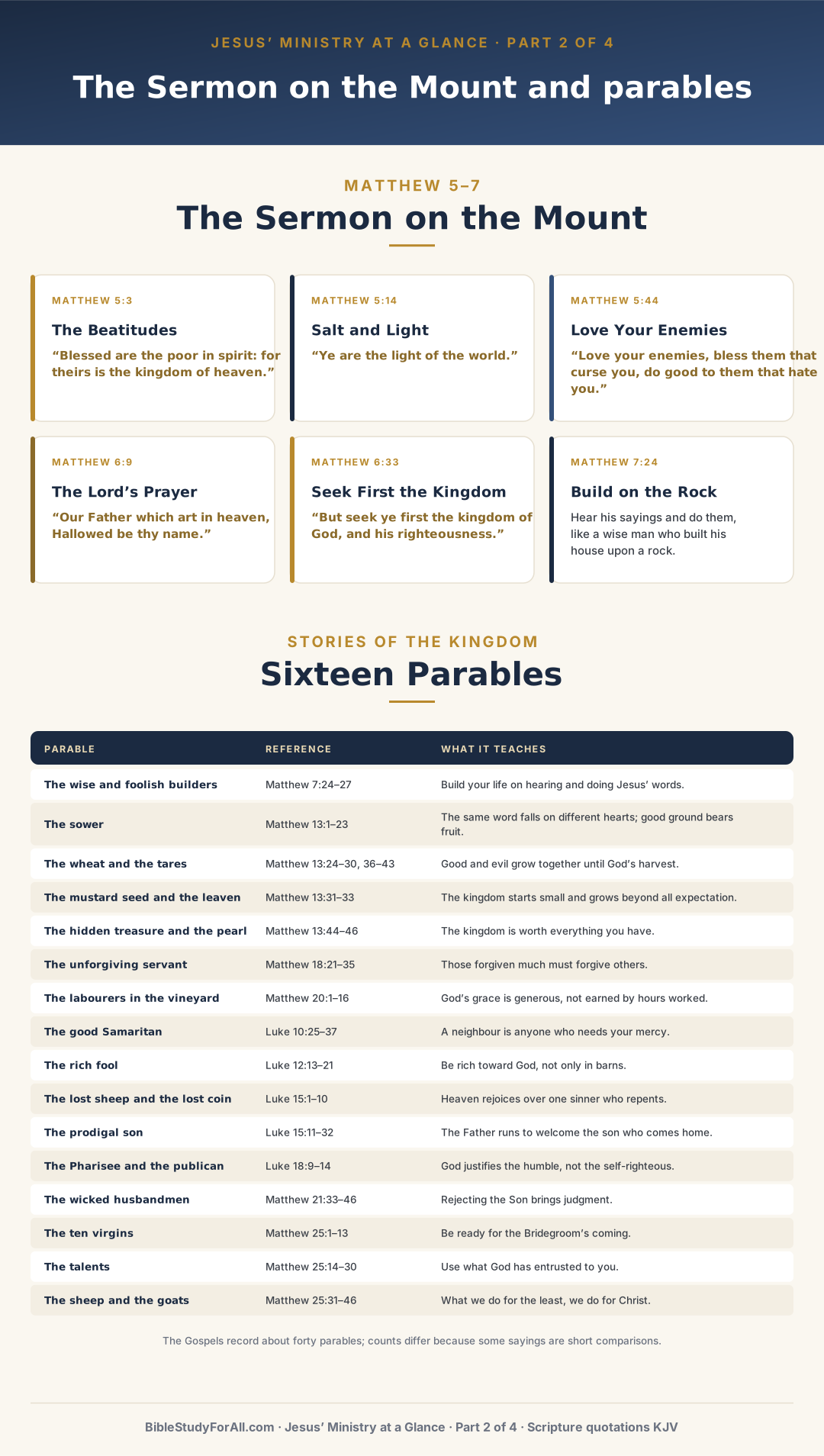
The Sermon on the Mount
Matthew 5–7 gathers Jesus’ teaching on life in God’s kingdom into one sermon, the most famous ever preached. Read it in one sitting: Matthew 5–7 (KJV).
Matthew 5:3–12
The Beatitudes
“Blessed are the poor in spirit: for theirs is the kingdom of heaven.”
Matthew 6:25–34
Do not worry
“But seek ye first the kingdom of God, and his righteousness”
Matthew 7:12
The golden rule
“All things whatsoever ye would that men should do to you, do ye even so to them”
The Parables
A parable is a short story from everyday life that teaches a truth about God’s kingdom. The Gospels record about forty. Here are sixteen to start with.
| Parable | Read (KJV) | What it teaches |
|---|---|---|
| The wise and foolish builders | Matthew 7:24–27 | Build your life on hearing and doing Jesus’ words. |
| The sower | Matthew 13:1–23 | The same word falls on different hearts; good ground bears fruit. |
| The wheat and the tares | Matthew 13:24–30, 36–43 | Good and evil grow together until God’s harvest. |
| The mustard seed and the leaven | Matthew 13:31–33 | The kingdom starts small and grows beyond all expectation. |
| The hidden treasure and the pearl | Matthew 13:44–46 | The kingdom is worth everything you have. |
| The unforgiving servant | Matthew 18:21–35 | Those forgiven much must forgive others. |
| The labourers in the vineyard | Matthew 20:1–16 | God’s grace is generous, not earned by hours worked. |
| The good Samaritan | Luke 10:25–37 | A neighbour is anyone who needs your mercy. |
| The rich fool | Luke 12:13–21 | Be rich toward God, not only in barns. |
| The lost sheep and the lost coin | Luke 15:1–10 | Heaven rejoices over one sinner who repents. |
| The prodigal son | Luke 15:11–32 | The Father runs to welcome the son who comes home. |
| The Pharisee and the publican | Luke 18:9–14 | God justifies the humble, not the self-righteous. |
| The wicked husbandmen | Matthew 21:33–46 | Rejecting the Son brings judgment. |
| The ten virgins | Matthew 25:1–13 | Be ready for the Bridegroom’s coming. |
| The talents | Matthew 25:14–30 | Use what God has entrusted to you. |
| The sheep and the goats | Matthew 25:31–46 | What we do for the least, we do for Christ. |
His Mighty Works
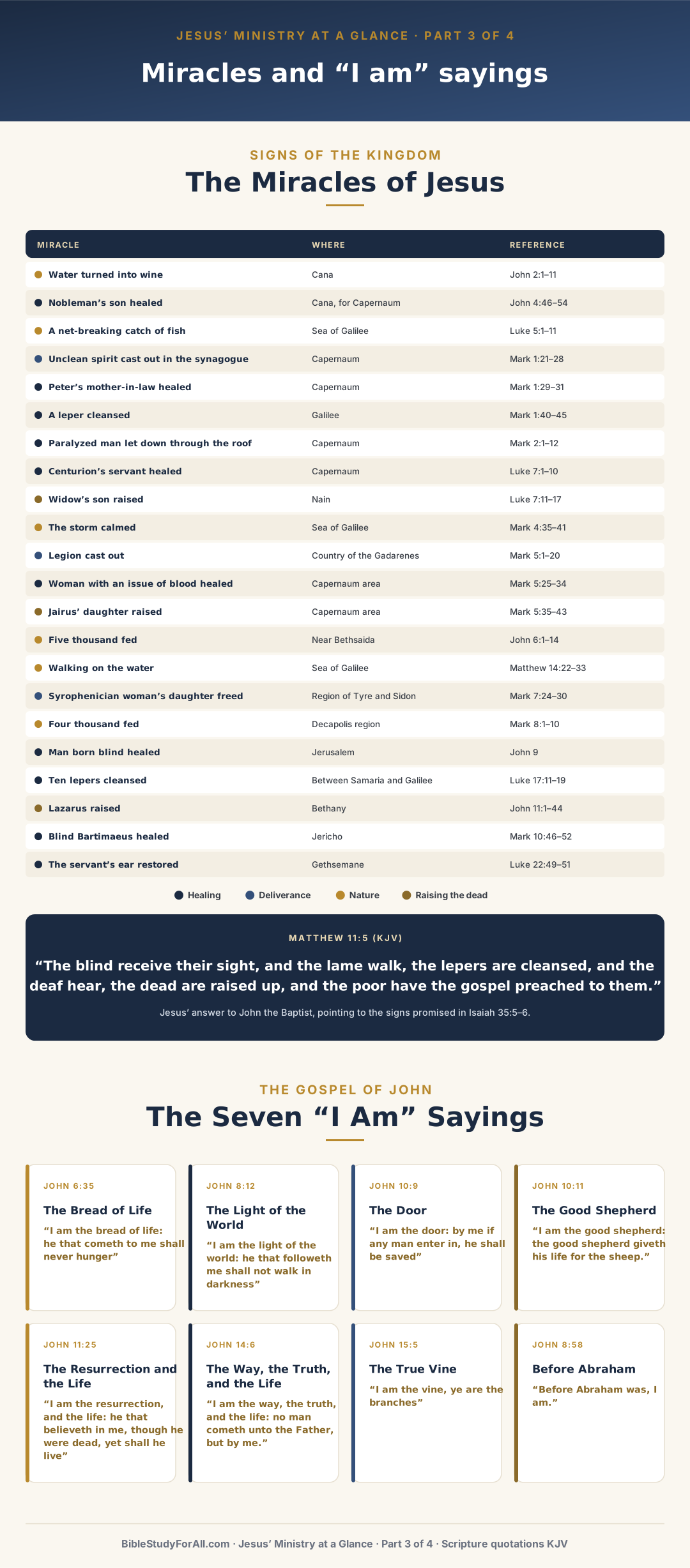
The Miracles of Jesus
John calls Jesus’ miracles “signs”: they point beyond themselves to who he is. The Gospels describe more than twenty in detail and mention many more in summary, “And many other signs truly did Jesus in the presence of his disciples, which are not written in this book” (John 20:30).
Healing
The blind, the lame, lepers, and the sick made whole.
10 in the table below
Deliverance
Unclean spirits cast out with a word.
3 in the table below
Nature
Wind and sea, bread and fish obey him.
6 in the table below
Raising the dead
A widow’s son, Jairus’ daughter, and Lazarus.
3 in the table below
| Miracle | Where | Kind | Read (KJV) |
|---|---|---|---|
| Water turned into wine | Cana | Nature | John 2:1–11 |
| Nobleman’s son healed | Cana, for Capernaum | Healing | John 4:46–54 |
| A net-breaking catch of fish | Sea of Galilee | Nature | Luke 5:1–11 |
| Unclean spirit cast out in the synagogue | Capernaum | Deliverance | Mark 1:21–28 |
| Peter’s mother-in-law healed | Capernaum | Healing | Mark 1:29–31 |
| A leper cleansed | Galilee | Healing | Mark 1:40–45 |
| Paralyzed man let down through the roof | Capernaum | Healing | Mark 2:1–12 |
| Centurion’s servant healed | Capernaum | Healing | Luke 7:1–10 |
| Widow’s son raised | Nain | Raising the dead | Luke 7:11–17 |
| The storm calmed | Sea of Galilee | Nature | Mark 4:35–41 |
| Legion cast out | Country of the Gadarenes | Deliverance | Mark 5:1–20 |
| Woman with an issue of blood healed | Capernaum area | Healing | Mark 5:25–34 |
| Jairus’ daughter raised | Capernaum area | Raising the dead | Mark 5:35–43 |
| Five thousand fed | Near Bethsaida | Nature | John 6:1–14 |
| Walking on the water | Sea of Galilee | Nature | Matthew 14:22–33 |
| Syrophenician woman’s daughter freed | Region of Tyre and Sidon | Deliverance | Mark 7:24–30 |
| Four thousand fed | Decapolis region | Nature | Mark 8:1–10 |
| Man born blind healed | Jerusalem | Healing | John 9 |
| Ten lepers cleansed | Between Samaria and Galilee | Healing | Luke 17:11–19 |
| Lazarus raised | Bethany | Raising the dead | John 11:1–44 |
| Blind Bartimaeus healed | Jericho | Healing | Mark 10:46–52 |
| The servant’s ear restored | Gethsemane | Healing | Luke 22:49–51 |
Who He Is
The Seven “I Am” Sayings
In John’s Gospel Jesus describes himself seven times with “I am” and a picture. He also said simply, “Before Abraham was, I am” (John 8:58), echoing the name God gave Moses at the burning bush (Exodus 3:14).
John 6:35
The Bread of Life
“I am the bread of life: he that cometh to me shall never hunger”
John 8:12
The Light of the World
“I am the light of the world: he that followeth me shall not walk in darkness”
John 10:9
The Door
“I am the door: by me if any man enter in, he shall be saved”
John 10:11
The Good Shepherd
“I am the good shepherd: the good shepherd giveth his life for the sheep.”
John 11:25
The Resurrection and the Life
“I am the resurrection, and the life: he that believeth in me, though he were dead, yet shall he live”
John 14:6
The Way, the Truth, and the Life
“I am the way, the truth, and the life: no man cometh unto the Father, but by me.”
John 8:58
Before Abraham
“Verily, verily, I say unto you, Before Abraham was, I am.”
The Rest of the Story
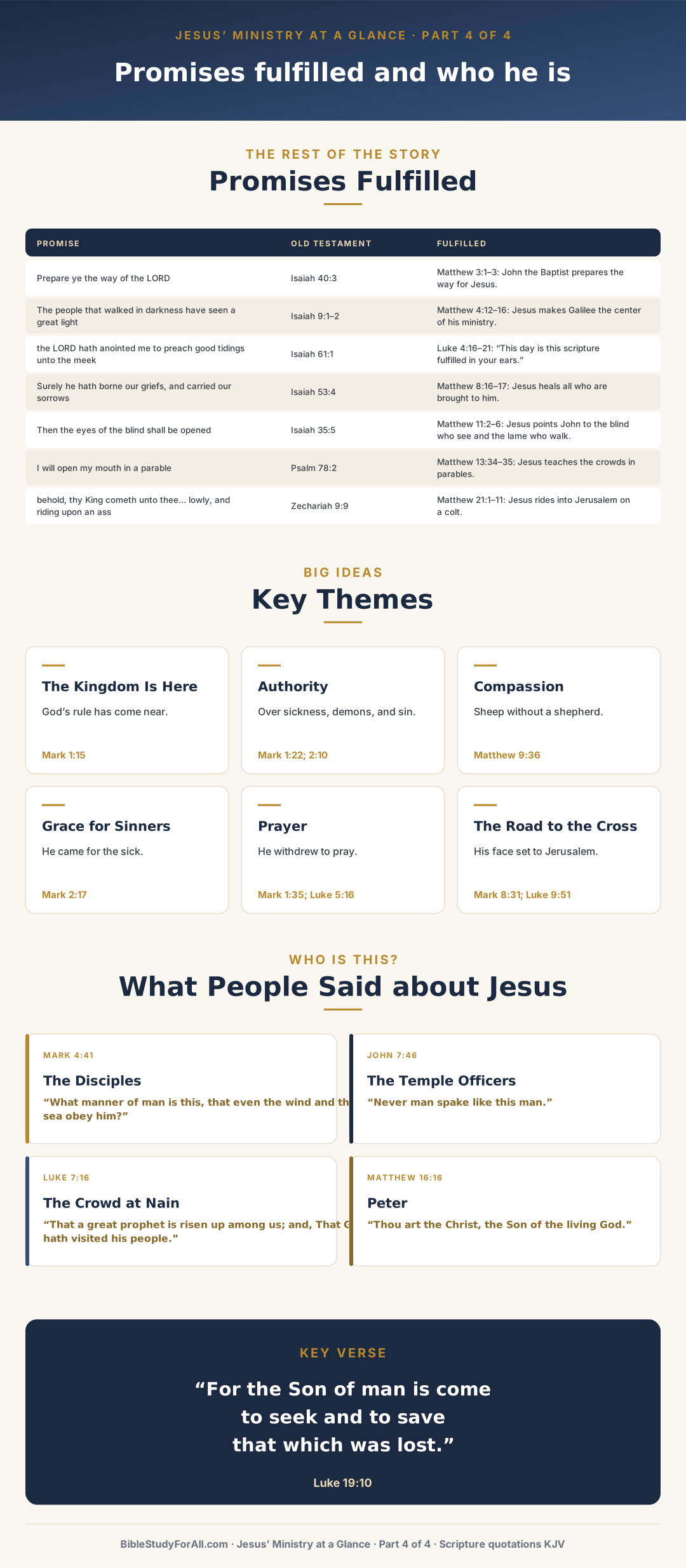
Promises Fulfilled in His Ministry
Jesus told his opponents, “Search the scriptures … they are they which testify of me” (John 5:39). The Gospel writers saw the Old Testament promises coming true in what Jesus said and did.
Isaiah 40:3 → Matthew 3:1–3
“Prepare ye the way of the LORD”
John the Baptist prepares the way for Jesus.
Isaiah 9:1–2 → Matthew 4:12–16
“The people that walked in darkness have seen a great light”
Jesus makes Galilee the center of his ministry.
Isaiah 61:1 → Luke 4:16–21
“the LORD hath anointed me to preach good tidings unto the meek”
“This day is this scripture fulfilled in your ears.”
Isaiah 53:4 → Matthew 8:16–17
“Surely he hath borne our griefs, and carried our sorrows”
Jesus heals all who are brought to him.
Isaiah 35:5 → Matthew 11:2–6
“Then the eyes of the blind shall be opened”
Jesus points John to the blind who see and the lame who walk.
Psalm 78:2 → Matthew 13:34–35
Big Ideas
Six Themes of Jesus’ Ministry
The kingdom is here
In Jesus, God’s rule has come near: “the kingdom of God is at hand” (Mark 1:15).
Authority
He taught, healed, forgave sins, and commanded wind and demons with a word (Mark 1:22, 27; 2:10).
Compassion
He saw the crowds “as sheep having no shepherd” and was moved with compassion (Matthew 9:36).
Grace for sinners
He ate with tax collectors and sinners: “I came not to call the righteous” (Mark 2:17).
Prayer
He rose early and withdrew to pray, even when crowds were waiting (Mark 1:35; Luke 5:16).
The road to the cross
From Caesarea Philippi on, he set his face toward Jerusalem (Mark 8:31; Luke 9:51).
Verses to Remember
Key Verses from Jesus’ Ministry
Along with the verses in each stage above, these are worth reading slowly, and memorizing.
Mark 1:15
“The time is fulfilled, and the kingdom of God is at hand: repent ye, and believe the gospel.”
Matthew 5:3
“Blessed are the poor in spirit: for theirs is the kingdom of heaven.”
Matthew 6:33
“But seek ye first the kingdom of God, and his righteousness; and all these things shall be added unto you.”
Matthew 11:28
“Come unto me, all ye that labour and are heavy laden, and I will give you rest.”
Mark 2:17
“They that are whole have no need of the physician, but they that are sick: I came not to call the righteous, but sinners to repentance.”
John 3:16
“For God so loved the world, that he gave his only begotten Son, that whosoever believeth in him should not perish, but have everlasting life.”
John 11:25
“I am the resurrection, and the life: he that believeth in me, though he were dead, yet shall he live.”
Luke 19:10
“For the Son of man is come to seek and to save that which was lost.”
Summary
Five Things to Remember
1
About three years
Jesus began about age thirty and taught for about three years (Luke 3:23; John 2:13; 6:4; 11:55).
2
The kingdom of God
His message: God’s rule has come near in him, so repent and believe (Mark 1:15).
3
Words and works
He taught with authority and did mighty works as signs of who he is (Matthew 7:29; John 20:30–31).
4
Good news for the lost
He welcomed sinners, outsiders, and the poor (Luke 4:18; 19:10).
5
Headed for the cross
Every stage led to Jerusalem, where he would give his life (Mark 8:31; 10:45).
Questions
Common Questions about Jesus’ Ministry
How long was Jesus’ ministry?
About three years, though the Gospels never give a number. John mentions three Passovers (John 2:13; 6:4; 11:55) and another feast that may have been a fourth Passover (John 5:1), which points to a ministry of between two and a half and three and a half years. Matthew, Mark, and Luke mention only the final Passover, so on their own they could fit a shorter ministry.
When did Jesus’ ministry take place?
Luke dates the start of John the Baptist’s preaching to “the fifteenth year of the reign of Tiberius Cæsar” (Luke 3:1), when Jesus was “about thirty years of age” (Luke 3:23). Depending on how Tiberius’s reign is counted, that is about A.D. 26–29. This page follows a ministry of about A.D. 27–30, ending with the crucifixion at Passover in A.D. 30; many others date it about A.D. 29–33.
What is the kingdom of God?
It is God’s rule as King. Jesus taught that in him the kingdom had come near (Mark 1:15): when he cast out demons “by the Spirit of God, then the kingdom of God is come unto you” (Matthew 12:28). Yet he also taught his disciples to pray “Thy kingdom come” (Matthew 6:10), looking ahead to its full arrival when he returns. Christians often describe the kingdom as “already” here and “not yet” complete. Matthew usually says “kingdom of heaven,” the same thing in a more Jewish way of speaking that avoids using God’s name.
Why did Jesus teach in parables?
Parables use everyday pictures that anyone can remember, and they invite the hearer to think. Jesus also said they had a dividing effect: they open the truth to those who want to understand and hide it from those who have closed their hearts (Matthew 13:10–17; Mark 4:11–12). He often explained them privately to his disciples (Mark 4:34).
Why did Jesus tell people not to tell anyone?
Several times Jesus told those he healed, and even his disciples, to keep quiet about him (Mark 1:44; 8:30). Many think he wanted to avoid being made a political king by crowds who expected a Messiah to overthrow Rome (John 6:15), and to make clear that he had come to suffer before he would reign. After the transfiguration he told the three to tell no one “till the Son of man were risen from the dead” (Mark 9:9).
Why do the Gospels tell events in different orders?
The Gospel writers did not always aim to give a day-by-day order. Matthew, for example, groups Jesus’ teaching into five long sermons, and some events are arranged by subject. Ancient biographies often worked this way. The differences show four witnesses telling the same story from their own angles; as Luke says, he wrote “in order” after careful research, so that his readers “mightest know the certainty of those things” (Luke 1:3–4).
Did Jesus do miracles in his hometown?
Very few. At Nazareth people asked, “Is not this the carpenter?” and “were offended at him.” Mark says “he could there do no mighty work, save that he laid his hands upon a few sick folk, and healed them,” and “he marvelled because of their unbelief” (Mark 6:3–6). Jesus did not perform miracles to win over people who had already decided against him.
Where can I read about Jesus’ death and resurrection?
All four Gospels give the last week of Jesus’ life in great detail: Matthew 26–28, Mark 14–16, Luke 22–24, and John 18–21. This study ends as Jesus enters Jerusalem; his arrest, trial, crucifixion, and resurrection are covered on the Crucifixion page, and his chosen followers on the 12 Apostles page.
Keep Reading
Continue Your Study
Read the Gospels for yourself with this study beside you. Mark is the shortest and a good place to start. Then dig deeper into each book on its own overview page.
Scripture quotations are from the King James Version (KJV), which is in the public domain. Verse links open at BibleGateway. Dates are approximate; this page follows a ministry of about A.D. 27–30 (many date it about A.D. 29–33).