
1 & 2 Samuel · 1 & 2 Kings · 1 & 2 Chronicles · Bible Study
The Kings of Israel and Judah
From Saul to the Exile
The kings of Israel began when Israel asked for a king, and God gave them Saul, then David, then Solomon. After Solomon the kingdom divided, and for almost 350 years the kings of Israel and Judah led the people toward God or away from Him. Meet every king, era by era.
About the Kings
The Kings at a Glance
Bible Study
Note: Scripture quotations and verse links on this site use the King James Version (KJV) because it is in the public domain, while most modern translations limit how much can be quoted online. Feel free to read along in the translation of your choice.
c. 1050 B.C.
Saul, the first king
About 460 Years
From Saul to the exile
42 Rulers
3 united · 19 Israel · 20 Judah
6 Books
1 Samuel to 2 Chronicles
About the Kings
The Kings of Israel and Judah
Who They Were
Forty-Two Rulers
Three kings ruled the united kingdom: Saul, David and Solomon. Then the kingdom split. Nineteen kings ruled Israel in the north, and twenty rulers of David’s line, with one queen, ruled Judah in the south.
The book of Kings sums up nearly every reign the same way: the king “did that which was right in the sight of the LORD,” or he “did evil.” Every northern king kept the golden calves Jeroboam set up at Bethel and Dan. In Judah, eight kings did right, including Asa, Jehoshaphat, Hezekiah and Josiah.
Behind almost every king stood a prophet: Samuel, Nathan, Elijah, Elisha, Isaiah and Jeremiah. The kings had power, but God’s word had the last say (2 Kings 17:13).
When and Where
c. 1050–586 B.C.
Saul became king about 1050 B.C. The kingdom divided about 930 B.C. Israel fell to Assyria in 722 B.C., and Judah fell to Babylon in 586 B.C.
The united kingdom lasted about 120 years under Saul, David and Solomon, each reigning forty years (Acts 13:21; 2 Samuel 5:4; 1 Kings 11:42). Israel’s capital moved from Shechem to Tirzah to Samaria. Judah kept Jerusalem and the temple to the end.
Solomon began the temple “in the four hundred and eightieth year” after the exodus (1 Kings 6:1), about 966 B.C., which places the exodus about 1446 B.C.
Why It Matters
God Is the True King
Israel asked for a king to be “like all the nations,” and in doing so rejected God as their King. The story of the kings shows what happens when a nation’s leaders turn toward God or away from Him.
God told Samuel, “they have not rejected thee, but they have rejected Me, that I should not reign over them” (1 Samuel 8:7). Yet God kept His promise to David that his throne would be established for ever (2 Samuel 7:16).
Every king fell short, even the best of them. The promise pointed ahead to Jesus Christ, “the son of David” (Matthew 1:1), who will reign “for ever; and of His kingdom there shall be no end” (Luke 1:33).
Key Verse
God’s Promise to David
“And thine house and thy kingdom shall be established for ever before thee: thy throne shall be established for ever.”
2 Samuel 7:16 (KJV)
Key Themes
Six Themes of the Kings
These six truths run through the whole story, from Saul to the exile.
1
God Is the True King
Israel’s request was a rejection of God’s rule.
“when the LORD your God was your king”
1 SAMUEL 12:12
2
God Looks on the Heart
Saul looked the part; David had the heart.
“but the LORD looketh on the heart”
1 SAMUEL 16:7
3
Leaders Shape a Nation
Jeroboam led Israel into sin; Josiah led Judah back to the covenant.
2 KINGS 23:3
4
God Speaks Through His Prophets
Kings rose and fell, but the word of the LORD stood.
2 KINGS 17:13
5
Sin Has Consequences
Both kingdoms were removed from the land because they would not turn back.
2 KINGS 17:18
6
God Keeps His Promise
He kept a lamp burning for David, even through the exile.
1 KINGS 15:4
From Saul to the Exile
What the Bible Says About the Kings of Israel
1 Samuel 8–12 · c. 1050 B.C.Israel Asks for a King
Samuel was old, and his sons took bribes. The elders came to him at Ramah: “now make us a king to judge us like all the nations” (1 Samuel 8:5). God told Samuel to listen, “for they have not rejected thee, but they have rejected Me” (1 Samuel 8:7). Samuel warned them what a king would take from them, but the people answered, “Nay; but we will have a king over us” (1 Samuel 8:19). God led Saul, a tall Benjamite looking for his father’s lost asses, to Samuel, who anointed him.
1 Samuel 13–31 · c. 1050–1010 B.C.Saul: The People’s Choice
Saul began well, but would not wait for Samuel at Gilgal and offered the burnt offering himself. Samuel told him, “the LORD hath sought Him a man after His own heart” (1 Samuel 13:14). Sent against Amalek, Saul spared King Agag and the best animals. Samuel answered, “Behold, to obey is better than sacrifice” (1 Samuel 15:22), and God rejected Saul as king. He spent his last years chasing David, and died with his sons on Mount Gilboa.
1 Samuel 16 – 1 Kings 2 · c. 1010–970 B.C.David: A Man after God’s Own Heart
Samuel anointed Jesse’s youngest son, a shepherd boy, “for the LORD seeth not as man seeth” (1 Samuel 16:7). David killed Goliath, spared Saul’s life twice, and reigned seven and a half years at Hebron and thirty-three in Jerusalem. God promised him a house and a throne “established for ever” (2 Samuel 7:16). David fell with Bathsheba and had Uriah killed, but when Nathan said, “Thou art the man,” David confessed, “I have sinned against the LORD” (2 Samuel 12:7, 13). See King David.
1 Kings 1–11 · c. 970–930 B.C.Solomon: Wisdom, Glory, and a Divided Heart
At Gibeon Solomon asked God for “an understanding heart to judge Thy people” (1 Kings 3:9), and God gave him wisdom, riches and honour. He built the temple, and “the glory of the LORD had filled the house of the LORD” (1 Kings 8:11). But he gathered horses, gold and seven hundred wives, and “his wives turned away his heart after other gods” (1 Kings 11:4). God said the kingdom would be torn from his son, all but one tribe, for David’s sake.
1 Kings 12–16 · c. 930–874 B.C.The Kingdom Divides
At Shechem Rehoboam refused to lighten the people’s load: “my father also chastised you with whips, but I will chastise you with scorpions” (1 Kings 12:14). Ten tribes made Jeroboam their king; Judah and Benjamin stayed with Rehoboam. God said, “this thing is from Me” (1 Kings 12:24). Jeroboam set up golden calves at Bethel and Dan, so his people would not go to Jerusalem. Every northern king after him followed “the sins of Jeroboam.”
1 Kings 16:29 – 2 Kings 10 · c. 874–814 B.C.Ahab, Elijah, and Jehu
Ahab married Jezebel and served Baal, and “did evil in the sight of the LORD above all that were before him” (1 Kings 16:30). On Mount Carmel Elijah asked, “How long halt ye between two opinions? if the LORD be God, follow Him” (1 Kings 18:21). Fire fell from heaven, and the people cried, “The LORD, He is the God” (1 Kings 18:39). Ahab died at Ramoth-gilead, as Micaiah warned. Elisha carried on Elijah’s work, and Jehu ended Ahab’s house and Baal worship in Israel.
2 Kings 11–17 · c. 841–722 B.C.The Fall of Israel
In Judah, Joash repaired the temple, and Amaziah, Uzziah and Jotham had long reigns. In Israel, Jeroboam II restored the old borders, as Jonah foretold (2 Kings 14:25), but Amos and Hosea condemned the nation’s injustice and idols. Four of Israel’s last six kings were assassinated. Hoshea stopped paying tribute to Assyria, and after a three-year siege Samaria fell in 722 B.C. The Bible gives the reason: “the children of Israel had sinned against the LORD their God” (2 Kings 17:7).
2 Kings 18–25 · c. 715–586 B.C.Judah’s Last Kings and the Exile
Hezekiah “trusted in the LORD God of Israel” (2 Kings 18:5), and God saved Jerusalem from Sennacherib in one night. His son Manasseh undid it all. Josiah found the book of the law, renewed the covenant and kept a great passover. But his sons turned away, and Babylon took Jerusalem. In 586 B.C. the temple was burned and the people carried away. Kings ends with hope: David’s heir Jehoiachin was freed from prison and given a place at the king’s table (2 Kings 25:27–30).
At a Glance
The Kings at a Glance
The kings of Israel and Judah on one page: eight eras, a chart of all forty-two rulers, the kings of the north and the south with their verdicts, a map of the divided kingdom, the prophets, the kings and Jesus, and lessons for today. Tap a topic to jump to it.
Printable Copy
Save or Print the Infographic
Everything in this section, with the key verse and key themes, is also on a printable infographic (seven pages). It opens in a new tab, where you can save it to your phone or computer, share it, or print it.
c. 1050–586 B.C.
From Saul to the Exile
The story of the kings moves in eight eras: the request for a king, the three kings of the united kingdom, the split into two kingdoms, and the long road to exile.
1 C. 1050 B.C.
Israel Asks for a King
“A king to judge us like all the nations.”
1 SAMUEL 8–12
2 C. 1050–1010
Saul
A promising start, half obedience, and a tragic end on Mount Gilboa.
1 SAMUEL 13–31
3 C. 1010–970
David
The shepherd king, God’s everlasting promise, a great sin, true repentance.
2 SAMUEL 1–24
4 C. 970–930
Solomon
Wisdom, the temple and a golden age, then a heart that drifts.
1 KINGS 1–11
5 C. 930–874
The Kingdom Divides
Ten tribes follow Jeroboam; Judah stays with David’s line.
1 KINGS 12–16
6 C. 874–814
Ahab, Elijah and Jehu
Baal worship, fire on Mount Carmel, and Jehu’s revolt.
1 KINGS 17 – 2 KINGS 10
7 C. 841–722
The Fall of Israel
Prosperity, prophets, assassinations, and Samaria’s fall.
2 KINGS 11–17
8 C. 715–586
Judah’s Last Kings
Hezekiah and Josiah bring revival, but Jerusalem falls.
2 KINGS 18–25
Who’s Who
Every King of Israel and Judah
Forty-two rulers in all: three over the united kingdom, nineteen over Israel in the north, and twenty over Judah in the south (nineteen kings and one queen). The verdicts are the ones the book of Kings gives.
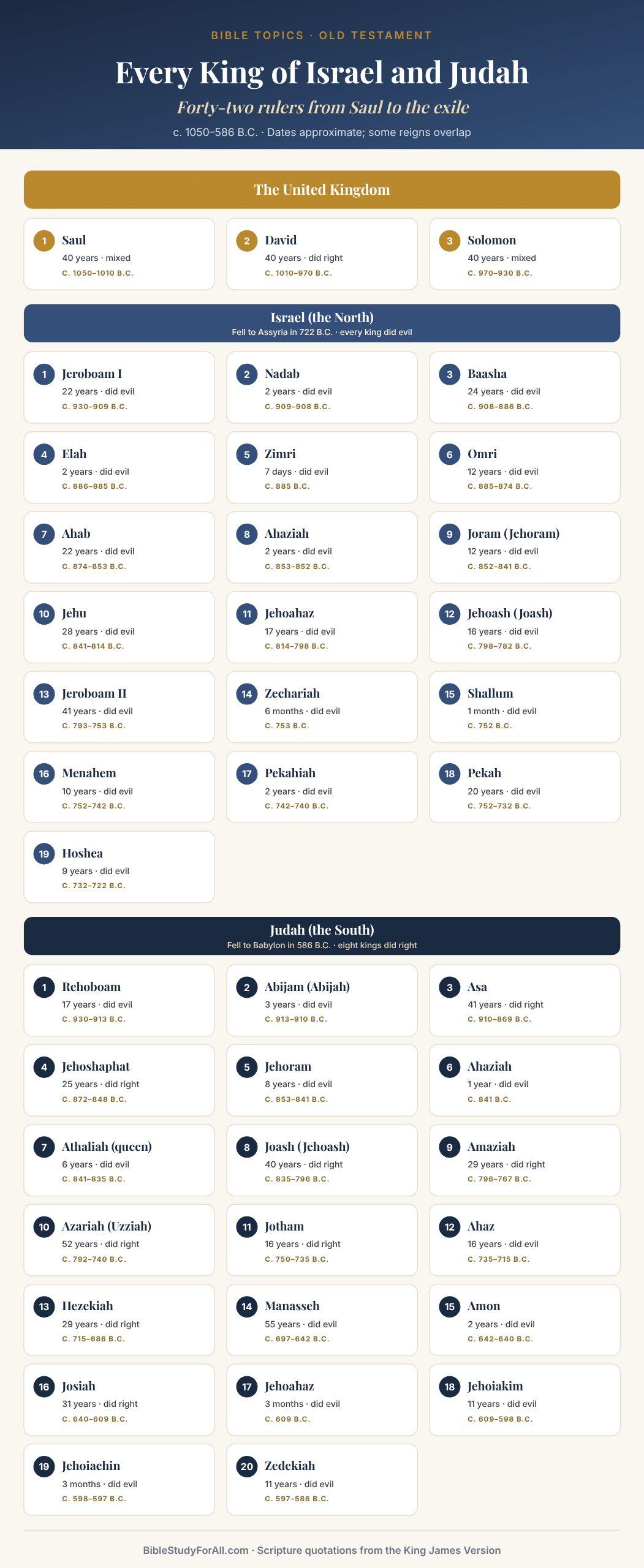
Dates are approximate, and some reigns overlap because sons often ruled alongside their fathers.
The North
The Kings of Israel
Capital: Shechem, then Tirzah, then Samaria. Nine royal families in about 210 years. Every king kept Jeroboam’s golden calves, and the kingdom fell to Assyria in 722 B.C.
KING AND READING
1. Jeroboam I · 22 years
1 KINGS 12:20–14:20
NOTES
Led the ten tribes away and set up golden calves at Bethel and Dan.
C. 930–909 · DID EVIL
KING AND READING
2. Nadab · 2 years
1 KINGS 15:25–31
NOTES
Killed by Baasha, who wiped out Jeroboam’s house.
C. 909–908 · DID EVIL
KING AND READING
3. Baasha · 24 years
1 KINGS 15:32–16:7
NOTES
Warned by the prophet Jehu son of Hanani; fought Asa of Judah.
C. 908–886 · DID EVIL
KING AND READING
4. Elah · 2 years
1 KINGS 16:8–14
NOTES
Killed while drunk by Zimri, his chariot commander.
C. 886–885 · DID EVIL
KING AND READING
5. Zimri · 7 days
1 KINGS 16:15–20
NOTES
Burned the palace over himself when Omri besieged Tirzah.
C. 885 · DID EVIL
KING AND READING
6. Omri · 12 years
1 KINGS 16:21–28
NOTES
Beat his rival Tibni and built Samaria as the new capital.
C. 885–874 · DID EVIL
KING AND READING
7. Ahab · 22 years
1 KINGS 16:29–22:40
NOTES
Married Jezebel and served Baal; opposed by Elijah.
C. 874–853 · DID EVIL
KING AND READING
8. Ahaziah · 2 years
1 KINGS 22:51–2 KINGS 1:18
NOTES
Injured in a fall, he sent to ask Baal-zebub instead of God.
C. 853–852 · DID EVIL
KING AND READING
9. Joram (Jehoram) · 12 years
2 KINGS 3:1–27
NOTES
Son of Ahab; the king in many of Elisha’s stories. Killed by Jehu.
C. 852–841 · DID EVIL
KING AND READING
10. Jehu · 28 years
2 KINGS 9:1–10:36
NOTES
Ended Ahab’s house and Baal worship, but kept Jeroboam’s calves.
C. 841–814 · DID EVIL
KING AND READING
11. Jehoahaz · 17 years
2 KINGS 13:1–9
NOTES
Oppressed by Syria; he besought the LORD, and God gave a deliverer.
C. 814–798 · DID EVIL
KING AND READING
12. Jehoash (Joash) · 16 years
2 KINGS 13:10–25
NOTES
Wept at Elisha’s deathbed and beat Syria three times.
C. 798–782 · DID EVIL
KING AND READING
13. Jeroboam II · 41 years
2 KINGS 14:23–29
NOTES
Restored Israel’s borders, as Jonah foretold; the age of Amos and Hosea.
C. 793–753 · DID EVIL
KING AND READING
14. Zechariah · 6 months
2 KINGS 15:8–12
NOTES
The fourth generation of Jehu, as God had said; killed by Shallum.
C. 753 · DID EVIL
KING AND READING
15. Shallum · 1 month
2 KINGS 15:13–15
NOTES
Killed by Menahem after one month.
C. 752 · DID EVIL
KING AND READING
16. Menahem · 10 years
2 KINGS 15:16–22
NOTES
Paid a thousand talents of silver to Pul, king of Assyria.
C. 752–742 · DID EVIL
KING AND READING
17. Pekahiah · 2 years
2 KINGS 15:23–26
NOTES
Killed by his captain Pekah.
C. 742–740 · DID EVIL
KING AND READING
18. Pekah · 20 years
2 KINGS 15:27–31
NOTES
Joined Syria against Judah; Assyria took Galilee and Gilead.
C. 752–732 · DID EVIL
KING AND READING
19. Hoshea · 9 years
2 KINGS 17:1–6
NOTES
The last king; Samaria fell after a three-year siege.
C. 732–722 · DID EVIL
The South
The Kings of Judah
Capital: Jerusalem, with the temple. One royal family, David’s, for about 345 years, broken only by Queen Athaliah. Eight kings did right. Judah fell to Babylon in 586 B.C.
KING AND READING
1. Rehoboam · 17 years
1 KINGS 14:21–31
NOTES
His harsh answer split the kingdom; Shishak of Egypt took the temple treasures.
C. 930–913 · DID EVIL
KING AND READING
2. Abijam (Abijah) · 3 years
1 KINGS 15:1–8
NOTES
His heart was not perfect, yet God kept a lamp in Jerusalem for David’s sake.
C. 913–910 · DID EVIL
KING AND READING
3. Asa · 41 years
1 KINGS 15:9–24
NOTES
Removed idols and even the queen mother Maachah; later relied on Syria.
C. 910–869 · DID RIGHT
KING AND READING
4. Jehoshaphat · 25 years
1 KINGS 22:41–50
NOTES
Taught the law in the cities, but allied himself with Ahab’s house.
C. 872–848 · DID RIGHT
KING AND READING
5. Jehoram · 8 years
2 KINGS 8:16–24
NOTES
Married Athaliah, Ahab’s daughter, and walked in the ways of Ahab.
C. 853–841 · DID EVIL
KING AND READING
6. Ahaziah · 1 year
2 KINGS 8:25–29
NOTES
Killed by Jehu while visiting Joram of Israel.
C. 841 · DID EVIL
KING AND READING
7. Athaliah (queen) · 6 years
2 KINGS 11:1–21
NOTES
Seized the throne; baby Joash was hidden in the temple.
C. 841–835 · DID EVIL
KING AND READING
8. Joash (Jehoash) · 40 years
2 KINGS 12:1–21
NOTES
Crowned at seven; repaired the temple while Jehoiada the priest guided him.
C. 835–796 · DID RIGHT
KING AND READING
9. Amaziah · 29 years
2 KINGS 14:1–22
NOTES
Right, yet not like David; beat Edom, then foolishly challenged Israel.
C. 796–767 · DID RIGHT
KING AND READING
10. Azariah (Uzziah) · 52 years
2 KINGS 15:1–7
NOTES
A long, strong reign; struck with leprosy for burning incense.
C. 792–740 · DID RIGHT
KING AND READING
11. Jotham · 16 years
2 KINGS 15:32–38
NOTES
Built the higher gate of the temple; the high places remained.
C. 750–735 · DID RIGHT
KING AND READING
12. Ahaz · 16 years
2 KINGS 16:1–20
NOTES
Made his son pass through the fire and turned to Assyria instead of God.
C. 735–715 · DID EVIL
KING AND READING
13. Hezekiah · 29 years
2 KINGS 18:1–20:21
NOTES
Trusted the LORD; God saved Jerusalem from Sennacherib of Assyria.
C. 715–686 · DID RIGHT
KING AND READING
14. Manasseh · 55 years
2 KINGS 21:1–18
NOTES
The longest and worst reign; he humbled himself in Babylon (2 Chronicles 33).
C. 697–642 · DID EVIL
KING AND READING
15. Amon · 2 years
2 KINGS 21:19–26
NOTES
Followed his father’s idols; killed by his servants.
C. 642–640 · DID EVIL
KING AND READING
16. Josiah · 31 years
2 KINGS 22:1–23:30
NOTES
Found the book of the law, renewed the covenant and kept a great passover.
C. 640–609 · DID RIGHT
KING AND READING
17. Jehoahaz · 3 months
2 KINGS 23:31–34
NOTES
Taken to Egypt by Pharaoh Necho.
C. 609 · DID EVIL
KING AND READING
18. Jehoiakim · 11 years
2 KINGS 23:35–24:7
NOTES
Served Babylon, then rebelled; burned Jeremiah’s scroll.
C. 609–598 · DID EVIL
KING AND READING
19. Jehoiachin · 3 months
2 KINGS 24:8–17
NOTES
Taken to Babylon with Ezekiel and ten thousand captives.
C. 598–597 · DID EVIL
KING AND READING
20. Zedekiah · 11 years
2 KINGS 24:18–25:7
NOTES
Rebelled against Babylon; Jerusalem and the temple were burned.
C. 597–586 · DID EVIL
For the united kingdom, read 1 Samuel 9–31 (Saul), 2 Samuel 1–24 (David) and 1 Kings 1–11 (Solomon). Chronicles retells Judah’s story in 2 Chronicles 10–36.
After Solomon
Two Kingdoms Compared
From about 930 B.C. there were two kingdoms side by side, sometimes at war with each other and sometimes allies.
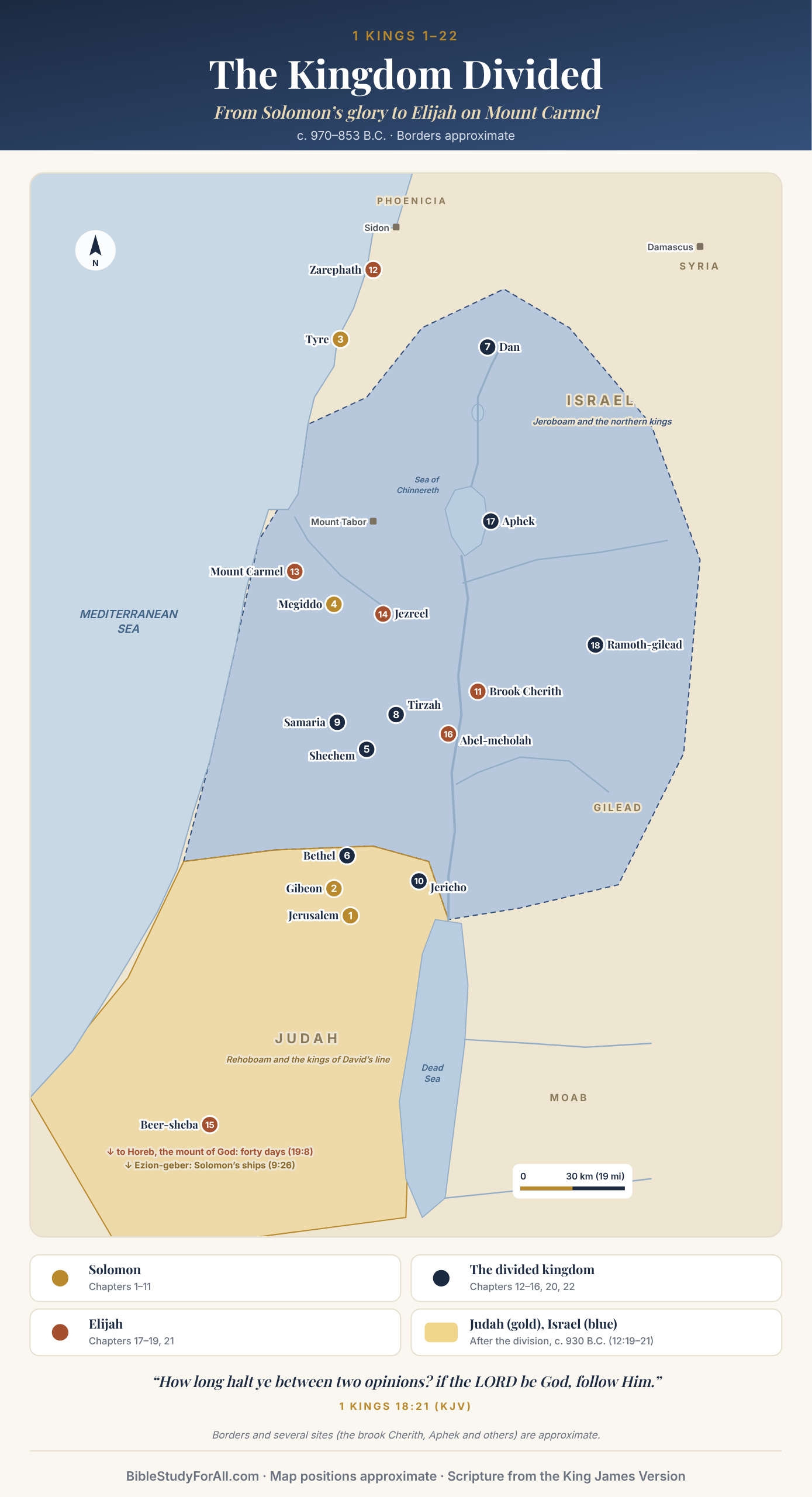
Borders and several sites are approximate.
C. 930–722 B.C.
Israel (the North)
Ten tribes, led by Ephraim. Capitals Shechem, Tirzah, then Samaria. Nineteen kings from nine royal families; none did right. Worship at golden calves in Bethel and Dan. Fell to Assyria in 722 B.C.
2 KINGS 17
C. 930–586 B.C.
Judah (the South)
Judah and Benjamin, joined by Levites and faithful people from the north. Capital Jerusalem, with the temple. All of David’s line except Athaliah; eight kings did right. Fell to Babylon in 586 B.C.
2 KINGS 25
God’s Messengers
The Prophets and the Kings
Israel’s kings were never meant to have the final word. God sent prophets to anoint them, guide them and confront them.
TO SAUL
Samuel
Anointed the first two kings: “to obey is better than sacrifice.”
1 SAMUEL 15
TO DAVID
Nathan
Brought God’s promise, and later the rebuke: “Thou art the man.”
2 SAMUEL 12
TO JEROBOAM
Ahijah
Tore his cloak into twelve pieces and gave Jeroboam ten.
1 KINGS 11:29–39
TO AHAB
Elijah
Announced the drought and called down fire on Mount Carmel.
1 KINGS 17–19
TO JORAM AND JEHU
Elisha
Did many miracles and sent a prophet to anoint Jehu.
2 KINGS 2–9
TO JEROBOAM II
Amos and Hosea
Spoke against injustice and idols in Israel’s richest days.
AMOS 7:10–17
TO AHAZ AND HEZEKIAH
Isaiah
Urged Ahaz to trust God and assured Hezekiah God would save Jerusalem.
ISAIAH 37
TO JOSIAH TO ZEDEKIAH
Jeremiah
Prophesied for forty years and saw Jerusalem fall.
JEREMIAH 1:1–3
“Yet the LORD testified against Israel, and against Judah, by all the prophets, and by all the seers, saying, Turn ye from your evil ways, and keep My commandments and My statutes”2 Kings 17:13 (KJV)
The Rest of the Story
The Kings and Jesus
Every king of Israel and Judah fell short. But God had promised David a son whose throne would last for ever, and the New Testament opens by announcing that He has come.
The Son of David
“The book of the generation of Jesus Christ, the son of David, the son of Abraham.”
MATTHEW 1:1
The Throne of David
“the Lord God shall give unto Him the throne of His father David”
LUKE 1:32
Greater than Solomon
“behold, a greater than Solomon is here.”
MATTHEW 12:42
The Humble King
“Behold, thy King cometh unto thee, meek, and sitting upon an ass”
MATTHEW 21:5
A Different Kingdom
“My kingdom is not of this world”
JOHN 18:36
King of Kings
“KING OF KINGS, AND LORD OF LORDS.”
REVELATION 19:16
For Today
Six Things to Remember
The kings lived long ago, but the lessons of their reigns are as near as your own heart.
1
God Wants to Be King
Israel’s deepest problem was rejecting God’s rule.
1 SAMUEL 8:7
2
God Looks at the Heart
Height, wisdom and cleverness could not replace a heart turned to God.
1 SAMUEL 16:7
3
One Choice Affects Many
Jeroboam’s calves led a nation astray; Josiah’s obedience turned it back.
1 KINGS 14:16
4
God Warns Before He Judges
He sent prophet after prophet for hundreds of years.
2 KINGS 17:13–14
5
God Keeps His Promises
He kept David’s line alive until the true Son of David came.
LUKE 1:32–33
6
Trust in the LORD
The best kings leaned on God, not on chariots or allies.
“Some trust in chariots, and some in horses: but we will remember the name of the LORD our God.”
PSALM 20:7
Think About It
Questions for Reflection
Israel wanted to be “like all the nations”: where are you tempted to trust what everyone else trusts instead of God? Saul offered sacrifice instead of obedience: is there an area where you are doing the same? Josiah’s reform began when he simply heard God’s word read: what would change if you took God’s word that seriously?
Bible Study
Read About the Kings in Scripture
Samuel and Kings tell the story of both kingdoms, and Chronicles retells Judah’s story with extra details. These passages gather the key ones in five parts. Tap a part below to jump to it, tap any section to expand it, and tap a verse reference to read it in the King James Version at BibleGateway.
Part I
The First King
1 Samuel 8–31 · Israel asks for a king, and Saul rises and falls.
- Make us a king · 1 Samuel 8:1–22
- Samuel anoints Saul · 1 Samuel 9:15–10:1
- Only fear the LORD · 1 Samuel 12:12–25
- A man after His own heart · 1 Samuel 13:5–14
- To obey is better than sacrifice · 1 Samuel 15:10–23
- Saul dies on Mount Gilboa · 1 Samuel 31:1–6
Part II
David and Solomon
1 Samuel 16 – 1 Kings 11 · The shepherd king, God’s promise, and Solomon’s glory.
- The LORD looketh on the heart · 1 Samuel 16:1–13
- Thy throne shall be established for ever · 2 Samuel 7:1–17
- Thou art the man · 2 Samuel 12:1–13
- An understanding heart · 1 Kings 3:5–15
- Solomon dedicates the temple · 1 Kings 8:22–30
- His heart turned away · 1 Kings 11:1–13
Part III
The Kingdom Divides
1 Kings 12–22 · Rehoboam, Jeroboam, and Elijah against Baal.
- To your tents, O Israel · 1 Kings 12:1–20
- Golden calves at Bethel and Dan · 1 Kings 12:25–33
- The drought announced · 1 Kings 17:1–16
- Fire on Mount Carmel · 1 Kings 18:17–40
- Naboth’s vineyard · 1 Kings 21:1–29
Part IV
The Fall of Israel
2 Kings 2–17 · Elisha, Jehu, and Samaria’s fall to Assyria.
- Elijah taken up · 2 Kings 2:1–15
- Jehu anointed · 2 Kings 9:1–13
- Joash hidden in the temple · 2 Kings 11:1–21
- Samaria falls, and why · 2 Kings 17:1–18
Part V
Judah’s Last Kings
2 Kings 18–25 · Hezekiah, Josiah, and the fall of Jerusalem.
- Hezekiah trusted in the LORD · 2 Kings 18:1–8
- Hezekiah’s prayer answered · 2 Kings 19:14–37
- The book of the law found · 2 Kings 22:8–20
- Josiah renews the covenant · 2 Kings 23:1–25
- Jerusalem burned · 2 Kings 25:1–21
- Jehoiachin set free · 2 Kings 25:27–30
Questions
Questions About the Kings of Israel
How many kings did Israel have?
This study counts forty-two rulers: three over the united kingdom (Saul, David and Solomon), nineteen kings of Israel in the north, and twenty rulers of Judah in the south, which is nineteen kings plus Queen Athaliah. Saul’s son Ish-bosheth also ruled the northern tribes for two years while David ruled Judah (2 Samuel 2:8–10).
Who was the first king of Israel?
Saul, a Benjamite, anointed by Samuel about 1050 B.C. (1 Samuel 10:1). Paul says God gave Israel Saul “by the space of forty years” (Acts 13:21).
Why don’t the reign lengths add up to the dates?
Some sons ruled alongside their fathers for years; for example, Jotham governed while his father Uzziah had leprosy (2 Kings 15:5). Israel and Judah also counted a king’s first partial year in different ways. That is why some reigns overlap on this page.
Was it wrong for Israel to ask for a king?
God had planned for a king (Genesis 17:6; Deuteronomy 17:14–20), so having one was not the problem. The problem was the reason. Israel wanted to be “like all the nations” and to have a king fight their battles, rejecting God as their King (1 Samuel 8:7, 20).
Were any of the northern kings good?
Kings says that every one of them did evil and kept Jeroboam’s calves. A few had better moments: Ahab humbled himself after Naboth’s death (1 Kings 21:29), Jehu ended Baal worship (2 Kings 10:30), and Jehoahaz “besought the LORD” (2 Kings 13:4). None led Israel back to the worship God commanded.
Why do Kings and Chronicles tell the story differently?
Kings explains why both kingdoms fell, so it follows Israel and Judah side by side. Chronicles was written after the return from Babylon and focuses on Judah, David’s line and the temple, to encourage the people rebuilding Jerusalem. It adds details such as Manasseh’s repentance (2 Chronicles 33:12–13). The two are complementary accounts of the same history.
Why do several kings have the same name?
The two royal families intermarried and used family names. There was a Jehoram (or Joram) in both kingdoms at the same time, an Ahaziah in each, a Jehoash (or Joash) in each and a Jehoahaz in each. The lists above give the other spellings in brackets.
What happened to the ten northern tribes?
Assyria carried many of them away and settled other peoples in their land (2 Kings 17:6, 24). But not all were lost: people from the northern tribes moved to Judah over the years (2 Chronicles 11:16; 30:11), and in the New Testament Anna the prophetess is “of the tribe of Aser” (Luke 2:36). God promised to make them “one nation” again under one king (Ezekiel 37:22).
Keep Studying
Related Studies
Continue Your Study
Scripture quotations and verse links are from the King James Version (KJV).