
Revelation 1–3 · Bible Study
The Seven Churches of Revelation
He That Hath an Ear, Let Him Hear
The seven churches of Revelation were real congregations in the Roman province of Asia, in what is now western Turkey. From the isle of Patmos the risen Lord Jesus sent each one a letter through the apostle John, with praise, warning and a promise to him that overcometh.
About the Seven Churches
The Seven Churches at a Glance
Bible Study
Note: Scripture quotations and verse links on this site use the King James Version (KJV) because it is in the public domain, while most modern translations limit how much can be quoted online. Feel free to read along in the translation of your choice.
The Province of Asia
Western Turkey today
About A.D. 95
Written by John on Patmos
Seven Letters
Revelation 2 and 3
To Him That Overcometh
A promise in every letter
About the Seven Churches
What Are the Seven Churches of Revelation?
Who They Were
Seven Real Churches
Ephesus, Smyrna, Pergamos, Thyatira, Sardis, Philadelphia and Laodicea were seven cities about a day’s walk apart, each with a church that had heard the gospel.
Most of these churches began during Paul’s three years at Ephesus, when “all they which dwelt in Asia heard the word of the Lord Jesus” (Acts 19:10). By the time John wrote, some had grown strong, some had grown cold, and some were suffering for Christ.
“What thou seest, write in a book, and send it unto the seven churches which are in Asia; unto Ephesus, and unto Smyrna, and unto Pergamos, and unto Thyatira, and unto Sardis, and unto Philadelphia, and unto Laodicea” (Revelation 1:11).
When and Where
Patmos and the Province of Asia
The apostle John was banished to Patmos, a small island in the Aegean Sea, about A.D. 95. There, on the Lord’s day, the risen Christ appeared to him and told him to write.
“I John, who also am your brother, and companion in tribulation … was in the isle that is called Patmos, for the word of God, and for the testimony of Jesus Christ. I was in the Spirit on the Lord’s day” (Revelation 1:9–10).
The seven cities lay on a great road that ran in a loop through the province, so a messenger landing at Ephesus could carry the book to each church in turn, in the same order as the letters.
Why They Matter
A Message for Every Church
Every letter ends the same way: “He that hath an ear, let him hear what the Spirit saith unto the churches.” What Jesus said to them, He says to every church and every believer today.
The letters show what the Lord sees when He looks at a church. He knows its works, praises what is faithful, warns against what is wrong and calls it to repent.
They also show His love: “As many as I love, I rebuke and chasten: be zealous therefore, and repent” (Revelation 3:19). And every letter holds out a promise “to him that overcometh.”
Key Verse
What the Spirit Saith unto the Churches
“He that hath an ear, let him hear what the Spirit saith unto the churches.”
Revelation 2:7 (KJV)
Key Themes
Six Lessons from the Seven Churches
The seven churches of Revelation were very different, but the same truths run through all seven letters.
1
He Walks Among Them
Christ is present in His churches.
“who walketh in the midst of the seven golden candlesticks”
REVELATION 2:1
2
He Knows
Nothing is hidden from Him.
“I know thy works”
REVELATION 2:2
3
Love Comes First
Busy work cannot replace love for Him.
“thou hast left thy first love.”
REVELATION 2:4
4
Be Faithful
Even when it costs everything.
“be thou faithful unto death, and I will give thee a crown of life.”
REVELATION 2:10
5
Repent
He rebukes because He loves.
“As many as I love, I rebuke and chasten”
REVELATION 3:19
6
Overcome
A promise in every letter.
“To him that overcometh will I grant to sit with Me in My throne”
REVELATION 3:21
From Patmos to Laodicea
What the Bible Says About the Seven Churches of Revelation
Revelation 1:9–20John’s Vision on Patmos
On the Lord’s day John heard a great voice behind him, as of a trumpet. He turned and saw seven golden candlesticks, and in the midst of them “one like unto the Son of man,” with eyes as a flame of fire and a countenance “as the sun shineth in his strength” (Revelation 1:13, 16). John fell at His feet as dead. Jesus laid His right hand on him and said, “Fear not; I am the first and the last: I am He that liveth, and was dead; and, behold, I am alive for evermore” (1:17–18). He explained that the seven stars are the angels, or messengers, of the seven churches, and the seven candlesticks are the churches themselves (1:20).
Revelation 2:1–7Ephesus: The Church That Left Its First Love
Ephesus was the greatest city of Asia, home of the temple of Diana, and the church there had been taught by Paul for three years. Jesus praised its hard work, its patience and its stand against false apostles. “Nevertheless I have somewhat against thee, because thou hast left thy first love” (Revelation 2:4). He told them to remember, repent and do the first works, or He would remove their candlestick. To him that overcometh He promised “to eat of the tree of life, which is in the midst of the paradise of God” (2:7).
Revelation 2:8–11Smyrna: The Suffering Church
Smyrna was a rich port city where Christians were poor and persecuted. Jesus had no rebuke for them. “I know thy works, and tribulation, and poverty, (but thou art rich)” (Revelation 2:9). He warned that some would be cast into prison and tried for ten days, and said, “be thou faithful unto death, and I will give thee a crown of life” (2:10). The overcomer “shall not be hurt of the second death” (2:11).
Revelation 2:12–17Pergamos: The Church Where Satan’s Seat Is
Pergamos was the old capital of Asia, full of temples and altars. Jesus said, “I know thy works, and where thou dwellest, even where Satan’s seat is” (Revelation 2:13). The church had held fast His name, even when Antipas, His faithful martyr, was slain among them. But some held the doctrine of Balaam, who taught Israel to sin, and some the doctrine of the Nicolaitans. He called them to repent, and promised the overcomer hidden manna and a white stone with a new name written in it (2:17).
Revelation 2:18–29Thyatira: The Church That Tolerated Jezebel
To Thyatira, a city of trade guilds, Jesus came as “the Son of God, who hath His eyes like unto a flame of fire” (Revelation 2:18). He praised their charity, service, faith and patience, and said their last works were more than the first. But they allowed a woman He called Jezebel, a false prophetess, to teach His servants to commit fornication and eat things sacrificed to idols. To the faithful He said, “that which ye have already hold fast till I come” (2:25), and promised them power over the nations and “the morning star” (2:28).
Revelation 3:1–6Sardis: The Church That Was Dead
Sardis had once been a great royal city, and its church had a good name. But Jesus said, “I know thy works, that thou hast a name that thou livest, and art dead” (Revelation 3:1). He told them to be watchful and strengthen what remained, warning that He would come on them as a thief if they did not watch. A few in Sardis had not defiled their garments, and “they shall walk with Me in white: for they are worthy” (3:4). He promised not to blot the overcomer’s name out of the book of life (3:5).
Revelation 3:7–13Philadelphia: The Faithful Church
Philadelphia was a small city often shaken by earthquakes. Jesus, “He that hath the key of David,” praised the church and gave no rebuke: “I have set before thee an open door, and no man can shut it: for thou hast a little strength, and hast kept My word, and hast not denied My name” (Revelation 3:7–8). He promised, “I also will keep thee from the hour of temptation, which shall come upon all the world, to try them that dwell upon the earth” (3:10). “Behold, I come quickly: hold that fast which thou hast, that no man take thy crown” (3:11).
Revelation 3:14–22Laodicea: The Lukewarm Church
Laodicea was a wealthy banking city, known for its fine black wool and an eye salve, but its water came lukewarm through a long aqueduct. Jesus said, “I know thy works, that thou art neither cold nor hot … So then because thou art lukewarm, and neither cold nor hot, I will spue thee out of My mouth” (Revelation 3:15–16). They said they were rich and had need of nothing, but He saw them as “wretched, and miserable, and poor, and blind, and naked” (3:17). He counseled them to buy of Him gold tried in the fire, white raiment and eyesalve.
Revelation 3:19–22Behold, I Stand at the Door
Even to the lukewarm church, the Lord held out His hand. “As many as I love, I rebuke and chasten: be zealous therefore, and repent. Behold, I stand at the door, and knock: if any man hear My voice, and open the door, I will come in to him, and will sup with him, and he with Me” (Revelation 3:19–20). The overcomer will sit with Christ in His throne, “even as I also overcame, and am set down with My Father in His throne” (3:21).
Revelation 4:1Come Up Hither
Right after the seven letters, John saw a door opened in heaven, and the voice like a trumpet said, “Come up hither, and I will shew thee things which must be hereafter” (Revelation 4:1). The rest of the book shows the throne of God, the judgments of the tribulation, the glorious return of Christ and the new heaven and new earth. This site holds the premillennial, pre-tribulation view: the Lord will catch up His church to meet Him in the air before those judgments fall (1 Thessalonians 4:16–17; Revelation 3:10).
At a Glance
The Seven Churches at a Glance
The seven churches of Revelation on one page: how Christ showed Himself to John, a chart of the seven letters, a map of the seven cities, what He praised and what He warned, His promises to the overcomer, and lessons for churches today. Tap a topic to jump to it.
Printable Copy
Save or Print the Infographic
Everything in this section, with the key verse and key themes, is also on a printable infographic (six pages). It opens in a new tab, where you can save it to your phone or computer, share it, or print it.
Revelation 1
How Christ Appeared to John
Each letter to the seven churches of Revelation opens with a picture of Jesus taken from John’s vision in chapter 1, chosen to fit that church.
EPHESUS
Among the Candlesticks
He holds the seven stars.
“He that holdeth the seven stars in His right hand”
REVELATION 2:1
SMYRNA
The First and the Last
He died and lives again.
“the first and the last, which was dead, and is alive”
REVELATION 2:8
PERGAMOS
The Sharp Sword
His Word judges false teaching.
“He which hath the sharp sword with two edges”
REVELATION 2:12
THYATIRA
Eyes like a Flame
He searches the heart.
“I am He which searcheth the reins and hearts”
REVELATION 2:23
SARDIS
The Seven Spirits
He gives life to the dead.
“He that hath the seven Spirits of God, and the seven stars”
REVELATION 3:1
PHILADELPHIA
The Key of David
He opens doors no one can shut.
“He that openeth, and no man shutteth”
REVELATION 3:7
LAODICEA
The Faithful Witness
He tells the truth about us.
“the Amen, the faithful and true witness, the beginning of the creation of God”
REVELATION 3:14
JOHN
Alive for Evermore
Fear not.
“I am He that liveth, and was dead; and, behold, I am alive for evermore”
REVELATION 1:18
THE MEANING
Stars and Candlesticks
The messengers and the churches.
“the seven candlesticks which thou sawest are the seven churches.”
REVELATION 1:20
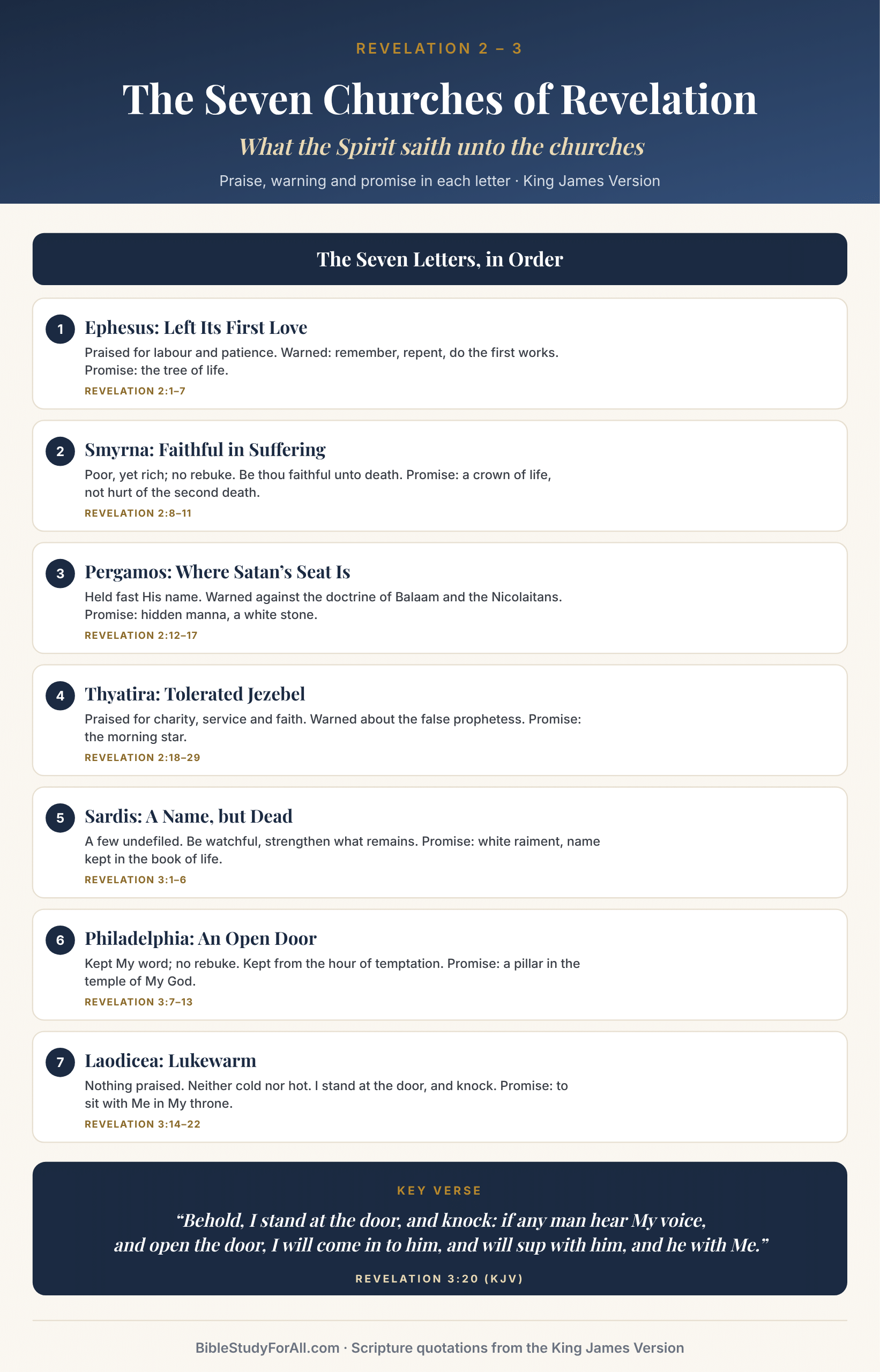
Chart
The Seven Churches Chart
The seven churches of Revelation in the order of the letters, with what Christ praised, what He warned, and His promise to the overcomer in each one.
Map
Map of the Seven Churches
The seven churches of Revelation stood in a loop about a hundred miles across, joined by Roman roads. A messenger from Patmos could land at Ephesus and visit them in the order of the letters.
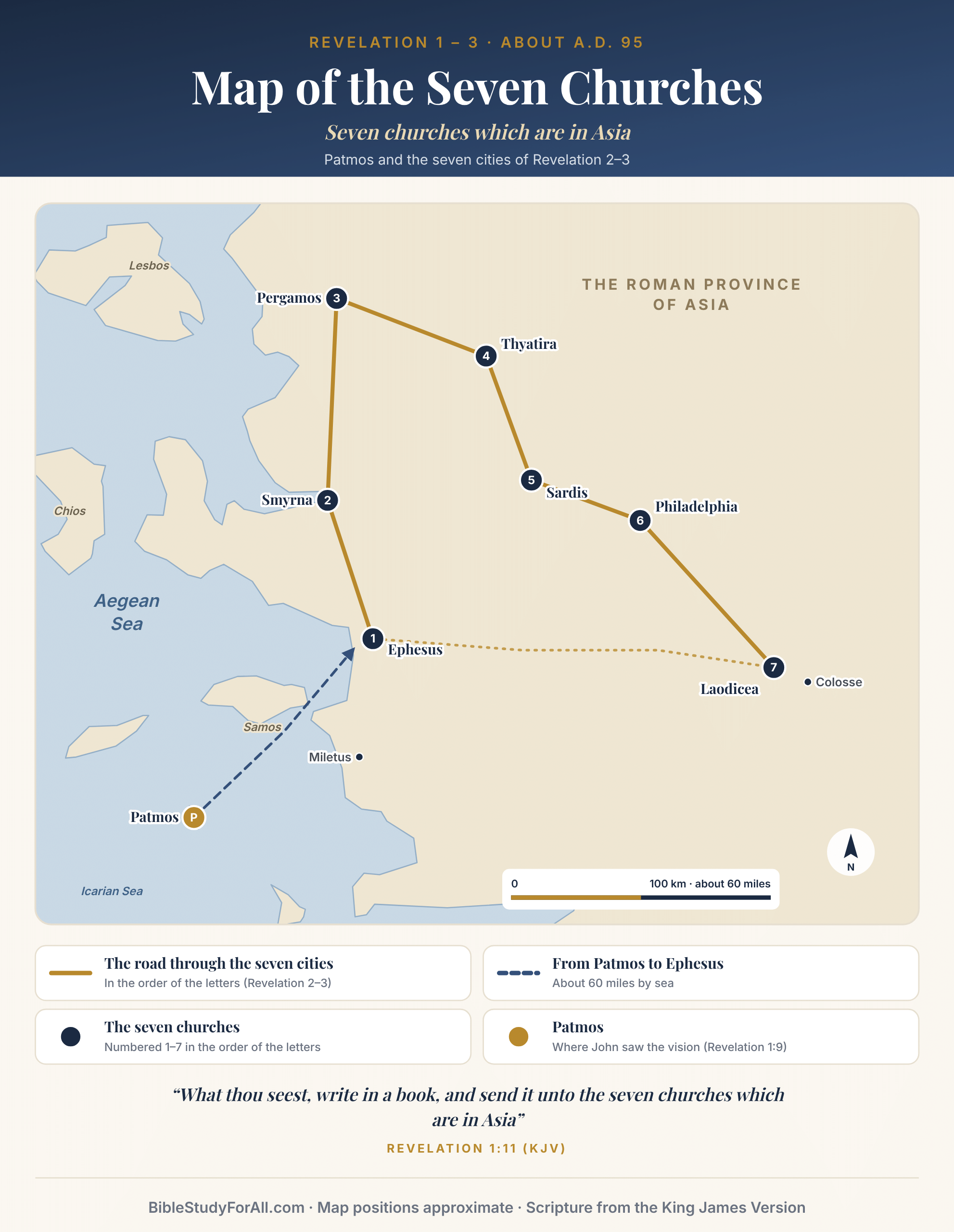
Positions and roads are approximate.
P
Patmos
John sees the vision and writes
REVELATION 1:9
1
Ephesus
Left its first love
REVELATION 2:1
2
Smyrna
Faithful unto death
REVELATION 2:8
3
Pergamos
Where Satan’s seat is
REVELATION 2:12
4
Thyatira
Tolerated Jezebel
REVELATION 2:18
5
Sardis
A name, but dead
REVELATION 3:1
6
Philadelphia
An open door
REVELATION 3:7
7
Laodicea
Neither cold nor hot
REVELATION 3:14
Praise and Warning
What He Praised and What He Warned
The Lord knew the works of each of the seven churches. Two received no rebuke, and one received no praise.
WHAT HE PRAISED
Ephesus: labour, patience, and testing false apostles
Revelation 2:2
WHAT HE WARNED
Thou hast left thy first love
Revelation 2:4
WHAT HE PRAISED
Smyrna: rich in faith though poor and persecuted
Revelation 2:9
WHAT HE WARNED
No rebuke. Fear none of those things which thou shalt suffer
Revelation 2:10
WHAT HE PRAISED
Pergamos: held fast My name, like Antipas the martyr
Revelation 2:13
WHAT HE WARNED
Some hold the doctrine of Balaam and of the Nicolaitans
Revelation 2:14–15
WHAT HE PRAISED
Thyatira: charity, service, faith and growing works
Revelation 2:19
WHAT HE WARNED
Thou sufferest that woman Jezebel
Revelation 2:20
WHAT HE PRAISED
Sardis: a few names which have not defiled their garments
Revelation 3:4
WHAT HE WARNED
Thou hast a name that thou livest, and art dead
Revelation 3:1
WHAT HE PRAISED
Philadelphia: kept My word, and not denied My name
Revelation 3:8
WHAT HE WARNED
No rebuke. Hold that fast which thou hast
Revelation 3:11
WHAT HE PRAISED
Laodicea: nothing praised
Revelation 3:14
WHAT HE WARNED
Thou art lukewarm, and neither cold nor hot
Revelation 3:16
To Him That Overcometh
Promises to Him That Overcometh
Every one of the seven letters ends with a promise for the believer who overcomes, that is, who keeps trusting Christ to the end.
EPHESUS
The Tree of Life
Lost in Eden, given back.
“will I give to eat of the tree of life”
REVELATION 2:7
SMYRNA
No Second Death
Safe from the lake of fire.
“He that overcometh shall not be hurt of the second death.”
REVELATION 2:11
PERGAMOS
Hidden Manna
And a new name.
“will I give to eat of the hidden manna, and will give him a white stone”
REVELATION 2:17
THYATIRA
The Morning Star
Christ Himself.
“And I will give him the morning star.”
REVELATION 2:28
SARDIS
White Raiment
A name never blotted out.
“I will not blot out his name out of the book of life”
REVELATION 3:5
PHILADELPHIA
A Pillar in the Temple
Never to be moved.
“Him that overcometh will I make a pillar in the temple of My God”
REVELATION 3:12
LAODICEA
A Seat on His Throne
Reigning with Christ.
“To him that overcometh will I grant to sit with Me in My throne”
REVELATION 3:21
WHO OVERCOMES
Faith Overcomes
Every true believer.
“and this is the victory that overcometh the world, even our faith.”
1 JOHN 5:4
THE END
Inherit All Things
The promise at the end of the book.
“He that overcometh shall inherit all things”
REVELATION 21:7
For Today
Lessons for Churches Today
The seven churches of Revelation are gone, but their letters still speak. Here is what the Spirit says to churches and believers now.
1
Keep Your First Love
Love Jesus more than the work.
“Remember therefore from whence thou art fallen, and repent”
REVELATION 2:5
2
Do Not Fear Suffering
He sees and rewards.
“Fear none of those things which thou shalt suffer”
REVELATION 2:10
3
Guard the Truth
False teaching spreads quietly.
“Repent; or else I will come unto thee quickly”
REVELATION 2:16
4
Wake Up
A good name is not life.
“Be watchful, and strengthen the things which remain”
REVELATION 3:2
5
Walk Through Open Doors
He opens what no one can shut.
“I have set before thee an open door, and no man can shut it”
REVELATION 3:8
6
Open the Door to Him
He knocks on every heart.
“Behold, I stand at the door, and knock”
REVELATION 3:20
“Behold, I come quickly: hold that fast which thou hast, that no man take thy crown.”Revelation 3:11 (KJV)
Bible Study
Read the Seven Churches of Revelation in Scripture
The letters to the seven churches fill Revelation 2 and 3. These passages gather them in five parts, with the vision before them and the churches’ beginnings in Acts. Tap a part below to jump to it, tap any section to expand it, and tap a verse reference to read it in the King James Version at BibleGateway.
Part I
The Vision on Patmos
Revelation 1 · The risen Christ among the candlesticks.
- Unto the seven churches which are in Asia · Revelation 1:1–8
- In the isle that is called Patmos · Revelation 1:9–16
- Fear not; I am the first and the last · Revelation 1:17–20
Part II
Ephesus, Smyrna, Pergamos
Revelation 2:1–17 · First love, suffering and compromise.
- Thou hast left thy first love · Revelation 2:1–7
- Be thou faithful unto death · Revelation 2:8–11
- Where Satan’s seat is · Revelation 2:12–17
Part III
Thyatira and Sardis
Revelation 2:18–3:6 · A false prophetess and a dead name.
- Hold fast till I come · Revelation 2:18–29
- Thou hast a name that thou livest · Revelation 3:1–6
Part IV
Philadelphia and Laodicea
Revelation 3:7–22 · An open door and a lukewarm heart.
- I have set before thee an open door · Revelation 3:7–13
- Behold, I stand at the door, and knock · Revelation 3:14–22
- A door was opened in heaven · Revelation 4:1–11
Part V
How the Churches Began
Acts · Ephesians · Colossians · The gospel comes to Asia.
- All they which dwelt in Asia heard the word · Acts 19:1–10
- Paul’s farewell to the Ephesian elders · Acts 20:17–38
- To the saints which are at Ephesus · Ephesians 1:1–14
- The church of the Laodiceans · Colossians 4:12–16
- A seller of purple, of the city of Thyatira · Acts 16:13–15
Questions
Questions About the Seven Churches of Revelation
What are the seven churches of Revelation?
They are Ephesus, Smyrna, Pergamos, Thyatira, Sardis, Philadelphia and Laodicea, seven real churches in the Roman province of Asia (Revelation 1:11). Today their ruins lie in western Turkey. Smyrna is the modern city of Izmir.
Who wrote the letters?
The Lord Jesus Christ Himself gave the words, and the apostle John wrote them down: “Unto the angel of the church of Ephesus write; These things saith He that holdeth the seven stars in His right hand” (Revelation 2:1). Each letter is also “what the Spirit saith unto the churches.”
Who are the angels of the churches?
The word “angel” means messenger. Jesus said, “The seven stars are the angels of the seven churches” (Revelation 1:20). Each letter is addressed to the angel of a church, most likely the messenger or leader responsible to bring the letter to that church and teach it.
Which churches did Jesus not rebuke?
Smyrna, the suffering church, and Philadelphia, the faithful church, received only praise. Laodicea, the lukewarm church, received no praise at all.
Who are the Nicolaitans?
The Bible does not explain who they were beyond their deeds and their doctrine, which Jesus said He hated (Revelation 2:6, 15). They are named alongside the doctrine of Balaam, which led God’s people into idolatry and immorality (2:14), so their teaching was probably of the same kind.
What does “I stand at the door, and knock” mean?
Jesus spoke these words to a church that had shut Him out by its self-satisfied, lukewarm life (Revelation 3:20). He offers fellowship to “any man” who will hear His voice and open the door. The same invitation stands for anyone who has never received Him. Read The Plan of Salvation.
What does Revelation 3:10 promise?
To the faithful church Jesus said, “I also will keep thee from the hour of temptation, which shall come upon all the world” (Revelation 3:10). This site holds the premillennial, pre-tribulation view: Christ will catch up His church before the tribulation that comes upon the whole world (1 Thessalonians 4:16–17). See Jesus Returning.
Keep Studying
Related Studies
The whole book: the letters, the throne, the judgments and Christ’s return.
The new Jerusalem and the promises to the overcomer fulfilled.
Three years at Ephesus, when the gospel spread through Asia.
How the church began at Pentecost and spread from Jerusalem.
Continue Your Study
Scripture quotations and verse links are from the King James Version (KJV).