
Old Testament · Minor Prophets · Book 34 of 66
Nahum
About a hundred years after Jonah, Nineveh had gone back to its cruelty, and Nahum announces its end. It is comfort for God’s people: “The LORD is good, a strong hold in the day of trouble; and He knoweth them that trust in Him” (1:7).
Nahum at a Glance
Book Outline
Note: Scripture quotations and verse links on this site use the King James Version (KJV) because it is in the public domain, while most modern translations limit how much can be quoted online. Feel free to read along in the translation of your choice.
3 Chapters
47 verses
Author
Nahum the Elkoshite (1:1)
Written
c. 650 B.C.
Key Verse
“The LORD is good, a strong hold” (1:7)
About the Name
Title
Named for the prophet Nahum, whose name means “comfort.” It is the seventh of the twelve Minor Prophets.
The book is named for its prophet, “Nahum the Elkoshite” (1:1). His name means “comfort.” His message of Nineveh’s fall was a comfort to Judah, which had long suffered under Assyria.
Nahum is the seventh of the twelve Minor Prophets. The book calls itself “The burden of Nineveh” (1:1), a heavy message of judgment on one city.
Who Wrote It
Author Details
Written by Nahum the Elkoshite, a prophet of Judah from the town of Elkosh, of whom nothing else is told.
Nahum was from Elkosh (1:1), a small town whose place is no longer known. The Bible tells us nothing else about him, but his message is clear: the God who is “slow to anger” will not “at all acquit the wicked” (1:3).
He wrote as a poet, with vivid pictures of chariots in the streets, the gates of the rivers opened, and the empty dwelling of the lions (2:4–13).
When It Was Written
Date of Writing
Written about 650 B.C., after Assyria sacked No (Thebes) in Egypt in 663 B.C. and before Nineveh fell in 612 B.C.
Nahum speaks of the fall of “populous No” as already past (3:8–10). Assyria destroyed No, the Egyptian city of Thebes, in 663 B.C. Nineveh was still strong and proud when he wrote, so the book dates to about 650 B.C., in the reign of Manasseh of Judah.
In 612 B.C. the Babylonians and the Medes took Nineveh, and the great city was never rebuilt, just as the LORD had said: “He will make an utter end” (1:9).
Key Verse
A Strong Hold in the Day of Trouble
“The LORD is good, a strong hold in the day of trouble; and He knoweth them that trust in Him.”
Nahum 1:7 (KJV)
Big Ideas
Key Themes
God’s Patience
Slow to anger.
1:3
God’s Justice
Will not at all acquit the wicked.
1:3
God’s Power
The mountains quake at Him.
1:5
God’s Goodness
A strong hold in trouble.
1:7
Comfort
I will afflict thee no more.
1:12
Good Tidings
That publisheth peace.
1:15
Pride Falls
I am against thee.
2:13
Violence Judged
Woe to the bloody city.
3:1
Prophecy Fulfilled
He will make an utter end.
1:9
Overview
Nahum Summary
OverviewThe End of Nineveh
In Jonah’s day Nineveh repented and was spared. A century later it had returned to its violence, destroyed Israel, and pressed hard on Judah. Nahum announces that God’s patience has an end: Nineveh will fall and never rise again. For Judah this was good news. The God who judges His enemies is also “a strong hold in the day of trouble” for those who trust Him (1:7).
Chapter 1Who the LORD Is
“God is jealous, and the LORD revengeth… The LORD is slow to anger, and great in power, and will not at all acquit the wicked” (1:2–3). The sea dries up and the mountains quake before Him: “Who can stand before His indignation?” (1:5–6). Yet “The LORD is good, a strong hold in the day of trouble; and He knoweth them that trust in Him” (1:7). To Judah He says, “I will afflict thee no more. For now will I break his yoke from off thee” (1:12–13). “Behold upon the mountains the feet of him that bringeth good tidings, that publisheth peace!” (1:15).
Chapter 2The Fall of Nineveh
“He that dasheth in pieces is come up before thy face” (2:1). Nahum pictures the attack: shields made red, chariots raging in the streets and running “like the lightnings” (2:3–4). “The gates of the rivers shall be opened, and the palace shall be dissolved” (2:6). The people flee, and the conquerors cry, “Take ye the spoil of silver, take the spoil of gold” (2:9). Nineveh was like a lion’s den filled with prey; now “Where is the dwelling of the lions?” (2:11). “Behold, I am against thee, saith the LORD of hosts” (2:13).
Chapter 3Woe to the Bloody City
“Woe to the bloody city! it is all full of lies and robbery” (3:1). Nineveh had sold nations through her witchcrafts (3:4). Nahum reminds her of No, the great city of Egypt that Assyria itself had sacked: “Art thou better than populous No?” (3:8). Her strong holds will fall like ripe figs into the mouth of the eater (3:12). “Thy shepherds slumber, O king of Assyria” (3:18). The book ends: “There is no healing of thy bruise… all that hear the bruit of thee shall clap the hands over thee: for upon whom hath not thy wickedness passed continually?” (3:19).
TodayComfort in God’s Justice
Nahum teaches that no power on earth is beyond God’s reach. Assyria seemed unbeatable, yet it fell exactly as foretold. The same God who is slow to anger keeps His word against the wicked and keeps those who trust in Him. His people can rest, because “the LORD is good” (1:7) and the messenger still brings “good tidings” of peace (1:15; Romans 10:15).
At a Glance
Nahum at a Glance
The whole book in short sections: its three parts, the map, who the LORD is, Nineveh then and now, the picture of the fall, and Christ in Nahum. Tap a topic to jump to it.
Printable Copy
Save or Print the Infographic
Everything in this section, with the key verse and key themes, is also on a printable infographic (four pages). It opens in a new tab, where you can save it to your phone or computer, share it, or print it.
Structure
The Book in Three Parts
Who the LORD is (1), what He will do to Nineveh (2), and why (3).
Each bar shows that part’s share of the 47 verses.
Map
Nineveh and No
Assyria had reached as far as No (Thebes) in Egypt and destroyed it. Nahum warns Nineveh that it is no better, and the Babylonians and Medes took it in 612 B.C. The numbers match the cards below.
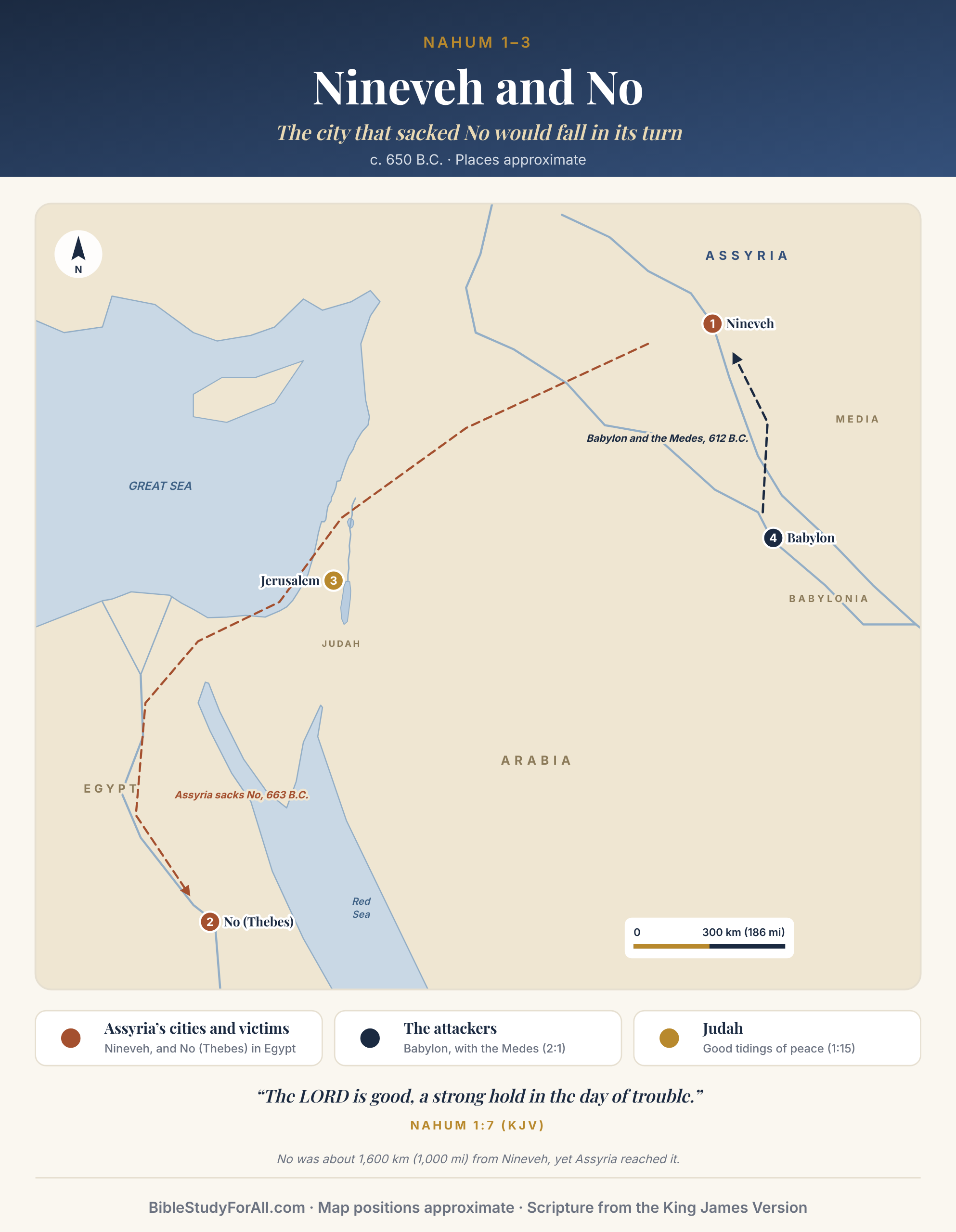
1 1:1; 2:8
Nineveh
Assyria’s capital. “The burden of Nineveh”: Assyria’s capital on the Tigris, fallen 612 B.C.
2 3:8–10
No (Thebes)
A lesson. “Art thou better than populous No?” Assyria had sacked it in 663 B.C.
3 1:15
Jerusalem
Good tidings. “O Judah, keep thy solemn feasts”: good tidings of peace.
4 2:1
Babylon
The attackers. “He that dasheth in pieces”: Babylon and the Medes took Nineveh.
Nahum 1
Who the LORD Is
Before Nahum speaks of Nineveh, he shows who God is.
1:2
Jealous
He revengeth His adversaries
1:3
Slow to Anger
And great in power
1:3
Just
Will not at all acquit the wicked
1:7
Good
A strong hold in trouble
“The LORD is good, a strong hold in the day of trouble; and He knoweth them that trust in Him.”Nahum 1:7 (KJV)
Two Prophets, One City
Nineveh in Jonah and in Nahum
The same city met God’s mercy and then His judgment.
JONAH, c. 760 B.C.
“Yet forty days, and Nineveh shall be overthrown”
Jonah 3:4
NAHUM, c. 650 B.C.
“He will make an utter end”
Nahum 1:9
JONAH, c. 760 B.C.
The people of Nineveh believed God
Jonah 3:5
NAHUM, c. 650 B.C.
“Woe to the bloody city! it is all full of lies”
Nahum 3:1
JONAH, c. 760 B.C.
God repented of the evil and spared it
Jonah 3:10
NAHUM, c. 650 B.C.
“There is no healing of thy bruise”
Nahum 3:19
Nahum 2–3
The Fall of Nineveh
Nahum’s pictures of the city’s last days.
2:4
Chariots Rage
Like the lightnings
2:6
Gates Opened
The gates of the rivers
2:9
Spoiled
Silver and gold taken
3:19
Never Healed
No healing of thy bruise
“Art thou better than populous No?” (3:8). Assyria had destroyed that great city; now its own turn had come.
Looking Forward
Christ in Nahum
Nahum’s good tidings point to the gospel of peace.
1:15 · ROMANS 10:15
Good Tidings of Peace
Paul uses this picture for those who preach the gospel.
1:7 · JOHN 10:14
He Knoweth His Own
The Good Shepherd knows those who trust in Him.
1:13 · GALATIANS 5:1
The Yoke Broken
Christ sets His people free from bondage.
1:3 · ACTS 17:31
The Judge of All
God will judge the world by the Man He has ordained.
Book Outline
Nahum Outline
Three chapters in three parts: the LORD who judges and protects (1), the fall of Nineveh (2), and woe to the bloody city (3). Tap a part below to jump to it, tap any section to expand it, and tap a verse reference to read it in the King James Version at BibleGateway.
Part I
The LORD Who Judges and Protects
1:1–15 · The LORD is slow to anger and great in power: an utter end for Nineveh, good tidings for Judah
- “The burden of Nineveh”: the book of the vision of Nahum the Elkoshite · 1:1
- “What do ye imagine against the LORD? He will make an utter end” · 1:9–11
- “I will afflict thee no more”: the LORD breaks Assyria’s yoke from Judah · 1:12–13
- The LORD’s commandment concerning Nineveh: “I will make thy grave” · 1:14
- “Behold upon the mountains the feet of him that bringeth good tidings, that publisheth peace!” · 1:15
Part II
The Fall of Nineveh
2:1–13 · The attacker comes, the gates of the rivers open, the city is spoiled, and the lions’ dwelling is empty
Part III
Woe to the Bloody City
3:1–19 · Nineveh’s cruelty and shame, the lesson of No, and a wound that cannot be healed
Continue Your Study
Scripture quotations and verse links are from the King James Version (KJV).