
Old Testament · Minor Prophets · Book 33 of 66
Micah
A country prophet warns proud Samaria and Jerusalem, names the town where the Messiah will be born, and sums up what God asks of us: “to do justly, and to love mercy, and to walk humbly with thy God” (6:8).
Micah at a Glance
Note: Scripture quotations and verse links on this site use the King James Version (KJV) because it is in the public domain, while most modern translations limit how much can be quoted online. Feel free to read along in the translation of your choice.
7 Chapters
105 verses
Author
Micah the Morasthite (1:1)
Written
c. 735–700 B.C.
Key Verse
“What doth the LORD require of thee?” (6:8)
About the Name
Title
Named for the prophet Micah, whose name means “Who is like the LORD?” It is the sixth of the twelve Minor Prophets.
The book is named for its prophet, “Micah the Morasthite” (1:1). His name is a short form of Micaiah and means “Who is like the LORD?” The book ends with the same question in praise: “Who is a God like unto Thee, that pardoneth iniquity?” (7:18).
Micah is the sixth of the twelve Minor Prophets. It is arranged in three messages, each opening with the word “Hear” (1:2; 3:1; 6:1).
Who Wrote It
Author Details
Written by Micah the Morasthite, a prophet from the country town of Moresheth-gath in Judah, in the days of Isaiah.
Micah came from Moresheth-gath, a small town in the low hills of Judah, about 35 km (22 mi) southwest of Jerusalem (1:1, 14). He spoke for the poor farmers whose fields were taken by the powerful (2:1–2). He lived in the same years as Isaiah, and both foretell the mountain of the LORD exalted in the last days (4:1–3; Isaiah 2:2–4).
A century later the elders of Judah remembered him by name: “Micah the Morasthite prophesied in the days of Hezekiah king of Judah” (Jeremiah 26:18). When Herod asked where Christ should be born, the scribes answered from Micah 5:2: “In Bethlehem of Judaea” (Matthew 2:5–6).
When It Was Written
Date of Writing
Written between about 735 and 700 B.C., in the reigns of Jotham, Ahaz and Hezekiah, kings of Judah.
Micah prophesied “in the days of Jotham, Ahaz, and Hezekiah, kings of Judah” (1:1), from about 735 to 700 B.C. He foretold the fall of Samaria, which Assyria destroyed in 722 B.C. (1:6; 2 Kings 17:6).
His warning that Zion would be plowed as a field moved King Hezekiah to fear the LORD, and the judgment was held back in his day (Jeremiah 26:18–19). Micah also foresaw Judah going to Babylon (4:10), more than a century before it happened in 586 B.C.
Key Verse
What Doth the LORD Require?
“He hath shewed thee, O man, what is good; and what doth the LORD require of thee, but to do justly, and to love mercy, and to walk humbly with thy God?”
Micah 6:8 (KJV)
Big Ideas
Key Themes
God Judges Sin
Samaria an heap of the field.
1:6
Justice for the Poor
They covet fields.
2:2
Faithful Leaders
Is it not for you to know judgment?
3:1
A Remnant
I will surely gather.
2:12
The Messiah
Out of thee shall He come forth.
5:2
Peace for the Nations
Swords into plowshares.
4:3
True Religion
Do justly, love mercy, walk humbly.
6:8
Hope in God
I will wait for the God of my salvation.
7:7
Forgiveness
He delighteth in mercy.
7:18
Overview
Micah Summary
OverviewWho Is Like the LORD?
Micah was a prophet from the country who spoke against the sins of the cities. Samaria and Jerusalem were full of idols, greedy rulers, priests who taught for hire and prophets who preached for money. Micah warned that both capitals would fall. Yet each of his three messages ends in hope: a remnant gathered, a King born in Beth-lehem, and a God who “delighteth in mercy” (7:18).
Chapters 1–2Judgment and a Remnant
“Hear, all ye people; hearken, O earth, and all that therein is” (1:2). The LORD comes forth, and the mountains melt under Him (1:3–4). Samaria will become “as an heap of the field” (1:6), and the wound reaches “unto the gate of my people, even to Jerusalem” (1:9). Micah mourns over the towns near his home (1:10–16). “Woe to them that devise iniquity… they covet fields, and take them by violence” (2:1–2). The people want prophets of wine and strong drink (2:11). Yet God promises: “I will surely gather the remnant of Israel… their king shall pass before them, and the LORD on the head of them” (2:12–13).
Chapter 3Rulers, Priests and Prophets
“Is it not for you to know judgment?” Micah asks the heads of Jacob, “who hate the good, and love the evil” (3:1–2). False prophets cry “Peace” for anyone who feeds them (3:5). “The heads thereof judge for reward, and the priests thereof teach for hire, and the prophets thereof divine for money” (3:11). Micah stands apart: “But truly I am full of power by the spirit of the LORD” (3:8). So “shall Zion for your sake be plowed as a field, and Jerusalem shall become heaps” (3:12).
Chapters 4–5The Mountain of the LORD and the Ruler from Beth-lehem
“But in the last days it shall come to pass, that the mountain of the house of the LORD shall be established in the top of the mountains” (4:1). Nations will come to learn His ways, and “they shall beat their swords into plowshares” (4:3). Zion will go to Babylon and be redeemed there (4:10). Then comes the great promise: “But thou, Beth-lehem Ephratah, though thou be little among the thousands of Judah, yet out of thee shall He come forth unto Me that is to be ruler in Israel; whose goings forth have been from of old, from everlasting” (5:2). He will feed His flock “in the strength of the LORD,” and “this man shall be the peace” (5:4–5).
Chapter 6What Doth the LORD Require?
God calls the mountains to hear His case against His people: “O My people, what have I done unto thee?” (6:3). He reminds them how He brought them out of Egypt (6:4). The people ask what would please Him: burnt offerings, thousands of rams, even a firstborn son (6:6–7)? Micah answers: “He hath shewed thee, O man, what is good; and what doth the LORD require of thee, but to do justly, and to love mercy, and to walk humbly with thy God?” (6:8). Yet the city kept wicked balances and the statutes of Omri (6:11, 16).
Chapter 7Who Is a God Like unto Thee?
Micah grieves that “there is none upright among men” and that “a man’s enemies are the men of his own house” (7:2, 6). But he turns to God: “Therefore I will look unto the LORD; I will wait for the God of my salvation: my God will hear me” (7:7). “When I fall, I shall arise; when I sit in darkness, the LORD shall be a light unto me” (7:8). The book ends in praise: “Who is a God like unto Thee, that pardoneth iniquity… He retaineth not His anger for ever, because He delighteth in mercy… Thou wilt cast all their sins into the depths of the sea” (7:18–19).
At a Glance
Micah at a Glance
The whole book in short sections: its three parts, the map, the three calls to hear, the mountain of the LORD, the Ruler from Beth-lehem, what the LORD requires, the God who pardons, and Christ in Micah. Tap a topic to jump to it.
Printable Copy
Save or Print the Infographic
Everything in this section, with the key verse and key themes, is also on a printable infographic (five pages). It opens in a new tab, where you can save it to your phone or computer, share it, or print it.
Structure
The Book in Three Parts
Three messages, each opening with “Hear,” and each moving from judgment to hope.
Each bar shows that part’s share of the 105 verses.
Map
From Samaria to Bethlehem
Micah warned both capitals, mourned over the towns around his home in the low hills of Judah, and named little Beth-lehem as the birthplace of the Ruler. The numbers match the cards below.
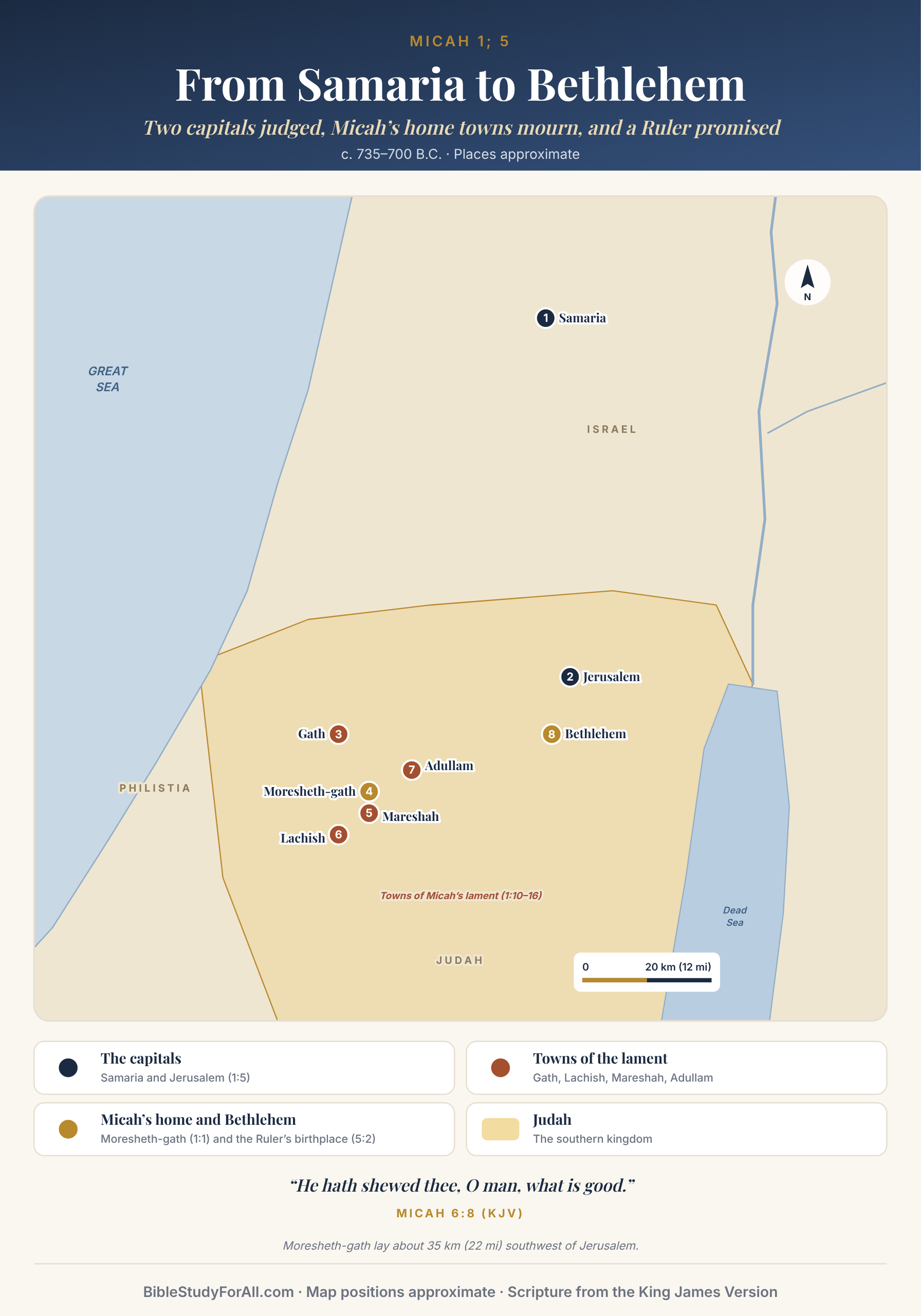
1 1:5–6
Samaria
Capital. Israel’s capital: “I will make Samaria as an heap of the field.”
2 1:9; 3:12
Jerusalem
Capital. The wound “is come unto the gate of my people, even to Jerusalem.”
3 1:10
Gath
Town of the lament. “Declare ye it not at Gath”: do not let the Philistines hear.
4 1:1, 14
Moresheth-gath
Home of promise. Micah’s home town in the low hills of Judah.
5 1:15
Mareshah
Town of the lament. “Yet will I bring an heir unto thee, O inhabitant of Mareshah.”
6 1:13
Lachish
Town of the lament. “Bind the chariot to the swift beast”: a fortress city of Judah.
7 1:15
Adullam
Town of the lament. “He shall come unto Adullam the glory of Israel.”
8 5:2
Bethlehem
Home of promise. Little among the thousands of Judah, yet the Ruler would come from it.
The Shape of the Book
Three Calls to Hear
Each message opens with “Hear” and ends with hope.
1 1:2 · 2:12
“Hear, All Ye People”
Samaria and Judah judged; then “I will surely gather the remnant.”
2 3:1 · 5:2
“Hear, I Pray You, O Heads of Jacob”
Corrupt rulers rebuked; then a Ruler from Beth-lehem.
3 6:1 · 7:18
“Hear Ye Now What the LORD Saith”
The LORD’s controversy; then “Who is a God like unto Thee?”
Micah 4
The Mountain of the LORD
In the last days the nations will come to learn God’s ways, and war will end.
4:1
Exalted
Above the hills
4:2
Taught
“He will teach us of His ways”
4:3
At Peace
Swords into plowshares
4:4
Secure
Every man under his vine
“And they shall beat their swords into plowshares, and their spears into pruninghooks: nation shall not lift up a sword against nation, neither shall they learn war any more.”Micah 4:3 (KJV)
Micah 5
The Ruler from Beth-lehem
Seven hundred years before His birth, Micah named the town where Christ would be born.
“But thou, Beth-lehem Ephratah, though thou be little among the thousands of Judah, yet out of thee shall He come forth unto Me that is to be ruler in Israel; whose goings forth have been from of old, from everlasting.”Micah 5:2 (KJV)
5:2
Born in Beth-lehem
Little among Judah
5:2
From Everlasting
His goings forth of old
5:4
The Shepherd
Feeds in the LORD’s strength
5:5
Our Peace
“This man shall be the peace”
Micah 6
What Doth the LORD Require?
Not rivers of oil or a firstborn son, but a life turned toward God and neighbour.
1 6:8
Do Justly
Deal fairly; no wicked balances or seized fields.
2 6:8
Love Mercy
Delight in kindness, as God delights in mercy (7:18).
3 6:8
Walk Humbly
Walk with thy God, in trust and obedience.
“He hath shewed thee, O man, what is good; and what doth the LORD require of thee, but to do justly, and to love mercy, and to walk humbly with thy God?” (6:8)
Micah 7
Who Is a God Like unto Thee?
The book closes by answering the question in Micah’s own name.
7:18
He Pardons
Iniquity and transgression
7:18
He Delights
In mercy
7:19
He Subdues
Our iniquities
7:19
He Casts
Sins into the depths of the sea
Looking Forward
Christ in Micah
Micah points to the King who would be born in Beth-lehem and shepherd His people.
5:2 · MATTHEW 2:5–6
Born in Bethlehem
The scribes told Herod that Christ would be born in Bethlehem of Judaea.
5:2 · JOHN 1:1
From Everlasting
The One born in Beth-lehem had no beginning.
5:4 · JOHN 10:11
The Good Shepherd
He feeds His flock in the strength of the LORD.
7:6 · MATTHEW 10:36
A Man’s Foes
Jesus used Micah’s words about households divided over Him.
Book Outline
Micah Outline
Seven chapters in three messages, each beginning with “Hear”: judgment and a remnant (1–2), corrupt rulers and the coming King (3–5), and the LORD’s controversy and His mercy (6–7). Tap a part below to jump to it, tap any section to expand it, and tap a verse reference to read it in the King James Version at BibleGateway.
Part I
Judgment on Samaria and Judah, and a Remnant
1:1–2:13 · “Hear, all ye people”: the LORD comes in judgment on idols and on men who seize fields, then gathers His flock
Part II
Corrupt Rulers and the Coming King
3:1–5:15 · “Hear, I pray you, O heads of Jacob”: Zion shall be plowed, yet the nations will come to the LORD’s mountain and a Ruler will come from Beth-lehem
- “Is it not for you to know judgment?”: heads “who hate the good, and love the evil” · 3:1–4
- The prophets that make My people err shall have no vision · 3:5–7
- “But truly I am full of power by the spirit of the LORD” · 3:8
- “Zion for your sake be plowed as a field, and Jerusalem shall become heaps” · 3:9–12
- They shall smite the judge of Israel with a rod upon the cheek · 5:1
- “But thou, Beth-lehem Ephratah … out of thee shall He come forth unto Me that is to be ruler in Israel” · 5:2
- He shall stand and feed in the strength of the LORD, and “this man shall be the peace” · 5:3–6
- The remnant of Jacob among many people as a dew and as a lion · 5:7–9
- The LORD cuts off horses, chariots, witchcrafts and graven images · 5:10–15
Part III
The LORD’s Controversy and His Mercy
6:1–7:20 · “Hear ye now what the LORD saith”: what the LORD requires, a land without the upright, and a God who delights in mercy
- “When I fall, I shall arise; when I sit in darkness, the LORD shall be a light unto me” · 7:8–10
- A day for building walls, and people coming from Assyria and from sea to sea · 7:11–13
- “Feed Thy people with Thy rod”: marvellous things as in the days of Egypt · 7:14–17
- He pardons iniquity and casts all their sins into the depths of the sea · 7:18–20
Continue Your Study
Scripture quotations and verse links are from the King James Version (KJV).