
Old Testament · Minor Prophets · Book 32 of 66
Jonah
A prophet runs from God’s call, is swallowed by a great fish, and preaches to Israel’s enemies, who repent. Then God shows him a heart bigger than his own: “should not I spare Nineveh, that great city?” (4:11).
Jonah at a Glance
Note: Scripture quotations and verse links on this site use the King James Version (KJV) because it is in the public domain, while most modern translations limit how much can be quoted online. Feel free to read along in the translation of your choice.
4 Chapters
48 verses
Author
Jonah the son of Amittai (1:1)
Written
c. 760 B.C.
Key Verse
“Salvation is of the LORD” (2:9)
About the Name
Title
Named for the prophet Jonah, whose name means “dove.” It is the fifth of the twelve Minor Prophets.
The book is named for its prophet, “Jonah the son of Amittai” (1:1). His name means “dove.” In the New Testament he is called Jonas (Matthew 12:39–41).
Jonah is the fifth of the twelve Minor Prophets. Unlike the others, it is mostly the story of the prophet himself; his message to Nineveh is only a few words long (3:4).
Who Wrote It
Author Details
Written by Jonah the son of Amittai, a prophet from Gath-hepher in Galilee who served under Jeroboam II (2 Kings 14:25).
Jonah the son of Amittai was a prophet of the northern kingdom from Gath-hepher in Galilee. He foretold that Jeroboam II would win back Israel’s borders “according to the word of the LORD God of Israel, which He spake by the hand of His servant Jonah” (2 Kings 14:25). Jonah told his own story honestly, including his disobedience and his anger.
The Lord Jesus spoke of Jonah as a real man and of these events as true: “For as Jonas was three days and three nights in the whale’s belly; so shall the Son of man be three days and three nights in the heart of the earth” (Matthew 12:40), and “The men of Nineveh … repented at the preaching of Jonas” (Matthew 12:41).
When It Was Written
Date of Writing
Written about 760 B.C., in the days of Jeroboam II, when Assyria and its great city Nineveh were Israel’s feared enemies.
Jonah prophesied in the reign of Jeroboam II of Israel (793–753 B.C.). His mission to Nineveh fits about 760 B.C., when Assyria was briefly weak, troubled by revolts, plagues and an eclipse of the sun (763 B.C.), and a city might well have listened to a warning.
About forty years later Assyria destroyed Israel and carried it away (2 Kings 17:6). Nineveh’s repentance did not last; about a century and a half later Nahum announced its fall, which came in 612 B.C.
Key Verse
Salvation Is of the LORD
“But I will sacrifice unto Thee with the voice of thanksgiving; I will pay that that I have vowed. Salvation is of the LORD.”
Jonah 2:9 (KJV)
Big Ideas
Key Themes
God Is Sovereign
Wind, fish, gourd and worm obey.
1:4, 17; 4:6–8
No Running from God
From the presence of the LORD.
1:3
Prayer
He heard me.
2:2
Salvation
Is of the LORD.
2:9
Second Chances
The word came the second time.
3:1
Repentance
They turned from their evil way.
3:10
God’s Mercy
Gracious and merciful.
4:2
Love for Enemies
Should not I spare Nineveh?
4:11
Our Hearts Exposed
Doest thou well to be angry?
4:4, 9
Overview
Jonah Summary
OverviewGod’s Mercy Reaches Further
Jonah is the story of a prophet who did not want God to show mercy to his enemies. God sent Jonah to Nineveh, the capital of cruel Assyria, but Jonah fled the other way. God brought him back through a storm and a great fish, and Nineveh repented at his preaching. Jonah was angry, and God answered him with a question. The book shows that “Salvation is of the LORD” (2:9), and that God’s compassion reaches even to the nations.
Chapter 1Running from God
“Arise, go to Nineveh, that great city, and cry against it; for their wickedness is come up before Me” (1:2). “But Jonah rose up to flee unto Tarshish from the presence of the LORD” (1:3). He went down to Joppa, down into the ship, and down into its sides to sleep. The LORD sent out a great wind; the heathen mariners prayed while Jonah slept (1:5–6). The lot fell on Jonah, and he confessed, “I fear the LORD, the God of heaven, which hath made the sea and the dry land” (1:9). He told them, “Take me up, and cast me forth into the sea” (1:12). They did, the sea ceased from her raging, and the men feared the LORD and offered a sacrifice (1:15–16). “Now the LORD had prepared a great fish to swallow up Jonah” (1:17).
Chapter 2A Prayer from the Deep
In the belly of the fish Jonah prayed: “I cried by reason of mine affliction unto the LORD, and He heard me” (2:2). He had gone down to the bottoms of the mountains, with the weeds wrapped about his head, “yet hast Thou brought up my life from corruption, O LORD my God” (2:6). “When my soul fainted within me I remembered the LORD” (2:7). He ends with thanksgiving and a vow: “Salvation is of the LORD” (2:9). And the LORD spake unto the fish, and it vomited out Jonah upon the dry land (2:10).
Chapter 3A City Repents
“And the word of the LORD came unto Jonah the second time” (3:1). This time he went. His message was short: “Yet forty days, and Nineveh shall be overthrown” (3:4). “So the people of Nineveh believed God, and proclaimed a fast, and put on sackcloth, from the greatest of them even to the least of them” (3:5). The king himself sat in ashes and decreed, “Who can tell if God will turn and repent, and turn away from His fierce anger, that we perish not?” (3:9). “And God saw their works, that they turned from their evil way; and God repented of the evil … and He did it not” (3:10).
Chapter 4Doest Thou Well to Be Angry?
Jonah was furious. “I knew that Thou art a gracious God, and merciful, slow to anger, and of great kindness,” he complained, and asked to die (4:2–3). God asked, “Doest thou well to be angry?” (4:4). Jonah sat east of the city to watch. God prepared a gourd to shade him, then a worm to kill the gourd, then a vehement east wind (4:6–8). Jonah pitied the gourd. God ended the book with a question: “And should not I spare Nineveh, that great city, wherein are more than sixscore thousand persons that cannot discern between their right hand and their left hand; and also much cattle?” (4:11).
At a Glance
Jonah at a Glance
The whole book in short sections: its four parts, the map, what God prepared, Jonah going down, the city that repented, Jonah and God compared, and Christ in Jonah. Tap a topic to jump to it.
Printable Copy
Save or Print the Infographic
Everything in this section, with the key verse and key themes, is also on a printable infographic (four pages). It opens in a new tab, where you can save it to your phone or computer, share it, or print it.
Structure
The Book in Four Parts
Two calls and two responses: Jonah runs (1–2), then obeys (3–4); the heathen sailors and Ninevites turn to God, while the prophet sulks.
Each bar shows that part’s share of the 48 verses.
Map
Nineveh or Tarshish
God sent Jonah east to Nineveh. Jonah went to Joppa and took a ship west toward Tarshish, as far the other way as he could go. The numbers match the cards below.
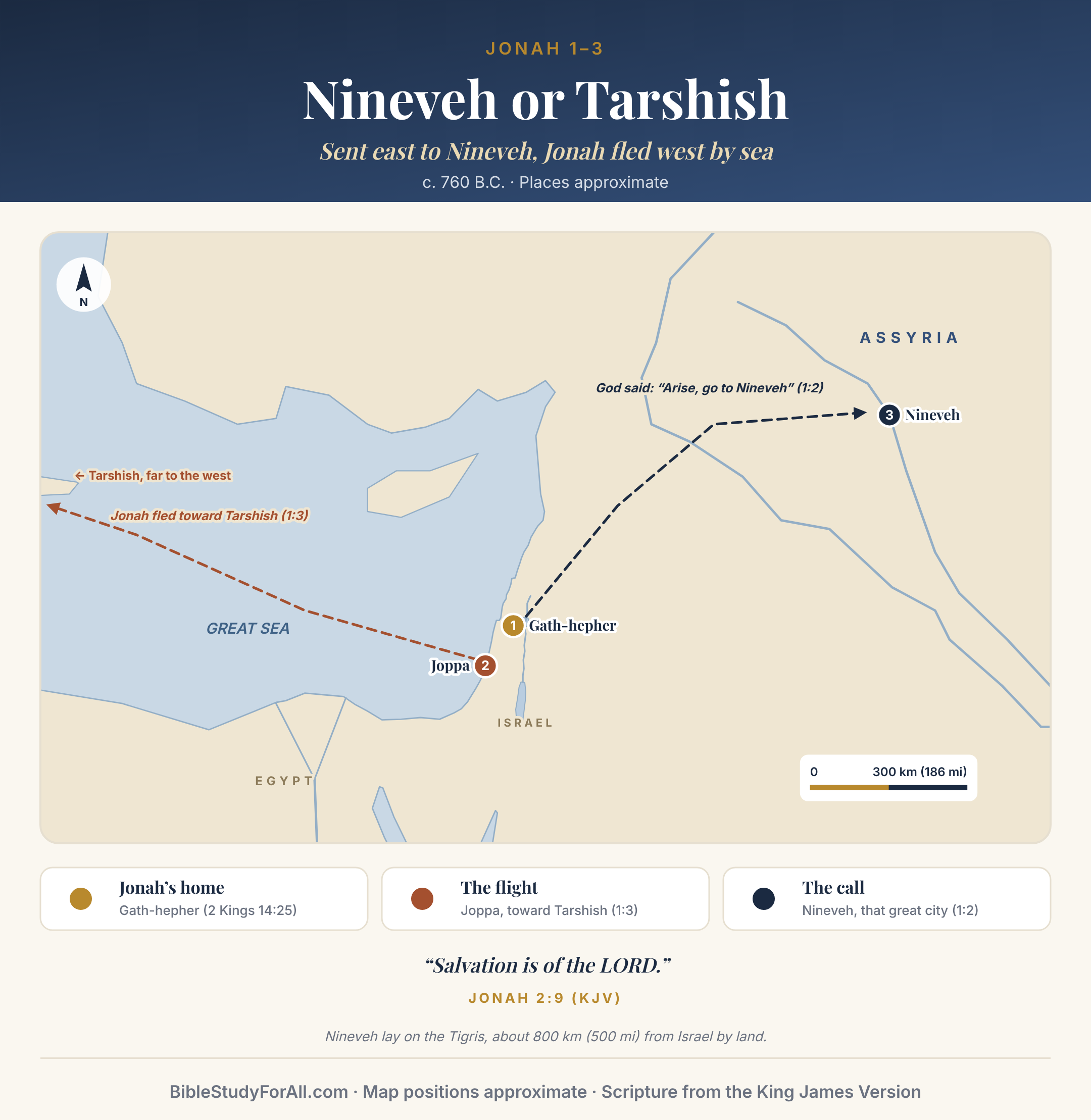
1 2 Kings 14:25
Gath-hepher
Jonah’s home. Jonah’s home town in Galilee, near later Nazareth.
2 1:3
Joppa
The flight. Jonah “went down to Joppa” and found a ship going to Tarshish.
3 1:2; 3:3
Nineveh
The call. “That great city” of Assyria, “of three days’ journey.”
God at Work
The LORD Prepared
Four times the book says God “prepared” something. All creation obeys Him, except His prophet.
1 1:17
A Great Fish
To swallow up Jonah
2 4:6
A Gourd
To shadow his head
3 4:7
A Worm
To smite the gourd
4 4:8
An East Wind
Vehement and hot
Jonah 1–2
Down, Down, Down
Running from God, Jonah kept going down, until God brought him up.
1:3
Down to Joppa
To flee from the presence of the LORD
1:3
Down into the Ship
Bound for Tarshish
1:5
Down into the Sides
Fast asleep in the storm
2:6
Down to the Mountains’ Roots
“Yet hast Thou brought up my life”
“I cried by reason of mine affliction unto the LORD, and He heard me; out of the belly of hell cried I, and Thou heardest my voice.”Jonah 2:2 (KJV)
Jonah 3
The People of Nineveh Believed God
A short message, and a whole city turned, from the king down to the cattle.
3:4
The Warning
“Yet forty days”
3:5
They Believed
Fasting and sackcloth
3:6–9
The King
Sat in ashes; “Who can tell?”
3:10
God Spared
He saw their works
Jonah 4
Jonah’s Heart and God’s Heart
The book ends by setting Jonah’s small heart beside God’s great one.
JONAH
Angry that Nineveh was spared
4:1
GOD
“A gracious God, and merciful, slow to anger”
4:2
JONAH
Pitied a gourd he did not plant
4:10
GOD
Pitied a city of more than sixscore thousand
4:11
JONAH
“I do well to be angry, even unto death”
4:9
GOD
“Should not I spare Nineveh, that great city?”
4:11
Looking Forward
Christ in Jonah
Jesus pointed to Jonah as a sign of His own death and resurrection.
1:17 · MATTHEW 12:40
The Sign of Jonas
Three days and three nights, then raised up: so the Son of man.
MATTHEW 12:41
A Greater Than Jonas
Nineveh repented at Jonah’s preaching; “a greater than Jonas is here.”
1:12 · JOHN 11:50
One for Many
Jonah was cast out to save the sailors; Christ died for the people.
4:11 · JOHN 3:16
For the World
God’s compassion for Nineveh points to His love for all nations.
Book Outline
Jonah Outline
Four chapters in four parts: Jonah runs from God (1), Jonah’s prayer from the fish (2), Nineveh repents (3), and Jonah’s anger and God’s compassion (4). Tap a part below to jump to it, tap any section to expand it, and tap a verse reference to read it in the King James Version at BibleGateway.
Part I
Jonah Runs from God
1:1–17 · Sent to Nineveh, Jonah sails for Tarshish; a storm, a lot cast, and a prophet cast into the sea
Part II
Jonah’s Prayer from the Fish
2:1–10 · Out of the fish’s belly Jonah cries to the LORD: “Salvation is of the LORD”
Part III
Nineveh Repents
3:1–10 · A second call, a short warning, and a whole city turning to God
Part IV
Jonah’s Anger and God’s Compassion
4:1–11 · Jonah is angry at God’s mercy, and God teaches him with a gourd, a worm and a question
Continue Your Study
Scripture quotations and verse links are from the King James Version (KJV).