
Old Testament · Minor Prophets · Book 35 of 66
Habakkuk
A prophet who took his questions straight to God. Troubled by violence in Judah and then by God’s plan to use the ruthless Babylonians, Habakkuk asked “How long?” and “Why?” and waited for an answer. He learned that “the righteous person will live by his faithfulness,” and ended with a song of trust: “Though the fig tree does not bud … yet I will rejoice in the LORD.”
3 Chapters
56 verses in three parts
Author
Habakkuk the prophet
Written
c. 609–605 B.C. (debated)
Written For
Judah, before Babylon came
Overview
Habakkuk Summary
Habakkuk lived in the last troubled years of the kingdom of Judah. Good King Josiah had led a reform and renewed the covenant, but he was killed in battle in 609 B.C., and under his son Jehoiakim the land filled again with violence, injustice and idolatry. Meanwhile the world was changing fast. Assyria, the empire Nahum had said would fall, lost its capital Nineveh in 612 B.C., and a new power, Babylon, was rising in its place. Habakkuk is unusual among the prophets. Most prophetic books bring God’s message to the people, but Habakkuk records a conversation in which the prophet brings his honest questions to God, waits for God’s answers, and ends in worship. For this reason it has often been called the book that moves from “Why?” to “Yet I will rejoice.”
Chapter 1 opens with Habakkuk’s first complaint: “How long, LORD, must I call for help, but you do not listen? Or cry out to you, ‘Violence!’ but you do not save?” (1:2). He sees destruction, strife and conflict all around him. “The law is paralyzed, and justice never prevails. The wicked hem in the righteous, so that justice is perverted” (1:4). Habakkuk does not doubt that God exists or that God is good. His struggle is that a good and holy God seems to be doing nothing about the evil among his own people. Many believers have found comfort in the fact that the Bible includes such honest prayers.
God’s first answer is startling. “Look at the nations and watch, and be utterly amazed. For I am going to do something in your days that you would not believe, even if you were told” (1:5). God is not ignoring Judah’s sin. He is “raising up the Babylonians, that ruthless and impetuous people,” to bring judgment (1:6). The LORD describes them in vivid terms: they are feared and dreaded, a law to themselves; their horses are swifter than leopards and fiercer than wolves at dusk; they fly like an eagle swooping to devour; they mock kings and laugh at fortified cities (1:7–10). Yet God also calls them “guilty people, whose own strength is their god” (1:11). In Acts 13:41 Paul quotes 1:5 as a warning to those who might scoff at God’s work in the gospel.
This answer only deepens Habakkuk’s problem, and he brings a second complaint. He begins by confessing who God is: “LORD, are you not from everlasting? My God, my Holy One, you will never die” (1:12). He accepts that God has appointed the Babylonians to judge, but he asks how a holy God can use a nation even more wicked than Judah: “Your eyes are too pure to look on evil; you cannot tolerate wrongdoing. Why then do you tolerate the treacherous? Why are you silent while the wicked swallow up those more righteous than themselves?” (1:13). He pictures people as helpless fish caught in the Babylonians’ hooks and nets, and the conqueror so proud of his success that he “sacrifices to his net and burns incense to his dragnet” (1:16). Is he to keep on emptying his net, destroying nations without mercy (1:17)?
Chapter 2 begins with the prophet waiting: “I will stand at my watch and station myself on the ramparts; I will look to see what he will say to me” (2:1). The LORD tells him to “write down the revelation and make it plain on tablets so that a herald may run with it” (2:2). The answer may take time, but it is certain: “Though it linger, wait for it; it will certainly come and will not delay” (2:3). Then comes the heart of the book: “See, the enemy is puffed up; his desires are not upright, but the righteous person will live by his faithfulness” (2:4). The proud conqueror will not last, but the one who is right with God will live by steadfast trust in him. The New Testament quotes this verse three times. Paul uses it in Romans 1:17 and Galatians 3:11 to show that people are made right with God through faith, and Hebrews 10:38 uses it to encourage believers to keep trusting and not shrink back. It became a key verse for Martin Luther and the Protestant Reformation.
The rest of chapter 2 is a taunt song of five woes that the nations will one day sing over the proud oppressor. Woe to him who piles up stolen goods, for the plundered will rise up and plunder him (2:6–8). Woe to him who builds his house by unjust gain, for “the stones of the wall will cry out” against him (2:9–11). Woe to him who builds a city with bloodshed, for all his labor is only fuel for the fire (2:12–13). In the middle of these woes comes a shining promise: “For the earth will be filled with the knowledge of the glory of the LORD as the waters cover the sea” (2:14). Woe to him who makes his neighbors drunk to shame them, for the cup from the LORD’s right hand will come around to him (2:15–17). And woe to him who says to a piece of wood, “Come to life!” or to lifeless stone, “Wake up!” (2:19). Idols cannot speak, but the true God reigns: “The LORD is in his holy temple; let all the earth be silent before him” (2:20).
Chapter 3 is “a prayer of Habakkuk the prophet,” set to music like a psalm (3:1, 19). It begins with awe and a request: “LORD, I have heard of your fame; I stand in awe of your deeds, LORD. Repeat them in our day, in our time make them known; in wrath remember mercy” (3:2). Habakkuk then describes the LORD coming in power, using pictures drawn from Israel’s past: God coming from Teman and Mount Paran in the south, as at Sinai; his splendor like the sunrise; mountains shaking and the ancient hills collapsing; rivers and sea split as at the Red Sea and the Jordan; and sun and moon standing still, as in Joshua’s day (3:3–11). The LORD strides through the earth in anger against the nations, but his purpose is salvation: “You came out to deliver your people, to save your anointed one” (3:13).
The vision leaves Habakkuk shaken: “I heard and my heart pounded, my lips quivered at the sound; decay crept into my bones, and my legs trembled” (3:16). Yet he chooses to “wait patiently for the day of calamity to come on the nation invading us.” Then comes one of the most loved passages in the Old Testament. Habakkuk imagines losing everything a farmer in Judah depended on, and still chooses joy: “Though the fig tree does not bud and there are no grapes on the vines, though the olive crop fails and the fields produce no food, though there are no sheep in the pen and no cattle in the stalls, yet I will rejoice in the LORD, I will be joyful in God my Savior” (3:17–18). The book ends, “The Sovereign LORD is my strength; he makes my feet like the feet of a deer, he enables me to tread on the heights” (3:19). The prophet who began by asking “How long?” ends by trusting God even before the answer arrives. History followed the course Habakkuk was shown: Babylon conquered Judah and destroyed Jerusalem in 586 B.C., and Babylon itself fell to the Persians in 539 B.C.
Several themes run through Habakkuk. Honest prayer: God welcomes his people’s hard questions and answers them (1:2–4, 12–17). God rules history: even a ruthless empire is under his control and will answer to him (1:5–11; 2:6–20). Living by faith: the righteous live by steadfast trust in God, not by sight or by their own strength (2:4). Pride brings its own downfall: those who build on greed, violence and idols will see their works turn against them (2:6–19). God’s glory will fill the earth: the end of the story is not the rule of the proud but the knowledge of the LORD everywhere (2:14, 20). Joy that does not depend on circumstances: faith rejoices in God himself (3:17–19). Readers understand some parts of Habakkuk in different ways. Habakkuk 2:4 is read by some as mainly about faithfulness, steady loyalty to God, and by others as mainly about faith, trust in God; many see the two as belonging together, since faith shows itself in faithfulness, and the Greek translation and the New Testament quotations highlight faith. Chapter 3 is taken by some as a separate psalm added to the book and by others as its original ending (see the Author card). The pictures in 3:3–15 are read by some mainly as poetic memories of the exodus and conquest and by others also as a vision of God’s future coming in judgment and salvation, and some Christians see “your anointed one” (3:13) as pointing ahead to the Messiah. The date is debated, from Manasseh’s reign to after 605 B.C. (see the Date card). This outline simply follows the text.
Habakkuk at a Glance
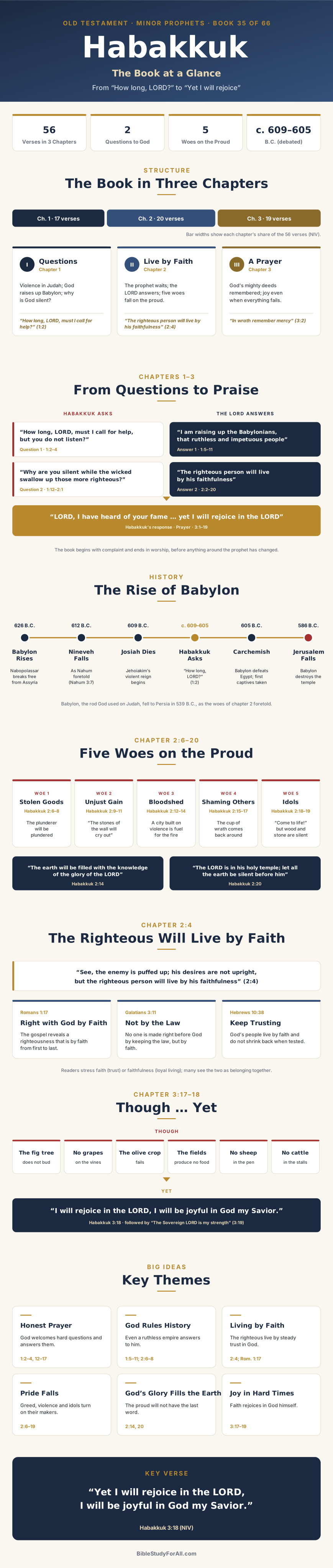
The whole book on one page: its three chapters, the conversation from questions to praise, Babylon’s rise, the five woes, how the New Testament uses 2:4, “though … yet” in 3:17–18, and the key themes.
About the Name
Title
Habakkuk probably means “one who embraces.” The book is the eighth of the twelve Minor Prophets, after Nahum and before Zephaniah, and records a prophet’s conversation with God.
The book is named after its author, the prophet Habakkuk. The meaning of his name is not certain. Many connect it with a Hebrew word meaning “to embrace,” so that Habakkuk means “one who embraces” or “one who clings.” The reformer Martin Luther liked this meaning, saying that Habakkuk embraces his people to comfort them, the way one holds a weeping child. Others connect the name with an Akkadian word for a garden plant, which would fit a time when Babylonian words were known in Judah. Either way, the name is unusual and appears nowhere else in the Bible.
The book opens, “The prophecy that Habakkuk the prophet received” (1:1). The word translated “prophecy” is often rendered “burden,” a message that weighs on the prophet. In English and Hebrew Bibles Habakkuk is the eighth of the twelve Minor Prophets, after Nahum and before Zephaniah. “Minor” refers to the books’ shorter length, not their importance. Habakkuk is different from most prophetic books. Instead of speaking God’s words to the people, much of it records the prophet speaking to God, asking hard questions and receiving God’s answers, and it ends with a psalm-like prayer.
Who Wrote It
Author Details
Habakkuk the prophet (1:1; 3:1), probably a recognized prophet in Jerusalem. Nothing else is known of his life. Tradition holds that he wrote the whole book; some think chapter 3 was a separate psalm.
The book names its author twice as “Habakkuk the prophet” (1:1; 3:1). He is one of only three Old Testament writers called “the prophet” in the first line of their books, along with Haggai and Zechariah, which may mean he was a recognized prophet in Jerusalem. Nothing is known of his family, hometown or life. The musical notes in chapter 3, “On shigionoth” (3:1) and “For the director of music. On my stringed instruments” (3:19), have led some to think he was a Levite who served in the temple choir, but the book does not say so. A later Greek addition to the book of Daniel, called Bel and the Dragon, tells a story of a prophet named Habakkuk carrying food to the lions’ den, but this is a legend and is not part of the Hebrew Bible.
Jewish and Christian tradition holds that Habakkuk wrote the whole book, and most scholars agree that chapters 1–2 come from him. Chapter 3 is more debated. It has its own title, musical notes and the word selah, like a psalm, and the commentary on Habakkuk found among the Dead Sea Scrolls covers only chapters 1–2. Some scholars therefore think chapter 3 was a separate psalm added later. Others answer that the commentary simply did not need chapter 3, that other ancient copies include it, and that the prayer completes the journey of the first two chapters from complaint to trust. This page follows the traditional view that the whole book comes from Habakkuk.
When It Was Written
Date of Writing
Babylon is rising but has not yet struck Judah (1:6), which fits King Jehoiakim’s reign. This page shows c. 609–605 B.C. Others date the book earlier, under Manasseh, or after 605 B.C.
Habakkuk gives no king’s name, but the LORD says, “I am raising up the Babylonians” (1:6), and their attack on Judah is still in the future. The Babylonians (also called Chaldeans) rose to power after 626 B.C., destroyed Nineveh in 612 B.C., and defeated Egypt at the battle of Carchemish in 605 B.C., after which they began taking captives from Judah. The violence and injustice Habakkuk complains about in Judah (1:2–4) fit the reign of King Jehoiakim (609–598 B.C.), whom Jeremiah condemned for oppression and bloodshed (Jeremiah 22:13–17). Many conservative scholars therefore date the book c. 609–605 B.C., and this page shows that date.
Other dates have been proposed. Some date the book earlier, in the time of King Manasseh (c. 650s B.C.), because God says the people “would not believe” what he was about to do (1:5), which suggests the Babylonians were not yet a known threat. Others date it later, after 605 or even after the first exile in 597 B.C., when Judah had already felt Babylon’s cruelty. Whichever date is right, Habakkuk lived in the last years before Jerusalem fell in 586 B.C., around the same time as Jeremiah and Zephaniah.
Study Guide
Habakkuk Outline
Three chapters in three parts: Habakkuk’s two complaints and the LORD’s first answer (1), the LORD’s second answer with its call to live by faith and five woes on the proud (2), and Habakkuk’s prayer of awe and trust (3). Tap any section to expand it, and tap a verse reference to read it at BibleGateway.
Part I
Habakkuk’s Questions
Chapter 1 · “How long, LORD?” Violence in Judah, the Babylonians are coming, and “Why are you silent?”
Part II
The Righteous Will Live by Faith
Chapter 2 · The prophet waits, the LORD answers, and five woes fall on the proud and violent
Part III
A Prayer of Trust
Chapter 3 · Habakkuk remembers God’s mighty deeds and chooses joy even when everything fails
Continue Your Study
Verse references link to the NIV at BibleGateway.