
Old Testament · History · Book 12 of 66
The Book of 2 Kings
Elijah goes up by a whirlwind and Elisha carries on his work. Then the two kingdoms slide toward ruin: Israel falls to Assyria, and in spite of Hezekiah and Josiah, Judah is carried away to Babylon, “because they obeyed not the voice of the LORD their God” (18:12).
2 Kings at a Glance
Book Outline
Note: Scripture quotations and verse links on this site use the King James Version (KJV) because it is in the public domain, while most modern translations limit how much can be quoted online. Feel free to read along in the translation of your choice.
25 Chapters
719 verses
Author
Jeremiah the prophet
Time Covered
c. 852–561 B.C.
Two Falls
Samaria 722 · Jerusalem 586 B.C.
About the Name
Title
The second half of the one Hebrew book of Kings, which continues the story of Israel’s kings from Ahaziah to the fall of Jerusalem.
In the Hebrew Bible 1 and 2 Kings are one book called Kings. 2 Kings begins where 1 Kings ends, in the days of Ahab’s son Ahaziah, and carries the history of both kingdoms to the end: Israel carried to Assyria and Judah to Babylon. The King James Bible calls it “The Second Book of the Kings, commonly called The Fourth Book of the Kings,” from the Greek and Latin custom of counting Samuel and Kings as four books.
In the Hebrew Bible, Kings belongs to the Former Prophets, and the prophets fill 2 Kings: Elijah and Elisha, Jonah (14:25), Isaiah (19–20) and Huldah (22). The book shows that God sent His prophets “rising up betimes” (Jeremiah 25:4), and that every word they spoke came to pass.
Who Wrote It
Author Details
Written by the prophet Jeremiah, as the Jewish Talmud records. He lived through the last days of Judah that the book describes.
The Talmud (Baba Bathra 15a) names Jeremiah as the writer of Kings. He was called as a prophet in the thirteenth year of Josiah (Jeremiah 1:2) and saw the reigns of Jehoahaz, Jehoiakim, Jehoiachin and Zedekiah and the burning of Jerusalem. The last chapters of 2 Kings (24:18–25:30) are repeated almost word for word in Jeremiah 52.
The writer drew on the official records, “the book of the chronicles of the kings of Israel” and “of Judah” (1:18; 8:23), and on the stories of the prophets. Guided by the Holy Spirit, he showed why both kingdoms fell: “they would not hear, but hardened their necks” (17:14).
When It Was Written
Date of Writing
Covers about 290 years, from Ahaziah of Israel about 852 B.C. to Jehoiachin’s release in Babylon about 561 B.C.
2 Kings begins about 852 B.C., when Ahaziah, son of Ahab, reigns in Samaria and Elijah is taken up to heaven. Samaria falls to Assyria in 722 B.C. (17:6). Judah survives another 136 years; Nebuchadnezzar takes Jehoiachin to Babylon in 597 B.C. and burns Jerusalem and the temple in 586 B.C. (25:8–9).
The last event in the book is the release of King Jehoiachin from prison “in the seven and thirtieth year of the captivity” (25:27), about 561 B.C. The book was completed soon after, during the exile, for the Jews in Babylon.
Key Verse
They Would Not Hear
“Notwithstanding they would not hear, but hardened their necks, like to the neck of their fathers, that did not believe in the LORD their God.”
2 Kings 17:14 (KJV)
Big Ideas
Key Themes
God Keeps His Word
Every warning and promise of the prophets comes true.
10:10; 24:2
Sin Has Consequences
Israel and Judah reap what they sowed.
17:7–18
God Is Patient
He sent prophets again and again.
17:13
Trust in the LORD
Hezekiah spreads the letter before Him.
18:5; 19:14–19
The Power of God’s Word
Josiah’s heart is tender when the law is read.
22:11–19
Mercy to All
A Syrian leper and a widow are helped.
4:1–7; 5:14
Unseen Protection
They that be with us are more.
6:16–17
No God But the LORD
Now I know there is no God in all the earth but in Israel.
5:15; 19:19
Hope Beyond Judgment
David’s line survives in exile.
25:27–30
Overview
2 Kings Summary
OverviewTwo Kingdoms Fall
2 Kings continues the story of 1 Kings without a break and carries it to its bitter end. It opens with the prophet Elijah taken up to heaven and his successor Elisha doing many miracles in Israel. Then the writer follows the kings of the two kingdoms side by side until Israel, the northern kingdom, is carried away by Assyria in 722 B.C. (chapter 17). The last eight chapters follow Judah alone: two great reformers, Hezekiah and Josiah, cannot undo the sins of Manasseh, and Jerusalem is burned by Babylon in 586 B.C. The book explains why it happened: Israel and Judah would not listen to the prophets.
Chapters 1–2Elijah Taken Up by a Whirlwind
Ahab’s son Ahaziah falls through a lattice and sends to ask Baal-zebub, the god of Ekron, whether he will recover. Elijah meets the messengers: “Is it not because there is not a God in Israel, that ye go to enquire of Baal-zebub the god of Ekron?” (1:3), and Ahaziah dies. Then Elijah and Elisha walk from Gilgal to Bethel, Jericho and the Jordan, which parts when Elijah strikes it with his mantle. Elisha asks, “let a double portion of thy spirit be upon me” (2:9), and “there appeared a chariot of fire, and horses of fire … and Elijah went up by a whirlwind into heaven” (2:11). Elisha cries, “My father, my father, the chariot of Israel, and the horsemen thereof” (2:12), takes up the mantle, and parts the Jordan himself.
Chapters 2–5The Miracles of Elisha
Elisha’s ministry is full of miracles, many of them acts of mercy to ordinary people: bad water healed at Jericho, a widow’s oil that flows until “there is not a vessel more” (4:6), a son given to a Shunammite woman and later raised from the dead, poisoned stew made harmless, and a hundred men fed with twenty loaves. Naaman, captain of the Syrian army, is told to wash seven times in the Jordan; at last he obeys, “and his flesh came again like unto the flesh of a little child, and he was clean” (5:14). He confesses, “Behold, now I know that there is no God in all the earth, but in Israel” (5:15), while Elisha’s servant Gehazi, who runs after Naaman for silver, receives his leprosy.
Chapters 6–8Chariots of Fire and the Siege of Samaria
When the Syrian army surrounds Dothan, Elisha’s servant is afraid. Elisha says, “Fear not: for they that be with us are more than they that be with them” (6:16), and the young man sees “the mountain was full of horses and chariots of fire round about Elisha” (6:17). During a terrible siege of Samaria, Elisha promises food by the next day, and four lepers find the Syrian camp deserted, for the LORD had made the Syrians hear the noise of a great army (7:6). Elisha also weeps as he tells Hazael that he will be king of Syria and do great harm to Israel (8:12–13).
Chapters 9–12Jehu, Athaliah and Joash
The house of Ahab now reaches its end. Elisha sends a young prophet to anoint Jehu king over Israel (9:6). Jehu kills King Joram of Israel and King Ahaziah of Judah, and Jezebel is thrown from a window, as Elijah had foretold (9:36). Jehu kills Ahab’s family and gathers the worshippers of Baal into their temple and destroys them: “Thus Jehu destroyed Baal out of Israel” (10:28). But “from the sins of Jeroboam … Jehu departed not,” keeping the golden calves at Bethel and Dan (10:29). In Judah, Ahab’s daughter Athaliah seizes the throne and kills the royal family, but the baby Joash is hidden in the temple for six years. The priest Jehoiada crowns him at seven, Athaliah is killed, and the people tear down the house of Baal. “Jehoash did that which was right in the sight of the LORD all his days wherein Jehoiada the priest instructed him” (12:2), and he repairs the temple.
Chapters 13–16The Last Kings of Israel
Chapters 13–16 trace the kings of both kingdoms. Elisha dies, and a dead man thrown into his grave revives when he touches Elisha’s bones (13:21). Even in Israel’s sin “the LORD was gracious unto them, and had compassion on them … because of His covenant with Abraham, Isaac, and Jacob” (13:23). Under Jeroboam II Israel’s borders are restored “according to the word of the LORD … by the hand of His servant Jonah, the son of Amittai” (14:25). In Judah, Amaziah and Azariah (Uzziah) do “right in the sight of the LORD,” though the high places remain. But Israel’s last years are bloody: four of its last six kings are murdered (15:10, 14, 25, 30), and Assyria begins taking its land. In Judah, King Ahaz sends temple treasure to the king of Assyria and copies a pagan altar he saw in Damascus (16:8–16).
Chapter 17Why Israel Fell
In the ninth year of Hoshea, after a three-year siege, “the king of Assyria took Samaria, and carried Israel away into Assyria” (17:6). Chapter 17 then gives the reason at length: “For so it was, that the children of Israel had sinned against the LORD their God, which had brought them up out of the land of Egypt” (17:7). They worshipped idols, though “the LORD testified against Israel, and against Judah, by all the prophets … saying, Turn ye from your evil ways, and keep My commandments and My statutes” (17:13). “Therefore the LORD was very angry with Israel, and removed them out of His sight: there was none left but the tribe of Judah only” (17:18). The king of Assyria resettles Samaria with people from other lands, who “feared the LORD, and served their own gods” (17:33).
Chapters 18–20Hezekiah Trusts the LORD
Hezekiah breaks the idols and even the brass serpent Moses had made, which the people had turned into an idol (18:4). “He trusted in the LORD God of Israel; so that after him was none like him among all the kings of Judah” (18:5). When the Assyrian king Sennacherib takes the fortified cities of Judah and his officer mocks the LORD outside Jerusalem’s walls, Hezekiah spreads the letter before the LORD and prays, “save Thou us out of his hand, that all the kingdoms of the earth may know that Thou art the LORD God, even Thou only” (19:19). Through Isaiah God answers, and that night the angel of the LORD strikes 185,000 in the Assyrian camp (19:35). When Hezekiah is sick to death, God says, “I have heard thy prayer, I have seen thy tears” (20:5) and adds fifteen years to his life. But Hezekiah shows all his treasures to envoys from Babylon, and Isaiah warns that all of it will one day be carried there (20:17).
Chapters 21–25Manasseh, Josiah and the Fall of Jerusalem
Hezekiah’s son Manasseh reigns fifty-five years and undoes all his father’s reforms, building altars for Baal, putting a carved image in the temple, making his son pass through the fire, and filling Jerusalem with innocent blood (21:1–16). God declares that He will “wipe Jerusalem as a man wipeth a dish” (21:13). His grandson Josiah becomes king at eight. While the temple is being repaired, Hilkiah the high priest says, “I have found the book of the law in the house of the LORD” (22:8). Josiah tears his clothes, the prophetess Huldah confirms the coming judgment but promises that Josiah will not see it, and the king leads the people in renewing the covenant, cleansing the land, and keeping a great passover. “Like unto him was there no king before him, that turned to the LORD with all his heart, and with all his soul, and with all his might” (23:25). Yet “the LORD turned not from the fierceness of His great wrath” because of Manasseh (23:26). Josiah is killed by Pharaoh Necho at Megiddo, and the last four kings of Judah are puppets of Egypt and Babylon. Nebuchadnezzar takes Jehoiachin and ten thousand captives to Babylon (24:14), and when Zedekiah rebels, Jerusalem is besieged, the temple is burned, the walls broken down, and “Judah was carried away out of their land” (25:21). The book closes with a quiet sign of hope: in Babylon, Jehoiachin is released from prison “and he did eat bread continually before him all the days of his life” (25:29). David’s line still lives.
At a Glance
2 Kings at a Glance
The whole book in short sections: its four parts, a timeline, Elisha and the kings on the map, Elisha’s ministry, Naaman, Jehu and Joash, why Israel fell, the exiles on the map, Hezekiah, Josiah, the fall of Jerusalem, and Christ in 2 Kings. Tap a topic to jump to it.
Printable Copy
Save or Print the Infographic
Everything in this section, with the key verse and key themes, is also on a printable infographic (six pages). It opens in a new tab, where you can save it to your phone or computer, share it, or print it.
Structure
The Book in Four Parts
Elisha carries on Elijah’s work (1:1–8:15); Jehu ends Ahab’s house (8:16–12:21); Israel falls to Assyria (13–17); Judah falls to Babylon (18–25).
Each bar shows that part’s share of the 719 verses.
I 1:1–8:15 · 209 verses
Elijah and Elisha
The whirlwind, the mantle, and Elisha’s miracles.
II 8:16–12:21 · 129 verses
Jehu and Joash
Ahab’s house ends; a boy king repairs the temple.
III 13–17 · 153 verses
Israel Falls
The last kings of Israel and the fall of Samaria.
Dates B.C. (Approximate)
From Elisha to the Exile
Two falls frame the book: Samaria in 722 B.C. and Jerusalem in 586 B.C.
2:11
c. 852
Elijah taken up; Elisha begins
9:1–10:36
841
Jehu ends the house of Ahab
17:6
722
Samaria falls to Assyria
19:35
701
Sennacherib’s army struck down
22:8
622
The book of the law found
23:29
609
Josiah slain at Megiddo
25:8–10
586
Jerusalem and the temple burned
25:27
c. 561
Jehoiachin released in Babylon
Map
Elisha and the Kings
The places of Elisha and the kings of Israel and Judah. Rust markers belong to Elisha, navy to Israel and Syria, and gold to Judah. The numbers match the cards below.
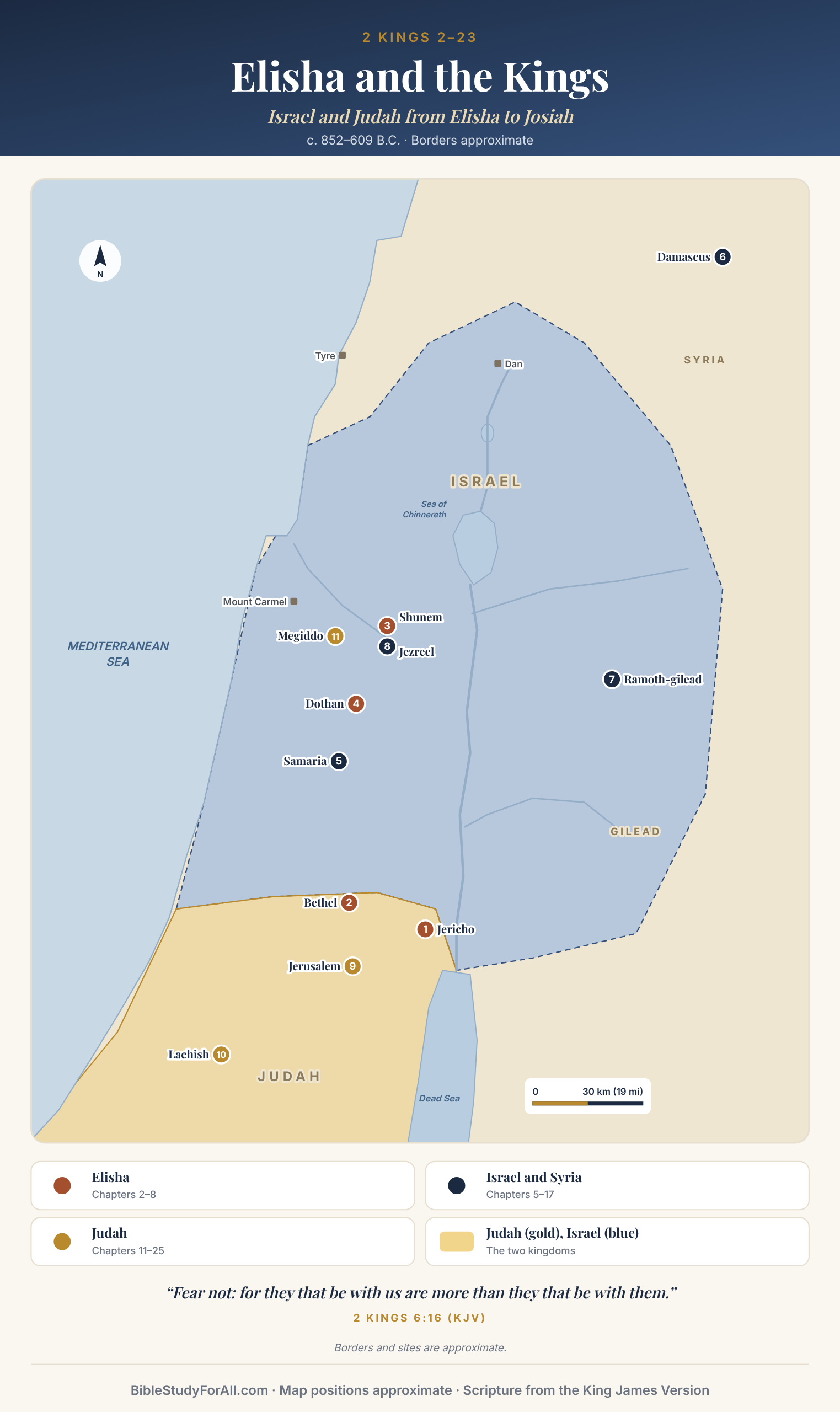
1 2:4–22
Jericho
Elisha. Elijah is taken up beyond Jordan; Elisha heals the spring.
2 2:23–25
Bethel
Elisha. The young men who mock the prophet are judged.
3 4:8–37
Shunem
Elisha. The Shunammite’s son is raised to life.
4 6:13–17
Dothan
Elisha. The mountain full of horses and chariots of fire.
5 6:24–7:20; 17:5–6
Samaria
Israel and Syria. Siege and famine, then plenty; taken by Assyria after three years.
6 5; 8:7–15
Damascus
Israel and Syria. Home of Naaman the leper; Hazael made king of Syria.
7 9:1–13
Ramoth-gilead
Israel and Syria. A young prophet anoints Jehu king over Israel.
8 9:14–37
Jezreel
Israel and Syria. Jehu slays Joram and Jezebel, as Elijah had said.
9 11–12; 18–20; 25
Jerusalem
Judah. Joash saved; Hezekiah delivered; the city burned in 586 B.C.
10 18:14–17; 19:8
Lachish
Judah. Sennacherib’s camp; Hezekiah sends tribute.
11 23:29–30
Megiddo
Judah. Josiah is slain by Pharaoh-nechoh.
2 Kings 2–8
Elisha’s Ministry
Elisha asked for a double portion of Elijah’s spirit, and God used him in mercy to kings and to ordinary people alike.
1 2:9–14
The Mantle
“Where is the LORD God of Elijah?” The Jordan parts again.
2 4:1–7
The Widow’s Oil
The oil flows until every vessel is full.
3 4:32–37
The Shunammite’s Son
The child is raised to life.
4 4:38–44
Death in the Pot
The pottage healed; a hundred men fed with twenty loaves.
5 6:1–7
The Axe Head
“The iron did swim.”
6 6:15–17
Chariots of Fire
“LORD, I pray Thee, open his eyes, that he may see.”
“Fear not: for they that be with us are more than they that be with them.”2 Kings 6:16 (KJV)
2 Kings 5
Naaman the Leper
A great Syrian captain learns that God’s healing comes by humble obedience, not by riches or rank.
5:2–3
A Little Maid
A captive girl points him to the prophet
5:10
Go Wash
“Wash in Jordan seven times”
5:11–12
Wroth
Naaman wants a grander cure
5:14
Clean
“His flesh came again like … a little child”
“Behold, now I know that there is no God in all the earth, but in Israel.”2 Kings 5:15 (KJV)
Jesus said, “Many lepers were in Israel in the time of Eliseus the prophet; and none of them was cleansed, saving Naaman the Syrian” (Luke 4:27).
2 Kings 9–12
Jehu and Joash
God judged the house of Ahab, as Elijah had foretold, and preserved the line of David through a hidden child.
JEHU IN ISRAEL
Anointed king by a son of the prophets
9:6
JOASH IN JUDAH
Hidden six years in the house of the LORD
11:3
JEHU IN ISRAEL
Jezebel thrown down at Jezreel
9:33–37
JOASH IN JUDAH
Crowned at seven: “God save the king”
11:12
JEHU IN ISRAEL
Destroys Baal out of Israel
10:28
JOASH IN JUDAH
Repairs the house of the LORD
12:4–15
JEHU IN ISRAEL
“Took no heed to walk in the law of the LORD”
10:31
JOASH IN JUDAH
Did right “all his days wherein Jehoiada the priest instructed him”
12:2
2 Kings 17
Why Israel Fell
Chapter 17 explains the fall of Samaria in God’s own terms.
17:7
They Sinned Against the LORD
The God who brought them out of Egypt.
17:13
God Sent Warnings
“By all the prophets, and by all the seers.”
17:14
They Would Not Hear
They “hardened their necks” like their fathers.
17:16
They Made Idols
Two calves, a grove, and the worship of Baal.
“Therefore the LORD was very angry with Israel, and removed them out of His sight: there was none left but the tribe of Judah only.”2 Kings 17:18 (KJV)
Map
Carried Away Captive
Israel was carried to Assyria in 722 B.C.; Judah was carried to Babylon in 597 and 586 B.C. Navy markers belong to Israel and gold to Judah.

1 17:5–6
Samaria
Israel. Taken by the king of Assyria in 722 B.C. after a three-year siege.
2 17:6
Gozan by the Habor
Israel. Israel placed “in Halah and in Habor by the river of Gozan.”
3 17:6; 18:11
Halah
Israel. One of the places of Israel’s captivity in Assyria.
4 17:6
Cities of the Medes
Israel. Israel also placed “in the cities of the Medes.”
5 19:36–37
Nineveh
Judah. Sennacherib returns home and is slain in the house of his god.
6 23:29; 24:7
Carchemish
Judah. Babylon takes all from “the river of Egypt unto the river Euphrates.”
7 23:33; 25:6–7, 20–21
Riblah
Judah. Zedekiah blinded; Judah’s leaders judged by Nebuchadnezzar.
8 24:10–16; 25:8–11
Jerusalem
Judah. Jehoiachin taken in 597 B.C.; the city and temple burned in 586 B.C.
9 24:15; 25:11, 27–30
Babylon
Judah. Judah carried away; Jehoiachin later lifted up out of prison.
10 23:34; 25:26
Egypt
Judah. Jehoahaz taken there; the people flee there after Gedaliah’s murder.
2 Kings 18–20
Hezekiah Trusts the LORD
When the Assyrians surrounded Jerusalem, Hezekiah spread the letter before the LORD.
1 18:4
Idols Broken
Even the brasen serpent, called Nehushtan.
2 18:5
He Trusted
“He trusted in the LORD God of Israel.”
3 19:14–19
The Letter
Spread before the LORD in His house.
4 19:35
The Angel of the LORD
185,000 Assyrians smitten in one night.
5 20:5–6
Fifteen Years
“I have heard thy prayer, I have seen thy tears.”
6 20:17
A Warning
All shall be carried to Babylon.
“O LORD our God, I beseech Thee, save Thou us out of his hand, that all the kingdoms of the earth may know that Thou art the LORD God, even Thou only.”2 Kings 19:19 (KJV)
2 Kings 22–23
Josiah and the Book of the Law
A king who turned to the LORD with all his heart when God’s word was found again.
22:1
Age Eight
Josiah begins to reign
22:8
The Book Found
In the house of the LORD
23:3
The Covenant
Renewed before the LORD
23:21–23
The Passover
None like it since the judges
2 Kings 23:25
No King Like Him
“And like unto him was there no king before him, that turned to the LORD with all his heart, and with all his soul, and with all his might, according to all the law of Moses; neither after him arose there any like him.”
2 Kings 24–25
The Fall of Jerusalem
The last four kings of Judah would not turn, and the LORD did what He had said.
23:31–34
Jehoahaz
Three months; taken to Egypt by Pharaoh-nechoh.
23:36–24:7
Jehoiakim
Serves Nebuchadnezzar, then rebels.
24:8–16
Jehoiachin
Three months; taken to Babylon with ten thousand captives.
24:17–25:7
Zedekiah
Rebels; Jerusalem besieged, taken, and burned.
The book ends with hope: Jehoiachin, a son of David, is lifted up out of prison in Babylon and eats at the king’s table “all the days of his life” (25:27–30).
Looking Forward
Christ in 2 Kings
The prophets, the kings and the exile all prepare the way for the coming King.
2:11 · ACTS 1:9–11
Taken Up into Heaven
Elijah went up by a whirlwind; Christ ascended and will come again.
4:42–44 · JOHN 6:9–13
Bread for the Many
Elisha fed a hundred men with twenty loaves; Jesus fed five thousand with five.
5 · LUKE 4:27
Grace to the Gentiles
Naaman the Syrian was cleansed; the gospel goes to all nations.
25:27–30 · MATTHEW 1:11–12
David’s Line Preserved
Jechonias (Jehoiachin) is named in the genealogy of Jesus Christ.
Book Outline
2 Kings Outline
Twenty-five chapters in four parts: Elijah and Elisha (1:1–8:15), Jehu, Athaliah and Joash (8:16–12:21), the kings until Israel’s exile (13–17), and the last kings of Judah to the fall of Jerusalem (18–25). Tap a part below to jump to it, tap any section to expand it, and tap a verse reference to read it in the King James Version at BibleGateway.
Part I
Elijah and Elisha
1:1–8:15 · Elijah taken up to heaven, Elisha’s miracles, Naaman, and the siege of Samaria
Part II
Jehu, Athaliah and Joash
8:16–12:21 · Jehu ends the house of Ahab, and young Joash is saved and repairs the temple
Part III
The Kings until Israel’s Exile
13:1–17:41 · Elisha’s death, the last kings of Israel, and the fall of Samaria
Part IV
The Last Kings of Judah
18:1–25:30 · Hezekiah, Manasseh, Josiah, the fall of Jerusalem, and Jehoiachin released
- Jehoahaz king of Judah · 23:31–35
- Jehoiakim king of Judah · 23:36–24:7
- Jehoiachin king of Judah · 24:8–17
- Zedekiah king of Judah · 24:18–20
Continue Your Study
Scripture quotations and verse links are from the King James Version (KJV).