
Old Testament · History · Book 13 of 66
1 Chronicles
From Adam to the exiles who came home, nine chapters of names show that God has kept His people. Then the reign of David is told again, centred on the ark, the covenant and the temple: “Seek the LORD and His strength, seek His face continually” (16:11).
1 Chronicles at a Glance
Note: Scripture quotations and verse links on this site use the King James Version (KJV) because it is in the public domain, while most modern translations limit how much can be quoted online. Feel free to read along in the translation of your choice.
29 Chapters
942 verses
Author
Ezra the scribe
Time Covered
Adam to David; David c. 1010–970 B.C.
Key Word
“Seek” (16:11; 22:19; 28:9)
About the Name
Title
In Hebrew the book is called Dibre Hayyamim, “the words of the days,” that is, the annals. With 2 Chronicles it was one book, the last in the Hebrew Bible.
The Hebrew title, Dibre Hayyamim, means “the words (or events) of the days,” a fitting name for a book of annals. The Greek translators called it Paraleipomena, “things left out,” because it adds much that Samuel and Kings do not tell. Jerome, translating the Bible into Latin, suggested the name “chronicle of the whole of sacred history,” and from him came our English title, Chronicles.
First and Second Chronicles were one book in the Hebrew Bible, where it stands last of all. So the Hebrew Bible ends with the decree of Cyrus, “let him go up” (2 Chronicles 36:23), a word of hope for God’s people. Jesus spoke of the martyrs “from the blood of Abel unto the blood of Zacharias” (Luke 11:51), from the first book of the Hebrew Bible to the last (2 Chronicles 24:20–21).
Who Wrote It
Author Details
Written by Ezra the priest and scribe, as the Jewish Talmud records. The last verses of Chronicles are the first verses of the book of Ezra.
The Talmud (Baba Bathra 15a) says that “Ezra wrote his own book and the genealogies of the book of Chronicles.” Ezra was “a ready scribe in the law of Moses” (Ezra 7:6), a priest descended from Aaron (Ezra 7:1–5), who “had prepared his heart to seek the law of the LORD, and to do it, and to teach” (Ezra 7:10). Chronicles shows the same love for the temple, the priests and Levites, and the law.
The last two verses of 2 Chronicles (36:22–23) are repeated as the first verses of Ezra (1:1–3), joining the two books into one story. The writer used many sources, which he names: the books of Samuel the seer, Nathan the prophet and Gad the seer (29:29), the book of the kings of Israel and Judah, and others. Guided by the Holy Spirit, he chose what the returned exiles needed to hear.
When It Was Written
Date of Writing
The genealogies run from Adam to the returned exiles; the story covers David’s reign, about 1010–970 B.C. Ezra wrote about 450–430 B.C.
Chapters 1–9 trace the families of Israel from Adam (1:1) to those who returned from Babylon and lived in Jerusalem (9:1–34). Chapters 10–29 tell of Saul’s death and David’s forty-year reign, about 1010–970 B.C., ending with Solomon made king (29:22–28).
Ezra came to Jerusalem in the seventh year of Artaxerxes, 458 B.C. (Ezra 7:7–8), and wrote Chronicles in the years that followed, about 450–430 B.C. His first readers were the small community that had come home from exile. They needed to know that they were still God’s people, heirs of His promises to David, and that the worship of the temple was the heart of their life.
Key Verse
Seek His Face Continually
“Seek the LORD and His strength, seek His face continually.”
1 Chronicles 16:11 (KJV)
Big Ideas
Key Themes
Seek the LORD
Seek His face continually.
16:11; 22:19; 28:9
God Keeps His People
Every family remembered by name.
1–9
Worship
The ark, the singers and the house of God.
15–16; 23–26
The Covenant with David
A throne established for ever.
17:11–14
Obedience in Worship
Seek God “after the due order.”
15:13
Giving Willingly
All things come of Thee.
29:9, 14
Answered Prayer
God granted Jabez his request.
4:10; 5:20
A Perfect Heart
Serve God with a willing mind.
28:9; 29:19
God Is King
Thine is the kingdom, O LORD.
29:11–12
Overview
1 Chronicles Summary
OverviewIsrael’s Story Retold for the Returned Exiles
1 Chronicles retells Israel’s story for the Jews who had come home from exile. The book has two main parts. Chapters 1–9 are genealogies, lists of names running from Adam to the families living in Jerusalem after the exile, which show that the returned community still belonged to the twelve tribes and to God’s plan from the beginning. Chapters 10–29 tell of David’s reign, not as a story of personal triumph and failure as in 2 Samuel, but with the focus on the ark, the worship of God, the covenant with David’s house, and David’s preparations for the temple his son would build.
Chapters 1–8From Adam to the Twelve Tribes
The genealogies begin, “Adam, Sheth, Enosh” (1:1), and move through Noah and Abraham to the twelve sons of Israel (2:1–2). Most space goes to Judah, the royal tribe, and David’s line, which is traced through the kings of Judah to Zerubbabel and his descendants after the exile (3:1–24), and to Levi, the tribe of priests and singers (6:1–81). Among the lists are short stories. Jabez “called on the God of Israel, saying, Oh that Thou wouldest bless me indeed, and enlarge my coast, and that Thine hand might be with me, and that Thou wouldest keep me from evil … And God granted him that which he requested” (4:10). The tribes east of the Jordan won a battle “for they cried to God in the battle … because they put their trust in Him” (5:20), but later went into exile for their unfaithfulness (5:25–26).
Chapters 9–10The Returned Exiles and the End of Saul
The lists end by saying, “So all Israel were reckoned by genealogies … who were carried away to Babylon for their transgression” (9:1), and then name the priests, Levites and gatekeepers who lived in Jerusalem after the return (9:2–34). The genealogies tell the returned community where they came from and that they have a place in God’s purpose. Saul’s family is then repeated (9:35–44) to lead into the story. Chapter 10 tells only of Saul’s death on Mount Gilboa and gives the reason: “So Saul died for his transgression which he committed against the LORD … And enquired not of the LORD: therefore He slew him, and turned the kingdom unto David the son of Jesse” (10:13–14).
Chapters 11–12David King over All Israel
All Israel comes to Hebron and anoints David king (11:1–3), and he takes Jerusalem: “So David waxed greater and greater: for the LORD of hosts was with him” (11:9). The Chronicler lists David’s mighty men and the warriors from every tribe who came to make him king, among them the men of Issachar, “which were men that had understanding of the times, to know what Israel ought to do” (12:32). He leaves out the years of civil war and David’s sin with Bathsheba, not to hide them (his readers had Samuel and Kings) but to keep his eyes on God’s purpose for David’s house and the temple.
Chapters 13–15The Ark Brought to Jerusalem
David’s first act as king over all Israel is to bring up the ark: “for we enquired not at it in the days of Saul” (13:3). The first attempt, on a new cart, ends with Uzza’s death. David learns the lesson: “None ought to carry the ark of God but the Levites” (15:2), for “the LORD our God made a breach upon us, for that we sought Him not after the due order” (15:13). The second time the Levites carry it with singers, harps and trumpets, and David appoints Levites “to record, and to thank and praise the LORD God of Israel” (16:4).
Chapters 16–17A Psalm of Thanks and God’s Covenant with David
David gives the singers a psalm of thanks (16:8–36), drawn from Psalms 105, 96 and 106: “Give thanks unto the LORD, call upon His name, make known His deeds among the people” (16:8); “Seek the LORD and His strength, seek His face continually” (16:11); “worship the LORD in the beauty of holiness” (16:29); “O give thanks unto the LORD; for He is good; for His mercy endureth for ever” (16:34). When David wishes to build God a house, God promises instead to build David a house and to raise up his son: “He shall build Me an house, and I will stablish his throne for ever” (17:12). Here the promise reads, “I will settle him in Mine house and in My kingdom for ever” (17:14). David answers, “Who am I, O LORD God, and what is mine house, that Thou hast brought me hitherto?” (17:16).
Chapters 18–22David’s Wars and the Temple Site
Chapters 18–20 list David’s victories over the Philistines, Moab, Zobah, Syria, Edom and Ammon, through which he gathered the bronze and gold later used for the temple (18:8–11). Then “Satan stood up against Israel, and provoked David to number Israel” (21:1). God sends a plague, and the angel of the LORD stops at the threshing floor of Ornan the Jebusite. David insists on paying full price: “I will not take that which is thine for the LORD, nor offer burnt offerings without cost” (21:24), and fire from heaven answers his sacrifice (21:26). David declares, “This is the house of the LORD God” (22:1); this place, Mount Moriah, is where the temple will stand (2 Chronicles 3:1).
Chapters 23–27Worship Set in Order
David cannot build the temple himself: “Thou hast shed blood abundantly, and hast made great wars: thou shalt not build an house unto My name” (22:8). But he gathers stone, iron, bronze, cedar, gold and silver, and charges Solomon, “a man of rest” (22:9), to build it. Chapters 23–27 show David organizing the Levites, the twenty-four courses of priests, the musicians who would “prophesy with harps” (25:1), the gatekeepers, the treasurers, the army and the officials. The pattern David set would shape worship in Jerusalem for centuries, down to the courses of priests in the New Testament (Luke 1:5, 8).
Chapters 28–29David’s Charge and Prayer
In his last assembly David gives Solomon the plans for the temple “by the spirit” (28:12) and charges him: “And thou, Solomon my son, know thou the God of thy father, and serve Him with a perfect heart and with a willing mind” (28:9), and “Be strong and of good courage, and do it” (28:20). David and the leaders give freely, and “the people rejoiced, for that they offered willingly” (29:9). David blesses God in one of the great prayers of Scripture: “Thine, O LORD, is the greatness, and the power, and the glory, and the victory, and the majesty: for all that is in the heaven and in the earth is Thine” (29:11), and “all things come of Thee, and of Thine own have we given Thee” (29:14). Solomon is made king, and David “died in a good old age, full of days, riches, and honour” (29:28).
At a Glance
1 Chronicles at a Glance
The whole book in short sections: its four parts, the line from Adam to David, the tribes on the map, the prayer of Jabez, David’s mighty men, the ark brought home, God’s covenant with David, the temple prepared, David’s prayer, and Christ in 1 Chronicles. Tap a topic to jump to it.
Printable Copy
Save or Print the Infographic
Everything in this section, with the key verse and key themes, is also on a printable infographic (five pages). It opens in a new tab, where you can save it to your phone or computer, share it, or print it.
Structure
The Book in Four Parts
Nine chapters of genealogies (1–9) show that God kept His people; twenty chapters on David (10–29) show His promise and His house.
Each bar shows that part’s share of the 942 verses.
I 1:1–4:23 · 156 verses
Adam to Judah
The patriarchs, the sons of Israel, and the line of David.
II 4:24–9:44 · 251 verses
The Tribes
Every tribe remembered, and the exiles who came home.
III 10–16 · 204 verses
David and the Ark
Saul’s end, David crowned, and the ark brought up.
IV 17–29 · 331 verses
The Covenant and the Temple
God’s promise, the temple site, and David’s charge.
1 Chronicles 1–3
From Adam to David
The genealogies follow the line of promise, generation by generation.
1:1
Adam
“Adam, Sheth, Enosh”
1:4
Noah
and his sons Shem, Ham and Japheth
1:27–28
Abraham
Abram, “the same is Abraham”
2:1–2
Israel
the twelve sons of Jacob
2:3; 5:2
Judah
“Judah prevailed above his brethren”
2:12–15
Jesse
father of David, the seventh son
3:1–9
David
and his sons born in Hebron and Jerusalem
3:17–19
Zerubbabel
the line of kings kept through the exile
Matthew 1 and Luke 3 carry the same line forward to Jesus Christ, “the son of David, the son of Abraham” (Matthew 1:1).
Map
The Tribes and the Kingdom of David
The tribes of the genealogies in their lands, and the places of chapters 10–21. Navy markers belong to Saul’s end, gold to David and the ark, and rust to David’s wars. The numbers match the cards below.
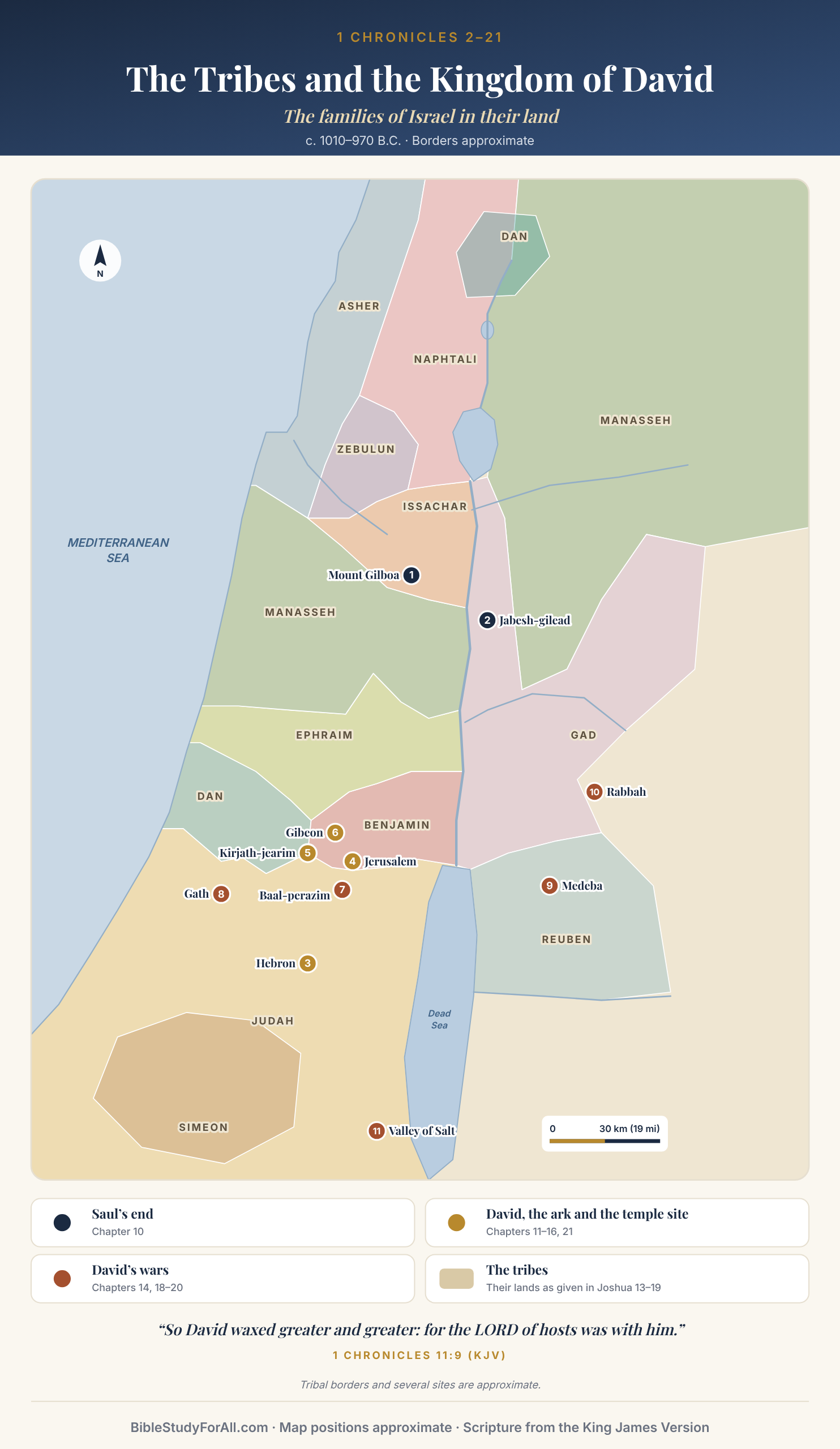
1 10:1–8
Mount Gilboa
Saul’s end. Saul and his sons fall before the Philistines.
2 10:11–12
Jabesh-gilead
Saul’s end. Valiant men bury the bones of Saul and his sons.
3 11:1–3; 12:23–40
Hebron
David and the ark. All Israel anoints David king, “with a perfect heart.”
4 11:4–9; 15–16; 21:18–22:1
Jerusalem
David and the ark. Zion taken; the ark brought up with joy; Ornan’s threshing floor chosen for the temple.
5 13:5–6
Kirjath-jearim
David and the ark. David goes to bring up the ark from here.
6 16:39–40; 21:29
Gibeon
David and the ark. The tabernacle of the LORD and the altar of burnt offering.
7 14:8–12
Baal-perazim
David’s wars. “God hath broken in upon mine enemies.”
8 18:1; 20:4–8
Gath
David’s wars. Taken from the Philistines; the giants of Gath fall.
9 19:7
Medeba
David’s wars. The Ammonites and their hired Syrian chariots gather.
10 20:1–3
Rabbah
David’s wars. Joab takes the royal city of the Ammonites.
11 18:12–13
Valley of Salt
David’s wars. Abishai slays eighteen thousand Edomites.
1 Chronicles 4:9–10
The Prayer of Jabez
In the middle of the lists of names, one man is remembered for his prayer.
“Oh that Thou wouldest bless me indeed, and enlarge my coast, and that Thine hand might be with me, and that Thou wouldest keep me from evil, that it may not grieve me! And God granted him that which he requested.”1 Chronicles 4:10 (KJV)
5:20
They Cried to God
The tribes east of Jordan won “because they put their trust in Him.”
5:25–26
They Transgressed
The same tribes later went after other gods and were carried away.
1 Chronicles 11–12
David King over All Israel
All Israel came to Hebron “with a perfect heart” to make David king.
1 11:1–3
Anointed at Hebron
“Thou shalt feed My people Israel.”
2 11:4–9
Zion Taken
Joab goes up first; it becomes the city of David.
3 11:17–19
Water from Bethlehem
David pours it out to the LORD.
4 11:22–23
Benaiah
Slew a lion in a pit in a snowy day.
5 12:22
A Great Host
Day by day men came to help David.
6 12:32
Men of Issachar
“Understanding of the times, to know what Israel ought to do.”
1 Chronicles 13–16
The Ark Brought Home
David’s first act as king was to bring back the ark of God. The first attempt failed; the second followed God’s word.
THE FIRST ATTEMPT (13)
A new cart, like the Philistines
13:7
THE SECOND ATTEMPT (15)
Carried on the Levites’ shoulders, “as Moses commanded”
15:15
THE FIRST ATTEMPT (13)
Uzza touches the ark and dies
13:9–10
THE SECOND ATTEMPT (15)
“We sought Him not after the due order”
15:13
THE FIRST ATTEMPT (13)
The ark left with Obed-edom three months
13:13–14
THE SECOND ATTEMPT (15)
Brought up with singers, harps and trumpets
15:16, 28
“Give thanks unto the LORD, call upon His name, make known His deeds among the people.”1 Chronicles 16:8 (KJV)
1 Chronicles 17
God’s Covenant with David
David wanted to build God a house; God promised to build David a house, a kingdom that would last for ever.
17:1–4
Not You
“Thou shalt not build Me an house to dwell in.”
17:10
The LORD Will Build
“The LORD will build thee an house.”
17:11–12
Thy Seed
“I will raise up thy seed after thee … and I will stablish his throne for ever.”
17:16
Who Am I?
David sits before the LORD in wonder.
1 Chronicles 17:14
For Ever
“But I will settle him in Mine house and in My kingdom for ever: and his throne shall be established for evermore.” The angel told Mary, “the Lord God shall give unto Him the throne of His father David” (Luke 1:32).
1 Chronicles 21–29
The Temple Prepared
David could not build the temple, but he gave everything to prepare for it.
1 21:24
The Threshing Floor
“I will not … offer burnt offerings without cost.”
2 22:1
The Place Chosen
“This is the house of the LORD God.”
3 22:5
Materials Gathered
Gold, silver, brass, iron, cedar and stone in abundance.
4 23–26
Courses of Service
Levites, priests, singers and porters set in order.
5 28:11–12
The Pattern
David gives Solomon the plan, “by the spirit.”
6 29:9
Willing Hearts
“The people rejoiced, for that they offered willingly.”
The threshing floor of Ornan is on Mount Moriah (2 Chronicles 3:1), where Abraham offered Isaac (Genesis 22:2).
1 Chronicles 29:10–19
David’s Prayer of Praise
At the end of his life David blessed the LORD before all the congregation.
1 Chronicles 29:11
Thine Is the Kingdom
“Thine, O LORD, is the greatness, and the power, and the glory, and the victory, and the majesty: for all that is in the heaven and in the earth is Thine; Thine is the kingdom, O LORD, and Thou art exalted as head above all.”
“For all things come of Thee, and of Thine own have we given Thee.”1 Chronicles 29:14 (KJV)
Looking Forward
Christ in 1 Chronicles
The genealogies, the covenant and the temple all lead to Jesus Christ.
1–3 · MATTHEW 1:1
The Son of David
The line of promise from Adam through David comes to Jesus.
17:11–14 · HEBREWS 1:5
God’s Son
“I will be His Father, and He shall be My son” is applied to Christ.
21:18–26 · 1 PETER 1:18–19
The Costly Sacrifice
David would not give what cost him nothing; we are redeemed “with the precious blood of Christ.”
29:11 · MATTHEW 6:13
Thine Is the Kingdom
David’s praise echoes in the prayer Jesus taught.
Book Outline
1 Chronicles Outline
Twenty-nine chapters in four parts: from Adam to the family of Judah (1:1–4:23), the tribes and the returned exiles (4:24–9:44), David made king and the ark brought to Jerusalem (10–16), and the covenant and the temple (17–29). Tap a part below to jump to it, tap any section to expand it, and tap a verse reference to read it in the King James Version at BibleGateway.
Part I
From Adam to the Family of Judah
1:1–4:23 · The patriarchs, the twelve sons of Israel, and the families of Judah and David
Part II
The Tribes and the Returned Exiles
4:24–9:44 · Simeon, the tribes east of the Jordan, Levi, the northern tribes, and those who came home
Part III
David King; the Ark to Jerusalem
10:1–16:43 · Saul’s death, David’s mighty men, and the ark brought up with music and praise
- The death of Saul and his sons: “enquired not of the LORD” · 10:1–14
- David plans to bring up the ark from Kirjath-jearim · 13:1–4
- Uzza and the ark · 13:5–14
- David’s house and children · 14:1–7
- The Philistines defeated · 14:8–17
- The ark carried up by the Levites · 15:1–29
- The ark placed in the tent · 16:1–7
- David’s psalm of thanks: “His mercy endureth for ever” · 16:8–36
- Worship before the ark · 16:37–43
Part IV
The Covenant and the Temple
17:1–29:30 · God’s promise, David’s wars, the census, and his preparations for the temple
Continue Your Study
Scripture quotations and verse links are from the King James Version (KJV).