
Old Testament · History · Book 10 of 66
Book of 2 Samuel
David becomes king, first over Judah and then over all Israel. He takes Jerusalem, brings up the ark, and receives God’s promise of a throne for ever. Then his sin with Bath-sheba brings the sword into his own house, yet God keeps His word: “thy throne shall be established for ever” (7:16).
2 Samuel at a Glance
Book Outline
Note: Scripture quotations and verse links on this site use the King James Version (KJV) because it is in the public domain, while most modern translations limit how much can be quoted online. Feel free to read along in the translation of your choice.
24 Chapters
695 verses
Author
Nathan and Gad, completing Samuel’s book
Time Covered
c. 1010–970 B.C., David’s 40 years
Key Word
“House” (7:11, 16)
About the Name
Title
Named for Samuel, the prophet who anointed David. In the Hebrew Bible 1 and 2 Samuel were one book; this second half tells the reign of David.
The book carries the name of Samuel, although he died before it begins (1 Samuel 25:1). In the Hebrew Bible 1 and 2 Samuel were a single book, named for the prophet who anointed Israel’s first two kings. This second half tells the story of the second of them, David, from the news of Saul’s death to the last years of his reign.
The Greek Old Testament divided it in two and called it the second book of Kingdoms, so some older Bibles call it “The Second Book of the Kings.” Samuel’s anointing of David (1 Samuel 16:13) comes to pass here, when the men of Judah and then all the tribes anoint him king (2:4; 5:3).
Who Wrote It
Author Details
Written by the prophets Nathan and Gad, who completed the book of Samuel and recorded the acts of David (1 Chronicles 29:29).
Samuel had died, so Jewish tradition, recorded in the Talmud, says the prophets Nathan and Gad completed his book. Scripture names their writings: the acts of David “are written in the book of Samuel the seer, and in the book of Nathan the prophet, and in the book of Gad the seer” (1 Chronicles 29:29).
Both men appear in 2 Samuel. Nathan brings God’s covenant to David (7:4–17) and rebukes him for his sin (12:1–14), and Gad, “David’s seer,” brings God’s word after the census (24:11–19). They were eyewitnesses of what they wrote, and “all scripture is given by inspiration of God” (2 Timothy 3:16).
When It Was Written
Date of Writing
David reigned forty years, about 1010–970 B.C.: seven and a half years in Hebron and thirty-three in Jerusalem (5:4–5).
David “was thirty years old when he began to reign, and he reigned forty years. In Hebron he reigned over Judah seven years and six months: and in Jerusalem he reigned thirty and three years over all Israel and Judah” (5:4–5). His reign ran about 1010–970 B.C.: in Hebron about 1010–1003, and in Jerusalem about 1003–970.
Nathan and Gad wrote during David’s lifetime and soon after, about 1010–970 B.C. The first readers were Israelites under David and Solomon, who needed to know that God had chosen David’s house and promised it a throne for ever.
Key Verse
Thy Throne Shall Be Established for Ever
“And thine house and thy kingdom shall be established for ever before thee: thy throne shall be established for ever.”
2 Samuel 7:16 (KJV)
Big Ideas
Key Themes
God’s Covenant
A house, kingdom and throne for ever.
7:12–16; 23:5
The LORD Was with Him
God gave David rest and victory.
5:10; 8:14
Sin Has Consequences
Forgiven, yet the sword stayed in his house.
12:10–14
Repentance
David confessed and was forgiven.
12:13; Psalm 51
Kindness
The kindness of God shown to Mephibosheth.
9:1–13
Worship
Dancing before the LORD; costly offerings.
6:14; 24:24
Waiting on God
David trusts God with his throne.
15:25–26
God Our Rock
The LORD is my rock and my deliverer.
22:2–3
A Coming King
Fulfilled in Jesus, the Son of David.
7:16; Luke 1:32–33
Overview
2 Samuel Summary
OverviewThe Reign of King David
Second Samuel tells the forty-year reign of David, the man after God’s own heart. In the first half God lifts him up: he becomes king over Judah, then over all Israel, takes Jerusalem, brings up the ark, and defeats his enemies on every side. At the centre stands God’s covenant: David’s house, kingdom and throne will last for ever. In the second half David falls into sin with Bath-sheba, and the sword never departs from his house. Yet David repents, and God keeps His promise, which is fulfilled at last in Jesus Christ, the Son of David. “David went on, and grew great, and the LORD God of hosts was with him” (5:10).
Chapters 1–4King over Judah
David hears that Saul and Jonathan have fallen on Gilboa, and he mourns them in a song: “how are the mighty fallen!” (1:19). At God’s word he goes up to Hebron, where the men of Judah anoint him king (2:4). Abner, Saul’s captain, makes Saul’s son Ish-bosheth king over the other tribes, and “there was long war between the house of Saul and the house of David: but David waxed stronger and stronger” (3:1). Joab murders Abner, and two captains murder Ish-bosheth, but David will not reward treachery and mourns them both.
Chapters 5–6Jerusalem and the Ark
All the tribes come to Hebron and anoint David king over Israel (5:3). He takes the strong hold of Zion from the Jebusites, “the same is the city of David” (5:7), and twice defeats the Philistines. When he brings the ark up on a new cart, Uzzah touches it and dies, for it was to be carried by the Levites. Three months later David brings it up with joy: “David danced before the LORD with all his might” (6:14). His wife Michal despises him, but he answers that he will gladly be humbled before the LORD.
Chapter 7God’s Covenant with David
David wants to build a house for God, but through Nathan the prophet God promises to build David a house instead: a son will sit on his throne and build the temple, and “thine house and thy kingdom shall be established for ever before thee: thy throne shall be established for ever” (7:16). David sits before the LORD in wonder: “Who am I, O Lord GOD? and what is my house, that Thou hast brought me hitherto?” (7:18). This promise is the foundation of every later hope of the Messiah, the King from David’s line.
Chapters 8–10Victory and Kindness
God gives David victory over the Philistines, Moab, Zobah, Syria, Edom and Ammon, and “David executed judgment and justice unto all his people” (8:15). Remembering his covenant with Jonathan, he seeks out Jonathan’s son Mephibosheth, lame on both feet, to “shew the kindness of God unto him” (9:3). He gives him Saul’s land and a seat at the king’s table for the rest of his life (9:7, 13).
Chapters 11–12David’s Great Sin
“At the time when kings go forth to battle … David tarried still at Jerusalem” (11:1). He takes Bath-sheba, the wife of Uriah, and when she is with child he has Uriah killed in battle at Rabbah. “But the thing that David had done displeased the LORD” (11:27). Nathan tells a parable of a rich man who stole a poor man’s only lamb, and when David is angry he says, “Thou art the man” (12:7). David confesses, “I have sinned against the LORD,” and Nathan answers, “The LORD also hath put away thy sin; thou shalt not die” (12:13). Yet the child dies, and the sword will never depart from his house (12:10). Then Solomon is born, “and the LORD loved him” (12:24). Psalm 51 is David’s prayer of repentance.
Chapters 13–19Absalom’s Revolt
The sword comes quickly. Amnon wrongs his sister Tamar, and her brother Absalom kills him and flees. After he is brought home, Absalom “stole the hearts of the men of Israel” (15:6) and has himself made king in Hebron. David leaves Jerusalem weeping, barefoot up the mount of Olives, and sends the ark back: “let Him do to me as seemeth good unto Him” (15:26). At Mahanaim his army defeats Absalom’s in the wood of Ephraim; Absalom is caught by his head in an oak and Joab kills him. The king weeps: “O my son Absalom, my son, my son Absalom! would God I had died for thee” (18:33). Then David is brought back over the Jordan.
Chapters 20–24Last Words and the Altar
Sheba of Benjamin leads a short revolt that ends at Abel-beth-maachah (20). The closing chapters gather events from across David’s reign: a famine for Saul’s sin against the Gibeonites, his mighty men, and his song of praise, “The LORD is my rock, and my fortress, and my deliverer” (22:2), with his last words of “an everlasting covenant, ordered in all things, and sure” (23:5). When David proudly numbers the people, God sends a plague, and David chooses to “fall now into the hand of the LORD; for His mercies are great” (24:14). He buys the threshingfloor of Araunah, refusing to offer “of that which doth cost me nothing” (24:24), and builds an altar there, on the site where Solomon would build the temple.
At a Glance
2 Samuel at a Glance
The whole book in short sections: its four parts, a timeline, the kingdom of David on the map, God’s covenant with David, David and Mephibosheth, David’s sin and repentance, Absalom’s revolt, David’s song, and Christ the Son of David. Tap a topic to jump to it.
Printable Copy
Save or Print the Infographic
Everything in this section, with the key verse and key themes, is also on a printable infographic (four pages). It opens in a new tab, where you can save it to your phone or computer, share it, or print it.
Structure
The Book in Four Parts
The book turns on David’s sin in chapter 11: blessing as he rises to rule all Israel (1–10), then sorrow in his own house (11:1–19:8), and at last his return and closing words (19:9–24:25).
Each bar shows that part’s share of the 695 verses.
II 5–10 · 127 verses
King over All Israel
Jerusalem, the ark, God’s covenant, victories.
III 11:1–19:8 · 260 verses
Sin and the Sword
Bath-sheba and Uriah, Nathan, Absalom’s revolt.
IV 19:9–24:25 · 198 verses
David Restored
Sheba’s revolt, David’s song, the altar.
Dates B.C. (Approximate)
David’s Forty Years
Dates follow David’s reign of forty years, seven and a half in Hebron and thirty-three in Jerusalem (5:4–5).
2:4
c. 1010
David anointed king over Judah at Hebron
5:3–7
c. 1003
King over all Israel; Jerusalem taken
6:12–17
c. 1000
The ark brought up to Jerusalem
7:16
c. 998
God’s covenant with David
11–12
c. 993
Bath-sheba and Uriah; Nathan’s rebuke
12:24
c. 991
Solomon born
15–18
c. 976
Absalom’s revolt and death
1 KINGS 2:10–11
c. 970
David dies after forty years
Map
The Kingdom of David
The kingdom God gave David, from Hebron and Jerusalem to the lands he subdued. The numbers match the cards below.
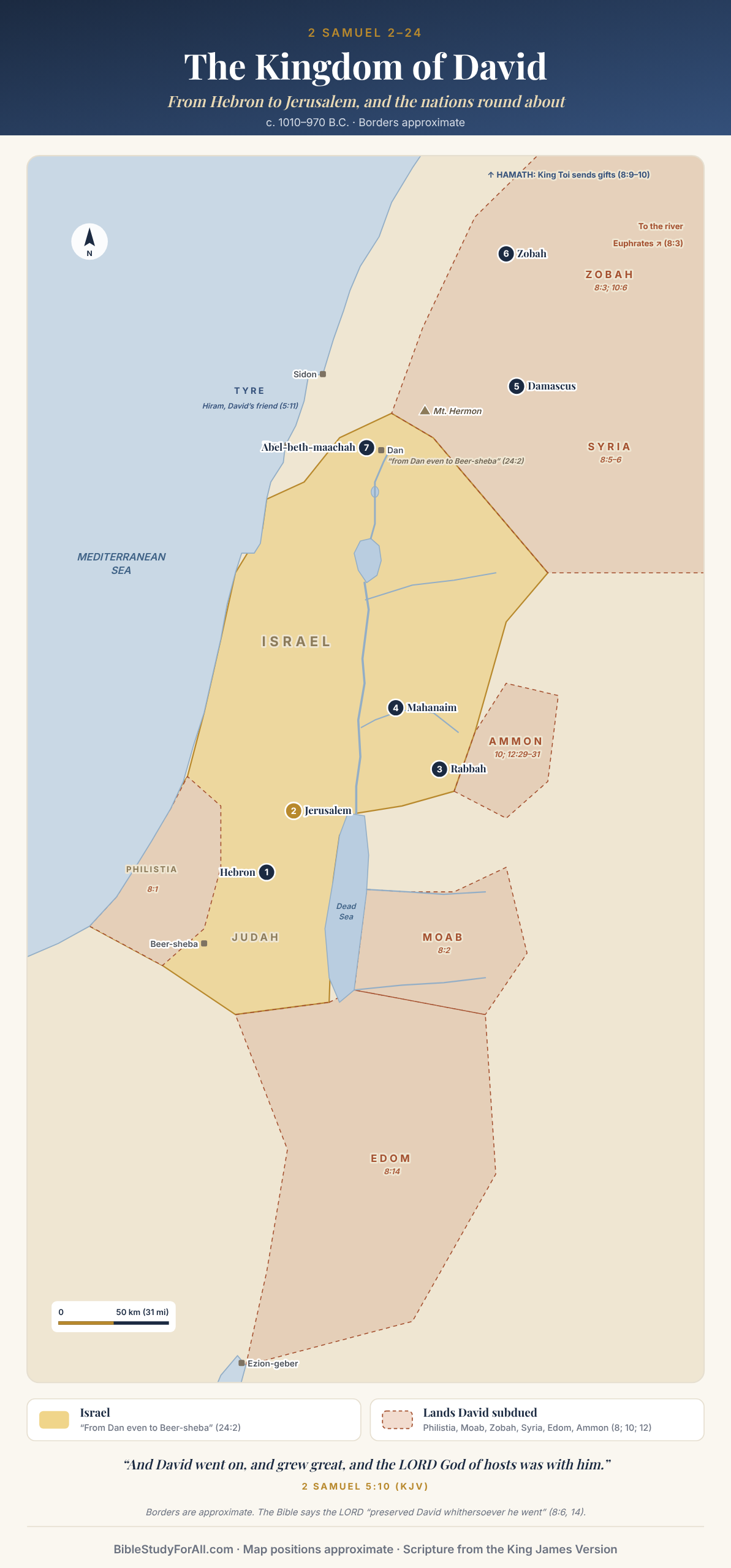
1 2:1–4; 5:1–5
Hebron
David reigns over Judah seven years and six months; then all Israel anoints him.
2 5:6–10; 6; 7
Jerusalem
Taken from the Jebusites; the city of David; the ark brought up; God’s covenant.
3 11:1; 12:26–31
Rabbah of Ammon
While Joab besieged it, David sinned with Bath-sheba; the city taken.
4 17:24–19:8
Mahanaim
David’s refuge in Absalom’s revolt; “O my son Absalom.”
5 8:5–6
Damascus
David put garrisons in Syria of Damascus.
6 8:3–4; 10:6–19
Zobah
Hadadezer smitten “as he went to recover his border at the river Euphrates.”
7 20:14–22
Abel-beth-maachah
Sheba’s revolt ends when a wise woman saves the city.
2 Samuel 7
God’s Covenant with David
David wanted to build God a house. God promised to build David a house that would last for ever.
1 7:12
A Son on the Throne
“I will set up thy seed after thee … and I will establish his kingdom.”
2 7:13
A House for God
“He shall build an house for My name.”
3 7:14–15
A Father’s Mercy
God will chasten, but His mercy will not depart as it did from Saul.
4 7:16
For Ever
House, kingdom and throne established for ever.
“Wherefore Thou art great, O LORD God: for there is none like Thee, neither is there any God beside Thee.”2 Samuel 7:22 (KJV)
2 Samuel 9
The Kindness of God
David kept his covenant with Jonathan by honouring Jonathan’s lame son.
1 9:3
Seeking Him Out
“That I may shew the kindness of God unto him.”
2 9:7
Fear Not
Saul’s land restored, for Jonathan’s sake.
3 9:13
At the King’s Table
He ate continually at the king’s table, lame on both his feet.
Mephibosheth could bring nothing to the king, yet was made like one of the king’s sons (9:11), a picture of the grace God shows sinners in Christ.
2 Samuel 11–12
David’s Sin and Repentance
One idle evening led to adultery, deceit and murder. God sent His prophet, and David confessed.
THE SIN
David stays home when kings go to battle
11:1
THE REPENTANCE
Nathan: “Thou art the man”
12:7
THE SIN
He takes Bath-sheba, and has Uriah killed
11:4, 15
THE REPENTANCE
“I have sinned against the LORD”
12:13
THE SIN
“The thing that David had done displeased the LORD”
11:27
THE REPENTANCE
“The LORD also hath put away thy sin”
12:13
Psalm 51:10
David’s Prayer
“Create in me a clean heart, O God; and renew a right spirit within me.” Forgiven, David still reaped what he had sown: “the sword shall never depart from thine house” (12:10).
2 Samuel 13–19
Absalom’s Revolt
The sword Nathan foretold came through David’s own sons.
1 13
Amnon and Tamar
Amnon wrongs Tamar; Absalom kills him and flees.
2 15:6
Stolen Hearts
Absalom “stole the hearts of the men of Israel.”
3 15:30
Up Mount Olivet
David flees Jerusalem, weeping and barefoot.
4 17:24
Mahanaim
David gathers his men across the Jordan.
5 18:9–15
The Wood of Ephraim
Absalom caught in an oak; Joab kills him.
6 19:15
Brought Back
Judah brings the king back over the Jordan.
“O my son Absalom, my son, my son Absalom! would God I had died for thee, O Absalom, my son, my son!”2 Samuel 18:33 (KJV)
2 Samuel 22–24
David’s Song and Last Words
At the end of his life David praised the God who had delivered him, and rested on God’s covenant.
“The LORD is my rock, and my fortress, and my deliverer; the God of my rock; in Him will I trust.”2 Samuel 22:2–3 (KJV)
22:31
His Way Is Perfect
“As for God, His way is perfect; the word of the LORD is tried.”
23:2, 5
Last Words
“The Spirit of the LORD spake by me” of an everlasting covenant.
24:24
Costly Worship
No offering “of that which doth cost me nothing.”
Looking Forward
Christ, the Son of David
God’s promise of a throne for ever is fulfilled in Jesus, the King from David’s line.
7:16 · LUKE 1:32–33
The Throne of David
“The Lord God shall give unto Him the throne of His father David … and of His kingdom there shall be no end.”
MATTHEW 1:1
The Son of David
The New Testament opens with “Jesus Christ, the son of David.”
ACTS 2:30
Raised to Sit on His Throne
Peter says God swore to David to “raise up Christ to sit on his throne.”
REVELATION 22:16
Root and Offspring
“I am the root and the offspring of David, and the bright and morning star.”
Book Outline
2 Samuel Outline
Twenty-four chapters in four parts: David king over Judah (1–4), king over all Israel, with God’s covenant (5–10), his sin and the sword in his house (11:1–19:8), and his return, last words and the closing chapters (19:9–24:25). Tap a part below to jump to it, tap any section to expand it, and tap a verse reference to read it in the King James Version at BibleGateway.
Part I
King over Judah
1:1–4:12 · David mourns Saul and Jonathan, reigns in Hebron, and the house of Saul grows weaker
Part II
King over All Israel
5:1–10:19 · Jerusalem taken, the ark brought up, God’s covenant with David, and his victories
Part III
Sin and the Sword in David’s House
11:1–19:8 · Bathsheba and Uriah, Nathan’s rebuke, Amnon and Absalom, and Absalom’s revolt and death
- Absalom’s death in the wood of Ephraim · 17:24–18:18
- David mourns: “O my son Absalom, my son, my son Absalom!” · 18:19–19:8
Part IV
David Restored; His Last Words
19:9–24:25 · Return to Jerusalem, Sheba’s revolt, David’s song and last words, his mighty men, and the altar
Continue Your Study
Scripture quotations and verse links are from the King James Version (KJV).