
Old Testament · History · Book 6 of 66
Joshua
Moses is dead, and Joshua leads Israel over the Jordan into the land God promised to Abraham. Walls fall, the land is divided among the tribes, and Joshua calls the people to choose: “as for me and my house, we will serve the LORD” (24:15).
Joshua at a Glance
Book Outline
Note: Scripture quotations and verse links on this site use the King James Version (KJV) because it is in the public domain, while most modern translations limit how much can be quoted online. Feel free to read along in the translation of your choice.
24 Chapters
658 verses
Author
Joshua (24:26)
Jordan Crossed
c. 1406 B.C.
Key Phrase
“Be strong and of a good courage”
About the Name
Title
Named for Joshua, Moses’ servant and successor. His name means “the LORD is salvation”; in Greek it is Iesous, the same name as Jesus. It opens the books of history.
The book is named for its leader, Joshua the son of Nun, of the tribe of Ephraim. He was first called Oshea, and Moses named him Jehoshua (Numbers 13:16), “the LORD is salvation.” In the Greek Old Testament his name is Iesous, the same name as Jesus, and in the King James Version the name “Jesus” in Acts 7:45 and Hebrews 4:8 refers to Joshua.
Joshua had served Moses from his youth (Numbers 11:28). He led Israel against Amalek (Exodus 17:9), went up the mount with Moses (Exodus 24:13), and with Caleb gave the good report of the land (Numbers 14:6–9). In English Bibles the book opens the twelve books of history; in the Hebrew Bible it begins the section called the Former Prophets.
Who Wrote It
Author Details
Written by Joshua: “Joshua wrote these words in the book of the law of God” (24:26). The closing verses about his death and burial were added by Eleazar and Phinehas.
The book says that “Joshua wrote these words in the book of the law of God” (24:26), and it shows the hand of an eyewitness: “until we were passed over” (5:1), and Rahab “dwelleth in Israel even unto this day” (6:25), while she was still living. Joshua also had a description of the land written “in a book” when the land was divided (18:9). Jewish tradition holds that Joshua wrote the book, and that the account of his death (24:29–33) was added by Eleazar the high priest and his son Phinehas, as the account of Moses’ death closes Deuteronomy.
Joshua was the servant of the LORD (24:29) to whom God promised, “as I was with Moses, so I will be with thee: I will not fail thee, nor forsake thee” (1:5). “All scripture is given by inspiration of God” (2 Timothy 3:16), and the New Testament draws on Joshua for faith and for warning (Hebrews 4:8; 11:30–31; James 2:25).
When It Was Written
Date of Writing
Israel crossed the Jordan about 1406 B.C., forty years after the exodus of c. 1446 B.C. (1 Kings 6:1). Joshua wrote near the end of his life, about 1400–1380 B.C.
First Kings 6:1 places the exodus 480 years before Solomon began the temple (c. 966 B.C.), about 1446 B.C., and Jephthah’s “three hundred years” (Judges 11:26) agrees. Forty years later, about 1406 B.C., Israel passed over Jordan “on the tenth day of the first month” (4:19). Caleb was forty when Moses sent the spies and eighty-five when he received Hebron (14:7, 10), so the main campaigns lasted about seven years.
Joshua died at a hundred and ten (24:29), some years after “the LORD had given rest unto Israel” (23:1). He wrote while those who had seen these things were still alive, about 1400–1380 B.C., for the generation that entered the land and their children, so they would know that “There failed not ought of any good thing which the LORD had spoken unto the house of Israel; all came to pass” (21:45).
Key Verse
Be Strong and of a Good Courage
“Have not I commanded thee? Be strong and of a good courage; be not afraid, neither be thou dismayed: for the LORD thy God is with thee whithersoever thou goest.”
Joshua 1:9 (KJV)
Big Ideas
Key Themes
God Keeps His Promises
Not one good thing failed of all the LORD had spoken.
21:43–45; 23:14
Courage and God’s Presence
Be strong, for the LORD is with thee.
1:5–9
God’s Word
Meditate on the book of the law day and night.
1:8; 8:34–35
The LORD Fights for Israel
Victory is the LORD’s doing, not Israel’s strength.
6:2; 10:14, 42; 23:10
Faith and Obedience
Jericho fell by faith; Rahab was saved by faith.
6; Hebrews 11:30–31
Sin Brings Defeat
Achan’s hidden sin troubled all Israel.
7:1, 11–12
Holiness and Judgment
God judged the wickedness of Canaan.
Genesis 15:16; Deuteronomy 9:5
The Inheritance
Each tribe received its portion by lot from the LORD.
13–21
Choose to Serve the LORD
Each generation must choose for itself.
24:14–15, 24
Overview
Joshua Summary
OverviewGod Keeps His Promise of the Land
Joshua tells how God brought Israel into the land He had promised to Abraham, Isaac and Jacob. Under Joshua’s leadership the people cross the Jordan, defeat the kings of Canaan, and receive their inheritance, tribe by tribe. The book shows that God keeps every promise: “There failed not ought of any good thing which the LORD had spoken unto the house of Israel; all came to pass” (21:45). It also shows that victory comes by faith and obedience, not by strength. It falls into four parts: entering the land (1–5), taking the land (6–12), dividing the land (13–21), and serving the LORD in the land (22–24).
Chapter 1Joshua Commissioned
The book opens, “Moses My servant is dead; now therefore arise, go over this Jordan” (1:2). God promises Joshua, “Every place that the sole of your foot shall tread upon, that have I given unto you” (1:3), and “as I was with Moses, so I will be with thee: I will not fail thee, nor forsake thee” (1:5). Three times He tells him to be strong and of a good courage, and He gives him the secret of success: “This book of the law shall not depart out of thy mouth; but thou shalt meditate therein day and night, that thou mayest observe to do according to all that is written therein” (1:8). The tribes beyond Jordan promise to go over armed with their brethren (1:16).
Chapters 2–5Rahab, the Jordan and Gilgal
Joshua sends two spies to Jericho, and Rahab the harlot hides them, for she has heard what the LORD did: “the LORD your God, He is God in heaven above, and in earth beneath” (2:11). She binds a line of scarlet thread in her window, and her house is spared. Then, as the priests carrying the ark step into the flooded river, the waters are cut off, and “all the Israelites passed over on dry ground” (3:17). Twelve stones taken from the river are set up at Gilgal as a memorial, so that when children ask, “What mean ye by these stones?” they will be told (4:6–7). At Gilgal the new generation is circumcised, the Passover is kept, and the manna ceases (5:2–12).
Chapters 5–6The Captain of the LORD’s Host and Jericho
Near Jericho Joshua meets a man with a drawn sword: “as captain of the host of the LORD am I now come” (5:14). Joshua falls on his face and worships, and is told, “Loose thy shoe from off thy foot; for the place whereon thou standest is holy” (5:15), as Moses was told at the bush. This was the LORD Himself, appearing to lead His people. The battle is His. For six days Israel marches once around Jericho with the ark and seven priests blowing trumpets of rams’ horns; on the seventh day they march seven times, the people shout, and “the wall fell down flat” (6:20). “By faith the walls of Jericho fell down” (Hebrews 11:30). Rahab and her household are saved alive (6:25).
Chapters 7–8Achan’s Sin and Ai
But “the children of Israel committed a trespass in the accursed thing” (7:1): Achan of Judah took a goodly Babylonish garment, silver and gold from Jericho and hid them in his tent. Israel is beaten at the small city of Ai, and Joshua falls on his face before the ark. The sin is found out, Achan confesses, “I coveted them, and took them” (7:21), and he and his household are stoned in the valley of Achor. Then Ai is taken by an ambush (8). Joshua builds an altar on mount Ebal, writes a copy of the law of Moses on stones, and reads “all the words of the law, the blessings and cursings” before the whole congregation (8:34), as Moses had commanded (Deuteronomy 27).
Chapters 9–12The Conquest of the South and the North
The Gibeonites deceive Israel with old sacks and mouldy bread, and Joshua makes a league with them because the leaders “asked not counsel at the mouth of the LORD” (9:14). When five Amorite kings attack Gibeon, Joshua marches all night to save it, the LORD casts down great hailstones, and at Joshua’s word “the sun stood still, and the moon stayed” (10:13): “there was no day like that before it or after it … for the LORD fought for Israel” (10:14). The southern cities fall, then a great northern alliance under Jabin king of Hazor is defeated at the waters of Merom (11). “So Joshua took the whole land … And the land rested from war” (11:23). Chapter 12 lists thirty-one kings defeated west of Jordan.
Chapters 13–21The Land Divided
Though some land remains to be taken (13:1), Joshua divides the land by lot among the tribes. Reuben, Gad and half the tribe of Manasseh have already received land east of the Jordan (13). Caleb, now eighty-five, asks for the hill country of the Anakims: “give me this mountain” (14:12). He receives Hebron “because that he wholly followed the LORD God of Israel” (14:14). Judah, Ephraim and Manasseh receive their portions; then the tabernacle is set up at Shiloh (18:1), and the seven remaining tribes receive theirs. Six cities of refuge are appointed (20), and the Levites receive forty-eight cities among the tribes (21). For a map of the tribal lands, see our study 12 Tribes of Israel.
Chapter 22The Altar of Witness
The two and a half tribes from east of the Jordan, having kept their promise, return home with Joshua’s blessing and his charge: “to love the LORD your God, and to walk in all His ways, and to keep His commandments, and to cleave unto Him, and to serve Him with all your heart and with all your soul” (22:5). They build a great altar by the Jordan, and the other tribes, fearing it means turning away from the LORD, prepare for war. Phinehas and the princes go to them and learn that the altar is not for sacrifice but a witness that the eastern tribes also have a part in the LORD. War is avoided, and the altar is named Ed, “a witness between us that the LORD is God” (22:34).
Chapters 23–24Choose You This Day
In his old age Joshua gathers the leaders and then all Israel. He reminds them that “not one thing hath failed of all the good things which the LORD your God spake concerning you” (23:14), and warns them not to mix with the nations or serve their gods. At Shechem he retells their history from Abraham onward, all of it God’s doing, and calls them to decide: “choose you this day whom ye will serve … but as for me and my house, we will serve the LORD” (24:15). The people answer, “The LORD our God will we serve, and His voice will we obey” (24:24), and Joshua makes a covenant with them and sets up a great stone as a witness. The book ends with three burials in the promised land: Joshua at a hundred and ten, the bones of Joseph at Shechem, and Eleazar the priest (24:29–33).
At a Glance
Joshua at a Glance
The whole book in short sections: its four parts, a timeline, Joshua’s charge, the crossing of the Jordan, Jericho, the conquest with a map, Caleb’s faith, the tribes’ land with a map, the cities of refuge, Joshua’s farewell, and pictures of Christ in Joshua. Tap a topic to jump to it.
Printable Copy
Save or Print the Infographic
Everything in this section, with the key verse and key themes, is also on a printable infographic (seven pages). It opens in a new tab, where you can save it to your phone or computer, share it, or print it.
Structure
The Book in Four Parts
Joshua moves from promise to possession: Israel enters the land (1–5), takes it (6–12), divides it among the tribes (13–21), and is called to serve the LORD in it (22–24).
Each bar shows that part’s share of the 658 verses.
I 1:1–5:12 · 95 verses
Entering the Land
Joshua’s charge, Rahab and the spies, the Jordan crossed, and Gilgal.
II 5:13–12:24 · 208 verses
Taking the Land
Jericho, Achan and Ai, Gibeon, and the southern and northern campaigns.
III 13–21 · 272 verses
Dividing the Land
The tribal inheritances, Caleb, Shiloh, the cities of refuge and the Levites.
IV 22–24 · 83 verses
Serving the LORD
The altar of witness, Joshua’s farewell, and the covenant at Shechem.
Dates B.C. (Approximate)
Timeline of the Conquest
Dates follow the early exodus (c. 1446 B.C., 1 Kings 6:1) and the ages and years the book gives.
c. 1446 B.C.
The Exodus
Joshua serves Moses (Exodus 17:9; 24:13)
c. 1445 B.C.
The Spies
Joshua and Caleb’s good report (14:7)
c. 1406 B.C.
Moses Dies
Joshua takes command (1:1–2)
c. 1406 B.C.
Jordan Crossed
The tenth day of the first month (4:19)
c. 1406 B.C.
Jericho Falls
The walls fall down flat (6:20)
c. 1406–1399 B.C.
The Campaigns
South, then north (10–11)
c. 1399 B.C.
Caleb Gets Hebron
At eighty-five (14:10)
c. 1390–1380 B.C.
Joshua Dies
At a hundred and ten (24:29)
Joshua 1:1–9
Joshua’s Charge
God gives Joshua three promises, a command repeated three times, and one secret of success.
1 1:3
The Land Given
“Every place that the sole of your foot shall tread upon, that have I given unto you.”
2 1:5
No Enemy Shall Stand
“There shall not any man be able to stand before thee all the days of thy life.”
3 1:5
God’s Presence
“as I was with Moses, so I will be with thee: I will not fail thee, nor forsake thee.”
Joshua 1:8
The Secret of Success
“This book of the law shall not depart out of thy mouth; but thou shalt meditate therein day and night, that thou mayest observe to do according to all that is written therein: for then thou shalt make thy way prosperous, and then thou shalt have good success.”
“Be strong and of a good courage” is said three times in the chapter (1:6, 7, 9), and the people say it back to Joshua (1:18).
Joshua 2–5
Rahab, the Jordan and Gilgal
Before a single battle, God prepares His people and shows His power.
1 2
Rahab’s Faith
She hides the spies and binds the line of scarlet thread in her window.
2 3
The Jordan Parts
The waters are cut off when the priests’ feet touch the river.
3 4
Twelve Stones
A memorial at Gilgal: “What mean ye by these stones?”
4 5:2–9
Circumcision
The new generation receives the sign of the covenant.
5 5:10–12
Passover
Kept in the land; the manna ceases the next day.
6 5:13–15
The Captain of the LORD’s Host
Joshua worships; the battle belongs to the LORD.
“That all the people of the earth might know the hand of the LORD, that it is mighty: that ye might fear the LORD your God for ever.”Joshua 4:24 (KJV)
Joshua 6
The Fall of Jericho
Jericho was taken not by siege but by faith and obedience to God’s word.
1 6:3
Six Days
Once around the city each day
2 6:4
Seven Priests
Trumpets of rams’ horns before the ark
3 6:15
The Seventh Day
Seven times around the city
4 6:20
The Shout
“the wall fell down flat”
“By faith the walls of Jericho fell down, after they were compassed about seven days.”Hebrews 11:30 (KJV)
Rahab and all her household were saved (6:25). She married Salmon of Judah and is named in the line of King David and of Jesus Christ (Matthew 1:5).
Joshua 7–12
The Conquest of Canaan
Defeat at Ai teaches that hidden sin brings defeat; then the LORD fights for Israel in the south and the north.
7
Achan’s Sin
A garment, silver and gold hidden in his tent; Israel defeated at Ai.
8:1–29
Ai Taken
An ambush behind the city; Ai burned.
8:30–35
The Law at Mount Ebal
An altar built and all the words of the law read.
9
The Gibeonites
A league made without asking counsel of the LORD.
10
The Southern Campaign
Hailstones, and the sun standing still over Gibeon.
11
The Northern Campaign
Jabin of Hazor and his allies defeated at the waters of Merom.
“So Joshua took the whole land, according to all that the LORD said unto Moses; … And the land rested from war.”Joshua 11:23 (KJV)
The Canaanites were judged for their wickedness, which God had waited four hundred years to punish (Genesis 15:16; Deuteronomy 9:5). Chapter 12 lists 31 kings defeated west of the Jordan.
Joshua 2–12 · Map
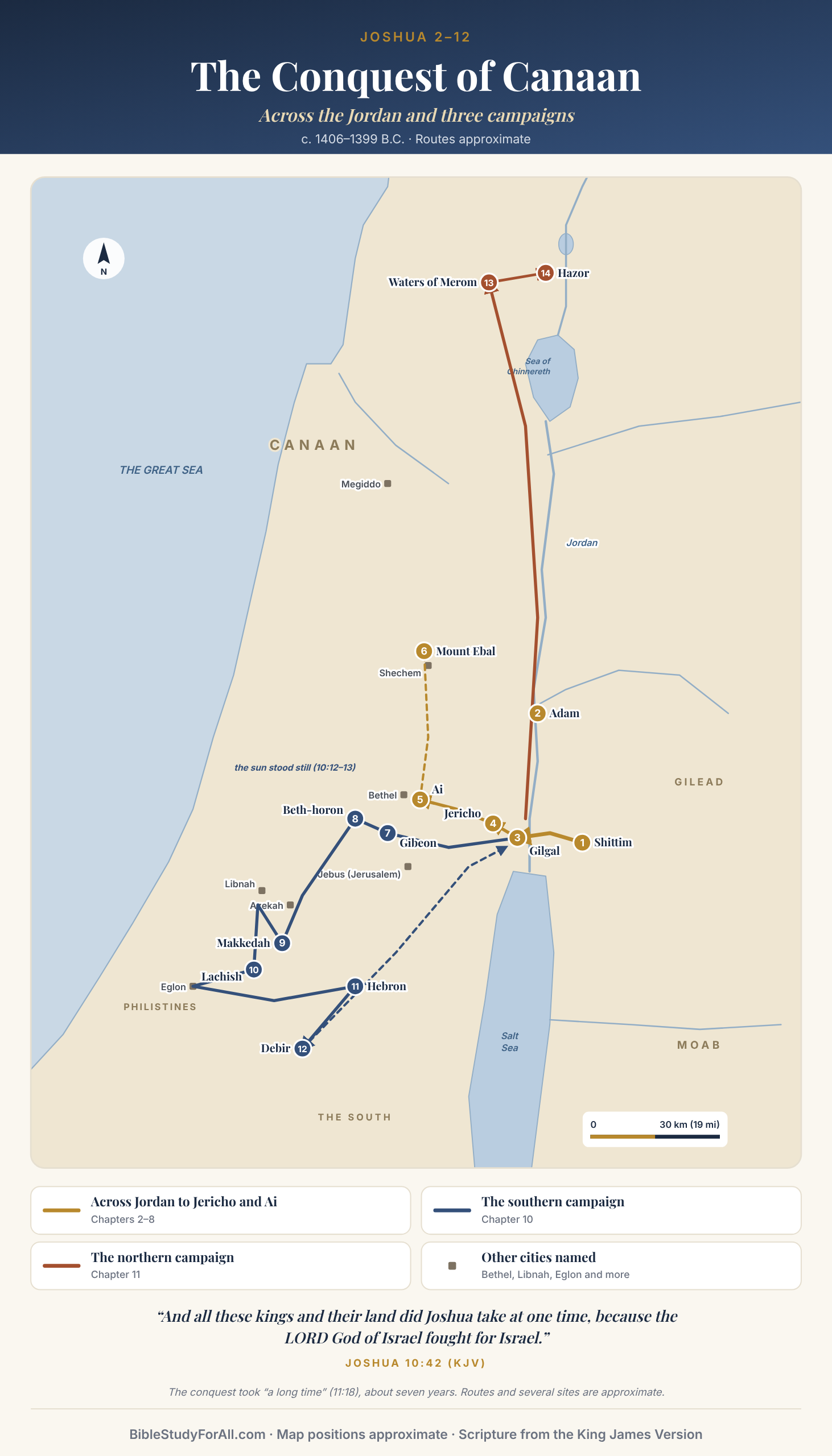
Map of the Conquest
Israel crossed the Jordan from Shittim to Gilgal, took Jericho and Ai, and read the law at Mount Ebal. Then came two campaigns: south, after the LORD fought for Gibeon, and north, against Jabin of Hazor. The numbers match the cards below.
1 2:1; 3:1
Shittim
Crossing and center. Joshua sends two spies; Israel sets out for the Jordan.
2 3:14–17
Adam
Crossing and center. The waters stand up upon an heap “very far from the city Adam.”
3 4:19–5:12; 10:15, 43
Gilgal
Crossing and center. Twelve stones set up; the men circumcised; the passover kept. Israel’s camp.
4 6
Jericho
Crossing and center. The walls fall down flat after seven days; Rahab is saved.
5 7–8:29
Ai
Crossing and center. Defeat because of Achan’s sin, then victory by an ambush.
6 8:30–35
Mount Ebal
Crossing and center. An altar built and the law read before all Israel, blessings and cursings.
7 9; 10:1–14
Gibeon
Southern campaign. The Gibeonites deceive Israel; five kings attack them; the sun stands still.
8 10:10–11
Beth-horon
Southern campaign. The LORD casts down great stones from heaven on the fleeing Amorites.
9 10:16–28
Makkedah
Southern campaign. The five kings found hidden in a cave and slain.
10 10:31–32
Lachish
Southern campaign. Taken on the second day; Libnah and Eglon also fall.
11 10:36–37; 14:13–15
Hebron
Southern campaign. Taken by Joshua; later given to Caleb for his inheritance.
12 10:38–39; 15:15–17
Debir
Southern campaign. The southern campaign ends; Othniel later takes it (Kirjath-sepher).
13 11:1–9
Waters of Merom
Northern campaign. Jabin’s alliance, “as the sand that is upon the sea shore,” routed.
14 11:10–13
Hazor
Northern campaign. “The head of all those kingdoms” burned with fire.
Joshua 14:6–15
Caleb: He Wholly Followed the LORD
Forty-five years after he and Joshua gave the good report, Caleb asks for the hardest ground in the land.
40 14:7
At Kadesh-barnea
Sent by Moses to spy out the land; he brought back a true report.
85 14:10–11
Still Strong
“As yet I am as strong this day as I was in the day that Moses sent me.”
✓ 14:13–14
Hebron Given
“because that he wholly followed the LORD God of Israel.”
“Now therefore give me this mountain, whereof the LORD spake in that day; … if so be the LORD will be with me, then I shall be able to drive them out.”Joshua 14:12 (KJV)
Joshua 13–19
The Land Divided Among the Tribes
The land was divided by lot before the LORD. For a map of every tribe’s land, see 12 Tribes of Israel.
EAST · 13:15–33
Reuben, Gad, Half Manasseh
Beyond the Jordan, given by Moses
15
Judah
The south, with Jerusalem’s border
16–17
Ephraim and Manasseh
The children of Joseph, in the centre
18:11–28
Benjamin
Between Judah and Ephraim
19:1–9
Simeon
Within Judah’s inheritance
19:10–39
Zebulun, Issachar, Asher, Naphtali
The north, around Galilee
19:40–48
Dan
Toward the coast; later moved north
13:14, 33; 21
Levi
No land: “the LORD God of Israel was their inheritance”
After Judah and Joseph received their land, the tabernacle was set up at Shiloh (18:1), and the land of the seven remaining tribes was described in a book and divided there by lot (18:8–10). Joshua himself received Timnath-serah last of all (19:49–50).
Joshua 13–24 · Map
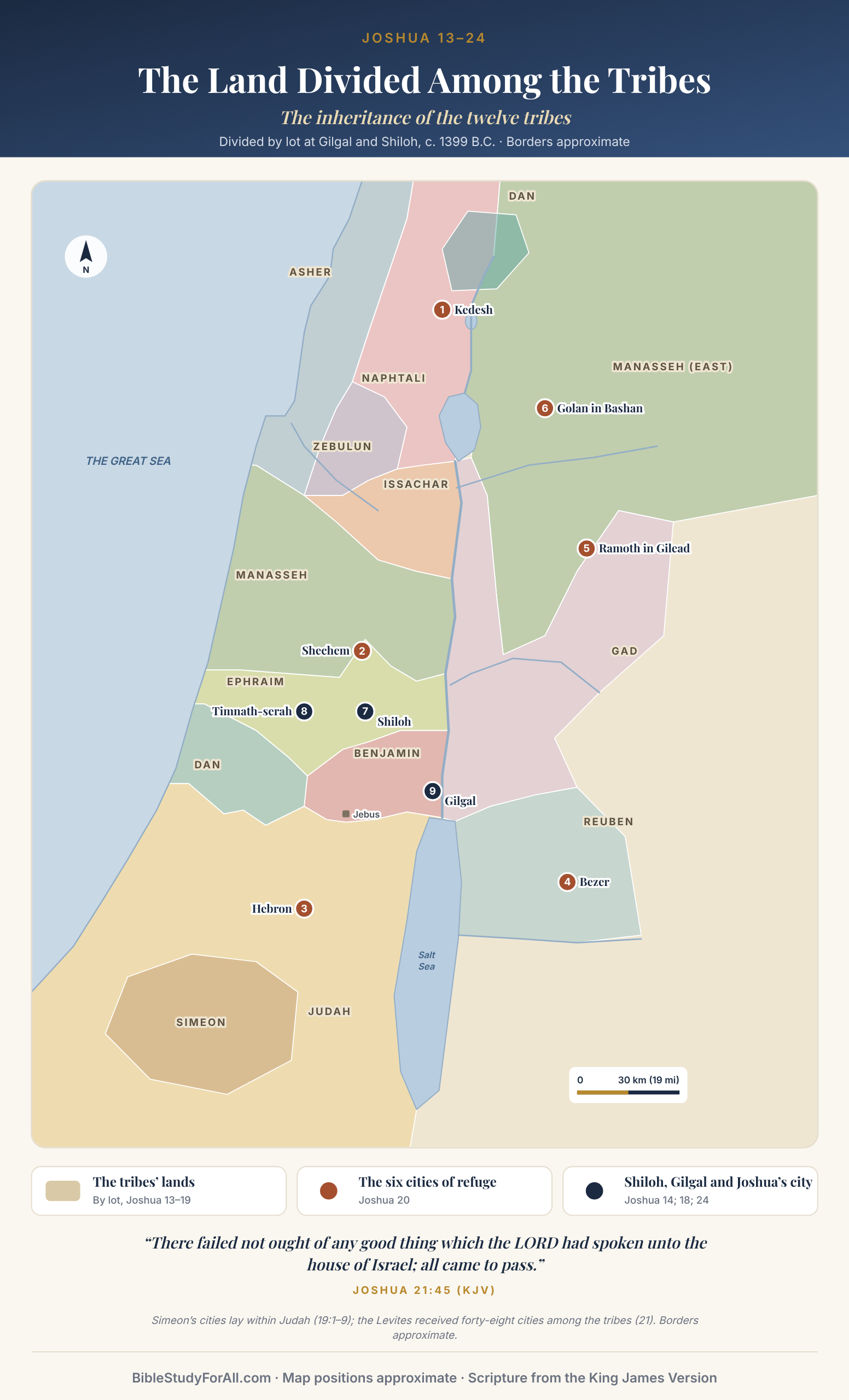
Map of the Tribes and Cities of Refuge
Each tribe’s land, as given by lot at Gilgal and Shiloh, with the six cities of refuge, three on each side of Jordan. The numbers match the cards below.
1 20:7; 21:32
Kedesh
City of refuge. City of refuge in Galilee, in mount Naphtali.
2 20:7; 24:1–28
Shechem
City of refuge. City of refuge in mount Ephraim; Joshua’s last covenant: “choose you this day.”
3 14:13–15; 20:7
Hebron
City of refuge. Kirjath-arba in the mountain of Judah: Caleb’s inheritance and a city of refuge.
4 20:8
Bezer
City of refuge. City of refuge in the wilderness upon the plain, of Reuben.
5 20:8
Ramoth in Gilead
City of refuge. City of refuge of the tribe of Gad.
6 20:8
Golan in Bashan
City of refuge. City of refuge of the half tribe of Manasseh.
7 18:1–10; 22:12
Shiloh
Camp and tabernacle. The tabernacle set up; the land surveyed and divided by lot before the LORD.
8 19:49–50; 24:29–30
Timnath-serah
Camp and tabernacle. Joshua’s own inheritance in mount Ephraim, where he was buried.
9 14:6; 15:7
Gilgal
Camp and tabernacle. The first camp, where Judah and Joseph received their lots.
Joshua 20–21
Cities of Refuge and the Levites
Six cities, three on each side of the Jordan, where one who killed a man unawares could flee from the avenger of blood (20:3).
WEST OF THE JORDAN
Kedesh in Galilee, in mount Naphtali
20:7
EAST OF THE JORDAN
Bezer in the wilderness, of Reuben
20:8
WEST OF THE JORDAN
Shechem in mount Ephraim
20:7
EAST OF THE JORDAN
Ramoth in Gilead, of Gad
20:8
WEST OF THE JORDAN
Kirjath-arba (Hebron) in the mountain of Judah
20:7
EAST OF THE JORDAN
Golan in Bashan, of Manasseh
20:8
The Levites received forty-eight cities with their suburbs among all the tribes (21:41), so that God’s teachers lived throughout the land.
“There failed not ought of any good thing which the LORD had spoken unto the house of Israel; all came to pass.”Joshua 21:45 (KJV)
Joshua 22–24
Choose You This Day
Joshua’s last words call Israel to love the LORD, keep His law, and serve Him alone.
1 22
The Altar of Witness
Ed: “a witness between us that the LORD is God” (22:34).
2 23
Farewell to the Leaders
“One man of you shall chase a thousand: for the LORD your God, He it is that fighteth for you” (23:10).
3 24:1–28
The Covenant at Shechem
History retold; the people choose; a great stone set up as a witness.
Joshua 24:15
As for Me and My House
“And if it seem evil unto you to serve the LORD, choose you this day whom ye will serve; … but as for me and my house, we will serve the LORD.”
Three burials end the book: Joshua at Timnath-serah, Joseph’s bones at Shechem (Genesis 50:25), and Eleazar the priest (24:29–33).
Looking Forward
Pictures of Christ in Joshua
Joshua bears the same name as Jesus, and the book points ahead to the greater salvation He brings.
1:1–9 · HEBREWS 4:8–9
Joshua, “The LORD Is Salvation”
Joshua led Israel into rest in the land; Jesus gives the rest that remains for the people of God.
5:13–15
The Captain of the LORD’s Host
The LORD Himself appears with a drawn sword and receives Joshua’s worship.
2:18 · HEBREWS 11:31
The Scarlet Line
Rahab’s house saved under a scarlet sign, as Israel was under the blood at Passover.
20 · HEBREWS 6:18
The Cities of Refuge
“we … who have fled for refuge to lay hold upon the hope set before us.”
Book Outline
Joshua Outline
Twenty-four chapters in four parts: entering the land (1:1–5:12), taking the land (5:13–12:24), dividing the land among the tribes (13–21), and Israel united to serve the LORD (22–24). For a map of the tribal lands, see 12 Tribes of Israel. Tap a part below to jump to it, tap any section to expand it, and tap a verse reference to read it in the King James Version at BibleGateway.
Part I
The Promised Land Entered
1:1–5:12 · Joshua’s commission, Rahab and the spies, crossing the Jordan, and circumcision and Passover at Gilgal
Part II
The Promised Land Taken
5:13–12:24 · Jericho, Achan and Ai, the covenant at Mount Ebal, Gibeon, the southern and northern campaigns, and the defeated kings
Part III
The Promised Land Divided
13:1–21:45 · Land still to be taken, the tribal inheritances, Shiloh, the cities of refuge and the Levites’ cities
- The tabernacle set up at Shiloh: “How long are ye slack to go to possess the land?” · 18:1–10
- Benjamin · 18:11–28
- Simeon, within Judah’s inheritance · 19:1–9
- Zebulun and Issachar · 19:10–23
- Asher and Naphtali · 19:24–39
- Dan, who also take Leshem in the north · 19:40–48
- Joshua receives Timnath-serah; “So they made an end of dividing the country” · 19:49–51
- Six cities where one who killed “unawares and unwittingly” may flee “from the avenger of blood” · 20:1–9
Part IV
Israel United to Serve the LORD
22:1–24:33 · The eastern tribes and the altar of witness, Joshua’s farewell, and the covenant at Shechem
- Joshua blesses them: “love the LORD your God … and to serve Him with all your heart” · 22:1–9
- An altar by the Jordan nearly brings war; it is called Ed, “a witness between us that the LORD is God” · 22:10–34
- “Cleave unto the LORD your God”; “not one thing hath failed of all the good things which the LORD your God spake” · 23:1–16
- Joshua dies at an hundred and ten; Joseph’s bones are buried at Shechem; Eleazar dies · 24:29–33
Continue Your Study
Scripture quotations and verse links are from the King James Version (KJV).