
Matthew · Mark · Luke · John · Acts · Bible Study
The 12 Apostles
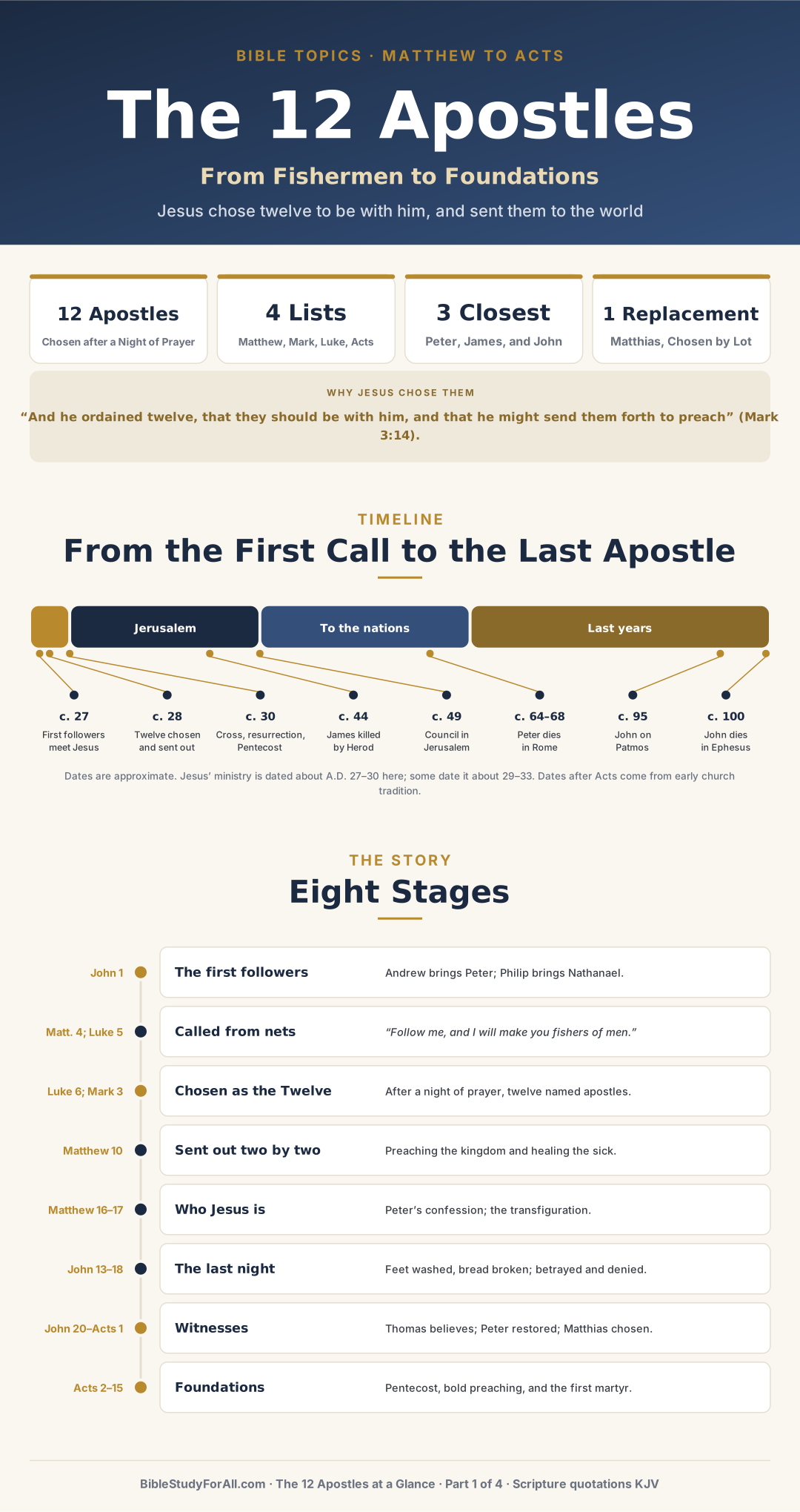
Jesus chose twelve men to follow him and become the first teachers of the Gospel message. Fishermen, a tax collector, a zealot, a doubter, and a traitor, they walked with Jesus for about three years, saw him risen from the dead, and carried his message to the world. Follow their story from the first call to the foundations of the church, and meet each one.
“And he ordained twelve, that they should be with him, and that he might send them forth to preach.”
Mark 3:14
12 Apostles
Chosen after a night of prayer
4 Lists
Matthew, Mark, Luke, and Acts
3 Closest
Peter, James, and John
1 Replacement
Matthias, chosen by lot
At a Glance
From Fishermen to Foundations
The story moves in eight stages: the first followers meet Jesus, he calls them from their work, chooses twelve, sends them out, teaches them who he is, spends a last night with them, meets them risen from the dead, and builds his church on their witness. Select a stage to jump straight to it.
Stage 1 · c. A.D. 27
Disciples of John the Baptist meet Jesus and bring their brothers and friends.
Stage 2 · c. A.D. 27–28
Fishermen leave their boats and a tax collector leaves his booth.
Stage 5 · c. A.D. 29
Peter’s confession, the transfiguration, and hard lessons about greatness.
Stage 6 · Passover, c. A.D. 30
Feet washed, bread broken, a betrayal, a denial, and a scattering.
Stage 7 · c. A.D. 30
Doubt turned to faith, Peter restored, and Matthias chosen.
Stage 8 · c. A.D. 30–50 and beyond
Pentecost, bold preaching, the first martyr of the Twelve, and twelve foundations.
The whole story in four parts. Save or print them to keep beside your Bible.
Before You Begin
Three Habits for This Study
You don’t need any background to follow along. These habits will help you get the most from each stage.
Watch the names
Several apostles have two or three names (Simon, Peter, Cephas; Matthew, Levi; Thaddaeus, Judas of James), and two pairs share a name: two Simons, two Jameses, and two Judases. The cards below sort them out.
Read the Gospels side by side
Matthew, Mark, and Luke often tell the same event. Compare the call of the fishermen in Matthew 4:18–22 and Luke 5:1–11 (KJV), and notice what each adds.
Look for yourself in the story
The apostles doubted, argued, boasted, and ran away, and Jesus kept teaching them. As you read, ask what Jesus is teaching you through the same moments.
Stage 1 of 8 · John 1:35–51
The First Followers
When: c. A.D. 27
“And he brought him to Jesus. And when Jesus beheld him, he said, Thou art Simon the son of Jona: thou shalt be called Cephas, which is by interpretation, A stone.”John 1:42 (KJV) · Read John 1:35–51
What happens
Near the Jordan, John the Baptist points at Jesus and says, “Behold the Lamb of God!” Two of John’s disciples hear him and follow Jesus. One is Andrew, and the first thing he does is find his brother Simon: “We have found the Messias” (John 1:41). Jesus looks at Simon and gives him a new name, Cephas, which means “a stone.”
The next day Jesus finds Philip of Bethsaida and says, “Follow me.” Philip finds Nathanael, who doubts that “any good thing” could “come out of Nazareth.” Philip’s answer is simple: “Come and see” (John 1:46). When Jesus tells Nathanael he saw him under the fig tree, Nathanael answers, “Rabbi, thou art the Son of God; thou art the King of Israel” (John 1:49). These men go with Jesus to a wedding in Cana, where “his disciples believed on him” (John 2:11).
Look closer
Long before Jesus chose the Twelve, the first followers came one by one, and each one brought another. Andrew brought Peter. Philip brought Nathanael. The pattern of the whole book of Acts is already here: people who have met Jesus tell others, “Come and see.”
Matthew, Mark, and Luke start later, with the call beside the sea. John fills in this earlier meeting, which explains why the fishermen were ready to leave their nets.
Think about it
Andrew’s first act as a follower of Jesus was to bring his brother. Who is one person you could invite to “come and see”?
Stage 2 of 8 · Matthew 4:18–22; 9:9–13; Luke 5:1–11
Called from Nets and Tables
When: c. A.D. 27–28
“And he saith unto them, Follow me, and I will make you fishers of men.”Matthew 4:19 (KJV) · Read Luke 5:1–11
What happens
Walking by the Sea of Galilee, Jesus sees Simon and Andrew casting a net, and James and John mending nets with their father Zebedee. “Follow me,” he says, “and I will make you fishers of men.” They leave their nets, their boat, and their father, and go (Matthew 4:18–22). Luke adds a night of empty nets and then a catch so great the boats begin to sink. Peter falls at Jesus’ knees: “Depart from me; for I am a sinful man, O Lord.” Jesus answers, “Fear not; from henceforth thou shalt catch men” (Luke 5:8–10).
Then Jesus calls a man no rabbi would choose. Matthew, also called Levi, sits at the tax booth in Capernaum collecting money for Rome. “Follow me. And he arose, and followed him” (Matthew 9:9). Matthew throws a feast for his tax-collector friends, and when the Pharisees object, Jesus says, “I am not come to call the righteous, but sinners to repentance” (Matthew 9:13).
Look closer
The first apostles were working men from Galilee, not priests or scholars. Later the council in Jerusalem would marvel that Peter and John were “unlearned and ignorant men,” and take note “that they had been with Jesus” (Acts 4:13).
Jesus’ call was costly. Peter later said, “Behold, we have forsaken all, and followed thee” (Matthew 19:27). Jesus promised that no one who left home and family for his sake would lose out, now or in the age to come (Mark 10:29–30).
Think about it
The fishermen left their nets and Matthew left his money. What would it mean for you to answer Jesus’ “Follow me” today?
Stage 3 of 8 · Mark 3:13–19; Luke 6:12–16
Chosen as the Twelve
When: c. A.D. 28
“And when it was day, he called unto him his disciples: and of them he chose twelve, whom also he named apostles.”Luke 6:13 (KJV) · Read Luke 6:12–16
What happens
By now many people follow Jesus. Before choosing his closest helpers he goes up a mountain “and continued all night in prayer to God” (Luke 6:12). In the morning he calls his disciples and chooses twelve of them, “whom also he named apostles.” The word means ‘ones who are sent.’
Mark gives two reasons for the choice: “that they should be with him, and that he might send them forth to preach” (Mark 3:14). First they would live with Jesus, hear his teaching, and watch his miracles. Then they would be sent out in his name. Right after choosing them, Jesus comes down and teaches the crowds what life in God’s kingdom looks like (Luke 6:17–49; compare Matthew 5–7).
Look closer
Why twelve? Israel had twelve tribes. By choosing twelve, Jesus was showing that he was gathering and renewing God’s people. He later told them, “ye also shall sit upon twelve thrones, judging the twelve tribes of Israel” (Matthew 19:28).
The Twelve were an unlikely mix: four fishermen, a tax collector who had worked for Rome, a zealot who may have wanted Rome driven out, a doubter, and a betrayer. Jesus chose them all on purpose, after prayer.
Think about it
Jesus’ first calling for the Twelve was simply “that they should be with him.” How much time do you spend just being with Jesus?
Stage 4 of 8 · Matthew 10; Mark 6:7–13; Luke 9:1–10
Sent Out Two by Two
When: c. A.D. 28–29
“And as ye go, preach, saying, The kingdom of heaven is at hand. Heal the sick, cleanse the lepers, raise the dead, cast out devils: freely ye have received, freely give.”Matthew 10:7–8 (KJV) · Read Matthew 10:1–16
What happens
Jesus gives the Twelve “power against unclean spirits, to cast them out, and to heal all manner of sickness” (Matthew 10:1) and sends them out in pairs (Mark 6:7). This first mission is to the towns of Israel, “the lost sheep of the house of Israel” (Matthew 10:6). They are to travel light, with no money or spare coat, and to trust God to provide through the people who welcome them.
Jesus is honest about the danger: “Behold, I send you forth as sheep in the midst of wolves” (Matthew 10:16). They will be arrested and hated, but they are not to fear, because the Father knows even the sparrows. The apostles go out and preach “that men should repent,” cast out devils, and heal the sick (Mark 6:12–13). When they return, they tell Jesus everything, and he takes them away to rest (Mark 6:30–31).
Look closer
Later Jesus sent out seventy others in the same way (Luke 10:1), so the work was never meant for the Twelve alone. When the seventy came back thrilled that “even the devils are subject unto us,” Jesus told them to rejoice instead “because your names are written in heaven” (Luke 10:17–20).
This mission was a practice run. After the resurrection the circle would widen from Israel to “all nations” (Matthew 28:19).
Think about it
Jesus sent the apostles out in pairs, never alone. Who walks with you in serving God, and whom could you encourage this week?
Stage 5 of 8 · Matthew 14–17; Mark 8–10
Learning Who Jesus Is
When: c. A.D. 29
“He saith unto them, But whom say ye that I am? And Simon Peter answered and said, Thou art the Christ, the Son of the living God.”Matthew 16:15–16 (KJV) · Read Matthew 16:13–28
What happens
The apostles watch Jesus calm a storm (“What manner of man is this, that even the wind and the sea obey him?” Mark 4:41), feed five thousand, and walk on the water. Near Caesarea Philippi he asks them directly, “But whom say ye that I am?” Peter answers for them all: “Thou art the Christ, the Son of the living God” (Matthew 16:16). When many other followers leave, Peter again speaks for the Twelve: “Lord, to whom shall we go? thou hast the words of eternal life” (John 6:68).
Then Jesus begins to tell them he must suffer, be killed, and rise again. Peter rebukes him and is rebuked in turn (Matthew 16:21–23). Six days later Peter, James, and John see Jesus transfigured, his face shining “as the sun” (Matthew 17:2). Yet on the road the apostles argue about which of them is the greatest. Jesus answers, “If any man desire to be first, the same shall be last of all, and servant of all” (Mark 9:35).
Look closer
The apostles were slow learners, and the Gospels do not hide it. James and John asked for the best seats in the kingdom (Mark 10:37), and the others were angry because they wanted them too. Jesus pointed to himself: “even the Son of man came not to be ministered unto, but to minister, and to give his life a ransom for many” (Mark 10:45).
Peter could make the greatest confession and the biggest mistake in the same chapter. Jesus kept teaching him anyway.
Think about it
Jesus asked, “But whom say ye that I am?” How would you answer him in your own words today?
Stage 6 of 8 · Matthew 26; John 13–18
The Last Night
When: Passover, c. A.D. 30
“By this shall all men know that ye are my disciples, if ye have love one to another.”John 13:35 (KJV) · Read John 13:1–17
What happens
On the night before he dies, Jesus eats the Passover with the Twelve in an upper room. He takes a towel and washes their feet, the job of a servant: “If I then, your Lord and Master, have washed your feet; ye also ought to wash one another’s feet” (John 13:14). He breaks bread and says, “This is my body which is given for you: this do in remembrance of me” (Luke 22:19). He gives them a new commandment, to love one another as he has loved them, and promises the Holy Spirit, who “shall teach you all things” (John 14:26).
He also tells them, “one of you shall betray me” (John 13:21). Judas takes the bread and “went immediately out: and it was night” (John 13:30). In Gethsemane, Judas arrives with a crowd and kisses Jesus. Peter draws a sword, then flees with the rest: “they all forsook him, and fled” (Mark 14:50). In the high priest’s courtyard Peter denies Jesus three times, and “the Lord turned, and looked upon Peter” (Luke 22:61).
Look closer
Every one of the Eleven had promised, “Though I should die with thee, yet will I not deny thee” (Matthew 26:35). Every one of them ran. The difference between Peter and Judas was not the size of their failure but what came next. Peter “wept bitterly” and came back; Judas was filled with remorse, but he despaired and took his life (Matthew 27:3–5).
Jesus knew Peter would fall, and had already prayed for him: “when thou art converted, strengthen thy brethren” (Luke 22:32).
Think about it
Jesus washed the feet of the man who would deny him and the man who would betray him. Whom might God be asking you to serve, even if they have hurt you?
Stage 7 of 8 · John 20–21; Acts 1
Witnesses of the Risen Lord
When: c. A.D. 30
“But ye shall receive power, after that the Holy Ghost is come upon you: and ye shall be witnesses unto me both in Jerusalem, and in all Judæa, and in Samaria, and unto the uttermost part of the earth.”Acts 1:8 (KJV) · Read John 20:19–29
What happens
On the first Easter evening the disciples hide behind locked doors. Jesus stands among them: “Peace be unto you: as my Father hath sent me, even so send I you” (John 20:21). Thomas is missing and will not believe until he sees the nail prints. A week later Jesus invites him to touch, and Thomas answers, “My Lord and my God” (John 20:28). By the Sea of Galilee Jesus asks Peter three times, “lovest thou me?” and three times gives him a charge: “Feed my sheep” (John 21:15–17).
For forty days the risen Jesus shows himself to them “by many infallible proofs” (Acts 1:3). He sends them to “teach all nations” (Matthew 28:19) and then is taken up into heaven before their eyes. Back in Jerusalem the Eleven pray with the women and Jesus’ family, and they choose Matthias by lot to take Judas’ place, a man who had been with them from the beginning and could be “a witness with us of his resurrection” (Acts 1:22).
Look closer
An apostle in this first sense had to be an eyewitness of the risen Jesus. Paul lists the appearances: “he was seen of Cephas, then of the twelve” (1 Corinthians 15:5). Paul himself was called later by the risen Lord, “as of one born out of due time” (1 Corinthians 15:8).
Each restored apostle had a different failure behind him: Thomas his doubt, Peter his denial, all of them their flight. The risen Jesus met each one where he was.
Think about it
Jesus asked Peter, “lovest thou me?” before he gave him work to do. What would your honest answer to that question be?
Stage 8 of 8 · Acts 2–15; Ephesians 2:20; Revelation 21:14
Foundations of the Church
When: c. A.D. 30–50 and beyond
“And are built upon the foundation of the apostles and prophets, Jesus Christ himself being the chief corner stone.”Ephesians 2:20 (KJV) · Read Acts 2:1–42
What happens
At Pentecost the Holy Spirit fills the believers, and Peter, “standing up with the eleven,” preaches to the crowds in Jerusalem (Acts 2:14). About three thousand believe, and the new church continues “stedfastly in the apostles’ doctrine and fellowship, and in breaking of bread, and in prayers” (Acts 2:42). When the council orders Peter and John to stop preaching, they reply, “We ought to obey God rather than men” (Acts 5:29), and they leave the council rejoicing “that they were counted worthy to suffer shame for his name” (Acts 5:41).
As the church grows, the Twelve appoint seven helpers so they can give themselves “to prayer, and to the ministry of the word” (Acts 6:4). Peter preaches to the Gentile Cornelius (Acts 10). About A.D. 44 Herod Agrippa I kills “James the brother of John with the sword” (Acts 12:2), the first of the Twelve to die for Christ. The apostles and elders meet in Jerusalem to welcome Gentile believers (Acts 15). After that the Bible says little more about most of the Twelve.
Look closer
The apostles’ teaching became the New Testament’s foundation. Matthew and John are credited with Gospels, Peter with two letters, and John with three letters and Revelation. Mark’s Gospel is linked by early writers to Peter’s preaching.
John’s vision of the New Jerusalem shows a wall with “twelve foundations, and in them the names of the twelve apostles of the Lamb” (Revelation 21:14), next to gates named for the twelve tribes of Israel.
Think about it
The church still stands on what the apostles saw and taught. How are you building your life on that foundation?
Who’s Who
Meet the Twelve
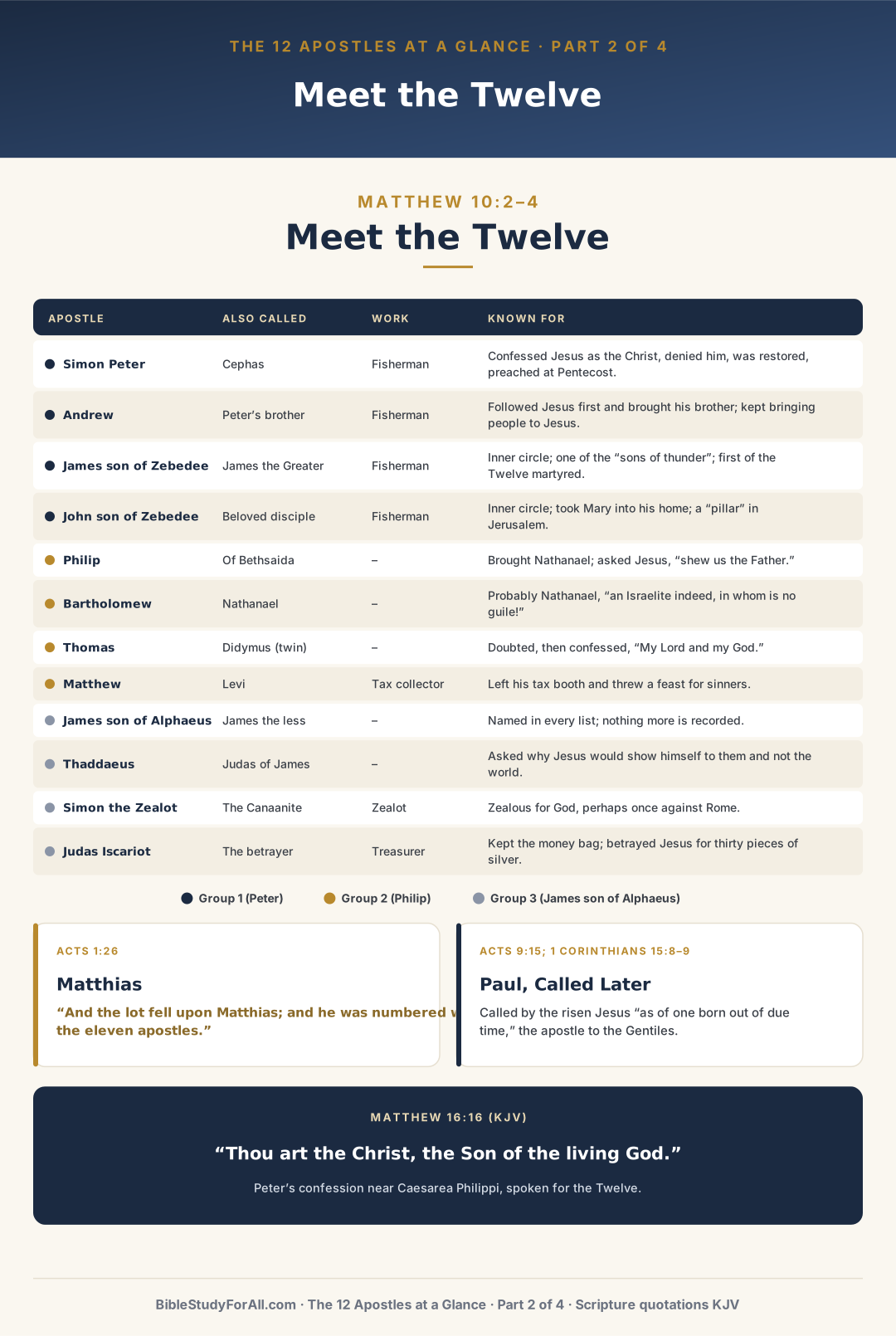
Here are the apostles in the order Matthew lists them, two by two (Matthew 10:2–4). Each card gives their other names, where they came from, a verse by or about them, what the Bible tells us, and what early church tradition says about their later life. Tradition is not Scripture, and accounts of their travels and deaths come from later writers and vary in how reliable they are.
Apostle 1 · Matthew 10 order
Simon Peter
Also called: Simon son of Jona; Cephas; Peter (‘a stone’)
From: Bethsaida, later Capernaum · Before: Fisherman, married
“Thou art the Christ, the Son of the living God.” (Matthew 16:16)
Brought to Jesus by his brother Andrew, who renamed him Cephas, “a stone” (John 1:42). Always named first in the lists. He walked on the water and began to sink (Matthew 14:28–31), confessed Jesus as the Christ, and denied him three times the night of his arrest. The risen Jesus restored him by the Sea of Galilee: “Feed my sheep” (John 21:17). He preached at Pentecost, opened the door to the Gentiles at Cornelius’ house (Acts 10), and wrote 1 and 2 Peter.
Tradition: Early writers say he was crucified in Rome under Nero, about A.D. 64–68; John 21:18–19 hints at how he would die.
Read: John 1:40–42 · Matthew 16:13–19 · John 21:15–19 · Acts 2:14–41
Apostle 2 · Matthew 10 order
Andrew
Also called: Peter’s brother
From: Bethsaida, later Capernaum · Before: Fisherman; first a disciple of John the Baptist
“We have found the Messias, which is, being interpreted, the Christ.” (John 1:41)
One of the first two disciples to follow Jesus, after John the Baptist said, “Behold the Lamb of God!” (John 1:36). His first act was to bring his brother. Andrew keeps bringing people to Jesus: the boy with five barley loaves and two small fishes (John 6:8–9), and the Greeks who said, “Sir, we would see Jesus” (John 12:20–22). He was with Peter, James, and John on the Mount of Olives (Mark 13:3).
Tradition: Tradition places his preaching around the Black Sea and Greece and his death at Patras in Greece; the X-shaped cross comes from later legend.
Read: John 1:35–42 · John 6:5–13 · John 12:20–22
Apostle 3 · Matthew 10 order
James son of Zebedee
Also called: James the Greater; with John, “Boanerges, … The sons of thunder”
From: Galilee (probably Capernaum or Bethsaida) · Before: Fisherman with his father Zebedee, partner of Simon
“And he killed James the brother of John with the sword.” (Acts 12:2)
Called from mending nets in his father’s boat (Matthew 4:21–22). With Peter and John he saw Jairus’ daughter raised, the transfiguration, and Jesus’ agony in Gethsemane. He and John wanted to call down fire on a Samaritan village (Luke 9:54) and asked for the seats at Jesus’ right and left (Mark 10:35–37). Jesus told them they would drink his cup (Mark 10:39). James was the first of the Twelve to die for Christ, killed by Herod Agrippa I about A.D. 44.
Tradition: The Bible records his death (Acts 12:2). A much later tradition links him with Spain and his burial with Santiago de Compostela.
Read: Mark 1:19–20 · Mark 10:35–45 · Acts 12:1–2
Apostle 4 · Matthew 10 order
John son of Zebedee
Also called: James’s brother; one of the “sons of thunder”
From: Galilee · Before: Fisherman with his father Zebedee
“That which we have seen and heard declare we unto you, that ye also may have fellowship with us.” (1 John 1:3)
In the inner circle with Peter and James. The Gospel of John speaks of “the disciple whom Jesus loved,” who leaned on Jesus at supper, stood at the cross, and was given Mary to care for (John 19:26–27); the church has long identified him as John. He and Peter ran to the empty tomb, and later stood before the council: “we cannot but speak the things which we have seen and heard” (Acts 4:20). Paul called him one of the “pillars” of the Jerusalem church (Galatians 2:9).
Tradition: Early writers say he lived to old age in Ephesus after exile on Patmos (Revelation 1:9), the only one of the Twelve said to die naturally. Tradition names him as author of the Gospel, three letters, and Revelation.
Read: John 13:23–26 · John 19:25–27 · Acts 4:13–20
Apostle 5 · Matthew 10 order
Philip
Also called: Not the same as Philip the evangelist of Acts 8
From: Bethsaida · Before: Not stated
“Lord, shew us the Father, and it sufficeth us.” (John 14:8)
Jesus found Philip and said, “Follow me” (John 1:43). Philip at once found Nathanael: “We have found him, of whom Moses in the law, and the prophets, did write” (John 1:45). Jesus tested him before feeding the five thousand (John 6:5–7), Greeks came to him to ask for Jesus (John 12:21), and at the Last Supper his request drew Jesus’ answer, “he that hath seen me hath seen the Father” (John 14:9).
Tradition: Tradition says he ministered and died at Hierapolis in Asia Minor (modern Turkey).
Read: John 1:43–46 · John 6:5–7 · John 14:8–11
Apostle 6 · Matthew 10 order
Bartholomew
Also called: Probably Nathanael
From: Cana in Galilee (if Nathanael) · Before: Not stated
“Rabbi, thou art the Son of God; thou art the King of Israel.” (John 1:49)
Matthew, Mark, and Luke always pair Bartholomew with Philip; John never uses the name but tells how Philip brought Nathanael. So many identify the two. Nathanael doubted at first, “Can there any good thing come out of Nazareth?” but Jesus called him “an Israelite indeed, in whom is no guile!” (John 1:46–47). He was fishing with Peter when the risen Jesus appeared at the sea (John 21:2). The quote above is Nathanael’s.
Tradition: Traditions differ: India (Eusebius) or Armenia, where a later account says he was martyred.
Read: John 1:45–51 · John 21:1–2
Apostle 7 · Matthew 10 order
Thomas
Also called: Didymus (‘the twin’)
From: Galilee · Before: Not stated
“My Lord and my God.” (John 20:28)
Thomas is remembered for his doubt, but he was also brave: when Jesus went back toward Jerusalem he said, “Let us also go, that we may die with him” (John 11:16). His honest question, “how can we know the way?” brought the answer “I am the way, the truth, and the life” (John 14:5–6). He would not believe the others until he saw the nail prints, and when Jesus appeared he made one of the clearest confessions in the Gospels (John 20:24–29).
Tradition: Tradition says he took the gospel east to Parthia and India, where the Mar Thoma Christians of south India trace their church to him.
Read: John 11:16 · John 14:5–6 · John 20:24–29
Apostle 8 · Matthew 10 order
Matthew
Also called: Levi son of Alphaeus
From: Capernaum · Before: Tax collector (“publican”)
“Follow me. And he arose, and followed him.” (Matthew 9:9)
Jesus called Matthew from his tax booth, and Matthew left it all (Luke 5:28). Tax collectors worked for Rome and were despised as traitors and cheats, so when Matthew threw a great feast for his friends, the Pharisees complained. Jesus answered, “I am not come to call the righteous, but sinners to repentance” (Matthew 9:13). His own Gospel’s list calls him “Matthew the publican” (Matthew 10:3).
Tradition: The early church named him as author of the Gospel of Matthew. Traditions about his later work (Ethiopia, Persia) vary.
Read: Matthew 9:9–13 · Luke 5:27–32
Apostle 9 · Matthew 10 order
James son of Alphaeus
Also called: Often identified with “James the less”
From: Not stated · Before: Not stated
“Mary the mother of James the less and of Joses” (Mark 15:40)
Named ninth in every list, but no words or deeds of his are recorded. Many identify him with “James the less” (or ‘the younger’), whose mother Mary stood near the cross (Mark 15:40). He is a different man from James son of Zebedee, and most Protestant readers also see him as different from James the Lord’s brother, who led the Jerusalem church and wrote the letter of James (Galatians 1:19). Matthew is also called a son of Alphaeus, but the Bible never calls the two brothers.
Tradition: Little is known. Some traditions place him in Syria or Egypt.
Read: Mark 3:18 · Mark 15:40
Apostle 10 · Matthew 10 order
Thaddaeus
Also called: Judas ‘of James’ (Luke 6:16; Acts 1:13); Lebbaeus
From: Not stated · Before: Not stated
“Lord, how is it that thou wilt manifest thyself unto us, and not unto the world?” (John 14:22)
Matthew and Mark call him Thaddaeus; Luke and Acts call him Judas ‘of James,’ which the KJV gives as “the brother of James” and many versions as ‘the son of James.’ John carefully marks him off from the betrayer: “Judas saith unto him, not Iscariot” (John 14:22). His one recorded question, at the Last Supper, asked why Jesus would show himself to the disciples and not to the world.
Tradition: Tradition links him with Edessa and with Simon the Zealot in Persia. Most think the letter of Jude was written by Jude the Lord’s brother rather than by this apostle (compare Jude 17).
Read: John 14:21–24 · Luke 6:16
Apostle 11 · Matthew 10 order
Simon the Zealot
Also called: Simon the Canaanite (KJV); Simon Zelotes
From: Not stated · Before: Probably a Jewish nationalist
“Simon called Zelotes” (Luke 6:15)
Luke calls him “Zelotes,” the zealous one. Matthew and Mark’s “Canaanite” comes from the Aramaic word for zealous, not from the land of Canaan. The name may mean he had belonged to the Jewish movement that wanted to drive out Rome, or simply that he was zealous for God’s law. Either way, Jesus put a man like Simon in the same band as Matthew, who had worked for Rome.
Tradition: Traditions differ: Persia with Thaddaeus, or Egypt and North Africa.
Read: Luke 6:15 · Matthew 10:4
Apostle 12 · Matthew 10 order
Judas Iscariot
Also called: Son of Simon Iscariot (John 6:71)
From: Possibly Kerioth in Judea (“Iscariot” may mean ‘man of Kerioth’) · Before: Kept the group’s money bag
“What will ye give me, and I will deliver him unto you?” (Matthew 26:15)
Always named last, and “which also was the traitor” (Luke 6:16). He carried the money bag and stole from it (John 12:6). He agreed to hand Jesus over for thirty pieces of silver, left the Last Supper into the night, and led the arresting crowd to Gethsemane, where he greeted Jesus with a kiss (Matthew 26:47–49). Afterward he returned the money, saying “I have sinned in that I have betrayed the innocent blood,” and hanged himself (Matthew 27:3–5).
Tradition: The Bible records his death (Matthew 27:5; Acts 1:18). He died before Jesus’ resurrection, the first of the Twelve to die.
Read: Matthew 26:14–16 · Matthew 26:47–50 · Matthew 27:3–10 · Acts 1:16–20
Acts 1:26 · Chosen to replace Judas
Matthias
Also called: Chosen to replace Judas
From: Not stated · Before: A follower of Jesus since John’s baptism
“And the lot fell upon Matthias; and he was numbered with the eleven apostles.” (Acts 1:26)
Between the ascension and Pentecost, Peter said Judas’ place must be filled by a man who had been with them “Beginning from the baptism of John” and could be “a witness with us of his resurrection” (Acts 1:22). Two were put forward, Joseph called Barsabas and Matthias. The believers prayed and cast lots, and the lot fell on Matthias.
Tradition: Traditions differ: Judea, or Cappadocia and the Caspian region.
Read: Acts 1:15–26
Called later
Paul and Other Apostles
The word apostle is also used more widely. The risen Jesus called Paul on the road to Damascus to carry his name “before the Gentiles” (Acts 9:15), and Paul called himself “the least of the apostles” (1 Corinthians 15:9). Barnabas is called an apostle with Paul (Acts 14:14), and Paul names James the Lord’s brother among the apostles he met in Jerusalem (Galatians 1:19).
But the Twelve were a unique group: chosen by Jesus during his ministry, eyewitnesses from the beginning, and named on the twelve foundations of the holy city (Revelation 21:14).
Read: Acts 9:1–19 · 1 Corinthians 15:3–10
Matthew 10 · Mark 3 · Luke 6 · Acts 1
The Four Lists of the Twelve
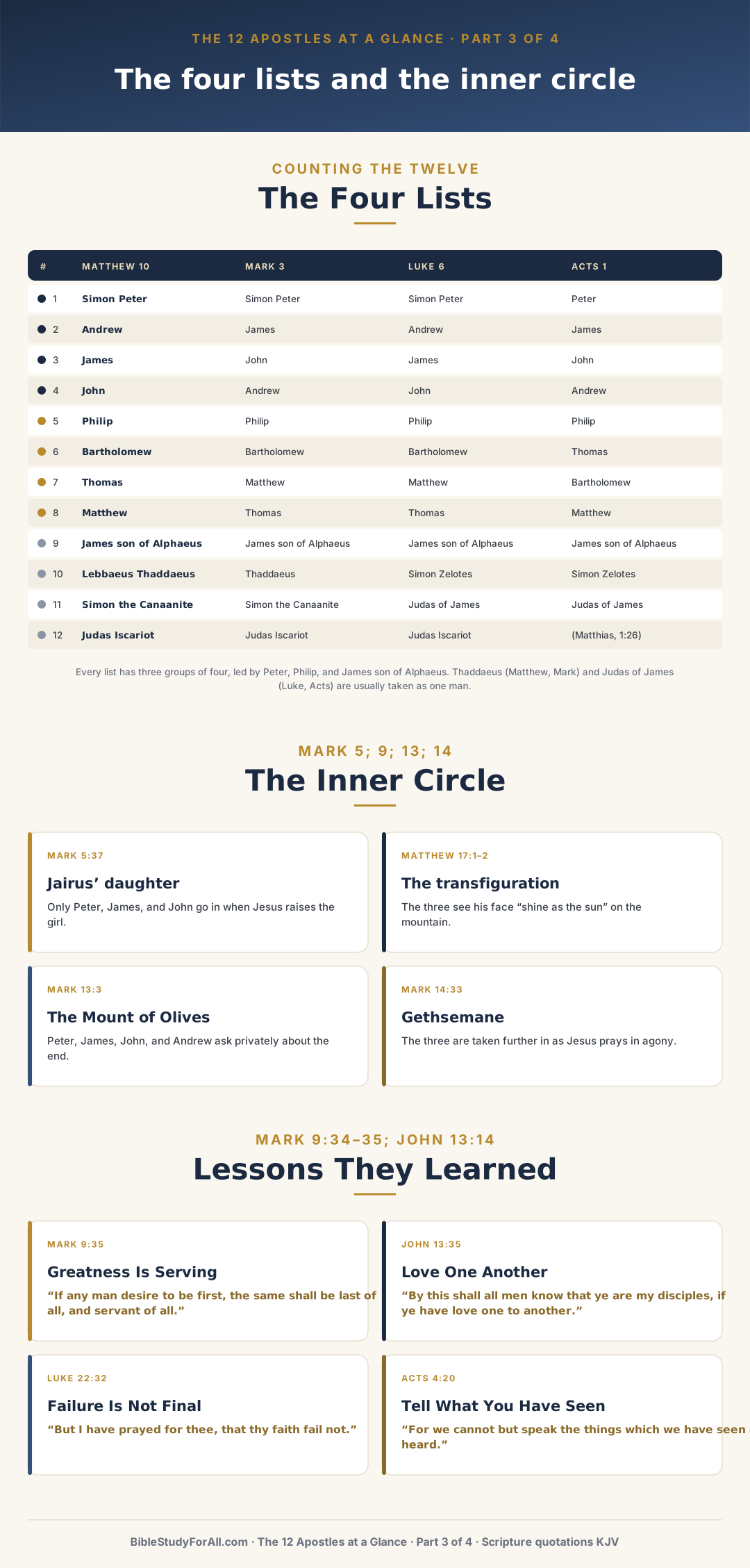
The New Testament names the Twelve four times. The names fall into the same three groups of four every time, and each group always begins with the same man: Peter, Philip, and James son of Alphaeus. The main difference is a name: Matthew and Mark’s Thaddaeus is Luke’s “Judas the brother of James.”
Group 1 · led by Peter
Peter, Andrew, James, John
The four fishermen, the first called. Peter, James, and John formed Jesus’ inner circle, with Andrew sometimes joining them.
Group 2 · led by Philip
Philip, Bartholomew, Thomas, Matthew
The order changes inside the group, but these four always stand in places five to eight.
Group 3 · led by James son of Alphaeus
James, Thaddaeus, Simon, Judas
The least known group. Judas Iscariot is always named last, with a note that he betrayed Jesus.
| # | Matthew 10:2–4 | Mark 3:16–19 | Luke 6:14–16 | Acts 1:13 |
|---|---|---|---|---|
| 1 | Simon Peter | Simon Peter | Simon Peter | Peter |
| 2 | Andrew | James | Andrew | James |
| 3 | James | John | James | John |
| 4 | John | Andrew | John | Andrew |
| 5 | Philip | Philip | Philip | Philip |
| 6 | Bartholomew | Bartholomew | Bartholomew | Thomas |
| 7 | Thomas | Matthew | Matthew | Bartholomew |
| 8 | Matthew | Thomas | Thomas | Matthew |
| 9 | James son of Alphaeus | James son of Alphaeus | James son of Alphaeus | James son of Alphaeus |
| 10 | Lebbaeus Thaddaeus | Thaddaeus | Simon Zelotes | Simon Zelotes |
| 11 | Simon the Canaanite | Simon the Canaanite | Judas of James | Judas of James |
| 12 | Judas Iscariot | Judas Iscariot | Judas Iscariot | (Judas gone; Matthias added in 1:26) |
The Inner Circle
Four times Jesus took only a few of the Twelve with him. Peter, James, and John were there every time.
Matthew 17:1–2
The transfiguration
The three see his face “shine as the sun” on the mountain.
After the Book of Acts
Where Did the Apostles Go?
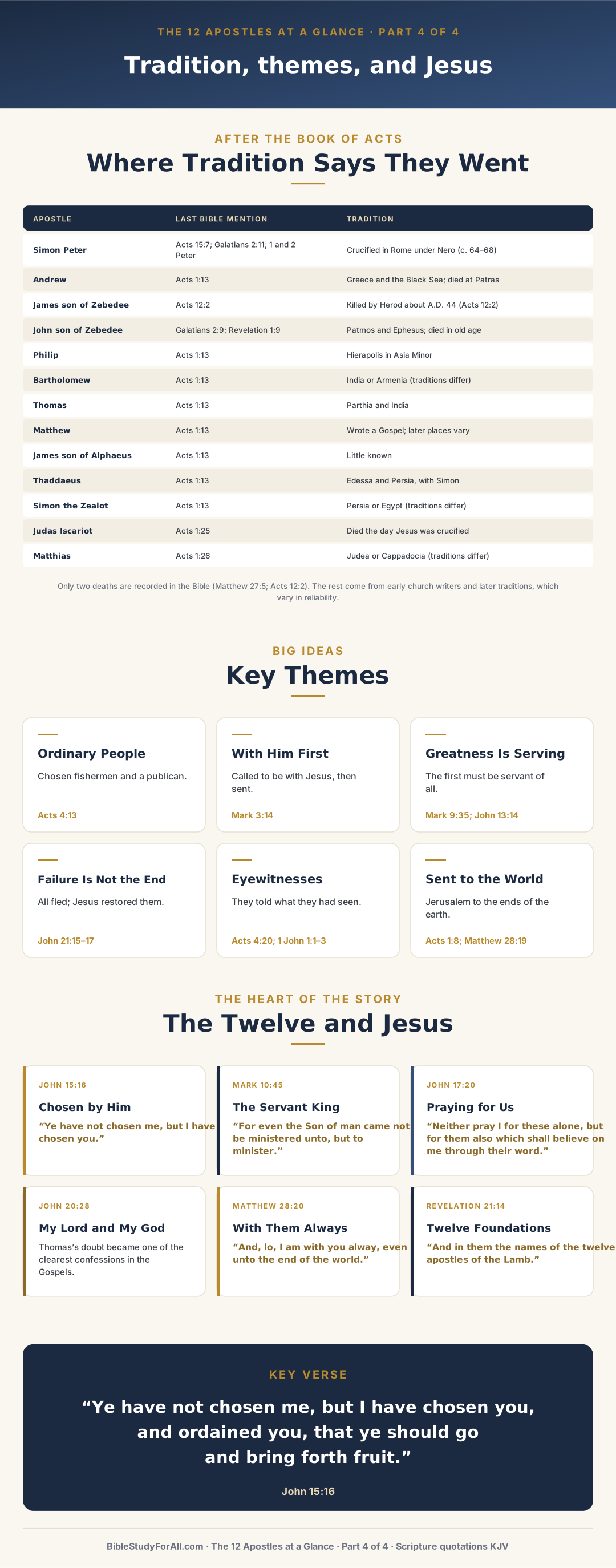
The Bible records the deaths of only two of the Twelve: Judas (Matthew 27:5) and James son of Zebedee (Acts 12:2). For the rest we rely on early church writers such as Clement of Rome, Eusebius, and later traditions. Some of these accounts are early and widely accepted, like Peter’s death in Rome; others are late legends. Read them as history to weigh, not as Scripture.
| Apostle | Last mention in the Bible | What tradition says |
|---|---|---|
| Simon Peter | Acts 15:7; Galatians 2:11; 1 and 2 Peter | Crucified in Rome under Nero (c. 64–68) |
| Andrew | Acts 1:13 | Greece and the Black Sea; died at Patras |
| James son of Zebedee | Acts 12:2 | Killed by Herod about A.D. 44 (Acts 12:2) |
| John son of Zebedee | Galatians 2:9; Revelation 1:9 | Patmos and Ephesus; died in old age |
| Philip | Acts 1:13 | Hierapolis in Asia Minor |
| Bartholomew | Acts 1:13 | India or Armenia (traditions differ) |
| Thomas | Acts 1:13 | Parthia and India |
| Matthew | Acts 1:13 | Wrote a Gospel; later places vary |
| James son of Alphaeus | Acts 1:13 | Little known |
| Thaddaeus | Acts 1:13 | Edessa and Persia, with Simon |
| Simon the Zealot | Acts 1:13 | Persia or Egypt (traditions differ) |
| Judas Iscariot | Acts 1:25 | Died the day Jesus was crucified |
| Matthias | Acts 1:26 | Judea or Cappadocia (traditions differ) |
Big Ideas
Six Themes of the Apostles
Jesus chooses ordinary people
Fishermen and a tax collector, “unlearned and ignorant men,” were known for having “been with Jesus” (Acts 4:13).
Following comes first
The Twelve were chosen first “that they should be with him,” and only then sent out (Mark 3:14).
Greatness means serving
Jesus washed their feet and taught that the first must be “servant of all” (Mark 9:35; John 13:14).
Failure is not the end
All of them fled; Peter denied him three times. The risen Jesus restored them (John 21:15–17).
Witnesses to the resurrection
Their message rested on what they had seen and heard (Acts 4:20; 1 John 1:1–3).
Sent to the whole world
From Jerusalem to “the uttermost part of the earth” (Acts 1:8; Matthew 28:19).
The Heart of the Story
The Twelve and Jesus
The story of the apostles is really the story of their Teacher. Jesus chose them, taught them, prayed for them, forgave them, and sent them out. Their message was never about themselves: “we cannot but speak the things which we have seen and heard” (Acts 4:20).
John 15:15–16
Chosen as friends
“Ye have not chosen me, but I have chosen you, and ordained you, that ye should go and bring forth fruit”
Mark 10:45
The Servant King
“For even the Son of man came not to be ministered unto, but to minister, and to give his life a ransom for many.”
Luke 22:31–32
He prays for them
“But I have prayed for thee, that thy faith fail not: and when thou art converted, strengthen thy brethren.”
John 17:20–21
He prays for us
“Neither pray I for these alone, but for them also which shall believe on me through their word”
Matthew 28:19–20
He sends them out
“Go ye therefore, and teach all nations … and, lo, I am with you alway, even unto the end of the world.”
Revelation 21:14
Apostles of the Lamb
“And the wall of the city had twelve foundations, and in them the names of the twelve apostles of the Lamb.”
Verses to Remember
Key Verses about the Apostles
Along with the verses in each stage above, these are worth reading slowly, and memorizing.
Mark 1:17
“And Jesus said unto them, Come ye after me, and I will make you to become fishers of men.”
Luke 9:23
“If any man will come after me, let him deny himself, and take up his cross daily, and follow me.”
John 6:68
“Then Simon Peter answered him, Lord, to whom shall we go? thou hast the words of eternal life.”
John 13:34
“A new commandment I give unto you, That ye love one another; as I have loved you, that ye also love one another.”
John 20:29
“Thomas, because thou hast seen me, thou hast believed: blessed are they that have not seen, and yet have believed.”
Acts 2:42
“And they continued stedfastly in the apostles’ doctrine and fellowship, and in breaking of bread, and in prayers.”
Acts 4:13
“Now when they saw the boldness of Peter and John, and perceived that they were unlearned and ignorant men, they marvelled; and they took knowledge of them, that they had been with Jesus.”
Acts 5:29
“Then Peter and the other apostles answered and said, We ought to obey God rather than men.”
Summary
Five Things to Remember
1
Twelve, for a reason
Jesus chose twelve after a night of prayer, like the twelve tribes of a renewed Israel (Luke 6:12–13; Matthew 19:28).
2
With him, then sent
An apostle is ‘one who is sent,’ but first they were called to be with Jesus (Mark 3:14).
3
An unlikely team
Fishermen, a tax collector, a zealot, a doubter, and a betrayer were all chosen on purpose (Matthew 10:2–4).
4
Restored, not replaced
All of them failed on the last night, and Jesus restored them; Matthias took only Judas’ place (John 21; Acts 1:26).
5
Eyewitnesses who changed the world
Their testimony to the risen Jesus is the foundation of the church (Acts 1:8; Ephesians 2:20).
Questions
Common Questions about the Apostles
What is the difference between a disciple and an apostle?
A disciple is a learner or follower; Jesus had many disciples, men and women, including the seventy he sent out (Luke 10:1) and the women who traveled with him and supported him (Luke 8:1–3). An apostle is ‘one who is sent.’ Jesus chose twelve of his disciples, “whom also he named apostles” (Luke 6:13), to be with him and to be sent out with his authority. So every apostle was a disciple, but not every disciple was one of the Twelve.
Why did Jesus choose exactly twelve?
The number matches the twelve tribes of Israel. Jesus told the Twelve they would “sit upon twelve thrones, judging the twelve tribes of Israel” (Matthew 19:28; Luke 22:30). By choosing twelve, he was showing that he had come to gather and renew God’s people. That is also why the eleven filled Judas’ place before Pentecost (Acts 1:15–26), and why the New Jerusalem has twelve gates named for the tribes and twelve foundations named for the apostles (Revelation 21:12–14).
Is Bartholomew the same person as Nathanael?
The Bible never says so directly, but many think so. Matthew, Mark, and Luke never mention Nathanael and always pair Bartholomew with Philip. John never mentions Bartholomew but tells how Philip brought Nathanael to Jesus (John 1:45) and lists Nathanael among the disciples at the Sea of Galilee (John 21:2). Bartholomew means ‘son of Tolmai,’ a family name, so he could also have had a personal name such as Nathanael.
Why do the lists name Thaddaeus or Judas?
Matthew and Mark name Thaddaeus (Matthew adds Lebbaeus), while Luke and Acts have Judas ‘of James’ in the same place. Most readers take these as two names for one man; with Judas Iscariot in the group, it would be natural to use another name for him. The KJV says “Judas the brother of James” (Luke 6:16); the Greek simply says ‘Judas of James,’ and many versions read ‘son of James.’
Was James son of Alphaeus the brother of Jesus?
Most Protestant readers say no. Jesus’ brothers James, Joses, Simon, and Judas (Matthew 13:55) did not believe in him during his ministry (John 7:5), so they were not among the Twelve; James the Lord’s brother became a believer after the resurrection (1 Corinthians 15:7) and led the Jerusalem church. Some older traditions, especially those that hold Mary remained a virgin, understand Jesus’ “brethren” as cousins and identify the two Jameses. The Bible itself does not settle the question.
Who was “the disciple whom Jesus loved”?
The Gospel of John never names him. He leaned on Jesus at the Last Supper, stood at the cross, ran to the tomb with Peter, and is said to be the one who “wrote these things” (John 21:20–24). Since early times the church has identified him as the apostle John, son of Zebedee, who is never named in John’s Gospel. Some modern scholars suggest another disciple, but the traditional view remains the most widely held.
Why did Judas betray Jesus?
The Bible gives several pieces of the answer. John says Judas “was a thief, and had the bag” (John 12:6). Matthew shows him asking the priests, “What will ye give me?” (Matthew 26:15). Luke and John say Satan entered into him (Luke 22:3; John 13:27). Some suggest he was also disappointed that Jesus was not the political Messiah he expected, though the Bible does not say this. Matthew and Acts describe his death in different words (Matthew 27:5; Acts 1:18); many readers see the accounts as two sides of the same event.
Are there still apostles today?
Christians answer this in different ways. Many believe the Twelve held a unique office that could not be passed on, since an apostle in this sense had to be an eyewitness of the risen Jesus (Acts 1:21–22) and their teaching became the church’s foundation (Ephesians 2:20). Others believe the wider gift of apostle, one who is sent to plant churches and spread the gospel, continues today (Ephesians 4:11). Both views agree that the Twelve stand alone as the apostles of the Lamb (Revelation 21:14).
Keep Reading
Continue Your Study
Read the key chapters for yourself with the apostle cards beside you. Then dig deeper into each book on its own overview page.
Scripture quotations are from the King James Version (KJV), which is in the public domain. Verse links open at BibleGateway. Dates are approximate; this page follows a ministry of about A.D. 27–30 (some date it about A.D. 29–33). Traditions about the apostles’ later lives come from early church writers, not the Bible.