
Old Testament · History · Book 16 of 66
Book of Nehemiah
A cupbearer in the Persian palace hears that Jerusalem’s walls are broken down. He prays, goes, and leads the people to rebuild in fifty-two days. Then Ezra reads the law, and the people weep and rejoice, “for the joy of the LORD is your strength” (8:10).
Nehemiah at a Glance
Book Outline
Note: Scripture quotations and verse links on this site use the King James Version (KJV) because it is in the public domain, while most modern translations limit how much can be quoted online. Feel free to read along in the translation of your choice.
13 Chapters
406 verses
Author
Nehemiah, governor of Judah
Time Covered
c. 445–432 B.C.
52 Days
To rebuild the wall (6:15)
About the Name
Title
Named for Nehemiah, the cupbearer who became governor of Judah. Its first words are “The words of Nehemiah the son of Hachaliah.”
The book opens, “The words of Nehemiah the son of Hachaliah” (1:1). His name means “the LORD comforts.” He was cupbearer to Artaxerxes king of Persia (1:11), a trusted man who tasted the king’s wine and stood in his presence every day, and the king made him governor of Judah (5:14).
In the Hebrew Bible, Ezra and Nehemiah were counted as one book, and Nehemiah carries on Ezra’s story. After the temple was rebuilt (Ezra 1–6) and the people renewed by the law (Ezra 7–10), the city’s walls were rebuilt so that Jerusalem could stand again as the city of God.
Who Wrote It
Author Details
Written by Nehemiah himself, much of it in the first person, like a personal memoir with short prayers along the way: “Remember me, O my God.”
Nehemiah tells his own story as “I” through most of the book (1–7; 12:31–13:31). It reads like a governor’s journal, broken by quick prayers to God: “So I prayed to the God of heaven” (2:4); “Think upon me, my God, for good” (5:19); “Remember me, O my God, for good” (13:31).
He also includes official lists, such as the builders of the wall (3), the families who came home with Zerubbabel (7:6–73, matching Ezra 2), those who sealed the covenant (10:1–27), and the people of Jerusalem (11–12). Guided by the Holy Spirit, Nehemiah recorded how “this work was wrought of our God” (6:16).
When It Was Written
Date of Writing
Begins in the twentieth year of Artaxerxes, 445 B.C., and ends after Nehemiah’s second visit, about 432 B.C. He wrote soon after, about 430 B.C.
Nehemiah heard the news from Jerusalem in the month Chisleu and stood before the king in Nisan of the twentieth year of Artaxerxes, 445 B.C. (1:1; 2:1). The wall was finished on the twenty-fifth of Elul, after fifty-two days (6:15). He governed Judah for twelve years, to the thirty-second year of Artaxerxes, 433 B.C. (5:14; 13:6), went back to the king, and then returned to Jerusalem to correct new abuses (13:6–31).
Nehemiah wrote his account soon after, about 430 B.C. The prophet Malachi spoke to the same people in these years, and the sins he names (careless priests, withheld tithes, marriages to idolaters) are the very ones Nehemiah fought.
Key Verse
The Joy of the LORD Is Your Strength
“Then he said unto them, Go your way, eat the fat, and drink the sweet, and send portions unto them for whom nothing is prepared: for this day is holy unto our Lord: neither be ye sorry; for the joy of the LORD is your strength.”
Nehemiah 8:10 (KJV)
Big Ideas
Key Themes
Prayer
Pray first, pray often, pray in the moment.
1:4; 2:4; 4:9
Work Together
The people had a mind to work.
3; 4:6
Courage
Remember the Lord, great and terrible.
4:14
Watch and Work
A sword in one hand, a trowel in the other.
4:17–18
Justice
Walk in the fear of God toward the poor.
5:9–11
God’s Word
Read distinctly, understood, obeyed.
8:8
Joy
The joy of the LORD is your strength.
8:10; 12:43
Confession
Thou art just; we have done wickedly.
9:33
Faithfulness
We will not forsake the house of our God.
10:39; 13:11
Overview
Nehemiah Summary
OverviewWalls Rebuilt, People Renewed
Nehemiah tells how the walls of Jerusalem were rebuilt and the people renewed, about ninety years after the first exiles came home. The book has two halves. In chapters 1–7 Nehemiah, a Jew serving as cupbearer to the king of Persia, leads the rebuilding of the wall in fifty-two days in spite of mockery, threats and trouble within. In chapters 8–13 the focus moves from the walls to the people: Ezra reads the law, the people confess their sins and make a covenant, the wall is dedicated with great joy, and Nehemiah deals firmly with the sins that crept back. Throughout, Nehemiah is a man of prayer and of action.
Chapter 1Nehemiah Weeps and Prays
In the palace at Shushan, Nehemiah hears from his brother Hanani that “the wall of Jerusalem also is broken down, and the gates thereof are burned with fire” (1:3). “I sat down and wept, and mourned certain days, and fasted, and prayed before the God of heaven” (1:4). His prayer begins with God’s greatness and faithfulness, “O LORD God of heaven, the great and terrible God, that keepeth covenant and mercy for them that love Him” (1:5), confesses Israel’s sins, recalls God’s promise through Moses to gather His people if they return (1:8–9), and asks for mercy “in the sight of this man. For I was the king’s cupbearer” (1:11).
Chapter 2The King’s Favour and a Night Ride
Four months later the king notices Nehemiah’s sad face and asks, “For what dost thou make request?” Nehemiah says, “So I prayed to the God of heaven” (2:4), and then asks to be sent to rebuild the city. The king grants letters for safe passage and timber from the king’s forest, “according to the good hand of my God upon me” (2:8). In Jerusalem Nehemiah inspects the broken walls by night, then calls the leaders: “come, and let us build up the wall of Jerusalem, that we be no more a reproach.” They answer, “Let us rise up and build” (2:17–18). When Sanballat, Tobiah and Geshem laugh, Nehemiah replies, “The God of heaven, He will prosper us; therefore we His servants will arise and build” (2:20).
Chapters 3–4Every Family Builds
Chapter 3 lists the builders section by section around the city, beginning with the high priest Eliashib at the sheep gate: priests, goldsmiths, perfumers, merchants, rulers, and Shallum “he and his daughters” (3:12), most of them building near their own houses. Sanballat and Tobiah mock: “if a fox go up, he shall even break down their stone wall” (4:3). Nehemiah prays and keeps building: “So built we the wall; and all the wall was joined together unto the half thereof: for the people had a mind to work” (4:6). When enemies plot an attack, “we made our prayer unto our God, and set a watch against them day and night” (4:9). Nehemiah arms the people: “Be not ye afraid of them: remember the Lord, which is great and terrible, and fight for your brethren” (4:14). From then on the builders work “with one of his hands … and with the other hand held a weapon” (4:17).
Chapter 5Trouble from Within
Trouble also comes from within. In a time of famine, the rich are lending at interest and taking the poor’s fields and even their children as pledges. Nehemiah is very angry: “ought ye not to walk in the fear of our God because of the reproach of the heathen our enemies?” (5:9). The nobles promise to give everything back. Nehemiah himself, through twelve years as governor, refuses the governor’s food allowance “because of the fear of God” (5:15), and prays, “Think upon me, my God, for good, according to all that I have done for this people” (5:19).
Chapters 6–7The Wall Finished in Fifty-Two Days
His enemies try four times to lure him to a meeting in the plain of Ono, but he answers, “I am doing a great work, so that I cannot come down: why should the work cease, whilst I leave it, and come down to you?” (6:3). They send an open letter accusing him of planning to be king, and a hired prophet urges him to hide in the temple, but Nehemiah refuses: “Should such a man as I flee?” (6:11), and prays, “Now therefore, O God, strengthen my hands” (6:9). “So the wall was finished in the twenty and fifth day of the month Elul, in fifty and two days” (6:15), and the enemies “perceived that this work was wrought of our God” (6:16). Nehemiah sets gatekeepers and watchmen and finds the register of those who first returned (7:5–73).
Chapter 8Ezra Reads the Law
In the seventh month all the people gather “as one man” at the water gate, and Ezra the scribe reads from the book of the law of Moses from morning until midday, “and the ears of all the people were attentive unto the book of the law” (8:3). The Levites “read in the book in the law of God distinctly, and gave the sense, and caused them to understand the reading” (8:8). The people weep as they hear it, but Nehemiah and Ezra say, “neither be ye sorry; for the joy of the LORD is your strength” (8:10). Finding in the law the command to dwell in booths, they keep the feast of tabernacles as it had not been kept “since the days of Jeshua the son of Nun” (8:17), “and there was very great gladness.”
Chapters 9–10Confession and Covenant
On the twenty-fourth day, the people gather with fasting and sackcloth to confess their sins, and the Levites lead a long prayer reviewing Israel’s history from creation to the exile: “Thou, even Thou, art LORD alone; Thou hast made heaven, the heaven of heavens” (9:6). Again and again Israel rebelled, “but Thou art a God ready to pardon, gracious and merciful, slow to anger, and of great kindness, and forsookest them not” (9:17). The prayer ends with a covenant: “we make a sure covenant, and write it” (9:38). Nehemiah, the priests, Levites and leaders seal it, and the people promise “to walk in God’s law, which was given by Moses” (10:29): not to marry outside the covenant people, to keep the sabbath and the seventh year, and to support the temple, ending, “we will not forsake the house of our God” (10:39).
Chapters 11–13The Wall Dedicated and the Last Reforms
Jerusalem is still thinly peopled, so the leaders live there and one family in ten is chosen by lot to move into the city, and the people bless those who willingly go (11:1–2). The lists of residents, priests and Levites follow (11:3–12:26). Then the wall is dedicated with two great choirs walking on top of it in opposite directions and meeting at the temple: “God had made them rejoice with great joy … so that the joy of Jerusalem was heard even afar off” (12:43). But when Nehemiah returns from a visit to the king, he finds the high priest has given Tobiah a room in the temple, the Levites unpaid, the sabbath broken by trade, and men married to women of Ashdod, Ammon and Moab. He throws out Tobiah’s goods, restores the tithes, shuts the gates on the sabbath, and reminds the people that even Solomon was led into sin this way (13:26). The book ends with his prayer: “Remember me, O my God, for good” (13:31).
At a Glance
Nehemiah at a Glance
The whole book in short sections: its four parts, a timeline, the wall and its gates on a plan of Jerusalem, Nehemiah’s prayers, building with opposition, the law read, the great confession, the covenant, and Christ in Nehemiah. Tap a topic to jump to it.
Printable Copy
Save or Print the Infographic
Everything in this section, with the key verse and key themes, is also on a printable infographic (five pages). It opens in a new tab, where you can save it to your phone or computer, share it, or print it.
Structure
The Book in Four Parts
The first half rebuilds the walls (1–7); the second rebuilds the people around God’s word (8–13).
Each bar shows that part’s share of the 406 verses.
IV 11–13 · 114 verses
Reforms
The city resettled, the wall dedicated, abuses corrected.
Dates B.C.
Nehemiah’s Years
The dates follow the years of Artaxerxes given in the book.
1:1–4
Chisleu 445
News from Jerusalem
2:1–8
Nisan 445
Nehemiah asks the king
2:11–15
445
The walls viewed by night
6:15
Elul 445
The wall finished in 52 days
8:2
Tisri 445
Ezra reads the law
9:1; 10:29
Tisri 445
Confession and covenant
13:6
433
Nehemiah returns to the king
13:7–31
c. 432
Back in Jerusalem: reforms
A Plan of Jerusalem
The Wall and Its Gates
Chapter 3 names the builders gate by gate around the city. The numbers on the plan follow that order and match the cards below.
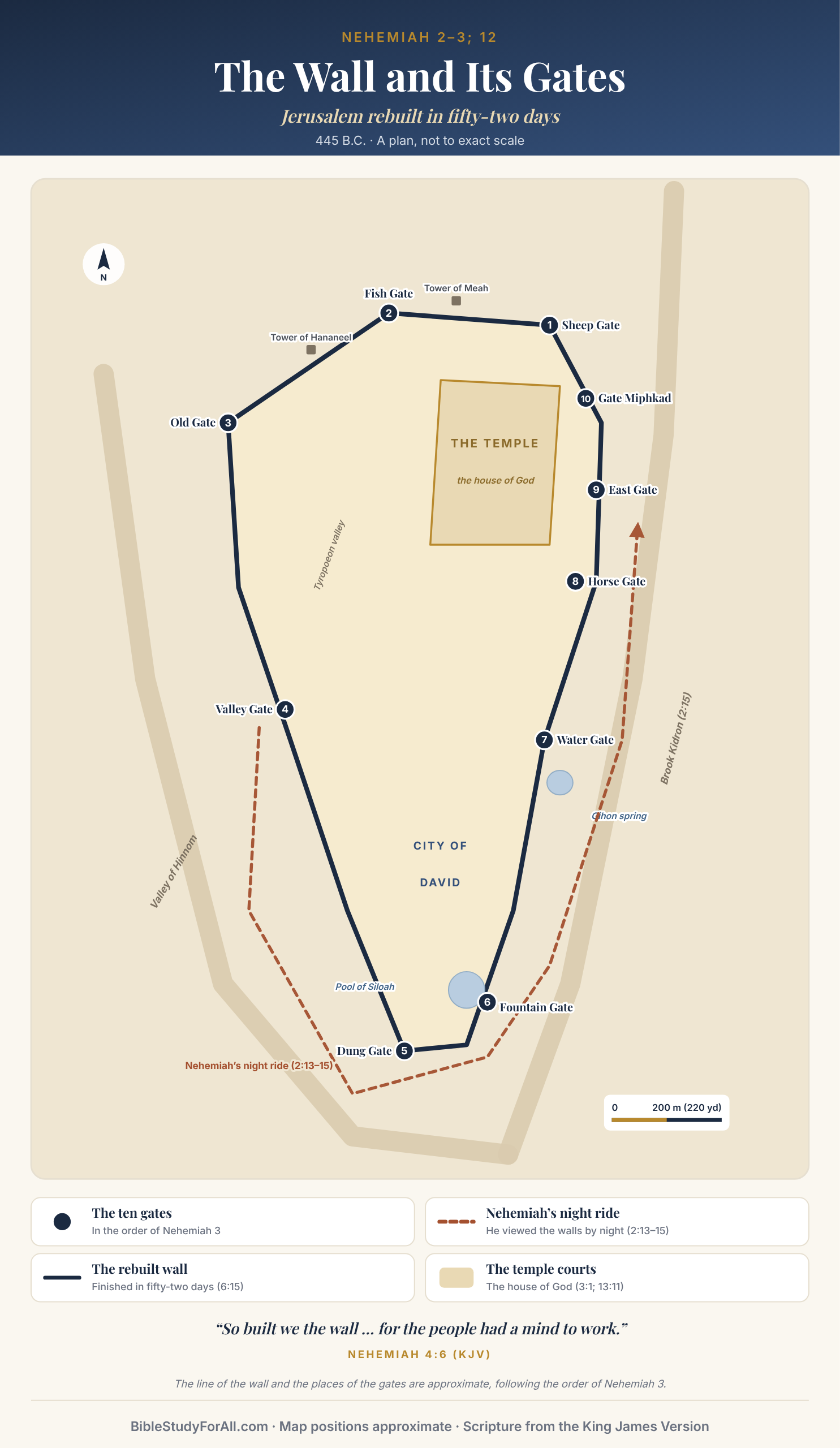
1 3:1, 32
Sheep Gate
Built by Eliashib the high priest and the priests; sanctified first.
2 3:3
Fish Gate
The sons of Hassenaah lay its beams and set up its doors.
3 3:6
Old Gate
Repaired by Jehoiada and Meshullam.
4 2:13, 15; 3:13
Valley Gate
Where Nehemiah went out by night; Hanun and Zanoah repair it.
5 2:13; 3:14
Dung Gate
Repaired by Malchiah; it led down to the valley of Hinnom.
6 2:14; 3:15
Fountain Gate
By the pool of Siloah and the stairs of the city of David.
7 3:26; 8:1–3
Water Gate
Ezra reads the law in the street before it.
8 3:28
Horse Gate
Each priest repairs over against his own house.
9 3:29
East Gate
Shemaiah, the keeper of the east gate, repairs.
10 3:31
Gate Miphkad
Malchiah the goldsmith repairs as far as the corner.
Prayer in Nehemiah
A Man of Prayer
Nehemiah prayed for months, and he also prayed in a single breath before the king.
1:4–11
Fasting and Confession
“We have sinned against Thee … Remember, I beseech Thee, the word that Thou commandedst Thy servant Moses.”
2:4
An Arrow Prayer
“So I prayed to the God of heaven,” and then he answered the king.
4:9
Prayer and a Watch
“We made our prayer unto our God, and set a watch.”
6:9
Strengthen My Hands
“Now therefore, O God, strengthen my hands.”
“O Lord, I beseech Thee, let now Thine ear be attentive to the prayer of Thy servant.”Nehemiah 1:11 (KJV)
Nehemiah 3–6
Building with Opposition
Sanballat, Tobiah and Geshem tried mockery, threats, plots and lies. The people kept building.
THE ENEMY
Mockery: “What do these feeble Jews?”
4:2–3
THE ANSWER
“Hear, O our God; for we are despised”
4:4
THE ENEMY
Threat of attack
4:8, 11
THE ANSWER
A sword in one hand and a trowel in the other
4:17–18
THE ENEMY
Debt and oppression among the Jews
5:1–5
THE ANSWER
“Ought ye not to walk in the fear of our God?”
5:9
THE ENEMY
Invitations to the plain of Ono
6:2
THE ANSWER
“I am doing a great work, so that I cannot come down”
6:3
THE ENEMY
A false prophet: hide in the temple
6:10
THE ANSWER
“Should such a man as I flee?”
6:11
“Be not ye afraid of them: remember the Lord, which is great and terrible, and fight for your brethren.”Nehemiah 4:14 (KJV)
Nehemiah 8
The Law Read at the Water Gate
The wall finished, the people gathered “as one man” to hear the word of God.
1 8:3
Morning to Midday
All the people were attentive to the book of the law.
2 8:5–6
They Stood
They lifted up their hands: “Amen, Amen.”
3 8:8
The Sense
They read distinctly, “and gave the sense.”
4 8:9
They Wept
The people wept when they heard the words of the law.
5 8:10
Rejoice
“The joy of the LORD is your strength.”
6 8:14–17
Booths
The feast of tabernacles kept with very great gladness.
Nehemiah 9–10
Confession and Covenant
The Levites led a prayer that recounts the whole story of Israel, from creation to the people’s own day.
Nehemiah 9:6
Thou Art LORD Alone
“Thou, even Thou, art LORD alone; Thou hast made heaven, the heaven of heavens, with all their host, the earth, and all things that are therein … and the host of heaven worshippeth Thee.”
9:17
A God Ready to Pardon
“Gracious and merciful”
9:33
Thou Art Just
“We have done wickedly”
10:29
The Covenant
To walk in God’s law
10:39
God’s House
“We will not forsake the house of our God”
Looking Forward
Christ in Nehemiah
Nehemiah’s work points to the One who builds a city that can never fall.
2:5 · JOHN 6:38
Sent to Rebuild
Nehemiah left the palace to restore Jerusalem; Christ came down from heaven to do His Father’s will.
DANIEL 9:25
The Command to Build
Daniel’s weeks are counted “from the going forth of the commandment to restore and to build Jerusalem unto the Messiah the Prince.”
8:8 · LUKE 24:27
The Sense of Scripture
Ezra gave the sense; Jesus expounded “in all the scriptures the things concerning Himself.”
HEBREWS 11:10
A City with Foundations
Abraham “looked for a city which hath foundations, whose builder and maker is God.”
Book Outline
Nehemiah Outline
Thirteen chapters in four parts: Nehemiah’s arrival (1–2), the building of the wall (3–7), renewal under the law (8–10), and the city and the reforms (11–13). Tap a part below to jump to it, tap any section to expand it, and tap a verse reference to read it in the King James Version at BibleGateway.
Part I
The Arrival of Nehemiah
1:1–2:20 · Bad news from Jerusalem, Nehemiah’s prayer, the king’s favour, and the walls inspected by night
Part II
The Building of the Wall
3:1–7:73 · Every family builds; mockery, threats and debts are overcome; the wall finished in 52 days
Part III
Renewal under the Law
8:1–10:39 · Ezra reads the law, the feast of booths, the great prayer of confession, and the covenant sealed
Part IV
The City and the Reforms
11:1–13:31 · Jerusalem resettled, the wall dedicated with joy, and Nehemiah’s final reforms
Continue Your Study
Scripture quotations and verse links are from the King James Version (KJV).