
Old Testament · History · Book 17 of 66
Book of Esther
A Jewish orphan becomes queen of Persia just before a decree to destroy her people. God’s name is never mentioned, yet His hand is everywhere: “who knoweth whether thou art come to the kingdom for such a time as this?” (4:14).
Esther at a Glance
Book Outline
Note: Scripture quotations and verse links on this site use the King James Version (KJV) because it is in the public domain, while most modern translations limit how much can be quoted online. Feel free to read along in the translation of your choice.
10 Chapters
167 verses
Author
Mordecai the Jew
Time Covered
c. 483–473 B.C.
Feast of Purim
The 14th and 15th of Adar
About the Name
Title
Named for Esther, the Jewish queen of Persia. Her Hebrew name was Hadassah, “myrtle”; Esther is Persian and means “star.”
The book is named after its heroine, “Hadassah, that is, Esther” (2:7), an orphan raised by her cousin Mordecai. Hadassah is Hebrew for “myrtle”; Esther is Persian and means “star.” With Ruth, it is one of two books of the Bible named for a woman.
In the Hebrew Bible, Esther is one of the five short scrolls (the Megilloth), and it is read aloud every year at the feast of Purim, which the book explains. It is the only book of the Bible in which the name of God does not appear, yet every turn of the story shows His care for His people.
Who Wrote It
Author Details
Written by Mordecai, who “wrote these things” and sent letters to all the Jews (9:20). He knew the Persian court and the events from the inside.
The book says that “Mordecai wrote these things, and sent letters unto all the Jews that were in all the provinces of the king Ahasuerus” (9:20), and that the decree of Esther “confirmed these matters of Purim; and it was written in the book” (9:32). Mordecai sat in the king’s gate, became second to the king (10:3), and knew the court, its customs and its records better than anyone.
The writer also drew on “the book of the chronicles of the kings of Media and Persia” (10:2; 2:23; 6:1). Guided by the Holy Spirit, he told how God delivered His people in the land of their captivity, so that every generation would remember it at Purim (9:28).
When It Was Written
Date of Writing
The events run from the third year of Ahasuerus (Xerxes), 483 B.C., to his twelfth year, 473 B.C. Mordecai wrote soon after, about 470 B.C.
Ahasuerus is the king the Greeks called Xerxes, who reigned 486–465 B.C. His great feast was in his third year, 483 B.C. (1:3); Esther became queen in his seventh year, 479 B.C. (2:16); Haman cast lots in the twelfth year, 474 B.C. (3:7), and the Jews were delivered on the thirteenth of Adar, 473 B.C. (9:1).
The story fits between Ezra 6 and Ezra 7, after the temple was rebuilt and before Ezra came to Jerusalem. Mordecai wrote soon after the events, about 470 B.C., while Ahasuerus still reigned.
Key Verse
For Such a Time as This
“For if thou altogether holdest thy peace at this time, then shall there enlargement and deliverance arise to the Jews from another place; but thou and thy father’s house shall be destroyed: and who knoweth whether thou art come to the kingdom for such a time as this?”
Esther 4:14 (KJV)
Big Ideas
Key Themes
God’s Providence
He works even when unseen.
4:14; 6:1
Courage
If I perish, I perish.
4:16
Fasting
Seeking God together in danger.
4:3, 16
Pride Goes Before a Fall
Haman’s gallows became his own.
5:11–14; 7:10
Faithfulness Rewarded
Mordecai honoured by the king.
6:10–11; 10:3
God Keeps His People
Deliverance from another place.
4:14; 9:1
Sorrow to Joy
Mourning turned into a good day.
9:22
Remember
Purim kept in every generation.
9:28
Seeking the Good of Others
Mordecai sought the wealth of his people.
10:3
Overview
Esther Summary
OverviewGod’s Hidden Hand
Esther tells how God saved His people from destruction in the Persian empire, through a young Jewish queen and her cousin Mordecai, without His name ever being mentioned. It is a story of reversals: the proud are brought low and the lowly raised up, a decree of death is turned into a day of joy, and the gallows Haman built for Mordecai becomes his own. The book explains the origin of the Jewish feast of Purim, and it shows that God was watching over His people even among those who did not go back to Jerusalem. Its events fall about thirty years before Nehemiah, in the gap between the sixth and seventh chapters of Ezra.
Chapter 1The King’s Feast and Vashti’s Refusal
King Ahasuerus (Xerxes), who “reigned, from India even unto Ethiopia, over an hundred and seven and twenty provinces” (1:1), holds a feast of 180 days for his nobles and then a seven-day banquet in Shushan the palace. On the last day, merry with wine, he commands Queen Vashti to come and show her beauty to the people and princes. “But the queen Vashti refused to come at the king’s commandment” (1:12). On the advice of his wise men, the king removes her as queen and sends letters to every province that “every man should bear rule in his own house” (1:22).
Chapter 2Esther Made Queen
Later a search is made for beautiful young women from every province to be brought to the palace. Among them is Esther, an orphan raised by her cousin Mordecai: “he brought up Hadassah, that is, Esther, his uncle’s daughter” (2:7). On Mordecai’s instruction, “Esther had not shewed her people nor her kindred” (2:10). After a year of preparation she is brought to the king in his seventh year, “and the king loved Esther above all the women … so that he set the royal crown upon her head, and made her queen instead of Vashti” (2:17). Soon after, Mordecai, sitting in the king’s gate, learns of a plot by two chamberlains to kill the king and tells Esther, who tells the king in Mordecai’s name. The plotters are hanged, and the deed is written “in the book of the chronicles before the king” (2:23), but Mordecai is not rewarded.
Chapter 3Haman’s Decree
The king promotes Haman the Agagite and commands all to bow to him. “But Mordecai bowed not, nor did him reverence” (3:2), because he was a Jew. Haman, full of wrath, decides to destroy not only Mordecai but “all the Jews that were throughout the whole kingdom of Ahasuerus” (3:6). He casts Pur, “that is, the lot” (3:7), to choose the day, and it falls on the thirteenth of Adar, eleven months away. He tells the king, “There is a certain people scattered abroad and dispersed among the people in all the provinces of thy kingdom; and their laws are diverse from all people” (3:8), and offers ten thousand talents of silver. The king gives Haman his ring, and letters go out “to destroy, to kill, and to cause to perish, all Jews, both young and old” (3:13). “And the king and Haman sat down to drink; but the city Shushan was perplexed” (3:15).
Chapter 4For Such a Time as This
Mordecai tears his clothes and puts on sackcloth, and in every province there is “great mourning among the Jews, and fasting, and weeping, and wailing” (4:3). He sends word to Esther to plead with the king. Esther answers that anyone who goes to the king uninvited is put to death unless he holds out his golden sceptre, and she has not been called for thirty days. Mordecai replies: “For if thou altogether holdest thy peace at this time, then shall there enlargement and deliverance arise to the Jews from another place; but thou and thy father’s house shall be destroyed: and who knoweth whether thou art come to the kingdom for such a time as this?” (4:14). Esther asks all the Jews in Shushan to fast for her three days, “and so will I go in unto the king, which is not according to the law: and if I perish, I perish” (4:16).
Chapter 5Esther Goes in unto the King
On the third day Esther stands in the inner court, and the king holds out the golden sceptre: “What wilt thou, queen Esther? and what is thy request? it shall be even given thee to the half of the kingdom” (5:3). She invites the king and Haman to a banquet, and there invites them to a second banquet the next day. Haman goes home proud and glad, boasting of his riches and honour, but “Yet all this availeth me nothing, so long as I see Mordecai the Jew sitting at the king’s gate” (5:13). His wife Zeresh and his friends advise him to build a gallows fifty cubits high and ask the king in the morning to hang Mordecai on it.
Chapter 6A Sleepless Night
“On that night could not the king sleep” (6:1). He has the chronicles read to him and hears how Mordecai saved his life, and learns that nothing was done for him. Just then Haman arrives to ask for Mordecai’s death. The king asks, “What shall be done unto the man whom the king delighteth to honour?” (6:6). Thinking the king means himself, Haman describes royal robes, a royal horse and a public proclamation, and is ordered to do it all for Mordecai. His wife and wise men now say, “If Mordecai be of the seed of the Jews, before whom thou hast begun to fall, thou shalt not prevail against him, but shalt surely fall before him” (6:13).
Chapter 7Haman Hanged on His Own Gallows
At the second banquet Esther finally makes her request: “let my life be given me at my petition, and my people at my request: For we are sold, I and my people, to be destroyed” (7:3–4). When the king asks who has done this, she answers, “The adversary and enemy is this wicked Haman” (7:6). The king goes out in anger; when he returns he finds Haman fallen on the queen’s couch, pleading for his life. A chamberlain mentions the gallows Haman has built for Mordecai, and the king says, “Hang him thereon.” “So they hanged Haman on the gallows that he had prepared for Mordecai” (7:10).
Chapters 8–10Deliverance and Purim
The king gives Haman’s house to Esther and his ring to Mordecai. But a law of the Medes and Persians cannot be reversed (8:8), so Esther pleads again: “how can I endure to see the evil that shall come unto my people?” (8:6). A second decree allows the Jews to gather and defend themselves on the thirteenth of Adar, and “The Jews had light, and gladness, and joy, and honour” (8:16). On the appointed day, “though it was turned to the contrary” (9:1), the Jews overcome those who attacked them, but “on the spoil laid they not their hand” (9:10, 15–16). Mordecai and Esther write that the fourteenth and fifteenth of Adar are to be kept every year as “the month which was turned unto them from sorrow to joy, and from mourning into a good day,” with feasting, sending portions to one another, “and gifts to the poor” (9:22). “Wherefore they called these days Purim after the name of Pur” (9:26). The book closes with Mordecai “next unto king Ahasuerus … seeking the wealth of his people, and speaking peace to all his seed” (10:3).
At a Glance
Esther at a Glance
The whole book in short sections: its four parts, a timeline, the empire on the map, the people of the story, Esther’s courage, the great reversals, the feast of Purim, God’s hidden hand, and Christ in Esther. Tap a topic to jump to it.
Printable Copy
Save or Print the Infographic
Everything in this section, with the key verse and key themes, is also on a printable infographic (five pages). It opens in a new tab, where you can save it to your phone or computer, share it, or print it.
Structure
The Book in Four Parts
Each part turns on a feast or a banquet: the king’s feast (1–2), Esther’s first banquet (3–5), her second banquet (6–7), and the feast of Purim (8–10).
Each bar shows that part’s share of the 167 verses.
I 1–2 · 45 verses
Queen Esther
The king’s feasts, Vashti, Esther chosen, a plot uncovered.
II 3–5 · 46 verses
The Plot
Haman’s decree, “for such a time as this,” the first banquet.
III 6–7 · 24 verses
Haman Falls
A sleepless king, Mordecai honoured, Haman hanged.
Dates B.C.
The Years of Ahasuerus
The book dates its events by the reign of Ahasuerus (Xerxes).
1:3
483
The great feast; Vashti refuses
2:16–17
479
Esther made queen
2:21–23
c. 478
Mordecai uncovers a plot
3:7
474
Haman casts Pur, the lot
3:12–13
474
Haman’s decree sent out
8:9–14
474
The king’s second decree
9:1–16
473
The thirteenth of Adar
9:17–28
473
The first Purim
Map
From India unto Ethiopia
King Ahasuerus ruled 127 provinces. Gold markers belong to the Persian court, navy to the Jews’ homeland and exile, and rust to the ends of the empire. The numbers match the cards below.
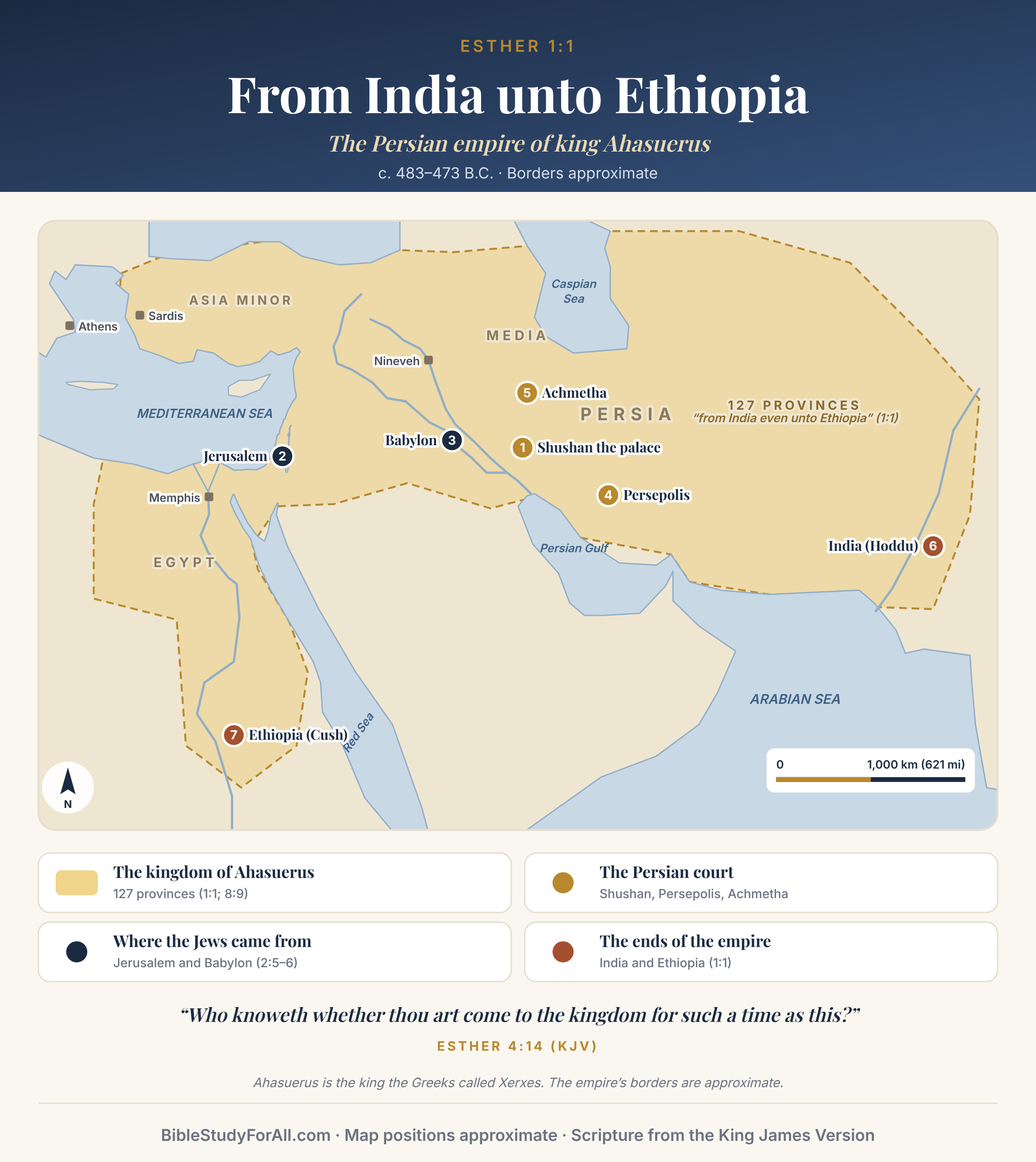
1 1:2; 2:8; 3:15
Shushan the palace
The Persian court. Winter capital of Ahasuerus, where the whole story takes place.
2 2:5–6
Jerusalem
The Jews. Mordecai’s family was carried away from here with Jeconiah king of Judah.
3 2:6
Babylon
The Jews. Where Nebuchadnezzar took the captives; many Jews still lived in its provinces.
4 1:3
Persepolis
The Persian court. A royal city of the kings “of Persia and Media.”
5 1:14, 19
Achmetha
The Persian court. Summer capital in Media; the laws of “the Persians and the Medes.”
6 1:1; 8:9
India (Hoddu)
The ends of the empire. The eastern edge of the 127 provinces.
7 1:1; 8:9
Ethiopia (Cush)
The ends of the empire. The southern edge of the 127 provinces.
Who’s Who
The People of the Story
Five people carry the story; one more, unseen and unnamed, rules over it all.
1:1
Ahasuerus
King of Persia (Xerxes), powerful but easily swayed.
1:12
Vashti
The queen who would not come at the king’s command.
2:7
Esther
An orphan, “fair and beautiful,” who became queen.
2:5–7
Mordecai
A Benjamite in the king’s gate, Esther’s cousin and guardian.
3:1, 10
Haman
The Agagite, “the Jews’ enemy.”
4:14
The Unseen One
Deliverance would arise “from another place.”
Esther 4–5
If I Perish, I Perish
To go to the king uncalled was to risk death. Esther asked her people to fast, and then she went.
“For if thou altogether holdest thy peace at this time, then shall there enlargement and deliverance arise to the Jews from another place; but thou and thy father’s house shall be destroyed: and who knoweth whether thou art come to the kingdom for such a time as this?”Esther 4:14 (KJV)
1 4:16
Fast for Me
Three days, night or day, she and her maidens too.
2 4:16
I Will Go In
“And if I perish, I perish.”
3 5:2
The Golden Sceptre
She obtains favour in the king’s sight.
Esther 6–9
Turned to the Contrary
Again and again, what Haman planned for others fell on his own head.
HAMAN PLANNED
A gallows fifty cubits high for Mordecai
5:14
GOD TURNED IT
Haman hanged on the same gallows
7:10
HAMAN PLANNED
Honour for himself: the king’s robe and horse
6:6–9
GOD TURNED IT
Leading Mordecai through the street in honour
6:10–11
HAMAN PLANNED
The Jews destroyed on the thirteenth of Adar
3:13
GOD TURNED IT
The Jews “had rule over them that hated them”
9:1
HAMAN PLANNED
Mordecai in sackcloth
4:1
GOD TURNED IT
Mordecai in royal apparel of blue and white
8:15
“The month which was turned unto them from sorrow to joy, and from mourning into a good day.”Esther 9:22 (KJV)
Esther 9
The Feast of Purim
Purim is named for the lot, Pur, that Haman cast to choose the day of destruction (3:7). The Jews still keep it today.
9:17–19
Adar 14 and 15
Days of feasting and gladness
9:22
Portions
Sending food to one another
9:22
Gifts
“And gifts to the poor”
9:28
For Ever
“Remembered and kept throughout every generation”
Providence
God’s Hidden Hand
God is not named, but He is never absent. Little “coincidences” work together to save His people.
2:17
The Right Queen
Esther is made queen years before the danger comes.
2:21–23
A Plot Written Down
Mordecai’s good deed is recorded and forgotten, until the right night.
6:1
A Sleepless King
“On that night could not the king sleep.”
6:4
Perfect Timing
Haman walks in at the very moment the king asks who is in the court.
“The king’s heart is in the hand of the LORD, as the rivers of water: He turneth it whithersoever He will” (Proverbs 21:1).
Looking Forward
Christ in Esther
God preserved the Jewish people, and with them the line of the promised Messiah.
3:6, 13 · GENESIS 3:15
A People Preserved
Haman sought to destroy all the Jews; had he succeeded, the line of promise would have ended.
4:16 · HEBREWS 7:25
The Intercessor
Esther risked her life to plead for her people; Christ “ever liveth to make intercession” for His.
7:10 · COLOSSIANS 2:14–15
The Enemy Defeated
The weapon raised against God’s people became the enemy’s end, as the cross became Christ’s triumph.
9:22 · JOHN 16:20
Sorrow Turned to Joy
“Your sorrow shall be turned into joy.”
Book Outline
Esther Outline
Ten chapters in four parts: Esther made queen (1–2), Haman’s plot and Esther’s courage (3–5), Haman’s fall (6–7), and deliverance and the feast of Purim (8–10). Tap a part below to jump to it, tap any section to expand it, and tap a verse reference to read it in the King James Version at BibleGateway.
Part I
Esther Made Queen
1:1–2:23 · The king’s feasts, Vashti’s refusal, Esther chosen, and Mordecai uncovers a plot
Part II
Haman’s Plot and Esther’s Courage
3:1–5:14 · Haman’s decree, “for such a time as this,” and Esther’s first banquet
Part III
Haman’s Fall
6:1–7:10 · A sleepless night, Mordecai honoured, and Haman hanged on his own gallows
- A sleepless night: “the man whom the king delighteth to honour” · 6:1–14
Part IV
Deliverance and Purim
8:1–10:3 · A new decree, the Jews delivered, the feast of Purim, and Mordecai’s greatness
Continue Your Study
Scripture quotations and verse links are from the King James Version (KJV).