
Old Testament · Minor Prophets · Book 30 of 66
Book of Amos
A herdman from Judah is sent north to rich, religious Israel to cry out against injustice and empty worship: “Let judgment run down as waters, and righteousness as a mighty stream” (5:24).
Amos at a Glance
Book Outline
Note: Scripture quotations and verse links on this site use the King James Version (KJV) because it is in the public domain, while most modern translations limit how much can be quoted online. Feel free to read along in the translation of your choice.
9 Chapters
146 verses
Author
Amos, a herdman of Tekoa (1:1)
Written
c. 760 B.C., to Israel
Key Phrase
“Thus saith the LORD”
About the Name
Title
Named for the prophet Amos, whose name means “burden-bearer.” It is the third of the twelve Minor Prophets.
The book is named for its prophet, Amos, whose Hebrew name means “burden” or “burden-bearer.” He carried a heavy message to a nation that did not want it. He is not the same man as Amoz, the father of Isaiah.
Amos is the third of the twelve Minor Prophets, between Joel and Obadiah.
Who Wrote It
Author Details
Written by Amos, a herdman and gatherer of sycomore fruit from Tekoa in Judah, whom the LORD sent to Israel (7:14–15).
“The words of Amos, who was among the herdmen of Tekoa” (1:1). Tekoa was a village in the hills of Judah, about ten miles south of Jerusalem. Amos was not trained in a school of prophets: “I was no prophet, neither was I a prophet’s son; but I was an herdman, and a gatherer of sycomore fruit: And the LORD took me as I followed the flock, and the LORD said unto me, Go, prophesy unto My people Israel” (7:14–15).
So a man from the south went north to Bethel, the king’s chapel, and spoke against Israel’s sin, until Amaziah the priest told him to go home (7:10–13).
When It Was Written
Date of Writing
Written about 760 B.C., “two years before the earthquake,” under Uzziah of Judah and Jeroboam II of Israel (1:1).
Amos prophesied “in the days of Uzziah king of Judah, and in the days of Jeroboam the son of Joash king of Israel, two years before the earthquake” (1:1). The earthquake was so great it was remembered for centuries (Zechariah 14:5). This places Amos about 760 B.C.
It was a time of peace and wealth. Jeroboam II had won back Israel’s old borders (2 Kings 14:25), and the rich built summer houses and winter houses with ivory (3:15). But the poor were crushed, and worship was busy but empty. About forty years later, in 722 B.C., Assyria carried Israel away “beyond Damascus” (5:27).
Key Verse
Let Judgment Run Down
“But let judgment run down as waters, and righteousness as a mighty stream.”
Amos 5:24 (KJV)
Big Ideas
Key Themes
God Judges All Nations
For three, and for four.
1:3–2:16
Privilege and Responsibility
You only have I known.
3:2
Justice
Judgment as waters.
5:24
Care for the Poor
Not sold for shoes.
2:6; 8:6
Empty Worship
I hate your feast days.
5:21–23
False Security
At ease in Zion.
6:1
Prayer
O Lord GOD, forgive.
7:2–6
God’s Word
A famine of hearing.
8:11
Restoration
David’s tabernacle raised.
9:11–15
Overview
Amos Summary
OverviewJustice and True Worship
Amos was a farmer from Judah whom God sent to Israel in its richest days. Israel was proud of its wealth and busy with religion, but it sold the poor, took bribes and worshipped at Bethel and Gilgal while ignoring God’s law. Amos warned that the LORD, who had chosen Israel, would judge it all the more, and that it would go into captivity. Yet the book ends with a promise that God will raise up the fallen tabernacle of David and plant His people in their land for ever.
Chapters 1–2For Three Transgressions, and for Four
“The LORD will roar from Zion” (1:2). Amos begins with Israel’s neighbours, and the people must have nodded along: Damascus, Gaza, Tyre, Edom, Ammon and Moab, each judged “for three transgressions … and for four” for their cruelty. Then Judah, for despising the law of the LORD (2:4). Then the circle closes on Israel itself: “they sold the righteous for silver, and the poor for a pair of shoes” (2:6), though God had brought them out of Egypt and given them the land (2:9–10).
Chapters 3–4Hear This Word
“You only have I known of all the families of the earth: therefore I will punish you for all your iniquities” (3:2). Privilege brings responsibility. “Can two walk together, except they be agreed?” (3:3); “The lion hath roared, who will not fear? the Lord GOD hath spoken, who can but prophesy?” (3:8). Amos calls the rich women of Samaria “kine of Bashan” who crush the needy (4:1) and mocks their worship: “Come to Beth-el, and transgress” (4:4). God sent famine, drought, blight, plague and overthrow, “yet have ye not returned unto Me” (4:6–11). “Prepare to meet thy God, O Israel” (4:12).
Chapters 5–6Seek the LORD and Live
Amos sings a funeral song for Israel: “The virgin of Israel is fallen” (5:2). Yet the door is still open: “Seek ye Me, and ye shall live” (5:4); “Seek good, and not evil, that ye may live” (5:14). God hates their feasts and songs while they trample the poor: “But let judgment run down as waters, and righteousness as a mighty stream” (5:24). “Woe to them that are at ease in Zion” (6:1), who lie upon beds of ivory and drink wine in bowls, “but they are not grieved for the affliction of Joseph” (6:6). They will be the first to go captive.
Chapters 7–8Visions of Judgment
God shows Amos grasshoppers and fire, and twice Amos prays, “O Lord GOD, forgive,” and “the LORD repented for this” (7:2–6). Then a plumbline: Israel is measured and found crooked, “I will not again pass by them any more” (7:8). Amaziah the priest of Bethel tells Amos to go back to Judah (7:12), but Amos answers that the LORD took him from the flock (7:15). A basket of summer fruit shows that “The end is come upon My people of Israel” (8:2), and a worse famine is coming: “not a famine of bread, nor a thirst for water, but of hearing the words of the LORD” (8:11).
Chapter 9The Tabernacle of David Raised Up
Amos sees the Lord standing upon the altar; no one can hide from Him, in hell or heaven, on Carmel or at the bottom of the sea (9:1–4). Israel will be sifted among the nations, “yet shall not the least grain fall upon the earth” (9:9). Then comes hope: “In that day will I raise up the tabernacle of David that is fallen” (9:11). The plowman will overtake the reaper, the mountains will drop sweet wine, and “I will plant them upon their land, and they shall no more be pulled up out of their land” (9:15).
At a Glance
Amos at a Glance
The whole book in short sections: its three parts, the map of the eight judgments, Israel’s sins, the warnings God sent, the five visions, the call to seek the LORD, and Christ in Amos. Tap a topic to jump to it.
Printable Copy
Save or Print the Infographic
Everything in this section, with the key verse and key themes, is also on a printable infographic (five pages). It opens in a new tab, where you can save it to your phone or computer, share it, or print it.
Structure
The Book in Three Parts
Amos circles the nations (1–2), speaks to Israel (3–6), and reports his visions (7–9).
Each bar shows that part’s share of the 146 verses.
Map
For Three Transgressions, and for Four
Amos’s first messages circle Israel like a noose: the nations around first, then Judah, then Israel itself. Rust marks the nations, gold Judah and Tekoa, navy Israel. The numbers follow the order of the book.
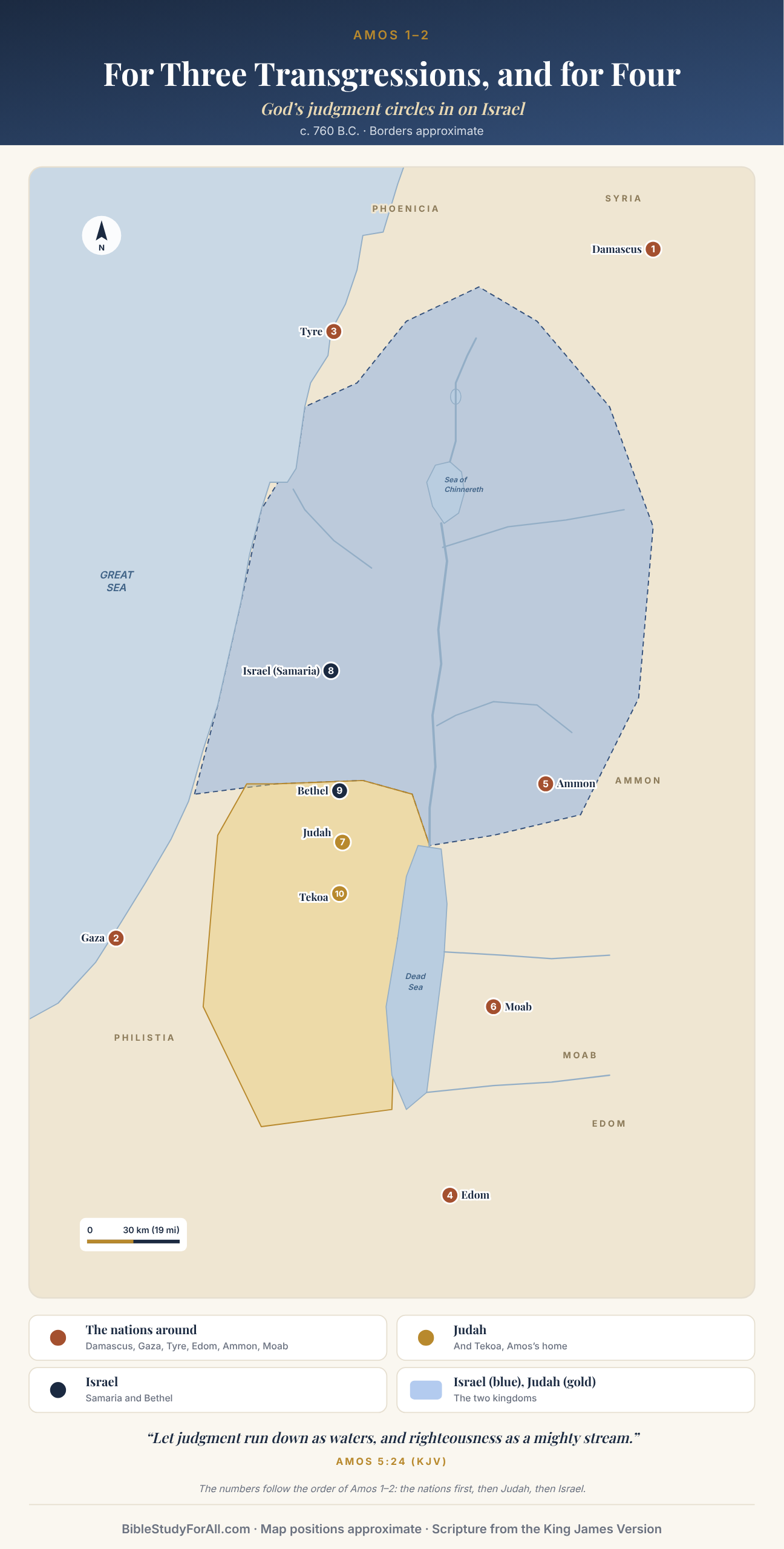
1 1:3–5
Damascus
The nations. Syria “threshed Gilead with threshing instruments of iron.”
2 1:6–8
Gaza
The nations. Philistia carried away whole peoples to deliver them to Edom.
3 1:9–10
Tyre
The nations. Tyre “remembered not the brotherly covenant.”
4 1:11–12
Edom
The nations. Edom “did pursue his brother with the sword.”
5 1:13–15
Ammon
The nations. Ammon was cruel in Gilead to enlarge their border.
6 2:1–3
Moab
The nations. Moab burned the bones of the king of Edom into lime.
7 2:4–5
Judah
Judah. Judah “despised the law of the LORD.”
8 2:6–16; 3:9–4:1
Israel (Samaria)
Israel. Israel “sold the righteous for silver, and the poor for a pair of shoes.”
9 4:4; 7:10–13
Bethel
Israel. The king’s chapel, where Amaziah the priest told Amos to flee.
10 1:1
Tekoa
Amos’s home. Where Amos was a herdman and a gatherer of sycomore fruit.
Amos 2–8
Israel’s Sins
Israel was rich and religious, but God saw how the poor were treated.
2:6
Selling the Poor
For a pair of shoes.
4:1
Crushing the Needy
The kine of Bashan.
5:12
Taking Bribes
Turning aside the poor in the gate.
6:4
Ease and Luxury
Beds of ivory, wine in bowls.
8:5
False Balances
The ephah small, the shekel great.
4:4; 5:21
Empty Worship
“I hate, I despise your feast days.”
“But let judgment run down as waters, and righteousness as a mighty stream.”Amos 5:24 (KJV)
Amos 4:6–12
Yet Have Ye Not Returned
Five times God sent trouble to turn Israel back. Five times they did not return.
1 4:6
Famine
Cleanness of teeth in all your cities.
2 4:7–8
Drought
Rain withheld three months before harvest.
3 4:9
Blight
Blasting, mildew and the palmerworm.
4 4:10
Pestilence and Sword
After the manner of Egypt.
5 4:11
Overthrow
As God overthrew Sodom and Gomorrah.
! 4:12
Prepare
“Prepare to meet thy God, O Israel.”
Amos 7–9
Five Visions
God showed Amos five pictures of judgment. For the first two, Amos prayed and God relented.
1 7:1–3
Grasshoppers
Amos prays; “It shall not be.”
2 7:4–6
Fire
Amos prays; “This also shall not be.”
3 7:7–9
A Plumbline
Israel measured and found crooked.
4 8:1–3
Summer Fruit
“The end is come.”
5 9:1–4
The Lord upon the Altar
No place to hide.
★ 9:11–15
Then Hope
The tabernacle of David raised up.
Amos 5
Seek the LORD, and Ye Shall Live
In the middle of judgment, God still calls His people to come back to Him.
SEEK NOT
Beth-el, Gilgal and Beer-sheba
5:5
BUT SEEK
“Seek ye Me, and ye shall live”
5:4
SEEK NOT
Evil
5:14
BUT SEEK
“Seek good, and not evil, that ye may live”
5:14
SEEK NOT
The day of the LORD as a wish
5:18
BUT SEEK
“Hate the evil, and love the good”
5:15
Looking Forward
Christ in Amos
Amos ends with the promise of David’s fallen house raised up, fulfilled in Jesus, the Son of David.
9:11–12 · ACTS 15:14–17
David’s Tabernacle Raised
James quoted Amos when the Gentiles came to Christ.
8:9 · MATTHEW 27:45
Darkness at Noon
“There was darkness over all the land unto the ninth hour.”
5:24 · LUKE 4:18
Good News to the Poor
Christ came “to preach the gospel to the poor.”
8:11 · JOHN 6:68
The Words of Life
“Thou hast the words of eternal life.”
Book Outline
Amos Outline
Nine chapters in three parts: judgment on the nations, closing in on Israel (1–2), messages to Israel (3–6), and five visions with a promise of restoration (7–9). Tap a part below to jump to it, tap any section to expand it, and tap a verse reference to read it in the King James Version at BibleGateway.
Part I
Judgment on the Nations
Chapters 1–2 · “For three transgressions … and for four”: eight messages that circle Israel’s neighbours and then land on Israel
- Damascus: Gilead threshed with threshing instruments of iron · 1:3–5
- Gaza: whole captivities delivered up to Edom · 1:6–8
- Tyre: the brotherly covenant forgotten · 1:9–10
- Edom: pursuing his brother with the sword · 1:11–12
- Ammon: cruelty in Gilead to enlarge their border · 1:13–15
- Moab: the bones of the king of Edom burned into lime · 2:1–3
- Judah: “they have despised the law of the LORD” · 2:4–5
Part II
Messages to Israel
Chapters 3–6 · Three messages that begin “Hear this word” and two that begin “Woe”: privilege, oppression, empty worship and ease
- Woe unto you that desire the day of the LORD · 5:18–20
- “Let judgment run down as waters” · 5:21–24
- Captivity “beyond Damascus” · 5:25–27
- “Woe to them that are at ease in Zion” · 6:1–3
- “Beds of ivory”: the first to go captive · 6:4–7
- The LORD abhors the excellency of Jacob · 6:8–11
- Judgment turned into gall; a nation raised up against you · 6:12–14
Part III
Five Visions and the Promise of Restoration
Chapters 7–9 · Grasshoppers, fire, a plumbline, summer fruit and the Lord upon the altar, then the tabernacle of David raised up
Continue Your Study
Scripture quotations and verse links are from the King James Version (KJV).