
Old Testament · Minor Prophets · Book 34 of 66
Nahum
Comfort for a people who had lived under a cruel empire. About a century after Nineveh repented at Jonah’s preaching, Nahum announced that the LORD, who is slow to anger but great in power, would bring the proud Assyrian capital to an end. For Judah the news was good: “The LORD is good, a refuge in times of trouble. He cares for those who trust in him.”
3 Chapters
47 verses in three parts
Author
Nahum the Elkoshite
Written
c. 663–612 B.C.
Written For
Judah, about Nineveh
Overview
Nahum Summary
Nahum is a short book with a single subject: the fall of Nineveh, the capital of the Assyrian empire. For more than a century Assyria had been the most feared power in the ancient world. Its armies destroyed the northern kingdom of Israel and took Samaria in 722 B.C., invaded Judah and surrounded Jerusalem in 701 B.C., and in 663 B.C. sacked the great Egyptian city of Thebes. Assyrian kings boasted in their own records of burning cities, deporting whole populations and cruelly punishing those who resisted. Judah, under kings such as Manasseh, paid heavy tribute and lived under Assyria’s shadow. Into that world came Nahum, whose name means “comfort,” with a message that the LORD had seen everything and that Nineveh’s day was coming.
Nahum is closely linked with the book of Jonah. About a hundred years earlier, Jonah had preached in Nineveh, the people had repented, and God had spared the city (Jonah 3:10). Jonah had even complained that God was “a gracious and compassionate God, slow to anger and abounding in love” (Jonah 4:2). Nahum describes the same God, “slow to anger but great in power,” and adds the other half of the description given to Moses: “the LORD will not leave the guilty unpunished” (Nahum 1:3; Exodus 34:6–7). Nineveh’s earlier repentance did not last, and Nahum shows that God’s patience, though great, is not endless. Read together, the two books show both God’s mercy and his justice toward the same city.
Chapter 1 begins not with Nineveh but with the LORD himself. “The LORD is a jealous and avenging God; the LORD takes vengeance and is filled with wrath” (1:2). “Jealous” here means that God is fiercely devoted to his people and will not allow their enemies to destroy them. The poem pictures the LORD coming in power like a storm: “His way is in the whirlwind and the storm, and clouds are the dust of his feet” (1:3). Seas dry up, mountains quake and the hills melt away before him. “Who can withstand his indignation? Who can endure his fierce anger?” (1:6). Then comes one of the most comforting verses in the prophets: “The LORD is good, a refuge in times of trouble. He cares for those who trust in him” (1:7). The same power that protects those who trust him will, “with an overwhelming flood,” make an end of Nineveh (1:8).
The rest of chapter 1 turns back and forth between Nineveh and Judah. To Nineveh the LORD says that whatever it plots against him, he will bring to an end, and “trouble will not come a second time” (1:9). Though the Assyrians “have allies and are numerous, they will be destroyed and pass away” (1:12). Their idols will be destroyed, their name will not continue, and the LORD will prepare their grave (1:14). To Judah he speaks words of relief: “Although I have afflicted you, Judah, I will afflict you no more. Now I will break their yoke from your neck and tear your shackles away” (1:12–13). The chapter ends with a messenger running across the mountains: “Look, there on the mountains, the feet of one who brings good news, who proclaims peace! Celebrate your festivals, Judah, and fulfill your vows. No more will the wicked invade you” (1:15). Isaiah uses almost the same words for the good news of Jerusalem’s salvation (Isaiah 52:7), and Paul applies them to those who preach the gospel (Romans 10:15).
Chapter 2 is a vivid, fast-moving picture of the attack on Nineveh, written as if the prophet were watching from the walls. “An attacker advances against you, Nineveh. Guard the fortress, watch the road” (2:1). The LORD is about to “restore the splendor of Jacob” (2:2). The enemy soldiers carry red shields, and their chariots “storm through the streets, rushing back and forth through the squares. They look like flaming torches; they dart about like lightning” (2:4). The defenders stumble as they hurry to the wall. Then “the river gates are thrown open and the palace collapses” (2:6). Nineveh stood beside the Tigris River and had rivers and canals running through it, and ancient writers later told of floodwaters helping to break down part of its walls. The city is “like a pool whose water is draining away. ‘Stop! Stop!’ they cry, but no one turns back” (2:8). Its vast treasure is carried off: “Plunder the silver! Plunder the gold! The supply is endless” (2:9).
The chapter closes with a powerful picture. The kings of Assyria often compared themselves to lions, and Nahum asks, “Where now is the lions’ den, the place where they fed their young…?” The lion “killed enough for his cubs” and “filled his lairs with the kill” (2:11–12). In other words, Nineveh had grown rich by tearing apart other nations. Now the hunter becomes the hunted. “I am against you,” declares the LORD Almighty. “I will burn up your chariots in smoke, and the sword will devour your young lions. I will leave you no prey on the earth. The voices of your messengers will no longer be heard” (2:13).
Chapter 3 begins with a cry of woe: “Woe to the city of blood, full of lies, full of plunder, never without victims!” (3:1). In short, sharp phrases Nahum describes the battle in the streets: “the crack of whips, the clatter of wheels, galloping horses and jolting chariots,” and “piles of dead, bodies without number” (3:2–3). Nineveh is pictured as a prostitute and sorceress who lured and enslaved nations (3:4). Again the LORD says, “I am against you” (3:5), and the city will be exposed to shame. “Nineveh is in ruins, who will mourn for her? Where can I find anyone to comfort you?” (3:7). Then Nahum reminds Nineveh of Thebes, the great city on the Nile with water around her and powerful allies, which Assyria itself had conquered (3:8–10). If Thebes could fall, so could Nineveh. Its fortresses are like ripe figs that fall into the mouth of whoever shakes the tree (3:12), and its gates will be wide open to the enemy (3:13).
The final verses mock Nineveh’s preparations: “Draw water for the siege, strengthen your defenses!” (3:14). It will not help. Its merchants have multiplied “till they are more numerous than the stars,” but like locusts they strip the land and fly away; its guards and officials are like swarms of locusts that settle on walls on a cold day and vanish when the sun rises (3:15–17). The shepherds of the king of Assyria slumber, and the people are scattered on the mountains with no one to gather them (3:18). The book ends with a verdict and a question: “Nothing can heal you; your wound is fatal. All who hear the news about you clap their hands at your fall, for who has not felt your endless cruelty?” (3:19). History confirmed Nahum’s words. In 612 B.C. an alliance of Babylonians and Medes captured and destroyed Nineveh, and within a few years the Assyrian empire was gone. The city was so thoroughly ruined that its location was forgotten for centuries, until its ruins were uncovered near modern Mosul in the 1800s.
Several themes run through Nahum. God’s justice: the LORD is slow to anger, but he will not leave the guilty unpunished, and violence and cruelty do not go unseen (1:3; 3:1, 19). God is a refuge: the same power that judges oppressors protects those who trust him (1:7). God rules over the nations: no empire is so strong or so proud that it is beyond his reach; if Thebes fell, Nineveh could fall too (3:8–10). Good news for the oppressed: the end of a cruel power is comfort and peace for those it crushed (1:12–15). God keeps his word: the city that once repented under Jonah and returned to its ways met the judgment Nahum foretold. Readers understand some parts of Nahum in different ways. Some are troubled by a book that rejoices over a city’s fall, while others answer that Nahum celebrates God’s justice for the victims of Assyria’s cruelty, not cruelty itself, and that the book should be read alongside Jonah’s picture of God’s mercy toward Nineveh. The “one who plots evil against the LORD” (1:11) is taken by some as a particular Assyrian king, such as Sennacherib or Ashurbanipal, and by others as the Assyrian kings in general. The flood in 1:8 and 2:6 is read by some as a literal flood that helped breach the walls and by others as a picture of overwhelming judgment. The messenger of good news (1:15) first announced Nineveh’s fall, and many Christians, following Paul, also see in it a picture of the gospel. The date is debated within the years 663–612 B.C. (see the Date card). This outline simply follows the text.
Nahum at a Glance
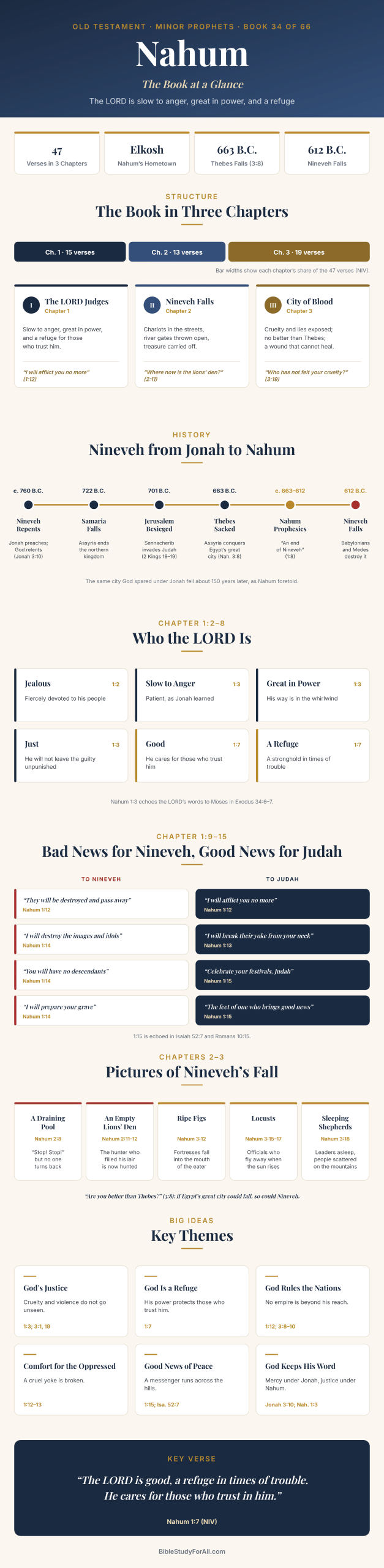
The whole book on one page: its three chapters, Nineveh from Jonah to Nahum, who the LORD is, bad news for Nineveh and good news for Judah, pictures of the fall, and the key themes.
About the Name
Title
Nahum means “comfort.” The book calls itself “a prophecy concerning Nineveh” and is the seventh of the twelve Minor Prophets, after Micah and before Habakkuk. It is often read alongside Jonah.
The book is named after the prophet Nahum. His name comes from the Hebrew word for comfort and means “comfort” or “comforter.” The name fits the message: the fall of Nineveh, the capital of the Assyrian empire, would bring relief and comfort to Judah and to the many nations Assyria had crushed. Ironically, the book asks of Nineveh, “Where can I find anyone to comfort you?” (3:7). Many think the town of Capernaum in Galilee, where Jesus later lived and taught, takes its name from a man called Nahum, since Kefar Nahum means “village of Nahum,” though no one knows whether it was this prophet.
The opening verse calls the book “a prophecy concerning Nineveh” and “the book of the vision of Nahum” (1:1). It is the only prophetic book that calls itself a “book” in its first line, which suggests it was written down from the start. In English and Hebrew Bibles Nahum is the seventh of the twelve Minor Prophets, after Micah and before Habakkuk. “Minor” refers to the books’ shorter length, not their importance. Nahum is often read alongside Jonah, because both books are about Nineveh: Jonah tells how the city repented and was spared, and Nahum announces its final judgment after it returned to violence and pride.
Who Wrote It
Author Details
Nahum the Elkoshite, a prophet from the town of Elkosh, whose location is uncertain. Nothing else is known of him. Tradition holds that he wrote the whole book; some think its opening hymn is older.
The book was written by “Nahum the Elkoshite” (1:1), that is, Nahum from the town of Elkosh. Nothing else is known about his life or family, and he is not mentioned anywhere else in the Bible. Even the location of Elkosh is uncertain. One old tradition places it at Al-Qosh in northern Iraq, near the ruins of Nineveh, where a tomb of Nahum has long been shown. The early Christian scholar Jerome placed it in Galilee. Another early tradition places it in southern Judah. Many scholars favor a town in Judah, because Nahum speaks to Judah as his own people (1:12–15). Wherever he came from, his vivid descriptions of chariots, siege works and Nineveh’s river gates show that he knew how Assyria fought and what its great city was like.
Jewish and Christian tradition holds that Nahum wrote the whole book, and most scholars agree that the core of it comes from him. Some point out that the opening poem (1:2–8) is a partial alphabetic acrostic, with lines beginning with the first letters of the Hebrew alphabet in order, and think Nahum adapted an older hymn or that the poem was added when the book was prepared for public reading. Others see the acrostic as Nahum’s own skilled poetry. This page follows the traditional view that the book comes from Nahum.
When It Was Written
Date of Writing
Nahum wrote after Assyria sacked Thebes in 663 B.C. (3:8) and before Nineveh fell in 612 B.C. This page shows that range, c. 663–612 B.C. Scholars debate where within it the book belongs.
The book gives two clues to its date. First, Nahum reminds Nineveh that the great Egyptian city of Thebes was conquered and its people taken captive (3:8–10). Assyria sacked Thebes in 663 B.C., so the book was written after that. Second, Nahum speaks of Nineveh’s fall as still to come, and Nineveh was destroyed in 612 B.C. by an alliance of Babylonians and Medes. The book therefore comes from sometime between these two events, during the reigns of Manasseh, Amon or Josiah in Judah. This page shows that range, c. 663–612 B.C.
Within that range opinions differ. Many conservative scholars prefer a date around 660–650 B.C., while Assyria was still at the height of its power and “numerous” (1:12), and while the fall of Thebes was fresh news. Others prefer a date closer to 615 B.C., after the death of the Assyrian king Ashurbanipal (c. 631 B.C.), when the empire was weakening and its enemies were closing in. A few scholars think parts of the book were written or shaped after Nineveh fell, as a celebration of its downfall. Whichever date is right, the message is the same: no empire is too strong for the LORD to judge.
Study Guide
Nahum Outline
Three chapters in three parts: who the LORD is and what he will do to Nineveh and for Judah (1), a vivid picture of Nineveh’s fall (2), and a final “woe” to the city of blood (3). Tap any section to expand it, and tap a verse reference to read it at BibleGateway. Verse numbers follow the NIV; in Hebrew Bibles 1:15 is 2:1, so the rest of chapter 2 is numbered one higher.
Part I
The LORD Who Judges and Protects
Chapter 1 · The LORD is slow to anger but great in power: an end for Nineveh, good news for Judah
Part II
The Fall of Nineveh
Chapter 2 · The attacker comes, the river gates open, the city is plundered, and the lions’ den is empty
Part III
Woe to the City of Blood
Chapter 3 · Nineveh’s cruelty and shame, the lesson of Thebes, and a wound that cannot be healed
Continue Your Study
Verse references link to the NIV at BibleGateway.